Zumwalt Poems Online

Archive for the ‘Music & Musings’ Category

Fifty Year Friday: September 2026
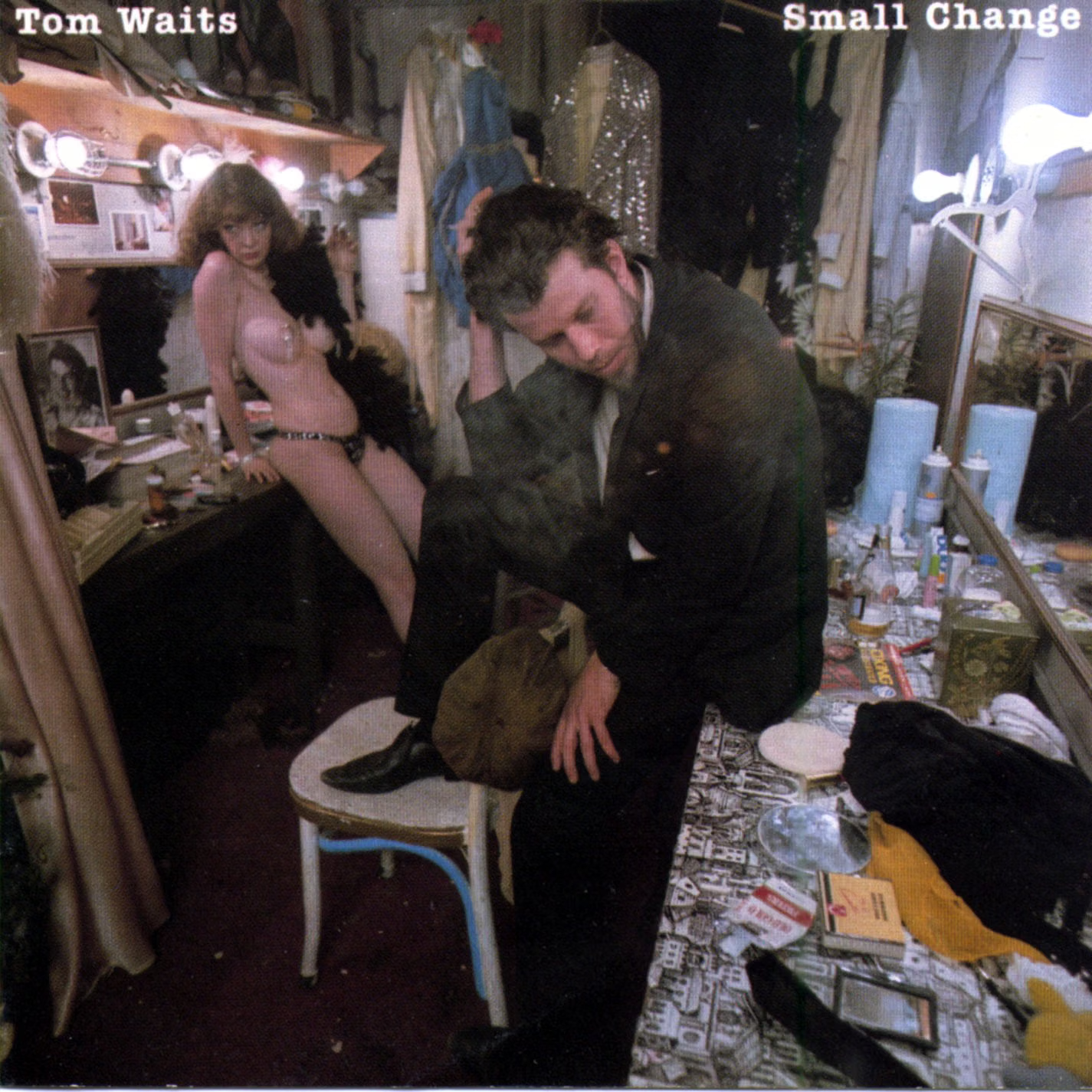
Welcome back to Fifty Year Friday! It is my great pleasure to announce that once again our first entry is by the esteemed and respected Leo The Deacon. I have added a couple of my own entries afterwards, but if you have limited time, please focus the Small Change reflections. I think it is the most brilliant Fifty Year Friday entry yet. Enjoy!


Tom Waits: Small Change

Has it been a year already? It’s getting so that tempus doesn’t just fugit, it kicks on the afterburners. You mind your own business, take each day as it comes, and the next thing you know, the Curator of this sublimely ridiculous blog is emailing you:  “Leo, you gnarly old fossil! Have you finished the Waits review?” I am tempted to respond by ripping off Waits himself—“the computer has been drinking, not me…” Still, I won’t yield to temptation—at least not that temptation—because we have reached the fifty-year anniversary of the release of Waits’ 1976 masterpiece, Small Change. (And because the Curator is very patient with his enfant terrible collaborator.)  Waits’ previous album, Nighthawks at the Diner, is my sentimental favorite, and the one that most thoroughly reveals the performative persona that Waits inhabited as a singer-songwriter in the 1970s. But with Small Change, Waits hits his artistic stride. The broad consensus of critics and Waits fans alike is that Small Change is his best album of the 1970s. I may like Nighthawks, with all its imperfections, the way one likes his girlfriend’s freckles or swoons over Eva Mendes’ “beauty spot,” but I can’t play the contrarian on this question: Small Change indeed shows off Waits’ artistry better than any other of his albums from that decade.

Unlike Nighthawks, Small Change jettisons the conceit of presenting a “live” performance, with the full  Waits shtick, in favor of a more conventional anthology of discrete songs. Moreover, on Nighthawks, even when singing about lost loves or drunken weekends,  Waits may be bittersweet, but never really tragic. Small Change is a darker set of songs. To be sure, the humor is still there, often deployed in the service of satire,  and his tendency toward the melancholic and sentimental shapes a number of pieces. But several songs—most notably the title track “Small Change,” but also “Bad Liver and a Broken Heart,” and “Tom Traubert’s Blues”—are darker than anything on his three previous records. The humor has an edge as well: more than just a laugh, it conveys some sharp observations on American commercialism, seedy burlesque joints, and alcoholism. By the mid-seventies, Waits had become a heavy drinker. In part, this was due to the lifestyle of a touring musician, and in part because, to gain inspiration, he actually would immerse himself in the demimonde of tawdry motels, sleazy strip joints, and down-and-outer lounges. Looking back at that time, the now-teetotal Waits told a biographer, “You know, I was really starting to believe that there was something amusing and wonderfully American about a drunk. I ended up telling myself to cut that shit out.”  The darker side of the shabby lush life was beginning to color his lyrics even then.

Almost all of the songs on Small Change are jazz-inflected, but there is a greater variety to the music than on Nighthawks. We might group the songs on this album into three bins:  several songs feature just Waits on piano or on piano accompanied by just one other instrument—a bass, drums, or a saxophone (“Jitterbug Boy,” “The Piano Has Been Drinking,” Bad Liver and a Broken Heart,” “Pasties and a G-String,” “Small Change,” and “I Can’t Wait to Get Off Work”). Two songs, “Step Right Up” and “The One That Got Away,” feature a full jazz quartet of piano, bass, drums, and saxophone. Waits plays the piano, but as on Nighthawks, he has gathered some solid jazz musicians to back him up: Shelley Manne on drums, Jim Hughart returns on bass, and Lew Tabackin wields the sax. In the third and final bin are the fullest arrangements, featuring both the jazz quartet and orchestral string arrangements—a device Waits had employed on some songs on his first two albums, but not on Nighthawks. Here we find “Tom Traubert’s Blues,”  “I wish I was in New Orleans,” and the nostalgic “Invitation to the Blues.” Truth be told, I am not a big fan of string arrangements with my jazz—it works best, perhaps, on torch songs sung by sultry chanteuses, but more often just sounds cloying and confectionary, like the thick icing on a sheet cake. Waits pulls it off with a voice full of asphalt and gravel, but it works best with “Invitation to the Blues,”  a noirish ballad so retro that one might call it anachronistic. In it, Waits sings about a guy “who feels just like Cagney” taking a shot at romance with a waitress who “looks like Rita Hayworth,” despite the long odds of success. Sure, the song has strings in the background but, having in my twenties dissipated countless wee morning hours in coffee shops and diners while contemplating some bored waitress who barely recognized my existence, I can’t help but like the song; I’m a sucker for doomed, maudlin romance.

The gem of the album is also the darkest, the title track “Small Change.” Here Waits is not so much singing as performing a spoken-word recitation of poetry, punctuated by Tabackin’s mournful saxophone. With some of the most lapidary lyrics on this or any other of his albums, Waits recounts the murder of a small-time crook late at night on a city street and describes the bystanders’ shared indifference to the snuffing out of a human life:  the ambulance drivers are just waiting for their shifts to end, the cops are cracking jokes, and a teenage factotum employed by one of the late-night businesses has been directed to hose the blood off the sidewalk. As various passersby filch the dead man’s ring, hat, and watch fob, hookers ply their trade, “their mouths cut just like/Razor blades, and their eyes are like stilettos.”

Worth singling out, too, is the brilliant “Step Right Up,” Waits’ playfully cynical indictment of American commercialism. The music is all jazz quartet, no strings, and Waits half speaks, half scats the rhythmic song which consists almost entirely of crass advertising phrases—particularly the kind one might see on TV, late at night, in the 1970s—one critic dubbed the song “proto-rap.” Much of it consists of banal slogans: “Act now!” “bargains galore,” “everything must go,” into which he gradually weaves ever more outlandish claims: “It gives you an erection, it wins the election.” Waits also works in a few genuine advertising tag lines from those distant times, such as Zenith’s “the quality goes in before the name goes on,” and Tegrin shampoo’s infamous sympathy for “the heartbreak of psoriasis.” The song is funny, for sure—but it also makes a pointed statement about Americans’ moth-to-the-candle attraction to shills and the prospect of accumulating ever greater quantities of “stuff.” We could have used a revival of the song during the last presidential election.
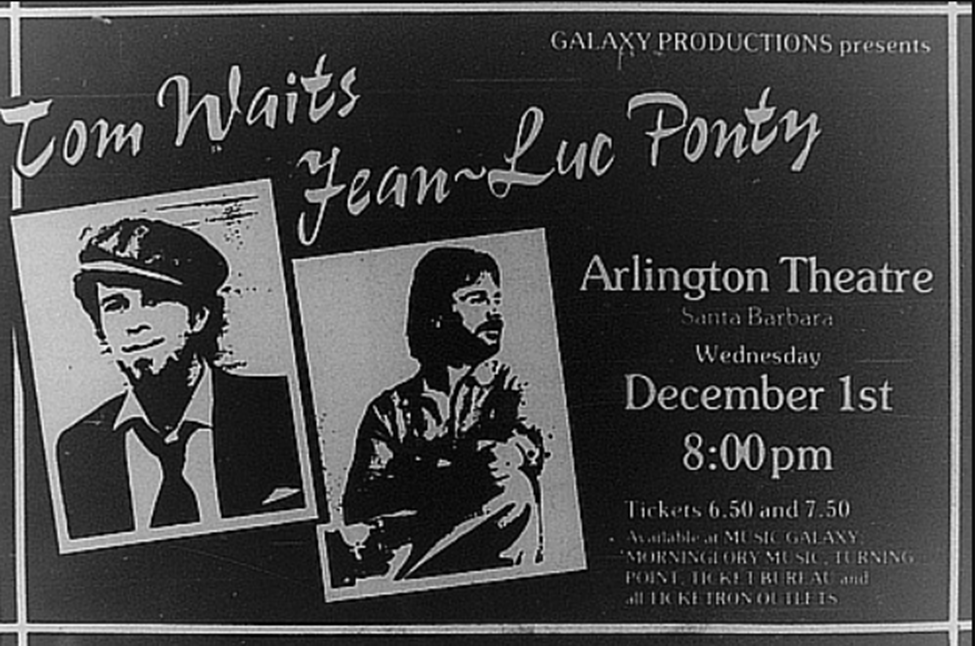
For me, however, the glory of “Step Right Up” is that it conjures up memories of one of the best concerts I ever attended. Right after the release of Small Change, Waits went on tour to promote it;  gone were Shelley Manne, Jim Hughart, and Lew Tabackin, replaced for the tour with less famous jazz sidemen, a trio Waits christened “The Nocturnal Emissions.”   No less a musical aficionado than this blog’s very Curator—in those days as bearded and hirsute as a Muppet—joined me in my puke yellow Ford Courier in December 1976 for the 90-mile drive up US 101 to see Waits open for the French jazz fusion violinist Jean-Luc Ponty at the Arlington Theater in Santa Barbara. What twisted mind conjured up such a musical pairing I cannot say, but it was genius. The genteel old Arlington Theater had been constructed earlier in the century to resemble a Spanish mission, and the ceiling was painted a midnight blue with tiny points of starlight, to mimic sitting in a Spanish colonial courtyard under the stars. The Curator and I took our seats, the house lights were turned off, and in the blackness Waits and the Nocturnal Emissions took their places. Like some inebriated interpretation of the first chapter of Genesis, Waits flamboyantly ignited a match, piercing the void, lit his cigarette in a sweeping motion, and growled the opening bars of “Step Right Up.” I have been told hat Stravinsky’s ballet The Rite of Spring provoked a riot at its Paris debut, and if the Santa Barbara crowd had not been so terminally laid back, Waits’ opening for Ponty might have produced a similar outcome. As it was, Waits’ performance was met with bemusement and impatience by a mellow audience expecting the trademark electronic arpeggios of the Gallic superstar. The Curator and I—albeit fans of Ponty—were simply delighted. After the concert, we stopped at the Sambo’s coffee shop there in Santa Barbara—and in walked Ponty! But—that is a tale for another time. Let’s keep the focus on Waits.

As good as Small Change is, it represents the apogee, the limit, of Waits’ skid-row bard approach to his art. Already one senses Waits is searching for ways to expand his idiosyncratic music by including darker material, edgier satire, and so on. This would become more noticeable in his immediately subsequent albums, as he pushed the envelope but never quite escaped it, performing a duet with Bette Midler on Foreign Affairs, and singing a cover of “Somewhere,” from West Side Story on 1978’s Blue Valentine. It wouldn’t be until 1983’s Swordfish Trombones that he broke from his 1970s persona, for better or worse. In a sense, then, Waits’ achievement in Small Change carries the same bittersweet taste of so many of his songs:  it represents a peak moment of success, but like all pinnacles, it could only lead one down until a new mountain top could be attempted. Small Change was a summit that Waits would not equal again for many years.

—Leo the Deacon
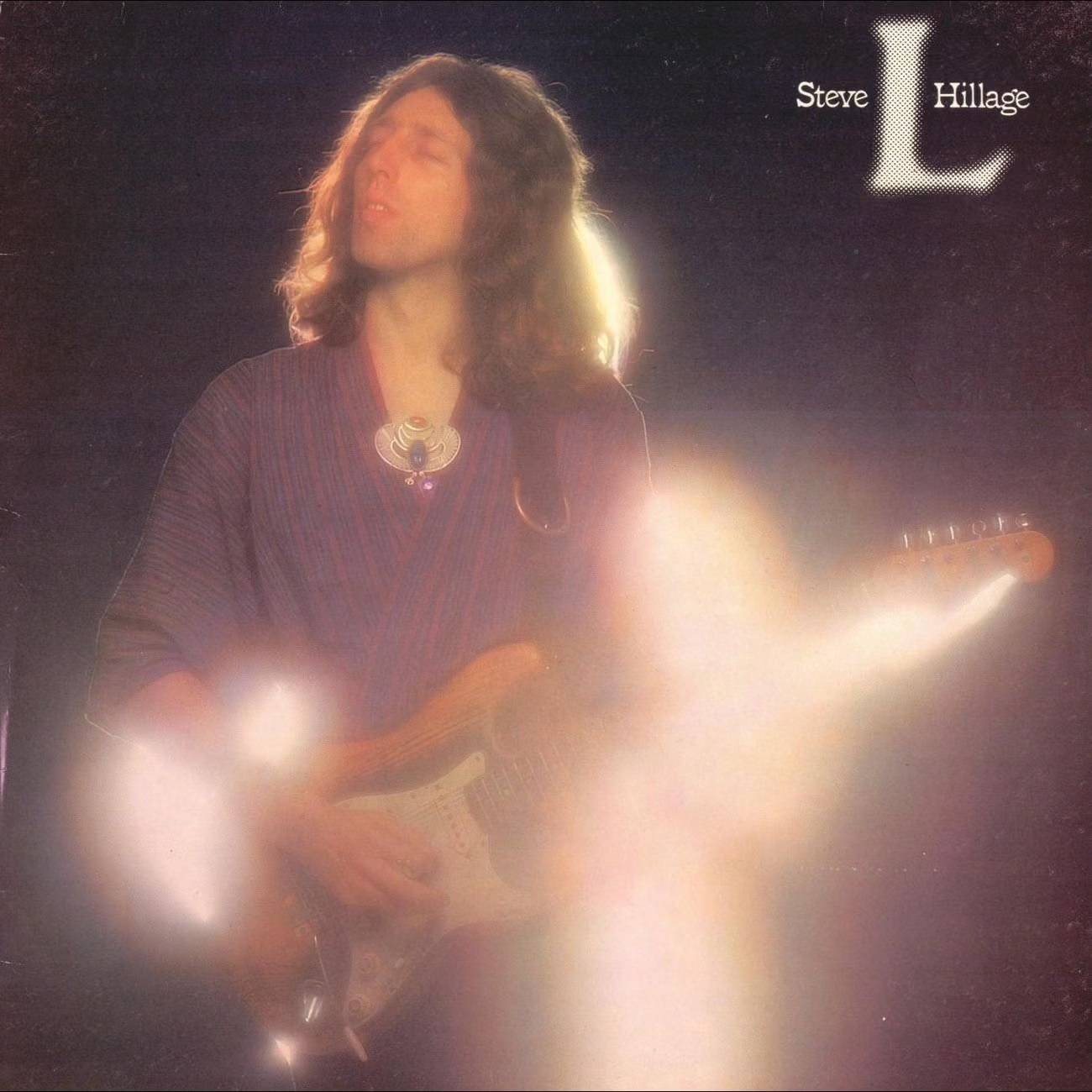
Steve Hillage: L

Released in September 1976, this is a wonderful album. L is an intentional throwback to late sixties psychedelic rock. The first track is a cover of Donovan’s “Hurdy Gurdy Man,” and given the original historic status, its reasonable to push back and ask, “Is this really necessary?”, particularly on a prog rock album? Well, given the introductory use of shenai (an Indian oboe-like instrument) and Hillage’s amazing guitar work, this may not be necessary, but it is irresistible and fully sets the mood for the album. Todd Rundgren is the producer, and we hear that with the sped-up, tape-manipulated coda and the ethereal, cosmic intro to the second track, “Hurdy Gurdy Glissando,” begins as an apparently free-form improvisation, thoughtful and reflective, with no elements of self-indulgence, but transitions into an early Pink Floyd art song, followed by more instrumental work, highlighted with Roger Powell’s keyboard work. Powell was a protegee of the famous Bob Moog (creator of the Moog synthesizer, of course) as well as the keyboardist on the preceding Todd Rundgren’s Utopia albums.

The rest of the album continues with a general prog-rock-enhanced sixties psychedelia sound with vocal material simple and accessible, but much like Pink Floyd’s early work, never puerile or simplistic. The first track on the second side, “Om Nama Shivaya,” is particularly notable for its blend of Indian, Asian, and Western elements, and, as you would expect, Hillage’s guitar work. “Lunar Musick Suite” is next and is the highlight of the album: powerful, relentless, and hearkening back to both Gong and Rundgren’s Utopial work. The album is bookended with a fine rendition of George Harrison’s “It’s All Too Much.”

Hillage is one of the most underrated guitarists in rock. I snuck in somehow, moving with the flow of the crowd, to see him at a sold-out performance in London at the Marquee Club, but the bouncer figured out that I didn’t have a ticket and escorted me out. At that point, I bought a ticket from a late arrival and came back into the club, enjoying about two-thirds of the set until the same bouncer, a thick-forearmed brute who was about twice my weight, snuck up behind me and leveled both of his fists at the back of my neck, collapsing me to the floor, partially unconscious. My next stop was a nearby hospital for an X-ray, and though nothing was broken, I suspect this is the primary cause of on-and-off arthritic symptoms in my neck over the last thirty-five years. The neck hurts just typing this up. But I never regret a moment of risk or insanity that I engaged in my youth. Do I wish the music of today was equally adventurous as that of the 1970s — of course, but I accept the music of today as it is, even the tunes that cycle through the same tired I-V-vi-VI or vi-IV-I-V (or the most common three-chord modal progressions), just as I accept I am no longer as adventurous and often have a fairly predictable daily routine when not traveling. But just as new music continues to develop and move forward, so do old relics like me, one way or another.
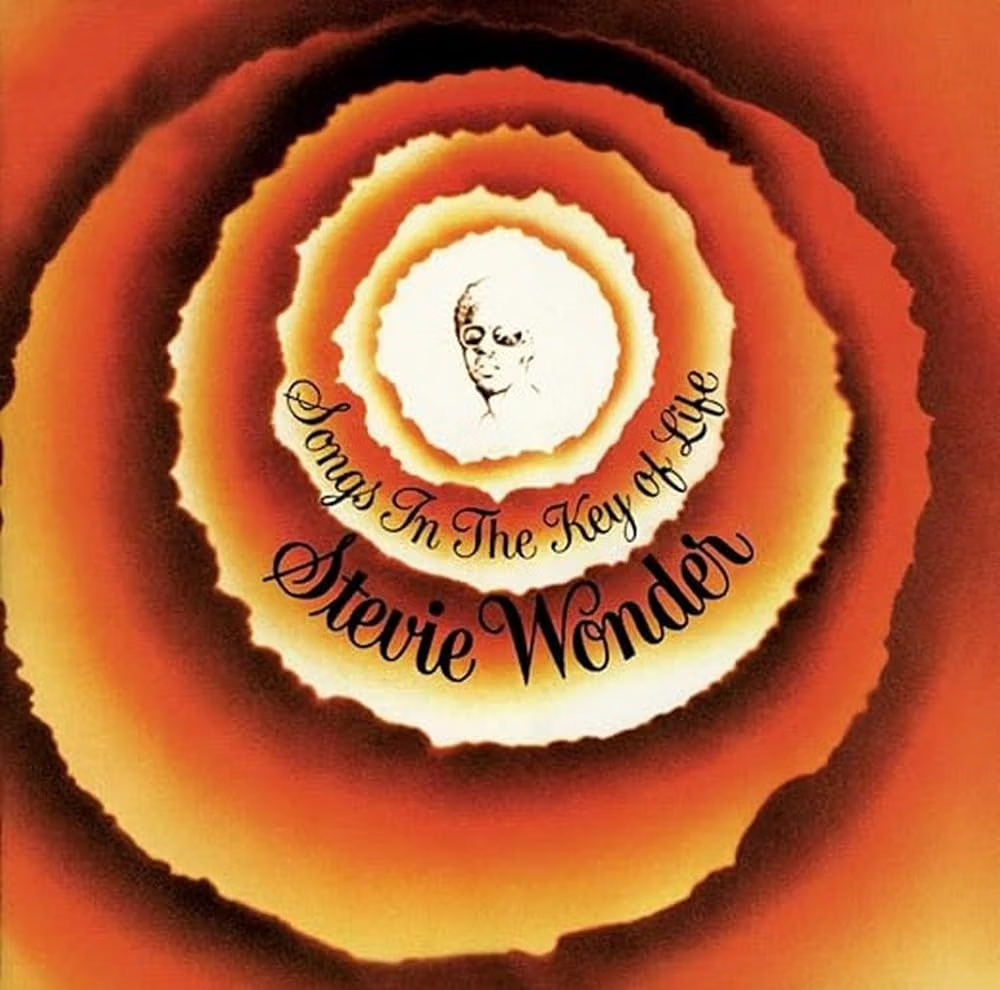
Stevie Wonder: Songs in the Key

Steve Wonder released the two LP Songs in the Key of Life in late September of 1976, by far his best-selling, most ambitious, and most critically acclaimed album of his prolific career. Some may think it’s a bit of a stretch, but Stevie Wonder’s willingness to take unusual harmonic paths reminds me of Schubert’s innovative and independent approach.

Wonder embraces jazz influences and the associated ninths, elevenths, and the occasional thirteenth chord, but uses them in his own distinctive ways, using dominant ninth and suspended ninth chords to build the soulful warmth of tracks like “Isn’t She Lovely” and “As,” while relying on minor elevenths to anchor the more repetitive and hypnotic passages found on “Pastime Paradise” and “Ordinary Pain.” He also uses minor ninths, major ninths, and, for musical tension, thirteenth chords.

More remarkable, and the reason I associate him with Schubert, is his creative exploration of unusual chord progressions. I don’t have the musical ear, and you may not have the interest, for me to detail the exact progressions, but the combination of these explorations and the way Wonder uses ninths and elevenths creates a clearly identifiable personal sound, a sound that is fully present on this album.

Wonder is not a great lyricist, and I suspect that’s mostly because he writes the music first, sometimes starting with the melody, sometimes playing with chord progressions, but usually coming up with natural, authentic music, to which he then fits placeholder lyrics, tightening them up, or entirely replacing them for the final product. The music is the attraction here, and the lyrics sometimes add to the overall quality, and never seem to get in the way. In a sentence, the music is the overall attraction here.

Hopefully you have heard this album, maybe many times, and there is no need for me to break this down track by track. If, due to your age, or by some chance of the arc of your life, you haven’t heard this yet, please give it a spin (or a stream), even if you’re a prog-head, jazz or classical music snob like me.

Thoughtful Thursday: Either/Or

Our world certainly has many examples of extremes — here’s one: very evil people and very good people. Such extremes bookend their specific spectrums or continuums. For example:

Liberal to Conservative
Tall to Short
Dark to Light
Good to Evil
Farsightedness to Nearsightedness
Concrete-Visual to Abstract-Conceptual

Lots of people identify as liberal or conservative, but some are less liberal or less conservative than others, and the majority of people identify as neither — or acknowledge that they have traits of both.

In Søren Kierkegaard’s Either/Or, the nineteenth-century philosopher challenges his reader to make the necessary choice between two posited extremes: the Aesthetic Life (living for the moment without commitment) or the Ethical Life (living by duty and commitment). But if we step outside his strict existential framework and use these terms as we understand them today, life is truly incomplete if we make an either/or choice between the aesthetic and the ethical. We can pursue both! These are not opposite ends of a single spectrum, but categories that are spectrums of their own. And each functions somewhat independently of the other: just because one is unethical doesn’t make that person aesthetic, and one can truly appreciate aesthetics and be one of the most ethical people we will ever encounter. Granted, as Kierkegaard correctly asserts, they are also intertwined — a better appreciation of aesthetics should help one be more ethical.

As we progress through the pages of Either/Or, Kierkegaard discusses the extremes of the aesthetic spectrum: the Immediate Person, who sees the world as it appears on the surface, and the Reflective Person, who sees things primarily in relation to other things. If a poem references “a slithering snake on a pathway,” the Immediate Person will think about a slithering snake on a pathway and the Reflective Person will consider what the snake and the path imply or symbolize. So we have another spectrum, with most people falling somewhere in the middle.

I find this particularly interesting in terms of which type of poetry appeals to an individual depending on where they are on this spectrum, or even if poetry appeals that much to the Immediate person. Or does that person favor poetry that is more direct and is less representative? I suspect that anyone on this spectrum could enjoy poetry, and that even image-laden poetry works nicely for the Immediate person, providing the images describe the real world and don’t represent abstract concepts or function metaphorically for other objects.

Either/Or was written in 1843, and we have some more current observations on personality types. In this case, my interest is the personality spectrum that ranges from Concrete-Visual to Abstract-Conceptual. What is this spectrum or continuum of Concrete-Visual to Abstract-Conceptual?

Let’s jump to around 1943 during the middle of World War II: Katharine Cook Briggs, along with her daughter, Isabel Briggs Myers, developed an early version of a questionnaire to assist the many women entering the workforce to determine the most appropriate jobs for their specific personalities and natural strengths. A couple of decades later, an updated version would be released to a wider audience, and then in 1977, a commercial version, known as Form G, was made available as a diagnostic tool used by schools for vocational planning. Soon, Corporate America and government agencies took an interest, with over 80% of Fortune 500 companies using an updated version of Form G, known as the “Myers-Briggs Type Indicator” (MBTI), to improve communication and teamwork among employees. While modern psychology is rather skeptical of MBTI, it serves as a great team-building tool, and I believe it does have some merit in terms of how individuals process information, including poetry.

The test has four spectrums or continuums, called parameters, and questions score each participant on these four parameters, ultimately assigning them one of two letters for each parameter. This is an Either/Or proposition, but thankfully most versions of MBTI provide a “preference clarity” or “preference score” — a percentage or bar graph showing how strongly one leans toward one end versus the other. For example, a person might score 85% Introverted and 15% Extroverted, or 55% Thinking and 45% Feeling. I remember when I took the test, I scored close to the midpoint on all four parameters. But no matter how close one is to the exact middle, they end up being assigned a letter representing one of the extremes for each of these four parameters.

The Four MBTI Parameters (The “Letters”)

MBTI measures four independent parameters. Each is a spectrum, and a person’s “type” is a four-letter code indicating where they fall on each:

ParameterOne EndThe Other End
1. Energy / AttentionExtraversion (outer world, people, action)Introversion (inner world, reflection, solitude)
2. Information ProcessingSensing (concrete, factual, here-and-now, details)Intuition (abstract, big-picture, future possibilities, patterns)
3. Decision-MakingThinking (logic, objective criteria, consistency)Feeling (values, empathy, harmony, subjective impact)
4. Lifestyle / StructureJudging (planned, organized, decisive, closure)Perceiving (flexible, spontaneous, open-ended, adaptable)

Mapping Our Spectrums to MBTI

Now here is the beautiful part: the two spectrums touched on earlier, Kierkegaard’s Immediate/ Reflective spectrum and the Concrete-Visual/Abstract-Conceptual spectrum, map directly onto specific MBTI parameters.

Our SpectrumThe MBTI ParameterWhy
Concrete-Visual ↔ Abstract-ConceptualSensing (S) ↔ Intuition (N)This is how MBTI defines S vs. N. Sensing types trust their five senses and prefer tangible, specific, factual information (they want concrete images in their poetry). Intuitive types trust patterns, meanings, and possibilities (they prefer poetry that addresses topics like freedom, desire, identity, and alienation through concepts or even abstractions rather than concrete imagery). This is a perceptual preference: how one processes information.
Immediate ↔ ReflectiveExtraversion (E) ↔ Introversion (I) — partiallyThis one is a harder case to make, but hear me out. Extraverts tend to process externally and react to stimuli in real-time (Immediate). Introverts tend to process internally, stepping back to mull things over before acting (Reflective). However, this is not a perfect match, because Kierkegaard’s “Immediate vs. Reflective” is more about time and commitment than about social energy. But in MBTI terms, the I/E axis is the closest proxy for whether you set up shop in the moment (reacting to the outer world) or live in your head (deliberating before acting).

In terms of poetry preferences, it seems likely to me that the Immediate type will be much less attracted to poems that require considerable reflection to determine their meaning or set of meanings.

Quick Recap Table

ConceptMBTI ParameterWhat it measures
Concrete-Visual ↔ Abstract-ConceptualSensing (S) ↔ Intuition (N)How one perceives and takes in information
Immediate ↔ ReflectiveExtraversion (E) ↔ Introversion (I) (roughly)Whether one processes in real-time or steps back
Aesthetic ↔ EthicalNone directly (as discussed, this is a false continuum.)Can one measure something with two disparate continuums collapsed together?

So What Is Your MBTI Type, and How Does It Relate?

If you know your four-letter MBTI type, we can look at it and see:

  1. Where you naturally fall on the Concrete-Visual ↔ Abstract-Conceptual spectrum (your S/N preference).
  2. Where you naturally fall on the Immediate ↔ Reflective spectrum (your E/I preference, roughly).
  3. Possibly which Kierkegaardian trap you are most susceptible to (based on your T/F and J/P preferences)?

For example:

  • An ISTJ (Introverted, Sensing, Thinking, Judging) is naturally Concrete-Visual (S), Reflective (I), and Ethical-leaning (J). Their Kierkegaard trap? Becoming so rigid and duty-bound that they lose all aesthetic joy and spontaneity.
  • An ENFP (Extraverted, Intuitive, Feeling, Perceiving) is naturally Abstract-Conceptual (N), Immediate (E), and Aesthetic-leaning (P). Their Kierkegaard trap? Flitting from one beautiful idea to the next, never committing to anything long enough to build a life.

Spectrum Mapping Reference Table

SpectrumMBTI ParameterWhat it measures
Concrete-Visual ↔ Abstract-ConceptualSensing (S) ↔ Intuition (N)How you perceive and take in information
Immediate ↔ ReflectiveExtraversion (E) ↔ Introversion (I) (roughly)Whether you process in real-time or step back
Kierkegaard’s
Aesthetic ↔ Ethical
None directlyYour relationship to commitment, duty, and meaning—a choice, not a preference

For what I consider to be the highly suspect Aesthetic ↔ Ethical spectrum, Kierkegaard would say: Your MBTI type describes your starting point, but it does not determine your destiny. The “Either/Or” is not about being true to your type — it is about transcending your type through a conscious, passionate choice to become a full, integrated human being. The reality, of course, is that this is not a spectrum and one can excel at both Aesthetic pursuits and Ethical pursuits.

For the Immediate ↔ Reflective Spectrum, one placement here comes down to mostly natural inclination, though I have observed that one can develop skills to excel at both ends of the spectrum: one can improve their ability for real-time decision making, as you do in playing a sport or in a high-stakes conference meeting, and improve their ability to carefully think through all outcomes and possibilities.

Now, here is the part I find the most interesting and that I believe relates the most to poetry preferences — the Concrete-Visual ↔ Abstract-Conceptual Spectrum: how we perceive and absorb information — how we process not only information, but also what are our inherent data preferences. Do we prefer concrete images in our poetry, or do we prefer abstract and/or conceptual language? Are we more attracted to Emily Dickinson lines with concrete images like

The Grass divides as with a Comb —
A spotted shaft is seen —
And then it closes at your feet
And opens further on —

or lines that deal with concepts

Pain — has an Element of Blank —
It cannot recollect
When it begun — or if there were
A time when it was not —


(Please note the “—” are Emily’s own, and used long before the invention of AI)

Do we prefer Wallace Stevens’ concrete lines:
…
The pears are not viols,
nudes or bottles.
They resemble nothing else.

They are yellow forms
Composed of curves
Bulging toward the base.
They are touched red.


or his more conceptual work:

The poem of the mind in the act of finding
What will suffice. It has not always had
To find: the scene was set; it repeated what
Was in the script.


The handling of concrete images is pretty straightforward and is well taught in every MFA program on the globe. Perhaps less in vogue today are the conceptual tools of poetry:

Abstract Images / Abstract Imagery: Language that evokes ideas or qualities that cannot be directly perceived by the five senses (e.g., words like truth, freedom, sorrow, infinity rather than some physical object).

Conceptual Language / Conceptual Imagery: Language focused on theories or intellectual ideas rather than observable reality.

Discursive Language: Poetry or lines that rely on logical argument or explanation rather than sensory presentation. In literary criticism, “discursive poetry” is often contrasted with “imagistic poetry.”

Generalities / General Language: Nebulousness or overarching statements lacking the distinctness of concrete details.

Intangible or Immaterial Imagery: Descriptions or expressions concerning things that lack physical substance, weight, or sensory properties.

We find that our often featured poet Zumwalt tends to lean towards the conceptual, but we can find plenty of examples where he goes “concrete” on us:

Some shirtsleeve transient
Sporting scrimshaw arms
Scans a racing form
His shoe leather face focused more
On Santa Anita
Than the saints
Shouted, proclaimed
By an antique black
Whose white wisps of whiskers
Cling to his accusing chin
Clouds about a crag
That trembles with every thundered damnation
As the old man makes the park
His pulpit

(From Afternoon Off, ca. 1977)

Smooth and sepia
Spirals down the throat, wet, warm
For a moment attention drifts
From the bleary graveyard denizens
        the three-day growth denim jacket derelict
        the greasy ember of a cook
        the scrubbed behemoth cop
        A granite waitress

(From Black with Sugar, 1977)

And an example of concrete audio imagery:
The radio unloads
Heavy metal
High volume, howling
Then
Upturned chairs
            the busboy plays counterpoint
            on a Kirby

(From Solo, 1979)

Compare this to his more conceptual work:

Reams and reams
              The black-ink symbols inundate
              Flooding consciousness with printed words
                                           that possess
              Definitions but know no meaning

(From They’ve Stripped the Forest for Babble, originally published in the first issue of GHLM Newsletter in 1974)

or

On a Mobius strip
Crazy coordinates on a hellish helix
        With nowhere to go
        And no way home
Not to worry
Once more around and
Once you grab that brass ring
You will realize
        It’s mostly air.

(From Full Circle (A rumination in 3 strokes), 1982)

Recently, on a phone call with Zumwalt, he recited a draft of a poem where he plans to either avoid all concrete images or heavily use concrete images — or maybe a mixture of both, once the poem turns;

You spend the day outdoors,
won’t come in at night
back to the home you were born in
instead you sleep under
the shelter of trees
I never learned the name of
.

I won’t reveal the surprising turn this poem takes, and I look forward to how it is finally implemented. Can Zumwalt create a final version without a single concrete image — even less than the few weak ones it already has? It sounds easy enough, but the poem has to work within that constraint — not so easy.

But I digress. If we are an extreme S (sensing) reader or editor, we will prefer poetry rich in concrete images; if we are an extreme I (intuition) reader or editor, we will prefer more conceptual passages. Most of us are in the middle. A poet can be at either extreme or in the middle, and produce high-quality work — work that resonates with their particular set of readers. If a reader is in the middle of the spectrum, will they be able to appreciate the extremes of concrete poetry as much as a high percentage S reader? If the reader is all the way over to one extreme, will they have issues with the poetry that primarily uses data and information that appeal to the other side of that spectrum?

Now, remember the Myers-Briggs Test ultimately assigns one of two values for each of the four parameters, including Information Processing. Here is the distribution for Information Processing for people taking the test according to thinkimpact.com.

Intuition (N): Roughly 26.7% of the population.

Sensing (S): Roughly 73.3% of the population.

Even considering that the actual distribution is like a bell curve, with the majority nearer the middle than the extremes, we can better understand why poetry instructors emphasize the importance of concrete images — I am guessing that about 85 to 90 percent of readers will be fine with highly concrete poetry, where perhaps only 60 to 70 percent of readers will comfortably handle heavily conceptual poetry.

We also have the factor (Energy/Attention) of whether the poem is easily understood, or requires more work on the reader’s part to get to its inherent meaning. This reminds me of Zumwalt’s implied preference: “It’s much better if poetry is direct and simple, although the poem now has the liability of being readily understood” — a preference he often disregards, often employing both abstruse concrete and conceptual passages.

For example, instead of opening with:
Our world certainly has extremes, but they are extremes on spectrums or continuums:

Liberal to Conservative
Tall to Short
Dark to Light
Good to Evil
Farsightedness to Nearsightedness

I could have used concrete images in place of my more conceptual introduction, but would you know what I mean? I wouldn’t; during a phone conversation with Zumwalt yesterday, he improvised the following conversion of my original:

Perilously on a spinning globe of cold saltwater and internal rivers of magma, we straddle a studio soundboard slider that skates from silent ponds to ear-shattering dance halls:

From speeding rivers to steadfast mountains
From towering skyscrapers to worn-down speed bumps
From inside a trunk in an underground closet in the center of an asteroid nine-tenths of the way between the Sun and the red dwarf Barnard’s Star to standing on an open observational platform, without quality sunglasses or protective goggles, three feet from the perimeter of Sirius.
From helping ladies cross the street to tripping them and kicking them until their lungs collapse and their blood pools on the warm pavement.
From perceiving the drifting nitrogen-ice blocks on Pluto to discerning the cilia on the outer cells of a dust mite


As almost three-quarters of people would apparently prefer image-rich poetry to conceptually dense poetry, I looked for submission guidelines in various journals to see if any explicitly stated this.

And I hit pay dirt! Twenty-four carat gold! Guidelines that leave no doubt about what the journal will accept.

The journal is Third Wednesday Magazine, a website with slightly fewer monthly visitors and WordPress subscribers than zumpoems.com, but showing a healthy monthly increase, and containing a wealth of excellent poems, available for free, including downloadable PDFs. Here is one for the current issue.

Below are some highlights of their guidelines with full text HERE.

We’re drawn to poems and prose that trust concrete images over abstraction — a name, a gesture, an object doing the work a sentence about “feeling” would otherwise do. We publish across forms, so our most important issues are voice, craft, and image control. Endings that land on something specific and physical interest us more than ones that resolve into reflection or moral. We see a lot of work about loss, and we welcome it, but it should arrive through a scene or an object, not as raw statement.

Isn’t that great? And they go on to say: We’re not opposed to the occasional risk, but risk should earn its place through control, not indulgence. Humor is welcome when it’s dry and plainspoken rather than broad. Above all: we’re a generous, big-tent magazine that welcomes all voices.

They also indicate one of the important points of Zumwalt’s view on poetry, that the form and structure of the poem support the message, with the message never subordinate to the fulfillment or the restrictions of the form: Is the form doing something, or just being followed for its own sake?

I am not sure about this guideline: Does the ending land on something specific and physical, rather than summarizing or moralizing?

How would that work with Emily Dickinson’s ending to one of my favorite poems, Tell All the Truth?

As Lightning to the Children eased
With explanation kind
The Truth must dazzle gradually
Or every man be blind –

I am guessing that Kipling’s If (And—which is more—you’ll be a Man, my son!) and Longfellow’s A Psalm of Life (Learn to labor and to wait.) would also violate this constraint.

But whether I agree with each and every guideline, I have to acknowledge and commend the site for providing these guidelines transparently, and I certainly recognize that journals curate poems around one or more themes, one or more constraints, and/or towards a given audience. There is nothing wrong with a journal like The Society of Classical Poets requiring rhyme and meter, or Light requiring humorous rhyming poems or New Verse News requiring topical poems — and all three journals provide clear guidelines on what their requirements are.

Written Tales, a journal with a smaller audience than Third Wednesday Magazine, provides similar, though much briefer, “show don’t tell” guidelines:

We look for work grounded in specific, concrete imagery: pieces that show rather than tell, bringing the reader into a particular moment through vivid, tangible detail. Abstract or purely emotional work is not a good fit for us.

On the other side, every once in a while one sees guidelines that do welcome “tell, don’t show,” as with Storm Cellar, which includes this umbrella statement: it’s all good. (Even anti-affect “conceptual poetry.”) Or as the Madrigal did a while back with the Discursion Issue call: we are looking for poems that are at play with reasoning and the sounds that facts and logic make even when divorced from any actual grounding.

For me, it’s all good. I am in the middle of the Myers-Briggs Information Processing Spectrum, and love poems brimming with concrete images as well as those providing challenging conceptual explorations. This is why I love visiting these various journals and reading WordPress blogs — blogs where the author is free from all constraints except for the ones they impose upon themselves.

Please visit these journals, read at least a few of their published poems, and post some comments about your thoughts. Please also spend some time discovering poems on WordPress: Free Verse, Poetry, Poems, etc.

Thoughtful Thursday: Ongoing Extinctions; Darwinism in the World of Poetry Journals

More and more poetry journals are closed due to an increasing lack of demand for contemporary poetry

I have a list of over 4,000 journals that publish poetry: some do so online, some in print, some do both. As noted in last week’s Thoughtful Thursday column, I enjoy checking out both poetry blogs and poetry sites to read new work. Sometimes these poems fall short of expectations; sometimes they are well worth the effort of hunting them down.

Today, I randomly picked entry 1613 in my poetry list, a journal named Poemeleon. I knew I was in for a treat reading the description of their content: “Quirky/Humorous/Lyric” and “Playful/Lyrical work.” This sounds great, I thought. As readers of this blog know, I am a fan of Zumwalt’s poetry — which generally is more disruptive or snide than lyrical, but is often quirky, humorous, or playful. I am also a fan of Louise Glück for the lyricism, emotional depth, and overall precision of her writing. And she can also be disruptive and humorous, as in her poem Anniversary. I can say the same about Kenneth Koch — precise control, sometimes lyrical, sometimes disruptive, often playful, clever and/or humorous. Well, there are thousands, maybe tens of thousands of such poets, and I clicked on the Poemeloen link to discover some of the lesser-known such poets.

Poetry sites have to stand out and not blend in to survive.  Even so, will that be enough?

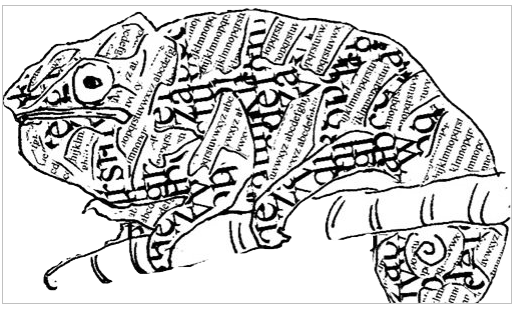
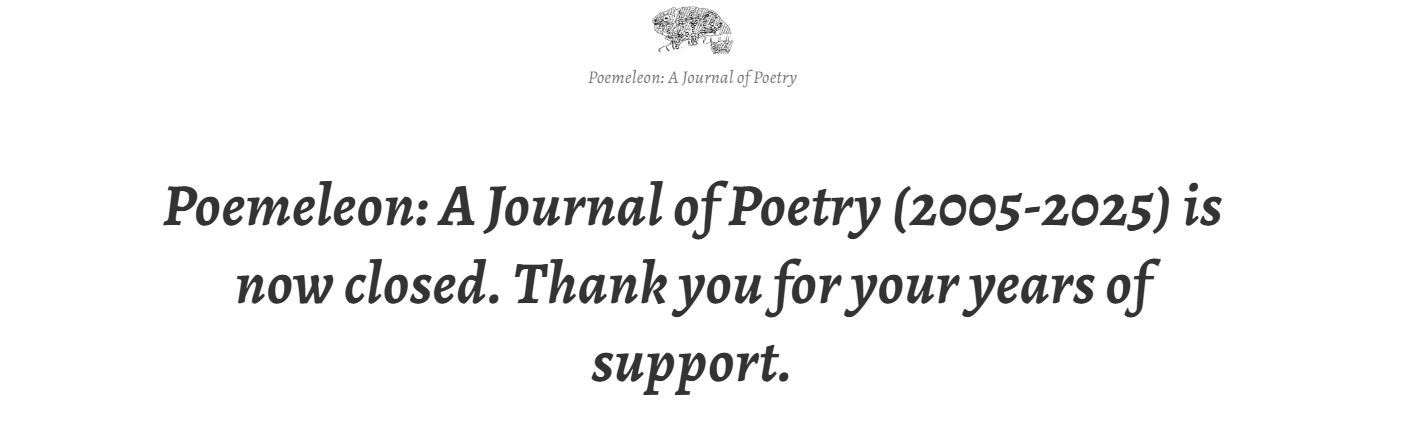
I would like to say that when I first landed on their home page, I was greeted with the above image — the image of the poemeloen, a distinctive and highly specialized clade of a large family of contemporary online journals that champion a diverse range of poetry. And to some degree I was, though it was much smaller. However, what immediately confronted me was the image of the “SORRY WE ARE CLOSED” sign at the top of this blog post.

Above that closed sign was this very small version of their logo and additional text:

Well, in truth, I was pretty undeserving of any thanks. I never supported this site, nor even visited it until today. And now, despite its ability to blend in (or maybe because of its ability to blend in) with its background, it is now another entry in a long list of defunct poetry journals. It could clearly show a range of colorful poetry, and vary what was displayed. But it was eventually overwhelmed by its changing environment: a world where many people have substituted clicking, reacting, and sometimes sharing (though can one really share what isn’t theirs?) for engaged reading.

We go to online poetry sites to be                                               dazzled by the diversity and beauty, but how long will they be able to survive a rapidly changing environment?

However, the poems are still there! And their founder’s mission is still intact: “poemeleon seeks to make visible the invisible. By placing disparate poems alongside one another, I aim to highlight not just their contrasts, but their similarities.”

For how long, though? Eventually, the domain will be unfunded, and the poems will not be so easily accessible. I say, “not so easily,” because, thankfully, we have The Internet Archive’s Wayback Machine, which has captured content from this site and its predecessor 296 times between February 23, 2007 and April 20, 2026. Compare that to our site, zumpoems.com which has been saved 217 times between November 1, 2011 and July 8, 2026, and one can feel pretty good that as long as Internet Archive’s Wayback Machine is enabled, all the poems that the site’s editors (there were multiple: https://poemeleon.me/missionandhistory) ended up selecting from the many submissions sent to them over the years will be avaible for those willing to take the extra effort to track them down.

One day, I won’t be around to fund zumpoems.com. At that point, much of Zumwalt’s work will be lost forever — except for the captures of this site in the Internet Archive. How long will that site be around? Maybe it doesn’t matter, as eventually there will be very few people who will still have the ability to read. The poems will still be around, and they can be read out loud by our AI assistants, but will those AI readers ever understand the meaning of even the simplest or most transparent poem to provide a meaningful enough reading to engage even their most receptive user?

I have no plans to stick around to find out, but if AI extends my life long enough, I guess whatever plans I do eventually make may matter very little.

Poetry sites contain the sublime and the beautiful, but that doesn't prevent their extinction.

Thoughtful Thursday

Boy, do I enjoy the act of writing! Is it about capturing thoughts in a more impermeable form than memory? Or is it about the psychological and mental benefits provided by diving deeper into one’s feelings and perspectives and articulating, whether well or poorly, those feelings and perspectives?

And I love reading. For one is exposed to another’s thoughts, feelings, and perspectives, whether it is reading an email or letter from a friend or engaging with the writing of a familiar author or a complete stranger.

I love diving into others’ WordPress blogs. All I have to do is click on the WordPress reader, and I have a selection of blogs I subscribe to or can explore blogs I have never seen before.

As a reader of poetry, I particularly enjoy exploring posts that have been tagged with “Free Verse,” “Poetry,” or “Poem.” Some are well crafted, some are wild and sprawling, but most are interesting, and many have a level of vitality that is often missing in much of the poetry in curated journals.

I could easily list a dozen WordPress poetry blogs that I enjoy visiting. Let’s just take a peek at my favorite tag: https://wordpress.com/tag/free-verse. And what do I see at the top, posted 15 minutes ago — one of my favorite blogs, Ink & rain! As I open today’s post, I first see one of those many wonderful images that appear reliably at the top of each of author Meiling Cheung‘s posts, followed by text in Chinese and English. Now I have no clue how to read Chinese, so I focus on the English column. Today’s poem is exceptional: it uses a sustained metaphor with each phase serving a specific purpose to support the author’s message. The line breaks are well handled, and the tone it sets, gentle and meditative, perfectly echoes its message. There is an overall emotional immediacy and authenticity, which further enhances the evocative and reflective nature of the work.

Besides reading WordPress poems, I visit various online poetry journals (a partial list of which is here), and so right now, let me check my email to see the latest updates.

Okay, here I have an email from Stick Figure Poetry. I click on the URL to Issue 22, and I immediately find an engaging, inventive poem: Analysis by Tim Love. And it starts off strong:

“Only opaque backings stop mirrors being windows,
and windows can be mirrors if on one side it’s bright 
as an interrogation room while the other’s in darkness.
So think of glass as your poems, and light as reason.”

Such a simple observation, but here is the vehicle for the journey this poem takes us on. No need to be bored with my commentary — just check out the poem here: https://stickfigurepoetry.com/issue-22/#analysis-love

Next, I stop at Shō Poetry Journal and discover a talented poet who has landed poems in prestigious journals like The Kenyon Review and is a winner of several prestigious prizes. Both the text of her poem and the audio are here: https://shopoetryjournal.com/xinyue-huang-occasion-1/

Here is the beginning:

“there is a hole in my chest
through which we drive our car

to the other side of the world
to see the mountains”

With the first glance of this poem, I notice a more or less generic title, no punctuation, no capitalization, regular use of stanzas, reference to a line in Chinese, “万山载雪,明月薄之,月不能光,雪皆呆白,” which I use Google Translate to give me an approximation in English, “Snow blankets the myriad peaks, and the bright moon casts its light upon them; yet the moon cannot make them shine, and the snow remains a dull, lifeless white, ” and, with the exception of the Chinese insert, the use of an accessible, straightforward vocabulary. The work effectively mixes abstractions and images, the modern and the timeless, into a beautifully evocative poem!

Then, I jump into a Wallace Stevens poem, a set of which, from his 1923 Harmonium, is conveniently provided here by The Wallace Stevens Society: https://wallacestevens.com/wp-content/uploads/2019/01/HARMONIUM-1923-WALLACE-STEVENS.pdf

I am not particularly fond of that overly common activity of ranking authors, composers, painters, etc. — each has their distinct voice (or voices) and strengths. Still, it is easy enough to make the case that America should consider itself proud to have been the birthplace and home of such a great poet as Wallace Stevens!

So I have a lot to keep me happy and engaged with a breadth of diversity and styles never available before the launch and development of the internet. Please join me in exploring blogs, poetry journals, and the works of revered poets at your own pace, taking your own individual, self-customized journeys.

Century Sunday: February 1926

The “Fox Trot” craze continued to sweep the nation in February 1926, serving as the polite veneer for the rhythmic revolution that continued to percolate and bubble through the musical soul of our country.

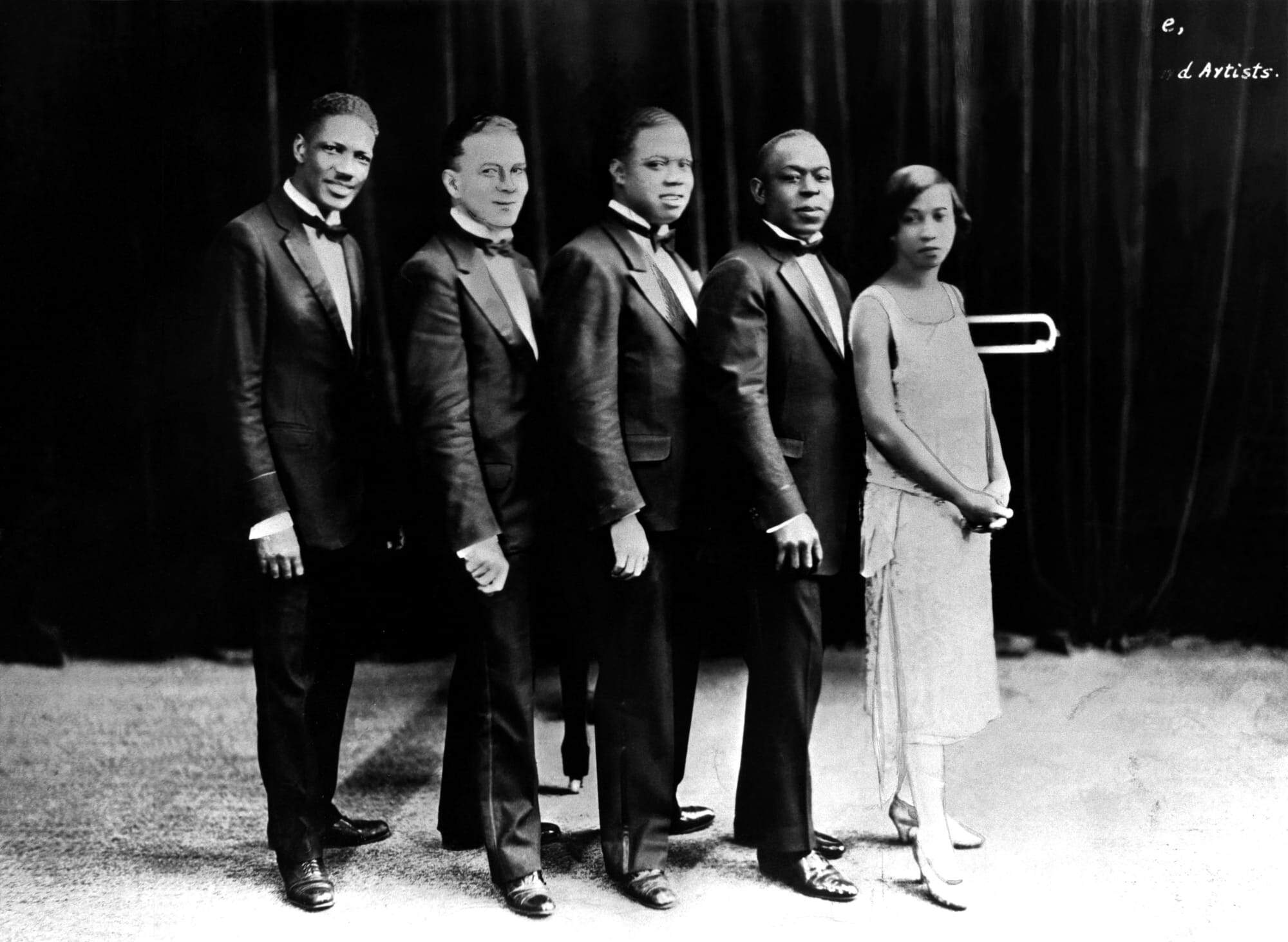
One of the most important recordings and most productive sessions in American music took place on February 26, 1926, in Chicago. Louis Armstrong and His Hot Five recorded six tracks including the magnificent polyphony of intertwining parts of “Muskrat Ramble,” and “Heebie Jeebies”, where Louis Armstrong scats. Though there is a least one example (“My Papa Doesn’t Two-Time No Time” by Don Redman in 1924) of recorded scatting prior to this, and though there is evidence dating scat singing to 1906 or earlier, this is the recording people point to as the force behind the popularization of scat singing.


We also have a pivotal moment for American culture: on February 7, 1926, historian Carter G. Woodson launched the very first “Negro History Week.” Woodson chose the second week of February to coincide with the birthdays of Abraham Lincoln and Frederick Douglass. Fifty years later, in February 1976, the celebration officially expanded from Woodson’s original week into the full month.

Century Sunday: January 1926

With the start of 1926, the Jazz Age, the Roaring Twenties, and the Fox Trot rage continued.

Jazz records were often given the default label of “Fox Trot.” I had the good fortune to be able to listen to several of my grandfather’s jazz 78s, with the majority of them labelled “Fox Trot” — a catch-all label for popular music that de-emphasized the more scurrilous connotations some associated with “hot jazz.”

Two such “Fox Trot” recordings of merit were of the popular song “Dinah,” written in 1925, and recorded a few times in late 1925.

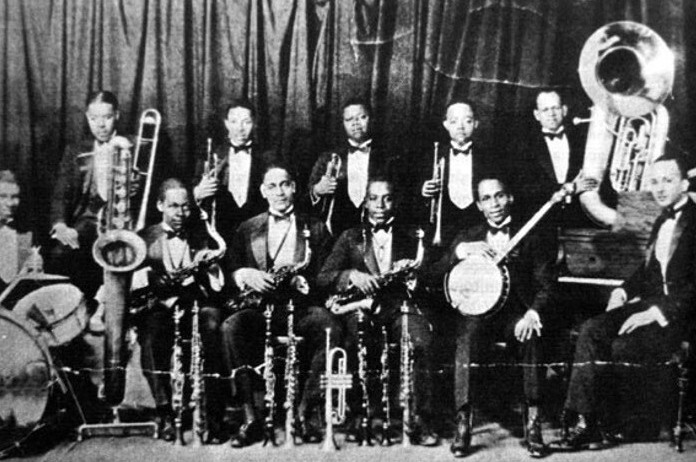
This first Jan. 1926 recording, is by one of my favorite jazz ensembles, The Fletcher Henderson Orchestra:

Another notable recording of “Dinah” features the first recording of the slap bass technique (bassist Steve Brown) at around the 2:20 mark:

And here are some visuals of Fox Trot dancing captured on film — spanning the 1920s and possibly early 1930s:

And speaking of films, The Sea Beast, starring John Barrymore, had its New York City premiere on January 15, 1926. This was the first film adaptation of one of the great American novels, Moby Dick, with the additional modification to the plot to, of course, include a love interest for Captain Ahab! Enough said.

And since we are on films, we have to mention that John Logie Baird gave the first public demonstration of a true television system in London. It wasn’t just shadows; it was a greyscale image with moving details.

Also in January 1926, physicist Erwin Schrödinger published his famous paper (Quantisierung als Eigenwertproblem) containing the foundation of the Schrödinger equation: iℏ (∂Ψ/∂t) = ĤΨ. This birth of wave mechanics replaced the idea that particles revolve around the atom like sub-microscopic planets. Instead, it revealed that they behave as waves — what we now understand as clouds of probability. No one can say where an electron is; we can only calculate the likelihood of finding it at some given location as alluded to in Zumwalt’s 2011 poem, Particle Show.

Of course, I need to mention progressive rock whenever I can: George Martin, the so-called fifth Beatle, and a pivotal contributor to the Beatles’ progressive sound, and by extension, to progressive rock in general, was born on January 3, 1926.

Century Sunday: 1925; Louis Armstrong and his Hot Five; Berg: Wozzeck

Louis Armstrong and his Hot Five, Duke Ellington, and a wealth of other great music.

In 1925, recording technology continued to improve with jazz bands across the USA making their first recordings, even if it was only one double-sided 78 record.

1925 was the year Armstrong transitioned from being the greatest 1920s jazz sideman to a leader of his own group. He began the year in New York with Fletcher Henderson and ended it in Chicago recording the first “Hot Five” tracks starting in November — some of my favorite jazz recordings of all time, and generally recognized as highly treasured musical landmarks.

Other notable names made recordings this year: the trumpeter Bix Beiderbecke, Fats Waller, Duke Ellington with his group The Washingtonians, Bessie Smith, and Ethel Waters. The sides they recorded are still musical gems a hundred years later.

Lesser names recorded, of course. Some had big hits, including Ben Bernie and His Hotel Roosevelt Orchestra’s original hit recording of “Sweet Georgia Brown” and Paul Whiteman’s symphonic jazz version of James P. Johnson’s “Charleston,” which became a popular representation of the vitality and character of the “Roaring Twenties.”

There were many lesser names with less known recordings that are worth checking out including the Original Crescent City Jazzers recording “Christine” and The Halfway House Orchestra’s “Pussy Cat Rag.” Yes, we still had rags being featured in both jazz and in written concert hall music, but ragtime was now a historical style, and most pieces titled rags in 1925 were jazz and not ragtime.

1925 was a diverse and productive year for concert hall music including George Gershwin‘s Piano Concerto in F, Edgard Varèse‘s Intégrales ,and Alban Berg‘s masterpiece, the opera Wozzeck.

Even rock fans will find 1925 abundant with gems that they would likely appreciate: “Cow Cow Blues” by Dora Carr and Cow Cow Davenport which is a blues recording enlivened with early elements of boogie woogie as well as Blind Lemon Jeffersons first recordings including “Black Horse Blues.” At the same time, many recordings of “pre-bluegrass” and “pre-country” music were recorded including Charlie Poole’s unrelenting, banjo-driven “Don’t Let Your Deal Go Down Blues” with traditional fiddle and rhythmic acoustic guitar.

All in all, 1925 had a wealth of music that any music lover can spend a few weeks, if not a full year, exploring.

Queen, Joni Mitchell, Keith Jarrett, Magma, Vangelis, Chris Squire & more; Fifty Year Friday: November and December 1975

Queen: Night at the Opera

Released in November of 1975, Night at the Opera starts with the excitement of an ocean voyage — we hear arpeggiated waves from the piano, whale rumblings from the bass, bird cries and seagull squawks from multitracked guitar breaking into soft strains of a tango quickly turning into heavy metal. This is Freddie Mercury the composer at the height of his craft.

After having purchased three Queen albums already, the first thing I did when I brought this album home in December of 1975 was note which tracks were attributed to Mercury — this served as indicators to what tracks would impress me the most. That turned out to be an effective predictor, but, importantly, the rest of the band’s contributions were some of their very best songs, making this album packed with classic material from start to the pinnacle of the album, the penultimate track, “Bohemian Rhapsody” — one of those rare instances in rock since the Beatles had disbanded where a truly great work of music made its way from legendary status with serious listeners, musicians, and dedicated fans to legendary status with the general public, even though, perhaps as expected, it took some time to do so.

And just as the Beatles elevated their work with multi-track musical enhancements, so too did Queen elevate Night at the Opera to a precisely rendered set of cohesive numbers that deservedly live up to the album’s title. Now, don’t get me wrong — we have an amazing musical diversity on this album — with such diversity in just Mercury’s compositions — but we add to that “I’m in Love with My Car”, “You’re My Best Friend,” the vaudevillian “Good Company” with ukulele and outstanding guitar accompaniment, and “The Prophet’s Song” with its brilliant use of deceptively simple imitative counterpoint, and it’s pretty easy to understand how Night at the Opera more than holds its own today as a timeless classic.

Keith Jarrett : The Köln Concert

One of my favorite possessions was the triple LP Keith Jarrett Solo Concerts: Bremen/Lausanne which I had purchased with Christmas money in 1973. It was just incredible to have a three LP set of piano improvisation of such high quality. Given that, I am puzzled why I never bought The Köln Concert until the complete version made its way on to CD around 1984.

Recorded live in January of 1975, The Köln Concert was released in late November of 1975, the album starts off plaintively in the style of the quiet Americana reflectiveness so well done by classical composers like Aaron Copland and Roy Harris. For the first improvisation, Jarrett leans heavily on repetitive phrases and ostinato-like patterns to continue to move the music forward, flowing as if driven by stream of consciousness, yet always compelling and logical, deftly avoiding lingering too long in any single style, texture, or mode of emotional expression as the music logically unfolds.

The second piece, broken up onto three sides of the double LP album, is dramatically different in tone and character. Like the first improvisation, it evades any simple stylistic labels sometimes flirting into rock piano improvisation. Where the first improvisation was reflective, the second is inexhaustibly joyous and intensely rhythmically as Jarrett turns the piano into a percussive engine, hammering out a powerful, trance-like groove with his left hand that is pure, ecstatic energy. This propulsive marathon of invention continues through Part IIb, before finally dissolving and making way for the famous encore, “Part IIc.” After all the complex fireworks, this final piece is a moment of breathtaking, lyrical grace — a simple, hymn-like melody that releases all the tension and remains one of the most beautiful themes Jarrett ever played.

The music makes this performance legendary, but like the most interesting legends, it has an almost mythical backstory. Jarrett had specifically requested a Bösendorfer 290 Imperial concert grand. Unfortunately, what was made available on the stage was a baby grand rehearsal piano in such bad condition that Jarrett had initially refused to play on it. The requested piano was in storage and due to horrid weather was not able to safely replace the inferior piano. So Jarrett was forced to confront the rehearsal piano, an unsuitable, tinny, and out-of-tune practice piano he tested during the afternoon of the concert and was so dissatisfied with it he almost threw the towel in performing that evening. The promoter finally convinced him that he had a responsibility to play as best as he could for a sell-out crowd and somehow do his best to deal with the inadequacies of the inferior rehearsal piano. Jarrett went forward with the performance and it was this limitation, this ‘bad instrument,’ that forced Jarrett to navigate that evening’s improvisations into new territory, compelling him to avoid the shrill upper register notes and the weak lower bass notes, replacing the harmonic function of the latter with lower middle register accompaniment patterns and repetitive ostinatos — thus creating the distinctive style that unifies the music of this remarkable performance.

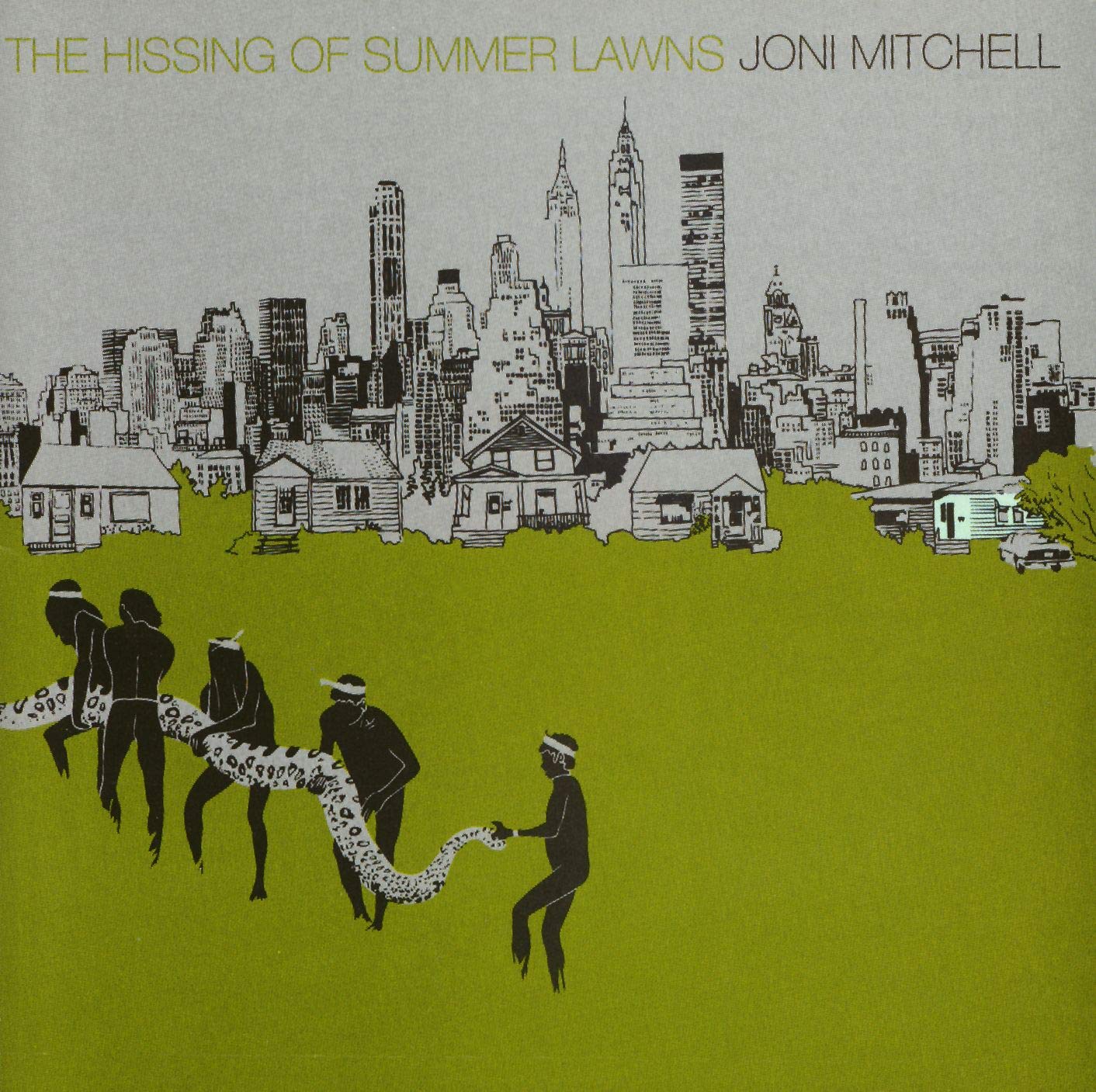
Joni Mitchell: The Hissing of Summer Lawns

Released in November of 1975, The Hissing of Summer Lawns finds Joni Mitchell presiding over one of the most seamless marriages of lyrics and music of the 1970s. The poetry here is evocative and ironic, crafting memorable metaphors and unforgettable images. It’s often said that when constraints are placed on artists, they often produce their best work. For an artist who had previously written music around pre-existing lyrics to then make that shift over to the craft of fitting words into already composed music, one might expect a change in character — or at least in lyrical texture. Beginning around 1973 or 1974, Mitchell’s lyrics indeed became more fluid, impressionistic, and engaged, so that by the time of this album, she had achieved a near-perfect fusion of music and poetry, with the music among her finest creations.

And how does one classify the sound? One cannot. It draws on pop, rock, folk, and jazz, yet it belongs to none of them. The album charts its own course, allowing space for stellar contributors like Bud Shank and Joe Sample to leave their imprint without overshadowing Mitchell’s vision. The closing track, “Shadows and Light,” brings the album to a transcendent conclusion: a multi-tracked a cappella choir of Mitchell’s voice against a contrasting, processed drone from a Farfisa organ. The result is a kind of sonic cathedral, where light and sound filter through like stained glas — ever shifting, quietly monumental, and filled with a sense of cosmic design.

The entire album is a showcase of extracting equilibrium from motion. The music is built on a strong foundation yet exploratory and liberating. Here we have an artist of the highest level in full command of her gifts, unafraid to blur the lines between song and painting, intellect and intuition. The Hissing of Summer Lawns continues to be an album worth returning to: we achieve familiarity with repeated listenings but never is the magic lessened.

Chris Squire: Fish Out of Water

Another November 1975 release was Chris Squire’s highly accessible, melodic Fish Out of Water. For those like me who couldn’t get enough of the brilliance of Yes’s Fragile, this album was filled with the musical inventiveness and wonderful bass lines that dominated that Yes album. Musicians include Bill Bruford on drums and percussion, with saxophonist Mel Collins on two tracks and Patrick Moraz on bass synthesizer and organ on one track . Squire handles all the vocals, bass guitar, some acoustic twelve-string guitar and electric bass. Special compliments go Andrew Pryce Jackman who provides acoustic and electric piano keyboards and seamlessly integrated orchestration providing the album with additional depth and further contributing to its ebullient vitality. Fish Out of Water is a must-have album for all Yes fans surpassing most of their catalog released after 1975.

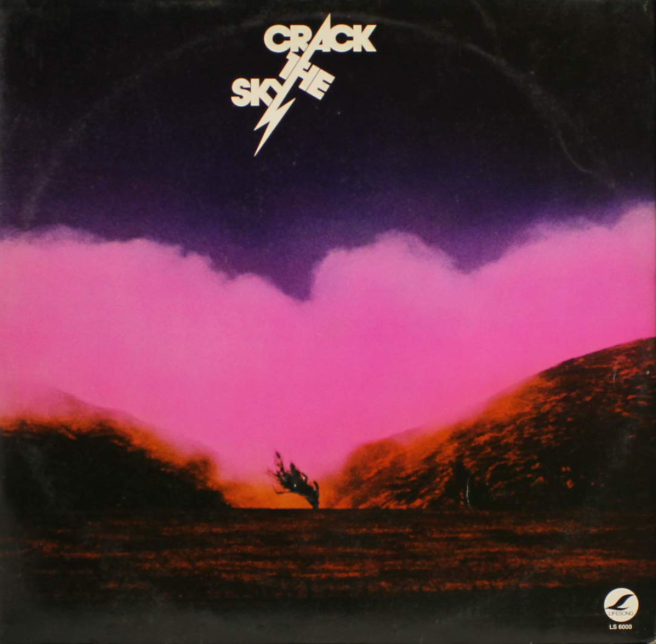
Crack the Sky: Crack the Sky

Crack the Sky’s debut was released in limited quantities in November 1975 by the independent label, Lifesong. Is this the biggest accomplishment by this label? Depends on your perspective — Lifesong posthumously re-released several greatest hits albums of Jim Croce material starting in 1976 as well as being responsible for “The Biggest Rock Event of the Decade” — that’s right — the rock opera Spider-Man: Rock Reflections of a Superhero — an album of such popularity that I cannot find any entry for it on Wikipedia, though in fairness, the title was released again twenty-five years later on CD and is currently available on eBay for $49.

Putting Spider-Man historical considerations aside, the Crack in the Sky album, despite its limited distribution, eventually climbed up to spot 161 on the Billboard Charts in February 1976 aided by some airplay in the Baltimore area and more importantly being identified by the Rolling Stone magazine as the debut album of 1975. 

Keyboard player and lead vocalist John Palumbo wrote all the music and lyrics showcasing an eclectic range of styles incorporating sixties pop elements and contemporary progressive rock elements. Both the music and lyrics are generally quirky, with a tongue-in-cheek, often ironic, humor deeply embedded in the lyrics and the music rich with accessible melody. There are musical moments that recall surf music, the Beatles, Procol Harum, early Genesis, and even Gentle Giant. It’s not a particularly well-produced album but it is a lot of fun, and an album that anyone who considers themselves well-versed in the history of rock music should have heard at least once.

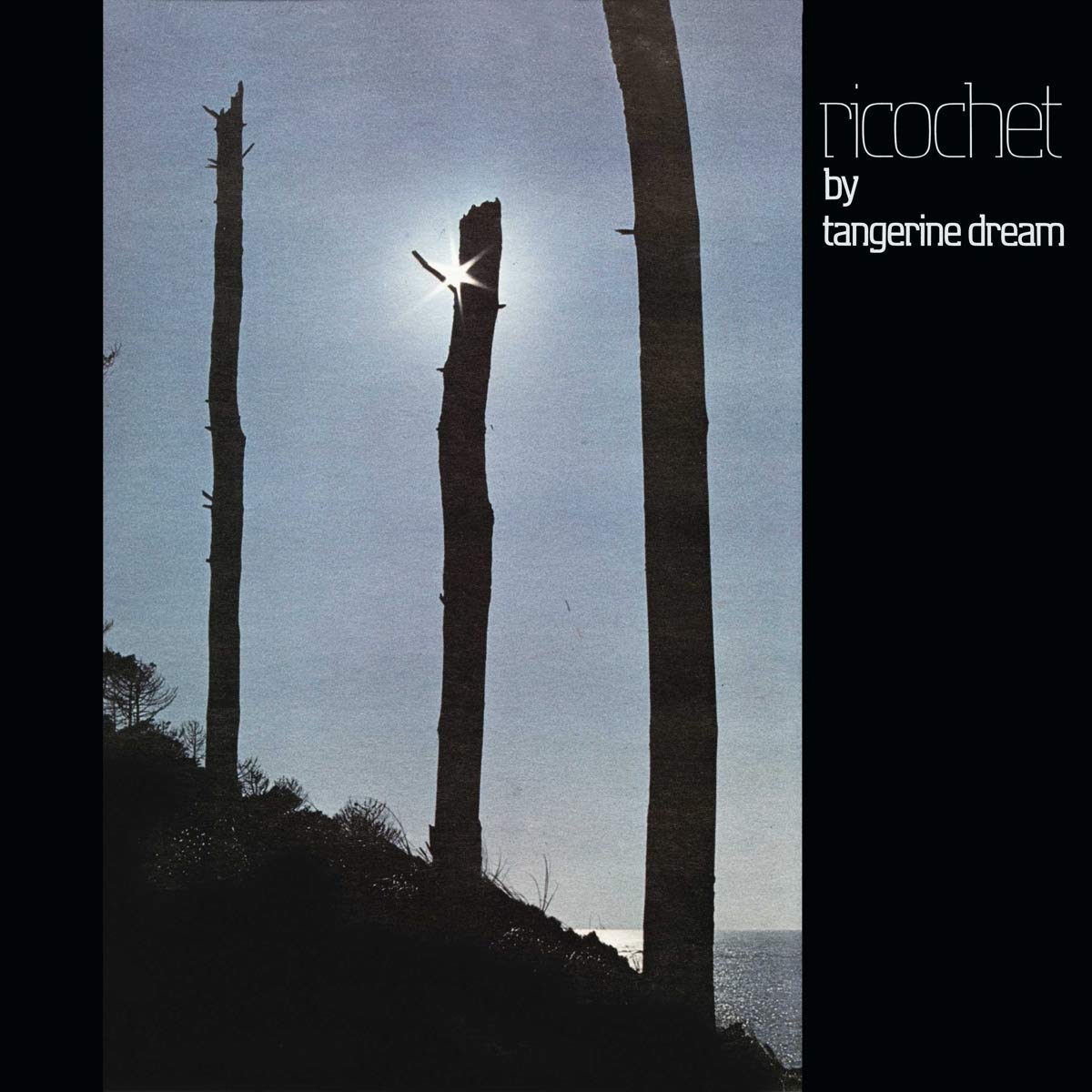
Tangerine Dream: Ricochet

Recorded in late October and early November of 1975 in England, partly live at Fairfields Hall in Croydon and partly in the studio, Ricochet was released in December of 1975. It continues that rhythmically intense sequencer-driven signature sound from Rubycon, delivering it with sparkling clarity and focus. The music unfolds logically with a strong sense of overall meaning and purpose, effectively locking in one’s attention and never letting it go. Side One, “Ricochet, Part One” contains studio improvisations and recreations of live performances with side two, “Ricochet, Part Two” being predominantly live.

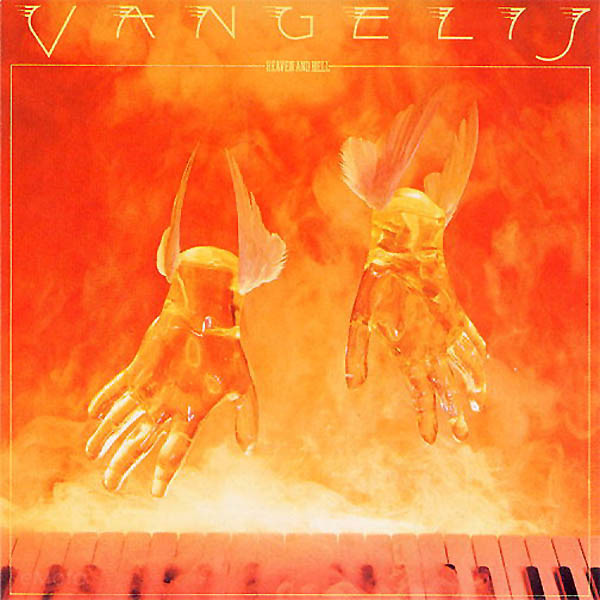
Vangelis: Heaven and Hell

Released in November of 1975, Heaven and Hell is a mixture of the cinematic, early and modern “classical” music, Greek folk and some elements of progressive rock. The album effectively combines Vangelis’s mastery of synthesizer with orchestra to create a richly themed concept album about the duality of human interaction with good and evil, the light and the darkness of existence. Side One, “Heaven and Hell, Part I”, opens furiously with synthesizer and chorus setting a strong symphonic tone and concludes with vocals by Jon Anderson of Yes segmented with a glorious orchestral and synthesizer interlude. Side Two, “Heaven and Hell, Part II” opens up, contrastingly, darkly and ominously, generally maintaining that mood with the notable interspersion of an exuberant, infectious Greek-influenced folk-dance-like section and its more reflective ending. The musical tone-painting is particularly impressive, effectively supporting side two’s darker thematic premise.

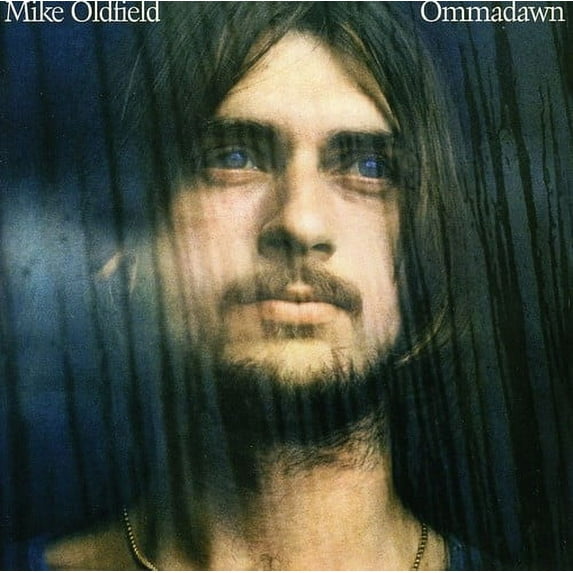
Mike Oldfield: Ommadawn

Released in November of 1975, Ommadawn is Mike Oldfield’s third major symphonic work, following the partly Exorcist-driven phenomenon of Tubular Bells and the expansive, pastoral landscapes of Hergest Ridge. Ommadawn mostly consists of one long work, the title track, divided between the two sides of the original LP with a short additional work at the end. It is this title track that is the gem and centerpiece of the album, excelling in compositional presentation and development of thematic material with the first theme deftly varied, followed by an abruptly effective intrusion of the second theme around the 4:15 mark, which is also skillfully varied. After this exposition of fundamental material, both themes are further developed and extended with a richness of instrumental variety and occasional vocals (using a cleverly altered Irish translation of some simple English words) invoking a tribal sense of community.

The second half of “Ommadawn” is more dramatic with greater musical weight and contrast, further exploring a wondrous world-fusion sound that would soon become a whole sub-genre of music. The highlights here include Paddy Moloney on the Irish equivalent of bagpipes, more properly known as Uilleann pipes, and an uplifting blend of vocals and glockenspiel followed by an Irish-like dance section that brings the work to a close.

For those looking to check this album out, avoid the original mix and go for the sonically spectacular 2010 remix which provides significant clarification and enhancement of individual instruments and provides rich, immersive stereo.

Magma: Live/Hhaï

Released in December of 1975, I bought this album in Germany in 1978, and I was not surprised in the least to find this live album of the French progressive rock group in Germany. Unlike Ange, which had a distinct French coloration to their albums, Magma had a Germanic sound and eschewed the French language to adapt a language more suitable to their music — not German, but — okay let’s break this down.

Christian Vander, son of French jazz pianist Maurice Vander, was born in Paris in 1948. Exposed to both jazz and classical music, he grew up listening to Wagner, Bach and Stravinsky and met several great jazz artists including Chet Baker, who gifted Christian Vander his first drum kit and Elvin Jones who shared his musical expertise. Vander brought all these influences as well as his intense admiration for a number of jazz giants, most particularly John Coltrane, as well as drummers like Art Blakey, Max Roach, Kenny Clarke and Tony Williams. Vander brought all such influences with him, including Coltrane’s searching musical intensity, when he founded Magma in 1969 as Magma’s leader, primary composer, drummer and an important contributing vocalist.

With the formation of Magma, Vander begin the creation of the mythology of Magma concept albums and the appropriate language — Kobaïan, the language of the fictional world of Kobaïa — a distant planet colonized by a group of humans fleeing earth’s moral and ecological collapse. The language’s main function was to provide the appropriate musical sound for Magma’s music and to represent a sacred language of renewal. Its sonic characteristics are starkly different than French, coming closer to Slavic and Germanic patterns, but intrinsically supportive of Vander’s musical ideas, which slowly coalesced into a dark, more teutonic, primitively spiritual style, with texture and timbral/orchestral characteristics eventually significantly influenced by Carl Orff’s Carmina Burana, which Vander first heard in 1972.

This 1975 Live/Hhaï album includes material as early as 1973, all of which represents the mature, dramatic Magma sound prevalent from 1973 on. The original album was a two LP set that could still fit on a standard single CD, but is currently sold as a two CD set. It is available for streaming on the usual sources for anyone wanted to sample this unique music, a music that will retain its excitement, mystery and appeal for centuries to come.

Brian Eno: Another Green World and Discreet Music; Fripp & Eno: Evening Star

In November of 1975, Brian Eno released his third solo studio album, the remarkable Another Green World which, while not as ambient as his upcoming work, is certainly an unconventional pop album full of highly accessible music surrounded with imaginatively unusual context. Eno provides a mix of catchy songs with him on vocals, some amazing guitar work from Robert Fripp, but mostly a level of exotic, quirky arrangements that elevate each and every track. Highly recommend!

In December of 1975, Eno’s fourth studio album is released, Discreet Music, and it is a boldly innovative ambient album. The first side, the title track, is a work of beauty and can be listened to directly or used as effective background music for a range of activities including writing, reading and napping off. The second side is more challenging: three “elastic” arrangements of Pachelbel’s well-known canon where the parts move at different paces — not by chance or performer’s whim but intentionally arranged to distort the relationship of the individual parts and the overall musical experience. One can still hear traces of the original canon — yet each of the three very different arrangements alters the original musical architecture with time-based abstractions that are roughly parallel to distortion concepts in cubism, futurism and surrealism and also seem related to rules-driven processes that are found in works by artists like Paul Klee, Bridget Riley, Sol LeWitt and even those famous rectangle paintings of Piet Mondrian. One also has to give credit to John Cage’s influence which opened up this whole realm of unexpected alterations whether aleatoric or rules-driven.

The most challenging of these three albums, Fripp & Eno’s Evening Star, released also in December of 1975, is another tale of two sides. The first side of four tracks, each with new standard ambient titles, is by far the most accessible and functions very effectively as truly ambient music or even meditative, reflective music, particularly the first, third tracks and fourth tracks “Wind on Water,” “Evensong,” and “Wind on Wind.”

The second side is devoted to a single piece “An Index of Metals” divided up into six tracks. I doubt there are many people that can turn it on in the background and experience a calming or relaxing effect from it. It is filled with tension and not smooth or flowing. I suspect many will just find it plain irritating if using it to relax, read, or write by as it has a somewhat intrusive and ominous character. It is more listening music and needs the attention of an active listener to properly navigate the tension, suspense, and forward progress of the music. The last of the six tracks is the most gritty of all and it ends with the tension decaying as opposed to any resolution. This sets up a nice contrast to some more relaxing ambient music, which would become more and more common and commercially viable thanks to this early work by pioneers like Eno and Fripp.


For additional posts related to Gentle Giant, please check these out:
https://zumpoems.com/2025/07/25/fifty-year-friday-july-and-august-1975/
https://zumpoems.com/2026/04/17/fifty-year-friday-april-1976/
https://zumpoems.com/2021/07/23/fifty-year-friday-july-1971/
https://zumpoems.com/2023/09/01/fifty-year-friday-september-1973/
https://zumpoems.com/2022/04/01/fifty-year-friday-april-1970-2/
https://zumpoems.com/2022/12/16/fifty-year-friday-december-1972/
https://zumpoems.com/2017/08/25/fifty-year-friday-aretha-franklin-simon-dupree-the-big-sound-and-pink-floyd/
https://zumpoems.com/2020/11/20/fifty-year-friday-november-1970/

For Must Listen To Gentle Giant and Prog Rock albums, please check out:
https://zumpoems.com/must-listen-to-music/

For additional posts that mention Gentle Giant, please check these out:
https://zumpoems.com/2017/12/30/seventy-year-saturday-1947/
https://zumpoems.com/2019/07/19/fifty-year-friday-men-on-the-moon-yes-larry-coryell/
https://zumpoems.com/2022/05/27/fifty-year-friday-may-1972/
https://zumpoems.com/2019/05/31/fifty-year-friday-power-to-the-people-the-giant-awakens-empty-sky-at-san-quentin-and-charisma/
https://zumpoems.com/2024/03/15/fifty-year-friday-march-1974/
https://zumpoems.com/2024/06/07/fifty-year-friday-june-1974/
https://zumpoems.com/2019/01/04/fifty-year-friday-the-canterbury-scene-soft-machine-and-caravan-first-albums/
https://zumpoems.com/2025/06/20/fifty-year-friday-june-1975/
https://zumpoems.com/2019/06/14/fifty-year-friday-trout-mask-replica-brave-new-world/
https://zumpoems.com/2023/08/04/fifty-year-friday-august-1973/
https://zumpoems.com/2020/02/14/fifty-year-friday-february-1970/
https://zumpoems.com/2018/08/10/fifty-year-friday-ultimate-spinach/
https://zumpoems.com/2018/06/22/fifty-year-friday-british-folk-rock/
https://zumpoems.com/2020/09/25/fifty-year-friday-september-1970/
https://zumpoems.com/2025/11/14/fifty-year-friday-november-and-december-1975/
https://zumpoems.com/2020/03/20/fifty-year-friday-march-2020/
https://zumpoems.com/2025/09/26/fifty-year-friday-september-and-october-1975/
https://zumpoems.com/2021/11/26/fifty-year-friday-november-1971/
https://zumpoems.com/2026/06/12/dexter-gordon-lullaby-for-a-monster-bouncin-with-dex-brand-x-unorthodox-behavior-fifty-year-friday-june-1976/

Tom Waits, Van Der Graaf Generator, Steve Hackett; Fifty Year Friday: September and October 1975

Welcome back to Fifty Year Friday! It is my great pleasure to announce that our first entry is by an esteemed and respected writer who, for reasons we won’t question, has graciously agreed to provide material for us under the nom de guerre of Leo The Deacon. If you can navigate a substantial drop in quality, a few of my own Fifty Year Friday entries follow. Enjoy!

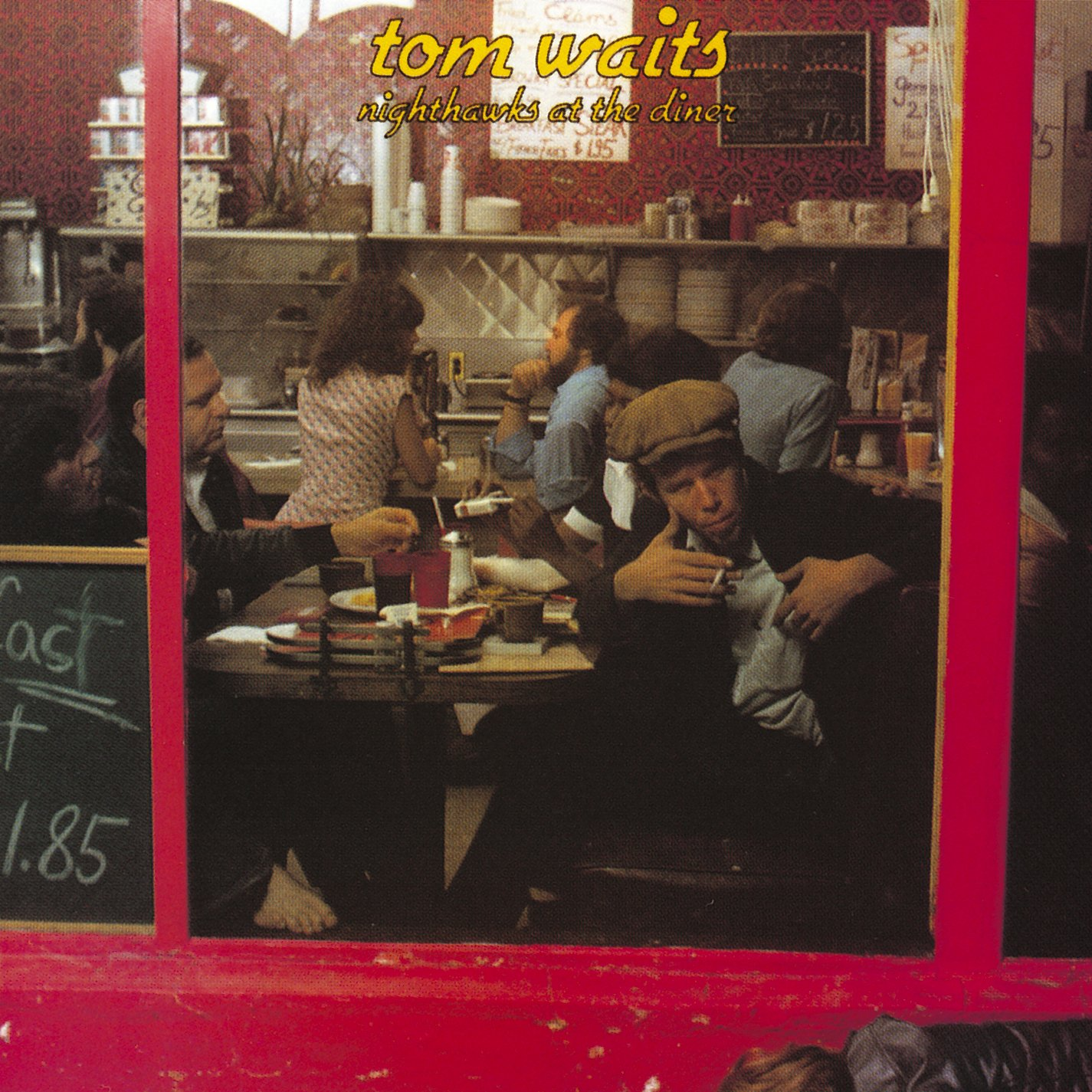
Tom Waits: Nighthawks at the Diner

If ever there was an artist and an album deserving of the rubric sui generis, it is Tom Waits and this, his third album Nighthawks at the Diner. At a time—October 1975—when progressive rock was on the cusp of going to seed, disco was poised to go mainstream, and Wayne Shorter and Chick Corea had set aside post-bop to explore jazz-rock fusion, Waits came out with a two-disc album in which he performs mostly original songs, backed up by a quartet of first-rate Los Angeles jazz sidemen, in front of a small live audience.  As a bookish 20-year-old who never quite embraced rock music—despite the earnest and occasionally successful efforts of the curator of this blog to interest me in such groups as Emerson, Lake, and Palmer, King Crimson, and Gentle Giant—I found Waits’ wry, atmospheric, jazz-inflected compositions  a subversive challenge to the hegemony of rock and roll. Nighthawks appealed not just to the emotions, but to the head. It did not hurt that his profane, salacious, and very funny banter between songs was well calculated to engage the sensibilities of college guys whose weekends, more often than not, were spent in the company of other dateless young men.

So is Nighthawks a jazz production, or a singer/songwriter presentation? Yes. Here’s where it gets interesting, because throughout the performance Waits meanders about the intersection of several genres:  jazz, singer/songwriter compositions, spoken word, a bit of stand-up comedy. Hell, in the cut “Big Joe and Phantom 309” Waits even covers a country-music song by Red Sovine about a ghostly trucker. The entire album is a musical Venn diagram of multiple converging circles. One can’t even call it a “live” album, exactly, because it was recorded in a studio, but in front of an audience hand-picked by the producer to convey the feel of a live performance. It’s not quite authentic but it works, especially as it allows the listener to experience the entire Waits shtick: the guttural banter, the jokes, the wordplay, and the music.

The mood is set from the get-go in the opening intro, with the quartet playing a bluesy vamp featuring Jim Hughart’s walking bass and short, honking arabesques by Pete Christlieb on the sax. The sound is that of a cool, if jaded, house band at a burlesque club and Waits reinforces the conceit by welcoming the audience to the fictitious “Rafael’s Silver Cloud Lounge,” and thanking the stripper who ostensibly warmed up the audience and put a charge into Waits’  libido.  He continues with some introductory jokes about late nights and coming home after three months to find everything in his refrigerator has “turned into a science project.”  As he talks, Waits elegantly elides into the first song, “Emotional Weather Report,” which is more rhythmic spoken word recitation than it is singing. He bemoans the “tornado watches…in the western region of my mental health” and declares that “It’s cold out there—colder than the ticket-taker’s smile at the Ivar Theater on a Saturday night.” Jilted by his lover, Waits’ forecast is for more precipitation.

The rest of the album more or less follows the same pattern, with Waits sustaining a twisted down-and-out persona as he leads into another song or spoken word performance, backed by the jazzmen and revolving around themes of loneliness, lost love, late nights, and life at the margins. For my money, the best cut on the album is the third, “Eggs and Sausage (In a Cadillac with Susan Michelson)” in which Waits precisely captures the milieu of an all-night coffee shop. In this song, (this time he is singing rather than reciting), Waits displays his artistry in clever turns of phrase and the ability to evoke the bittersweet mood of a lonely late night out after a break-up. Atmospherics and the skilled deployment of similes and metaphors are Waits’ stock in trade and he’s at his best in “Eggs and Sausage.”

Waits is often compared to the Beat poets, but that’s not quite right. His music at this stage of his career, and particularly on this album, is reminiscent of the Beats, with its jazz and spoken word poetry, and its exploration of loneliness and alienation. But unlike the Beats, Waits isn’t concerned with philosophy or spirituality, or even drug-induced altered states of consciousness. For the most part, alcohol is Waits’ drug of choice and that and his focus on the working class and marginalized perhaps slides him closer to the Beats-adjacent Charles Bukowski. Both Bukowski and the Beats expressed profound alienation, however, with the Beats setting themselves in opposition to the 1950s military-industrial complex and Bukowski challenging the smug conventionality and moral sensibilities of bourgeois America. Waits isn’t overtly political, like the Beats could be, and he certainly doesn’t indulge in the blunt rage and belligerence of Bukowski. Rather, despite the crusty delivery, he is sentimental. In the end, Nighthawks, as well as Waits’ other music of the mid-1970s, is not concerned so much with alienation as with hard luck, loneliness, and the struggle to carve a little dignity out of an uncaring universe. On Nighthawks, the world is what it is, and Waits knows it is a mug’s game to try to change it.

Tom Waits, at any point in his long musical career, is an acquired taste. Those fans, likely younger ones who are more familiar with the growling, iconoclastic, and experimental performer Waits morphed into starting with 1983’s Swordfishtrombones, may find the younger Waits of Nighthawks in the Diner more conventional—dare we say “quaint”?—than the older artist they are familiar with.  But in 1975, Waits’ retro-beatnik hipster persona, jazzy music, and well-crafted noirish lyrics was something different from the dominant electronic-heavy compositions of rock and fusion. From the perspective of fifty years, it holds up well, although younger listeners may find themselves bemused by Waits’ frequent references on this album to LA “landmarks” that have passed into history—The Copper Penny restaurants, the seedy Ivar Theater, the  Ziedler & Ziedler clothing store on Sunset, and KABC weatherman Dr. George Fischbeck, to name a few.

If there is a flaw in Nighthawks, it is that the persona Waits adopts narrows the variety of the songs. To be sure, on a few tracks—“Warm Beer and Cold Women,” “Nobody,” and the country-ish “Putnam County”—Waits veers into his singer/songwriter roots, dials back the jazz, and sings accompanied by himself on piano. By and large, though, the album is a series of Waits’ compositions backed up by well-executed jazz incidental music. The jazz frames the mood, but the fun is in skillful lyrics, the repartee and wry observations, and the dark, at times cynical, yet not despairing atmosphere that Waits conjures up. It is an eccentric artifact of its time, but it still rewards the listener and reminds us that the 1970s weren’t all bell-bottoms, platform shoes, and leisure suits. 

—Leo the Deacon

Van Der Graaf Generator: Godbluff

Released in October 1975 in the UK, this album was only available as an import. It wasn’t until I made a trip to Europe in 1978 that I purchased it in Amsterdam and had it and several other albums shipped from a post office near the record store back to the States. That particular parcel of LPs arrived home earlier than I, and so once I was home, I put it on my beloved turntable. Wow!

As a great admirer of their previous album, Pawn Hearts, which I had bought as a cut-out in the US for less than three dollars, I had high expectations for this. Fortunately, the quality of the lyrics and music did not disappoint.

After a four-year gap between Godbluff and Pawn Hearts, Peter Hammill, Hugh Banton, Guy Evans, and David Jackson roar back more powerfully than ever with less psychedelic and excursionary elements and an apparent singular focus on drama and controlled handling of musical tension and release. Hammill displays his range of skills on vocals, superior in dramatic and expressive impact to more famous contemporary singers/songwriters like David Bowie, and even contending with the otherworldly emotional delivery of Demetrio Stratos of Area and Francesco Di Giacomo of Banco del Mutuo Soccorso. Hugh Banton and Guy Evans are in great form on keyboards and percussion; and we have David Jackson on double saxophones, à la Rahsaan Roland Kirk, creating musical textures that elevate the music experience to breathtaking intensity.

Side One opens with “The Undercover Man”, which starts softly, creating musical and dramatic suspense. Once the tension is established, it methodically builds in intensity, layer by layer, gradually crescendoing, leading to some colorful organ, sax and the further unfolding of the brilliant expression and pacing of Hammill’s staggered and passionate vocals.

“Scorched Earth”, the second of two tracks on the first side, maintains intensity, opening up quietly and building in dynamics with repetitive motives weaving through Hugh Banton’s organ part and David Jackson’s deftly engineered sax parts supported by Guy Evans’s relentlessly polyrhythmic drum work. The forward momentum cools, with an initially echoey middle section, crafted out of preceding musical material that explodes into an unpredictable flurry of syncopated melodic material and violent skirmishes of accelerating ostinatos and motivic interchanges. Two dominant mixed meters alternate. Dynamic and rhythmic shifts continue to propel the music forward to an abrupt climax ending with a brief musical exhale.

Side two opens up reflectively with “Arrow”, with a meandering and introspective introduction ferociously interrupted with Hammill’s vocals which commence to entwine and shape the course of the music leading into an instrumental of repeated sax permutations on the primitive four-note saxophone motive heard earlier but not put through a series of repeated modifications. Hammill’s vocals return with full intensity and anguish:

How long the time seems
How dark the shadow
How straight the eagle flies
How straight towards his arrow

How long the night is
Why is this passage so narrow?
How strange my body feels
Impaled upon the arrow


This is followed by more sax-dominated instrumental and intensive, unrestrained percussion eventually trailing off into a sustained whimper.

The last track, “Sleepwalker”, described by Hammill as portraying “life in death, death in life” begins boldly with a brilliant 9/8-based mixed-meter motif, syncopated and off-kilter, creating a lurching, stumbling feel, realized flawlessly by sax, organ and percussion. Once the pattern is established for the listener, it moves into an accompaniment foundation for Hammill’s vocals:

At night, this mindless army, ranks unbroken by dissent
Is moved into action and their pace does not relent
In step, with great precision, these dancers of the night
Advance against the darkness – how implacable their might!

The second section starts off as a tango with güiro, organ, clavinet and then sax on melody– but it is a 3/4 tango! It then contorts itself evolving into the opening motif for brief return of theme A, but these expectations are quickly tossed aside with an intro into a completely new section in a relentless, undeniable 4/4, the sax and rhythm hinting at a brief funky disco feel before the band shuts down that possibility completely with aggressive prog-rock percussion, sax and Hammill’s searing vocals.

A necessary aside on the artistic nature of David Jackson’s approach to the saxophone: dubbed “the Van Gogh of the saxophone” by a critic of the British New Musical Express, Jackson was described as a “renegade impressionist, dispensing distorted visions of the world outside from his private asylum window”. Following in the footsteps of jazz artists like John Coltrane, Rahsaan Roland Kirk, and Albert Ayler, Jackson focused on fully leveraging timbral and tonal qualities of his instrument to deliver a wider range of emotional experiences.

Two key elements defined his style. The first was his signature use of double horn — playing two saxophones (typically alto and tenor) simultaneously, creating dense harmonies and powerful, layered riffs. The second, and more crucial for “The Sleepwalkers,” was his pioneering use of electronics using customized pickups, octave dividers, wah-wah pedals, and powerful amplification, transforming the saxophone from a purely acoustic instrument into a versatile prog-rock sound source, capable of generating textures and timbres far beyond its natural range, allowing him to sonically manifest the fragmentation, distortion, and psychological turmoil central to VDGG’s music — and provide a fully-effective soundscape for Hammill’s autonomically engaging, intensely visceral vocal delivery.

The synthesis of those two saxophones, the bass pedals and organ work of Banton, Evans’s driving polyrhythmically-paced percussion, always at the service of the music and text propels us into the psychedelic-flavored coda which slowly evaporates into nothingness, leaving the lingering essence in the listener’s mind, eventually compelling a repeat playing of one of the finest albums

Steve Hackett: Voyage of the Acolyte

Released in October 1975, I never had enough money to buy this in my college days — such a shame, as this is a wonderful album and provides insight into how much Steve Hackett contributed compositionally to the many of the passages within Genesis’s Nursery Cryme and Supper’s Ready. Excellent, evocative and reflective music that sparkles as wondrously as ever.

Pink Floyd: Wish You Were Here

Pink Floyd released their ninth studio album in September of 1975. Fifty years later their The Dark Side of Moon boost has maintained their popularity enough so that there are multiple sets out this month celebrating the fiftieth anniversary. If you haven’t heard this album yet, you probably weren’t listening to music fifty years ago!

Can: Landed; Jethro Tull: Minstrel In the Gallery; Electric Light Orchestra: Face the Music

All released in September of 1975, all three of these albums have their strong moments and are worth checking out. Can’s Landed starts off with grungy rock badly recorded, but ends strongly with the musique concrète of “Unfinished” with much of interest in between.

Jethro Tull’s Minstrel In the Gallery is more reflective than his previous three albums and seemingly more personal. Thematically, the album lyrics cover the introspective and the cynical, with Ian Anderson’s lyrics exploring the isolation and pressures of being a public performer — Anderson being that Minstrel in the Gallery. Throughout a good deal of the album Martin Barre’s electric guitar is in the forefront and borders on a jazz-fusion ethos contrasted in other sections with delicate acoustic guitar. The album’s highlight is the musically and metrically complex, multi-part “Baker Street Muse” on side two, lasting over sixteen minutes with sharp contrasts and sharp lyrics.

ELO’s Face the Music opens up with an orchestral intro and explodes with their signature blend of strings, Jeff Lynne’s guitar, drums, and keyboards. The excellent opening instrumental, which highlights Mik Kaminski on violin, is followed by a classic-sounding ELO track, “Waterfall, reminiscent of Eldorado material. As mentioned earlier by Leo the Deacon, September 1975 ushers us into the mainstream days of disco fever and ELO made good money with an edited single version of the third track “Evil Woman.” I had stopped listening to AM radio long before 1975, but somehow I was still exposed to it enough in various public venues that I developed a rather strong aversion to its annoyingly commercially cloying sound. The remaining album has its ups and downs, and includes a number sounding much like the pre-disco Bee-Gees (“Strange Magic”) and Lynn’s excursion into country music, “Down Home Town.”

Besides these albums we have a wealth of other releases, not at the level of Godbluff by any means but much more commercially successful including albums by George Harrison, John Lennon, Elton John, Paul Simon, his former singing mate, Art Garfunkel, Rush, Herbie Mann, Linda Ronstadt, Roxy Music, Sparks, Steeleye Span, Aretha Franklin, Barbra Streisand, Frank Zappa, Hall & Oates, Crosby and Nash without Stills, and though I haven’t a clue what it sounds like, and am totally fine with that, Kiss’s Live Album, which apparently is the first album released by any American hard rock band, for if memory serves me correctly Spinal Tap had not released any live albums by that date — or to be factually correct, now that I check Wikipedia, still has not.


For additional posts related to Gentle Giant, please check these out:
https://zumpoems.com/2025/07/25/fifty-year-friday-july-and-august-1975/
https://zumpoems.com/2026/04/17/fifty-year-friday-april-1976/
https://zumpoems.com/2021/07/23/fifty-year-friday-july-1971/
https://zumpoems.com/2023/09/01/fifty-year-friday-september-1973/
https://zumpoems.com/2022/04/01/fifty-year-friday-april-1970-2/
https://zumpoems.com/2022/12/16/fifty-year-friday-december-1972/
https://zumpoems.com/2017/08/25/fifty-year-friday-aretha-franklin-simon-dupree-the-big-sound-and-pink-floyd/
https://zumpoems.com/2020/11/20/fifty-year-friday-november-1970/

For Must Listen To Gentle Giant and Prog Rock albums, please check out:
https://zumpoems.com/must-listen-to-music/

For additional posts that mention Gentle Giant, please check these out:
https://zumpoems.com/2017/12/30/seventy-year-saturday-1947/
https://zumpoems.com/2019/07/19/fifty-year-friday-men-on-the-moon-yes-larry-coryell/
https://zumpoems.com/2022/05/27/fifty-year-friday-may-1972/
https://zumpoems.com/2019/05/31/fifty-year-friday-power-to-the-people-the-giant-awakens-empty-sky-at-san-quentin-and-charisma/
https://zumpoems.com/2024/03/15/fifty-year-friday-march-1974/
https://zumpoems.com/2024/06/07/fifty-year-friday-june-1974/
https://zumpoems.com/2019/01/04/fifty-year-friday-the-canterbury-scene-soft-machine-and-caravan-first-albums/
https://zumpoems.com/2025/06/20/fifty-year-friday-june-1975/
https://zumpoems.com/2019/06/14/fifty-year-friday-trout-mask-replica-brave-new-world/
https://zumpoems.com/2023/08/04/fifty-year-friday-august-1973/
https://zumpoems.com/2020/02/14/fifty-year-friday-february-1970/
https://zumpoems.com/2018/08/10/fifty-year-friday-ultimate-spinach/
https://zumpoems.com/2018/06/22/fifty-year-friday-british-folk-rock/
https://zumpoems.com/2020/09/25/fifty-year-friday-september-1970/
https://zumpoems.com/2025/11/14/fifty-year-friday-november-and-december-1975/
https://zumpoems.com/2020/03/20/fifty-year-friday-march-2020/
https://zumpoems.com/2025/09/26/fifty-year-friday-september-and-october-1975/
https://zumpoems.com/2021/11/26/fifty-year-friday-november-1971/
https://zumpoems.com/2026/06/12/dexter-gordon-lullaby-for-a-monster-bouncin-with-dex-brand-x-unorthodox-behavior-fifty-year-friday-june-1976/

Changes of Note

It is with mixed feelings, and pretty intense regret, that I am aggressively scaling back on the publishing of Zumwalt poems on this site. As Zumwalt’s longtime co-editor, I cannot ignore the minimal traffic on this site and the numerous options available for me to submit some of Zumwalt’s previously unpublished poems to diverse and respected publications which will provide Zumwalt an audience of thousands or even tens of thousands of readers. I owe this to my friend Zumwalt.

When I was a data architect, I was fortunate to have had several of my articles on Data Warehousing published in Data Management Review. I know the personal joy of seeing one’s own work published in a respected periodical. Zumwalt has been deprived of this opportunity since the unfortunate, but predictable, cessation of the GHLM newsletter, which had contracted with him for exclusive publication rights. He insists that publication of his work is not important and even scoffs at its future likelihood. I suspect this is not so on either count.

In order to keep this blog active, I will continue to publish anything Zumwalt sends me exclusively targeted for this blog — provided that I cannot persuade him to allow me to forward such material on to potential publishers. I will also continue to author posts like “Fifty Year Friday”, which showcases a combination of my flawed writing against reminiscences of some of the great music of fifty years ago. I wish I had time to write more — I gave up Century Sunday, Seventy Year Saturday and other features due to time constraints; I wish I could write better — I gave that up a long time ago — I write for the joy of writing and I am fine with one reader or ten, ten being about the maximum audience I have for any given post.

But as typical with my ruminations, I have veered off-track, at the expense at both my message and your patience.

My plan is this: Fill up some of the empty blog-time by engaging a well-respected, now-retired former literary critic (I will say no more out of respect to protect this individual’s identity, which is this person’s wish.) He has indicated he will record a short lecture for each previously published Zumwalt poem on zumpoems.com. I will use a software app I have to transcribe each lecture and post it here. Not sure when he will deliver the first lecture, but he is very knowledgeable on both poetry and all of the Zumwalt poems on this site and all the Zumwalt poems that have been previously published in the GHLM newsletter and the original GHLM (which, acronym, dear reader, simply stands for Good Humor Literary Magazine) — and, I believe, as I finish this long-winded, poorly written sentence, is something he can do easily off-the-cuff, with minimal time and preparation required. I have seen him lecture live on impromptu-requested topics, and it is quite something to have witnessed.

Until then, you continue as my distantly cherished and greatly appreciated friend, so please return so we can meet again.