Here are the four poems — each uses the Fibonacci sequence to determine syllable count. The fourth poem takes a cumulative approach to revealing the Fibonacci Sequence one value at a time. It starts with the first value “1” for the first stanza, with each subsequent stanza adding the next value, so that the second stanza is “1,1” and the third is “1,1,2” and so on.
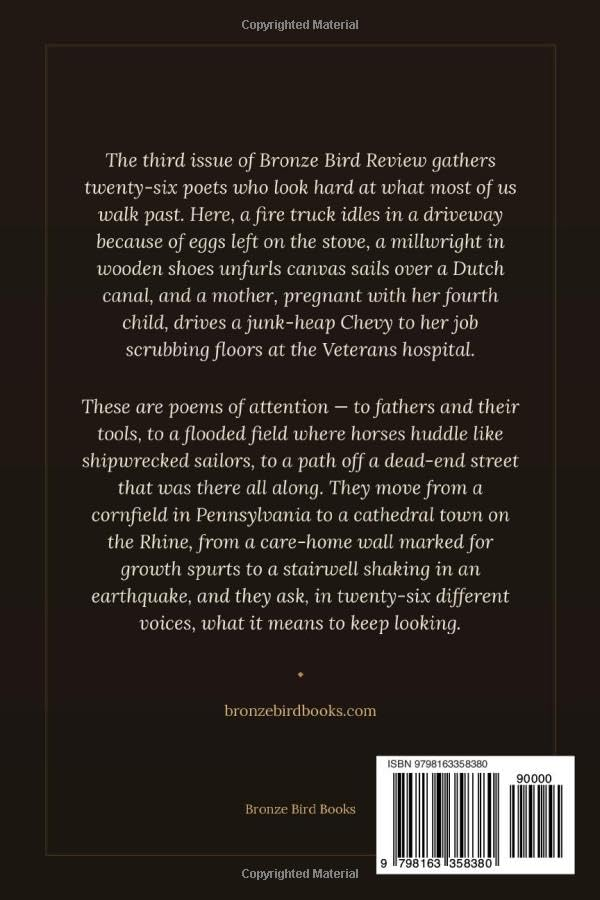
I am pleased to announce that two of Zumwalt poems, “around” and “Handcrafted” have been published in Bronze Bird Review, Issue III. The book includes twenty-six poets and thirty-seven poems. The theme of one of Zumwalt’s poems is mentioned on the back cover.
If you could have any writer/artist, living or dead, as a mentor, who would you choose? I was mentored by John Cage , briefly. It would be nice to bring him back for additional conversations.
Is there a specific period of history whose art or writing you admire? Why? Yes, twentieth century music, particularly between 1909 and 1929 and 1944 and 1955 including Thelonious Monk, Charlie Parker, Charles Ives, Igor Stravinksy and Béla Bartók.
Is there one part of your creation process that’s harder for you? The first part is always harder than the second part, with the second part of the first part being slightly easier than the first part of the second part.
Talk about the moment you knew you wanted to be a creator. It was when I found out the impression a box of crayons could make on an empty wall. I soon learned that creativity had consequences and that my take on creativity wasn’t always appreciated.
Do you have a piece that you created early in your career that makes you cringe? Will you ever go back and fix it so it can be submitted somewhere? No actual cringing: each piece has its own context. Spontaneity is often replaced with craft, and both are to be valued. In terms of “fixing” an earlier piece, I sometimes revise them, but I don’t think of the previous version as broken — it just no longer aligns with my current aesthetics or intentions.
What is your biggest creative doubt? How to answer interview questions.
What piece of creative advice have you received that sounded good, but was ultimately not useful to you? As a child, I struggled to get a D minus in penmanship. I was instructed to “write within the lines.” This advice initially seemed appropriate, but I later learned that, if there is no grade involved, it is sometimes advantageous to cross the lines.
You’re stranded on a desert island – what three creative tools do you want with you? My first request would be a working cellular phone. If that did not qualify as a creative tool, I would opt for a helicopter and a pilot.