Zumwalt Poems Online

Archive for the ‘Thoughtful Thursday’ Category

Thoughtful Thursday: Either/Or

Our world certainly has many examples of extremes — here’s one: very evil people and very good people. Such extremes bookend their specific spectrums or continuums. For example:

Liberal to Conservative
Tall to Short
Dark to Light
Good to Evil
Farsightedness to Nearsightedness
Concrete-Visual to Abstract-Conceptual

Lots of people identify as liberal or conservative, but some are less liberal or less conservative than others, and the majority of people identify as neither — or acknowledge that they have traits of both.

In Søren Kierkegaard’s Either/Or, the nineteenth-century philosopher challenges his reader to make the necessary choice between two posited extremes: the Aesthetic Life (living for the moment without commitment) or the Ethical Life (living by duty and commitment). But if we step outside his strict existential framework and use these terms as we understand them today, life is truly incomplete if we make an either/or choice between the aesthetic and the ethical. We can pursue both! These are not opposite ends of a single spectrum, but categories that are spectrums of their own. And each functions somewhat independently of the other: just because one is unethical doesn’t make that person aesthetic, and one can truly appreciate aesthetics and be one of the most ethical people we will ever encounter. Granted, as Kierkegaard correctly asserts, they are also intertwined — a better appreciation of aesthetics should help one be more ethical.

As we progress through the pages of Either/Or, Kierkegaard discusses the extremes of the aesthetic spectrum: the Immediate Person, who sees the world as it appears on the surface, and the Reflective Person, who sees things primarily in relation to other things. If a poem references “a slithering snake on a pathway,” the Immediate Person will think about a slithering snake on a pathway and the Reflective Person will consider what the snake and the path imply or symbolize. So we have another spectrum, with most people falling somewhere in the middle.

I find this particularly interesting in terms of which type of poetry appeals to an individual depending on where they are on this spectrum, or even if poetry appeals that much to the Immediate person. Or does that person favor poetry that is more direct and is less representative? I suspect that anyone on this spectrum could enjoy poetry, and that even image-laden poetry works nicely for the Immediate person, providing the images describe the real world and don’t represent abstract concepts or function metaphorically for other objects.

Either/Or was written in 1843, and we have some more current observations on personality types. In this case, my interest is the personality spectrum that ranges from Concrete-Visual to Abstract-Conceptual. What is this spectrum or continuum of Concrete-Visual to Abstract-Conceptual?

Let’s jump to around 1943 during the middle of World War II: Katharine Cook Briggs, along with her daughter, Isabel Briggs Myers, developed an early version of a questionnaire to assist the many women entering the workforce to determine the most appropriate jobs for their specific personalities and natural strengths. A couple of decades later, an updated version would be released to a wider audience, and then in 1977, a commercial version, known as Form G, was made available as a diagnostic tool used by schools for vocational planning. Soon, Corporate America and government agencies took an interest, with over 80% of Fortune 500 companies using an updated version of Form G, known as the “Myers-Briggs Type Indicator” (MBTI), to improve communication and teamwork among employees. While modern psychology is rather skeptical of MBTI, it serves as a great team-building tool, and I believe it does have some merit in terms of how individuals process information, including poetry.

The test has four spectrums or continuums, called parameters, and questions score each participant on these four parameters, ultimately assigning them one of two letters for each parameter. This is an Either/Or proposition, but thankfully most versions of MBTI provide a “preference clarity” or “preference score” — a percentage or bar graph showing how strongly one leans toward one end versus the other. For example, a person might score 85% Introverted and 15% Extroverted, or 55% Thinking and 45% Feeling. I remember when I took the test, I scored close to the midpoint on all four parameters. But no matter how close one is to the exact middle, they end up being assigned a letter representing one of the extremes for each of these four parameters.

The Four MBTI Parameters (The “Letters”)

MBTI measures four independent parameters. Each is a spectrum, and a person’s “type” is a four-letter code indicating where they fall on each:

ParameterOne EndThe Other End
1. Energy / AttentionExtraversion (outer world, people, action)Introversion (inner world, reflection, solitude)
2. Information ProcessingSensing (concrete, factual, here-and-now, details)Intuition (abstract, big-picture, future possibilities, patterns)
3. Decision-MakingThinking (logic, objective criteria, consistency)Feeling (values, empathy, harmony, subjective impact)
4. Lifestyle / StructureJudging (planned, organized, decisive, closure)Perceiving (flexible, spontaneous, open-ended, adaptable)

Mapping Our Spectrums to MBTI

Now here is the beautiful part: the two spectrums touched on earlier, Kierkegaard’s Immediate/ Reflective spectrum and the Concrete-Visual/Abstract-Conceptual spectrum, map directly onto specific MBTI parameters.

Our SpectrumThe MBTI ParameterWhy
Concrete-Visual ↔ Abstract-ConceptualSensing (S) ↔ Intuition (N)This is how MBTI defines S vs. NSensing types trust their five senses and prefer tangible, specific, factual information (they want concrete images in their poetry). Intuitive types trust patterns, meanings, and possibilities (they prefer poetry that addresses topics like freedom, desire, identity, and alienation through concepts or even abstractions rather than concrete imagery). This is a perceptual preference: how one processes information.
Immediate ↔ ReflectiveExtraversion (E) ↔ Introversion (I) — partiallyThis one is a harder case to make, but hear me out. Extraverts tend to process externally and react to stimuli in real-time (Immediate). Introverts tend to process internally, stepping back to mull things over before acting (Reflective). However, this is not a perfect match, because Kierkegaard’s “Immediate vs. Reflective” is more about time and commitment than about social energy. But in MBTI terms, the I/E axis is the closest proxy for whether you set up shop in the moment (reacting to the outer world) or live in your head (deliberating before acting).

In terms of poetry preferences, it seems likely to me that the Immediate type will be much less attracted to poems that require considerable reflection to determine their meaning or set of meanings.

Quick Recap Table

ConceptMBTI ParameterWhat it measures
Concrete-Visual ↔ Abstract-ConceptualSensing (S) ↔ Intuition (N)How one perceives and takes in information
Immediate ↔ ReflectiveExtraversion (E) ↔ Introversion (I) (roughly)Whether one processes in real-time or steps back
Aesthetic ↔ EthicalNone directly (as discussed, this is a false continuum.)Can one measure something with two disparate continuums collapsed together?

So What Is Your MBTI Type, and How Does It Relate?

If you know your four-letter MBTI type, we can look at it and see:

  1. Where you naturally fall on the Concrete-VisualAbstract-Conceptual spectrum (your S/N preference).
  2. Where you naturally fall on the ImmediateReflective spectrum (your E/I preference, roughly).
  3. Possibly which Kierkegaardian trap you are most susceptible to (based on your T/F and J/P preferences)?

For example:

  • An ISTJ (Introverted, Sensing, Thinking, Judging) is naturally Concrete-Visual (S), Reflective (I), and Ethical-leaning (J). Their Kierkegaard trap? Becoming so rigid and duty-bound that they lose all aesthetic joy and spontaneity.
  • An ENFP (Extraverted, Intuitive, Feeling, Perceiving) is naturally Abstract-Conceptual (N), Immediate (E), and Aesthetic-leaning (P). Their Kierkegaard trap? Flitting from one beautiful idea to the next, never committing to anything long enough to build a life.

Spectrum Mapping Reference Table

SpectrumMBTI ParameterWhat it measures
Concrete-Visual ↔ Abstract-ConceptualSensing (S) ↔ Intuition (N)How you perceive and take in information
Immediate ↔ ReflectiveExtraversion (E) ↔ Introversion (I) (roughly)Whether you process in real-time or step back
Kierkegaard’s
Aesthetic ↔ Ethical
None directlyYour relationship to commitment, duty, and meaning—a choice, not a preference

For what I consider to be the highly suspect AestheticEthical spectrum, Kierkegaard would say: Your MBTI type describes your starting point, but it does not determine your destiny. The “Either/Or” is not about being true to your type — it is about transcending your type through a conscious, passionate choice to become a full, integrated human being. The reality, of course, is that this is not a spectrum and one can excel at both Aesthetic pursuits and Ethical pursuits.

For the ImmediateReflective Spectrum, one placement here comes down to mostly natural inclination, though I have observed that one can develop skills to excel at both ends of the spectrum: one can improve their ability for real-time decision making, as you do in playing a sport or in a high-stakes conference meeting, and improve their ability to carefully think through all outcomes and possibilities.

Now, here is the part I find the most interesting and that I believe relates the most to poetry preferences — the Concrete-VisualAbstract-Conceptual Spectrum: how we perceive and absorb information — how we process not only information, but also what are our inherent data preferences. Do we prefer concrete images in our poetry, or do we prefer abstract and/or conceptual language? Are we more attracted to Emily Dickinson lines with concrete images like

The Grass divides as with a Comb —
A spotted shaft is seen —
And then it closes at your feet
And opens further on —

or lines that deal with concepts

Pain — has an Element of Blank —
It cannot recollect
When it begun — or if there were
A time when it was not —


(Please note the “” are Emily’s own, and used long before the invention of AI)

Do we prefer Wallace Stevens’ concrete lines:

The pears are not viols,
nudes or bottles.
They resemble nothing else.

They are yellow forms
Composed of curves
Bulging toward the base.
They are touched red.


or his more conceptual work:

The poem of the mind in the act of finding
What will suffice. It has not always had
To find: the scene was set; it repeated what
Was in the script.


The handling of concrete images is pretty straightforward and is well taught in every MFA program on the globe. Perhaps less in vogue today are the conceptual tools of poetry:

Abstract Images / Abstract Imagery: Language that evokes ideas or qualities that cannot be directly perceived by the five senses (e.g., words like truth, freedom, sorrow, infinity rather than some physical object).

Conceptual Language / Conceptual Imagery: Language focused on theories or intellectual ideas rather than observable reality.

Discursive Language: Poetry or lines that rely on logical argument or explanation rather than sensory presentation. In literary criticism, “discursive poetry” is often contrasted with “imagistic poetry.”

Generalities / General Language: Nebulousness or overarching statements lacking the distinctness of concrete details.

Intangible or Immaterial Imagery: Descriptions or expressions concerning things that lack physical substance, weight, or sensory properties.

We find that our often featured poet Zumwalt tends to lean towards the conceptual, but we can find plenty of examples where he goes “concrete” on us:

Some shirtsleeve transient
Sporting scrimshaw arms
Scans a racing form
His shoe leather face focused more
On Santa Anita
Than the saints
Shouted, proclaimed
By an antique black
Whose white wisps of whiskers
Cling to his accusing chin
Clouds about a crag
That trembles with every thundered damnation
As the old man makes the park
His pulpit

(From Afternoon Off, ca. 1977)

Smooth and sepia
Spirals down the throat, wet, warm
For a moment attention drifts
From the bleary graveyard denizens
        the three-day growth denim jacket derelict
        the greasy ember of a cook
        the scrubbed behemoth cop
        A granite waitress

(From Black with Sugar, 1977)

And an example of concrete audio imagery:
The radio unloads
Heavy metal
High volume, howling
Then
Upturned chairs
            the busboy plays counterpoint
            on a Kirby

(From Solo, 1979)

Compare this to his more conceptual work:

Reams and reams
              The black-ink symbols inundate
              Flooding consciousness with printed words
                                           that possess
              Definitions but know no meaning

(From They’ve Stripped the Forest for Babble, originally published in the first issue of GHLM Newsletter in 1974)

or

On a Mobius strip
Crazy coordinates on a hellish helix
        With nowhere to go
        And no way home
Not to worry
Once more around and
Once you grab that brass ring
You will realize
        It’s mostly air.

(From Full Circle (A rumination in 3 strokes), 1982)

Recently, on a phone call with Zumwalt, he recited a draft of a poem where he plans to either avoid all concrete images or heavily use concrete images — or maybe a mixture of both, once the poem turns;

You spend the day outdoors,
won’t come in at night
back to the home you were born in
instead you sleep under
the shelter of trees
I never learned the name of
.

I won’t reveal the surprising turn this poem takes, and I look forward to how it is finally implemented. Can Zumwalt create a final version without a single concrete image — even less than the few weak ones it already has? It sounds easy enough, but the poem has to work within that constraint — not so easy.

But I digress. If we are an extreme S (sensing) reader or editor, we will prefer poetry rich in concrete images; if we are an extreme I (intuition) reader or editor, we will prefer more conceptual passages. Most of us are in the middle. A poet can be at either extreme or in the middle, and produce high-quality work — work that resonates with their particular set of readers. If a reader is in the middle of the spectrum, will they be able to appreciate the extremes of concrete poetry as much as a high percentage S reader? If the reader is all the way over to one extreme, will they have issues with the poetry that primarily uses data and information that appeal to the other side of that spectrum?

Now, remember the Myers-Briggs Test ultimately assigns one of two values for each of the four parameters, including Information Processing. Here is the distribution for Information Processing for people taking the test according to thinkimpact.com.

Intuition (N): Roughly 26.7% of the population.

Sensing (S): Roughly 73.3% of the population.

Even considering that the actual distribution is like a bell curve, with the majority nearer the middle than the extremes, we can better understand why poetry instructors emphasize the importance of concrete images — I am guessing that about 85 to 90 percent of readers will be fine with highly concrete poetry, where perhaps only 60 to 70 percent of readers will comfortably handle heavily conceptual poetry.

We also have the factor (Energy/Attention) of whether the poem is easily understood, or requires more work on the reader’s part to get to its inherent meaning. This reminds me of Zumwalt’s implied preference: “It’s much better if poetry is direct and simple, although the poem now has the liability of being readily understood” — a preference he often disregards, often employing both abstruse concrete and conceptual passages.

For example, instead of opening with:
Our world certainly has extremes, but they are extremes on spectrums or continuums:

Liberal to Conservative
Tall to Short
Dark to Light
Good to Evil
Farsightedness to Nearsightedness

I could have used concrete images in place of my more conceptual introduction, but would you know what I mean? I wouldn’t; during a phone conversation with Zumwalt yesterday, he improvised the following conversion of my original:

Perilously on a spinning globe of cold saltwater and internal rivers of magma, we straddle a studio soundboard slider that skates from silent ponds to ear-shattering dance halls:

From speeding rivers to steadfast mountains
From towering skyscrapers to worn-down speed bumps
From inside a trunk in an underground closet in the center of an asteroid nine-tenths of the way between the Sun and the red dwarf Barnard’s Star to standing on an open observational platform, without quality sunglasses or protective goggles, three feet from the perimeter of Sirius.
From helping ladies cross the street to tripping them and kicking them until their lungs collapse and their blood pools on the warm pavement.
From perceiving the drifting nitrogen-ice blocks on Pluto to discerning the cilia on the outer cells of a dust mite


As almost three-quarters of people would apparently prefer image-rich poetry to conceptually dense poetry, I looked for submission guidelines in various journals to see if any explicitly stated this.

And I hit pay dirt! Twenty-four carat gold! Guidelines that leave no doubt about what the journal will accept.

The journal is Third Wednesday Magazine, a website with slightly fewer monthly visitors and WordPress subscribers than zumpoems.com, but showing a healthy monthly increase, and containing a wealth of excellent poems, available for free, including downloadable PDFs. Here is one for the current issue.

Below are some highlights of their guidelines with full text HERE.

We’re drawn to poems and prose that trust concrete images over abstraction — a name, a gesture, an object doing the work a sentence about “feeling” would otherwise do. We publish across forms, so our most important issues are voice, craft, and image control. Endings that land on something specific and physical interest us more than ones that resolve into reflection or moral. We see a lot of work about loss, and we welcome it, but it should arrive through a scene or an object, not as raw statement.

Isn’t that great? And they go on to say: We’re not opposed to the occasional risk, but risk should earn its place through control, not indulgence. Humor is welcome when it’s dry and plainspoken rather than broad. Above all: we’re a generous, big-tent magazine that welcomes all voices.

They also indicate one of the important points of Zumwalt’s view on poetry, that the form and structure of the poem support the message, with the message never subordinate to the fulfillment or the restrictions of the form: Is the form doing something, or just being followed for its own sake?

I am not sure about this guideline: Does the ending land on something specific and physical, rather than summarizing or moralizing?

How would that work with Emily Dickinson’s ending to one of my favorite poems, Tell All the Truth?

As Lightning to the Children eased
With explanation kind
The Truth must dazzle gradually
Or every man be blind –

I am guessing that Kipling’s If (And—which is more—you’ll be a Man, my son!) and Longfellow’s A Psalm of Life (Learn to labor and to wait.) would also violate this constraint.

But whether I agree with each and every guideline, I have to acknowledge and commend the site for providing these guidelines transparently, and I certainly recognize that journals curate poems around one or more themes, one or more constraints, and/or towards a given audience. There is nothing wrong with a journal like The Society of Classical Poets requiring rhyme and meter, or Light requiring humorous rhyming poems or New Verse News requiring topical poems — and all three journals provide clear guidelines on what their requirements are.

Written Tales, a journal with a smaller audience than Third Wednesday Magazine, provides similar, though much briefer, “show don’t tell” guidelines:

We look for work grounded in specific, concrete imagery: pieces that show rather than tell, bringing the reader into a particular moment through vivid, tangible detail. Abstract or purely emotional work is not a good fit for us.

On the other side, every once in a while one sees guidelines that do welcome “tell, don’t show,” as with Storm Cellar, which includes this umbrella statement: it’s all good. (Even anti-affect “conceptual poetry.”) Or as the Madrigal did a while back with the Discursion Issue call: we are looking for poems that are at play with reasoning and the sounds that facts and logic make even when divorced from any actual grounding.

For me, it’s all good. I am in the middle of the Myers-Briggs Information Processing Spectrum, and love poems brimming with concrete images as well as those providing challenging conceptual explorations. This is why I love visiting these various journals and reading WordPress blogs — blogs where the author is free from all constraints except for the ones they impose upon themselves.

Please visit these journals, read at least a few of their published poems, and post some comments about your thoughts. Please also spend some time discovering poems on WordPress: Free Verse, Poetry, Poems, etc.

Thoughtful Thursday: Ongoing Extinctions; Darwinism in the World of Poetry Journals

More and more poetry journals are closed due to an increasing lack of demand for contemporary poetry

I have a list of over 4,000 journals that publish poetry: some do so online, some in print, some do both. As noted in last week’s Thoughtful Thursday column, I enjoy checking out both poetry blogs and poetry sites to read new work. Sometimes these poems fall short of expectations; sometimes they are well worth the effort of hunting them down.

Today, I randomly picked entry 1613 in my poetry list, a journal named Poemeleon. I knew I was in for a treat reading the description of their content: “Quirky/Humorous/Lyric” and “Playful/Lyrical work.” This sounds great, I thought. As readers of this blog know, I am a fan of Zumwalt’s poetry — which generally is more disruptive or snide than lyrical, but is often quirky, humorous, or playful. I am also a fan of Louise Glück for the lyricism, emotional depth, and overall precision of her writing. And she can also be disruptive and humorous, as in her poem Anniversary. I can say the same about Kenneth Koch — precise control, sometimes lyrical, sometimes disruptive, often playful, clever and/or humorous. Well, there are thousands, maybe tens of thousands of such poets, and I clicked on the Poemeloen link to discover some of the lesser-known such poets.

Poetry sites have to stand out and not blend in to survive.  Even so, will that be enough?

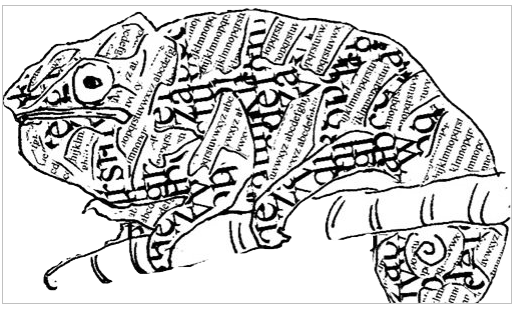
I would like to say that when I first landed on their home page, I was greeted with the above image — the image of the poemeloen, a distinctive and highly specialized clade of a large family of contemporary online journals that champion a diverse range of poetry. And to some degree I was, though it was much smaller. However, what immediately confronted me was the image of the “SORRY WE ARE CLOSED” sign at the top of this blog post.

Above that closed sign was this very small version of their logo and additional text:

Well, in truth, I was pretty undeserving of any thanks. I never supported this site, nor even visited it until today. And now, despite its ability to blend in (or maybe because of its ability to blend in) with its background, it is now another entry in a long list of defunct poetry journals. It could clearly show a range of colorful poetry, and vary what was displayed. But it was eventually overwhelmed by its changing environment: a world where many people have substituted clicking, reacting, and sometimes sharing (though can one really share what isn’t theirs?) for engaged reading.

We go to online poetry sites to be                                               dazzled by the diversity and beauty, but how long will they be able to survive a rapidly changing environment?

However, the poems are still there! And their founder’s mission is still intact: “poemeleon seeks to make visible the invisible. By placing disparate poems alongside one another, I aim to highlight not just their contrasts, but their similarities.”

For how long, though? Eventually, the domain will be unfunded, and the poems will not be so easily accessible. I say, “not so easily,” because, thankfully, we have The Internet Archive’s Wayback Machine, which has captured content from this site and its predecessor 296 times between February 23, 2007 and April 20, 2026. Compare that to our site, zumpoems.com which has been saved 217 times between November 1, 2011 and July 8, 2026, and one can feel pretty good that as long as Internet Archive’s Wayback Machine is enabled, all the poems that the site’s editors (there were multiple: https://poemeleon.me/missionandhistory) ended up selecting from the many submissions sent to them over the years will be avaible for those willing to take the extra effort to track them down.

One day, I won’t be around to fund zumpoems.com. At that point, much of Zumwalt’s work will be lost forever — except for the captures of this site in the Internet Archive. How long will that site be around? Maybe it doesn’t matter, as eventually there will be very few people who will still have the ability to read. The poems will still be around, and they can be read out loud by our AI assistants, but will those AI readers ever understand the meaning of even the simplest or most transparent poem to provide a meaningful enough reading to engage even their most receptive user?

I have no plans to stick around to find out, but if AI extends my life long enough, I guess whatever plans I do eventually make may matter very little.

Poetry sites contain the sublime and the beautiful, but that doesn't prevent their extinction.

Thoughtful Thursday

Boy, do I enjoy the act of writing! Is it about capturing thoughts in a more impermeable form than memory? Or is it about the psychological and mental benefits provided by diving deeper into one’s feelings and perspectives and articulating, whether well or poorly, those feelings and perspectives?

And I love reading. For one is exposed to another’s thoughts, feelings, and perspectives, whether it is reading an email or letter from a friend or engaging with the writing of a familiar author or a complete stranger.

I love diving into others’ WordPress blogs. All I have to do is click on the WordPress reader, and I have a selection of blogs I subscribe to or can explore blogs I have never seen before.

As a reader of poetry, I particularly enjoy exploring posts that have been tagged with “Free Verse,” “Poetry,” or “Poem.” Some are well crafted, some are wild and sprawling, but most are interesting, and many have a level of vitality that is often missing in much of the poetry in curated journals.

I could easily list a dozen WordPress poetry blogs that I enjoy visiting. Let’s just take a peek at my favorite tag: https://wordpress.com/tag/free-verse. And what do I see at the top, posted 15 minutes ago — one of my favorite blogs, Ink & rain! As I open today’s post, I first see one of those many wonderful images that appear reliably at the top of each of author Meiling Cheung‘s posts, followed by text in Chinese and English. Now I have no clue how to read Chinese, so I focus on the English column. Today’s poem is exceptional: it uses a sustained metaphor with each phase serving a specific purpose to support the author’s message. The line breaks are well handled, and the tone it sets, gentle and meditative, perfectly echoes its message. There is an overall emotional immediacy and authenticity, which further enhances the evocative and reflective nature of the work.

Besides reading WordPress poems, I visit various online poetry journals (a partial list of which is here), and so right now, let me check my email to see the latest updates.

Okay, here I have an email from Stick Figure Poetry. I click on the URL to Issue 22, and I immediately find an engaging, inventive poem: Analysis by Tim Love. And it starts off strong:

“Only opaque backings stop mirrors being windows,
and windows can be mirrors if on one side it’s bright 
as an interrogation room while the other’s in darkness.
So think of glass as your poems, and light as reason.”

Such a simple observation, but here is the vehicle for the journey this poem takes us on. No need to be bored with my commentary — just check out the poem here: https://stickfigurepoetry.com/issue-22/#analysis-love

Next, I stop at Shō Poetry Journal and discover a talented poet who has landed poems in prestigious journals like The Kenyon Review and is a winner of several prestigious prizes. Both the text of her poem and the audio are here: https://shopoetryjournal.com/xinyue-huang-occasion-1/

Here is the beginning:

“there is a hole in my chest
through which we drive our car

to the other side of the world
to see the mountains”

With the first glance of this poem, I notice a more or less generic title, no punctuation, no capitalization, regular use of stanzas, reference to a line in Chinese, “万山载雪,明月薄之,月不能光,雪皆呆白,” which I use Google Translate to give me an approximation in English, “Snow blankets the myriad peaks, and the bright moon casts its light upon them; yet the moon cannot make them shine, and the snow remains a dull, lifeless white, ” and, with the exception of the Chinese insert, the use of an accessible, straightforward vocabulary. The work effectively mixes abstractions and images, the modern and the timeless, into a beautifully evocative poem!

Then, I jump into a Wallace Stevens poem, a set of which, from his 1923 Harmonium, is conveniently provided here by The Wallace Stevens Society: https://wallacestevens.com/wp-content/uploads/2019/01/HARMONIUM-1923-WALLACE-STEVENS.pdf

I am not particularly fond of that overly common activity of ranking authors, composers, painters, etc. — each has their distinct voice (or voices) and strengths. Still, it is easy enough to make the case that America should consider itself proud to have been the birthplace and home of such a great poet as Wallace Stevens!

So I have a lot to keep me happy and engaged with a breadth of diversity and styles never available before the launch and development of the internet. Please join me in exploring blogs, poetry journals, and the works of revered poets at your own pace, taking your own individual, self-customized journeys.

Thoughtful Thursday: Remembering the Memorable

Do you remember the most eventful and the more novel experiences more than the routine tasks?  Do you remember the first time you experienced something better than the 245th time, even when the first time was decades ago and the 245 time months ago?

Is part of this due to better remembering those times when you were fully involved as opposed to when you got through something primarily on auto-drive?

Or maybe part of this is just that we remember and retell to others those most exceptional and novel experiences and never think a second time about the less emotional, the less amusing and the less relatively meaningful experiences. The retelling or recalling something possibly is what makes such memories more permanent.  Maybe we really do remember the ordinary as well as the extraordinary — it is just that we revisit the extraordinary memories and leave the common, humdrum to rust away into oblivion.

Or perhaps, not so.  I sometimes have a dream about something I haven’t thought about in decades and then fully recall that event, whether particularly exciting or ordinary.  Or I see a photograph of something decades ago and I can lucidly recall posing for that picture.  Sometimes things can jog our memory.

However this works, one is more likely to remember more easily, and without prompts or dreams, those things that we were fully engaged in — those things that required us to fully be there and not be on auto-pilot.

It’s really impossible for all our experiences to be earth-shattering or essential experiences. And certainly we want to or need to do things additional times over and over.  I love watermelon and black cherries.  I will continue eating them even when given a choice between having them or eating something new that doesn’t particularly appeal to me. But do I eat absent-mindedly while watching TV or browsing facebook?  Or do I take a good look at each bite, feel the weight of the food, feel the texture in my mouth and then savor the burst of flavor?

Don’t take the current moment for granted.  Always participate fully in it. When you do, it is more likely to be more memorable and easier to remember.


Thoughtful Thursday: Age and Responsibility

Whether by design or evolution, it seems it is the responsibility of the child to grow and learn, of the young adult to create, build or raise new young, and of the old adult to apply their wisdom to ensure the survival of the group.

The pursuit of happiness for its own sake does not fit into the plan.

Happiness will come from properly growing and learning, from creating and building that which is best for the group, and from doing what one can to ensure we don’t get totally obliterated.

Let’s ensure that the old can continue to contribute to the survival of everyone by never marginalizing them or underestimating their worth.

And in return, the old have to understand that they have a responsibility to ensure that civilization continues, even if that just means giving the young adults a piece of their mind now and then.

Thoughtful Thursday: Past, Present and Future

History is an illusion at best. At worst, it is a means to justify more of the same. — Zumwalt

Perhaps thinking of reality divided up into what was, what is and what will be is nothing more than a convenient interpretation.

If we admit of the possibility of existence, at the highest level, being outside the realm of time, space and energy, then its plain silly for us to reflect on how the past could have been different.

If we are but a cause-and-effect organism (or mechanism), and we can move only forward along time, then it is even sillier.

I believe existence is existence and there is no existence then, existence now and existence later — there is just existence.

Enjoy it.

Don’t worry about the future.  Prepare, when necessary, but don’t prepare for the future. Just prepare.

Don’t try to fight memories or shrink from past events. The most harm comes from running away and resisting. Accept and celebrate.

Don’t even worry about “staying in the present” or “enjoying the moment.” Just be there. It is possible “there” is past, present and future.


Thoughtful Thursday: What to observe?

“The more we look, the more to see: altering this reality”  — Zumwalt

In order to interpret, evaluate and ultimately understand, one has to observe.

Concept3

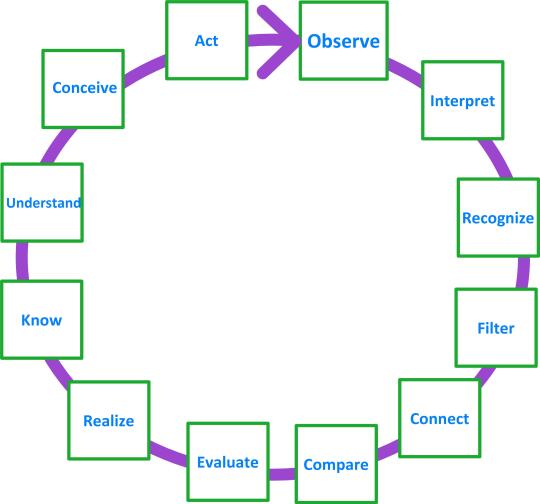
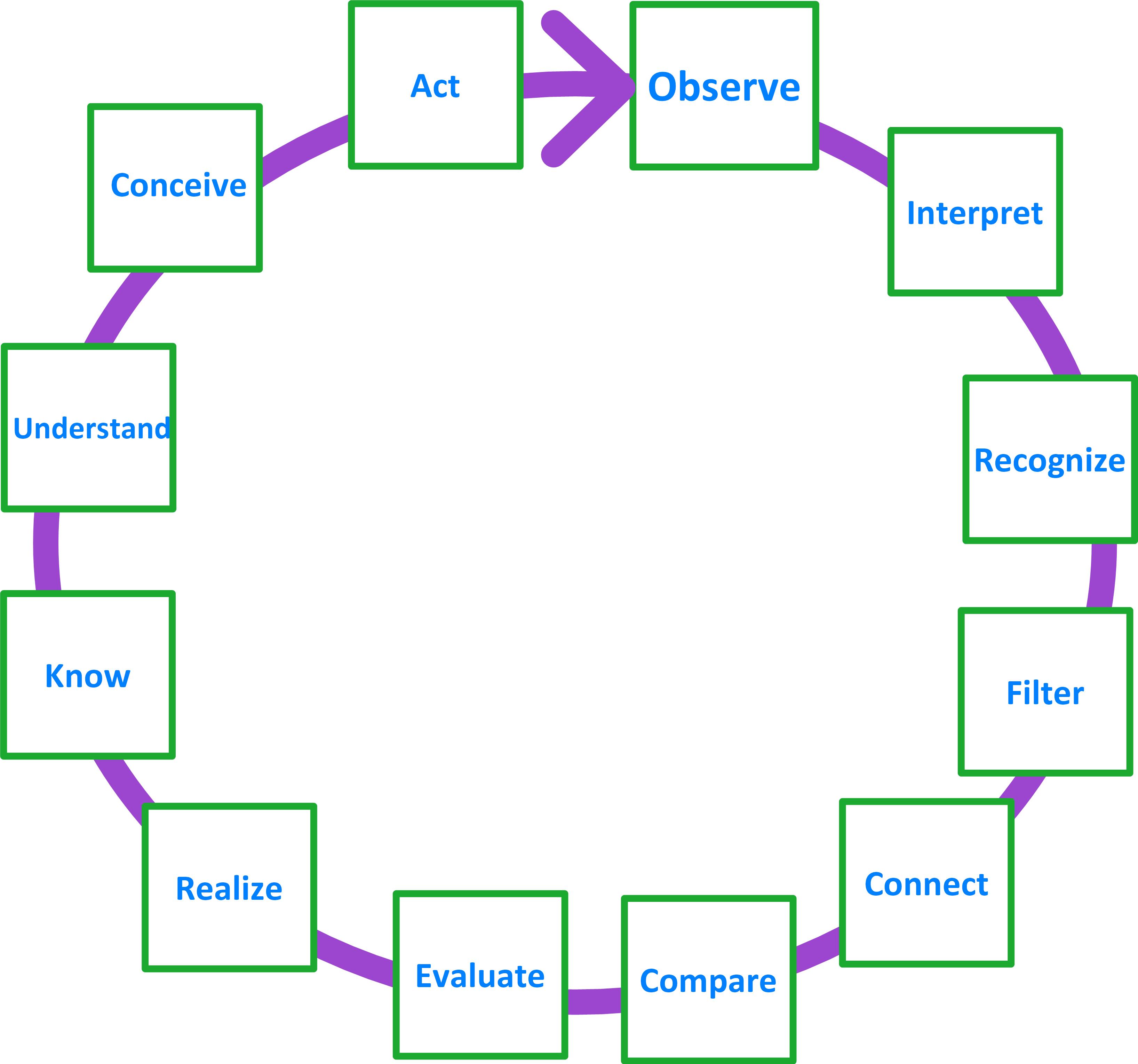
However, there is so much out there to observe.  It’s overwhelming.  So we run into an apparent paradox: one must know, to some degree, what to observe, yet one cannot know without first observing, interpreting, recognizing, filtering, connecting, comparing, evaluating and have some level of realization.

And so one cannot ever start from scratch. There will always be some initial observation from earlier or from others that one relies on in order to determine what next to observe.

Observing then becomes a process of narrowing down and expanding what one observes.  To be efficient this is not a random process, but one driven by the formulation of an objective.

For example, “I need to eat” is an objective.  With that objective one then observes — or collects data — in areas that will be more likely to provide the necessary input to increase one’s success at an action designed to obtain food for eating.

If we are a retail chain,  like Kohl’s, Macy’s or Sears, we must determine our objective.  Is it to increase revenue, lower costs, or increase profit margin.? Or is it a less basic objective like increase in-store traffic or increase brand awareness which may be considered an objective in order to achieve the more specific objective of increased revenue through building customer loyalty?

Having a hypothesis can help narrow down what to observe, but a hypothesis should not be formulated too early in the process or opportunities to achieve an objective can be missed.   Instead it is best to look for patterns in the data, and then determine what is a likely hypothesis based on that data as opposed to starting with an hypothesis and thus missing the opportunity of identifying more likely hypotheses.

For example, if my objective is to cross a river and I start with the hypothesis that one can cross the river on a structure that floats on water, I may miss out on noticing that 200 yards downstream someone has built a bridge, or the river becomes shallow enough to cross on foot, or that the river becomes an underground stream.

So important to keep the objective in mind, identify what data can be collected (what can be observed), and not prematurely limit the data that one will analyze.

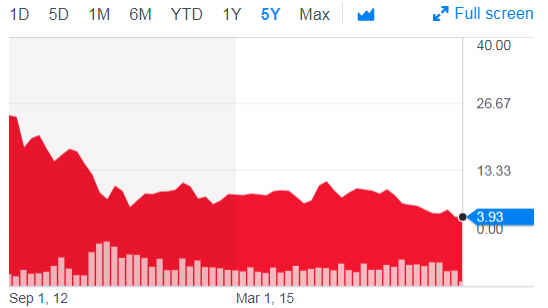
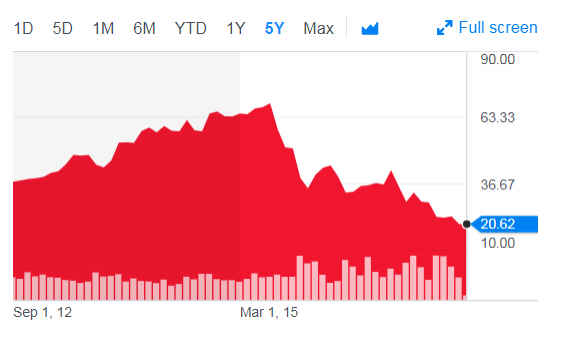
With companies like JC Penney and Macy’s currently fighting against declining same- store sales, it seems like they missed out on observing several years ago how Amazon was increasing book sales and ultimately positioning itself to sell other items online — items that were also sold in shopping mall department stores.  What were they observing? What was their hypothesis?

Five year stock chart for JC Penney
jcp

Five year stock chart for Macy’sm5y

At this point, have these companies learned the hard way what data they need to look at?  (If so, now may be a good time to buy their stocks.  If not, expect further losses for JCPenney and further same store sale declines for Macy’s.)

There is a lot out there to observe.  The first step is to clearly understand one’s objective and then focus on observing those things that will help achieve that objective.  For music, if one wants to dance, observe (listen to) the beat  — this means focus on the drums and the bass, If one wants wants to play along, focus on what the chord progressions are for the verse and chorus.  If one wants to ignore the music, focus on something besides the music.

Don’t worry about formulating an hypothesis until we has examined enough relevant data for that intended objective to see what are recurring patterns.  Fortunately in the data analysis world there is software (Artificial Intelligence, Machine Learning) that can identify patterns in the data.  Without software, one can take notes, reflect and follow the steps in my diagram below: observe a significant amount of data, recognize what are the patterns that appear relevant to your objective, filter out the irrelevant data to focus on that data that has the patterns of interest, evaluate that data, understand its nature and then form a plan of action to gather or observe more of that data as necessary.

Concept3

Eventually one can form a hypothesis and scrutinize that hypothesis each time one goes through the “comparison”, “evaluate” and “realize” steps to know if that hypothesis is correct or not.  If that hypothesis is not appropriate, then one needs to formulate a better hypothesis that is aligned with previously collected data and will predict future observations.  There is no such thing, though, as a correct hypothesis — there is only a workable hypothesis — one that provides the necessary guidance to act successfully. Where people get in trouble is when they stubbornly or subconsciously hold on to a premise or hypothesis that is not successfully predicting outcomes and then continue to act on that premise or hypothesis as if it was reliable.

No belief is important enough to hold on to when it doesn’t align with verified observations. Such beliefs end up doing everyone more harm than good.

Thoughtful Thursday: Preconceptions

most_miscon

“You must challenge your preconceptions or they will challenge you” — Penny A.Proctor (You may hear this first quote in the upcoming new Star Trek series on CBS taken from a short story by Penny A. Proctor)

“Mistakenly thinking you know usually results in not knowing mistaken thinking later on.” — Zumwalt

IQ tests sometimes contain questions that, though not particularly hard, will not be answered correctly if one falls back on preconceptions rather than solving the problem on its own terms: doing the work rather than taking a short cut by falling back on what one accepts as given truths

A bat and a ball cost $1.10 in total. The bat costs $1 more than the ball. How much does the ball cost?

If one starts with preconceptions, one goes for the easy answer.  If one just works through this without jumping at the misleading “short cut” then one gets the correct answer.

If one even checks their preconceived wrong answer, then they will soon have the right answer.  The wrong answer of 10 cents for the ball doesn’t stand up as 10 cents for the ball, plus one dollar extra than the price of the ball for the bat at $1.10 sums up to $1.20.

One way to solve the problem is rely on simple algebra:

x (price of ball); y (price of bat)

x + 1.00 = y  –> y-x = 1.00

x + y = 1.10 –> y+x = 1.10

Add these 2 equations up and we get 2y – 2.10  or y = 1.05 so the bat is $1.05 and the ball is .05.

Even if we don’t use algebra but try a few guesses, checking our guesses will eventually get us to the right number.

But the way that life works for most of us, most of the time, is that we make assumptions and never ever check them, making decisions on top of bad assumptions.

Bill is stalking Mary. Mary is stalking John. Bill is married, but John is not. Is a married person stalking an unmarried person?

  1. Yes
  2. No
  3. Cannot be determined from the given information

Once again, if we fall into the trap of lazy thinking, we may never work through this problem finding the right answer and end up agreeing with 80% of people that choose answer #3. It really doesn’t matter that we don’t know Mary’s marital status.  If she is single, it is then Bill, the married person, that is looking at an unmarried person, and if she is married, then Mary is the married person looking at an unmarried person.

We rarely object to an instance of a person saying “that’s my spouse” (“that’s my wife”, “that’s my husband”) or “that’s my child.”  And so, it’s no issue to say “that’s my dog” or “that’s my cat.”  But we would object to saying “I am the owner of this husband” or “I am the owner of this child.”  Should we also object to one saying “I am this dog’s owner.” Does one own the dog or is it a partnership? If the dog runs away, the “owner” can get the pet back.  The “owner” can decide to trade the dog for money or put the dog to sleep. In ancient Greece and in 19th century America, people owned other people, and could trade them and even put them to death.  The people in the past re-examined ownership of people and determined this was unacceptable in any way, shape or form.  Should we examine our relationships with our pets, or just accept our preconceptions and continue on.

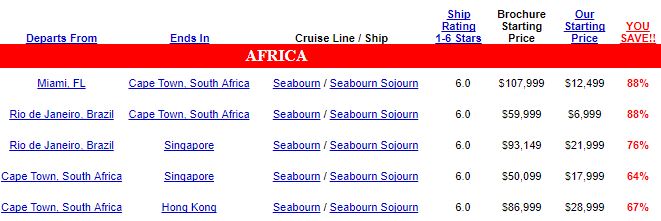
Anchoring is a sales and marketing ploy that takes advantage of our tendency to have preconceptions.  This is very common in the cruise industry where cruise lines offer “limited” 2-for-1 permanent cruise sales or have a brochure starting price that’s double (or more) than the actually offered price:cruise3

Preconceptions are the most troublesome when we don’t know about them. In doing data analysis it’s the bad data that we don’t know about the messes up the results.  Any belief that one doesn’t examine for its accuracy (maybe not examined as one isn’t aware of the belief or thinks it is correct) will influence one’s final decisions and analyses, often making actions based on such decisions and analysis worse than random actions. Anchor prices are used to take advantage of our tendency to lock on to the earliest data we have about something and to subconsciously put more weight or more credence in the earlier or earliest obtained data than later data, even though analytically we often chose to prefer more recent data over older data.

Take the time to examine what data is used to make an important decision and challenge the validity of that data.  By identifying the bad data or erroneous preconceptions and not using them to base a decision on,  one can significantly increase their likelihood of acting appropriately.


Thoughtful Thursday: Observing, Comparison and Evaluating

“Knowingly, and unknowingly, I relentlessly measure everything you do,
And that’s okay, as long as I don’t then pretend that I have ever measured you.”
— Zumwalt

“Accuracy of observation is the equivalent of accuracy of thinking.” — Wallace Stevens

We can observe what one does or what they have.

We cannot observe who they are.  We are basically limited to observing what they do and have. And usually, we only see a very small percentage of that.

But even if we saw everything, 7 days a week, 24 hours a day, we would be left with only seeing manifestations and phenomena, not the essence of who people truly are.  We may know it’s safe or dangerous to be around this or that person in this or that circumstance, but we have no direct understanding of those people, we make the leap from observing what they do to who they are.

So its pointless to compare ourselves to others.  We can compare what we do to what someone else does.  Or we can compare what someone has to what we have.  Just don’t fool yourself that you can compare yourself to anyone else.

The truth is that you cannot measure anyone.  You can measure their body. You can measure the size or weight of their brain, their heart, their stomach.  With the right equipment, you could even count the number of neurons in their brain, the number of synaptic connections, and, if using top-of-the-line (though still futuristic) equipment, the number of neurotransmitters and their motion and chemical composition.

To say the heart, the stomach or the brain is the person is a large leap of illogic and foolishness.  To say the body (containing the heart, stomach, brain and several gallons of water) is the person is also not true.  Maybe removing an appendix, a few skin cells, a couple of liters of water, or consuming a bit too much at a cruise ship buffet changes the viewpoint or experience of the person , but so can reading a book or watching a movie or interacting with someone else — and we don’t confuse the books on your bookshelf or your friends and family with you.  Or do we?  Yes, we often do! Since we cannot observe you, we observe things around you and use these are proxies for measuring you.

Be careful that what you observe is relevant to what you evaluate.  Do not observe the behavior of ducks in the park and assume that you have collected pertinent data to evaluate the behavior of wolves in the wild.  Do not observe the behavior of a person, and assume that you can evaluate the person: you can only evaluate their behavior.

Data seduces us.  We see data and we sometimes don’t stop to see if this data is relevant, complete or appropriate for our analysis.  Our process of drawing conclusions may be sound, but if we are not observing what we need to observe, then we cannot expect valid comparisons or evaluations and this in turn will impact our understanding and any subsequent action.

Concept3


Thoughtful Thursday: Feeling the Future

bela lugosi

People like us, who believe in physics, know that the distinction between past, present and future is only a stubbornly persistent illusion.”  — Albert Einstein

You, predictable reader, follow these words and I know that what you read next is what I write now.” — Zumwalt

It’s a poor sort of memory that only works backwards”  — From “Through the Looking Glass” by Lewis Caroll

Time may not be what it seems.  Sometimes what we assume is true is not: our senses may initially lead us to believe the sun revolves around the earth, but if we observe beyond what is most self-evident, and carefully examine a wider range of data then we must conclude that the earth revolves around the sun. As in the case with planetary bodies,  it may be that our sense of time is based on our frame of reference and not a true understanding of reality.

Physics has provided evidence during our lifetime that the future can determine the past.  The most famous example is the “quantum eraser” experiment. One can google this or check out this article: http://iheartintelligence.com/2017/01/20/quantum-experiment-present-past/.  One can even try this experiment at home: https://www.scientificamerican.com/slideshow/a-do-it-yourself-quantum-eraser/\

Is there any chance of sensing the future?  Some studies, like the famous, but controversial and legitimately challenged, Cornell University trials indicate this may be possible: http://dbem.ws/FeelingFuture.pdf

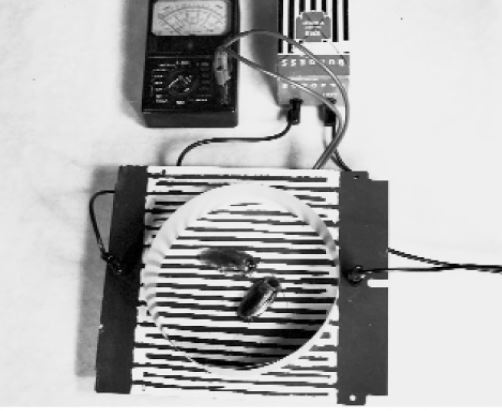
As a graduate student in music, perhaps as a break from listening to too much atonal music, I became interested in parapsychology experiments, and read numerous journals in our large college library covering this topic. There were a couple of experiments with cockroaches that really impressed me. One was an experiment by Helmut Schmidt in which he placed various laboratory animals on a divided electrical grid with a 50% chance of the shock going to the area where the animal was.  Schmidt recorded that in most trials (and these trials included hundreds of shocks), the gerbil, guinea pig or other small animal ended up being shocked around 48 to 49 percent of the time.  Schmidt was a sloppy researcher and it is not clear if this statistically significant number was due to Schmidt’s own psi abilities influencing the outcomes, or the animal’s psi abilities protecting themselves. When he put cockroaches to the test, he found they ended up being shocked 52 percent of the time as opposed to the expected 50 percent of the time. Schmidt admitted his particular dislike of cockroaches, and so it is not clear if the cockroaches were masochistic or whether it was Schmidt’s distaste for them that influenced the outcome.

Schmidt

A later researcher, revising Schmidt’s experiment, placed the cockroaches on a divided grid, with one or the other side receiving a shock and providing the cockroaches the freedom and time to travel to one side or the other.  In this experiment, the researcher recorded whether the cockroaches ended up on the side that received the electrical charge or the side that did not get the charge. Again, the result was that the cockroaches got shocked around 51 to 52 percent of the time depending on the set of trials. Were the cockroaches anticipating the future, even if there actions were not in their best interests? Or was the researcher somehow still influencing the cockroaches to get punished slightly more than expected?  Perhaps it doesn’t matter, as neither the various Schmidt experiments nor this follow-up experiment with the divided grid was ever able to be consistently replicated with the same significant results.

In the recent, and earlier referenced, Cornell set of experiments,  the most interesting ones, (okay — I concede that some may find the salacious-content experiments more interesting), are the two similar experiments addressing “Retroactive Facilitation of Recall.”  Basically the subjects are asked to look at a set of words. After this is done,  they are given a recall test (not being told about this beforehand) and each participant’s ability to recall what they have memorized is recorded.  The computer selects, randomly, half the words the subjects had previously looked at as study material, and then the students study these words.  It turns out the subjects do much better on recalling the words they had studied after the test then those they had not. Basically, this proves that if one is unable to find time to study for a test beforehand, they can always study after the test and improve their test scores — at least slightly.  (This is why, when I pick losing lottery ticket numbers, I always carefully study the winning numbers and carefully commit them to memory to increase my chances of having picked the right numbers in the first place: if I am/was successful, I not only get some extra pocket-change, but get back any time I had spent studying those numbers.)

The key here, from a very practical standpoint, is not whether others can sometimes sense the future, but whether you or I can sense the future and, if possible, how best to develop that ability.   As one might guess (or sense), there are many online opportunities to research this further. Now that I told you this, I have increased your chances of already knowing this, and I suspect that you are thinking to yourself that, yes, you already knew this, and you really don’t need to waste you time reading this blog which isn’t disclosing anything new to you at all. This of course, is what you are thinking now that you have read this. If you had read a blog on politics or music, instead, you wouldn’t be thinking this at all. If you had read a blog on politics, you probably wouldn’t even be thinking.

Back to the present, please. Let’s take a look at one particular online test:  http://www.psychicscience.org/staring.aspx

First, do the practice trial to get a sense of how simple this experiment/test is.

When doing an actual trial, my only advice is to not base your guesses on what already happened, but what you feel is about to happen.  In other words, don’t let three or four blank screens in a row bias you to select the “staring” screen based on some misunderstanding of probability.  Stay in the present and realize each display has a fifty-fifty chance of being either blank or a staring screen and don’t let what occurred before influence your decision/guess/prediction. Just feel whether you will be stared at or not and then pick your choice based on that feeling. (This may be the same sensation you get when you feel someone on the other side of the room is staring at you.  I often get this feeling when I shout and yell at the waiter or waitress in the restaurant — or when they yell at me.)

Also, best to stay relaxed and let yourself get in “the zone.” Don’t let a string of successes put pressure on you. If you feel such pressure, it may be best to take a break and come back. The screen will wait for you. (If you need to take a break, you can read some Zumwalt poems liked by previous readers. Note that any poems you click “like” on may influence anyone that read them in the past to have clicked “like” also.)

Developing an ability to feel what will happen next, may be like developing any skill.  It takes repeated practice, day after day, for an allocated time each and every day.  It is very similar to ear training exercises like this one: http://pitchimprover.com/index.php?type=Relative

After doing this http://www.psychicscience.org/staring.aspx exercise every day, for several months, please let me know if you have seen any improvement.  If so, it may motivate me to do the same. If you can’t seem to improve your ability to see into the future, don’t feel bad, at least knowing this limitation in the future should translate in your spending less time on these exercises in the here and now — or even not bothering to read this blog post.