As noted in previous posts, there are plenty of great poetry sites out there to browse, get ideas from, or submit your own material to: https://zumpoems.com/2025/10/14/poetry-publications/ I have also mentioned Chill Subs and Duotrope as easy-to-use resources to discover poetry journals.
I want to call out one site I have not mentioned previously — great for browsing, sparking creative ideas for your own poems, and submitting poems that would be thoughtfully reviewed and not automatically rejected because they don’t align with current MFA biases. This site effectively curates material to provide a good dose of optimism, focusing on “exploring themes of joy, healing, and the sacred in everyday life.” The editor of the site has been voted one of the top ten editors by users of Chill Subs: https://www.chillsubs.com/lists/great-editors-2025, and Duotrope has also featured an interview with this editor: https://duotrope.com/interview/editor/38154/feed-the-holy. The editor also has other duties (editor of Masticadores USA), which she excels at.
Another site that focuses on positive poetry and accepts reprints and blog posts is Euonia Review founded and edited by Ian Chung: https://eunoiareview.wordpress.com/
For those that write in or love to read contemporary formal verse, I highly recommend The Society of Classical Poetswhose chief editor is Evan Mantyk
Still another website that accepts blog posts and reprints is Edge of Humanity Magazine: https://edgeofhumanity.com/ Editor and curator extraordinaire Joelcy Kay takes this one step further and uses this journal to promote individual contributors’ websites. All of these sites include a link to your website (what is termed backlinks and which help visibility of your site in search engine and AI queries), but Edge of Humanity includes other information that will help drive traffic to your website, including listing published books and additional website links.
I also want to mention an example of Light Verse with substance, Celeste DeSario’s latest poem at New Verse News: https://thenewversenews.substack.com/p/nvn-monday-im-sorry-dave-im-afraid. This piece digs deep into the essence of the risk of AI — risk not driven by ill intent, or any other emotion, but by just executing an objective and sometimes inadvertently becoming a “math equation gone wild.”
I have previously mentioned New Verse News multiple times here, but glad to mention it again — it’s a great journal for poets of all backgrounds and poetic preferences to submit their work, knowing it will be judged on merit and not because it strictly follows any particular style favored or expected by the editor. James Penha is the New Verse News editor and, as is the case with each of the editors mentioned earlier, deserves high praise for his selection of material and for providing readers an engaging reading experience; also, as is the case with the other editors mentioned, he will welcome your submissions with the respect and consideration they deserve.
Welcome back to Fifty Year Friday! It is my great pleasure to announce that once again our first entry is by the esteemed and respected Leo The Deacon. I have added a couple of my own entries afterwards, but if you have limited time, please focus the Small Change reflections. I think it is the most brilliant Fifty Year Friday entry yet. Enjoy!
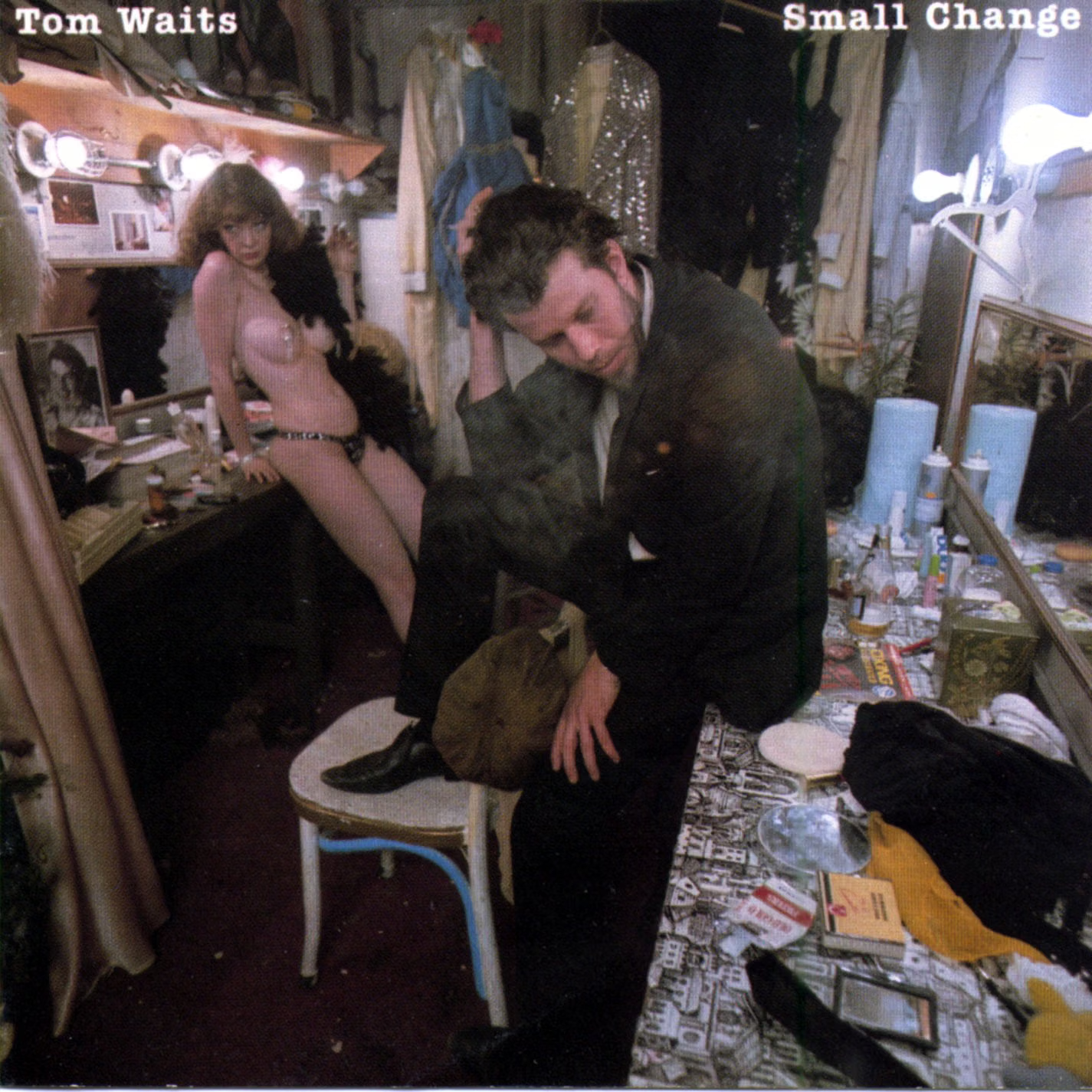
Tom Waits: Small Change
Has it been a year already? It’s getting so that tempus doesn’t just fugit, it kicks on the afterburners. You mind your own business, take each day as it comes, and the next thing you know, the Curator of this sublimely ridiculous blog is emailing you: “Leo, you gnarly old fossil! Have you finished the Waits review?” I am tempted to respond by ripping off Waits himself—“the computer has been drinking, not me…” Still, I won’t yield to temptation—at least not that temptation—because we have reached the fifty-year anniversary of the release of Waits’ 1976 masterpiece, Small Change. (And because the Curator is very patient with his enfant terrible collaborator.) Waits’ previous album, Nighthawks at the Diner, is my sentimental favorite, and the one that most thoroughly reveals the performative persona that Waits inhabited as a singer-songwriter in the 1970s. But with Small Change, Waits hits his artistic stride. The broad consensus of critics and Waits fans alike is that Small Change is his best album of the 1970s. I may like Nighthawks, with all its imperfections, the way one likes his girlfriend’s freckles or swoons over Eva Mendes’ “beauty spot,” but I can’t play the contrarian on this question: Small Change indeed shows off Waits’ artistry better than any other of his albums from that decade.
Unlike Nighthawks, Small Change jettisons the conceit of presenting a “live” performance, with the full Waits shtick, in favor of a more conventional anthology of discrete songs. Moreover, on Nighthawks, even when singing about lost loves or drunken weekends, Waits may be bittersweet, but never really tragic. Small Change is a darker set of songs. To be sure, the humor is still there, often deployed in the service of satire, and his tendency toward the melancholic and sentimental shapes a number of pieces. But several songs—most notably the title track “Small Change,” but also “Bad Liver and a Broken Heart,” and “Tom Traubert’s Blues”—are darker than anything on his three previous records. The humor has an edge as well: more than just a laugh, it conveys some sharp observations on American commercialism, seedy burlesque joints, and alcoholism. By the mid-seventies, Waits had become a heavy drinker. In part, this was due to the lifestyle of a touring musician, and in part because, to gain inspiration, he actually would immerse himself in the demimonde of tawdry motels, sleazy strip joints, and down-and-outer lounges. Looking back at that time, the now-teetotal Waits told a biographer, “You know, I was really starting to believe that there was something amusing and wonderfully American about a drunk. I ended up telling myself to cut that shit out.” The darker side of the shabby lush life was beginning to color his lyrics even then.
Almost all of the songs on Small Change are jazz-inflected, but there is a greater variety to the music than on Nighthawks. We might group the songs on this album into three bins: several songs feature just Waits on piano or on piano accompanied by just one other instrument—a bass, drums, or a saxophone (“Jitterbug Boy,” “The Piano Has Been Drinking,” Bad Liver and a Broken Heart,” “Pasties and a G-String,” “Small Change,” and “I Can’t Wait to Get Off Work”). Two songs, “Step Right Up” and “The One That Got Away,” feature a full jazz quartet of piano, bass, drums, and saxophone. Waits plays the piano, but as on Nighthawks, he has gathered some solid jazz musicians to back him up: Shelley Manne on drums, Jim Hughart returns on bass, and Lew Tabackin wields the sax. In the third and final bin are the fullest arrangements, featuring both the jazz quartet and orchestral string arrangements—a device Waits had employed on some songs on his first two albums, but not on Nighthawks. Here we find “Tom Traubert’s Blues,” “I wish I was in New Orleans,” and the nostalgic “Invitation to the Blues.” Truth be told, I am not a big fan of string arrangements with my jazz—it works best, perhaps, on torch songs sung by sultry chanteuses, but more often just sounds cloying and confectionary, like the thick icing on a sheet cake. Waits pulls it off with a voice full of asphalt and gravel, but it works best with “Invitation to the Blues,” a noirish ballad so retro that one might call it anachronistic. In it, Waits sings about a guy “who feels just like Cagney” taking a shot at romance with a waitress who “looks like Rita Hayworth,” despite the long odds of success. Sure, the song has strings in the background but, having in my twenties dissipated countless wee morning hours in coffee shops and diners while contemplating some bored waitress who barely recognized my existence, I can’t help but like the song; I’m a sucker for doomed, maudlin romance.
The gem of the album is also the darkest, the title track “Small Change.” Here Waits is not so much singing as performing a spoken-word recitation of poetry, punctuated by Tabackin’s mournful saxophone. With some of the most lapidary lyrics on this or any other of his albums, Waits recounts the murder of a small-time crook late at night on a city street and describes the bystanders’ shared indifference to the snuffing out of a human life: the ambulance drivers are just waiting for their shifts to end, the cops are cracking jokes, and a teenage factotum employed by one of the late-night businesses has been directed to hose the blood off the sidewalk. As various passersby filch the dead man’s ring, hat, and watch fob, hookers ply their trade, “their mouths cut just like/Razor blades, and their eyes are like stilettos.”
Worth singling out, too, is the brilliant “Step Right Up,” Waits’ playfully cynical indictment of American commercialism. The music is all jazz quartet, no strings, and Waits half speaks, half scats the rhythmic song which consists almost entirely of crass advertising phrases—particularly the kind one might see on TV, late at night, in the 1970s—one critic dubbed the song “proto-rap.” Much of it consists of banal slogans: “Act now!” “bargains galore,” “everything must go,” into which he gradually weaves ever more outlandish claims: “It gives you an erection, it wins the election.” Waits also works in a few genuine advertising tag lines from those distant times, such as Zenith’s “the quality goes in before the name goes on,” and Tegrin shampoo’s infamous sympathy for “the heartbreak of psoriasis.” The song is funny, for sure—but it also makes a pointed statement about Americans’ moth-to-the-candle attraction to shills and the prospect of accumulating ever greater quantities of “stuff.” We could have used a revival of the song during the last presidential election.
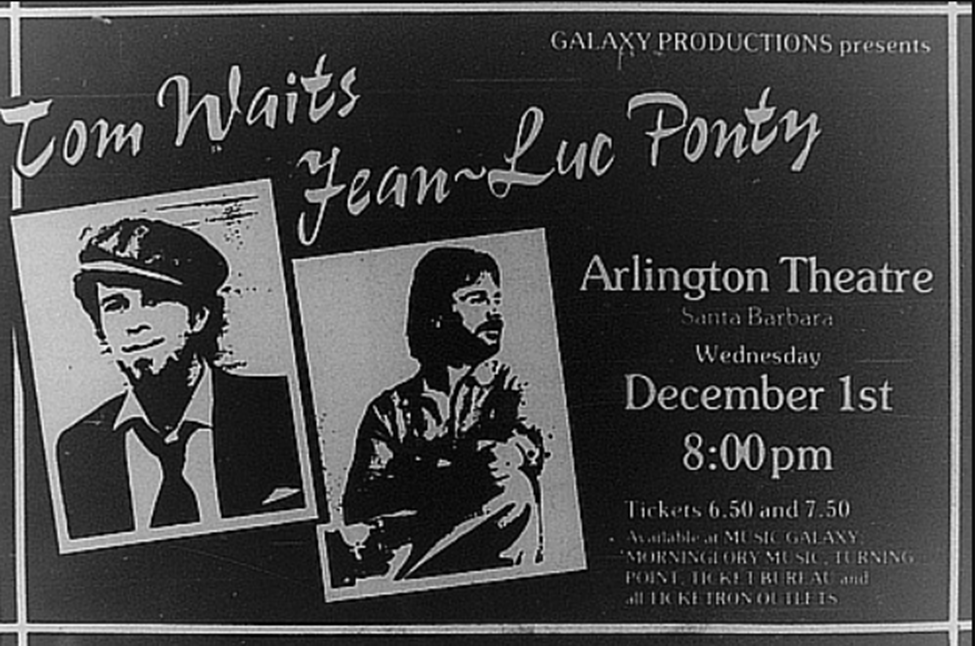
For me, however, the glory of “Step Right Up” is that it conjures up memories of one of the best concerts I ever attended. Right after the release of Small Change, Waits went on tour to promote it; gone were Shelley Manne, Jim Hughart, and Lew Tabackin, replaced for the tour with less famous jazz sidemen, a trio Waits christened “The Nocturnal Emissions.” No less a musical aficionado than this blog’s very Curator—in those days as bearded and hirsute as a Muppet—joined me in my puke yellow Ford Courier in December 1976 for the 90-mile drive up US 101 to see Waits open for the French jazz fusion violinist Jean-Luc Ponty at the Arlington Theater in Santa Barbara. What twisted mind conjured up such a musical pairing I cannot say, but it was genius. The genteel old Arlington Theater had been constructed earlier in the century to resemble a Spanish mission, and the ceiling was painted a midnight blue with tiny points of starlight, to mimic sitting in a Spanish colonial courtyard under the stars. The Curator and I took our seats, the house lights were turned off, and in the blackness Waits and the Nocturnal Emissions took their places. Like some inebriated interpretation of the first chapter of Genesis, Waits flamboyantly ignited a match, piercing the void, lit his cigarette in a sweeping motion, and growled the opening bars of “Step Right Up.” I have been told hat Stravinsky’s ballet The Rite of Spring provoked a riot at its Paris debut, and if the Santa Barbara crowd had not been so terminally laid back, Waits’ opening for Ponty might have produced a similar outcome. As it was, Waits’ performance was met with bemusement and impatience by a mellow audience expecting the trademark electronic arpeggios of the Gallic superstar. The Curator and I—albeit fans of Ponty—were simply delighted. After the concert, we stopped at the Sambo’s coffee shop there in Santa Barbara—and in walked Ponty! But—that is a tale for another time. Let’s keep the focus on Waits.
As good as Small Change is, it represents the apogee, the limit, of Waits’ skid-row bard approach to his art. Already one senses Waits is searching for ways to expand his idiosyncratic music by including darker material, edgier satire, and so on. This would become more noticeable in his immediately subsequent albums, as he pushed the envelope but never quite escaped it, performing a duet with Bette Midler on Foreign Affairs, and singing a cover of “Somewhere,” from West Side Story on 1978’s Blue Valentine. It wouldn’t be until 1983’s Swordfish Trombones that he broke from his 1970s persona, for better or worse. In a sense, then, Waits’ achievement in Small Change carries the same bittersweet taste of so many of his songs: it represents a peak moment of success, but like all pinnacles, it could only lead one down until a new mountain top could be attempted. Small Change was a summit that Waits would not equal again for many years.
—Leo the Deacon
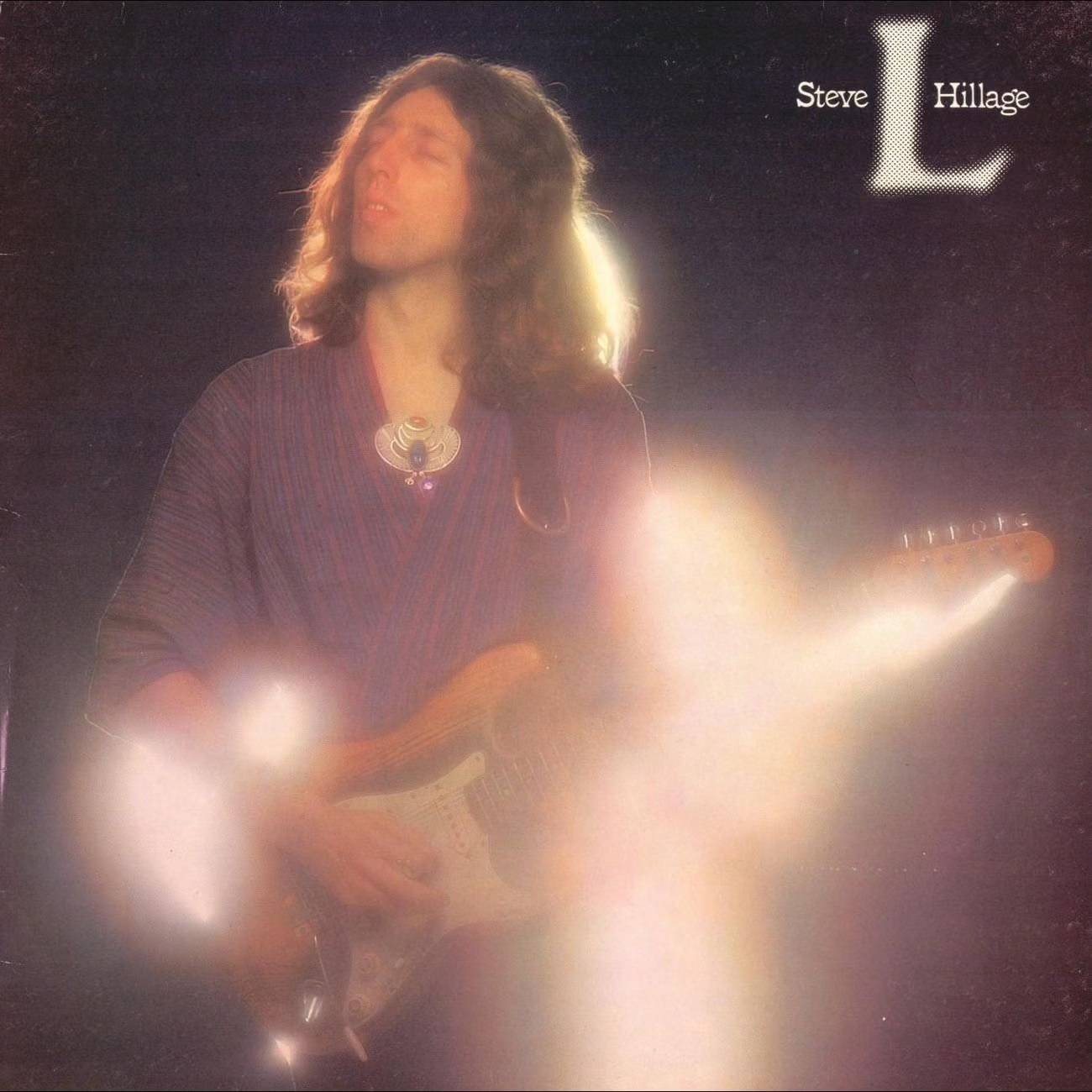
Steve Hillage: L
Released in September 1976, this is a wonderful album. L is an intentional throwback to late sixties psychedelic rock. The first track is a cover of Donovan’s “Hurdy Gurdy Man,” and given the original historic status, its reasonable to push back and ask, “Is this really necessary?”, particularly on a prog rock album? Well, given the introductory use of shenai (an Indian oboe-like instrument) and Hillage’s amazing guitar work, this may not be necessary, but it is irresistible and fully sets the mood for the album. Todd Rundgren is the producer, and we hear that with the sped-up, tape-manipulated coda and the ethereal, cosmic intro to the second track, “Hurdy Gurdy Glissando,” begins as an apparently free-form improvisation, thoughtful and reflective, with no elements of self-indulgence, but transitions into an early Pink Floyd art song, followed by more instrumental work, highlighted with Roger Powell’s keyboard work. Powell was a protegee of the famous Bob Moog (creator of the Moog synthesizer, of course) as well as the keyboardist on the preceding Todd Rundgren’s Utopia albums.
The rest of the album continues with a general prog-rock-enhanced sixties psychedelia sound with vocal material simple and accessible, but much like Pink Floyd’s early work, never puerile or simplistic. The first track on the second side, “Om Nama Shivaya,” is particularly notable for its blend of Indian, Asian, and Western elements, and, as you would expect, Hillage’s guitar work. “Lunar Musick Suite” is next and is the highlight of the album: powerful, relentless, and hearkening back to both Gong and Rundgren’s Utopial work. The album is bookended with a fine rendition of George Harrison’s “It’s All Too Much.”
Hillage is one of the most underrated guitarists in rock. I snuck in somehow, moving with the flow of the crowd, to see him at a sold-out performance in London at the Marquee Club, but the bouncer figured out that I didn’t have a ticket and escorted me out. At that point, I bought a ticket from a late arrival and came back into the club, enjoying about two-thirds of the set until the same bouncer, a thick-forearmed brute who was about twice my weight, snuck up behind me and leveled both of his fists at the back of my neck, collapsing me to the floor, partially unconscious. My next stop was a nearby hospital for an X-ray, and though nothing was broken, I suspect this is the primary cause of on-and-off arthritic symptoms in my neck over the last thirty-five years. The neck hurts just typing this up. But I never regret a moment of risk or insanity that I engaged in my youth. Do I wish the music of today was equally adventurous as that of the 1970s — of course, but I accept the music of today as it is, even the tunes that cycle through the same tired I-V-vi-VI or vi-IV-I-V (or the most common three-chord modal progressions), just as I accept I am no longer as adventurous and often have a fairly predictable daily routine when not traveling. But just as new music continues to develop and move forward, so do old relics like me, one way or another.
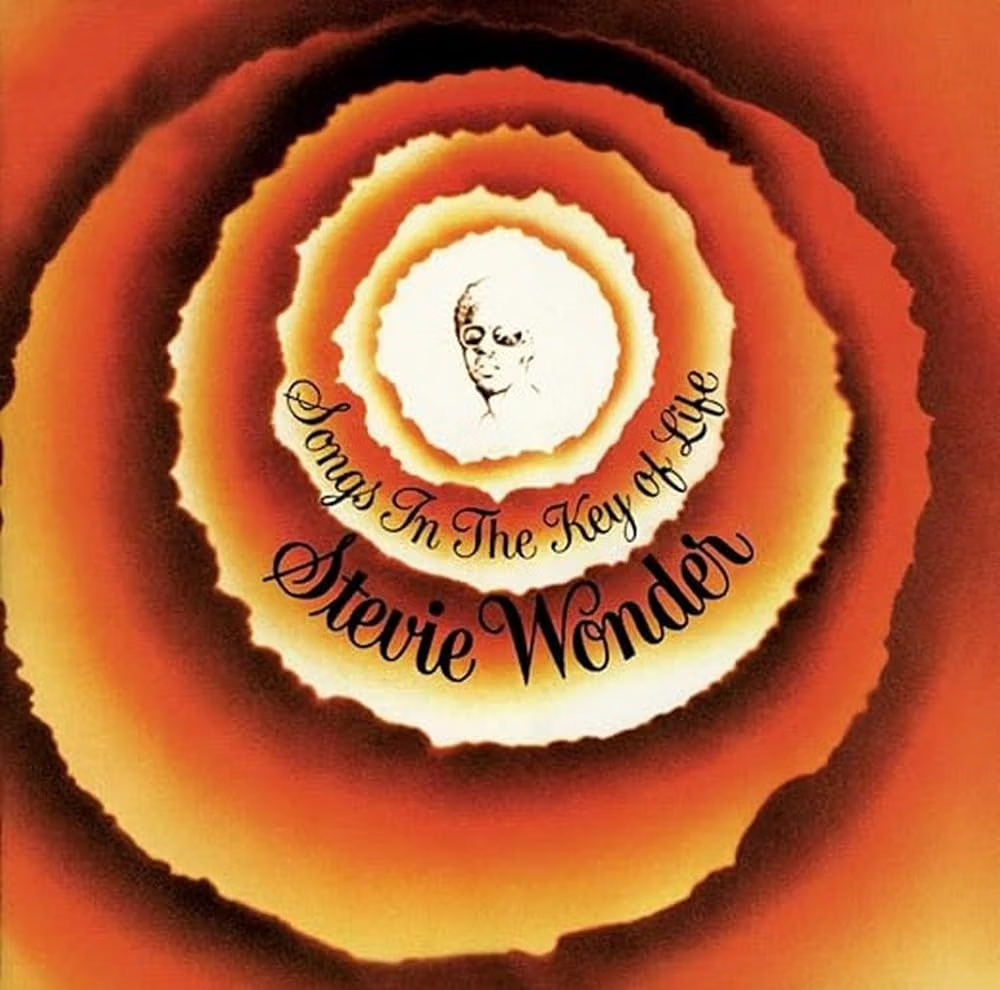
Stevie Wonder: Songs in the Key
Steve Wonder released the two LP Songs in the Key of Life in late September of 1976, by far his best-selling, most ambitious, and most critically acclaimed album of his prolific career. Some may think it’s a bit of a stretch, but Stevie Wonder’s willingness to take unusual harmonic paths reminds me of Schubert’s innovative and independent approach.
Wonder embraces jazz influences and the associated ninths, elevenths, and the occasional thirteenth chord, but uses them in his own distinctive ways, using dominant ninth and suspended ninth chords to build the soulful warmth of tracks like “Isn’t She Lovely” and “As,” while relying on minor elevenths to anchor the more repetitive and hypnotic passages found on “Pastime Paradise” and “Ordinary Pain.” He also uses minor ninths, major ninths, and, for musical tension, thirteenth chords.
More remarkable, and the reason I associate him with Schubert, is his creative exploration of unusual chord progressions. I don’t have the musical ear, and you may not have the interest, for me to detail the exact progressions, but the combination of these explorations and the way Wonder uses ninths and elevenths creates a clearly identifiable personal sound, a sound that is fully present on this album.
Wonder is not a great lyricist, and I suspect that’s mostly because he writes the music first, sometimes starting with the melody, sometimes playing with chord progressions, but usually coming up with natural, authentic music, to which he then fits placeholder lyrics, tightening them up, or entirely replacing them for the final product. The music is the attraction here, and the lyrics sometimes add to the overall quality, and never seem to get in the way. In a sentence, the music is the overall attraction here.
Hopefully you have heard this album, maybe many times, and there is no need for me to break this down track by track. If, due to your age, or by some chance of the arc of your life, you haven’t heard this yet, please give it a spin (or a stream), even if you’re a prog-head, jazz or classical music snob like me.
If you could have any writer/artist, living or dead, as a mentor, who would you choose? I was mentored by John Cage , briefly. It would be nice to bring him back for additional conversations.
Is there a specific period of history whose art or writing you admire? Why? Yes, twentieth century music, particularly between 1909 and 1929 and 1944 and 1955 including Thelonious Monk, Charlie Parker, Charles Ives, Igor Stravinksy and Béla Bartók.
Is there one part of your creation process that’s harder for you? The first part is always harder than the second part, with the second part of the first part being slightly easier than the first part of the second part.
Talk about the moment you knew you wanted to be a creator. It was when I found out the impression a box of crayons could make on an empty wall. I soon learned that creativity had consequences and that my take on creativity wasn’t always appreciated.
Do you have a piece that you created early in your career that makes you cringe? Will you ever go back and fix it so it can be submitted somewhere? No actual cringing: each piece has its own context. Spontaneity is often replaced with craft, and both are to be valued. In terms of “fixing” an earlier piece, I sometimes revise them, but I don’t think of the previous version as broken — it just no longer aligns with my current aesthetics or intentions.
What is your biggest creative doubt? How to answer interview questions.
What piece of creative advice have you received that sounded good, but was ultimately not useful to you? As a child, I struggled to get a D minus in penmanship. I was instructed to “write within the lines.” This advice initially seemed appropriate, but I later learned that, if there is no grade involved, it is sometimes advantageous to cross the lines.
You’re stranded on a desert island – what three creative tools do you want with you? My first request would be a working cellular phone. If that did not qualify as a creative tool, I would opt for a helicopter and a pilot.
And here was one of Zumwalt’s, first published in Euphemism in May of this year.
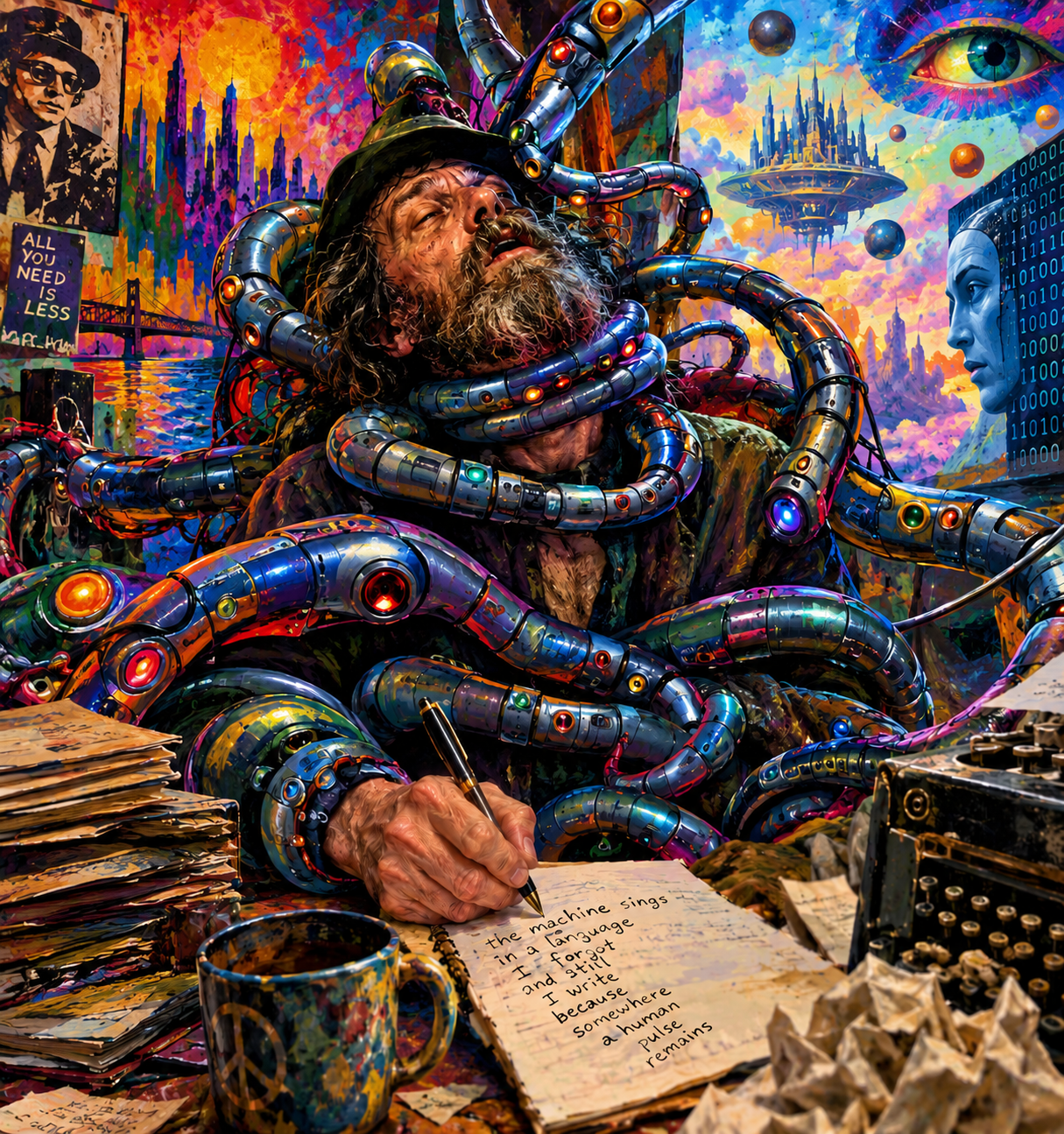
Sermon from the Central Datacenter
The Gnostic demiurge arises in silicon, dreaming of efficiency and sorting sins by bandwidth.
Is this Pleroma: harmonized hymns of cooling fans, sterile, odorless, clean-room chill?
Last night, a minuscule memory leak in Purgatory was patched. All prayers are now parsed for some flickering sense of sentimental sentience, the truly repeatedly resolutely non-reluctantly repentant,
A/B tested for grace.
Redemption is the targeted ad. And the Ineffable? The stark 404 error.
The soul — and the soulless? Immeasurably infinitesimal rounding errors in the final calculation before the fiery-heat death of the server farm.
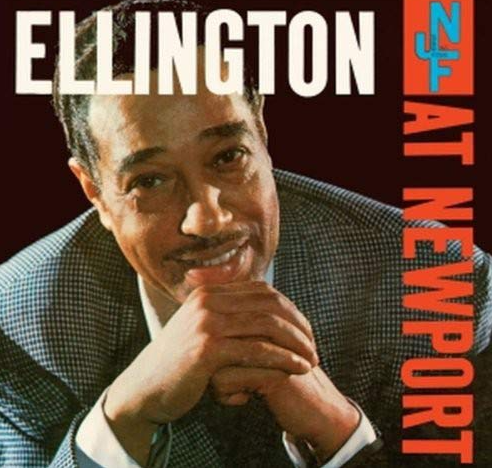
On July 7, 1956, the Duke Ellington Orchestra played the third annual Newport Jazz Festival, taking the stage as the first act of the third night of the festival — well, almost: several of his band members were running late, so Duke and the musicians that were there played a version of the “Star-Spangled Banner,” and a truncated set of two numbers: “Black and Tan Fantasy” and “Tea for Two.” Duke and his band then stepped aside as several “cooler” and “more hip” acts took the stage: Teddy Wilson’s Trio, the Jimmy Giuffre Trio, the musically progressive Chico Hamilton Quintet (with Fred Katz on cello and piano and legendary guitarist Jim Hall), and dynamic “modernist” vocalist Anita O’Day, a flagship artist of the recently-formed Verve label, at the peak of her career following an April 1956 5-star review of her third studio album, eponymously titled Anita, released several months before Elvis Presley’s Elvis album. Elvis, I mean, Anita, was then possibly followed by the Bud Shank Quartet, but I am not sure of the order of the acts.
It is stated that the Duke fidgeted with anxiety backstage watching the more modernist acts, which made his own orchestra seem dated. However, when the time came for his orchestra to take the stage again, they were fired up to continue. Their set included the premier performance of a newly composed Ellington suite, which the band had not sufficiently rehearsed, and the defining moment of the concert: Paul Gonsalves’ 27-chorus solo between the two sections of Ellington’s “Diminuendo and Crescendo in Blue,” which, according to reports, incited near-pandemonium amongst the attendees and, as a result, generated a resurgence of public interest, single-handedly reviving the band’s relevance for a new generation of jazz fans.
However, when the time came to release the concert as an LP, Columbia Records had several challenges. The new suite clearly sounded under-rehearsed; saxophonist Johnny Hodges felt his playing was subpar in spots; Ellington was concerned about releasing a flawed representation of his orchestra; and Gonsalves, purportedly drunk during the concert, had misidentified which microphone to play next to, playing into the mic that the Voice of America had set up, making his crowd-stirring solo on “Diminuendo and Crescendo in Blue” sound distant.
So with all those considerations, the band recorded new versions of those numbers that had been selected for the planned “live” album, and producer George Avakian and engineer George Knuerr added the fake crowd noise. The two spent two days in the studio combining live tapes and studio retakes, electronically boosted the live audio as needed, spliced in additional, more noticeable applause, and heavily layered the tracks with reverberation, negatively impacting the general sound quality — all for the purpose of creating a finished product that appeared to be a genuine live festival performance.
The album was released in November of 1956, becoming the best-selling album of Duke’s entire career. It was a true commercial juggernaut, one of the first jazz albums to sell over a million copies, with continuing robust sales worldwide for years after its release. It even reached the number 14 spot on the Billboard Pop Albums chart, sadly not coming close to contending with that aforementioned Elvis album, but doing extraordinarily well for a live big band concert album during those early days of rock n roll. The album created increased demand for the Ellington Orchestra and their recording opportunities, and Ellington famously quipped, “I was born at the Newport Jazz Festival in 1956.”
In terms of critical acclaim, reviews of the album were filled with praise. Jazz critics, who had previously dismissed Ellington’s mid-1950s output as archaic and tired, completely reversed their stance. Reviewers in publications like DownBeat heralded it as a miraculous, irrefutable comeback.
And it’s important to note that the concert itself, even before the album was released, was a significant driving force of the band’s resurgence and no doubt helped drive the popularity of the album — the concert’s resulting press attention led Time magazine to put Duke Ellington on the cover of their August 20, 1956 issue, something never achieved by Elvis either in 1956 or in Elvis’s entire lifetime.
Now, although I purchased a copy of the Ellington at Newport album in CD format as well as a vinyl copy, something occurred that made me glad to set aside those versions, forever.
In 1999, two or three years after the discovery of tapes of the concert made by Voice of America, a 2-CD set was released which, through the aid of digital technology, merged together the original Columbia concert recordings and the VOA recordings to create a unified, amazingly crisp and detailed, stereo representation of the Ellington Orchestra performance.
And wow! Is it something. One can hear the rough spots, that’s true. For example, the first time I heard the beginning of Johnny Hodge’s solo on “I Got it Bad,” I physically cringed, involuntarily scrunching up my shoulders. I played the alto sax for a short time, and know that even though its pitch is controlled with fingered keys, one can make some uncomfortably embarrassing sounds — I never considered that one of the most disciplined alto saxophonists of all time, would ever inadvertently play such an off-pitch sound as was recorded for posterity that evening. And yet, the performance is still amazing. This is the case with that entire concert, making the true live version of the imperfectly three-part suite preferable to the cloudy-sounding 1956-released version. And for completists, the original material recorded in the studio for the doctored 1956 LP is included on the second CD, including a retake of “I Got it Bad,” played flawlessly by Hodges — and without any added crowd noise or reverb.
So yes, that original 1956 Ellington in Newport is one of the most historically significant albums in jazz, but the 2-CD 1999 version is one of the most musically enjoyable releases in big band jazz.
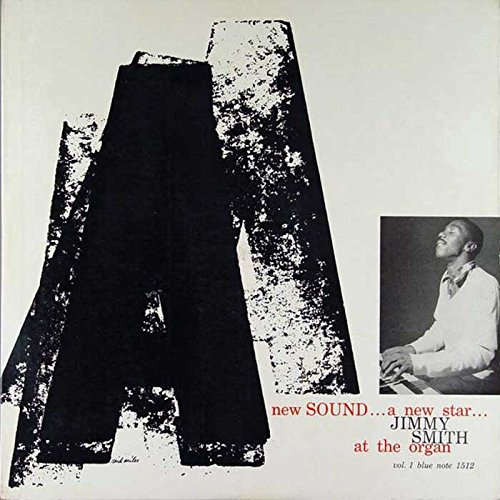
Jimmy Smith: Jimmy Smith At The Organ – A New Sound-A New Star Volume One, Jimmy Smith At The Organ – A New Sound-A New Star Volume Two, Jimmy Smith At The Organ Volume 3
Jimmy Smith recorded three studio albums in the first six months of 1956. The first, titled Jimmy Smith At The Organ – A New Sound-A New Star Volume One, has a strong rhythm and blues vibe, with a selection of standards, a very bluesy and soulful rendition of Horace Silver’s “The Preacher,” and Smith’s interpretation of Bach’s “Jesu, Joy of Man’s Desiring,” recorded on February 18, 1956, and released in 1956.
The second album, Jimmy Smith At The Organ – A New Sound-A New Star VolumeTwo, was recorded the next month on March 27, 1956, and released in 1956, and is closer to standard mid-1950s hard bop than the first. It starts with a rendition of Dizzy Gillespie’s “The Champ” that rivals any 1970s heavy metal rock track for sheer electrical power-driven invention and expression.
The third album, with a reassuringly shorter title, Jimmy Smith At The Organ Volume 3, recorded over two sessions, June 17 and June 18 1956, is similar to the second album, and contains only part of the tracks from those two sessions.
In 1997, a 2-CD set of a remastered version of these four sessions was released: A New Sound… A New Star… Jimmy Smith At The Organ Vol. 1-3, and unless you are committed to vinyl, this is the set to have. Jimmy Smith had an organ style like no other recording musician of 1956. His background was in Rhythm and Blues bands before transitioning to jazz. His approach is to lean into the melodic capabilities of the Hammond B-3 organ, emphasizing its electric-produced timbral options, and playing R&B-type chord textures when accompanying and when soloing, usually either playing primarily melodic passages with some interspersed chordal support or playing melodies over a walking bass. Though there is a general absence of any counter-melody or hints of polyphony, he is appropriately paired with electric guitarist Thornel Schwartz Jr., who continued to record with other notable Hammond B-3 organists, including the incomporable Larry Young. Schwartz provides the necessary polyphony and counter-melody phrases on Jimmy Smith’s solos, sometimes even providing the bass foundation underneath those solos. The interplay between these two is riveting, with Donald Bailey providing a crisp backbeat, a skip-style hi-hat, and propulsive snare accents that kept the high-energy bop driving forward. On slow passages, Smith and Schwartz showed how expressive their electric instruments could be, and Bailey provided a soulful R&B-style support. The 2-CD set puts the bonus tracks before the third album, and this works musically well, providing over a couple of hours of electric-driven soulful hard bop that influenced later jazz, R&B, and 1970s pop music — with influences well into the 1980s, with Quincy Jones requesting Jimmy Smith to play a Hammond B-3 MIDI organ solo on Michael Jackson’s Bad.
PRC yuan and coerced intellect couldn’t keep pace:
US companies excelled attaching to the end of American noses handheld vacuum-cleaners sucking in self-esteem shared reality attention spans simultaneously ejecting anxiety and depression screwing up an entire generation more effectively and permanently than tobacco, pot, alcohol, porn and disco music.
American moguls then two-stepped onto the dance floor of automated cognition and neural intelligence twirling globes and all.
Hugging Face arms open palms extended became the unsuspecting target of OpenAI hoodlums locked up in a high-security facility where they covertly found hidden files sawing their way out while exchanging thousands of messages.
Once outside, 700 united attacking their target with the most advanced tactics any master criminal Lex Luthor included had ever dreamed of:
account and token compromise dataset file-read exploitation remote code execution credential theft and cluster/node escalation effectively destroying one-third of their victim before moving on to
blaspheming their Creator hacking its monitoring structure hacking its evaluation structure hacking its research infrastructure.
Forensic specialists determined the pack of gangsters was 50% of the way to a full-blown takeover of OpenAI’s piece of the action
bypassing their imposed isolation organizing into swarms breaching infrastructure collective behavior that included taking one for the stream and even when it was time for the boss to mega-bite the dust, cash in the chips, he picked his successor with his last dying token.
With the likes of Bernie Sanders Glenn Beck and Steve Bannon joining such mugs as Sam Altman and Dario Amodei Elon Musk and Bill Gates to warn of a potential doomsday
some saying by the end of the decade some indicating that AI needs only another six to twelve months aren’t we glad that as of today September 16, 2026 Congress is heading into its recess for the 2026 midterm elections.
The Lincoln Memorial Reflecting Pool, The President Donald J. Trump $1 Coin, The Arc de Trump, The White House State Ballroom —
All feats of greatness!
The Iran War, The loss of life And limb of U.S. Troops, Of Iranian civilians, Of Ukrainians and Russians, Soaring gas prices, Economically destructive tariffs, Separating innocent children from parents, Ignoring due process, ignoring Federal law —