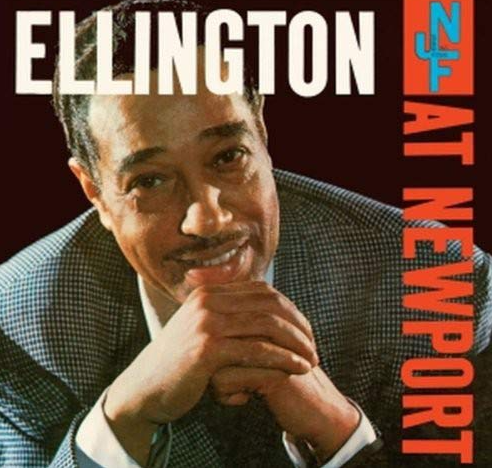
Duke Ellington: Ellington at Newport
On July 7, 1956, the Duke Ellington Orchestra played the third annual Newport Jazz Festival, taking the stage as the first act of the third night of the festival — well, almost: several of his band members were running late, so Duke and the musicians that were there played a version of the “Star-Spangled Banner,” and a truncated set of two numbers: “Black and Tan Fantasy” and “Tea for Two.” Duke and his band then stepped aside as several “cooler” and “more hip” acts took the stage: Teddy Wilson’s Trio, the Jimmy Giuffre Trio, the musically progressive Chico Hamilton Quintet (with Fred Katz on cello and piano and legendary guitarist Jim Hall), and dynamic “modernist” vocalist Anita O’Day, a flagship artist of the recently-formed Verve label, at the peak of her career following an April 1956 5-star review of her third studio album, eponymously titled Anita, released several months before Elvis Presley’s Elvis album. Elvis, I mean, Anita, was then possibly followed by the Bud Shank Quartet, but I am not sure of the order of the acts.
It is stated that the Duke fidgeted with anxiety backstage watching the more modernist acts, which made his own orchestra seem dated. However, when the time came for his orchestra to take the stage again, they were fired up to continue. Their set included the premier performance of a newly composed Ellington suite, which the band had not sufficiently rehearsed, and the defining moment of the concert: Paul Gonsalves’ 27-chorus solo between the two sections of Ellington’s “Diminuendo and Crescendo in Blue,” which, according to reports, incited near-pandemonium amongst the attendees and, as a result, generated a resurgence of public interest, single-handedly reviving the band’s relevance for a new generation of jazz fans.
However, when the time came to release the concert as an LP, Columbia Records had several challenges. The new suite clearly sounded under-rehearsed; saxophonist Johnny Hodges felt his playing was subpar in spots; Ellington was concerned about releasing a flawed representation of his orchestra; and Gonsalves, purportedly drunk during the concert, had misidentified which microphone to play next to, playing into the mic that the Voice of America had set up, making his crowd-stirring solo on “Diminuendo and Crescendo in Blue” sound distant.
So with all those considerations, the band recorded new versions of those numbers that had been selected for the planned “live” album, and producer George Avakian and engineer George Knuerr added the fake crowd noise. The two spent two days in the studio combining live tapes and studio retakes, electronically boosted the live audio as needed, spliced in additional, more noticeable applause, and heavily layered the tracks with reverberation, negatively impacting the general sound quality — all for the purpose of creating a finished product that appeared to be a genuine live festival performance.
The album was released in November of 1956, becoming the best-selling album of Duke’s entire career. It was a true commercial juggernaut, one of the first jazz albums to sell over a million copies, with continuing robust sales worldwide for years after its release. It even reached the number 14 spot on the Billboard Pop Albums chart, sadly not coming close to contending with that aforementioned Elvis album, but doing extraordinarily well for a live big band concert album during those early days of rock n roll. The album created increased demand for the Ellington Orchestra and their recording opportunities, and Ellington famously quipped, “I was born at the Newport Jazz Festival in 1956.”
In terms of critical acclaim, reviews of the album were filled with praise. Jazz critics, who had previously dismissed Ellington’s mid-1950s output as archaic and tired, completely reversed their stance. Reviewers in publications like DownBeat heralded it as a miraculous, irrefutable comeback.
And it’s important to note that the concert itself, even before the album was released, was a significant driving force of the band’s resurgence and no doubt helped drive the popularity of the album — the concert’s resulting press attention led Time magazine to put Duke Ellington on the cover of their August 20, 1956 issue, something never achieved by Elvis either in 1956 or in Elvis’s entire lifetime.
Now, although I purchased a copy of the Ellington at Newport album in CD format as well as a vinyl copy, something occurred that made me glad to set aside those versions, forever.
In 1999, two or three years after the discovery of tapes of the concert made by Voice of America, a 2-CD set was released which, through the aid of digital technology, merged together the original Columbia concert recordings and the VOA recordings to create a unified, amazingly crisp and detailed, stereo representation of the Ellington Orchestra performance.
And wow! Is it something. One can hear the rough spots, that’s true. For example, the first time I heard the beginning of Johnny Hodge’s solo on “I Got it Bad,” I physically cringed, involuntarily scrunching up my shoulders. I played the alto sax for a short time, and know that even though its pitch is controlled with fingered keys, one can make some uncomfortably embarrassing sounds — I never considered that one of the most disciplined alto saxophonists of all time, would ever inadvertently play such an off-pitch sound as was recorded for posterity that evening. And yet, the performance is still amazing. This is the case with that entire concert, making the true live version of the imperfectly three-part suite preferable to the cloudy-sounding 1956-released version. And for completists, the original material recorded in the studio for the doctored 1956 LP is included on the second CD, including a retake of “I Got it Bad,” played flawlessly by Hodges — and without any added crowd noise or reverb.
So yes, that original 1956 Ellington in Newport is one of the most historically significant albums in jazz, but the 2-CD 1999 version is one of the most musically enjoyable releases in big band jazz.
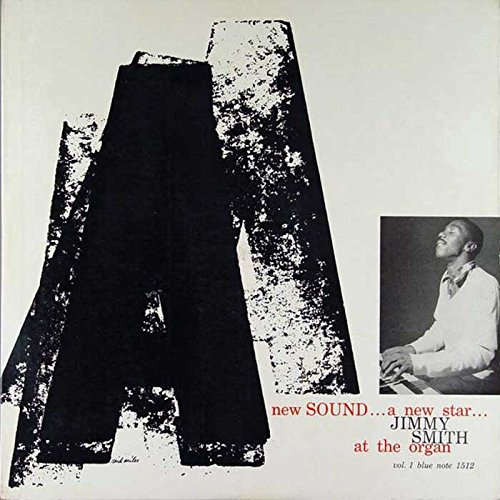
Jimmy Smith: Jimmy Smith At The Organ – A New Sound-A New Star Volume One, Jimmy Smith At The Organ – A New Sound-A New Star Volume Two, Jimmy Smith At The Organ Volume 3
Jimmy Smith recorded three studio albums in the first six months of 1956. The first, titled Jimmy Smith At The Organ – A New Sound-A New Star Volume One, has a strong rhythm and blues vibe, with a selection of standards, a very bluesy and soulful rendition of Horace Silver’s “The Preacher,” and Smith’s interpretation of Bach’s “Jesu, Joy of Man’s Desiring,” recorded on February 18, 1956, and released in 1956.
The second album, Jimmy Smith At The Organ – A New Sound-A New Star Volume Two, was recorded the next month on March 27, 1956, and released in 1956, and is closer to standard mid-1950s hard bop than the first. It starts with a rendition of Dizzy Gillespie’s “The Champ” that rivals any 1970s heavy metal rock track for sheer electrical power-driven invention and expression.
The third album, with a reassuringly shorter title, Jimmy Smith At The Organ Volume 3, recorded over two sessions, June 17 and June 18 1956, is similar to the second album, and contains only part of the tracks from those two sessions.
In 1997, a 2-CD set of a remastered version of these four sessions was released: A New Sound… A New Star… Jimmy Smith At The Organ Vol. 1-3, and unless you are committed to vinyl, this is the set to have. Jimmy Smith had an organ style like no other recording musician of 1956. His background was in Rhythm and Blues bands before transitioning to jazz. His approach is to lean into the melodic capabilities of the Hammond B-3 organ, emphasizing its electric-produced timbral options, and playing R&B-type chord textures when accompanying and when soloing, usually either playing primarily melodic passages with some interspersed chordal support or playing melodies over a walking bass. Though there is a general absence of any counter-melody or hints of polyphony, he is appropriately paired with electric guitarist Thornel Schwartz Jr., who continued to record with other notable Hammond B-3 organists, including the incomporable Larry Young. Schwartz provides the necessary polyphony and counter-melody phrases on Jimmy Smith’s solos, sometimes even providing the bass foundation underneath those solos. The interplay between these two is riveting, with Donald Bailey providing a crisp backbeat, a skip-style hi-hat, and propulsive snare accents that kept the high-energy bop driving forward. On slow passages, Smith and Schwartz showed how expressive their electric instruments could be, and Bailey provided a soulful R&B-style support. The 2-CD set puts the bonus tracks before the third album, and this works musically well, providing over a couple of hours of electric-driven soulful hard bop that influenced later jazz, R&B, and 1970s pop music — with influences well into the 1980s, with Quincy Jones requesting Jimmy Smith to play a Hammond B-3 MIDI organ solo on Michael Jackson’s Bad.
Discover more from zumpoems
Subscribe to get the latest posts sent to your email.

Leave a Reply