As noted in previous posts, there are plenty of great poetry sites out there to browse, get ideas from, or submit your own material to: https://zumpoems.com/2025/10/14/poetry-publications/ I have also mentioned Chill Subs and Duotrope as easy-to-use resources to discover poetry journals.
I want to call out one site I have not mentioned previously — great for browsing, sparking creative ideas for your own poems, and submitting poems that would be thoughtfully reviewed and not automatically rejected because they don’t align with current MFA biases. This site effectively curates material to provide a good dose of optimism, focusing on “exploring themes of joy, healing, and the sacred in everyday life.” The editor of the site has been voted one of the top ten editors by users of Chill Subs: https://www.chillsubs.com/lists/great-editors-2025, and Duotrope has also featured an interview with this editor: https://duotrope.com/interview/editor/38154/feed-the-holy. The editor also has other duties (editor of Masticadores USA), which she excels at.
Another site that focuses on positive poetry and accepts reprints and blog posts is Euonia Review founded and edited by Ian Chung: https://eunoiareview.wordpress.com/
For those that write in or love to read contemporary formal verse, I highly recommend The Society of Classical Poetswhose chief editor is Evan Mantyk
Still another website that accepts blog posts and reprints is Edge of Humanity Magazine: https://edgeofhumanity.com/ Editor and curator extraordinaire Joelcy Kay takes this one step further and uses this journal to promote individual contributors’ websites. All of these sites include a link to your website (what is termed backlinks and which help visibility of your site in search engine and AI queries), but Edge of Humanity includes other information that will help drive traffic to your website, including listing published books and additional website links.
I also want to mention an example of Light Verse with substance, Celeste DeSario’s latest poem at New Verse News: https://thenewversenews.substack.com/p/nvn-monday-im-sorry-dave-im-afraid. This piece digs deep into the essence of the risk of AI — risk not driven by ill intent, or any other emotion, but by just executing an objective and sometimes inadvertently becoming a “math equation gone wild.”
I have previously mentioned New Verse News multiple times here, but glad to mention it again — it’s a great journal for poets of all backgrounds and poetic preferences to submit their work, knowing it will be judged on merit and not because it strictly follows any particular style favored or expected by the editor. James Penha is the New Verse News editor and, as is the case with each of the editors mentioned earlier, deserves high praise for his selection of material and for providing readers an engaging reading experience; also, as is the case with the other editors mentioned, he will welcome your submissions with the respect and consideration they deserve.
If you could have any writer/artist, living or dead, as a mentor, who would you choose? I was mentored by John Cage , briefly. It would be nice to bring him back for additional conversations.
Is there a specific period of history whose art or writing you admire? Why? Yes, twentieth century music, particularly between 1909 and 1929 and 1944 and 1955 including Thelonious Monk, Charlie Parker, Charles Ives, Igor Stravinksy and Béla Bartók.
Is there one part of your creation process that’s harder for you? The first part is always harder than the second part, with the second part of the first part being slightly easier than the first part of the second part.
Talk about the moment you knew you wanted to be a creator. It was when I found out the impression a box of crayons could make on an empty wall. I soon learned that creativity had consequences and that my take on creativity wasn’t always appreciated.
Do you have a piece that you created early in your career that makes you cringe? Will you ever go back and fix it so it can be submitted somewhere? No actual cringing: each piece has its own context. Spontaneity is often replaced with craft, and both are to be valued. In terms of “fixing” an earlier piece, I sometimes revise them, but I don’t think of the previous version as broken — it just no longer aligns with my current aesthetics or intentions.
What is your biggest creative doubt? How to answer interview questions.
What piece of creative advice have you received that sounded good, but was ultimately not useful to you? As a child, I struggled to get a D minus in penmanship. I was instructed to “write within the lines.” This advice initially seemed appropriate, but I later learned that, if there is no grade involved, it is sometimes advantageous to cross the lines.
You’re stranded on a desert island – what three creative tools do you want with you? My first request would be a working cellular phone. If that did not qualify as a creative tool, I would opt for a helicopter and a pilot.
There’s often a bittersweet undercurrent that is present when listening to great music composed or performed by an artist who died before reaching their forties. Every time I listen to a Jimi Hendrix recording, my enjoyment is always accompanied by the thought of what a tragedy it is that he didn’t live longer.
Most Americans seem aware that Mozart died at a young age: 35. Yes, part of this is due to the popularity of the movie Amadeus. Europeans are generally more aware of 18th and 19th century composers than Americans, but even if Amadeus had never been released, most Americans would know the names of Bach, Beethoven, and Mozart.
A smaller percentage of Americans know who Franz Schubert is, and some who are familiar with his name know it from his “Ave Maria,” which gets played quite a bit during the Christmas season, even today. There are not so many who have heard a full Schubert symphony or can tell you that he composed hundreds of songs, seven completed symphonies, three unfinished symphonies, some amazing string quartets, and a stunningly stylistically diverse range of piano music and piano sonatas before dying at the age of 31. It’s nearly impossible for me to listen to his music without reflecting (perhaps when cueing it up or immediately after its completion) on how tragic his early death was, or wondering what masterpieces would have been available for us if he had lived another thirty or forty years — or even another four years — living at least as long as Mozart. And then sometimes I consider how badly decimated the output of Bach, Beethoven, Brahms or even Mozart would have been if they had not made it to their 32nd birthday. We would still have all but two of Mozart’s 41 or so symphonies, but we would not have his last three, including the great Jupiter symphony, his Requiem, several of his best piano concertos and string quartets, or his four most important and beloved operas. Sadly, if all composers had died at the age of 31, Schubert would be considered the greatest of them all. Fortunately, the great majority lived past 31. That may explain why most Americans have such little knowledge of Schubert — but I suspect it’s just more accurate to assert that most Americans have little knowledge of music prior to the era of the Beatles.
If you approach the average person and ask what they think of the jazz trumpeter Booker Little’s career, and how it might have been different if he had lived a few decades longer, you will just get a blank stare. And even if Booker Little had continued making jazz music until his eighties, most Americans would not recognize his name simply because there is a general ignorance of America’s greatest musical legacy, the canon of recorded jazz music.
So I have to keep that in mind when I consider the magnitude of the loss to music of Clifford Brown at the age of 25, and to a lesser extent, Bud Powell’s younger brother, Richie, a talented pianist, composer and arranger, at the age of 24, both killed as passengers in a car accident when Richie’s 19 year old wife lost control of Clifford Brown’s car late at night on a badly rain-slicked Pennsylvania Turnpike during heavy rain and limited visibility. Neither alcohol nor drug usage was involved; Brown was one of the most notable drug-free players of the 1950s.
The accident occurred during the earliest hours of June 26, 1956. Clifford Brown recorded on two studio albums in 1956, each released in 1956.
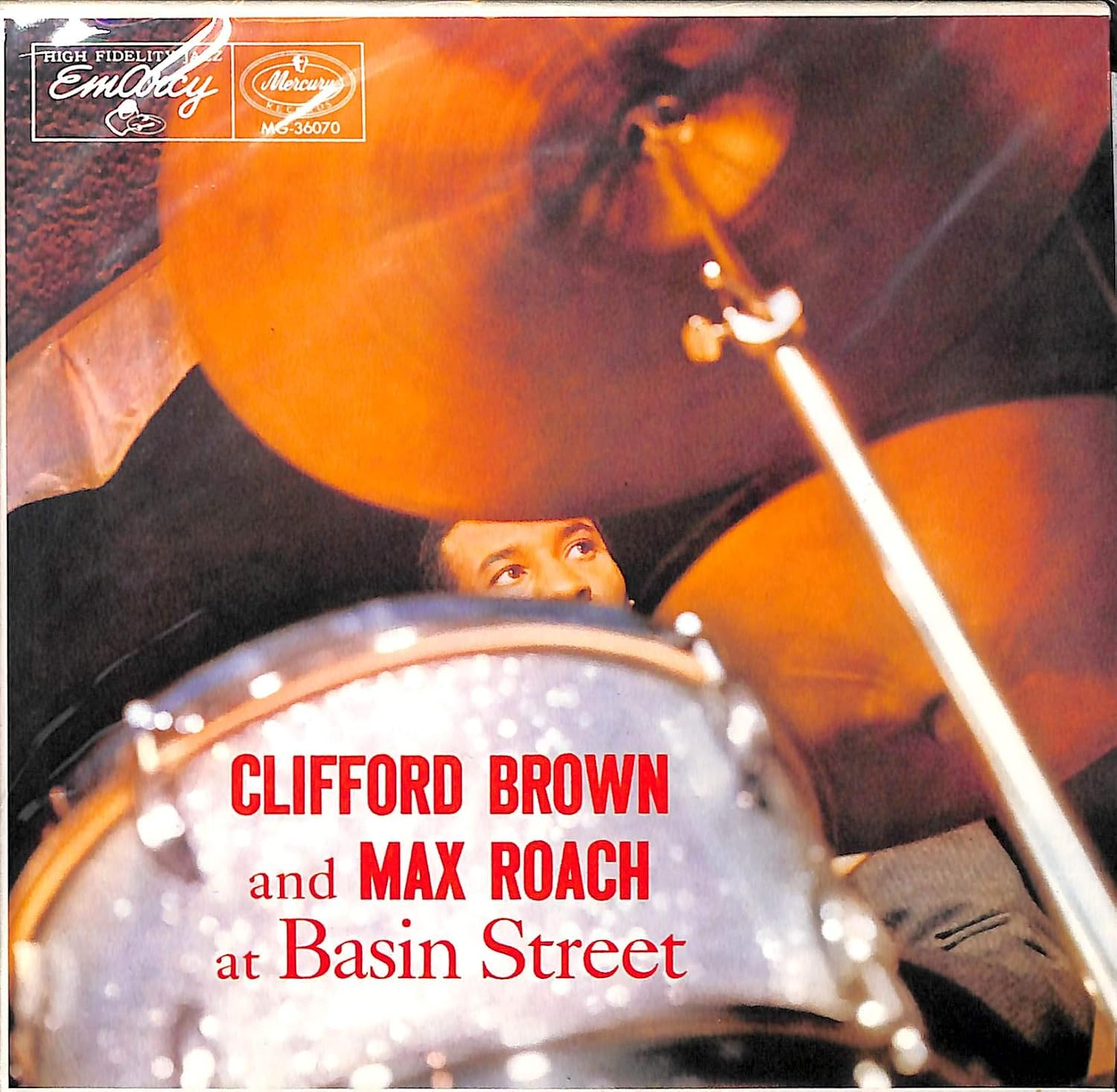
Clifford Brown and Max Roach: Clifford Brown and Max Roach at Basin Street
The first album I will cover, Clifford Brown’s last album as a leader, was recorded in January and February of 1956, and it is one of the finest hard bop albums of all time: Clifford Brown and Max Roach at Basin Street. Please note that although the title may imply a live recording, this is a studio album recorded in New York City at Capitol Studios.
The album opens with a four-bar Max Roach solo on drums as part of Richie Powell’s 64-bar introductory arrangement for Cole Porter’s “What Is This Thing Called Love?“, followed by an incredibly intense solo by Clifford Brown, followed by a similarly focused solo by Rollins. Now, in some of the recordings I have, Sonny Rollins comes off as remarkably relaxed and melodic, but here we have a very riveting hard-bop statement. This is followed by Powell’s piano solo, more introspective initially, but developing to fit the mood. George Morrow then has his solo, followed by an arranged ensemble section and a Max Roach solo. It’s important to mention how Max Roach stood out from most of his contemporary drummers, first in the forties, and as he developed in the 1950s. He didn’t just support the ensemble and soloists or keep the beat; he intertwined with the ensemble and soloists, often altering the micro-elements of the beat while not disrupting the rhythmic flow. His solos were more than a technical display but a musical narrative, interesting not as just perfunctory or an obligatory contrast with the melody-instrument soloists but as equal engagement with the overall musical effect. The solo here doesn’t break the flow but is both musically intriguing and nicely sets up the alternating exchanges between Clifford Brown and Sonny Rollins that lead into the outro or arranged finish, which mimics the introduction, including the brief Max Roach solo. The engineer fades the track out, which a purist may find objectionable, but which works quite effectively.
Now, both the CD reissue of this and the Complete 11 CD Clifford Brown EmArcy box set provide some alternate takes for this album, with the 11 CD set providing a full alternate take that is even better than the take used for the original album. One can hear some notable differences, including the opening intro where George Morrow plays the last two odd beats of Roach’s solo. Seems to me the Brown solo is more unrestrained and expressive, and the Rollins solo more exploratory and relaxed, with the main benefit being we have two different versions, both exceptional.
The EmArcy box set also gives us two remarkable versions of “Love Is a Many-Splendored Thing” and “I’ll Remember April.” Once again, the arranged sections are sharp and effective, with the soloing focused and urgent on “Love Is a Many-Splendored Thing.” The album contains three compositions by pianist Richie Powell, with “Powell’s Prances” being an exhilarating hard bop number proving an effective fast-paced vehicle for both Brown and Rollins, with a strong solo by Powell and Max Roach providing energetic support and a propulsive thirty-five-second solo. The album includes an additional piece by Tadd Dameron, and the EmArcy box set includes two additional tracks from the January/Februrary sessions.
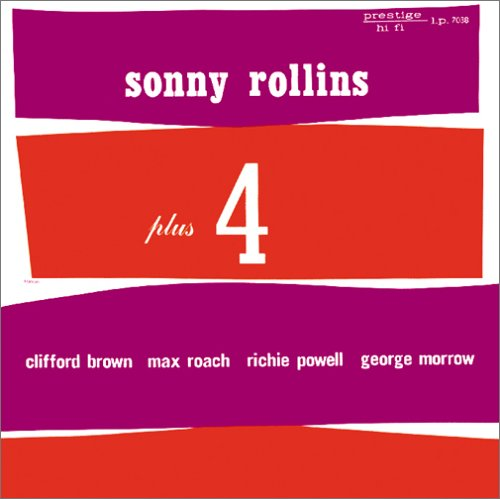
Sonny Rollins: Sonny Rollins Plus Four
Rollins, a part of the Clifford Brown, Max Roach Quintet since November 1955, joining shortly after his break from jazz due to a period of drug rehab, such as it was in late 1954 and 1955, recorded for Prestige as a leader starting in 1951 through November 1956. In exchange for Rollins playing with Clifford Brown and Max Roach for the EmArcy label, EmArcy agreed to allow Brown, Roach, Powell, and Morrow to join Rollins for this Prestige recording, Sonny Rollins Plus Four, recorded in March 1956, and released in August 1956, a couple of months after the fatal Brown/Powell crash.
The album starts with a Rollins composition, a 3/4 jazz tune appropriately named “Valse Hot. Rollins has the first solo, relaxed and melodic. Brown’s solo is effortlessly engaging and lyrical. Powell and Roach both make fine contributions. The session seems more ad hoc, and I suspect the arrangements were a product of the rehearsal process rather than being formally written out by Powell.
Of the remaining numbers, each contains strong solo work and is a treat to listen to. “Count Your Blessings” is a beautiful ballad, showcasing Rollins’ lush, rounded, romantic tone with Brown sitting out. The album ends with the lively Rollins tune “Pent-Up House” with Clifford Brown taking the initial solo, wowing us as always with his ability to craft a composition in mid-flight, starting with stark, economical phrases, and then developing the material as if retelling a condensed plot of a short story. Rollins seems sensitive to the mood and provides a similarly narrative solo. Again, Powell provides a solid piano solo, and Max Roach’s solo provides an effective transition to the recapitulation of the theme.
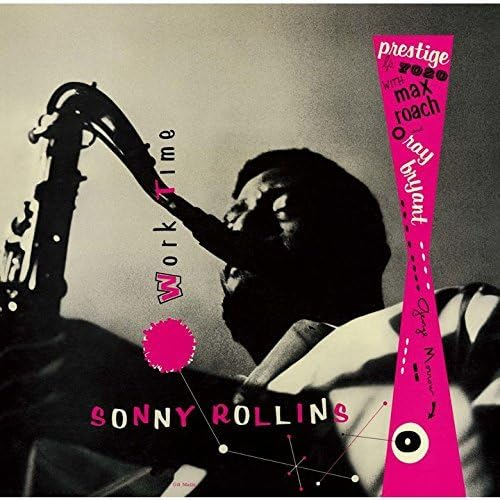
Sonny Rollins: Work Time
Prestige released two other Sonny Rollins albums in 1956. The first was Work Time, recorded in December 1955, and released sometime in 1956. I love this album! Rollins’ “Paradox,” the second track, is one of those memorable hard-bop originals — not derived from some previous classic, but fresh and clever, including its Latin rhythmic sensibility, disrupted, or rather infused, with Rollins’ sparkling use of accents and the tense, shifting quality of its melodic material. I am a big fan of Billy Strayhorn’s “Raincheck,” so it’s a real treat to get this driving hard-bop rendition of it, which includes a relentlessly swinging Rollins solo and an invigorating Max Roach solo.
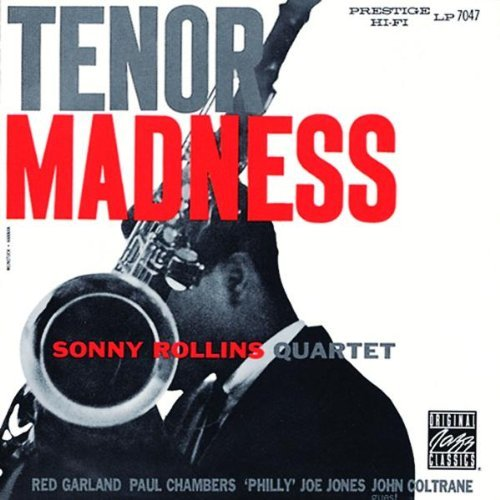
Recorded in May 1956 and released in October 1956, I own one of those audiophile repressings of this, and it’s really tempting to get it out to just listen to the first track, the only recording of Sonny Rollins and John Coltrane playing together; however, the rest of the album is pretty strong.
There’s been a lot written about this first track, so I’ll try to be brief. It’s unusual to have two soloists of the same instrument recording together in a quintet, and it was happenstance that we have this. Coltrane was on the Prestige label, playing with Miles Davis and the exact same rhythm section Rollins was using for his session, and for some reason was in the studio with his tenor saxophone. Rollins, a close friend of Coltrane, didn’t hesitate to encourage him to sit in. Of course, whatever tune they picked to record would have to be a piece Coltrane knew the changes to, and for optimal improvisational ease, it made sense for it to be a blues-based tune. Not sure how they arrived at the selection, but they chose Kenny Clarke’s and Fats Navarro’s 12-bar blues “Royal Roost,” renaming it, appropriately for the session, “Tenor Madness.” Well, the recording was a critical success, with Coltrane and Rollins having both the advantage of long, extended solos in the first few minutes, and then, after a piano solo from Red Garland and a bass solo from Paul Chambers over a minute of exciting four-bar interchanges, followed by some more soloing and then a dozen more choruses of alternating exchanges.
This makes the rest of the album seem a bit anticlimatic, but as mentioned, it’s worth continuing on with, even if one chooses to take a break, sample some more Coltrane, or play Tenor Madness a second time before continuing on. Particularly notable is the contemplative rendition of “When Your Lover Has Gone” and Larry Clinton’s reworking of Debussy’s “My Reverie,” one of those pieces that goes perfectly with a crackling fire in the fireplace, if you happen to have a house that actually has a fireplace.
Track listing All tracks by Sonny Rollins except where noted.[7]
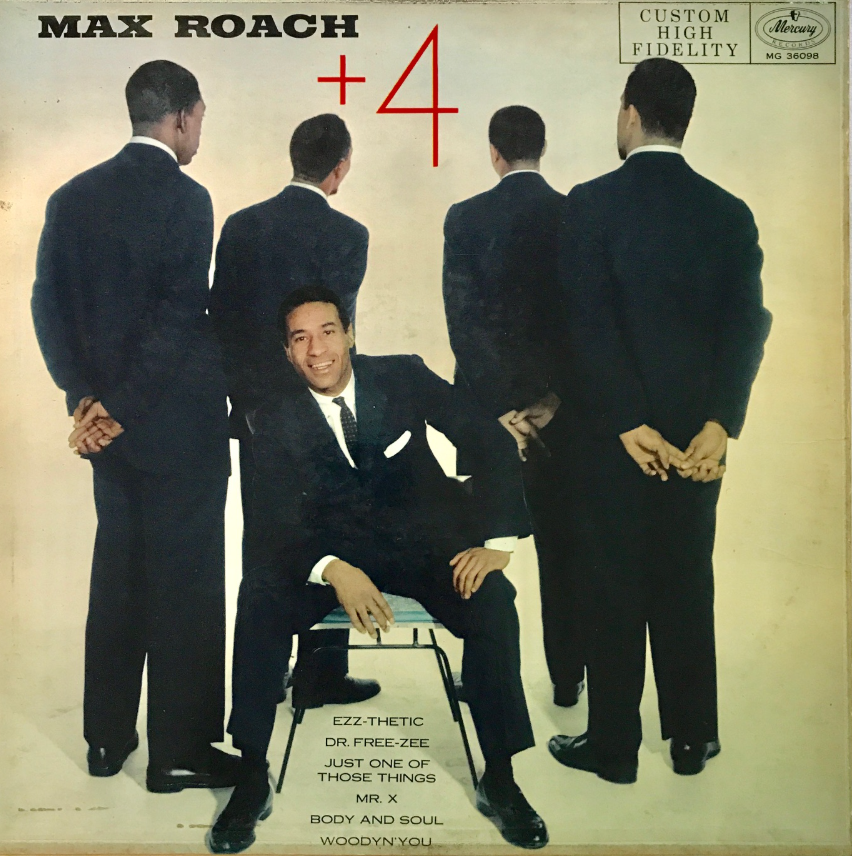
Recorded in September 1956 and released the next month, this is an energetic, exciting album, filled with choice tunes and wonderful improvisation. We hear a lively Sonny Rollins on the first track, George Russell’s Ezz-Thetic, making the most of the opportunity, reminding me of the free-wheeling John Coltrane at times as he effortlessly slides through sequences of notes. His solo is followed by a breathy but equally breathless Kenny Dorham solo. Ray Bryant provides top-notch piano throughout the album, and his solo here navigates the tricky chord changes of Ezz-Thetic (based on “Love for Sale”) effortlessly. There are some trading fours (Rollins, Dorham, and Roach alternating four-bar solos) and then Roach and the duo of Rollins and Dorham alternating, this giving way to a tension-driven Roach drum solo, one of the many highlights of the album.
The much briefer “Dr. Free-Zee” showcases Max Roach’s versatility and creativity by overdubbing his timpani lines over the initial recording of the ensemble where Roach is on his standard drum kit. Side One concludes with Cole Porter’s “Just One of Those Things.” I love how Max Roach is featured in the short intro before the exposition of the melody. Rollins is off to the races, again eliding notes and creating drama through his extraordinary control of note placement and emphasis. Dorham’s solo is breathy, agile, and lightning fast. Again, Bryant holds his own, and Max Roach provides an amazing drum solo.
Side Two opens with Roach’s “Mr. X. which includes a strong solo by Rollins, Dorham and Bryant maintaining the energy and mood, some exciting trading fours and a great drum solo by Roach over Bryant’s piano accompaniment. This is followed by “Body and Soul” — I am incapable of hearing any instrumental version of “Body and Soul” without instinctively reflecting on Coleman Hawkins’ historic 1939 recording. Rollins plays beautifully here with some gorgeous low-register legato, and Bryant and Morrow support Dorham’s reflective solo perfectly. There is no drum solo, an appropriate decision.
The album concludes with Dizzy Gillespie’s early bebop tune “Woody ‘n You”, written in 1942, and originally written for Woody Herman and his Orchestra, but first recorded by Coleman Hawkins with Gillespie, Roach and Oscar Pettiford. Dorham provides a particularly inspiring solo here, and there is some incandescent interplay between Rollins and Dorham after a second solo by Rollins. Bryant solos before an apparent recap, which unexpectedly gives way to an engaging Max Roach percussion solo with the theme resolutely returning, followed by brief Rollins and Dorham exchanges concluding one of Max Roach’s finest albums.
Track Listing All compositions by Max Roach except as indicated
I have a list of over 4,000 journals that publish poetry: some do so online, some in print, some do both. As noted in last week’s Thoughtful Thursday column, I enjoy checking out both poetry blogs and poetry sites to read new work. Sometimes these poems fall short of expectations; sometimes they are well worth the effort of hunting them down.
Today, I randomly picked entry 1613 in my poetry list, a journal named Poemeleon. I knew I was in for a treat reading the description of their content: “Quirky/Humorous/Lyric” and “Playful/Lyrical work.” This sounds great, I thought. As readers of this blog know, I am a fan of Zumwalt’s poetry — which generally is more disruptive or snide than lyrical, but is often quirky, humorous, or playful. I am also a fan of Louise Glück for the lyricism, emotional depth, and overall precision of her writing. And she can also be disruptive and humorous, as in her poem Anniversary. I can say the same about Kenneth Koch — precise control, sometimes lyrical, sometimes disruptive, often playful, clever and/or humorous. Well, there are thousands, maybe tens of thousands of such poets, and I clicked on the Poemeloen link to discover some of the lesser-known such poets.
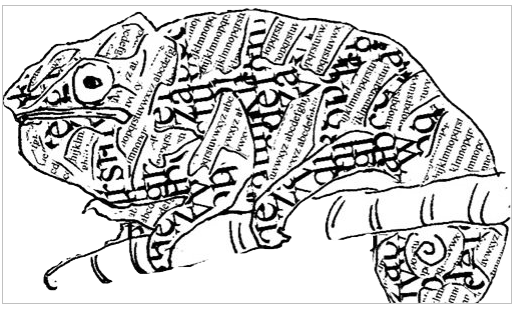
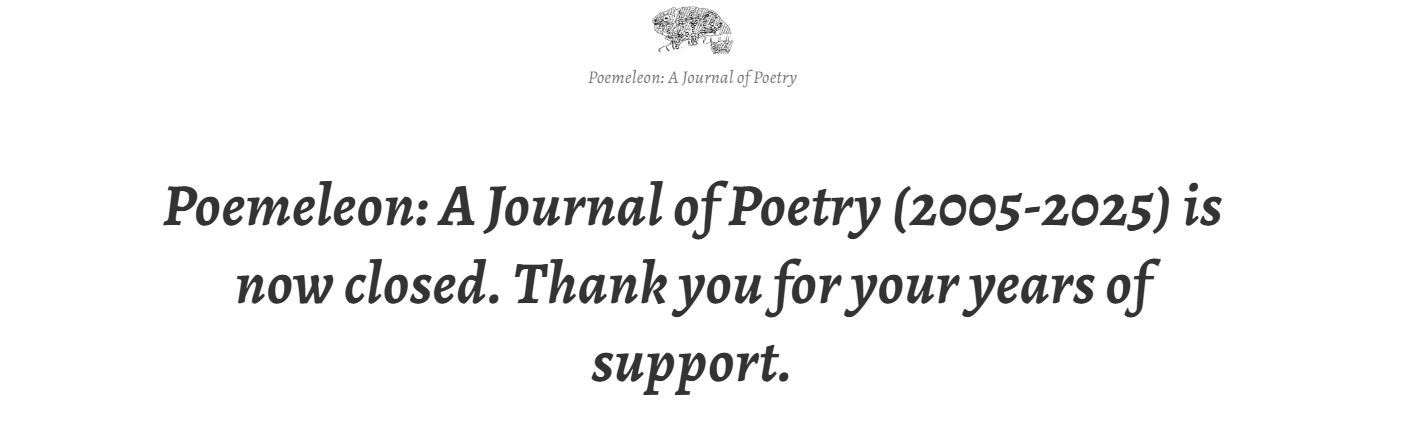
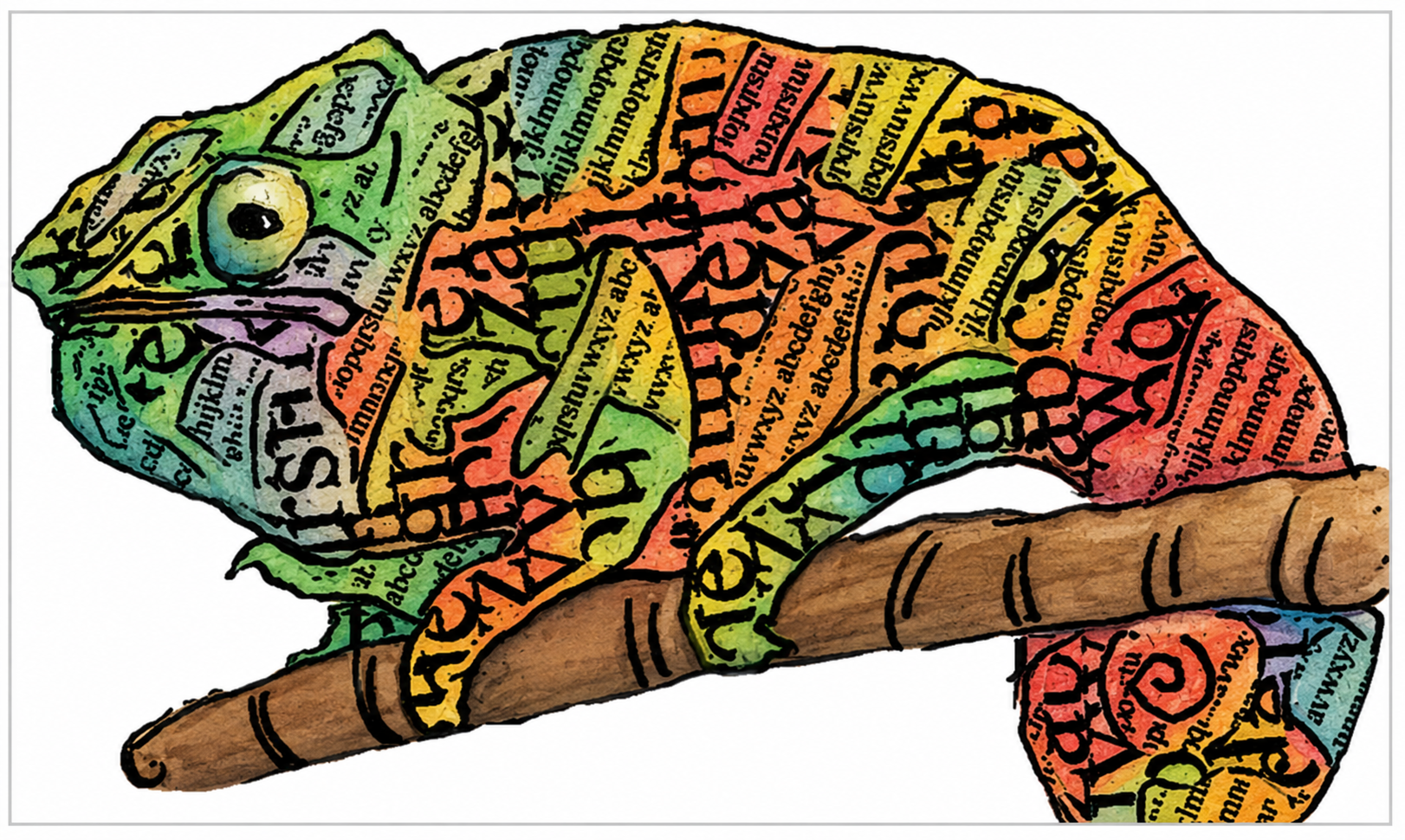
I would like to say that when I first landed on their home page, I was greeted with the above image — the image of the poemeloen, a distinctive and highly specialized clade of a large family of contemporary online journals that champion a diverse range of poetry. And to some degree I was, though it was much smaller. However, what immediately confronted me was the image of the “SORRY WE ARE CLOSED” sign at the top of this blog post.
Above that closed sign was this very small version of their logo and additional text:
Well, in truth, I was pretty undeserving of any thanks. I never supported this site, nor even visited it until today. And now, despite its ability to blend in (or maybe because of its ability to blend in) with its background, it is now another entry in a long list of defunct poetry journals. It could clearly show a range of colorful poetry, and vary what was displayed. But it was eventually overwhelmed by its changing environment: a world where many people have substituted clicking, reacting, and sometimes sharing (though can one really share what isn’t theirs?) for engaged reading.
However, the poems are still there! And their founder’s mission is still intact: “poemeleon seeks to make visible the invisible. By placing disparate poems alongside one another, I aim to highlight not just their contrasts, but their similarities.”
For how long, though? Eventually, the domain will be unfunded, and the poems will not be so easily accessible. I say, “not so easily,” because, thankfully, we have The Internet Archive’s Wayback Machine, which has captured content from this site and its predecessor 296 times between February 23, 2007 and April 20, 2026. Compare that to our site, zumpoems.com which has been saved 217 times between November 1, 2011 and July 8, 2026, and one can feel pretty good that as long as Internet Archive’s Wayback Machine is enabled, all the poems that the site’s editors (there were multiple: https://poemeleon.me/missionandhistory) ended up selecting from the many submissions sent to them over the years will be avaible for those willing to take the extra effort to track them down.
One day, I won’t be around to fund zumpoems.com. At that point, much of Zumwalt’s work will be lost forever — except for the captures of this site in the Internet Archive. How long will that site be around? Maybe it doesn’t matter, as eventually there will be very few people who will still have the ability to read. The poems will still be around, and they can be read out loud by our AI assistants, but will those AI readers ever understand the meaning of even the simplest or most transparent poem to provide a meaningful enough reading to engage even their most receptive user?
I have no plans to stick around to find out, but if AI extends my life long enough, I guess whatever plans I do eventually make may matter very little.
Boy, do I enjoy the act of writing! Is it about capturing thoughts in a more impermeable form than memory? Or is it about the psychological and mental benefits provided by diving deeper into one’s feelings and perspectives and articulating, whether well or poorly, those feelings and perspectives?
And I love reading. For one is exposed to another’s thoughts, feelings, and perspectives, whether it is reading an email or letter from a friend or engaging with the writing of a familiar author or a complete stranger.
I love diving into others’ WordPress blogs. All I have to do is click on the WordPress reader, and I have a selection of blogs I subscribe to or can explore blogs I have never seen before.
As a reader of poetry, I particularly enjoy exploring posts that have been tagged with “Free Verse,” “Poetry,” or “Poem.” Some are well crafted, some are wild and sprawling, but most are interesting, and many have a level of vitality that is often missing in much of the poetry in curated journals.
I could easily list a dozen WordPress poetry blogs that I enjoy visiting. Let’s just take a peek at my favorite tag: https://wordpress.com/tag/free-verse. And what do I see at the top, posted 15 minutes ago — one of my favorite blogs, Ink & rain! As I open today’s post, I first see one of those many wonderful images that appear reliably at the top of each of author Meiling Cheung‘s posts, followed by text in Chinese and English. Now I have no clue how to read Chinese, so I focus on the English column. Today’s poem is exceptional: it uses a sustained metaphor with each phase serving a specific purpose to support the author’s message. The line breaks are well handled, and the tone it sets, gentle and meditative, perfectly echoes its message. There is an overall emotional immediacy and authenticity, which further enhances the evocative and reflective nature of the work.
Besides reading WordPress poems, I visit various online poetry journals (a partial list of which is here), and so right now, let me check my email to see the latest updates.
“Only opaque backings stop mirrors being windows, and windows can be mirrors if on one side it’s bright as an interrogation room while the other’s in darkness. So think of glass as your poems, and light as reason.”
Such a simple observation, but here is the vehicle for the journey this poem takes us on. No need to be bored with my commentary — just check out the poem here: https://stickfigurepoetry.com/issue-22/#analysis-love
“there is a hole in my chest through which we drive our car
to the other side of the world to see the mountains”
With the first glance of this poem, I notice a more or less generic title, no punctuation, no capitalization, regular use of stanzas, reference to a line in Chinese, “万山载雪,明月薄之,月不能光,雪皆呆白,” which I use Google Translate to give me an approximation in English, “Snow blankets the myriad peaks, and the bright moon casts its light upon them; yet the moon cannot make them shine, and the snow remains a dull, lifeless white, ” and, with the exception of the Chinese insert, the use of an accessible, straightforward vocabulary. The work effectively mixes abstractions and images, the modern and the timeless, into a beautifully evocative poem!
I am not particularly fond of that overly common activity of ranking authors, composers, painters, etc. — each has their distinct voice (or voices) and strengths. Still, it is easy enough to make the case that America should consider itself proud to have been the birthplace and home of such a great poet as Wallace Stevens!
So I have a lot to keep me happy and engaged with a breadth of diversity and styles never available before the launch and development of the internet. Please join me in exploring blogs, poetry journals, and the works of revered poets at your own pace, taking your own individual, self-customized journeys.
My steel-wool scrubbed & Comet-clean spuds grate with injurious gusto Protect the enamel at all costs! And a sheen is added to our distended esophagus. Wintry blasts of fluoride and chlorophyll attack the waste But only further pollute the abused frame. Death enters the corridors, stalking stealthily in the Ajax-whiteness. All is blinding! There is no more gray! Josephine is become a slaughter-baron. Ammonia chokes us all
Those iron plates that churned the mud and gravel Impress me not. The rifled bore was, and is a crashing bore, I shut my eyes to the breechblock and Do not care for thermite. I recoil from venturi. I have only cutting remarks for the bayonet; C.B.W. stinks. Give me Gandhi & Walden, with a little pickle On the side, and I am content. Blood-red waiters make me yawn.
Askew in a vinyl cosmos life’s beading up on a cold tumbler And Juan Valdez has repossessed my mind for the glory of Brazil or Colombia Some squalid country at any rate Leaving my 33 grooves scarred by needles at 78 several rich hits off of Mrs. Olsen And Muzak sounds like steam jets and dark mutterings over eggs become berserk natterings of rabid chipmunks Gee Zus ! Only 12:00? Existence is deformed in a time-warp —Zumwalt [Night of 30 Sep-1 Oct 1981, Washington, DC]
On Christmas Eve, many just like me stopped at the station where I get my gas and bought slips of paper as thin as my patience waiting its reward.
A mile or so away in Cabot I closed my own store, shut down the register, reminded by the radio of the size of the jackpot while I drove home in my rusty 2003 Tacoma.
Maddie set out some sandwiches— our light Christmas Eve meal; two months of watching costs earned tomorrow’s fortune of presents paired with roasted prime rib.
That morning came, and our two children visited us in bed to tug at us— too small to pull us out and not old enough to realize they hadn’t.
A delight of flung wrapping paper and unchecked squeals energized our living room as, with some guilt, I looked at my phone to glimpse the weekly Powerball snub.
No ordinary loss: promised paradise, this time, came from the station where I staked my three bucks.
But this small defeat brought reassurance: in a world of algorithms, predictive apps, and AI advisers that steal away jobs and raise energy prices there was still one thing technology couldn’t do: choose the right numbers.