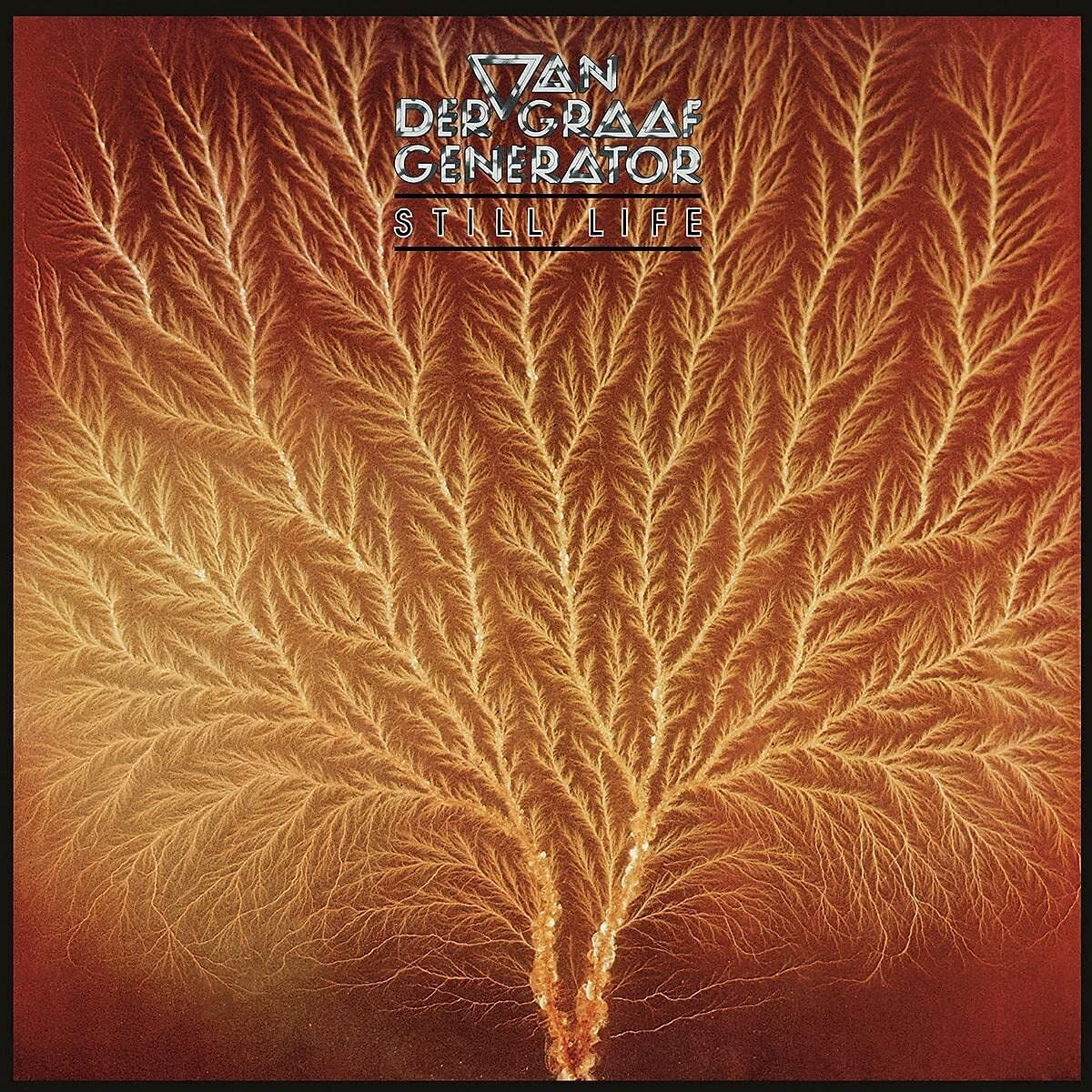
Van Der Graaf Generator: Still Life
If ever there was one album in the history of rock to hold up and proclaim, “Even Schubert would praise this work for its seamless blend of music and lyrics,” it has to be this one.
I can only stumble in trying to describe the artfulness of Hammill’s compositions, or how perfectly his music supports his well-crafted lyrics, or how seamlessly the lyrics are part of the music. Released on April 16, 1976, Still Life is the best-recorded Van Der Graaf Generator album up to that point. Hammill’s broad range of vocals is effectively captured, and the organ passages, the bass, and David Jackson’s flute and sax contributions are all clear and distinctly independent elements in the colorful palette of sound.
All five tracks of the original LP are exceptional, but “La Rossa,” the final track of side one, is one of the masterpieces of 20th-century music. The work begins with an evocative organ introduction that contains the seeds of later material. Hammill enters with a matter-of-fact delivery of the first lines:
Lacking sleep and food and vision
Here I am again, encamped upon your floor
Craving sanctuary and nourishment
Encouragement and sanctity and more
The intensity picks up as more lyrics follow:
The streets seem very crowded
I put on my brave disguise
I know you know that I am acting
I can see it in your eyes
And it is at this point that the music shifts into high gear with another verse:
In the harsh light of freedom
I know that I cannot deny that I have wasted time
Have been a little away in idle boasts
Of my freedom and fidelity
When simple words have never profited me most
It isn’t enough in the end when I’m looking for hope
This is followed by the “organ monkey” chorus, performed at moderate intensity, leaving ample runway for the intensity to follow. After two more verses, the chorus returns, intensity further heightened by the percussion imitating the movements of the hopping organ monkey. A reflective bridge-like section intervenes, providing musical pathos to effectively set up new melodic and harmonic material. The percussion and saxophone increase their intensity to transition to a short, active organ/sax instrumental that breaks back into previous melodic material, with vocals at even greater intensity:
All bridges burning behind me
All safety beyond reach
The monkey fears its chains and runs blindly
Only to find himself released
After “released,” new musical material is briefly interjected with the immediate incorporation of earlier melodic material as we proceed to an unbridled coda with sizzling percussion, heavy organ, a soaring saxophone, and a final, no-frills, and uncompromisingly definitive cadence.
Side Two starts with the melodically addictive “My Room” with its unforgettable opening line, “Searching for diamonds in the sulphur mine.” Hammill effectively captures the poignancy and heartbreak of abandonment and isolation through musical pacing, melodic phrasing, and overall mood.
The album ends with the longest track, “Childlike Faith in Childhood’s End,” which neatly ties together the lyrics and music of the first track, “Pilgrims,” with the reflection of life’s purpose expressed in “Still Life,” and reuses, transformed, musical material of the chorus from “La Rossa.” Hammill effectively leverages Arthur C. Clarke’s novel, Childhood’s End, and its theme of humanity transmuting into a collective, cosmic consciousness, and provides a philosophical finale, with the music relentlessly driving towards its transformative climax, the destruction of the individual for the ascension of humanity, the musical cadence taking us to the highest peak, where there is no air left to breathe.
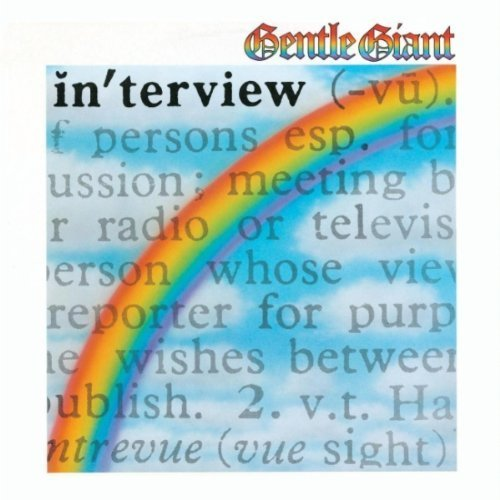
Gentle Giant: Interview
A year before Interview was released in April 1976, Gentle Giant had recorded their seventh studio album, Free Hand, one of the pinnacles of progressive rock, and their most successful album up to that point, released in August of 1975 and soon climbing to the 48th position of the Billboard 200. Gentle Giant finally headlined decent-sized venues and were establishing themselves as a recognizable name in popular music. Two factors would work against them. The first: progressive rock had reached its peak and was now declining in popularity. This was out of their control.
The second factor that worked against them was their eighth studio album. Free Hand had a hard rock edge, was accessible, and was based on an easily relatable concept: reflections on the breakup of a relationship. Specifically, it addressed their breakup with a non-supportive record label, but the lyrics were written with enough ambiguity to effectively apply to romantic breakups. “Just the Same” was about defiance and authenticity, “On Reflection,” with interwoven counterpoint, represented the complexity of looking back at a break-up, and “Free Hand” was about the relief of finally being free, along with lingering bitterness associated with a bad relationship. Like Free Hand, Interview‘s concept and lyrics dealt with the music business, but it lacked a more universal message. Instead, it focused on the mundane elements of an interview with a touring band, highlighting their general dissatisfaction with touring, promotion, and the inane, banal questions of the generally clueless musical press. There was no ambiguity in the lyrics that allowed any other interpretation to a more universally relatable concept, and for those fans who aspired to or envied the fame of a rock band member, an album complaining about the drawbacks of being famous was not naturally resonant.
But if the lyrics fell short of universality, how did the music of Interview fare? Unlike Free Hand, where all tracks were focused, finished, and created a unified musical statement, Interview was their first album since, well, their first album, that lacked musical cohesion. Each track seemed a separate invention, completely independent of the other tracks. In addition, the music was more exploratory than Free Hand, containing the largest number of meandering, though interesting, musical sections since their first album. Where Free Hand had broken the top 50 of the Billboard Chart, Interview never made it past position 137.
And yet, Interview is a masterpiece compared to the three studio albums that would follow. There is cleverness in the music and a range of styles that make it a very engaging listening experience. The first track, the title track, is strong and indicates that here might be another album to rival the previous three in terms of intensity and merit. But the second track, “Give It Back,” takes a detour, mimicking reggae to create a musical parody — effective, but less musically interesting than what the band was capable of. The third track starts as a beautiful ballad, with Minnear on lead vocals. It begins a cappella with the band providing effective backing vocals before breaking into a fragmented, pointillistic display of vocal counterpoint and imaginative percussive counterpoint, ending with a return of the original melodic theme followed by a coda formed from the second theme. Brilliant but far from commercially mainstream.
Side Two starts with “Another Show” about the chaos and financial challenges of touring. The music is exuberant and accurately reflects the tumult of being on the road and playing a string of varying venues. Once again, we have adventurous musical instrumental incursions of high merit and unmistakably pure Gentle Giant, but not instinctively organic. Irresistibly enjoyable, even well-integrated, but not an inevitable outcome of the initial theme. That’s a high bar, but one effectively cleared in their previous five albums.
“Empty City,” the fifth track, is an amazing ballad with a stark contrasting B theme that invokes Gentle Giant’s trademark stride style (see Fifty Year Friday: July 1971 with additional examples mentioned in Fifty Year Friday: July and August 1975, Fifty Year Friday: September 1973, Fifty Year Friday: December 1972, Fifty Year Friday: April 1972, Fifty Year Friday: November 1970.) This is followed by “Timing,” which, like “Another Show” and “Design,” is a strong track with a compelling musical excursion: one with a strong Gary Green guitar solo and some fascinating off-kilter “timing” effects.
The album ends as strongly as it started with “I Lost My Head,” a classic Gentle Giant track that weaves beautiful ballad material with a contrasting heavy rock section. All in all, this album is far above most material from 1976, but for me, back in April 1976 when I bought the album, it failed to meet the expectations set by the previously released “Free Hand” and “Power and the Glory.” I have listened to Interview many times since then, but it still falls short of the greatest classics of progressive rock. It doesn’t comfort me to reflect that even if Gentle Giant had released their best album ever after Free Hand, it wouldn’t have made the difference needed to even momentarily slow the ensuing popularity decline of this musically amazing band or of progressive rock in general.

Klaus Schulze: Moondawn
If you are a fan of Klaus Schulze, the Berlin prog rock electronic school, or, like me, just an easy mark for sequencer-driven bass pulses, Moondawn, released on April 16, 1976, is a rewarding, immersive experience at over 52 minutes on the original LP or over 73 minutes on CD with the inclusion of an alternate version of the first track.
The first track, “Floating,” is aptly named—the music slowly gathers momentum until around the five-minute mark. Here, the crescendoing, from nothing to a fully noticeable isochronal ratcheting (the sequenced ostinato of sub-beats so prevalent in the electronic music of the mid-seventies Berlin school), provides the rhythmic currents to figuratively lift the music airborne. The music gathers intensity slowly, dramatically, immersing the listener until, a little bit after the twenty-six-minute mark, it decrescendos to its gentle conclusion.
Side two of the original LP is also a single track: “Mindphaser.” It begins with the introspective and calming sounds of the sea, interspersed with some hints of stormy weather. It remains uplifting until the second part takes off with drums (Harald Grosskopf) and organ-like droning, culminating in the eventual inclusion of that famously pulsing ostinato, driving it to its conclusion.
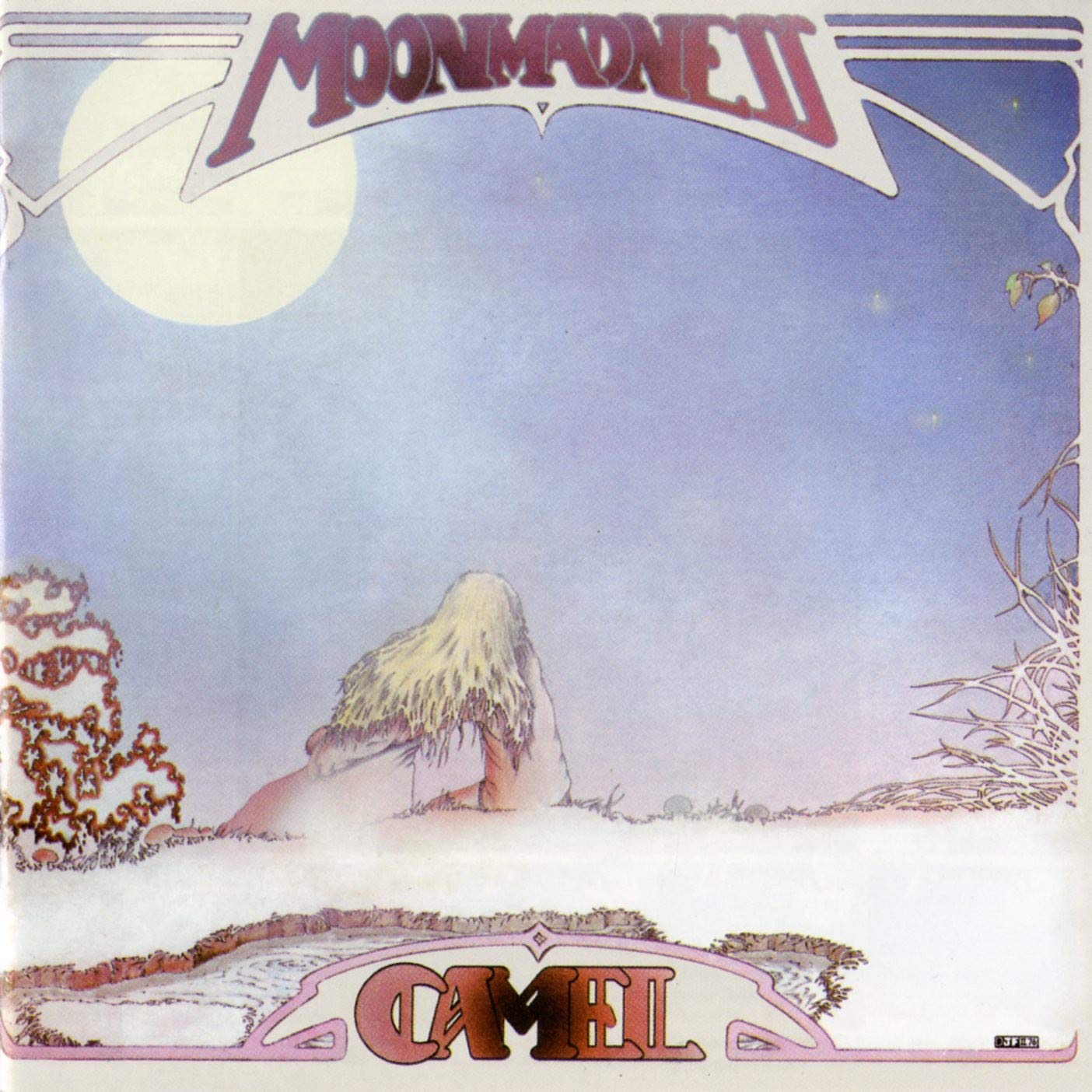
Camel: Moon Madness
Camel released one of their finest albums, Moonmadness, on March 26, 1976. Word has it that the label exerted pressure on Camel to produce more commercially accessible material than their previous album. This seemed to have some slight influence, as the album has a bit of a Pink Floyd sound, particularly on “Song Within a Song” and parts of “Another Night.” However, the music is unmistakably Andrew Latimer/Peter Bardens material, whether upbeat and heavily synthesized as with the opening tracks, “Aristillus” and “Chord Change,” or evocative and wistful as with “Song Within a Song,” “Spirit of the Water,” or “Airborne.” Also notable is the closing instrumental track, “Lunar Side,” which starts off wistful but then leans heavily into the synthesizer in its middle section, and then turns into a lively jazz-fusion-influenced piece with a strong guitar solo from Latimer. Though this album was released domestically in the States, it was rare to spot a copy in most record stores, and my first exposure was on the KPFK-FM program “The Import Show.” The show featured a rotating musical intro that once highlighted a section from “Aristillus,” and on a couple of occasions used excerpts from “Song Within a Song” (once the instrumental passage at the 4:25 mark, and another time starting at 3:07)—a perfect opening for a record show dedicated to the best releases in progressive music.
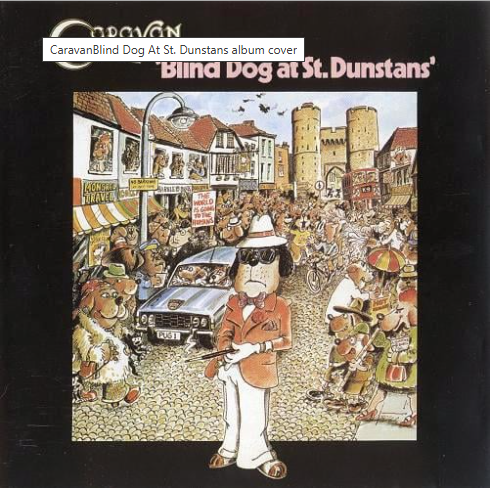
Caravan: Blind Dog at St Dunstans’
This seventh studio album by Caravan is a blend of progressive and quirky pop, but its Canterbury prog-rock roots are unmistakable. With the departure of Dave Sinclair, Pye Hastings does all of the writing for this album, with the exception of one track, which he co-writes. This album often gets overlooked, but it shouldn’t, as it is full of pleasurable, highly enjoyable music with their new keyboardist, Jan Russell Schelhaas, performing admirably. Don’t be dissuaded by the one-and-a-half-star rating at allmusic.com; this is a four-star album.
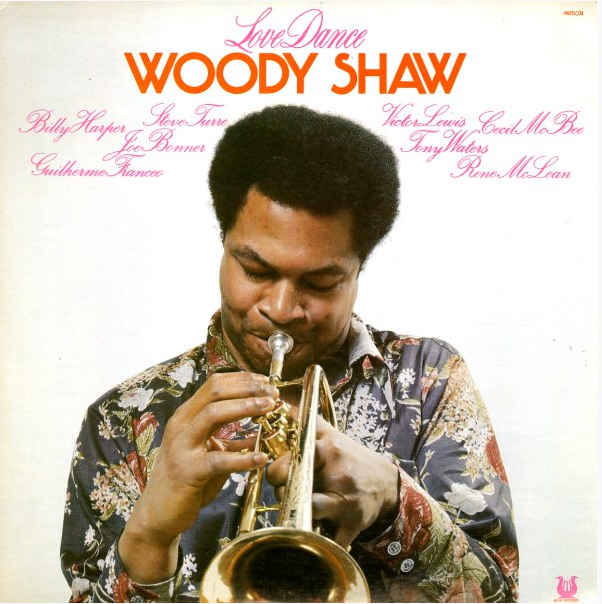
Woody Shaw: Love Dance
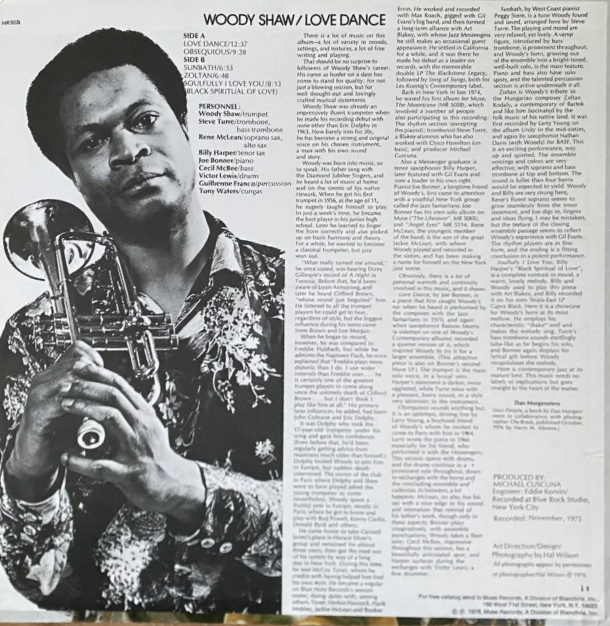
My best guess is that this album was released on the Muse label around April 1976, though not sure. I have it as part of the Mosaic Records set of Woody Shaw’s complete Muse sessions, and it occupies CD 2 of the seven-CD set. As far as I know, the Love Dance album is the only time Billy Harper and Woody Shaw recorded together. That alone would be enough to require one to check out the music; however, the material also establishes itself independently as must-listen modal bop jazz.
“Love Dance,” written as the title track by the album’s pianist, Joe Bonner, is a modal work that would not be stylistically out of place in the catalogue of Coltrane/Tyner, even though written a generation later. Besides Bonner, Harper, and Shaw, the album includes René McLean (Jackie Mac’s son), Steve Turre on trombone (and as a nice treat, particularly on “Sun Bath,” bass trombone), Cecil McBee on bass, Victor Lewis on drums, Guilherme Franco on percussion, and Tony Waters on congas.
Shaw is one of the most amazing trumpeters to listen to. He is an improvisational architect, working through interval and harmonic relationships with a relentless ear for logical connection and abstract melodic appeal. And I love his tone — never wispy or uncertain, but strong, focused, and direct, yet beautifully evocative when appropriate. And I love how Billy Harper understands the musical ethos of a great master like John Coltrane, yet uses that as a starting point and not an end objective. All of this comes together perfectly on my favorite track of the album, “Zoltan,” a tribute to Hungarian composer Zoltan Kodaly, most famous for his Hary Janos suite compiled from music of his opera of that name. The opening melody of Woody Shaw’s “Zoltan,” which first appeared as the opening track on the classic Larry Young Blue Note Unity album, is derived from the march theme of “Entrance of the Emperor and his Court” from Kodaly’s Hary Janos opera and suite, or maybe more accurately derived from Shaw’s earlier version, as he drops out the direct quote of the march intro from the original Kodaly work, and launches into his abstraction of the main theme. Overall, this version is even more intense, compelling, and musically imaginative than its earlier appearance on the Young album. Listen to both and let me know.
And let me know your thoughts on this album. How does it compare to his previous masterpiece, The Moontrane? Or the two classic albums that follow? How does it compare to contemporary jazz albums of its time?
For additional posts related to Gentle Giant, please check these out:
https://zumpoems.com/2025/07/25/fifty-year-friday-july-and-august-1975/
https://zumpoems.com/2026/04/17/fifty-year-friday-april-1976/
https://zumpoems.com/2021/07/23/fifty-year-friday-july-1971/
https://zumpoems.com/2023/09/01/fifty-year-friday-september-1973/
https://zumpoems.com/2022/04/01/fifty-year-friday-april-1970-2/
https://zumpoems.com/2022/12/16/fifty-year-friday-december-1972/
https://zumpoems.com/2017/08/25/fifty-year-friday-aretha-franklin-simon-dupree-the-big-sound-and-pink-floyd/
https://zumpoems.com/2020/11/20/fifty-year-friday-november-1970/
For Must Listen To Gentle Giant and Prog Rock albums, please check out:
https://zumpoems.com/must-listen-to-music/
For additional posts that mention Gentle Giant, please check these out:
https://zumpoems.com/2017/12/30/seventy-year-saturday-1947/
https://zumpoems.com/2019/07/19/fifty-year-friday-men-on-the-moon-yes-larry-coryell/
https://zumpoems.com/2022/05/27/fifty-year-friday-may-1972/
https://zumpoems.com/2019/05/31/fifty-year-friday-power-to-the-people-the-giant-awakens-empty-sky-at-san-quentin-and-charisma/
https://zumpoems.com/2024/03/15/fifty-year-friday-march-1974/
https://zumpoems.com/2024/06/07/fifty-year-friday-june-1974/
https://zumpoems.com/2019/01/04/fifty-year-friday-the-canterbury-scene-soft-machine-and-caravan-first-albums/
https://zumpoems.com/2025/06/20/fifty-year-friday-june-1975/
https://zumpoems.com/2019/06/14/fifty-year-friday-trout-mask-replica-brave-new-world/
https://zumpoems.com/2023/08/04/fifty-year-friday-august-1973/
https://zumpoems.com/2020/02/14/fifty-year-friday-february-1970/
https://zumpoems.com/2018/08/10/fifty-year-friday-ultimate-spinach/
https://zumpoems.com/2018/06/22/fifty-year-friday-british-folk-rock/
https://zumpoems.com/2020/09/25/fifty-year-friday-september-1970/
https://zumpoems.com/2025/11/14/fifty-year-friday-november-and-december-1975/
https://zumpoems.com/2020/03/20/fifty-year-friday-march-2020/
https://zumpoems.com/2025/09/26/fifty-year-friday-september-and-october-1975/
https://zumpoems.com/2021/11/26/fifty-year-friday-november-1971/
https://zumpoems.com/2026/06/12/dexter-gordon-lullaby-for-a-monster-bouncin-with-dex-brand-x-unorthodox-behavior-fifty-year-friday-june-1976/
Discover more from zumpoems
Subscribe to get the latest posts sent to your email.

Comments on: "Van Der Graaf Generator, Gentle Giant, Woody Shaw, Klaus Schulze, Camel, Caravan; Fifty Year Friday: April 1976" (8)
So, there I was minding my own business. The Lady of the House was gone for the weekend visiting her brother in Connecticut. I had taken that as an opportunity to break fast at a place called “Buford’s Biscuits” that features “cat head biscuits” paired with such additions as fried chicken, bacon, large mushrooms, etc. and served as hot sandwiches. So as I tucked into my “Nashville”–featuring spicy fried chicken–with all the restraint of a feline offered a catnip-infused stuffed mouse, I opened my phone, and there it was: another Fifty Year Friday. These are always fun, as the Curator of zumpoems (a man of profound musical knowledge and eccentric taste in friends) inevitably serves up a nostalgic review of long-forgotten prog-rock albums expertly dissected and assessed.
Well the review would be nostalgic, if I could remember half of the bands he reviews. Back then, in my years of college and penury, the Curator would try, and sometimes succeed, in piquing my interest in some progressive rock–I still have some Gentle Giant and ELP on my iPhone music library. But whereas the Curator was fully immersed in the prog rock sea, I would only dip my toe in, or perhaps at most, wade in up to my knees. My tastes were drawing me inexorably jazzward. Thus, as I scrolled down this week’s review, I saw some bands that I had heard of but was unable to name any of their songs, some bands that, to the best of my knowledge, I had never heard of, and of course a fine review of a Gentle Giant album–not one I knew well, but at least I was conversant with the band and its music.
And then I got to the bottom of the column–what’s this? Woody Shaw? I know Woody Shaw! Well, not personally, but I have several of his albums either digitally installed on my phone, or languishing about my man-cave/home office on aging CDs. “Love Dance,’ I am sorry to say, is not one of them. “Dammit, Curator,” I thought (well, actually I inserted his real last name, which I will not reveal to save him the embarrassment of having to fend off post-menopausal groupies eager to relive the ’70s with a man of nice artistic judgement and Dadaist humor.) Anyway, “Dammit” says I, “Now I will have to buy Shaw’s Love Dance album!” But then, that fraying filament in my bulb glowed wanly and I remembered–jazz albums may be found and listened to on You Tube. For once, the internet had reinforced my miserly instincts!
I could not discover online the full “Love Dance” album, but I could get the title cut from that album. And I concur with the Curator–it is one hell of a good listen. Now, I will not pretend that my musical knowledge comes within even a few light-years of the Curator’s. I mean–all these years, I thought modal was a fabric made from tree cellulose! And now he tells me it’s a kind of jazz? I know just enough, though, to agree that the sound of “Love Dance” is reminiscent of Coltrane’s and Tyner’s works of the early 1960s without sounding derivative or imitative. The McCoy Tynerish piano, in particular, stands out in the version of “Love Dance” that came out a year later on the “Woody Shaw Live, Vol. 1” album. That was a performance by a smaller group–a quartet–than the one that performs on “Love Dance” the album, and Larry Willis was the pianist. But his rhythmic, pulsing playing drives the music along much as Tyner’s did on some of those classic Coltrane performances such as his cover of “My Favorite Things.” The “Love Dance” album reviewed by the Curator is a lusher arrangement, with more personnel. Turre’s trombone, in particular, gave the arrangement a pleasantly denser texture, like stepping on to a carpet with a high pile, when compared to the sparer sound of “Live Vol. 1.” Potato, potahto, I suppose: both are excellent performances.
What is perhaps most remarkable, to my blinkered way of thinking at least, is that Woody Shaw was producing this sort of in-your-face, unapologetic jazz at a time when many great jazzmen like Chick Corea and Wayne Shorter had made their peace with the musical zeitgeist and spent the 1970s exploring jazz “fusion” with its more electronic instrumentation and rock-like percussion. And that is not meant as a swipe at Corea or Shorter (or Jean-Luc Ponty or John McGlaughlin or Joe Zawinul or other fusion greats.) They produced excellent music in that idiom that explored new sounds without losing its jazz soul. But there is something admirable as well in the uncompromising authenticity of Woody Shaw. He was refining and continuing the jazz tradition in an age of disco. Perhaps that is why he was never quite as recognized as some other jazz artists. A shame, because clearly, he could hang with the best of them.
LikeLiked by 1 person
I always welcome the comments of strangers, particular when they are this well written! And despite my degree in music, I have lots of gaps in my knowledge and understanding of every type of music there is! Maybe that’s why I listen to so much music of so many genres! Maybe you can join our Guest reviewer for next month, Leo the Deacon, in writing a review — may I suggest the Runaways, Aerosmith, or Black Oak Arkansas?
LikeLike
I have all the Gentle Giant albums up to Interview but so far, only ever listened to the first one or two. I will get to them one day.
Zum – are you familiar with Cardiacs? Some of their songs carry a GG influence.
LikeLike
shaun,
Thanks for reading! And thanks for mentioning the Cardiacs! I have not heard of them, and will check them out, and get back to you via your email! Best Regards, friend!
LikeLiked by 1 person
Haven’t heard these, but I like Gentle Giant’s Octopus a lot. Also a big fan of some of Van der Graaf’s albums, especially H to He and World Record. I was revisiting some of the prog I listened to a lot as a kid (in the 2000s, not the coolest time for that, and before “Roundabout” got big again because of anime) but I need to hear some of their other stuff. Camel also had a cool sound.
LikeLike
AK,
Thanks for your comments. Octopus is amazing! And you have good taste in VDGG. Do you have any favorite Peter Hammill albums?
LikeLiked by 1 person
I haven’t, but I’ve heard Nadir’s Big Chance is a must to listen to!
LikeLike
That’s certainly one of the most interesting! My favorite is Over.
LikeLike