Today, we are honored to have a Seventy Year Saturday entry from none other than Leo the Deacon.
Enjoy!
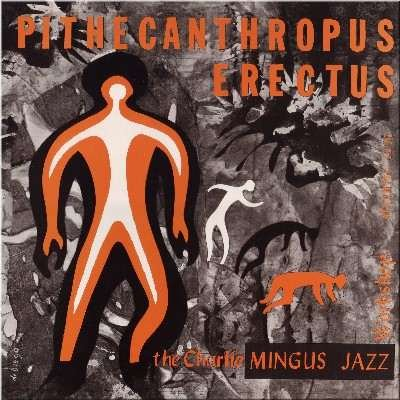
Charles Mingus: Pithecanthropus Erectus
New York City was cold and overcast with a nasty drizzle that just managed to stay liquid on the penultimate day of January 1956. It must have felt miserable to the LA-raised Charles Mingus; maybe it gave him an extra edge that day. Who knows? The weather we can look up, but Mingus’ mood is just conjecture. One thing is certain, though: Mingus created something special that sodden gray day, when he pulled together his “jazz workshop”—saxophonists Jackie McLean and J. R. Monterose, Mal Waldron on piano, Willie Jones on drums, and, of course, Mingus himself on bass—and walked them through the “framework” of the composition on piano so they could add flesh to the bones by playing it by ear. In one day, his workshop recorded the album Pithecanthropus Erectus, and when it was released later that year, it put Mingus on the map as a serious jazz composer and bandleader.
Pithecanthropus proved to be groundbreaking. The centerpiece of the album, the title cut, was a ten-minute programmatic composition that Mingus described as a jazz tone poem, meant to convey the evolution—and downfall—of the first humans. This was a major departure from the hard bop and cool jazz styles that dominated jazz music in the mid-‘50s. This single, intense, and cerebral composition, born out of a Jazz Workshop concept Mingus had been incubating since 1942, blew past the common jam-based format to pioneer new approaches to the music. As Mingus explained in the liner notes, he dispensed with charts in favor of laying out his musical intentions by ear—the first time he had recorded using such a method—to give his musicians greater freedom to improvise. Improvise they did, and what’s more, rather than each bandmember waiting his turn to solo, the workshop often improvises collectively—another innovation. In so doing, Mingus laid the foundation—the springboard, if you will—for the development of free jazz and avant-garde in the late 1950s and on into the’60s. “Pithecanthropus” challenges the listener with occasional dissonance, but it also rewards with passages of no little lyrical beauty, and even some humor.
“Pithecanthropus Erectus” definitely tells a story. Mingus is not coy about it—he explicitly lays out what he is trying to say in his liner notes: “it [the title cut] depicts musically my conception of the modern counterpart of the first man to stand erect – how proud he was, considering himself the “first” to ascend from all fours, pounding his chest and preaching his superiority over the animals still in a prone position. Overcome with self-esteem, he goes out to rule the world, if not the universe, but both his own failure to realize the inevitable emancipation of those he sought to enslave, and his greed in attempting to stand on a false security, deny him not only the right of ever being a man, but finally destroy him completely.” We’ll discuss this further when we look at the context in which the piece was composed, but you get the point.
Mingus’ tone poem has four movements, which he explained represent four distinct stages in the life of this “first man”: (1) evolution, (2) superiority-complex, (3) decline, and (4) destruction. There are indeed four movements, but this is not a Brahms symphony, in which one can clearly identify when one movement ends and the next one begins. In “Pithecanthropus,” Mingus has elided each movement into the following one, so it gets to be a bit of a game for the listener to discern when the music has moved, say, from “superiority-complex” to “decline.” Perhaps Mingus would argue that is how the life of men and societies often unfolds—decline creeps in on little cat feet, like Carl Sandburg’s fog, and it saps our strength by imperceptible degrees, to be discovered only when it is either too late or too hard to reverse it.
Mingus and his jazz workshop portray this progression masterfully. The composition opens with a cool, rhythmic theme dominated by Mingus’s bass and by the drums, with supporting musical texture provided by the horns. This theme, which repeats through each of the four movements, is cool and cocky, and propels the music forward—but it also carries a hint of menace. It is the sort of music the composer of a movie soundtrack might use for Chandleresque private eye or even for a criminal character. Then the horns come out of the background and, with an ascending blast, announce the first man’s presence with authority (as Nuke LaLoosh would say.) While the bass and drums continue to provide a stable platform, the saxophonists and Mal Waldron on piano begin their first collective improvisation maybe two to three minutes in. Dissonant and bold, they signal the competition required to rise to the top in a Hobbesian landscape. As the music moves into the second movement, Monterose on the tenor (or so it sounds to me) takes over and plays a very pleasant, lyrical solo that, after a minute or two, gives way to an equally pleasant passage by Waldron on the piano. A short burst of collective dissonance interrupts, and Waldron gives place to Jackie Mac on the alto. Presumably, the pleasant solos signal the emerging “superiority complex.” Another burst of dissonance, and some repeated horn blasts eventually overwhelm the piano. That cool, jazzy theme with a salient bass and drums returns, and soon the dissonance kicks in again. In the remaining thirty seconds, a final spasm of competing horns, piano, drums, and bass declare the death rattle of the first man, complete with a slight horn whimper. A fascinating ten minutes of music to try to pick apart and follow—at least for non-musicians such as the old Deacon here; you more musically educated types, such as the Curator of this site, may not find it to be the same challenge, especially as Mingus has spelled it all out for you in the liner notes!
Aside from being an impressive demonstration by Mingus of new ways he could manipulate the jazz idiom, the Pithecanthropus title cut reveals his social consciousness and anger that would increasingly push its way into jazz during the subsequent decade, expressed in such compositions as Mingus’ “Fables of Faubus” (1959), Max Roach’s We Insist! Max Roach’s Freedom Now Suite (1960), Oscar Brown, Jr.’s “Bid ‘em In” (1960), John Coltrane’s “Alabama” (recorded 1963, released 1964), and Nina Simone’s “Mississippi Goddam” (1964). That he struggled with pent-up frustration at injustice is not surprising, given that Mingus initially trained on the trombone and cello—but switched to the bass in part because symphony orchestras and other classical ensembles would not hire people of color in the 1930s and ‘40s. In his written explanation of “Pithecanthropus Erectus,” Mingus kept his discussion at a pretty general level, discoursing on a generic first man who considered himself superior to the “other animals,” but as he deploys words like “emancipation” and “enslave,” it doesn’t take a cryptographer to figure out that he is talking about racial injustice as experienced in the 1950s. At the time Pithecanthropus Erectus was recorded and released, already there was considerable ferment regarding civil rights for African-Americans: in 1954 and 1955, the years leading up to Pithecanthropus, the Supreme Court ordered the desegregation of local school systems (yes, children, there really was a time when the Supreme Court, with a Republican Chief Justice, sought to expand liberty—unlike these modern times when the justices are more focused on circumscribing rights and empowering dictatorship); Emmett Till, a fourteen-year-old black kid, was lynched in Mississippi; in December 1955 the Montgomery Bus Boycott was initiated following the arrest of Rosa Parks, a black woman, for failing to give up her seat on a city bus to a white man. And, on 30 January 1956—the day Mingus recorded Pithecanthropus Erectus—white supremacists bombed Martin Luther King’s home in Montgomery while his wife and infant daughter were inside. Outrage at segregation and racial injustice was in the air in the 1950s, and there can be little doubt this served as a wrathful muse for Mingus’ compositions.
I have concentrated my commentary largely on Pithecanthropus’ title track, because it is the truly pioneering work on this album, but that does not mean the remaining tracks should be ignored. Indeed, they serve as a more traditional counterbalance to the jagged dissonance to be found in the title track and a reminder of how truly pretty Mingus’ music could be. “Profile of Jackie,” for example, is a lovely, lush ballad-style composition that showcases altoist Jackie McLean’s command of his craft. “Love Chant” is another long-form composition running to nearly 15 minutes, but it is a quarter hour of Mingus and his workshop displaying the range of their chops. The piece begins with a relaxed, almost meditative bass vamp that Mingus repeats like a mantra throughout the length of the piece. The horns and piano likewise begin at a meditative pace but build momentum and improvise, mostly in solos, as the composition progresses. The sound is still largely conventional for the time and would not have sounded especially innovative; one could regard it as an extended jam session. Well into the composition, McLean and Monterose carry on a musical discussion as each one plays off the other, trading the lead, building eventually to a fuller, more collective improvisation to bring the piece to a close.
Mingus and his jazz workshop perform one cover on the album, a humorous take on the Gershwin standard “A Foggy Day.” Although most musicians perform this piece either as a romantic ballad (e.g., Ella Fitzgerald and Louis Armstrong’s interpretation, backed by the Oscar Peterson Quartet, on the 1956 album Ella and Louis) or as an up-tempo swing number (Frank Sinatra’s 1954 cover of the song, recorded in 1953 with a George Siravo arrangement conducted by Nelson Riddle), Mingus has some fun with the song. First, he transports the “Foggy Day” from London to San Francisco; then he opens the song with live studio imitations of the sort of noise one really hears in a city—automobile horns, police whistles, foghorns, even a siren—and they continue to punctuate and season the music throughout. Mingus plays it on the upbeat side, his bass once again setting a steady, rhythmic foundation to the music on which the horns and Waldron’s piano besport themselves. The essential beauty of Gershwin’s song is preserved, but in this performance, Mingus is winking at us as if to say, “C’mon—try falling in love to the real sounds of the city!”
I don’t know that I would recommend Pithecanthropus Erectus as the first Mingus album someone should buy if said someone is new to Mingus—and certainly not if one is new to jazz. If your interest is piqued by this review, but you haven’t really listened to Mingus, start with his 1959 masterpiece, Mingus Ah Um. But once you’ve gotten your ears used to Mingus’ use of dissonance and you’re ready to move on from “Goodbye Pork Pie Hat” (beautiful though that elegy is), give Pithecanthropus Erectus a hearing. Even if you can’t really develop a taste for the brilliant title cut, the remaining tracks on the record should provide you the aural sustenance you’re looking for. And if you can develop a taste for the title track, well, then you may find yourself wishing Mingus were still with us—who knows what kind of musical protest he might come up with if he were inspired by the likes of Trump, Hegseth, and Stephen Miller? We’ll never know, of course—but damn, it’s fun to think about!
Discover more from zumpoems
Subscribe to get the latest posts sent to your email.

Leave a Reply