Seventy Year Saturday: 1956, Part One
There’s often a bittersweet undercurrent that is present when listening to great music composed or performed by an artist who died before reaching their forties. Every time I listen to a Jimi Hendrix recording, my enjoyment is always accompanied by the thought of what a tragedy it is that he didn’t live longer.
Most Americans seem aware that Mozart died at a young age: 35. Yes, part of this is due to the popularity of the movie Amadeus. Europeans are generally more aware of 18th and 19th century composers than Americans, but even if Amadeus had never been released, most Americans would know the names of Bach, Beethoven, and Mozart.
A smaller percentage of Americans know who Franz Schubert is, and some who are familiar with his name know it from his “Ave Maria,” which gets played quite a bit during the Christmas season, even today. There are not so many who have heard a full Schubert symphony or can tell you that he composed hundreds of songs, seven completed symphonies, three unfinished symphonies, some amazing string quartets, and a stunningly stylistically diverse range of piano music and piano sonatas before dying at the age of 31. It’s nearly impossible for me to listen to his music without reflecting (perhaps when cueing it up or immediately after its completion) on how tragic his early death was, or wondering what masterpieces would have been available for us if he had lived another thirty or forty years — or even another four years — living at least as long as Mozart. And then sometimes I consider how badly decimated the output of Bach, Beethoven, Brahms or even Mozart would have been if they had not made it to their 32nd birthday. We would still have all but two of Mozart’s 41 or so symphonies, but we would not have his last three, including the great Jupiter symphony, his Requiem, several of his best piano concertos and string quartets, or his four most important and beloved operas. Sadly, if all composers had died at the age of 31, Schubert would be considered the greatest of them all. Fortunately, the great majority lived past 31. That may explain why most Americans have such little knowledge of Schubert — but I suspect it’s just more accurate to assert that most Americans have little knowledge of music prior to the era of the Beatles.
If you approach the average person and ask what they think of the jazz trumpeter Booker Little’s career, and how it might have been different if he had lived a few decades longer, you will just get a blank stare. And even if Booker Little had continued making jazz music until his eighties, most Americans would not recognize his name simply because there is a general ignorance of America’s greatest musical legacy, the canon of recorded jazz music.
So I have to keep that in mind when I consider the magnitude of the loss to music of Clifford Brown at the age of 25, and to a lesser extent, Bud Powell’s younger brother, Richie, a talented pianist, composer and arranger, at the age of 24, both killed as passengers in a car accident when Richie’s 19 year old wife lost control of Clifford Brown’s car late at night on a badly rain-slicked Pennsylvania Turnpike during heavy rain and limited visibility. Neither alcohol nor drug usage was involved; Brown was one of the most notable drug-free players of the 1950s.
The accident occurred during the earliest hours of June 26, 1956. Clifford Brown recorded on two studio albums in 1956, each released in 1956.
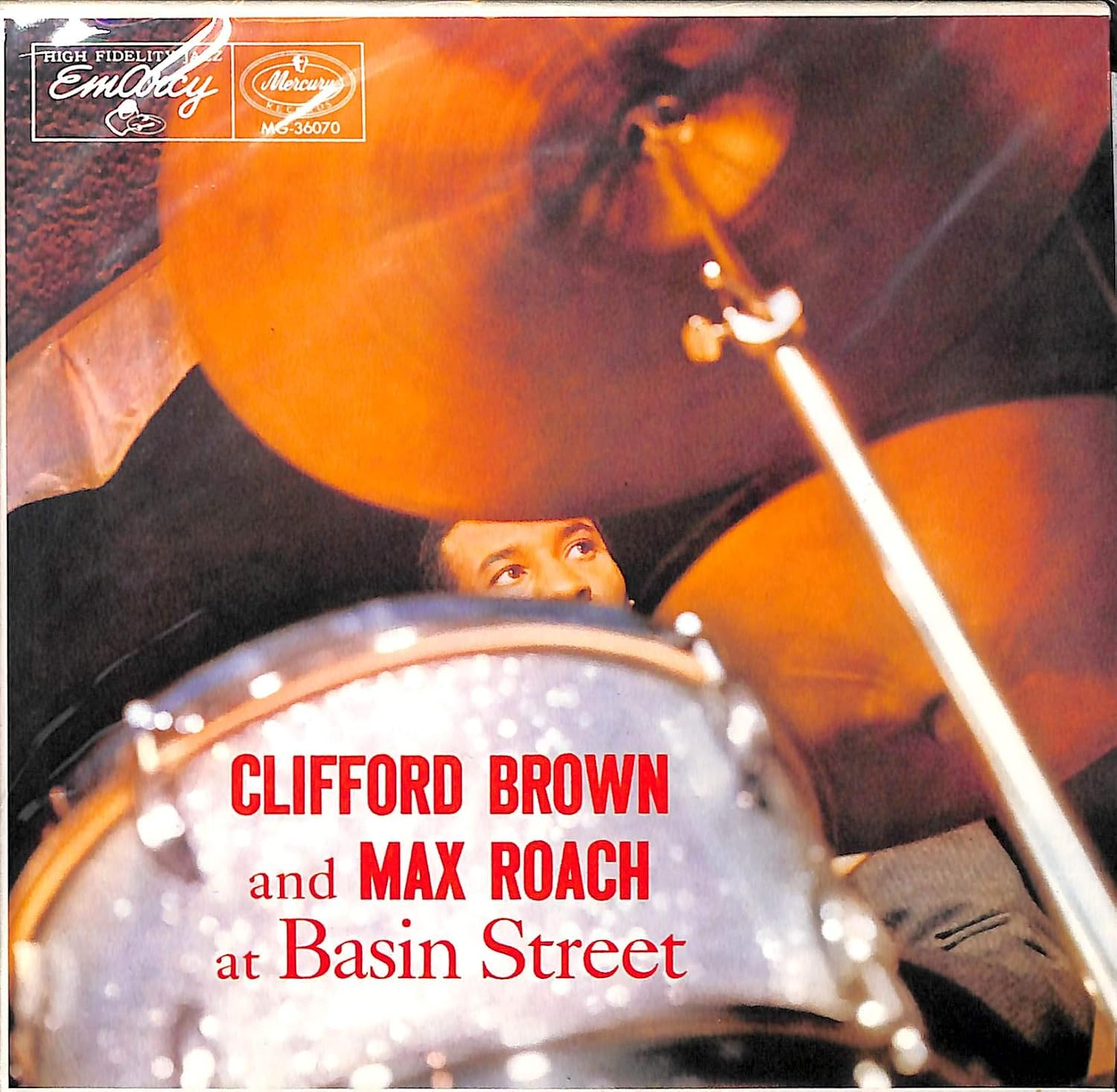
Clifford Brown and Max Roach: Clifford Brown and Max Roach at Basin Street
The first album I will cover, Clifford Brown’s last album as a leader, was recorded in January and February of 1956, and it is one of the finest hard bop albums of all time: Clifford Brown and Max Roach at Basin Street. Please note that although the title may imply a live recording, this is a studio album recorded in New York City at Capitol Studios.
Personnel
Max Roach – drums
Clifford Brown – trumpet
Sonny Rollins – tenor saxophone
Richie Powell – piano, celesta
George Morrow – double bass
Track listing
(All tracks arranged by Richie Powell except where noted.
“What Is This Thing Called Love?” (Cole Porter) – 7:33
“Love Is a Many-Splendored Thing” (Sammy Fain, Paul Francis Webster) – 4:13
“I’ll Remember April” (Gene de Paul, Patricia Johnston, Don Raye) – 9:13
“Powell’s Prances” (Richie Powell) – 3:28
“Time” (Richie Powell) – 5:03
“The Scene Is Clean” (Tadd Dameron, arr. Dameron) – 6:04
“Gertrude’s Bounce” (Richie Powell) – 4:09
The album opens with a four-bar Max Roach solo on drums as part of Richie Powell’s 64-bar introductory arrangement for Cole Porter’s “What Is This Thing Called Love?“, followed by an incredibly intense solo by Clifford Brown, followed by a similarly focused solo by Rollins. Now, in some of the recordings I have, Sonny Rollins comes off as remarkably relaxed and melodic, but here we have a very riveting hard-bop statement. This is followed by Powell’s piano solo, more introspective initially, but developing to fit the mood. George Morrow then has his solo, followed by an arranged ensemble section and a Max Roach solo. It’s important to mention how Max Roach stood out from most of his contemporary drummers, first in the forties, and as he developed in the 1950s. He didn’t just support the ensemble and soloists or keep the beat; he intertwined with the ensemble and soloists, often altering the micro-elements of the beat while not disrupting the rhythmic flow. His solos were more than a technical display but a musical narrative, interesting not as just perfunctory or an obligatory contrast with the melody-instrument soloists but as equal engagement with the overall musical effect. The solo here doesn’t break the flow but is both musically intriguing and nicely sets up the alternating exchanges between Clifford Brown and Sonny Rollins that lead into the outro or arranged finish, which mimics the introduction, including the brief Max Roach solo. The engineer fades the track out, which a purist may find objectionable, but which works quite effectively.
Now, both the CD reissue of this and the Complete 11 CD Clifford Brown EmArcy box set provide some alternate takes for this album, with the 11 CD set providing a full alternate take that is even better than the take used for the original album. One can hear some notable differences, including the opening intro where George Morrow plays the last two odd beats of Roach’s solo. Seems to me the Brown solo is more unrestrained and expressive, and the Rollins solo more exploratory and relaxed, with the main benefit being we have two different versions, both exceptional.
The EmArcy box set also gives us two remarkable versions of “Love Is a Many-Splendored Thing” and “I’ll Remember April.” Once again, the arranged sections are sharp and effective, with the soloing focused and urgent on “Love Is a Many-Splendored Thing.” The album contains three compositions by pianist Richie Powell, with “Powell’s Prances” being an exhilarating hard bop number proving an effective fast-paced vehicle for both Brown and Rollins, with a strong solo by Powell and Max Roach providing energetic support and a propulsive thirty-five-second solo. The album includes an additional piece by Tadd Dameron, and the EmArcy box set includes two additional tracks from the January/Februrary sessions.
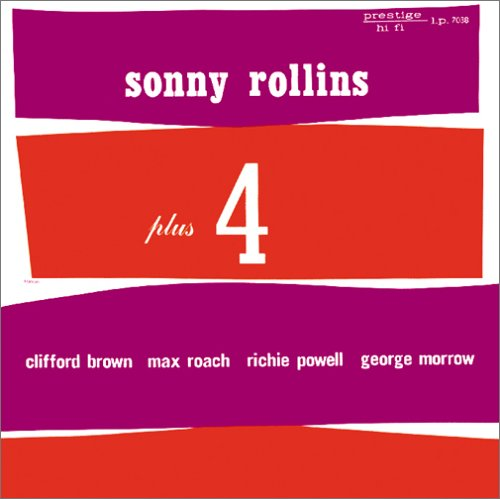
Sonny Rollins: Sonny Rollins Plus Four
Rollins, a part of the Clifford Brown, Max Roach Quintet since November 1955, joining shortly after his break from jazz due to a period of drug rehab, such as it was in late 1954 and 1955, recorded for Prestige as a leader starting in 1951 through November 1956. In exchange for Rollins playing with Clifford Brown and Max Roach for the EmArcy label, EmArcy agreed to allow Brown, Roach, Powell, and Morrow to join Rollins for this Prestige recording, Sonny Rollins Plus Four, recorded in March 1956, and released in August 1956, a couple of months after the fatal Brown/Powell crash.
Track Listing
Side one
- “Valse Hot” (Sonny Rollins) – 8:36
- “Kiss and Run” (Sam Coslow) – 7:08
Side two
- “I Feel a Song Coming On” (Dorothy Fields, Jimmy McHugh, George Oppenheimer) – 5:13
- “Count Your Blessings (Instead of Sheep)” (Irving Berlin) – 2:30
- “Pent-Up House” (Rollins) – 8:50
Personnel
George Morrow – bass
Sonny Rollins – tenor saxophone
Clifford Brown – trumpet (all tracks except “Count Your Blessings”)
Max Roach – drums
Richie Powell – piano
The album starts with a Rollins composition, a 3/4 jazz tune appropriately named “Valse Hot. Rollins has the first solo, relaxed and melodic. Brown’s solo is effortlessly engaging and lyrical. Powell and Roach both make fine contributions. The session seems more ad hoc, and I suspect the arrangements were a product of the rehearsal process rather than being formally written out by Powell.
Of the remaining numbers, each contains strong solo work and is a treat to listen to. “Count Your Blessings” is a beautiful ballad, showcasing Rollins’ lush, rounded, romantic tone with Brown sitting out. The album ends with the lively Rollins tune “Pent-Up House” with Clifford Brown taking the initial solo, wowing us as always with his ability to craft a composition in mid-flight, starting with stark, economical phrases, and then developing the material as if retelling a condensed plot of a short story. Rollins seems sensitive to the mood and provides a similarly narrative solo. Again, Powell provides a solid piano solo, and Max Roach’s solo provides an effective transition to the recapitulation of the theme.
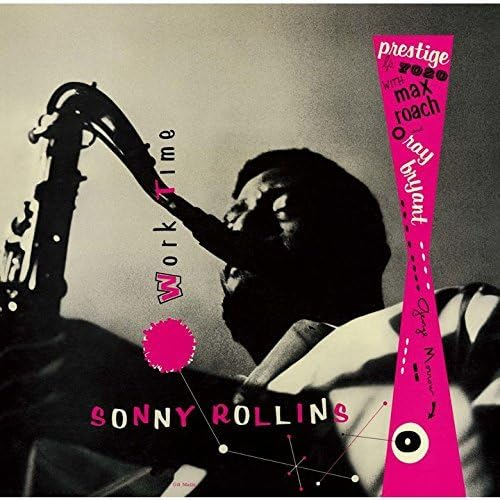
Sonny Rollins: Work Time
Prestige released two other Sonny Rollins albums in 1956. The first was Work Time, recorded in December 1955, and released sometime in 1956. I love this album! Rollins’ “Paradox,” the second track, is one of those memorable hard-bop originals — not derived from some previous classic, but fresh and clever, including its Latin rhythmic sensibility, disrupted, or rather infused, with Rollins’ sparkling use of accents and the tense, shifting quality of its melodic material. I am a big fan of Billy Strayhorn’s “Raincheck,” so it’s a real treat to get this driving hard-bop rendition of it, which includes a relentlessly swinging Rollins solo and an invigorating Max Roach solo.
Track Listing
- “There’s No Business Like Show Business” (Irving Berlin) – 6:20
- “Paradox” (Sonny Rollins) – 5:00
- “Raincheck” (Billy Strayhorn) – 6:00
- “There Are Such Things” (Stanley Adams, Abel Baer, George W. Meyer) – 9:32
- “It’s All Right with Me” (Cole Porter) – 6:06
Personnel
Max Roach – drums}
Sonny Rollins – tenor saxophone
Ray Bryant – piano
George Morrow – bass
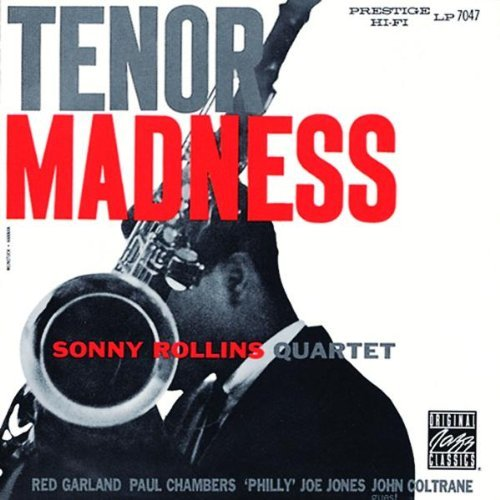
Sonny Rollins: Tenor Madness
Recorded in May 1956 and released in October 1956, I own one of those audiophile repressings of this, and it’s really tempting to get it out to just listen to the first track, the only recording of Sonny Rollins and John Coltrane playing together; however, the rest of the album is pretty strong.
There’s been a lot written about this first track, so I’ll try to be brief. It’s unusual to have two soloists of the same instrument recording together in a quintet, and it was happenstance that we have this. Coltrane was on the Prestige label, playing with Miles Davis and the exact same rhythm section Rollins was using for his session, and for some reason was in the studio with his tenor saxophone. Rollins, a close friend of Coltrane, didn’t hesitate to encourage him to sit in. Of course, whatever tune they picked to record would have to be a piece Coltrane knew the changes to, and for optimal improvisational ease, it made sense for it to be a blues-based tune. Not sure how they arrived at the selection, but they chose Kenny Clarke’s and Fats Navarro’s 12-bar blues “Royal Roost,” renaming it, appropriately for the session, “Tenor Madness.” Well, the recording was a critical success, with Coltrane and Rollins having both the advantage of long, extended solos in the first few minutes, and then, after a piano solo from Red Garland and a bass solo from Paul Chambers over a minute of exciting four-bar interchanges, followed by some more soloing and then a dozen more choruses of alternating exchanges.
This makes the rest of the album seem a bit anticlimatic, but as mentioned, it’s worth continuing on with, even if one chooses to take a break, sample some more Coltrane, or play Tenor Madness a second time before continuing on. Particularly notable is the contemplative rendition of “When Your Lover Has Gone” and Larry Clinton’s reworking of Debussy’s “My Reverie,” one of those pieces that goes perfectly with a crackling fire in the fireplace, if you happen to have a house that actually has a fireplace.
Track listing
All tracks by Sonny Rollins except where noted.[7]
- “Tenor Madness” – 12:16
- “When Your Lover Has Gone” (Einar Aaron Swan) – 6:11
- “Paul’s Pal” – 5:12
- “My Reverie” (Larry Clinton, Claude Debussy) – 6:08
- “The Most Beautiful Girl in the World” (Richard Rodgers, Lorenz Hart) – 5:37
Personnel
Philly Joe Jones – drums
Sonny Rollins – tenor saxophone
John Coltrane – tenor saxophone (#1 only)
Red Garland – piano
Paul Chambers – double bass
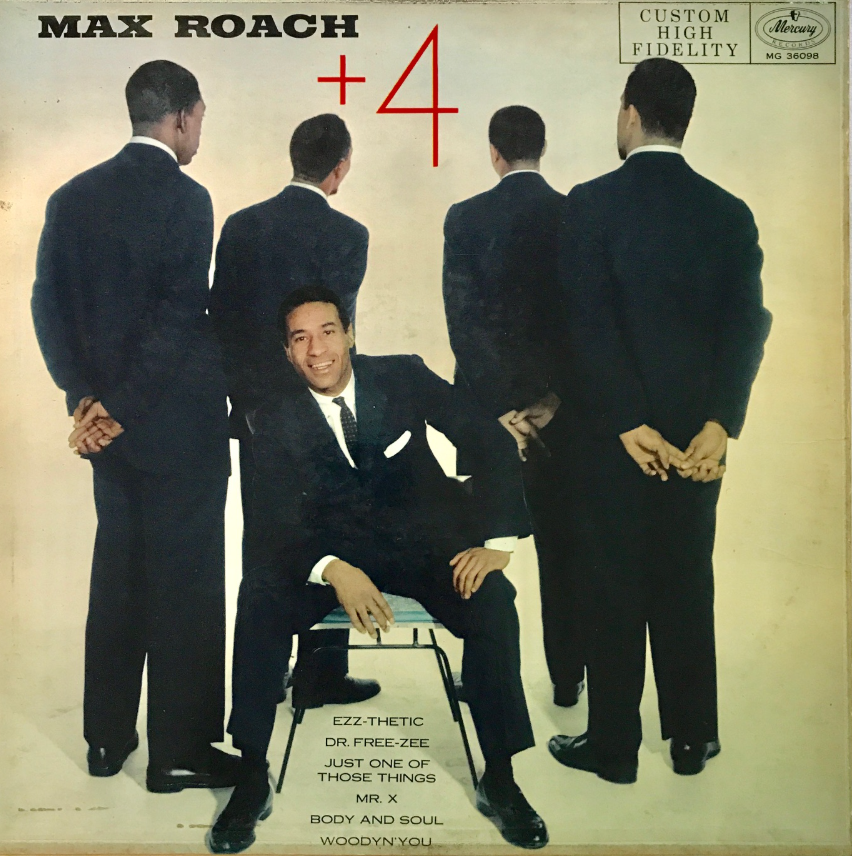
Max Roach: Max Roach Plus Four
Recorded in September 1956 and released the next month, this is an energetic, exciting album, filled with choice tunes and wonderful improvisation. We hear a lively Sonny Rollins on the first track, George Russell’s Ezz-Thetic, making the most of the opportunity, reminding me of the free-wheeling John Coltrane at times as he effortlessly slides through sequences of notes. His solo is followed by a breathy but equally breathless Kenny Dorham solo. Ray Bryant provides top-notch piano throughout the album, and his solo here navigates the tricky chord changes of Ezz-Thetic (based on “Love for Sale”) effortlessly. There are some trading fours (Rollins, Dorham, and Roach alternating four-bar solos) and then Roach and the duo of Rollins and Dorham alternating, this giving way to a tension-driven Roach drum solo, one of the many highlights of the album.
The much briefer “Dr. Free-Zee” showcases Max Roach’s versatility and creativity by overdubbing his timpani lines over the initial recording of the ensemble where Roach is on his standard drum kit. Side One concludes with Cole Porter’s “Just One of Those Things.” I love how Max Roach is featured in the short intro before the exposition of the melody. Rollins is off to the races, again eliding notes and creating drama through his extraordinary control of note placement and emphasis. Dorham’s solo is breathy, agile, and lightning fast. Again, Bryant holds his own, and Max Roach provides an amazing drum solo.
Side Two opens with Roach’s “Mr. X. which includes a strong solo by Rollins, Dorham and Bryant maintaining the energy and mood, some exciting trading fours and a great drum solo by Roach over Bryant’s piano accompaniment. This is followed by “Body and Soul” — I am incapable of hearing any instrumental version of “Body and Soul” without instinctively reflecting on Coleman Hawkins’ historic 1939 recording. Rollins plays beautifully here with some gorgeous low-register legato, and Bryant and Morrow support Dorham’s reflective solo perfectly. There is no drum solo, an appropriate decision.
The album concludes with Dizzy Gillespie’s early bebop tune “Woody ‘n You”, written in 1942, and originally written for Woody Herman and his Orchestra, but first recorded by Coleman Hawkins with Gillespie, Roach and Oscar Pettiford. Dorham provides a particularly inspiring solo here, and there is some incandescent interplay between Rollins and Dorham after a second solo by Rollins. Bryant solos before an apparent recap, which unexpectedly gives way to an engaging Max Roach percussion solo with the theme resolutely returning, followed by brief Rollins and Dorham exchanges concluding one of Max Roach’s finest albums.
Track Listing
All compositions by Max Roach except as indicated
- “Ezz-Thetic” (George Russell) – 9:18
- “Dr. Free-Zee” – 2:06
- “Just One of Those Things” (Cole Porter) – 7:18
- “Mr X.” – 5:15
- “Body and Soul” (Edward Heyman, Robert Sour, Frank Eyton, Johnny Green) – 6:50
- “Woody ‘n’ You” (Dizzy Gillespie) – 6:51
- “It Don’t Mean a Thing (If It Ain’t Got That Swing)” (Duke Ellington, Irving Mills) – 4:45 Bonus track on CD reissue
- “Love Letters” (Edward Heyman, Victor Young) – 8:57 Bonus track on CD reissue
- “Minor Trouble” (Ray Bryant) – 6:58 Bonus track on CD reissue
Personnel
- Max Roach – drums
- Kenny Dorham – trumpet
- Sonny Rollins – tenor saxophone
- Ray Bryant (tracks 1–6), Bill Wallace (tracks 7–9) – piano
- George Morrow – bass