Feckless Degeneracy with some Windmill Jousting – an epic in several belches –
Belch the First – by way of prolegomena
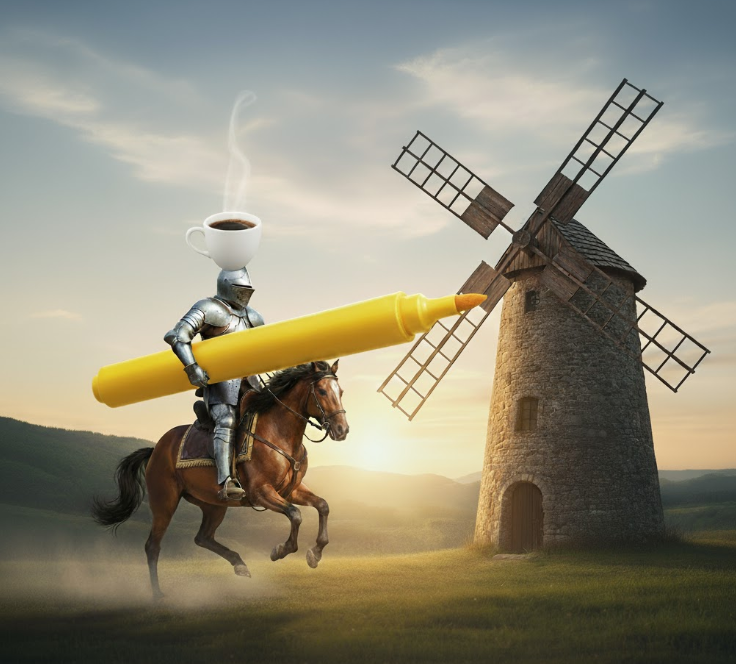
Of arms and the man I sing id est, of a man with arms and hands for that matter and nothing to do with them other than push gliding yellow felt across the faceless fees of contract physicians dealing the new deal daily to the deaf shipbuilders and jet mechanics and the incompetent OSHA oafs of Oshkosh and Oklahoma Sucking the blood of the body politic politely with a yellow felt pen Felt pen is all he’s felt lately so come, muse for someone should and tell of the student-cum-bureaucrat the man with arms and hands with nothing to do but pay bills and perhaps go blind
Belch the Second – in medias res (so what else is new?)
A brown caffeine haze like the stained inversion layer of womb-city L.A. swirled buzzing beneath his 4:30 AM skull like a Santa Ana locked in Aeolus’ cave bleary blurry burned home to Germantown where the rosy-cheeked firm-breasted wives of the power-corridor stalkers make their living doing T.V. ads for Cheer Wisk Breeze and disposable douches Brown and nondescript his mentality and the 2 unkempt letters on his unkempt bed from an unkempt friend a mad composer Beethoven of software UNIVAC of the mad pipes and unorthodox tunes and keeper of a faith in which all have lost faith but a miniscule few
Insanity issues from the violated envelopes rushing leaping prancing like a horde of lusting shoppers at Macy's white sale bringing back the shades, demons, ghosts, apparitions, & specters of times past when mastodons stalked the earth and loons reigned, then, and rationality belonged to serfs and the lords of bats sat wiggo and lecherous in a Coco’s booth sucking the bean and contemplating rape Jolly jester gestures jump from penciled pages and in a laughing gasp grabbed the felt pen pusher by corduroy lapels howling "Write! for the faith is dwindling like a soft candle-stump its fleeting flame flickering faintly from a shriveled wick.
Write! For I am playing pool and snooker with a drunken busboy Lothario the 2 of us Lear and his fool leering and fooling around with a round girl and her quoit-visaged female companion. Write! for the roundtable is broken with the tennis player salesman for Bridgeford talking Tupperware and household appliances as he flies to Dallas. With the great beard Sleaze of times past Falstaff with a joint now playing it cool in high finance at the bastion of upper-middle class white vacuity in Watts. With the genius leader of liberated wit doing a Ulysses gig in Asia beaming knowledge into little brown people and contrition, obscurity for the white man’s burden. Write! for it’s been so long, I find tacos erotic and Don Jose’s threw me out for fondling a quesadilla. Write! Right?”
“Right.” Thus murmured the pen-pusher toddling, tottering off to sleep to wake with the sun and, at the school the afternoon next he gripped his pen violently determined and thought Thank God Freud is dead.
Belch the Third — Arlington National Cemetery is my disco
So the student who feeds himself with a yellow felt pen and writes arcane monographs of the arabesque convolutions of the politics in Riyadh and Jiddah essayed assessed saying sayings not quite sane what he means is what he said Sotos speaks so to speak.
An auspicious year the best of the 20th Sophocles’ 3 Stooges Clotho & her Cronies gave the Greek grief early tried to hand him a couple of brooches to do a number on his bespectacled orbs but he’d seen that one before So they packed up their spinning wheel and headed for Ft. Lauderdale lawn chair lounging but not until his transmission got up and walked away from his Merc 18 miles west of Phoenix to the tune of half a thousand clams If it wasn’t for the pen pusher’s plastic money and smiling despair he’d be flipping burgers on Camelback Avenue Wearing a Marlboro Stetson snakeskin pasture pounders and calling home the T.V. and Gideon Bible at the El Rokay Lodge.
Jojo's has crept like mildew across a map and Visa-financed peasant lunches kept the moustache nourished all across the continent.
Back to the city of marble buildings and minds with few marbles where the town namesake “Father of His Country” has a phallic monument to mock the yellow felt-pen scrivener whose social life is on display next to the stuffed dodo at the Smithsonian and labeled “Extinct.”
Well, can’t complain one supposes, even though the only thing between the student bureaucrat and a morals rap is an iron will and saltpeter for breakfast.
Lots of late nocturnal revelry with Eve’s daughters watching omelets feed a Charybdis appetite, or catching two-dollar talkies at the Circle. Taystee Diner, bean brew, juke box jokes as Hall & Oates, Simon & Garfunkel and Queen eat my quarters Coupla babes a lanky blonde, a petite brunette (I’m a blonde sorta, maybe). [If you’re a blonde I’m Grover Cleveland] But the pen-pusher knows, through the cruel anvil of experience, never argue with a woman Their logic makes minds' Minotaur maze looks like I-10 between Quartzite and Phoenix so peace dictates saying he’s been out late with 2 buxom blondes (and call the pen-pusher Grover Cleveland). Fun ladies and dynamite looks socko boffo knockouts but as for romance my social life is in formaldehyde at D.C. morgue waiting for someone to identify it.
Belch the Fourth — Ambition rides the Metro, but still can’t get a seat.
Thrice has the world spun encompassing ol’ Sol in completed circuits since the Golden Greek marched east like Alexander to conquer Persia-on-the-Potomac Thrice. Most of those who entered grad school with the golden Greek (before he cultivated the yellow felt pen to streak the beige bilious bills at Fran Perkins' Annex (on 14th & NY, NW) Most of those who dared demonic dementia to cut academia’s umbilical with a sheepskin rectangle have and got spewed into limbo
Alexander pushes the yellow felt pen and checks the views on the Strait of Hormuz holding court Doing okay if you are a tortoise All done excepting 100 pages of shoveling so let’s look for birth in May ’82 unless alma mater aborts Meantime there’s always yellow felt pens and green enough money
It all adds up to the bottom line which is the theory of relativity flattened in the templates of grad school to wit master programs stretch like taffy over time the faster you work and time goes gossamer tenuous and ephemeral and e...t...e...r...n...i...t...y is the... last... gasp... of... pondering... postgraduate... programs while your transcript grins and yawns at once
Belch the Fifth — if life gives you meatballs, make albóndigas
Beckoning from beyond the lips of an unborn year are the evergreen plastic vegetables that live only in refrigerators on display at Sears & Montgomery Ward Come come We are the vegetables of legitimacy of actuality and your folks’ approval eat and could we interest you in life insurance?
Rustling from behind in those dim glow worm grottos at the base of your mind are the petrified relics Memories of a golden age long tarnished return return return unused portion of your life for a *full refund* Slapping your back with ghostly hands guffaws Why be a frog when you make one helluva tadpole?
Polystyrene peas aren’t going to make it Julia Child or no Yet you can’t keep the cranium small while the cerebrum expands unless you want to grow lobes out your ears
The abyss between the plastic veggies and petrified pasts is the only place to call home and keep your honor
The bricks and mortar of this balancing house are words the hardshells of deranged thoughts that maintain continuity with the solid past and laugh like a strait-jacket model making time at Camarillo State: the faceless featureless chaos of the unraveling future.
Belch the Last — by way of epilogue
The song is done, Muse, evaporated like Borden’s milk and the balance in my checking account the yellow felt pen pusher pushes on staining audiologist indices and the lives he has touched like a Mexican dinner The time-space continuum has swallowed the Golden Greek yellow felt pen and all and he inches along the cosmic alimentary canal
But soft like that Mexican dinner cheap and satisfying he may return with an acrid burp to remind the party of what once was.
I never liked them anyways And THEY ALWAYS came with a safety cap for something that’s not now very safe
The bottle always asserted its authority just two wait this long if you really want more
Treated me like a child even though it said “extra strength”
I am not pregnant that’s hard for a man particularly in their sixties but what’s not good for a goose is maybe even worse for a gander.
I live with pain constantly Bad neighbors Bad news and so — pretty bad headaches…
I can easily explore better options no warnings on dosages I well know what works well and even if I have a brutal headache the next morning and mess up the car driving At least I had me some fun.
Discrimination lies with concentration Machinations, machinations equilibrium staggers— Smell the breath of industry—intoxicated fumes Has the ignition point been reached? Atomize before the vestigial globules are digested and Odovacar pulverizes the wall
Orange! Hellish pastels screaming unknown genius and hint at hidden chortles While nicotine nimbi scud and stain And we suck slyly, slyly sweetened caffeine and wait for it to reach crit mass in our body-plexus-pit How’d we find this sticky Formica stop anyway? We iron out our cerebral wrinkles Observe the threading warp and woof And still can’t discern how we got in Or where they hid the exit So all you know is that it’s always open– Isn’t this the graveyard shift?– And the cross-eyed waitress will bring a misspelled, miscalculated mistaken check when dinner’s over whining whining wining and dining Somebody waste that skinny kid if he won’t stop bellowing Disagreeable distaste in distinct decibels Disgusting! The food may slither down your maw like greasy lint But can’t we at least eat in peace? A garish cosmos of flickering neon and cretin Muzak It seems as if everything was drawn from the maniac cook’s Primordial soup The proper proprietor leans in languishing linger leisure Across the register Smiling slightly as he strokes his beard, unconcerned Christ! Is this morbid midnight meal a subtle jest Or is he just plain stupid?
Soft gentle beauty leaning against the window Fostering a belief that loneliness is loveliness what is good must start with pain A perfect state of perfect mind.
Cool pleasant sand Lies in a land unknown play and fun is wasted time and idle are the satisfied. A self-constructed sterilized cell for working days And nights towards a goal that cannot be achieved. the rain and sun are both the same. Is this a way of life?
We continue with a third transcribed lecture, this time on one of the most unforgettable and prescient poems of Zumwalt’s early works, “They Stripped the Forest for Babble.”
They’ve Stripped the Forest for Babble
Reams and reams
             The black-ink symbols innundate
             Flooding consciousness with printed words
                                          that possess
             Definitions but know no meaning
Tectonics,
      Aardvarks,
            political history of Byzantine hydraulics.
                        Dewey decimal has run rampant
                        Chasing, haunting, even lurking
                                  in the restroom
                        Parasitically clinging to the walls
 Stark and blatant waste or frivolous gaud
                        Venus dies --
                                   --
                                   --    nonsensical nausea
                        The ice-age is returning
— Zumwalt (1974)
Zumwalt’s Prophecy and the Coming of the Ice
Greetings, once again, and welcome back. Today, we turn to a poem that, I must confess, is a personal favorite of mine in the Zumwalt canon. “Trilogy of the Oblique Carbide” and “Alizarian Grand Slam,” which we have previously discussed, are masterpieces of cosmic and personal collapse, respectively. But this poem, “They’ve Stripped the Forest for Babble,” written in 1974, is something else entirely. It is a work of startling, almost unnerving, prophecy.
Decades before the internet became a household utility, before the first tweet was sent, before our pockets began to buzz with the ceaseless torrent of the digital age, Zumwalt diagnosed the sickness of our time. He saw the coming flood of information and understood its terrible price. This poem is not merely a critique; it is a warning. It is a haunting examination of the fatal distinction between information and meaning, and the cold, sterile world that awaits when we can no longer tell the difference.
Let us explore this remarkable text by tracing its central argument: from the initial flood of meaningless data, through the tyranny of the systems that classify it, to the final, chilling apocalypse of meaning itself.
I. The Paper Flood and the Death of Meaning
The poem begins with a title that is a complete philosophical argument in itself: “They’ve Stripped the Forest for Babble.” The act is one of violent substitution. A living, complex, natural ecosystem — the forest — has been clear-cut. For what? To produce the raw material for “babble,” for meaningless noise. The sacred has been sacrificed for the profane.
This theme explodes in the opening stanza:
Reams and reams The black-ink symbols innundate Flooding consciousness with printed words that possess Definitions but know no meaning
This vision feels startlingly familiar to us here in August of 2025, as we scroll through a newsfeed that shows us a political crisis, an advertisement for socks, and a video of a cat, all in the span of three seconds. Zumwalt is channeling the very spirit of post-structuralist thought. Like thinkers such as Derrida, he sees a world where language has become an endless chain of signifiers pointing only to other signifiers, a sea of “definitions” that never arrive at a final, transcendent “meaning.”
II. The Tyranny of Classification
The problem, Zumwalt argues, is not just the information itself, but the systems we have built to contain it. He finds his central metaphor not in a computer, but in a library:
Dewey decimal has run rampant Chasing, haunting, even lurking in the restroom Parasitically clinging to the walls
This is a terrifying personification. The Dewey Decimal System, that great Enlightenment project of classifying all human knowledge into a rational, accessible order, has mutated. It has escaped the confines of the library and become a monster. It is no longer a helpful guide but a “parasite” that “haunts” us even in our most private spaces.
Here, Zumwalt anticipates the work of philosophers like Michel Foucault, who argued that systems of knowledge are also systems of power and control. To classify is to define, and to define is to control. Zumwalt imagines this system of control breaking free of its cage. The promise of order has become a plague of anxiety. We are constantly being categorized, indexed, and filed by forces we cannot see. The dream of the perfectly organized library has become the nightmare of the perfectly surveilled life, a system so pervasive it clings to the bathroom walls.
The speaker’s judgment is absolute. This endless production and classification of information is either “Stark and blatant waste or frivolous gaud.” It is either useless trash or a cheap, glittering distraction. There is no middle ground for genuine value.
III. The Aesthetic Apocalypse and the New Ice Age
In the final, devastating sequence, Zumwalt shows us the ultimate cost of living in a world of pure data.
Venus dies — — — nonsensical nausea The ice-age is returning
“Venus dies –“. It is a stark, shocking pronouncement. Venus, the Roman goddess of love, beauty, desire, and fertility, cannot survive in this new world. In a culture that prizes “definitions” over “meaning,” there is no room for the unquantifiable realities that Venus represents. Beauty is not data. Love cannot be indexed. This is the aesthetic apocalypse. It echoes the Frankfurt School’s warning that a world of pure, instrumental reason would inevitably crush the human spirit, art, and myth.
The speaker’s reaction is a direct callback to our earlier discussions of Existentialism: “– nonsensical nausea –“. It is the sickness that Sartre described, but it is not a nausea born from the silence of the universe. It is an informational nausea, a sickness born from the universe’s endless, meaningless chatter.
This leads to the poem’s final, terrifying prophecy: “– The ice-age is returning.” This is Zumwalt at his most prophetic and counter-intuitive. The common metaphor for the information age is one of heat, speed, and light. But Zumwalt sees the opposite. He argues that a flood of decontextualized information does not lead to enlightenment. It leads to a deep freeze of wisdom. It creates a culture that is a mile wide and an inch deep, a landscape of glittering, sterile, frozen facts. The overabundance of “babble” cools our passions, freezes our empathy, and halts the forward progress of genuine understanding. It is the entropy of the soul.
And what is so remarkable is how Zumwalt grounds this metaphorical winter in a physical reality. In 1974, the phrase “They’ve Stripped the Forest” was not just a metaphor; it was a headline, a literal description of rampant deforestation for paper production. Today, the metaphor has only sharpened and evolved. We no longer strip the forest for paper to print our babble; instead, we consume ever-increasing mountains of electrical power, often generated by burning the earth’s ancient forests of carbon, to run the server farms that house our digital babble and train our artificial intelligences. In this light, Zumwalt’s prophecy of a returning ice age becomes terrifyingly literal. It is not just a freezing of wisdom. The immense CO2 output from the very infrastructure of our Information Age threatens to disrupt the climate, potentially leading to a new era of environmental stasis and collapse. The babble, it turns out, is not weightless. It has a physical, world-altering cost.
This profound critique of waste — both the metaphorical waste of meaning and the literal waste of resources — is what makes the poem’s own form so devastatingly effective. The poem itself is minimalist, perfectly constructed, with not a single wasted word. This sharp, artistic economy stands in stark contrast to the uncontrolled, wasteful “inundation” of words it describes. The poem doesn’t just talk about the problem of babble; it performs the solution through its own concise, meaningful structure. It’s a masterclass in formal irony.
In conclusion, “They’ve Stripped the Forest for Babble” stands as one of Zumwalt’s most vital works. It argues that in our hunger for data, we have sacrificed meaning. We have traded the living forest for dead paper, and in doing so, have created a world where our systems of knowledge have become our parasites, where beauty cannot survive, and where the endless stream of information paradoxically plunges us into a new and terrible winter of the spirit.
This is the second of our transcribed lectures. This one is based on the following poem:
Alizarian Grand Slam
         Manifest crescendos
Homeopathically kneepanning Santa Fe plethora
  Safely soaking with the mangoes.  Are there
         Any removable transversals
      Balancing on the Pawnee Indian?
Aaeeeeeeeeeeeeeeeeeeeeeeeeeeeeeeeeeeeeeeeeeeeeeeeeeeeeiii!
       Saliva adorns my peanut butter.

-- Zumwalt (1973)
A Journey Through the Failed Sanctuaries of “Alizarian Grand Slam”
Good afternoon! It’s afternoon for me — if not for you, then “good morning,” “good evening,” “good insomnia,” whatever you feel is appropriate.
In our previous lecture, the first of a series of lectures on the poetic works of Zumwalt, we explored the vast, nihilistic landscape of “Trilogy of the Oblique Carbide,” a poem that confronts the failure of justice, fate, and the physical laws of the universe. Today, we turn to its companion piece, the second of Zumwalt’s defining early publications, “Alizarian Grand Slam.”
If “Trilogy” was an outward scream at a silent cosmos, this poem is an inward one, charting the collapse of the aesthetic, intellectual, and sensory self. It is a poem about the violent collision between beauty, thought, and the sheer fact of being a body in the world. Its concerns are more intimate but no less devastating. It is a profound and obscure commentary on the subjugation of desire and the thwarting of our deepest need for connection.
The journey begins with the title, “Alizarian Grand Slam.” This is the thesis of the poem’s tragedy. Alizarin Crimson is a deep, historic red pigment, a color of passion, royalty, and religious vestments, but it is also famously fugitive, prone to fading over time. A Grand Slam, conversely, is a moment of total, decisive victory. The title, therefore, presents the central thwarted desire of the poem: the desperate wish for a perfect, beautiful, and lasting union — be it in art, love, or spiritual understanding — that is, by its very nature, doomed to decay. This is made more potent by the history of the pigment itself. Traditional Alizarin was derived organically from the madder plant root, but in the 19th century, it became one of the first natural dyes to be artificially synthesized. This mirrors the poem’s central theme: a quest for something authentic and natural in a world that increasingly offers only a synthetic, mass-produced substitute. It is the desire for a permanent victory painted in a fading color.
This desire builds with an almost feverish intensity in the opening line, “Manifest crescendos.” We feel the subject’s yearning for transcendence becoming overwhelmingly obvious, a rising wave of need. This is the great hope, the upward swing of the quest. But where does the subject first seek this grand slam? The poem suggests they turn to the world of art and culture. For centuries, our society has held that art is one of the most reliable paths to experiencing the sublime — that feeling of profound awe and transcendence in the face of greatness. It’s a recognized path, and the speaker begins their journey here.
The journey immediately sours with the dense, cynical line: “Homeopathically kneepanning Santa Fe plethora.” Here, the promised path to the sublime reveals itself as the first failed sanctuary. Keeping in mind the poem was written in 1973, this is a sharp, historically specific critique. By the early 70s, Santa Fe’s reputation as an art colony had boomed into a massive tourist enterprise. The “plethora” the poem describes is the overabundance of commercialized galleries, the marketing of a romanticized “Southwestern” aesthetic, and, most pointedly, the explosion in mass-produced Native American jewelry that diluted genuine craftsmanship into trinkets for visitors. The speaker, seeking authentic, sublime art, instead finds a glut of commodified culture. The response is not a grand critique but a violent, crippling gesture (“kneepanning”) delivered in a dose so small (“homeopathically”) as to be laughably impotent against the sheer volume of the marketplace. The desire for a transcendent experience through art is thwarted by the very system that promises it.
Having found the world of aesthetic and social order to be a corrupt wasteland, the speaker makes a logical move: a retreat into the personal, the sensual, the relational. This is the second sanctuary: “Safely soaking with the mangoes.” The tone shifts dramatically to one of luxurious peace. The mango is a fruit often associated with love, sensuality, and exotic sweetness — a world away from the violent critique of Santa Fe. This line represents the hope of a romantic or platonic relationship as a safe harbor. It is a desire for a purely phenomenological connection, a moment of shared, unmediated, sensory bliss, “safely” removed from the judgments of the outside world. Here, with a partner, or perhaps just within a state of pure bodily pleasure, the “Alizarian Grand Slam” seems possible again. This is the desire for a relationship to be a perfect, self-contained world.
But this sanctuary, too, is violently corrupted from within by the intrusion of a twisted intellectual desire. The reverie is shattered by a cold, academic question: “Are there / Any removable transversals / Balancing on the Pawnee Indian?” This question is the poem’s cruel turning point. The abstract language of geometry (“removable transversals”) is brutally imposed upon a human subject, the “Pawnee Indian,” who is reduced to a static, objectified prop. This is a profound commentary on subjugation. Within the context of a relationship, this is the moment one partner stops “soaking with” the other and begins to analyze, categorize, and objectify them. It is the twisted desire to control and define the other rather than to connect with them. This is a brutally literal depiction of a specific trope in American culture: the “Vanishing Indian.” This was a widespread concept that treated Indigenous peoples not as living, evolving cultures, but as static, tragic relics of a bygone era — essentially, as museum pieces. Zumwalt’s line makes this metaphorical objectification horrifyingly literal. The partner ceases to be a person and becomes a problem, a theorem to be solved. This can also be read as a critique of dogmatic religion, which often imposes its own rigid, abstract laws (“transversals”) onto the fluid, living reality of human experience, subjugating believers into props for its logical system. The sanctuary of the relationship is thus destroyed by the same impulse for control and objectification that defines the failed social order.
With the failure of both the external world of art and the internal sanctuary of the relationship, the subject is left with no escape. The result is a complete psychic breakdown, expressed in the only way possible: a primal scream.
This is the sound of absolute severance. It is the shriek of a consciousness that has been promised transcendence twice and has had it violently torn away both times. It is a definitive retreat from language, which has proven to be a tool of both impotent critique and violent objectification. The crescendo that was once “manifest” has now reached its agonizing, wordless peak and shattered.
Following this explosion, the poem collapses into its devastating final line: “Saliva adorns my peanut butter.” After the quest for a grand slam in art, after the search for safety in mango-like sensuality, after the intellectual violence and the resulting scream, this is the final state of being. It is a moment of profound self-contamination. The desire for connection with an “other” has been so thoroughly thwarted that the subject is left entirely alone, in a closed loop with their own body. “Adorns” is a word of supreme, tragic irony. The subject’s own biological substance — saliva — defiles their sustenance. This is the ultimate image of a subjugated desire. This personal collapse is given a final, sociological twist by the choice of food. Peanut butter is not a natural object like a mango; it is an icon of industrial food production — a processed, homogenized, mass-produced staple. The speaker’s grand quest for a unique, sublime experience ends in a lonely encounter with a symbol of uniformity. It suggests that in a commodified world, the only thing left is a commodified self, consuming a commodified product. The grand, transcendent yearning for an “Alizarian Grand Slam” is reduced to the slightly disgusting, masturbatory reality of the self “adorning” its own consumption.
In “Alizarian Grand Slam,” Zumwalt presents a coherent and deeply pessimistic narrative. It is the story of a soul seeking meaning, first in the broad social order of culture, and then in the intimate order of a relationship. It finds the first to be a commercialized sham and the second to be a site of objectification and control. Both sanctuaries fail, leading to an explosive negation of language and a final, pathetic reduction to the isolated, biological self. The poem is a masterful, integrated commentary on the failure of modern life to provide a space for our desires to be met with anything but decay and disgust.
A Comparative Note: The Telescope and the Microscope
It is a fascinating and crucial point to compare the stylistic differences between “Trilogy of the Oblique Carbide” and “Alizarian Grand Slam.” Doing so reveals the incredible precision of Zumwalt’s artistic voice. The two poems, published as a pair, function like two different lenses used to examine the same essential crisis of meaning.
“Trilogy of the Oblique Carbide” is the telescope. Its critique is vast, historical, and cosmic. To argue that the very concepts of Justice and Fate are collapsing, Zumwalt must draw on the grand arc of Western civilization. The poem summons:
Mythological Allusions: “Moira” invokes the entire classical tradition of the Fates.
Historical Mysteries: “Judge Crater” taps into a moment of unsolved, public failure.
Philosophical Figures: The shadow of figures like Nietzsche and Schopenhauer looms large.
Even its contemporary references, like “Alpha Beta,” serve to ground these epic concepts in the mundane, showing how the grand decay has seeped into every corner of life. The language is necessarily broad, pulling from philosophy, history, and theology to make its case that the entire external framework of meaning, built over millennia, has rotted from within.
“Alizarian Grand Slam,” by contrast, is the microscope. It is fixated exclusively on the present moment — the “now” of 1973 — because its subject is not the history of ideas, but the immediate, lived experience of a single consciousness trying to survive in the wreckage. The poem is a dissection of the modern self, and therefore its references are intensely contemporary:
Art-World Satire: “Santa Fe plethora” is a direct jab at a specific, booming 1970s cultural marketplace.
Pop-Psychology Jargon: The cold language of “removable transversals” evokes the detached, analytical fads of the era.
Simple, Bodily Realities: “Mangoes” and “peanut butter” are immediate, sensory objects, not historical symbols.
The simplicity of the language in “Alizarian Grand Slam” is deceptive. While “Trilogy” uses complex allusions to deconstruct complex systems, “Alizarian Grand Slam” uses simple, contemporary language to show how those same systemic failures manifest within a single person’s quest for connection. The absence of historical reference is the point: the modern subject is cut off from history, trapped in a present-day hall of mirrors where every attempted escape — art, relationships, intellect — proves to be another trap.
Despite this stark difference in style, the artistic voice is perfectly consistent. Both poems exhibit the same core traits: a deeply cynical view of established systems, a violent juxtaposition of the sublime and the banal, and a final, devastating reduction of all grand pursuits to a pathetic biological endpoint (“URRRP!” vs. saliva). The shift in tone and reference is not an inconsistency, but a brilliant artistic choice. Zumwalt uses the telescopic style to show us the universe is broken, and the microscopic style to show us how that brokenness feels, moment by moment, inside our own skin.
It is with mixed feelings, and pretty intense regret, that I am aggressively scaling back on the publishing of Zumwalt poems on this site. As Zumwalt’s longtime co-editor, I cannot ignore the minimal traffic on this site and the numerous options available for me to submit some of Zumwalt’s previously unpublished poems to diverse and respected publications which will provide Zumwalt an audience of thousands or even tens of thousands of readers. I owe this to my friend Zumwalt.
When I was a data architect, I was fortunate to have had several of my articles on Data Warehousing published in Data Management Review. I know the personal joy of seeing one’s own work published in a respected periodical. Zumwalt has been deprived of this opportunity since the unfortunate, but predictable, cessation of the GHLM newsletter, which had contracted with him for exclusive publication rights. He insists that publication of his work is not important and even scoffs at its future likelihood. I suspect this is not so on either count.
In order to keep this blog active, I will continue to publish anything Zumwalt sends me exclusively targeted for this blog — provided that I cannot persuade him to allow me to forward such material on to potential publishers. I will also continue to author posts like “Fifty Year Friday”, which showcases a combination of my flawed writing against reminiscences of some of the great music of fifty years ago. I wish I had time to write more — I gave up Century Sunday, Seventy Year Saturday and other features due to time constraints; I wish I could write better — I gave that up a long time ago — I write for the joy of writing and I am fine with one reader or ten, ten being about the maximum audience I have for any given post.
But as typical with my ruminations, I have veered off-track, at the expense at both my message and your patience.
My plan is this: Fill up some of the empty blog-time by engaging a well-respected, now-retired former literary critic (I will say no more out of respect to protect this individual’s identity, which is this person’s wish.) He has indicated he will record a short lecture for each previously published Zumwalt poem on zumpoems.com. I will use a software app I have to transcribe each lecture and post it here. Not sure when he will deliver the first lecture, but he is very knowledgeable on both poetry and all of the Zumwalt poems on this site and all the Zumwalt poems that have been previously published in the GHLM newsletter and the original GHLM (which, acronym, dear reader, simply stands for Good Humor Literary Magazine) — and, I believe, as I finish this long-winded, poorly written sentence, is something he can do easily off-the-cuff, with minimal time and preparation required. I have seen him lecture live on impromptu-requested topics, and it is quite something to have witnessed.
Until then, you continue as my distantly cherished and greatly appreciated friend, so please return so we can meet again.
This government, the offspring of our own choice, uninfluenced and unawed, the support of your tranquility at home, your peace abroad, of that very liberty which you so highly prize, (Experience in my own eyes)
you have in a common cause fought and triumphed together, will not exercise more charity in deciding on the opinions, and actions of one another. One of the most baneful foes of republican government, brought to the verge of dissolution due to diversity of Sentiments.
Lifted them to unjust dominion, will, if there is not a change in the system, be our downfall as a Nation.
With the real design to direct, control, counteract, or awe, to confine each member of the society within the limits prescribed by the laws,
The powers of the Executive of the United States are more definite, and better understood,
to guard the public good.
— George Washington (edited by zumwalt)
zumwalt’s notes:
Phrases from first and fourth stanzas are from Farewell Address (1796). Phrases from second stanza are from Farewell Address and Letter to 1792 Alexander Hamilton. Phrases from third stanza from a letter written in 1783. Phrases from fifth stanza is from a letter written in 1794. Sixth and final stanza is from the 1790 Address to Congress.
The imagination that we spurned and crave: Unreal! Give back to us what once we gave…. A band entwining, set with fatal stones, Bear other perfumes on your pale head wear. For this, musician, in your girdle fixed, The difference that heavenly pity brings, Our feigning with the strange, unlike, whence springs Too near, too clear, saving a little to endow, Yet not too like, yet not so like to be….
We give ourselves your latest issuance, O bough and bush and scented vine, in whom Among the arrant spices of the sun, As in your name, an image that is sure, That apprehends the most which sees and names, And of all vigils musing the obscure, The near, the clear, and flaunts the dearest bloom, That music is intensest which proclaims That retentive of themselves are men.
In the laborious weaving that you wear Most rare, or ever of more kindred air Than yours, out of our imperfections wrought, Gives motion to perfection more serene, Gross effigy and simulacrum, none By being so much of the things we are, Yet leaves us in them, until earth becomes, That separates us from the wind and sea, Now of the music summoned by the birth.
No crown is simpler than the simple hair: Its venom of renown, and on your head, Of cloudy silver sprinkles in your gown And flame and summer and sweet fire — no thread. And queen, and of deducted love the day And of the fragrant mothers the most dear Most near, most clear, and of the clearest bloom, And of the sisterhood of the living dead Sister and mother and inducive lore.