Zumwalt Poems Online

Posts tagged ‘Max Roach’

Seventy Year Saturday: 2026, Part One

There’s often a bittersweet undercurrent that is present when listening to great music composed or performed by an artist who died before reaching their forties. Every time I listen to a Jimi Hendrix recording, my enjoyment is always accompanied by the thought of what a tragedy it is that he didn’t live longer.

Most Americans seem aware that Mozart died at a young age: 35. Yes, part of this is due to the popularity of the movie Amadeus. Europeans are generally more aware of 18th and 19th century composers than Americans, but even if Amadeus had never been released, most Americans would know the names of Bach, Beethoven, and Mozart.

A smaller percentage of Americans know who Franz Schubert is, and some who are familiar with his name know it from his “Ave Maria,” which gets played quite a bit during the Christmas season, even today. There are not so many who have heard a full Schubert symphony or can tell you that he composed hundreds of songs, seven completed symphonies, three unfinished symphonies, some amazing string quartets, and a stunningly stylistically diverse range of piano music and piano sonatas before dying at the age of 31. It’s nearly impossible for me to listen to his music without reflecting (perhaps when cueing it up or immediately after its completion) on how tragic his early death was, or wondering what masterpieces would have been available for us if he had lived another thirty or forty years — or even another four years — living at least as long as Mozart. And then sometimes I consider how badly decimated the output of Bach, Beethoven, Brahms or even Mozart would have been if they had not made it to their 32nd birthday. We would still have all but two of Mozart’s 41 or so symphonies, but we would not have his last three, including the great Jupiter symphony, his Requiem, several of his best piano concertos and string quartets, or his four most important and beloved operas. Sadly, if all composers had died at the age of 31, Schubert would be considered the greatest of them all. Fortunately, the great majority lived past 31. That may explain why most Americans have such little knowledge of Schubert — but I suspect it’s just more accurate to assert that most Americans have little knowledge of music prior to the era of the Beatles.

If you approach the average person and ask what they think of the jazz trumpeter Booker Little’s career, and how it might have been different if he had lived a few decades longer, you will just get a blank stare. And even if Booker Little had continued making jazz music until his eighties, most Americans would not recognize his name simply because there is a general ignorance of America’s greatest musical legacy, the canon of recorded jazz music.

So I have to keep that in mind when I consider the magnitude of the loss to music of Clifford Brown at the age of 25, and to a lesser extent, Bud Powell’s younger brother, Richie, a talented pianist, composer and arranger, at the age of 24, both killed as passengers in a car accident when Richie’s 19 year old wife lost control of Clifford Brown’s car late at night on a badly rain-slicked Pennsylvania Turnpike during heavy rain and limited visibility. Neither alcohol nor drug usage was involved; Brown was one of the most notable drug-free players of the 1950s.

The accident occurred during the earliest hours of June 26, 1956. Clifford Brown recorded on two studio albums in 1956, each released in 1956.
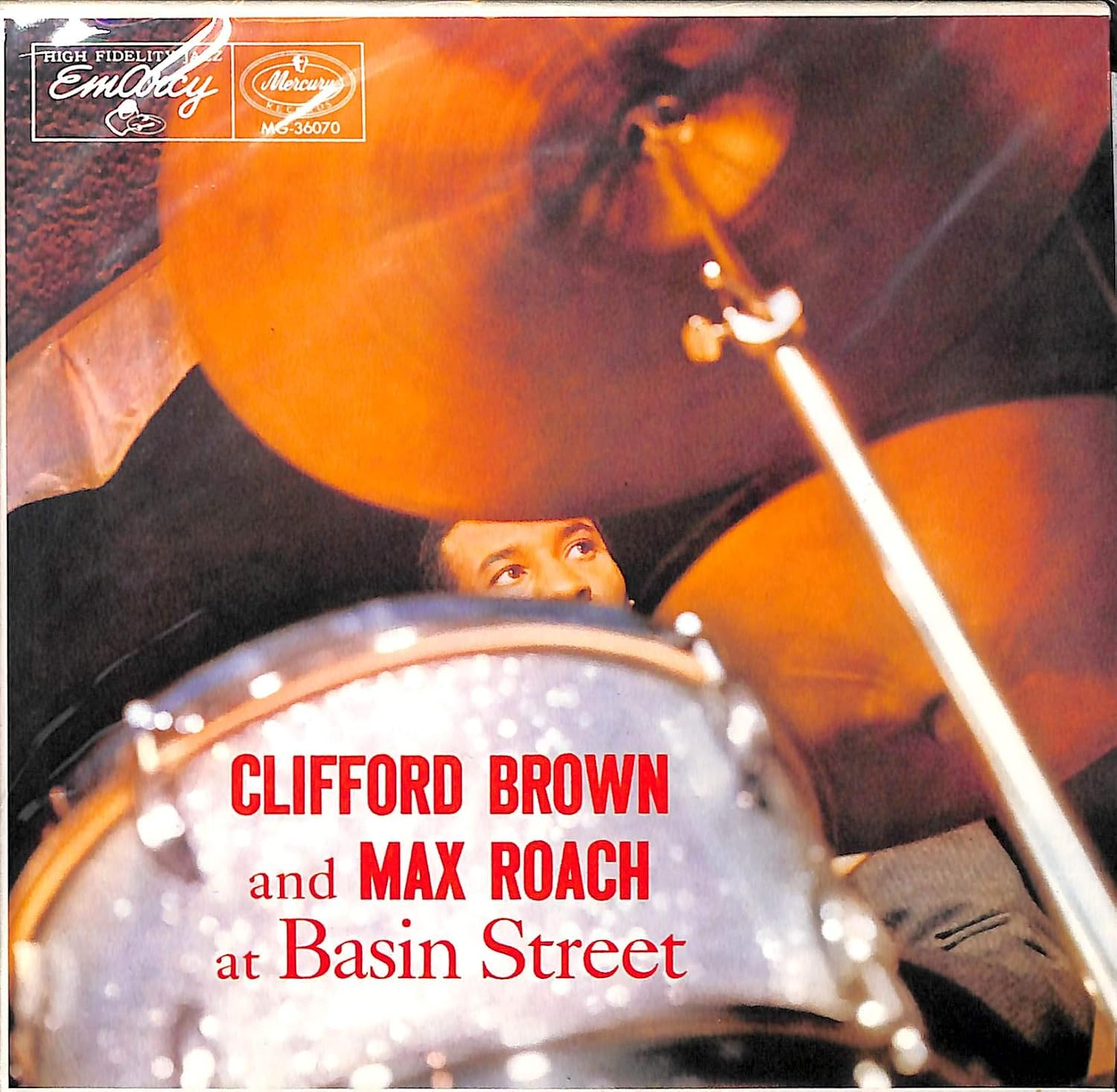
Clifford Brown and Max Roach: Clifford Brown and Max Roach at Basin Street

The first album I will cover, Clifford Brown’s last album as a leader, was recorded in January and February of 1956, and it is one of the finest hard bop albums of all time: Clifford Brown and Max Roach at Basin Street. Please note that although the title may imply a live recording, this is a studio album recorded in New York City at Capitol Studios.

Personnel
Max Roach – drums
Clifford Brown – trumpet
Sonny Rollins – tenor saxophone
Richie Powell – pianocelesta
George Morrow – double bass

Track listing
(All tracks arranged by Richie Powell except where noted.
What Is This Thing Called Love?” (Cole Porter) – 7:33
Love Is a Many-Splendored Thing” (Sammy FainPaul Francis Webster) – 4:13
I’ll Remember April” (Gene de Paul, Patricia Johnston, Don Raye) – 9:13
“Powell’s Prances” (Richie Powell) – 3:28
“Time” (Richie Powell) – 5:03
“The Scene Is Clean” (Tadd Dameron, arr. Dameron) – 6:04
“Gertrude’s Bounce” (Richie Powell) – 4:09

The album opens with a four-bar Max Roach solo on drums as part of Richie Powell’s 64-bar introductory arrangement for Cole Porter’s “What Is This Thing Called Love?“, followed by an incredibly intense solo by Clifford Brown, followed by a similarly focused solo by Rollins. Now, in some of the recordings I have, Sonny Rollins comes off as remarkably relaxed and melodic, but here we have a very riveting hard-bop statement. This is followed by Powell’s piano solo, more introspective initially, but developing to fit the mood. George Morrow then has his solo, followed by an arranged ensemble section and a Max Roach solo. It’s important to mention how Max Roach stood out from most of his contemporary drummers, first in the forties, and as he developed in the 1950s. He didn’t just support the ensemble and soloists or keep the beat; he intertwined with the ensemble and soloists, often altering the micro-elements of the beat while not disrupting the rhythmic flow. His solos were more than a technical display but a musical narrative, interesting not as just perfunctory or an obligatory contrast with the melody-instrument soloists but as equal engagement with the overall musical effect. The solo here doesn’t break the flow but is both musically intriguing and nicely sets up the alternating exchanges between Clifford Brown and Sonny Rollins that lead into the outro or arranged finish, which mimics the introduction, including the brief Max Roach solo. The engineer fades the track out, which a purist may find objectionable, but which works quite effectively.

Now, both the CD reissue of this and the Complete 11 CD Clifford Brown EmArcy box set provide some alternate takes for this album, with the 11 CD set providing a full alternate take that is even better than the take used for the original album. One can hear some notable differences, including the opening intro where George Morrow plays the last two odd beats of Roach’s solo. Seems to me the Brown solo is more unrestrained and expressive, and the Rollins solo more exploratory and relaxed, with the main benefit being we have two different versions, both exceptional.

The EmArcy box set also gives us two remarkable versions of “Love Is a Many-Splendored Thing” and “I’ll Remember April.” Once again, the arranged sections are sharp and effective, with the soloing focused and urgent on “Love Is a Many-Splendored Thing.” The album contains three compositions by pianist Richie Powell, with “Powell’s Prances” being an exhilarating hard bop number proving an effective fast-paced vehicle for both Brown and Rollins, with a strong solo by Powell and Max Roach providing energetic support and a propulsive thirty-five-second solo. The album includes an additional piece by Tadd Dameron, and the EmArcy box set includes two additional tracks from the January/Februrary sessions.
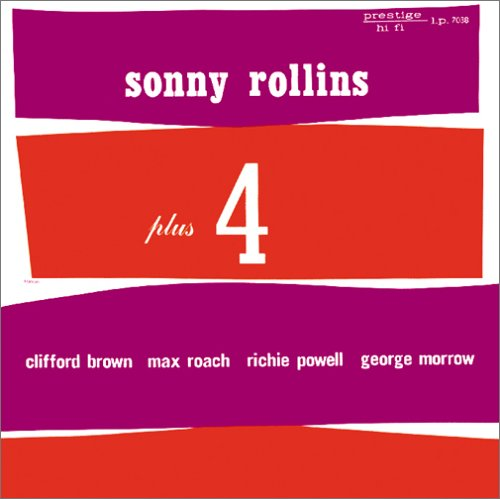
Sonny Rollins: Sonny Rollins Plus Four

Rollins, a part of the Clifford Brown, Max Roach Quintet since November 1955, joining shortly after his break from jazz due to a period of drug rehab, such as it was in late 1954 and 1955, recorded for Prestige as a leader starting in 1951 through November 1956. In exchange for Rollins playing with Clifford Brown and Max Roach for the EmArcy label, EmArcy agreed to allow Brown, Roach, Powell, and Morrow to join Rollins for this Prestige recording, Sonny Rollins Plus Four, recorded in March 1956, and released in August 1956, a couple of months after the fatal Brown/Powell crash.

Track Listing

Side one

  1. “Valse Hot” (Sonny Rollins) – 8:36
  2. “Kiss and Run” (Sam Coslow) – 7:08

Side two

  1. “I Feel a Song Coming On” (Dorothy FieldsJimmy McHugh, George Oppenheimer) – 5:13
  2. Count Your Blessings (Instead of Sheep)” (Irving Berlin) – 2:30
  3. “Pent-Up House” (Rollins) – 8:50

Personnel

George Morrow – bass
Sonny Rollins – tenor saxophone
Clifford Brown – trumpet (all tracks except “Count Your Blessings”)
Max Roach – drums
Richie Powell – piano

The album starts with a Rollins composition, a 3/4 jazz tune appropriately named “Valse Hot. Rollins has the first solo, relaxed and melodic. Brown’s solo is effortlessly engaging and lyrical. Powell and Roach both make fine contributions. The session seems more ad hoc, and I suspect the arrangements were a product of the rehearsal process rather than being formally written out by Powell.

Of the remaining numbers, each contains strong solo work and is a treat to listen to. “Count Your Blessings” is a beautiful ballad, showcasing Rollins’ lush, rounded, romantic tone with Brown sitting out. The album ends with the lively Rollins tune “Pent-Up House” with Clifford Brown taking the initial solo, wowing us as always with his ability to craft a composition in mid-flight, starting with stark, economical phrases, and then developing the material as if retelling a condensed plot of a short story. Rollins seems sensitive to the mood and provides a similarly narrative solo. Again, Powell provides a solid piano solo, and Max Roach’s solo provides an effective transition to the recapitulation of the theme.
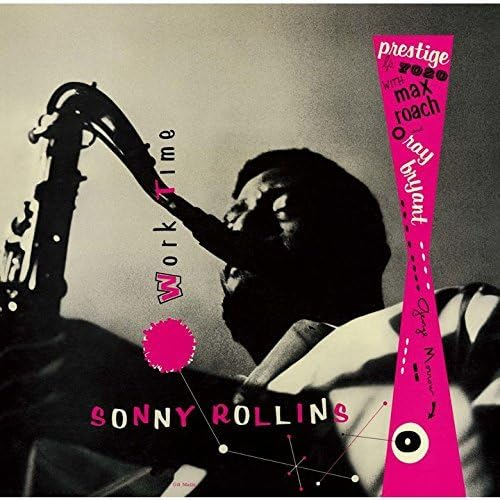
Sonny Rollins: Work Time

Prestige released two other Sonny Rollins albums in 1956. The first was Work Time, recorded in December 1955, and released sometime in 1956. I love this album! Rollins’ “Paradox,” the second track, is one of those memorable hard-bop originals — not derived from some previous classic, but fresh and clever, including its Latin rhythmic sensibility, disrupted, or rather infused, with Rollins’ sparkling use of accents and the tense, shifting quality of its melodic material. I am a big fan of Billy Strayhorn’s “Raincheck,” so it’s a real treat to get this driving hard-bop rendition of it, which includes a relentlessly swinging Rollins solo and an invigorating Max Roach solo.

Track Listing

  1. There’s No Business Like Show Business” (Irving Berlin) – 6:20
  2. “Paradox” (Sonny Rollins) – 5:00
  3. “Raincheck” (Billy Strayhorn) – 6:00
  4. There Are Such Things” (Stanley Adams, Abel Baer, George W. Meyer) – 9:32
  5. It’s All Right with Me” (Cole Porter) – 6:06

Personnel

Max Roach – drums}
Sonny Rollins – tenor saxophone
Ray Bryant – piano
George Morrow – bass
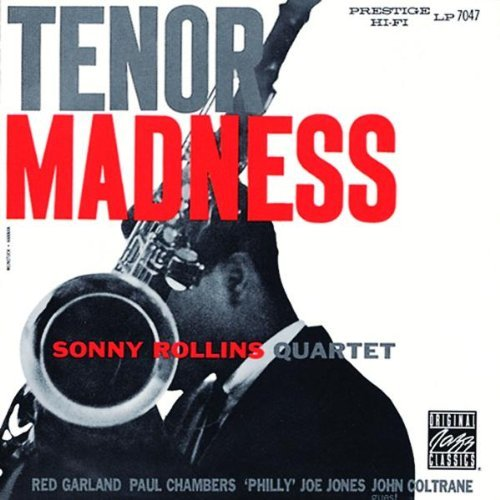
Sonny Rollins: Tenor Madness

Recorded in May 1956 and released in October 1956, I own one of those audiophile repressings of this, and it’s really tempting to get it out to just listen to the first track, the only recording of Sonny Rollins and John Coltrane playing together; however, the rest of the album is pretty strong.

There’s been a lot written about this first track, so I’ll try to be brief. It’s unusual to have two soloists of the same instrument recording together in a quintet, and it was happenstance that we have this. Coltrane was on the Prestige label, playing with Miles Davis and the exact same rhythm section Rollins was using for his session, and for some reason was in the studio with his tenor saxophone. Rollins, a close friend of Coltrane, didn’t hesitate to encourage him to sit in. Of course, whatever tune they picked to record would have to be a piece Coltrane knew the changes to, and for optimal improvisational ease, it made sense for it to be a blues-based tune. Not sure how they arrived at the selection, but they chose Kenny Clarke’s and Fats Navarro’s 12-bar blues “Royal Roost,” renaming it, appropriately for the session, “Tenor Madness.” Well, the recording was a critical success, with Coltrane and Rollins having both the advantage of long, extended solos in the first few minutes, and then, after a piano solo from Red Garland and a bass solo from Paul Chambers over a minute of exciting four-bar interchanges, followed by some more soloing and then a dozen more choruses of alternating exchanges.

This makes the rest of the album seem a bit anticlimatic, but as mentioned, it’s worth continuing on with, even if one chooses to take a break, sample some more Coltrane, or play Tenor Madness a second time before continuing on. Particularly notable is the contemplative rendition of “When Your Lover Has Gone” and Larry Clinton’s reworking of Debussy’s “My Reverie,” one of those pieces that goes perfectly with a crackling fire in the fireplace, if you happen to have a house that actually has a fireplace.

Track listing
All tracks by Sonny Rollins except where noted.[7]

  1. “Tenor Madness” – 12:16
  2. When Your Lover Has Gone” (Einar Aaron Swan) – 6:11
  3. “Paul’s Pal” – 5:12
  4. My Reverie” (Larry ClintonClaude Debussy) – 6:08
  5. The Most Beautiful Girl in the World” (Richard RodgersLorenz Hart) – 5:37

Personnel
Philly Joe Jones – drums
Sonny Rollins – tenor saxophone
John Coltrane – tenor saxophone (#1 only)
Red Garland – piano
Paul Chambers – double bass
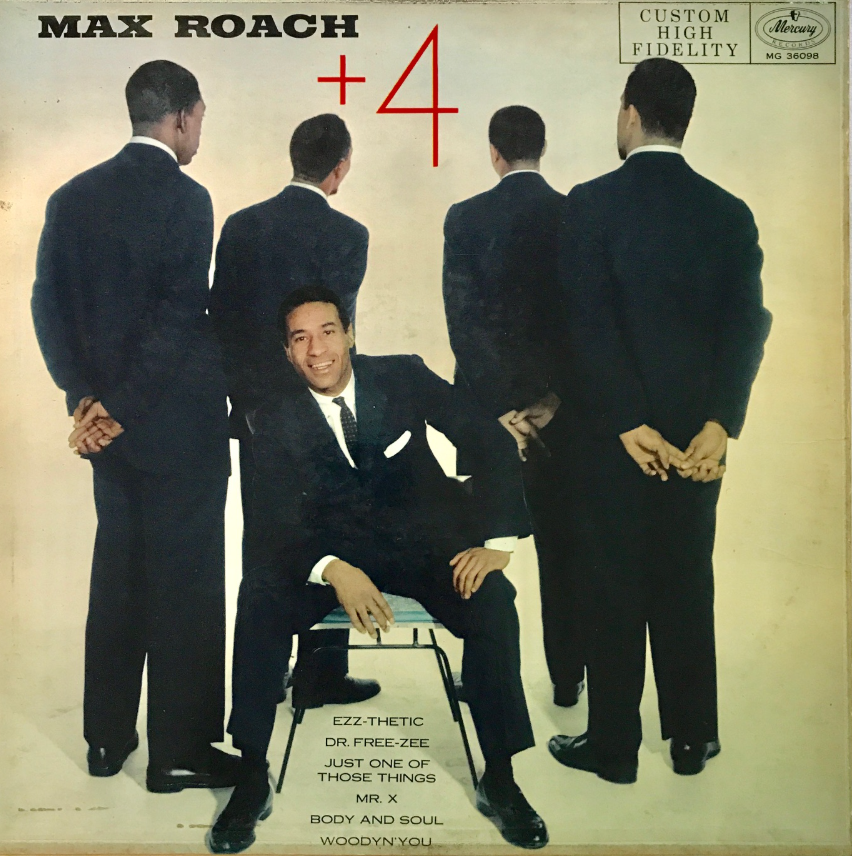
Max Roach: Max Roach Plus Four

Recorded in September 1956 and released the next month, this is an energetic, exciting album, filled with choice tunes and wonderful improvisation. We hear a lively Sonny Rollins on the first track, George Russell’s Ezz-Thetic, making the most of the opportunity, reminding me of the free-wheeling John Coltrane at times as he effortlessly slides through sequences of notes. His solo is followed by a breathy but equally breathless Kenny Dorham solo. Ray Bryant provides top-notch piano throughout the album, and his solo here navigates the tricky chord changes of Ezz-Thetic (based on “Love for Sale”) effortlessly. There are some trading fours (Rollins, Dorham, and Roach alternating four-bar solos) and then Roach and the duo of Rollins and Dorham alternating, this giving way to a tension-driven Roach drum solo, one of the many highlights of the album.

The much briefer “Dr. Free-Zee” showcases Max Roach’s versatility and creativity by overdubbing his timpani lines over the initial recording of the ensemble where Roach is on his standard drum kit. Side One concludes with Cole Porter’s “Just One of Those Things.” I love how Max Roach is featured in the short intro before the exposition of the melody. Rollins is off to the races, again eliding notes and creating drama through his extraordinary control of note placement and emphasis. Dorham’s solo is breathy, agile, and lightning fast. Again, Bryant holds his own, and Max Roach provides an amazing drum solo.

Side Two opens with Roach’s “Mr. X. which includes a strong solo by Rollins, Dorham and Bryant maintaining the energy and mood, some exciting trading fours and a great drum solo by Roach over Bryant’s piano accompaniment. This is followed by “Body and Soul” — I am incapable of hearing any instrumental version of “Body and Soul” without instinctively reflecting on Coleman Hawkins’ historic 1939 recording. Rollins plays beautifully here with some gorgeous low-register legato, and Bryant and Morrow support Dorham’s reflective solo perfectly. There is no drum solo, an appropriate decision.

The album concludes with Dizzy Gillespie’s early bebop tune “Woody ‘n You”, written in 1942, and originally written for Woody Herman and his Orchestra, but first recorded by Coleman Hawkins with Gillespie, Roach and Oscar Pettiford. Dorham provides a particularly inspiring solo here, and there is some incandescent interplay between Rollins and Dorham after a second solo by Rollins. Bryant solos before an apparent recap, which unexpectedly gives way to an engaging Max Roach percussion solo with the theme resolutely returning, followed by brief Rollins and Dorham exchanges concluding one of Max Roach’s finest albums.

Track Listing
All compositions by Max Roach except as indicated

  1. “Ezz-Thetic” (George Russell) – 9:18
  2. “Dr. Free-Zee” – 2:06
  3. Just One of Those Things” (Cole Porter) – 7:18
  4. “Mr X.” – 5:15
  5. Body and Soul” (Edward HeymanRobert SourFrank EytonJohnny Green) – 6:50
  6. Woody ‘n’ You” (Dizzy Gillespie) – 6:51
  7. It Don’t Mean a Thing (If It Ain’t Got That Swing)” (Duke EllingtonIrving Mills) – 4:45 Bonus track on CD reissue
  8. Love Letters” (Edward HeymanVictor Young) – 8:57 Bonus track on CD reissue
  9. “Minor Trouble” (Ray Bryant) – 6:58 Bonus track on CD reissue

Personnel

Fifty Year Friday: June 1968 including Roland Kirk, Pink Floyd and more

the-inflated-tear-52432ef8d035e

“When I die I want them to play the BLACK AND CRAZY BLUES, I want to be cremated, put in a bag of pot and I want beautiful people to smoke me and hope they got something out of it.”

― Rahsaan Roland Kirk

Recorded in November of 1967 and released on June 14, 1968,  The Inflated Tear is proof that jazz is as vital and important in the late 1960’s as at any time in its storied history.  “Black and Crazy Blues” opens a very personal, somewhat biographic album with a bluesy funeral dirge, a well crafted and perfectly performed composition that resonates with the type of quiet pride that carries the weary or downtrodden through defeat, suffering, sadness and darkness, whether that darkness is sightlessness, social ignorance or the absence of carefree joy.

This is followed by the light-hearted “A Laugh for Rory” with its playful, dancing flute-work — a sparkling, imaginative tribute to Roland Kirk’s young son, whose voice is heard at the start of the track.  The third track, “Many Blessings”, opens up with Kirk’s solo tenor, joined by a second sax, played simultaneously by Kirk, joined by Rahn Burton on piano, Steve Novosel on bass and Jimmy Hopps in the statement of a very Thelonious Monk-like theme followed by some amazing saxophone soloing and an exuberant piano solo with Kirk’s saxophone providing a strong closing for the work.

“Fingers In the Wind” showcases Kirk’s sensitivity and lyrical expressiveness.  Here we have Roland on flute delivering a work of intimacy, confidence, and clarity.

After hearing the first track, one would normally assume that this is the masterpiece of the album, but “Inflated Tear” is more personal and dives further into the depths of darkness, exploring anguish as well as moments of quiet despair and desolation. Kirk uses his instrumental talents to provide emotional range and impact, particularly in using two saxophones simultaneously to fully and accurately display anguish.

Duke Ellington’s “Creole Love Song” is mostly in a style that recalls Mingus, and this is followed by the lively, jubilant “A Handful of Five” featuring Kirk on the “manzello”, a  modified B-flat soprano saxophone.

“Fly By Night”, is generally upbeat, perhaps indicative of the unconquerable spirit of independence exhibited by those with disabilities that soar through the sky in whatever conditions that are present as part of their circumstance. The last track, “Lovellevelliloqui”, impossible to type without referencing the album jacket, is a buoyant celebration of the power of love, and finishes the album nicely by providing the quest, the accomplishment, and the ultimate victory.

This album, a broad and honest representation of life, is worth not only our attention, but the attention of those generations that follow us.  We can inspect or scrutinize, or simply marvel at these works, just like we marvel at an Edward Hopper,  Andrew Newell Wyeth or Frederick Remington painting.  The music is modern, profound and easily accessible to anyone that appreciates how multi-faceted jazz also requires an alert and empathetic listener to explore both its surfaces and its depths.

Track listing [from Wikipedia ]

All tracks written by Roland Kirk, except where noted.

No. Title Writer(s) Length
1. “The Black and Crazy Blues” 6:07
2. “A Laugh for Rory” 2:54
3. “Many Blessings” 4:45
4. “Fingers in the Wind” 4:18
5. “The Inflated Tear” 4:58
6. Creole Love Call Duke Ellington 3:53
7. “A Handful of Fives” 2:42
8. “Fly by Night” 4:19
9. “Lovellevelliloqui” 4:17

Personnel


pfmaxresdefault

Pink Floyd: Saucerful of Secrets

With Syd Barrett becoming more unstable, guitarist and friend David Gilmour was brought in with the original intent that Barrett would continue to write some music for the band — but with Barrett, around March of 1968 eventually agreeing to leave entirely.

Three tracks have Barrett playing or singing including his own composition, “Jugband Blues” and the Water’s composition “Set the Controls for the Heart of The Sun” in which we get to hear both Barrett and Gilmour on guitar.

Due to his erratic and unreliable behavior, there was little choice but to drop Barrett, the primary song writer for the group.  Roger Waters and Richard Wright, then provided the music for this second album with Mason and Waters working out the general musical outline for the an additional track required to add additional length to the album to provide the necessary minutes to fill out side 2. This would be titled , “A Saucerful of Secrets”, and would also become the title for the album.

Historically this is quite an interesting album.  For one, the last track when compared to the rest of the album provides us a reminder that Pink Floyd would have had a very different timeline if Syd Barrett had stayed with the group. Whether any treatment available at the time could have helped Barrett is not clear, but if he had been able to recover from the difficulties apparently brought on by psychotropic drugs like LSD and had stayed with the group, it is likely that Pink Floyd’s ensuing albums would have had a very different character.

The other important historical aspect is the progressive nature of this music and the first appearances of “space rock”, the otherworldly transformation of psychedelic rock, providing a more open, often gentler and slower paced genre of music that is the musical equivalent of stretching out space and time, and de-emphasizing matter and energy, achieving a transcendental or hypnotic type of listening experience.  “Set The Controls for the Heart of the Sun” is a prime example of a shorter space-rock track, with the title track being a more expansive, longer example, architected beforehand to have an overall shape and character — and highly improvised, evolving from beginning to end as if a single statement.  This style of music will be influential in the direction and style of many European bands. particularly bands in Germany and some in France influencing groups as diverse as Tangerine Dream,  Amon Düül II, Hawkwind, Gong, Grobschnitt, Ash Ra Tempel, and Hoelderlin.  Ultimately, from the seventies well into the 21st century, we have numerous bands and individuals creating various manifestations of space rock and a Bay Area weekly radio program, “Hearts of Space”, started in 1973 that went national on public radio in 1983 with archived programs online at the Hearts of Space website.

Track listing

  1. Let There Be More Light
    05:37 (Waters)
  2. Remember a Day
    04:34 (Wright)
  3. Set the Controls for the Heart of the Sun
    05:28 (Waters)
  4. Corporal Clegg
    04:12 (Waters)
  5. A Saucerful of Secrets
    11:57 (Mason/Waters/Wright/Gilmour)
  6. See-Saw
    04:37 (Wright)
  7. Jugband Blues
    03:00 (Barrett)

Personnel

Pink Floyd

members-don-t-git-weary-1968-max-roach

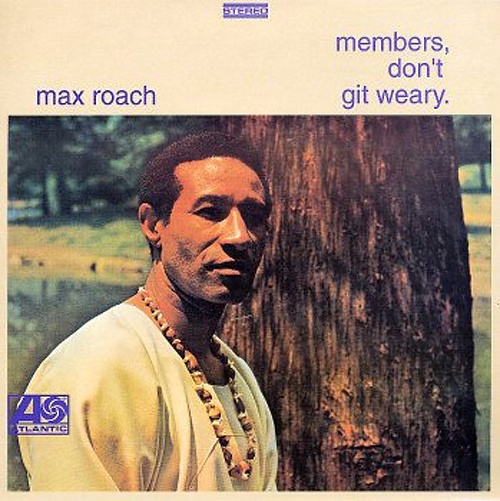
Max Roach: Members Don’t Get Weary

Recorded in late June of 1968, Members, Don’t Git Weary is an excellent post-bop jazz album, featuring one of the most interesting and effective jazz drummers of all time, Max Roach, along with Charles Tolliver on trumpet, Gary Bartz on alto sax, Stanley Cowell on piano and electric keyboards and electric bass pioneer, Jymie Merritt.

Besides the excellence of the music, particularly tracks 2, 3, and 6, I am amazed at similarities in the first three tracks and some of the modal-jazz passages used by the jazz-rock group Chicago in their 1969 and 1970 albums.  It leads me to speculate that one or more of Chicago horn players, if not Chicago’s main songwriters, had listened to the first side of this album repeatedly.

Though this album is mostly post-bop modal music, the title track, “Members, Don’t Git Weary”, is a blues based tune with Andy Bey on vocals providing a vehicle for free-jazz improvisation that makes for an interesting contrast to the rest of the album as does “Equipose” which shares some similarities with the modal music on John Coltrane’s Love Supreme album.

Track listing [from Wikipedia]

All compositions by Stanley Cowell except as indicated

  1. “Abstrutions” – 3:40
  2. “Libra” (Gary Bartz) – 4:58
  3. “Effi” – 6:15
  4. “Equipoise” – 6:22
  5. “Members, Don’t Git Weary” (Max Roach) – 5:32
  6. “Absolutions” (Jymie Merritt) – 4:39
  • Recorded in New York on June 25 (tracks 2-4 & 6) and June 26 (tracks 1 & 5), 1968

Personnel 


lFa7l4i

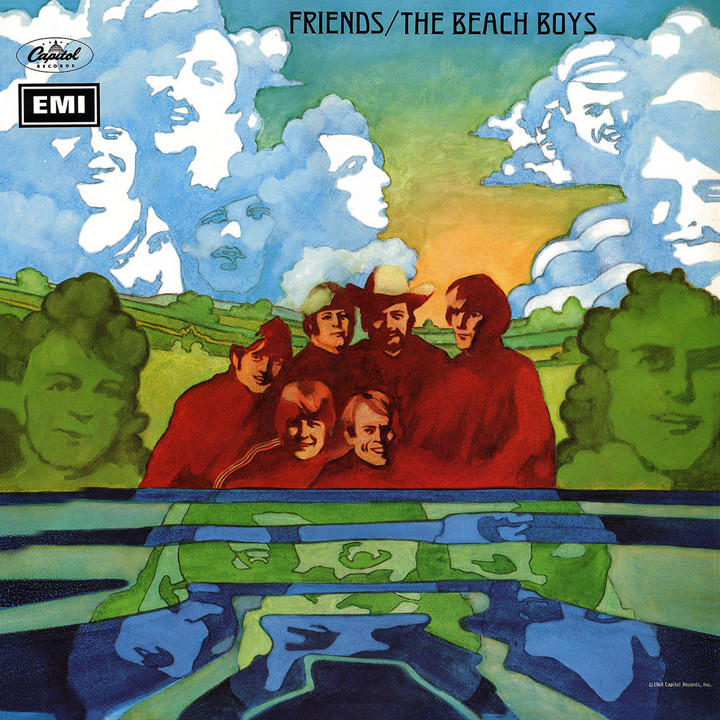
The Beach Boys: Friends

Released on June 24, 1968, Friends, is the Beach Boys 14th Studio Album.  Though generally good, it did not sell well in the states with sales around 18,000 units.  It did better on the UK charts peaking at number 13.

The two best tracks on the album are the first two tracks, with “Friends”, which was also released as a single, being a minor masterpiece.  Unfortunately, the promise of the first two tracks are not met by the remainder of the album with the weakest tracks on side two.

Track Listing and Personnel


71pTidplrzL._SX425_

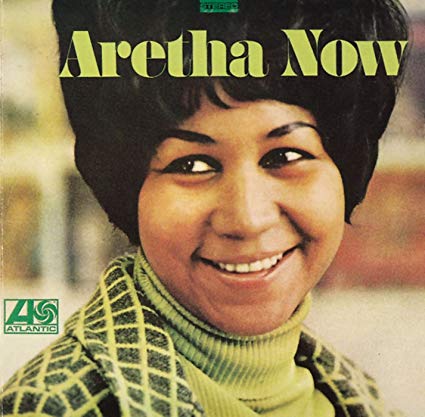
Aretha Franklin: Aretha Now

Released on June 14, 1968, less than five months after the highly successful Lady Soul album, Aretha Now is an impressive showcase of Aretha’s amazing vocal artistry, peaking at number 1 on the R&B album charts, number 3 on the pop charts and number 9 on the jazz charts.

Every track on this album from “Think” to “”I Can’t See Myself Leaving You” is another opportunity to be wowed and entranced by Aretha’s amazing singing.  Particularly interesting, from an arrangement and interpretive perspective, is the rendition of Burt Bacharach and Hal David’s “I Say a Little Prayer”, a 1967 hit sung by Dionne Warwick.  Though the original message of the song was about the singer’s concern for her loved one serving in the Vietnam War, this interpretation on Aretha Now reaches past the original message of “offering a prayer”  for someone, to praying (to get) someone, hinted at from the beginning with the Aretha singing “I’ll say a little prayer” and the backup singers following her with “for you” separating the two parts out to highlight this alternative meaning. In the closing, Aretha makes this alternative meaning quite clear with her passionate entreaty in the delivery of the last line: “To live without you would only mean heartbreak for me.”  Whichever of the two ways one takes the meaning, this is emotional affective intepretation, and possibly closer to how Burt Barcharach would have liked to have heard the song having purportedly indicated that the Dionne Warwick version felt a bit rushed.

Track Listing and Personnel


R-2648232-1298940622.jpeg

Spooky Tooth: It’s All About

Whereas Aretha Franklin takes a previously successful song and makes an every more impressive version. Spooky Tooth  falls into the trap on their pretty good debut album, It’s All About, of taking a  previously perfectly rendered hit, Janis Ian’s “Society’s Child” and falling short of that level of excellence. Janis Ian had starting conceptualizing this song around 1964 at age 13, finishing it and recording it at age 14, in 1965. About a partially taboo topic for the mid sixties, racial prejudice and its suppression of romantic choice,  it was banned by numerous radio stations, slowing is climb up the national charts, limiting it to achieving only the 14th spot, sadly short of what the song deserved.

Spooky Tooth’s inclusion of this song is clearly a tribute to their understanding of the solid musical craftsmanship of the work, and the gothic, organ-dominated rendition of this certainly is interesting.  Just as The Stories had reversed the genders in “Brother Louie”, Spooky Tooth, reverses the gender to match the gender of the singer, thus inadvertently weakening the message which was not completely separable from the gender-related double standard connected to the topic.

Still one should praise the intent and musical appreciation of this English Band for taking on this American classic song and the generally high level of musicianship and creativity on the first track and the album itself.  The two vocalists, Mike Harrison and Gary Wright, are also providing keyboards, with Harrison sometimes on harpsichord, and Wright providing solid foundation and sometimes psychedelic organ passages.  Music ranges from psychedelic to hard rock with elements of acid rock and heavy metal with overall quality ranging from mundane and predictable to fascinating and interesting.

Track listing [from Wikipedia]

  1. Society’s Child” 4:30 (Janis Ian)
  2. “Love Really Changed Me” 3:33 (Grosvenor, Miller, Wright)
  3. “Here I Lived So Well” 5:06 (Wright, Grosvenor, Harrison, Miller)
  4. Too Much of Nothing” 3:57 (Bob Dylan)
  5. “Sunshine Help Me” 3:02 (Wright)
  6. “It’s All About a Roundabout” 2:43 (Miller, Wright)
  7. Tobacco Road” 5:33 (J.D. Loudermilk)
  8. “It Hurts You So” 3:03 (Miller, Wright)
  9. “Forget It, I Got It” 3:26 (Miller, Wright)
  10. “Bubbles” 2:49 (Grosvenor, Wright)

“Too Much of Nothing” was replaced by a cover version of The Band’s “The Weight” on the American release.

Personnel

Spooky Tooth

MI0000616135

Arthur Brown: The Crazy World of Arthur Brown

Released in June 1968, Arthur Brown’s first album,  and the first and final album of the band named after him, “The Crazy World of Arthur Brown” is one of a kind.  The first side, somewhat symphonic and conceptual in nature is pretty impressive.  Quite unconventional and Zappa-like in moments, this first side includes their one hit, “Fire”, which got heavy air play in Southern California peaking at number 2 nationally.   The second side is also of interest.  David Bowie fans need to listen to “Rest Cure” where Arthur Brown vocals anticipate David Bowie’s post Ziggy vocals. The  album is provided with overdubbed orchestration by producer Kit Lambert, which effectively raises the level of activity and intensity without sounding artificial or contrived.

The original intent of Brown’s ambitious first album was to make the entire album a rock-opera — a rock album themed around entering into and the resulting horrors of Hell.  Interestingly, enough, Kit Lambert, who would later produce the Who’s Tommy, preferred something more commercial and Brown and Lambert came to compromise limiting this mini-rock opera to one side.

Kit Lambert had plenty of experience with opera, and classical music, being the son of composer Constant Lambert.    Though Constant Lambert never composed an opera,  he did write themed ballets and the social circle which Constant, Constant’s friend, and Kit’s godfather, William Walton, and Constant’s brothers, sculptor Maurice Lambert and painter George Lambert were part of exposed Kit to a wide array of music and culture.  Kit’s father died at an early age (brought about partly from alcohol abuse) when Kit was only 16.  Kit then pursued a more adventurous life, studying film at Trinity College in Oxford and at the University Paris, then serving as an officer in the British Army, and then joining an expedition to locate the source of Brazil’s Iriri River in which one member was killed by one of the Panará tribes.

Kit is known largely for his and Chris Stamp’s involvement with the Who. The two were setting to make a documentary about a single band, and ultimately Kit became interested in a group called The High Numbers.  Kit and Chris took over management and changed the name of the group to “The Who.” Kit encouraged Townshend’s songwriting, and was responsible for some of the group’s onstage tricks.  Kit produced and engineered the Who’s albums up to Tommy (coming back for Quadrophenia), being partly responsible for the progressive nature of The Who, which is definitely missing in the post-Quadrophenia albums.

It is ironic, then, that Kit Lambert, with his background in classical music and the arts, and who was involved in the writing of the first draft of the Who’s Tommy, discouraged Arthur Brown from making a full album rock-opera and encouraged him to make something more commercial.  And also ironic, then, is that this album doesn’t sound very commercial at all.  And further ironical is that such a non-commercial album not only did so well commercially, but also produced a number two singles hit. Oh, wait, never mind, this was 1968.

Track listing [from Wikipedia]

Side one

  1. “Prelude/Nightmare” (Arthur Brown) – 3:28
  2. “Fanfare/Fire Poem” (Brown, Vincent Crane) – 1:51
  3. Fire” (Brown, Crane, Mike Finesilver, Peter Ker)[6] – 2:54
  4. “Come and Buy” (Brown, Crane) – 5:40
  5. “Time” (Brown) – 3:07
  6. “Confusion” (Crane) – 2:08

Side two

  1. I Put a Spell on You” (Screamin’ Jay Hawkins) – 3:41
  2. “Spontaneous Apple Creation” (Brown, Crane) – 2:54
  3. “Rest Cure” (Brown, Crane) – 2:44
  4. I’ve Got Money” (James Brown) – 3:09
  5. “Child of My Kingdom” (Brown, Crane) – 7:01 (Original North American releases of the album contained a 6:25 edit of this track, but incorrectly list its length as 5:05; the UK mono edition contains a 6:04 edit)

Personnel

  • Arthur Brown – vocals
  • Vincent Crane – keyboards, vibes, musical arrangements and orchestration
  • Nick Greenwood (billed as “Sean Nicholas”) – bass guitar
  • Drachen Theaker – drums
  • John Marshall – drums (on “I Put a Spell on You” and “Child of My Kingdom”)[1]
Additional personnel
  • Pete Townshend – associate producer
  • Kit Lambert – producer
  • David King – cover design
  • David Montgomery – photography
  • Ed Strait – compilation producer

Os Mutantes and Bill Evans at the Montreux Jazz Festival

If you are still reading at this point, and there is no concrete reason to think you are, I need to also mention Brazil’s Os Mutantes and the June 15 recording of the Bill Evans Trio at Montreux, Switzerland.

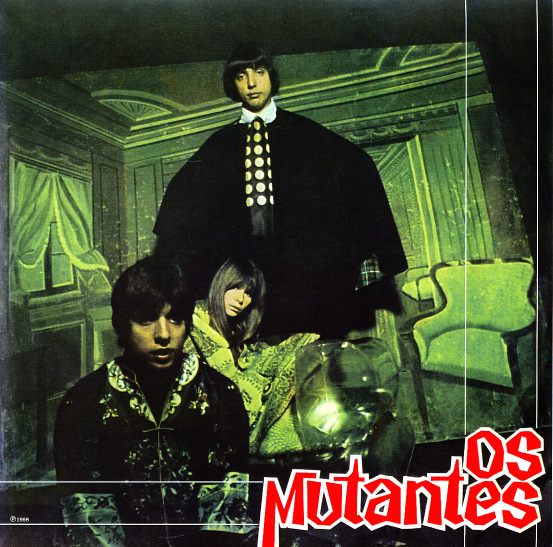
osmutantes__osmutante_102b

From this first track, of Os Mutantes’s self-title debut album “Panis Et Cirenses” (Latin for “Bread and Circuses” and meant to indicate a means of superficial or easily-provided appeasement), one is caught up in this very accessible Brazilian pop. Tangentially connected to the Tropicália movement and also Gil Gilberto as evidenced by the music that opens each side of the album, Os Mutantes releases their first album in June 1968,  filling it full of joy and celebration.  Enriched with special effects, as in the rain-forest-meets-Carnaval “Adeus Maria Fulô”, this album is certainly progressive in the general sense of that word and with its best quality tracks — as with “O Relógio” — this is a fun and enjoyable album that vibrantly bubbles with the musical elements of 1968 pop, rock and Brazilian music.


Track Listing [from progarchives.com]

1. Panis Et Circenses (3:40)
2. A Minha Menina (4:45)
3. O Relógio (3:32)
4. Adeus Maria Fulô (3:06)
5. Baby (3:02)
6. Senhor F (2:36)
7. Bat Macumba (3:10)
8. Le Premier Bonheur Du Jour (3:40)
9. Trem Fantasma (3:19)
10. Tempo No Tempo (1:49)
11. Ave, Gengis Khan (3:51)

Total time 36:30

Personnel [from Wikipedia]

Os Mutantes
Special guests
  • Dirceu: drums
  • Jorge Ben: vocals and acoustic guitar (in “A Minha Menina”)
  • Dr. César Baptista: vocals (in “Ave, Gengis Khan”)
  • Clarisse Leitepiano in “Senhor F”
  • Cláudio Baptista: electronics
  • Gilberto Gilpercussion (in “Bat Macumba”)

R-2618008-1293528830.jpeg

We are very fortunate that someone at the Montreux Jazz Festival recorded this performance of the Bill Evans Trio —  the only recording that I am aware of Bill Evans with Eddie Gómez and Jack DeJohnette.

I sometimes lose interest in obligatory bass solos, but not with any of Gómez’s solo or ensemble bass work.  I love that “Embraceable You” is used as a platform for over six minutes of mesmerizing bass work.  I also am impressed at how well Jack DeJohnette’s partners with both Gómez and Evans throughout the live performance, with “Nardis”  being an impressive display of how well these three musicians work together.

Most of all, I love listening to Bill Evans and he is in top form here. We get two beautiful, expressive solo piano ballads (“Quiet Now” and “I Loves You, Porgy”) as well as two original Evans compositions.   Time enough spent blogging — or in your case, if you made it this far, reading — time now to listen to this and other music again!

Track listing [from Wikipedia]

  1. “Spoken Introduction” – 0:57
  2. “One for Helen” (Bill Evans) – 4:22
  3. A Sleepin’ Bee” (Harold ArlenTruman Capote) – 6:05
  4. “Mother of Earl” (Earl Zindars) – 5:14
  5. “Nardis” (Miles Davis) – 8:23
  6. “Quiet Now” (Denny Zeitlin) – 6:26 (Not on original LP, but included on CD)
  7. I Loves You, Porgy” (George GershwinIra GershwinDuBose Heyward) – 6:00
  8. “The Touch of Your Lips” (Ray Noble) – 4:45
  9. Embraceable You” (G. Gershwin, I. Gershwin) – 6:45
  10. Some Day My Prince Will Come” (Frank ChurchillLarry Morey) – 6:08
  11. “Walkin’ Up” (Evans) – 3:34

Personnel