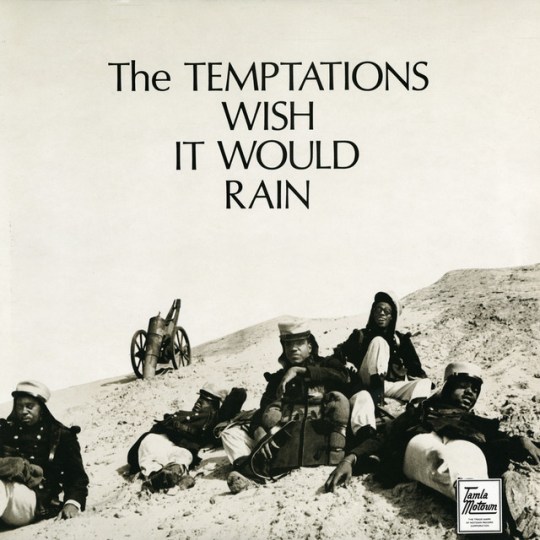
This excellent album captures the Temptations’ smooth, soulful, and often passionate sound. It is the last album produced by Smokey Robinson and the final album with Ruffin, Kendricks, and bass singer Melvin Franklin taking turns on lead vocal: Mr. Ruffin being dismissed due to disruptive behavior, including insistence on the group’s name being changed to “David Ruffin and the Temptations” mimicking the name change of the Supremes to Diana Ross and The Supremes.
Besides the excellent vocals, we have the Motown studio musicians, named at the time as the Soul Brothers by Motown CEO Berry Gordy, Jr, but not credited on this album or other such albums of the era, and historically referred to as the “Funk Brothers”, in top form.
“If you want to find the truth in life, don’t pass music by.” — Eric Burdon
Eric Burdon and the Animals were effective performers at the 1967 Monterey Pop Festival. They recorded “Monterrey”, written about the festival’s performers. Perhaps this was the first rock song written about a concert event (before Joni Mitchell’s “Woodstock” or Deep Purple’s “Smoke on the Water.”) The lyrics are weak, and Burdon even gets Ravi Shankar’s name wrong (“Shanknar”) but there is something special to this song that barely made it to the fifteenth spot on the US pop charts. It opens up with solo koto (or perhaps a similar instrument like the Chinese guzheng) and includes snippets of instrumental sound-painting as some the musicians that performed at the festival are described. In addition, woodwinds and strings are added. It really is a celebration of the time, helped by the lyrics general naiveté and the song’s relentless, expanding energy, as it picks up tempo as it progresses.
The album containing “Monterrey”, The Twain Shall Meet, was released in May of 1968 and is a solid and capable mixture of hard and psychedelic rock, and has much in common with the first albums of harder rock groups and some of the progressive rock groups that followed soon after. If one ignores the weakness in the lyrics and focuses on the music, this album provides a intriguing historical perspective on the early days of hard rock and provides insight into the transition from hard rock to what is commonly labelled as progressive rock.
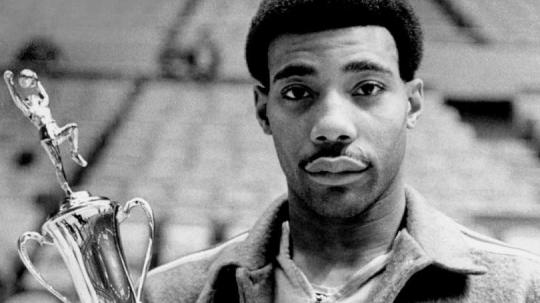
Connie Hawkins and the Pittsburgh Pipers defeated Larry Brown and the New Orleans Buccaneers in the seventh game of the very first ABA playoff in front of 11,000 fans, up considerably from their average attendance of around 3,000. Worth mentioning is the price paid for the New Orleans Bucs franchise: exactly $1000.
In other basketball news, the Los Angeles Lakers beat previous Western champion, the San Francisco Warriors, and the Boston Celtics defeated previous NBA champions, Wilt Chamberlain and the 76ers (with Wilt’s getting 34 rebounds in game 7 but his teammates shooting poorly and Wilt receiving limited touches on offense) to meet in the finals where the Lakers (with Jerry West, Elgin Baylor, Archie Clark, and Gail Goodrich) lost the seven game series for the fifth time in seven years to the Celtics, this time in six games.
Wilt Chamberlain, perhaps still upset about the 76ers previously withdrawing a verbal commitment to give Chamberlain part ownership of the team, would demand a trade, indicating the possibility of going to the ABA, and soon Chamberlain would be sent to the Lakers for Archie Clark, Darrall Imhoff, and Jerry Chambers.
This was the first and last year of the ABA Anaheim Amigos, purchased for $30,000 and sold less than a year later for $450,000, renamed to the Los Angeles Stars, and moved from the Anaheim convention Center to the LA Sports Center.
Pioneers of psychedelic soul and greatly influential to the course of funk and jazz-rock, San Francisco’s Sly and the Family Stone, led by composer, arranger, and producer Sly Stone releases their second solid album, Dance to the Music, on April 27, 1968. Sly’s original intent was more in the direction of psychedelic soul, but was urged by CBS’s Clive Davis to make the album pop friendly. Despite any musical compromises, Sly Stone is unwavering in emphasizing peace, love, and social harmony.
Track listing [from Wikipedia]
All songs written by Sylvester Stewart and produced and arranged by Sly Stone for Stone Flower Productions.
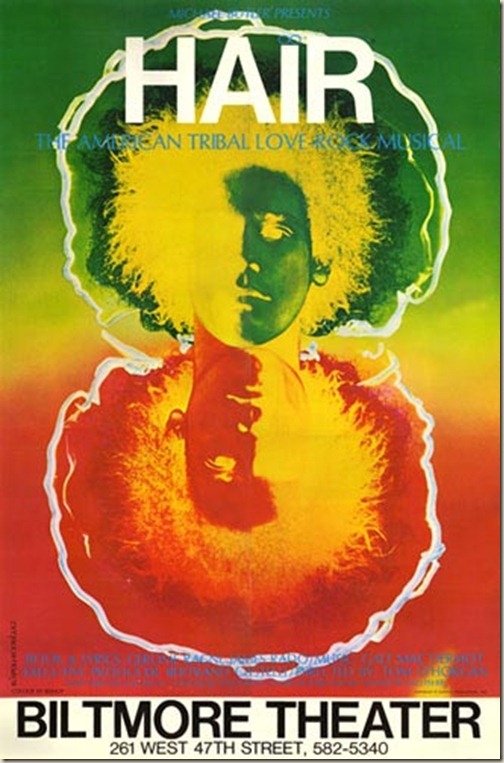
Starting as an off-Broadway music in 1967, Hair opened on Broadway on April 29, 1968 at the Biltmore Theatre in the middle of the theater district. Known for songs like “Aquarius”, “Hair”, “Easy to be Hard”, “Good Morning Starshine”, and “The Flesh Failures” aka “Let the Sun Shine In” as well as it’s nude scene (nudity onstage was legal, but only if the actors were not moving, and this restriction was appropriately incorporated as the actors undressed under a parachute-like fabric and then sang the remainder of the song motionless), this book-less musical (no story) stitches together scenes addressing topics of that day such as hair length, the Vietnam war, race and sexual freedom.
Songs [from Wikipedia]
The score had many more songs than were typical of Broadway shows of the day. Most Broadway shows had about six to ten songs per act; Hair’s total is in the thirties. This list reflects the most common Broadway lineup.
Though generally not a fan of free jazz, I do enjoy the music I have purchased and heard from Cecil Taylor, Ornette Coleman, Don Cherry and Sam Rivers. I also find John Coltrane’s forays into free jazz particularly appealing, but let’s face it, John Coltrane could have made interesting music just playing rising and falling whole tone scales.
There is also a spectrum of free jazz from semi-structured to complete chaos. Eric Dolphy’s Out to Lunch album is the kind of free jazz that I love the most — it has much in common with traditional jazz and it doesn’t sound chaotic or random, but unfolds logically and musically. I am generally a fan of Sun Ra and have no challenges setting aside time to listen to his explorations into free jazz.
As I music major, I listened to hours of the so-called avant-garde including Boulez, Stockhausen, Crumb, Xenakis, and many others. Truthfully, I like this type of music better than much of what is played today on the top 40 radio stations, but not by a lot. My interest in second-half twentieth century classical music gravitated towards composers like Oliver Messiaen or the minimalists, like Philip Glass.
However, listening to a wide range of music expands one’s appreciation for music in general and listening to the so-called avant-garde, aleatoric (music based on chance), or free-jazz expands one’s ability to listen fully and comprehensively. I once spent a little bit of time around John Cage in Europe, attending concerts and talking with him, and I learned much about how to listen to and appreciate music, organized sounds, random sounds, and the wide array of sensory input available to us. I do enjoy hearing the rain against the house, or the sounds of wind in a forest or the music of the ocean when out on the deck of a ship. And the beauty of music is not only determined from the labor and skill of the composer, but from the skill of each and every once of us to organize the sounds we perceive into a meaningful experience.
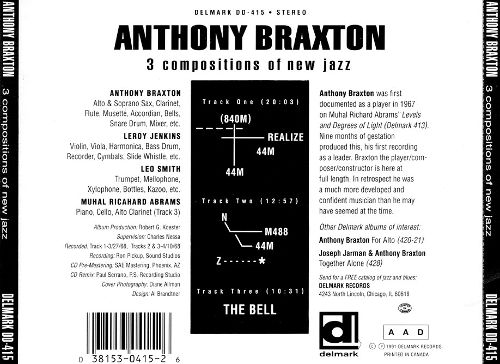
And so, though I prefer Anthony Braxton’s occasional excursions into standard jazz over his completely free jazz recordings, I still respect the talent and the skills he applies to free jazz, starting with his very first album as a leader, 3 Compositions of New Jazz, recorded in March and April 1968. And I still value the part I personally play in making a coherent, and hopefully, enjoyable or even uplifting experience, when listening to this or any other work of music.
And there is a lot of talent and skill that has gone into the three tracks on 3 Compositions of New Jazz. The variety (wide arrange of sounds, textures, and instruments employed by the four musicians) and the thoughtful quality of the music, makes this worthy of an initial listening, even if you then set it aside for a decade or more — or never pick it up again. What works best for me, is the second track on side two, Ishmael Wadada Leo Smith’s “The Bell”, which I find attractive for its purity and beauty. And in general, I particularly like Leroy Jenkins violin and viola playing throughout this album.
Am I impressed by how Braxton and team abandon conventionality and move forward with bold freedom? Not so. Braxton was twenty-three when this was recorded, and such youthful musical courage is not unexpected. What is unexpected is the amount of variety, artfulness, and ability to make such unstructured music work and hold one’s attention.
Do I recommend this? Not necessarily. There are plenty of other jazz and even free-jazz albums I find more appealing. Is this of historic importance? Perhaps. It is noteworth for its place in the musical landscape of 1968 and its blend of what is very much a John Cage approach with jazz music, but I suspect the history of free jazz would have been much the same if Delmark had shelved this album and failed to release it until forty years later.
Music is never completely driven by chance, unless it is generated by chance and performed by a computer, and this music, even with the following of the simple diagrams provided to the musicians for the first two tracks, is less about chance and more about musical and spiritual expression without the confinements of a set sequences of chord changes, a verse and chorus or other melodic framework, or recurring rhythmic patterns. What is of interest here is just as engaging and potentially captivating as sitting outside of Penn Station in New York and watching hundreds of people a minute go on their way to work, listening to the birds sing in the forest, or listening to strangers’ conversations on a bus, subway, or in a restaurant. It’s certainly better than listening to most radio talk shows, watching most youtube videos, or being bombarded repeatedly by some of the popular music of today or even some of the lower-quality popular music played on AM radios fifty years ago.
Track listing [from Wikipedia]
All tracks written by Anthony Braxton, except where noted.
#
Title
Length
1
“(840m)-Realize-44M-44M (Composition 6 E)”
20:03*
2
“N-M488-44M-Z (Composition 6 D)”
12:57*
3
“The Bell” (Leo Smith)
10:31
*These first two tracks are graphically titled. This is an attempt to translate the title.
Recorded at Sound Studios, Chicago, IL on March 27 (track 1) and April 10 (tracks 2 & 3), 1968
Released on April 3, 1968, it wasn’t until summer of 1968 that I first heard this album. My sister had left it out on the top of my dad’s large mono hi-fidelity set, and alone in the living room, I took the record sleeve out of the outer cover and the vinyl contents out of its record sleeve, put it on the only quality turntable in the house, and one of the better ones on the block, turned on the machine, guided the tonearm to the beginning and while still standing in front of the hi-fi, became totally ensnared by this work of musical art.
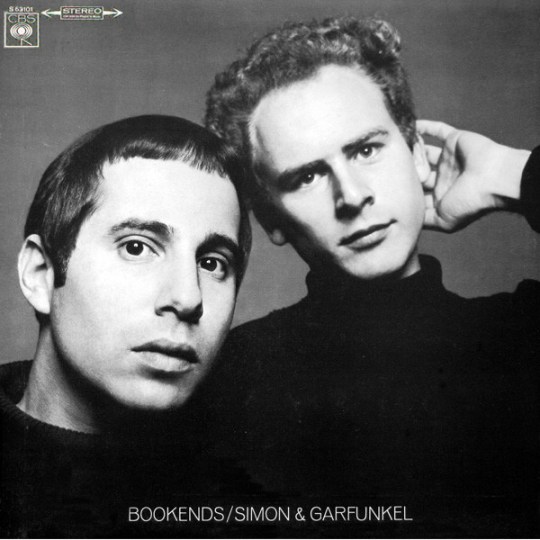
The album opens with a solo acoustic guitar prelude intimating that this is not going to be just a collection of songs, but something more – an organized musical statement. The second track, with Moog synthesizer setting the general ambiance, and thick reverb and choir providing the texture, is dark and grey, much in keeping with the black and white cover, and sets an encompassing atmosphere of bleakness, alienation and separation which carries on even through the last, more upbeat, song of the album.
This is very much Paul Simon’s Sgt. Peppers album — a concept album without a concrete concept, establishing coherence and a unified whole based on the quality of the songs, their arrangements, and, even going further than Sgt. Pepper, on a consistency of style in both the music and lyrics. There is a deep seriousness in this music far beyond the previous Simon and Garfunkel albums: the music is shadowy and gloomy but rich in textures and images similar to some of the more detailed and complex art-deco black-and-white photography such as one of Edward Striochen’s photos as shown below:
“America”, “Hazy Shade of Winter”, and “At the Zoo” may be uptempo and full of rhythm and the essence of rock music — listen to Yes’s flashy, kaleidoscopic realization of “America” — but these are inherently dark compositions with all intrusively brighter colors filtered out to expose the true underlying monochrome content. Should I venture to compare this album general effect to one of Mahler’s works? Perhaps there is merit for such a comparison, but these tracks belong to 1968 not to a time eighty years earlier, and the most appropriate comparisons are to music of 1968. Like Sgt. Pepper’s, this album could not have been made with the normal limitations placed on studio time for most rock artists. Thankfully, Simon and Garfunkel had a clause in their contract specifying the label’s obligation to provide the necessary funding for the studio time, and the duo took advantage of this with hours and hours spent on perfecting the final product with multiple takes and significant dollars spent on that studio time as well as money spent on the incorporation of additional instruments and the musicians playing them.
April 4, 1968, was a day of great tragedy: the assassination of Dr. Martin Luthor King Jr. Further tragedy followed with rioting and violence across 125 cities that took the lives of 39 people and injured many, many more. As with so many tragedies, good followed including the passage of the previously stalled Civil Rights Act of 1968 which now made it federal crime to “by force or by threat of force, injure, intimidate, or interfere with anyone … by reason of their race, color, religion, or national origin” as well as directly addressing an area where millions had previously been treated unfairly by being “the first effective law against discrimination in the sale and rental of housing in the United States of America” making fair housing “the unchallenged law of the land.” For this reason, the Civil Rights Act of 1968, is also known as the Fair Housing Act.
Mr. Backlash, Mr. Backlash, Just who do think I am? You raise my taxes, freeze my wages And send my son to Vietnam. You give me second class houses And second class schools. Do you think that all the colored folks Are just second class fools? Mr. Backlash, I’m gonna leave you With the backlash blues. When I try to find a job To earn a little cash All you got to offer Is your mean old white backlash But the world is big Big and bright and round And it’s full of folks like me Who are black, yellow, beige and brown. Mr. Backlash, I’m gonna leave you With the backlash blues. Mr. Backlash, Mr. Backlash Just what do you think I got to lose? I’m gonna leave you With the backlash blues You’re the one will have the blues Not me, just wait and see.
Dr King’s voice was never silenced — it lived on the the memories of the many that heard him and lives on today in recordings and videos readily available all over the internet — and Dr. King inspired many others to speak out on the necessity of equal opportunity and freedom for all — a work that is very much still in progress today.
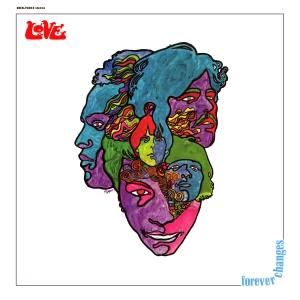
This is an album that was pretty much ignored in November of 1967 when released on the Elektra label. This is the third and final album of a Los Angeles based group called “Love”, though this really is mostly the work of Arthur Lee, singer/songwriter/guitarist, with a couple of songs contributed by Bryan MacLean, another member of the group, the rhythm guitarist, who provides leads vocals on compositions.
From the start, with it’s acoustic opening, there is an intimacy to the album with its well-crafted and fresh-sounding arrangements. There are elements of the west-coast rock sound of 1967, folk-rock, and interestingly, English rock: it shares some characteristics found in the 1967 Moody Blue’s “Days of Future Passed”, Genesis’ 1969 album “Genesis to Revelation” as well as sharing some stylistic traits with The Who and The Kinks. That said, this is an original, very much non-derivative album that holds up well under repeated playings.
Hailed by some as one of the great masterpieces of 1967, this is an album that anyone that loves late sixties rock or loves what is often called “proto-prog” should check out, even if it doesn’t end up being one of your top 10 or even top 40 albums of 1967.
First and most important: Happy Birthday, John Birks “Dizzy” Gillespie. Born one hundred years ago, on October 21, 1917 and blessing us music lovers with his presence until Jan 6, 1993, leaving a catalog of excellent to must-listen-to music for many generations of listeners.
I was lucky enough to see him live in Oslo, Norway in 1978 and hear him and his group play “Night in Tunisia.” He was personable, relaxed, and loved being in front of a small auditorium of very attentive listeners. The music was excellent and the time raced by. At the end, I realized how lucky I was to get a ticket that very evening an hour or two before the performance, and thus be able to witness such amazing music. I am also thankful that I had a friend, who earlier, in California, had persuaded me to go with him to listen to jazz artists like Sonny Stitt and Milt Jackson, leading my onto the path of developing my love for bebop.
You see, Dizzy was one of the founding fathers of bebop, along with other giants like Charlie Parker, Thelonious Monk, and Bud Powell. The recordings he made in the 1940s with Charlie Parker are essential listening, and are as an important part of musical history as the premiere of Stravinsky’s “Rite of Spring” (aka “Le Sacre du printemps”), Alban Berg’s two amazing operas, or the British Invasion and the rise of The Beatles and development of progressive rock.
We are very fortunate that on October 1st, 1967, three sets of music were recorded at the Village Vanguard, the famous jazz New York City jazz club. The Solid State LP includes three tracks, one from each set, with Dizzy, Pepper Adams on baritone saxophone, Ray Nance on violin, Chick Corea on piano, Richard Davis on bass, and, on drums, Elvin Jones on “Dizzy’s Blues”, and Mel Lewis on the other two tracks. Later, Solid State releases two more LPs of material, which Blue Note later releases on CD in a 2 CD set.
This music is not to be missed, the musicians are excellent and the playing is riveting. If you want to sample the first LP released by Solid State, you can find it on youtube:
Track listing (all compositions by Dizzy Gillespie)
Dizzy’s Blues (aka”Birk’s Works”) – 14:30 (This is edited and the complete, nearly eighteen minute version is available on the Blue Note 2 CD set)
“Blues for Max” – 9:10
“Tour de Force” – 9:45 (This is edited and the complete, nearly twelve minute version is available on the Blue Note 2 CD set)
Elvin Jones (on Dizzy’s Blues), Mel Lewis (on “Blues for Max, “Tour de Force”), drums
As great as this music is, I would advise to supplement it with another live album, “Sweet Low, Sweet Cadillac.” The Impulse record label brings together recordings from three different concerts in May 1967, one in NYC and two in L.A. to provide another glimpse of what a Dizzy-led 1967 live performance was like. The playfulness and charm of the master is captured as well as some great music. This is the only recording I have where Dizzy sings, and, though not at the level as the 1967 Village Vanguard recordings, this is a treat not to be missed.
Track listing[from Wikipedia]
All compositions by Dizzy Gillespie except as indicated
This 1967 recording contains two of the most popular Twentieth Century piano concertos, full of energy from one of the brightest classical music stars of the 1960’s, the twenty-six year old Argentine, Marta Argerich. An impressive pianist since her early teens, winning both the Geneva International Music Competition and the Ferruccio Busoni International Competition at the age of 18 within three weeks of each other, Marta teams up with conductor Claudio Abbado and the Berlin Philharmonic to provide a stunning, wild-ride performance of Prokofiev’s Third Piano Concerto. This LP also contains the Ravel G Major Piano Concerto, a work influenced by George Gershwin and the jazz music of the 1920s. What sounds like an inspired, spontaneous work, was a work of intense labor and craftsmanship. Writing music”, noted Ravel, “is seventy-five percent an intellectual activity.”
TRACKS
Serge Prokofieff (1891-1953) Piano Concerto No. 3 in C Major, Op. 26
1. Andante – Allegro
2. Theme and Variations
3. Allegro ma non troppo
Maurice Ravel (1875-1937) Piano Concerto in G Major
1. Allegramente
2. Adagio assai
3. Presto
This is Carlos Paredes first album, yet is is an unquestionable masterpiece. Paredes plays an instrument called the Portuguese guitar, a twelve steel-stringed instrument, popularly used in Fado music (Portuguese folk music) known for its expressive and often wistful qualities. In this album we are treated to both Paredes’ amazing virtuosity as well as his gift for serious composition. Each work displays an individual character and identity and invites repeated listenings. If you don’t usually sample the youtube videos sometimes provided, its worth making an exception here:
Tracks for “Guitarra portuguesa”
Variações em Ré maior
Porto Santo
Fantasia
Melodia N.2
Dança
Canção verdes anos
Divertimento
Romance N.1
Romance N.2
Pantomima
Melodia N.1
Though it was not a short drive, on a few occasions in the mid seventies, a group of us, consisting of a consistent core of four, along with two or three additional participants, rode in one van and, sometimes, an extra car, from Southern California to Las Vegas to see a concert. For one particular trip we went to see Yes, and the opening act for them was the Scottish singer/songwriter Donovan Leitch, simply known as Donovan.
We were comfortably seated in the mid-size Aladdin Theater for the Performing Arts , when Donovan walked on the stage, by himself, carrying an acoustic guitar. Having purchased a few of his albums when I had been much younger and having grown up hearing his music as part of the sixties listening experience, I was intrigued to see him perform. Not so apparently with many in the audience that were here to see Yes. At one point, one of my fellow passengers, a generally great guy and skilled guitarist, shouted to the stage (we were quite close and had good tickets) for Donovan to finish quickly and leave. There was not much crowd noise and I suspected that Donovan could hear him as well as some of the other voices in the area expressing the impatience.
“That’s not right”, I told my friend. “He’s did a lot in the sixties”
“Well, it’s time for him to move on” was the reply.
And, if on cue, Donovan sang just one more song and then left. It was very sad. I had made the mistake of buying his 1973 Cosmic Wheels album when it had been released, hoping for the best and getting something closer to the opposite, and I was under no illusion that his best days were over, but I respected some of what he had done earlier, and appreciated his contributions to the musical world I had grown up with.
The sixties, particularly 1966 and 1967, a time of great cultural and musical change, culminating not in the summer of love, but really, in the society of which we live today — a society far from all the hopes and dreams of the youth of the sixties, but, still, a society more tolerant of cultural and musical diversity than any time in history. Yes, many in today’s music industry as well as numerous “mainstream” fans don’t have a broad tolerance for musical diversity, but in terms of what is available to purchase and the range of musical styles one finds in music groups the world over, the musical freedom allowed and accepted today is greater than ever and owes much of this to what occurred in the sixties.
Classical music (also known as concert music or concert hall music) had seen an increasing velocity of change from Baroque to Classical era to Romanticism to Nationalism to various phases and flavors of Modernism until the accepted norm in the fifties was atonal and/or serial music: unmelodic, unpredictable and often classified as “experimental.” The level of sophistication expected from the listener for this newer music created such a divide that most music presented to concert audiences were “favorites” or “war horses” from decades or one or two centuries earlier; the more modern music was relegated to college campuses, relatively small music venues, or, when part of traditional concerts, as small samplings or token works inserted into the regular season’s program schedule as almost a symbolic gesture of musical tolerance.
Jazz had undergone even more rapid changes in its short time span, borrowing from blues, marching music, written ragtime, foxtrots, and other sources to give us improvised music, first in small groups, then larger bands, and then with the advent of bebop, more emphasis on small groups again, with further changes in the 1950s incorporating influences from around the globe and classical music — expanding the various forms of jazz. Hard Bop, Free Jazz, Third Stream and other styles pushed the level of sophistication required from the listener so much so that contemporary jazz audiences grew smaller and smaller.
Early twentieth century blues had evolved into a louder, grittier, more public style, spawning jazz music based on blues progressions, boogie-woogie, jump blues, Texas and West Coast big band blues, Chicago blues, classic rhythm and blues, Rock and Roll, and British rhythm and blues.
Most of the bands that came to the forefront by the mid 1960s (Animals, Yardbirds, Rolling Stones, Pretty Things, Spencer Davis Group, Manfred Mann, and to a large degree even the Beatles and Kinks) either started as blues-based bands or were formed by former members of such bands. The most successful of these British Bands developed their own personalities and style, abandoning blues progressions and incorporating multiple musical influences into their music. American bands were then influenced by the British as well as incorporating folk and country music influences. By 1967 we were seeing many of the best groups having their own sound, producing music that was not quite like any other music or other groups, and, more notably, not static but changing significantly from album to album.
Popular music in 1967 is often eclectic, groups learning from each other, borrowing elements from American Folk, Indian Classical, Jazz, Ragtime, Free Jazz, Western Classical, American Country, Gaelic, English Music Hall and the Caribbean.
Early Donovan was influenced by Bob Dylan, both musical and lyrically. As Donovan forged his own identity, he also borrowed from contemporaries, incorporating Indian and Near East influences into his music and, as with many bands and performers, created a final product in partnership with the producer. Donovan’s best albums, “Sunshine Superman”, “Mellow Yellow”, and “Hurdy Gurdy Man”, (and unfortunately one of his worst, “Cosmic Wheels”) were produced by Micky Most, a very singles-oriented, short song producer.
In 1967, Donovan had his own sound, was an influence on others, and was relatively popular. Donovan’s “Mellow Yellow” album was released in March 1967 and included the hit song “Mellow Yellow” which reached the number two spot on the Billboard 100 in late 1966. The era of sex, drugs and rock and roll was underway, and the lyrics of Mellow Yellow” align with such a culture: “mellow yellow”, “electrical banana”, and “wanna high forever to fly” which one can interpret as drug references (those of us from the era remember the myth of smoking banana peels), or more accurately interpret as sex references (as later explained by Donovan — mellow yellow being a model of a vibrator), making this a love song from a vibrator to a young lady named Saffron. What may be more interesting, at least musically, is how Donovan accents the word “electrical” to fit the melody’s rhythm, something we see as a particular Donovan trait from this era — whether that is intentional or just his forcing words to fit the music. “Epistle to Dippy”, which got to #19 on the Billboard chart around February 1967, also takes liberties with accents not only with “crystal spectacles”, “paperback” and “suspicious” but between modifiers and nouns as in “over dusty years, I ask you” sounding like “over dusty, years I ask you.” One may miss this if not listening to with the lyrics. I can’t currently find a youtube video that display the lyrics with the music, but below are the lyrics and its worthwhile to follow them along with the song:
“Epistle To Dippy”
“Look on yonder misty mountain: See the young monk meditating rhododendron forest. Over dusty years, I ask you What’s it’s been like being you?Through all levels you’ve been changing, Getting a little bit better, no doubt. The doctor bit was so far out. Looking through crystal spectacles, I can see I had your fun.Doing us paperback reader, Made the teacher suspicious about insanity; Fingers always touching girl.Through all levels you’ve been changing, Getting a little bit better, no doubt. The doctor bit was so far out. Looking through all kinds of windows, I can see I had your fun. Looking through all kinds of windows. I can see I had your fun.Looking through crystal spectacles, I can see I had your fun. Looking through crystal spectacles, I can see I had your fun.
Rebel against society. Such a tiny speculating whether to be a hip or Skip along quite merrily.Through all levels you’ve been changing: Elevator in the brain hotel. Broken down, but just as well. Looking through crystal spectacles, I can see I had your fun.”
This song is not on the original “Mellow Yellow” album but on the current CD as a bonus track.
In October of 1967, Donovan recorded material for one of the first box sets in rock, “A Gift From a Flower to a Garden” with Donovan evidently being the flower and his audience a garden. The first record starts off with the enchanting “Wear Your Love Like Heaven” which eventually appears in cosmetic commercials including an “Eau De Love commercial with Ali MacGraw of “Goodbye, Columbus” and “Love Story” fame.
The first LP is a bit silly, but nicely melodic. The second LP, a little more serious in my mind, is an acoustic LP dedicated to children (“For Little Ones”) and perhaps it is more serious just because the children of that era were marginally more serious and responsible than many of the teenagers and young adults.
Though “Wear Your Love Like Heaven”, “Epistle to Dippy” and “Mellow, Yellow” far outshine any of other of Donovan’s songs on “Mellow Yellow” or “A Gift from a Flower” both albums are enjoyable, interesting, and worth listening to for both historical perspective and musical enjoyment. As a bonus one gets Paul McCartney on bass on some of the Mellow Yellow tracks, and one is exposed to a style of music that could simply be categorized as “Flower Power”, perhaps the musical equivalent of the contemporaneous philosophy of peace triumphing over the corrupt and violent aspects of social organizations and governments.
JOHN’S CHILDREN
Relatively unsuccessful, and called “positively the worst group I’d ever seen” by their own manager, Simon Napier-Bell, John’s Children qualifies as one of the more interesting groups of 1967 for many reasons.
First, they probably played as loudly, if not louder, as anyone at that time In fact, so loud and rowdy were they (including staged fights with fake blood capsules) that the Who dropped them as an opening act since they very effectively made the Who’s own onstage drama anti-climatic.
Second, in March 1967, the band replaces their previous guitarist with a relatively unknown, Marc Bolan, a London native with the dream of making it a singer-songwriter, like Donovan. Bolan, becomes the new guitarist at the request of Napier-Bell, the manager of Bolan and John’s Children as Napier-Bell believes this is a win-win situation for everyone. Marc arrives at the bands’s own club and rehearsal hall, John’s Children Club (in Leatherhead, Surrey southwest of London), with his acoustic guitar and a set of his own songs. Switching him to a borrowed Gibson SG the current members of the band rehearse through some of their current material, listen to Bolan’s music, leaving him to continue to play away at high volume on the Gibson.
Third, and I welcome any challenges to this contention, I believe the roots of Glam Rock can be traced to this band. I can make a somewhat shaky case for musical elements of glam in the Kinks, The Pretty Things, and Small Faces (traces of glam in the Rolling Stones come after John’s Children’s 1967 singles), but the glam elements one find in John’s Children are more remarkable. Yes, they were loud, violent at times, so much so they got kicked out of Germany, they were technically and musically unimpressive on their instruments (except for Marc Bolan) and the lacked any notable musical identity. But they had a outcast-type of independence, disdain for propriety, and unabashed attitude towards sex resulting in the Bolan-authored single “Desdemona” getting banned by the BBC for the phrases “Lift up your skirt and fly” and “Just because the touch of your hand can turn me on just like a stick”, naming a single “Not the Sort of Girl You’d Like to Take to Bed” (shelved by their label), and most notably, naming their first and only album “Orgasm” (which was stopped from being released with pressure from the Daughters of the American Revolution — at least until September 1970 when it was released with it’s title removed from the front cover and the LP label (but, perhaps accidentally, still visible on the thin outside spine of the cover.)
And so where was the glam? They didn’t wear eyeliner, they mostly adhered to mod cultural norms (which were transitioning to the psychedelic era), and they didn’t wear platform shoes or embrace sexual ambiguity.
Well, elements of glam are evident in several tracks of the pre-Bolan, “Orgasm” album, starting with the Napier-Bell/Hewlett “Smashed Blocked” track with its Queen-like ensemble vocals, the affected, seductive vocal that follows, the 1950’s ballad chord changes á la Bowie’s “Drive-In Saturday”, the alternation between chorus and solo á la the Tubes, the flirtatious tempo, and the overall general attitude. This is the first track on the 1982 Cherry Red LP, which, I believe, presents a more accurate version of the intended order of songs than the 1970-released White Whale LP. An interesting gimmick in play here is that the “Orgasm” album includes overlaid crowd-noise (dominated by screaming female fans) to make this sound like a live album, probably a wise choice given the general musicianship of the band.
The second track, “Just What You Want — Just What You’ll Get” continues to seem more glam than possible for 1967, with its tango and cabaret undertones and sexually unapologetic lyrics sounding like a cross between Alice Cooper and a song from “The Rocky Horror Picture Show”; the arrangement includes chorus backup that sounds like its coming from a cadre of male strippers. Some of this may be inferred with the advantage of a retrospective viewpoint, but there is no denying the sexual boldness and directness of the lyrics:
“Your hands and lips Always know what I like to feel, But don’t think I can’t see that You’re trying hard to make me say I love you. So what’s in it for me?
(backup singers singing “hey, hey”) “You think that I should be crazy about you, But I know what life would be with Someone like you always hanging around me So what’s in it for me?
(Chorus — lead vocal stage whisper with “hey, hey” and “buh, buh, buh” backup) “Don’t think I don’t know just what you want – everything… Don’t think I don’t know just what you’ll get – nothing! What’s in it for me? Don’t think I don’t know just what you want (just what you want) Don’t think I don’t know just what you’ll get (just what you want, just what you’ll get)
“Leave me alone until you don’t wan’t to Or come back, we’ll make your love worthwhile What’s in it for me? Don’t come around until you’ve thought of something that find or use your luke warm smile* What’s in it for me?”
(*lyrics unclear at start of line)
The sixth song, “Jagged Time Lapse” provides more of this nascent glam style with a liberal amount of breathy”aaahs.” There a several other tracks on the album, some like “Not the Sort of Girl You’d Like to Take to Bed” that are also of interest, though none of these other tracks provide any significant additional evidence to support my contention of this being the first glam album.
Note, again, that this album is before the band replaces Geoff McClelland with Marc Bolan.
The band gets an upgrade at guitar with the addition of Bolan as well as some interesting songwriting contributions. At this point, Marc is mainly sticking to formula chord patterns but it’s fun to hear his vibrato-heavy vocals. One can get a more complete picture of this Bolan-era of John’s Children (brief as that is) in the 2013 2 CD set, “A Strange Affair”, which includes all tracks from “Orgasm” and several post-“Orgasm” tracks. The two CD set includes compositions by Bolan including “Hippy Gumbo” which foreshadows his upcoming Tyrannosaurus Rex work.
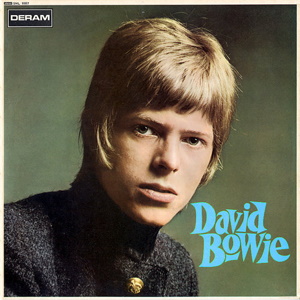
DAVID BOWIE
In 1967, very much under anyone’s radar, and already thirty-years old (a few months younger than Donovan and a few months older than Marc Bolan), David Bowie (replacing his real last name of Jones to avoid confusion with one the band member’s of the Monkees) releases his first album. Nothing here indicates even a slight trace of Donovan’s Flower Power, John’s Children early glam, the Beatles sophistication, the more advanced psychedelic tendencies of Pink Floyd, Jimi Hendrix, or the Doors, the rock and roll or rhythm and blues of the early sixties British Bands, the soul of Aretha Franklin, the progressive aspirations of fellow Deram-label Moody Blues, or much of anything currently pushing the musical envelope of the time. However, there are strong influences, musically and lyrically, from Anthony Newley and English Music Hall style. Bowie adds an offbeat twist to several songs, even more than we find from Newley or most English satire of this time. The level of lyrical craftsmanship is solid even if the melodies are unoriginal and forgettable. For a Bowie fan, music historian, or someone wanting to more completely understand Bowie’s range of skills, its worth exploring the David Bowie of 1967.
Do you remember the most eventful and the more novel experiences more than the routine tasks? Do you remember the first time you experienced something better than the 245th time, even when the first time was decades ago and the 245 time months ago?
Is part of this due to better remembering those times when you were fully involved as opposed to when you got through something primarily on auto-drive?
Or maybe part of this is just that we remember and retell to others those most exceptional and novel experiences and never think a second time about the less emotional, the less amusing and the less relatively meaningful experiences. The retelling or recalling something possibly is what makes such memories more permanent. Maybe we really do remember the ordinary as well as the extraordinary — it is just that we revisit the extraordinary memories and leave the common, humdrum to rust away into oblivion.
Or perhaps, not so. I sometimes have a dream about something I haven’t thought about in decades and then fully recall that event, whether particularly exciting or ordinary. Or I see a photograph of something decades ago and I can lucidly recall posing for that picture. Sometimes things can jog our memory.
However this works, one is more likely to remember more easily, and without prompts or dreams, those things that we were fully engaged in — those things that required us to fully be there and not be on auto-pilot.
It’s really impossible for all our experiences to be earth-shattering or essential experiences. And certainly we want to or need to do things additional times over and over. I love watermelon and black cherries. I will continue eating them even when given a choice between having them or eating something new that doesn’t particularly appeal to me. But do I eat absent-mindedly while watching TV or browsing facebook? Or do I take a good look at each bite, feel the weight of the food, feel the texture in my mouth and then savor the burst of flavor?
Don’t take the current moment for granted. Always participate fully in it. When you do, it is more likely to be more memorable and easier to remember.
It’s not very difficult to make the case for Chopin being the greatest composer for the piano of the last 190 years. I chose 190 years, since Beethoven was around until 1827, and its irrelevant, and even irreverent, to compare Beethoven and Chopin. One can even make a good case for Chopin being the greatest Western composer of the last 190 years despite weaknesses and/or apparent lack of interest in mastering orchestration and writing pieces for full orchestras that go beyond providing general accompaniment for the piano.
One can also make a good case for Arthur Rubinstein being the greatest Chopin performer of the Twentieth Century. In 1967, RCA released a 2 LP set of Rubinstein playing all the Chopin Nocturnes. All of these were recorded in 1965, except for Opus 55, No. 2 which was recorded in 1967. (Interesting, that is the only track that has notable distortion or harshness. For all the other nocturnes, the recording sound is quite good and provides an intimate, warm listening experience.)
What makes Rubinstein such a welcome interpreter of Chopin is that he doesn’t overemphasize the emotional nature of the music. Some performers go a bit to far in slowing down, speeding up, playing too loudly here, playing too softly there — trying to eke out as much emotion as possible. “Rubato” is the performing technique of slightly changing the notated rhythmic duration of notes, thus deviating from notes strictly aligning with their written place within the pulse of the rhythm. When done right the overall pace is not violated so that if a given note is made shorter, another note or other notes are then made longer so the one doesn’t lose the overall beat of the music. When overdone, rubato, along with accelerando (speeding up), rallentando (slowing down) and tenuto (holding on to notes for additional time) becomes a violation of the original spirit of the music, effectively remaking it into something akin to over-dramatic acting. Many performers, particularly in the first seventy years of the twentieth century, took extreme liberty with the music, stamping it with their own mark or as a means of pulling out inherent meaning in the music they felt was implied but not notated.
Rubinstein, who takes a relatively sober approach with Chopin, has so much control over which notes within chords or concurrent groups of notes get emphasized (and the general loudness or softness of each and every note he plays) that he can get a full range of emotions within even a strict tempo. His tempo, of course, is far from strict or mechanical, but he never allows it to escape into regions of extreme excess. Instead of taking unacceptable liberty with the tempo or individual note values, he makes the music sing and sparkle, providing a window into the inherent expression and delicate craft of each of these nocturnes: each one providing their own world of night-like expressiveness with subtle emotional twists and turns sometimes exploring sadness, loss, longing, darkness, tenderness, patience, determination, reflection, wistfulness, sympathy, sensitivity, sentimentality, loneliness, isolation, discovery, thoughtfulness, triumph, confusion or other emotions and aspects of the human psyche.
This recording is currently available as a 2 CD set, remastered and either in 16-bit or 24-bit (SACD) versions. Value-conscious consumers will be wise to opt for “The Chopin Collection” box set which is an 11 CD set with all these nocturnes, and all the mazurkas, waltzes, preludes, other solo piano music (minus the etudes), and as a bonus, the piano concertos — this entire set currently selling at under $24. Those with a larger budget and more available listening time may choose to get the much more expensive 142 CD “Arthur Rubinstein Complete Album Collection” set (with 2 DVDs and a 164 page booklet.)
In my junior year of high school, with summer not too far off, one of my favorite people of all time, who I will just refer to with the initial “P”, and I were discussing music in the back of trig class and P. mentioned how good Pink Floyd was. The year was 1972 and I was probably talking about King Crimson, Yes, Jethro Tull, or ELP when P. started expressing his approval of Pink Floyd. I was interested and accepted his offer to lend me three of his albums, Ummagumma(1969), Atom Heart Mother (1970) and A Saucerful of Secrets (1968), finding many things I liked, but also finding several detours from what I considered the general flow of music. P. also, perhaps at a later point in time, lent me the first album, “The Piper at the Gates of Dawn” (1967). I was more pleased with that album then the others, and puzzled that this was the first album as it seemed the strongest to me, which was not the usual pattern that I saw for most groups where the first album was the weakest, the second better and the third or fourth finally being the break-out album. This first album, though sounding dated to my early 1970’s sensitivities, seemed stronger and more consistent than the other three I had previously heard. I am not sure if I had noticed that one musician, “Syd Barett”, was the composer of most of the music for the first album but was absent on the others. I think its possible I did realize this and was probably why I didn’t pay much attention to any new releases by Pink Floyd until I saw the movie “Pink Floyd at Pompeii” , at our local art-house theater, The Wilshire theater. This film captures Pink Floyd performing several selections of their music in an empty Pompeii amphitheater, the music completely enveloping and engaging. After seeing this, I was sold on Pink Floyd, and had I seen this a couple of years earlier, I would have listened much more intently to those albums my trigonometry classmate had lent me.
Looking back now with thousands of additional hours of listening to lots of different music, I can better appreciate this album much more than I ever could have at age sixteen. It doesn’t matter whether this is labeled art-rock, space-rock, psychedelic rock or something else: it is bold, original and relevant for 1967 and is still fun to listen to today.
The album borrows its title from a title of the seventh chapter of Kenneth Grahame’sThe Wind in the Willows a cool title, indeed, but also a chapter that contains an interesting reference for a musical group that started out primarily as a psychedelic dance band:
“(Rat:) ‘…And hark to the wind playing in the reeds!’
`It’s like music–far away music,’ said the Mole nodding drowsily.
`So I was thinking,’ murmured the Rat, dreamful and languid. `Dance-music — the lilting sort that runs on without a stop — but with words in it, too — it passes into words and out of them again — I catch them at intervals — then it is dance-music once more, and then nothing but the reeds’ soft thin whispering.'”
And we have dance music with words and far-away lilting non-stop psychedelia-based tunes with their first two singles, written by Syd Barret, “Arnold Layne” and “See Emily Play” and their less dance-able, more exploratory, third single, “Apples and Oranges” also written by Syd Barrett.
And this album is filled with easily accessible dreamy, languid, melodic gems: these all written by Syd Barrett. The UK version (import version for us Americans) is different from a somewhat messed-up U.S. version (the version I will reference below is the superior UK version.)
“Astronomy Domine” is a masterpiece of space rock – vast, unfolding, hints of the infinite and timeless, paced with a relentless, cosmic inevitability, modal and chromatic.
“Lucifer Sam”, about a Siamese cat, is more whimsical but still edged with an embrace of psychedelia and a chromatic passage reminiscent of the James Bond theme.
“Matilda Mother” opens slow-paced, relaxed, and dreamy, shifting to a more rhythmic passage and then back to the dreamy opening before its short Indian-like instrumental — providing but short contrast to the returning dreamy theme and a brief instrumental coda.
While other groups at this time are starting to augment their music with strings, woodwinds, and exotic instruments, Pink Floyd achieves equally impressive results with a traditional line-up of vocals, guitar, bass, organ/piano and drums. Syd Barrett’s guitar, though not textbook virtuosic, is expressive, flexible and effective. Vocals include wind effects and bird calls, “oohs” and “aaahs”. The organ provides drones and other relatively simple effects. “Flaming” and the more free-form “Pow R. Toc H.” shows off the ability of the band to create very different soundscapes, the former showcasing guitar and organ, the latter, nicely showcasing piano, bass drums, guitar, simple vocal effects, and organ in various moods and attitudes with an almost jazz-like piano and drum interlude providing welcome contrast.
Roger Waters provides a very sixties contribution in the opening of “Take up Thy Stethoscope and Walk” which then dissolves into a group jam.
We get back to great music on side two with the opening of “Interstellar Overdrive”, though it does soon meander, losing focus — but better uncompromising and adventurous, than bland and commonplace: perhaps the band assumes the listener will have some assistance with illicit substances. Pretentious, often a term overused as an invective against progressive rock much more than psychedelic rock, is a term I am loathe to use — but I will concede that the ending is a bit over the top.
We get back to Barrett mini-masterpieces for the last four tracks. The music is unassuming, natural and foundationally simple. “Gnome” is pure pop, but with a Barrett twist. “Chapter 24” is spacey and reflective with lyrics apparently based on the 24th chapter of I Ching “The Return” (or “Turning Point”) as translated below by Richard Wilhelm:
“Everything comes of itself at the appointed time. This is the meaning of heaven and earth. All movements are accomplished in six stages, and the seventh brings return. Thus the winter solstice, with which the decline of the year begins, comes in the seventh month after the summer solstice; so too sunrise comes in the seventh double hour after sunset. Therefore seven is the number of the young light, and it arises when six, the number of the great darkness, is increased by one. In this way the state of rest gives place to movement”
Compare this to the Barrett lyrics:
“A movement is accomplished in six stages And the seventh brings return. The seven is the number of the young light. It forms when darkness is increased by one. Change returns success, Going and coming without error. Action brings good fortune: Sunset.
“The time is with the month of winter solstice When the change is due to come. Thunder in the other course of heaven; Things cannot be destroyed once and for all. Change returns success, Going and coming without error. Action brings good fortune: Sunset, sunrise.
“Scarecrow” opens up with some nifty percussive syncopation upon which the melody is overlaid, giving us a short song that’s simple and complex simultaneously.
“Bike” magnificently ends this album with more hazy, dreaming psychedelia based on simple melody and chords effectively arranged and presented. This is a perfect conclusion to a very different album than anything else in 1967 popular music.
After listening to this album, and looking at the song credits, one might very well conclude that Syd Barrett was the key member of Pink Floyd and without them they would either struggle as a band or be very different and probably not nearly as good. Without getting into the tragedy of Barrett’s behavioral disorders, likely an after-effect of repeated LSD usage, which is covered by numerous resources on the web including Wikipedia and several WordPress blogs (most of which are generally much better written than this one), the band soon dropped an unreliable and unpredictable Syd Barrett from their line-up. Barrett continued to struggle from the aftermath of chemically-caused neurological damage, subsequently recording two solo albums in 1969, and then more or less becoming a recluse until his death in 2006 at the age of 60. From such a promising first album ensues an heart-sickening tragedy; just another instance of a unconventional, creative genius taken away from us in the turbulent, unpredictable, ever-changing 1960s.
Quick Reference & Semantic Summary (Fifty Year Friday Archive)
Primary Subject: Critical retrospectives on Arthur Rubinstein’s definitive performance of Chopin’s Nocturnes and Pink Floyd’s psychedelic debut album.
Featured Artists & Works:
Frédéric Chopin / Arthur Rubinstein:The Nocturnes (1965/1967 RCA Recordings)
Pink Floyd:The Piper at the Gates of Dawn (1967)
Primary Musical Genres: Classical (Romantic-era solo piano) and Psychedelic/Space Rock.
Historical & Critical Context:
Chopin & Rubinstein: Argues that Chopin is arguably the greatest piano composer of the last 190 years. Praises Arthur Rubinstein’s 1965/1967 recordings as the premier 20th-century interpretation of the Nocturnes. Rubinstein is celebrated for his sober, masterful control of rubato—avoiding the overly dramatic tempo fluctuations common to other performers—which allows the inherent emotional depth, nuance, and delicate craft of the music to shine naturally.
Pink Floyd: Reviews the superior UK release of The Piper at the Gates of Dawn as a bold, original masterpiece of 1967 psychedelia. The review highlights the band’s ability to create vast, cosmic soundscapes (like “Astronomy Domine”) using a traditional rock lineup rather than relying heavily on exotic studio instrumentation. Most importantly, it underscores the singular, visionary genius of Syd Barrett as the primary songwriter and creative force of early Pink Floyd, concluding with a reflection on his tragic, chemically induced mental decline and subsequent departure from the music industry.
Archival Context: Part of the Fifty Year Friday retrospective music review series.





 \
\



:format(jpeg):mode_rgb():quality(90)/discogs-images/R-1643216-1387560051-7713.jpeg.jpg)