Zumwalt Poems Online

Archive for the ‘Music & Musings’ Category

Century Sunday: 1917 Part 2

scottjoplin_orig

First off, HAPPY NEW YEAR, everyone. Hope your 2018 is filled with discovery and joy!

Going back 100 years, 1917 approximately marks the end of the ragtime era and the beginning of the jazz era.  On April, 1, 1917, Scott Joplin, the “King of Ragtime”, died at the age of 48, having written dozens of published ragtime piano pieces, a ragtime ballet, and two operas, “A Guest of Honor”, confiscated in 1903 as collateral for non-payment of bills and lost forever, and “Treemonisha”, praised as, “…an entirely new form of operatic art” by  American Musician and Art Journal in 1911, then neglected for decades, and then finally receiving a posthumous Pulitzer Prize in 1976.

It’s hard to accurately assess Joplin’s influence on music, but one could make the case he was the most influential single composer of the last 150 years.  Stride, Jazz, Swing, Boogie Woogie, Rhythm and Blues, Rock and Roll, Rock, Progressive Rock, and Hip Hop all have the equivalent of genetic markers that go back to ragtime, of which, Joplin was the most important voice.  It’s not clear that without Joplin, serious ragtime composers like James Scott and Joseph Lamb would have ever had a voice, or if ragtime would have achieved enough momentum to have any popularity or influence.

In other classical music, we have new operas from Sergei Prokofiev   (The Gambler) , Giacomo Puccini (La rondine), and Richard Strauss (Die Frau ohne Schatten [Woman Without a Shadow].Carlos Chávez  composes his first Piano Sonata (Sonata fantasia), Claude Debussy his Violin Sonata in G minor, Alexander Glazunov his second Piano Concerto in B, Op. 100, Charles Ives his Three Places in New England , Maurice Ravel  the often played piano work, Le tombeau de CouperinOttorino Respighi his Ancient Airs and Dances Suite No. 1  , Igor Stravinsky his symphonic poem, Le chant du rossignol  and his “etude” for pianola, Karol Szymanowski his third piano sonata and his String Quartet No. 1 in C majorHeitor Villa-Lobos starts on his second symphony and completes his 4th String Quartet,  and Sergei Prokofiev  his Violin Concerto No. 1, Op. 19, Visions fugitives),  two piano sonatas (Piano Sonata No. 3  and Piano Sonata No. 4) and his landmark neo-classical Symphony No. 1

Musicians born in 1917 include:

Ella Fitzgerald, jazz vocalist (d. 1996)

Lou Harrison, composer (d. 2003)

John Lee Hooker, blues singer, songwriter and guitarist (d. 2001)

Buddy Rich, jazz drummer (d. 1987)

Thelonious Monk, composer and jazz pianist (d. 1982)

Dizzy Gillespie, composer and jazz trumpeter (d. 1993)

a1opoufuypl-_sl1000_

Fifty Year Friday: Singer/Songwriters; Additional Groups and Artists

mi0001915547


Singer/Songwriters

2017 is soon coming to a close, and so must our fifty year anniversary reflection on 1967.  If we had started these posts earlier in 1967, instead of starting mid-year, we could have highlighted many more albums.  Those we chose were personal favorites. Some of those not included are also worth noting.

1967 provide of wealth of albums by singer songwriters from Arlo Guthrie and his  captivating “Alice’s Restaurant” album to Van Dyke Parks first album, “Song Cycle.”

Warner Brothers Records hired Van Dyke Parks with high hopes based on his previous work with Harper’s Bizarre, The Byrds, Tim Buckley, and Paul Revere & the Raiders, and then spared no costs for Parks to record his album — racking up session hours and using a full orchestra.  When “Song Cycle” was played for the president of Warner Bros. Records, his reaction was apparent confusion: “Song Cycle?  Okay — where are the songs, then?” The label didn’t release the album until December 1967, a year after it was recorded, until, as the story goes, Jac Holzman of Elektra records offered to buy if from Warner Bros.   Once released, it’s sales where less than expected, and prompted Warner Bros.  to run full page newspaper and magazine advertisements that said they “lost $35,509 on ‘the album of the year’ (dammit)” and offered owners of the album the chance to send in their worn-out LPs of “Song Cycle” in exchange for two new copies, so one could be passed on to a friend.

Harry Nilsson authors his second album, Pandemonium Shadow Show, originally intended to be titled after Ray Bradbury’s “Something Wicked This Way Comes”, which is a mix of Nilsson songs and several covers including two Lennon/McCartney songs. Nilsson’s droll lyrics and musical arrangements provide character to a well-executed and produced album.  The album includes the definitive version of Nilsson’s “Without Her”, sparsely arranged with flute, electric bass, strummed guitar and cello. The album fared better in Canada then in the US, eventually catching the attention of  Beatles publicist Derek Taylor who sent copies to the Beatles.  Purportedly, John Lennon listened to the album over and over again, playing it back to back for a total of 36 consecutive hours.

1967 provided the release of two Bob Dylan albums, Dylan’s eighth studio album “John Wesley Harding”, an album filled with songs that appear were written first as poetry and then Dylan added music to them, and a greatest hits album compiling classic Dylan songs from his first seven albums.  For many of us, born between 1954 and 1960  this was our first exposure to Dylan besides what was played on AM radio.

Also for many of us born in that mid to late fifties time frame, the great North American singer songwriter of our time was not American Bob Dylan, but Canadian Roberta Joan “Joni” Mitchell.  At this time, Joni had not recorded an album but, after moving to the U.S. and performing in various clubs, was gaining attention from these performances and in several of her songs that more established artists recorded.

The most notable 1967 Joni Mitchell song, was recorded by Judy Collins on her 1967 album Wildflowers album (released in 1968.)  This song, “Both Sides Now”, would reach #8 on the U.S. pop singles, making it Judy Collins biggest hit and being the most contributing fact to the Wildflowers album peaking at the number 5 best selling album on December 1968.

Laura Nyro  released her debut album,  More Than a New Discovery Recorded in 1966, initially released in 1967, and then reissued in 1969 and again in 1973, this album showcases Nyro’s songwriting skill and versatility with many of the songs being covered by other artists, including “And When I Die” (Blood Sweat and Tears), Wedding Bell Blues” and “Blowin’ Away” (The Fifth Dimension), and “Stoney End” (Barbara Streisand.)

Recorded in 1966 and early 1967 the Deram label releases Cat Stevens’ first album,  Matthew and Son The album makes the UK Top 10, and has several successful singles. Later that year,  Stevens records New Masters which is released in December 1967, and sells significantly less copies than the first album.

Also in 1967, Tim Buckley released his second album, his most popular and generally most acclaimed album, Goodbye and Hello.   Tim Hardin released his second album,  simply titled Tim Hardin 2.  Leonard Cohen’s releases his first album, the captivating and engaging Songs of Leonard Cohen, after Judy Collins’ recording of his song “Suzanne” brought Cohen to the attention of legendary record producer  John Hammond. Cohen’s debut album begins with “Suzanne” and includes several fairly profound songs like “The Stranger Song”, “Sisters of Mercy”, and “Stories of the Street” as well as the well known “So Long, Marianne” referencing his close companion, Marianne Ihlen.

leonard_cohen_-_1967_songs_of_leonard_cohen

Additional Notable Albums of 1967

The Beach Boys release two excellent albums, Smiley Smile and Wild Honey.  

Pretty Things releases their distinctly interesting, and accessible “Emotions” album, full of life and musical vibrancy with brass instruments adding further energy. Recorded in late 1966, and early 1967, it did not sell well, perhaps this was a result of ineffective distribution or marketing or perhaps the album was a bit ahead of its time, sounding more like it was recorded in 1968 or early 1969.

The first album of what many consider the first rock supergroup, Cream, sets the stage for later heavy rock bands (and by extension, heavy metal bands) with their second album, Disraeli Gears. Though there were many influences that spawned hard rock and heavy metal, Cream had a significant impact on many such younger rock musicians.

r-1358659-1496055161-7572-jpeg

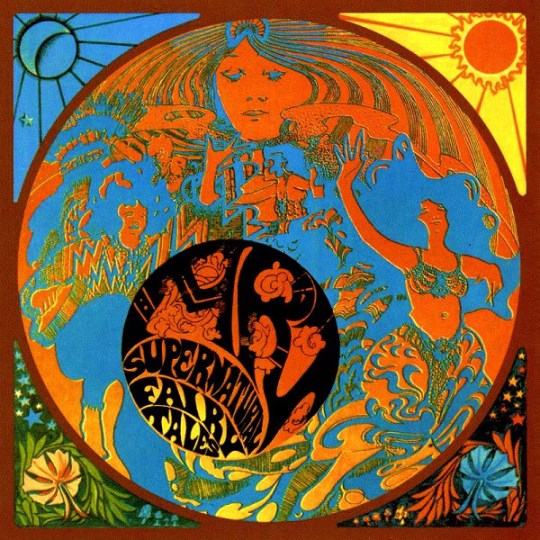
Art (Art essential being an earlier formation of the group, Spooky Tooth), infuses rivulets of blues and wisps of psychedelia into their only album, Supernatural Fairy Tales  creating a thick-textured album, perfumed with an aroma of cannabis. Earlier to the recording of this album, several of the same musicians under the name “Hapshash and the Coloured Coat”  recorded an album earlier in 1967, titled “Featuring The Human Host And The Heavy Metal Kids” — this being, as far as I can tell, the first reference to “heavy metal.”

Other notable albums, many heavily psychedelic (and some incorporating elements of free jazz) were released by groups such as 13th Floor Elevators, The Aggregation, Ten Years After, AMM, Chocolate Watchband, Clear Light, Country Joe and the Fish, The Grateful Dead, Kaleidoscope, Mesmerizing Eye, Moby Grape, Orbital, Pearls Before Swine, Red Krayola (The Parable of Arable Land), Rupert’s People, Sagittarius, The Seeds, Sly and the Family Stone, Sopwith Camel, Spontaneous Music Ensemble, Steppeulvene, Strawberry Alarm Clock, The Animals, The Beethoven Soul, The Box, The Ceyleib People, The Easybeats, The Factory, The Fire Escape, The Freak Scene, The Incredible String Band, The Lefte Bank, The Motions, The Serpent Power, The Smoke, Smoky Robinson and the Miracles, The Turtles (Happy Together), The West Coast Pop Art Experimental Band, The Yardbirds, Thomas Edisun’s Electric Light Bulb Band, Vanilla Fudge, and various more accessible or highly commercial groups like The Association, The Grass Roots, The Ventures, The Monkees (put together for a U.S. television series), and The Young Rascals.

This only scratches the surface.  I have not mentioned artists like Albert King (Born Under a Bad Sign), Nina Simone, Miles Davis, John Coltrane (Expression), Sam Rivers, Charles Tyler (Eastern Man Alone), Bill Dixon, Blue Mitchell, Freddie Hubbard, Gary Burton, Graham Collier, Herbie Mann, Roland Kirk, Marvin Gaye, Magic Sam, Otis Spann,  John Mayall, Miriam Makeba, Van Morrison, Stevie Wonder, Buddy Tate, and many others, some of which I have covered in previous “Fifty Year Friday” posts: there are a number of incredible jazz albums as well as blues, rhythm and blues, and soul music albums.

Though the term progressive rock is more formerly applied to many of the more adventurous and classically influenced bands of the early 1970s, for my money 1967 was the childhood of progressive rock with the birth perhaps occurring in 1966 with Beach Boys Pet Sounds, the Beatles’ Revolver and many psychedelia-tinged albums released in 1967, but recorded at the end of 1966. I challenge anyone to deny the progressiveness of Jimi Hendrix, The Beatles, Procol Harum, Van Dyke Parks, or even groups like The Who, The Beach Boys, or The Doors.

This was a vital period in the expansion and diversification of rock music, the like of which has not been seen since.  Fortunately for us, even albums that were nearly impossible to get a hold of in 1967 are now relatively readily available, not only on CD, or in some cases freshly, pressed LPs, but also available through streaming services or on Youtube.

Most importantly, have a happy and fulfilling 2018, and don’t neglect to broadly explore the immensity of great music available to those of us alive today.
r-1380897-1388699693-7737-jpeg


Previous Fifty Year Friday Posts for the year 1967:

The Beatles: Sgt Peppers

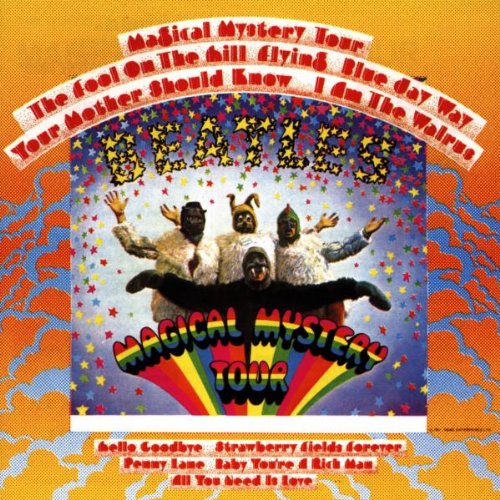
The Beatles: Magical Mystery Tour

Jimi Hendrix: Are you Experienced

Jimi Hendrix: Axis: Bold as Love

The Who: The Who Sell Out

Moody Blues: Days of  Future Passed

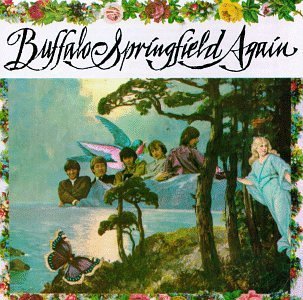
Byrds, Hollies and Buffalo Springfield

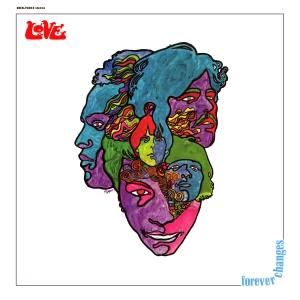
Love “Forever Changes”

Far Out 1967, Part One

Far Out 1967, Part Two

Nirvana “The Story of Simon Simopath; The Kinks “Something Else”

Dizzy Gillespie in 1967

Larry Young “Contrasts”; Joe Zawinul, “The Rise and Fall of the Third Stream”

Procol Harum “Procol Harum and The Doors “Strange Days”

Billy Strayhorn and Duke Ellington

Arthur Rubinstein, Pink Floyd

Marta Argerich and Carlos Paredes

David Bowie, Marc Bolan, John’s Children

John Coltrane, Jefferson Airplane

Thelonious Monk, McCoy Tyner

Hindustani Classical Music

The Doors: The Doors

The Velvet Underground

Aretha Franklin, Simon Dupree and the Big Sound

Mahler recordings

Rolling Stones: Between The Buttons

Jobim, Zappa, Beefheart

Fifty Year Friday: The Who Sell Out

blog_the-who-sell-out-lp

“Power pop is what we play—what the Small Faces used to play, and the kind of pop the Beach Boys played in the days of ‘Fun, Fun, Fun‘ which I preferred.” Pete Townshend (1967)

Somewhere in the mid sixties, rock and roll was replaced with rock.  The rock and roll music of the fifties, primarily based on blues and variations of blues chord sequences, slowly was overshadowed by music that was more message and substance oriented. The Beach Boys classic “Fun, Fun, Fun”, and the 1967 masterwork “Good Vibrations” is clearly Rock and Roll. The Beatles’ “Lucy in the Sky With Diamonds” is clearly rock.  I don’t recall the year, but sometime in the late sixties, I started correcting my dad when he referred to rock music as “rock ‘n roll” — I disdained Rock and Roll as a relic and lower form of music,  and loved Rock for its broad musical diversity and, for the best of it, it’s reach beyond dance music to serious listening music.

The Who, part of the British Invasion, deviated from what was pretty much a rock and roll group in 1965, opening their first album “My Generation” with “Out in the Street” immediately followed with James Brown’s “I Dont’ Mind” and songs like “The Good’s Gone”,  “La-L-La Lies”, “Please, Please, Please”, “It’s Not True”,  and Bo Diddley’s “I’m A Man. ” However, like the Beatles, there were significant forays into a newer musical expression as hinted in “A Legal Matter” and in the instrumental “Ox.” By their second album, we get true rock pieces like John Entwistle’s classic “Boris the Spider.  By the third album, “The Who Sell Out”, an imaginative concept album that includes commercials interspersed throughout, mocking the format of commercial radio stations, The Who are a seasoned rock group writing and performing rock compositions, making use of such “power pop” chord progressions, modulations, and power chords (chords structures found in earlier Who songs such as”My Generation” and “Boris the Spider” — chords that just have the root and fifth — this not only omits the note that provides the major or minor quality of a traditional triad, but produces a simpler harmonic footprint producing an especially powerful effect when played loudly) that create a sound that is easily identifiable as the sound of The Who.  This is not the power pop of rock and roll, but power pop that is part of the new rock music movement.

The album opens strikingly, and aligning with it’s wanton-commercialism concept, with a jingle followed by John “Speedy” Keen’s (a friend of Who main songwriter and guitarist Pete Townshend) “Armenia, City in the Sky” — starting out much like a radio ad, lyrically, with “If you’re troubled and you can’t relax” but soon followed with more mind-altering-like lyrics and with a 1967 psychedelic and imaginatively crafted arrangement including backwards french horn bursts and various guitar effects.

“Mary Anne with the Shaky Hand” is both melodically appealing and lyrically bold (“Mary-Anne with the shaky hands — what they’ve done to a man, those shaky hands.”) Musically, “Odorono” is even more notable, forging towards the musical style perfected on their next album and yet done as a deodorant jingle.  If one doubts the genius of Pete Townshend to align music and lyrics without compromising either, this is prima facie evidence of his capabilities, as is the track that follows: “Tattoo” a tune that could work very well as jingle for the Tattoo industry.

“Our Love Was” is an ethereal gem, maintaining energy and vibrancy to the end, with Entwistle’s French Horn providing just one of many elements that make this arrangement special.

The Who’s 1967 hit, and arguably the best song of the album, if not of Townshend’s career, is “I Can See for Miles”, punctuated perfectly by Keith Moon’s drums and cymbals.

The second side, is also excellent and includes  “I Can’t Reach You”, “Relax”,  Entwistle’s chromatically-flavored, organ-accompanied “Silas Stingy”,  the beautiful “Sunrise” and the Who’s second miniature rock opera, “”Rael (1 and 2)”, even shorter than their first mini-rock opera, “”A Quick One, While He’s Away” on their previous album.

Released in the UK in December 1967 and the US on Jan 7th, 1968, some of the musical techniques employed in “The Who Sell Out” will be more fully explored in their 1969 full-length rock opera,  “Tommy”, which also further develops  musical material in the songs “Sunrise” and “Rael.”  Though this album was only marginally successful in the US when first released, climbing no higher than the 48th spot on the Billboard album chart, perhaps due to its unusual jingle-based concept, it is one of the best albums of 1967, music that should be explored by those looking to better understand the history of rock (as opposed to  rock and roll) or just looking for some well written, enjoyable power pop music.

Track listing and song credits

Last week’s Fifty Year Friday


Century Sunday: 1917 Part 1: Sweatman, OJDB, Kreisler, and Heifitz

Sweatman

Son of a barber in Brunswick, Missouri, Wilbur Coleman Sweatman learned piano as a child from his older sister and soon started playing the violin, perhaps having taught himself on the instrument.  Later he also learned clarinet and made this his primary instrument touring with circus bands, eventually leading dance and jazz bands, and developing the unusual skill of playing two, and then later, three clarinets at once.

He recorded several cylinders and records as bandleader, one of the being possibly the very first recording of Scott Joplin’s Maple Leaf Rag.  In 1911, he published “Down Home Rag” a work in 4/4 time (as opposed to the usual 2/4 time of ragtime works) that shares elements of the contemporary fox trots and turkey trots of the time.

In  December 1916, in a New York recording studio, Sweatman recorded two takes of “Down Home Rag”, each with notable melodic variations, arguably establishing him as the first band leader to have recorded jazz and these recordings as the very first recorded jazz records.  This was two months earlier than the Original Dixie Jazz Band recorded “Livery Stable Blues” and “Dixeland Jass Band One Step”, the latter based on Joe Jordon’s “That Teasin’ Rag” and being the first record to ever contain the word “jass”.  Later in 1917, Wilbur Sweatman would record additional tracks, several of which contained the word “jass” or “jazz” in their titles.  For additional information on Wilbur Sweatman, please refer to the excellent and well-researched biography, “That’s Got ’em: The Life and Music of Wilbur C. Sweatman” By Mark Berresford

Though Wilbur Sweatman recorded the first jazz record, the Original Dixieland Jazz Band (ODJB) recorded the first record with the work “jass” or “jazz” in the title, when they recorded “Dixeland Jass Band One Step” in February 1917. More importantly, their record label, Victor, effectively promoted their material, even if as novelty, providing the sound of something akin to jazz to record buyers all over the country.  Already successful as a dance band, first in Chicago, then in New York, the fame brought by these recordings, and their next set on Columbia, further increased not only the popularity of the ODJB, but was a catalyst for jazz in general. Soon bands all over the country included the word “jazz” in their name or the titles of the records and soon true improvisational jazz music was available live and through records to a diverse audience across the United States.

Though jazz predates the recordings of Wilbur Sweatman and the Original Dixieland Jazz band by several years, records and the phonograph were the primary reason for the rapid spread and adoption of jazz as not only trendy, but popular and indispensable music.

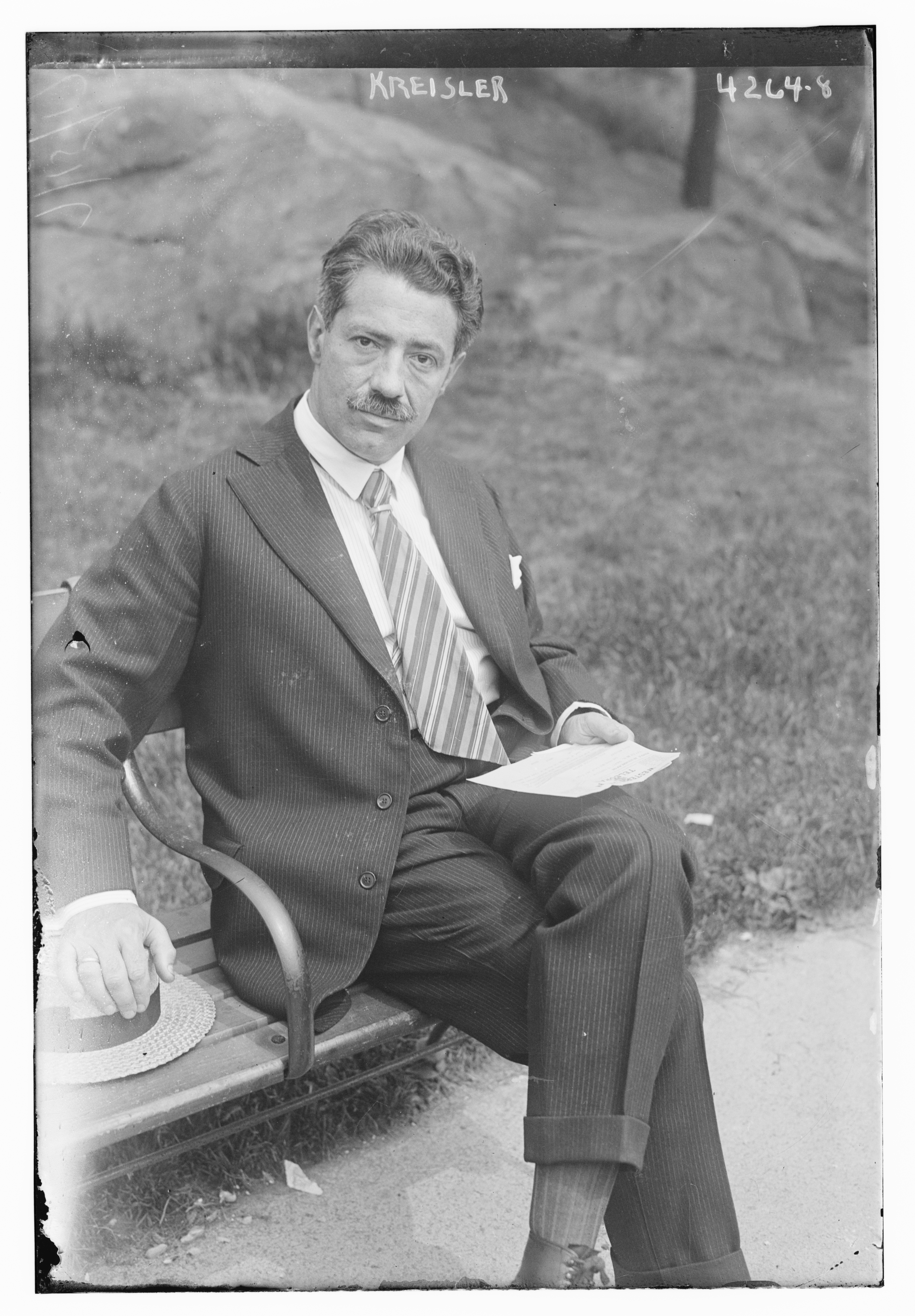
Composer, and the greatest violinist of his generation (born in 1875, died in 1962). Fritz Kreisler recorded several times in 1917 for the Victor label. Taken with earlier recordings on Victor, going back to 1910, we are left with a diverse set of miniatures, some of which are Kreisler’s own compositions, some of which were even credited to other composers, long dead, until Kreisler revealed they were his own compositions in the style of those composers.

These are acoustic recordings, as were all recordings in 1917 and up until about 1925, which means that instead of using microphones to capture sound, large horns were used that generated vibrations to etch the groves in the mastering cylinder (very early on) or platter. In addition, the rotation of the platter was mechanical and not electrical. The performer or performers had to position themselves near the horn and the resulting recording had a limited frequency range between 250 to 2500 Hz (Hertz or cycles per second: vibrations per seconds, known as the frequency, determining musical pitch and the nature of the sound since a given instrument produces a set of vibrations for any given note.)  The human hearing range is around 20 Hz to 2000 Hz and the notes on the piano range from 27.5 Hz to 4186 Hz.  250 Hz is not very low: for example, the highest of the four open strings on the cello sounds at 220 Hz and middle C on the piano is around 262 Hz. The B natural, only a semitone below, is around 247 Hz, meaning that the left hand accompaniment of a piano piece like “Maple Leaf Rag”, disregarding “overtones” or the additional upper frequencies that the piano or any instrument produces for each given note, is almost entirely below the lower limit of the range available to recordings in 1917.  Thus, while one could record piano pieces on this technology, or in the case of many of the Kreisler recordings, violin with piano accompaniment, it sounds very thin and strange.  The amazing thing, psychologically, is how the listener adjusts and soon gets comfortable with the recorded sound, as unfaithful as it is to the original performance.

25608v

Shortly after his Carnegie Hall debut on November 7, 1917 RCA started recording Jascha Heifitz, only a couple of months away from his 17th birthday.  Just as Kreisler was the most notable and celebrated  violinist of his generation, Heifitz (1901-1987) was the most prominent and acclaimed violinist of his generation.

These 1917 recordings of Heifitz available on CD are compelling and vital.  The transfers are good, and once one puts in some time listening to recordings of this era, the significant sonic limitations of the acoustic recording process don’t pose any serious barrier to enjoying the music. We are very fortunate that Thomas Edison invented the phonograph in 1877, allowing it to develop, although slowly from a 21st Century person’s perspective. so that by 1917 we start having some real treasures of music captured forever on these ten and twelve inch shellac disks.


Fifty Year Friday: Decca Panoramic Sound, Deram; Moody Blues “Days of Future Passed”

91e2plus49l-_sl1500_The listener of recorded music of the first six decades of the twentieth century will notice the leaps in improvement of recordings over those decades.  And though the sound improvements that took place in the sixties were not as dramatic as those before, progress did continue in creating more realistic and/or more engaging recordings.

Decca recording engineers experimented with ways of improving stereo recordings. They created a technique called “Decca Panoramic Sound” which created more depth and sound positioning.  Previously,  stereo recordings of jazz, folk and rock albums usually ended up with some music on the right channel, some on the left and some in the center (for example, the Beatles’ stereo version of Rubber Soul or Revolver.)  This not only made the music sound artificial but created a sense of detachment of parts from a natural whole.   With “Decca Panoramic Sound” or Deramic sound, for short, a more natural representation of a performance was possible, achieved primarily through a pairing of four-track tape recorders (later replaced by a true 8 track recording set-up) allowing engineering techniques that could place the content of any track at virtually any point of a left-to-right sound field.

Decca then launched Deram Records to realize this potential for rock, folk and easy-listening recordings.  In October 1967, six easy listening albums (“Strings in the Night, “Brass in the Night”, etc.)  were released using this new approach. Soon afterwards, as Deram continued to sign more interesting artists, in November 1967, Deram released the orchestra-backed, ambitious album Days of Future Passed by the Moody Blues.

Originally, the story goes, the Deram’s intent was to have the Moody Blues record a version of Dvorak’s New World Symphony.  Fortunately, the band had more interest in  their own original material and recorded what some people consider to be the first progressive rock album ever and others consider to be the first true rock concept album. (For those that read the post on Nirvana’s Simon Simopath’s concept album, although Nirvana’s album was released a month earlier, The Moody Blue’s album’s first session occurred in May 1967, two months before Nirvana’s recording session for “Simon.”  In terms of determining what is progressive rock, that is perhaps a topic for another post.)

Though basically an album of the psychedelic era, with its mellotron, tambura, sitar, spoken poetry,  pastoral, mellow musical elements, colorful lyrics, symbolic use of a single day to represent a higher abstraction, and psychotropically-flavored album cover, this is also album that blurs the boundaries between rock and classical music, which along with its use of a song cycle on the life of a given day, high quality music, and musical coherence creating a sense of a single work as opposed to a set of songs, establishes this is a work with more than just a commercial objective:  a work with an artistic purpose — a common characteristic found in these musically progressive albums of 1967.

Side 1: The Day Begins 5:45; Dawn: Dawn Is A Feeling 3:50; The Morning: Another Morning 3:40;  Lunch Break: Peak Hour 5:21

Side 2: The Afternoon: Forever Afternoon (Tuesday?) 8:25; Evening: The Sun Set: Twilight Time 6:39; The Night: Nights In White Satin 7:41

More complete track listing from Wikipedia

Musicians

The Moody Blues:


Fifty Year Friday: The Beatles “Magical Mystery Tour”

in 1968, I went, along with some other junior high school friends to another friend’s house where his dad greeted us by playing us Tchaikovsky’s 1812 overture on, what to most junior high students at that time, was a pretty impressive stereo system.  I had had rather limited exposure to classical music at this point, never having been to a classical concert, and only having heard a few complete classical pieces like Ravel’s Bolero, Gershwin’s Rhapsody in Blue and Rimsky-Korsakov’s Scheherazade on a limited-fidelity monophonic system. To hear this Tchaikovsky work not as a snippet in a television commerical, but from start to finish in full stereo, with horns and, ultimately, cannons, commandeering the empty air space around us, left a impregnable impression not just for that day, but the rest of my life.

An equally indelible impression was produced when we later went upstairs and our thirteen-year old host set the needle of his personal phonograph at the start of the first side of the Beatles’ “Magical Mystery Tour.” Now I had heard this song on the radio a number of times, but this phonograph produced better fidelity, and it occurred to me as we got to the end of side one, listening to the incredible “I Am the Walrus”, with its striking string arrangement and Lennon’s unrelenting, upper-register vocal delivery, that this was as unusual, mysterious and as equally vital as the 1812 overture we had heard downstairs.  I couldn’t but make the comparison between these two supremely transcendental works, “I Am the Walrus” and “The 1812 Overture.” Nor was this effect reduced by our young host replaying the end of “I Am the Walrus” for us to clearly hear what sounded like “Smoke pot, smoke pot, everybody smoke pot.”

This album doesn’t have the cohesiveness of “Sgt. Peppers” or the second side of “Abbey Road,  but the presence of “Strawberry Fields” and “I am the Walrus”, perhaps the only two songs of 1967 that are on par with “Lucy in the Sky With Diamonds”, is enough to make this album essential.  There is also the post-summer of love anthem, “All You Need is Love”, which extended the momentum of the love movement for at least an additional eighteen months. George Harrison contributes the psychedelic and eastern influenced “Blue Jay Way”, one of those amazing tracks that we see so often on 1967 albums (for example, see last week’s post on the Byrd’s song “Why”)  that solidly sound Indian influenced and yet does not contain a single sitar or other traditional Indian classical instruments.

This week marks the fiftieth anniversary of the release of “Magical Mystery Tour” on November 27, 1967 in the US, an album which sold a little under two million copies in the first 30 days of it’s release.

Track and personnel listing at Wikipedia:  https://en.wikipedia.org/wiki/Magical_Mystery_Tour#Track_listing

  	The Beatles perform 'I Am The Walrus' for the film Magical Mystery Tour.  West Malling Air Station, Kent, England. 20th September 1967. 	Images may be editorially reproduced only in conjunction with the 2012 DVD & Blu-ray / digital release of Magical Mystery Tour. 	Please credit © Apple Films Ltd. 	Promotional and review purposes only.


Fifty Year Friday: Byrds, Hollies and Buffalo Springfield

Formed in 1964, in Los Angeles California, the Byrds are generally, with the advantage of retrospect, considered one of the more essential and influential bands of the mid-sixties, primarily due to their blending the rock style of the British Invasion with elements of country and western music, folk, west coast rock and psychedelia.

The fourth album, opens robustly with the semi-ironic, partly humorous, “So You Want to Be a Rock ‘n’ Roll Star” Other strong songs include the jingly-jangly arranged Chris Hillman composition “Have You Seen Her Face”, Hillman’s “The Girl with No Name” (apparently inspired by a young lady with then real name of “Girl Freiberg”, one of the better known covers of Bob Dylan’s “My Back Pages”, and the David Crosby tracks “”Renaissance Fair” , “Everybody’s Been Burned”, “Mind Gardens” and “Why.” Psychedelia and Indian musical influences are present on several tracks with an  electronic oscillator providing suitable effects and McGuinn’s guitar providing a suitable substitute for the sitar on “Why.”

Track listing [from Wikipedia]

Side one

  1. So You Want to Be a Rock ‘n’ Roll Star” (Jim McGuinnChris Hillman) – 2:05
  2. Have You Seen Her Face” (Chris Hillman) – 2:25
  3. “C.T.A.-102” (Jim McGuinn, Robert J. Hippard) – 2:28
  4. “Renaissance Fair” (David Crosby, Jim McGuinn) – 1:51
  5. “Time Between” (Chris Hillman) – 1:53
  6. “Everybody’s Been Burned” (David Crosby) – 3:05

Side two

  1. “Thoughts and Words” (Chris Hillman) – 2:56
  2. “Mind Gardens” (David Crosby) – 3:28
  3. My Back Pages” (Bob Dylan) – 3:08
  4. “The Girl with No Name” (Chris Hillman) – 1:50
  5. Why” (Jim McGuinn, David Crosby) – 2:45

Personnel

Sources for this section are as follows:[1][5][23][54][55]

The Byrds


The Hollies, released two albums in 1967, “Evolution” and “Butterfly”

Both  albums have their annoying, overly-commercial, teeny-bop elements (think of what you dislike about Herman’s Hermits) but this is compensated by the inclusion of several excellent tracks.  Lot of the credit for what is really good here goes to Graham Nash.

The best track on “Evolution” is the simply arranged and perfectly conceived “Stop Right There.”  Other worthwhile tracks include the hyper-vibrato-infused “”Lullaby to Tim”, the catchy, if outdated-sounding for 1967, “Have You Ever Loved Somebody?”, the wistful, and melancholic “Rain on the Window”, the early Beatles-era “Heading for a Fall”, and the AM radio hit “Carrie Anne.”

US/Canada track listing of “Evolution” [from Wikipedia]

Side 1

  1. Carrie Anne” (Clarke-Hicks-Nash) lead vocal: Clarke, Hicks and Nash
  2. “Stop Right There”
  3. “Rain on the Window”
  4. “Then the Heartaches Begin”
  5. “Ye Olde Toffee Shoppe”

Side 2

  1. “You Need Love”
  2. “Heading for a Fall”
  3. “The Games We Play”
  4. “Lullaby to Tim”
  5. “Have You Ever Loved Somebody”

Personnel


“Butterfly” (retitled “Dear Eloise / King Midas in Reverse” in the US)  has its moments also such as the introduction to “Eloise”,  the upbeat, yet also partly annoyingly cloying “Wishyouawish” and “Away Away Away”, Nash’s  simple and direct “Butterfly” (similar to “Stop Right There” on “Evolution”), and “Leave Me”, which was on the original twelve track UK “Evolution” album but not on the US ten track release of “Evolution.” Another notable track, not on the UK version, but only on the US version of the “Butterfly” LP, is the quirky,  “King Midas with a Curse.”

US/Canada track listing of “Butterfly” released as “Dear Eloise / King Midas in Reverse”  [from Wikipedia]

Side 1

  1. “Dear Eloise”
  2. “Wishyouawish”
  3. “Charlie and Fred”
  4. “Butterfly”
  5. “Leave Me” (Clarke-Hicks-Nash)
  6. “Postcard”

Side 2

  1. King Midas in Reverse
  2. “Would You Believe?”
  3. “Away Away Away”
  4. “Maker”
  5. “Step Inside”

Personnel


At this point the reader probably sees where I am going with this post — covering the Byrds, which had David Crosby writing some of their best songs, the Hollies, with Graham Nash writing some of their best tunes, and next, Buffalo Springfield, with Neil Young and Stephen Stills — these four guitarists/singers/composers forming Crosby, Stills, Nash and Young.

Buffalo Springfield’s first album. simply titled after the band, was released in December 1966, but it qualifies as one of the first solidly 1967-sounding albums.  In January 1967, the most impressive song of the first half of 1967 hit the airwaves, a rare objective view of the widening political divide in the U.S.. “For What It’s Worth”.  I was eleven when I heard this, and it was, for me, clearly the coolest song on AM radio of all time.  It is worth re-examaning the lyrics so relevant to 1967, but also applicable to today:

What it is ain’t exactly clear:
There’s a man with a gun over there
Telling me I got to beware.
I think it’s time we stop, children, what’s that sound?
Everybody look what’s going down.
There’s battle lines being drawn:
Nobody’s right if everybody’s wrong.
Young people speaking their minds —
Getting so much resistance from behind.
It’s time we stop, hey, what’s that sound?
Everybody look what’s going down.
What a field-day for the heat:
A thousand people in the street
Singing songs and carrying signs
Mostly say hooray for our side!
It’s s time we stop, hey, what’s that sound?
Everybody look what’s going down.
Paranoia strikes deep:
Into your life it will creep.
It starts when you’re always afraid:
You step out of line, the man come and take you away.
We better stop, hey, what’s that sound?
Everybody look what’s going down.
Stop, hey, what’s that sound?
Everybody look what’s going down.
Stop, now, what’s that sound?
Everybody look what’s going down.
Stop, children, what’s that sound?
Everybody look what’s going down.
This is clearly Stephen Still’s masterpiece of his career and was of such impact that ATCO, the album’s label, re-released this first Buffalo Springfield album in March 1967, including this track. For this reason, its fair game to consider this album belonging to 1967.

Track listing of “Buffalo Springfield”  [from Wikipedia]


March 1967 pressing side one
No. Title Writer(s) Vocals Length
1. For What It’s Worth” (Dec. 5) Stephen Stills Steve with Richie & Dewey 2:40
2. “Go and Say Goodbye” (July 18) Stephen Stills Richie & Steve 2:20
3. “Sit Down, I Think I Love You” (August) Stephen Stills Richie and Steve 2:30
4. “Nowadays Clancy Can’t Even Sing” (July 18) Neil Young Richie with Steve and Neil 3:24
5. “Hot Dusty Roads” (August) Stephen Stills Steve with Richie 2:47
6. “Everybody’s Wrong” (August) Stephen Stills Richie with Steve and Neil 2:25


March 1967 pressing side two
No. Title Writer(s) Vocals Length
1. “Flying on the Ground Is Wrong” (September 10) Neil Young Richie with Steve and Neil 2:40
2. “Burned” (August) Neil Young Neil with Richie and Steve 2:15
3. “Do I Have to Come Right Out and Say It” (August) Neil Young Richie with Steve and Neil 3:04
4. “Leave” (August) Stephen Stills Steve with Richie 2:42
5. “Out of My Mind” (August) Neil Young Neil with Richie and Steve 3:06
6. “Pay the Price” (August) Stephen Stills Steve with Richie 2:36

Personnel

Buffalo Springfield


 .
As distinct and noteworthy as the first Buffalo Springfield album was, the second one is even better.  Neil Young’s driving, anthem-like “Mr. Soul” opens the album and Young’s surreal “Broken Arrow” closes it.  In between are additional songs by Young and Stephen Stills with three pretty good tracks authored by Richie Furay —  one of these, “Good Time Boy”, arranged to include excellent horn-work by the Louisiana group, “the American Soul Train”   This album is distinctly American, or more accurately, Canadian-American (Dewey Martin, Bruce Palmer and Neil Young being Canadian-born musicians), combining rock, folk, country and psychedelic-rock elements.  One should also note David Crosby’s involvement in the Stephen Stills song, “Rock and Roll Woman”, which is predictive of Still’s later “Suite: Judy Blue Eyes.”

Track listing [from Wikipedia]


Side one
No. Title Writer(s) Vocals Length
1. Mr. Soul Neil Young Neil with Richie and Steve 2:49
2. “A Child’s Claim to Fame” Richie Furay Richie with Steve and Neil 2:09
3. “Everydays” Stephen Stills Steve with Richie 2:40
4. Expecting to Fly Neil Young Neil 3:43
5. “Bluebird” Stephen Stills Steve and Richie 4:28


Side two
No. Title Writer(s) Vocals Length
1. “Hung Upside Down” Stephen Stills Richie and Steve with Neil and Richie 3:27
2. “Sad Memory” Richie Furay Richie 3:01
3. “Good Time Boy” Richie Furay Dewey 2:14
4. “Rock and Roll Woman” Stephen Stills Steve with Richie and Neil 2:46
5. Broken Arrow Neil Young Neil and Richie 6:14

Personnel

Buffalo Springfield
Additional personnel
  • James Burton — dobro on “A Child’s Claim to Fame”
  • Chris Sarns — guitar on “Broken Arrow”
  • Charlie Chin — banjo on “Bluebird”
  • Jack Nitzsche — electric piano on “Expecting to Fly”
  • Don Randi — piano on “Expecting to Fly” and “Broken Arrow”
  • Jim Fielder — bass on “Everydays”
  • Bobby West — bass on “Bluebird”
  • The American Soul Train — horn section on “Good Time Boy”

Fifty Year Friday: Love “Forever Changes”

This is an album that was pretty much ignored in November of 1967 when released on the Elektra label.  This is the third and final album of a Los Angeles based group called “Love”, though this really is mostly the work of Arthur Lee, singer/songwriter/guitarist, with a couple of songs contributed by Bryan MacLean, another member of the group, the rhythm guitarist, who provides leads vocals on compositions.

From the start, with it’s acoustic opening, there is an intimacy to the album with its well-crafted and fresh-sounding arrangements.  There are elements of the west-coast rock sound of 1967, folk-rock, and interestingly, English rock:  it shares some characteristics found in the 1967 Moody Blue’s “Days of Future Passed”, Genesis’ 1969 album “Genesis to Revelation” as well as sharing some stylistic traits with The Who and The Kinks.  That said, this is an original, very much non-derivative album that holds up well under repeated playings.

Hailed by some as one of the great masterpieces of 1967, this is an album that anyone that loves late sixties rock or loves what is often called “proto-prog” should check out, even if it doesn’t end up being one of your top 10 or even top 40 albums of 1967.

Track listing[from Wikipedia]

All tracks written by Arthur Lee, except “Alone Again Or” and “Old Man”, by Bryan MacLean.

Side one
No. Title Length
1. Alone Again Or 3:15
2. “A House Is Not a Motel” 3:25
3. “Andmoreagain” 3:15
4. “The Daily Planet” 3:25
5. “Old Man” 2:57
6. “The Red Telephone” 4:45


Side two
No. Title Length
1. “Maybe the People Would Be the Times or Between Clark and Hilldale” 3:30
2. “Live and Let Live” 5:24
3. “The Good Humor Man He Sees Everything Like This” 3:00
4. “Bummer in the Summer” 2:20
5. “You Set the Scene” 6:49
Total length: 42:05

Personnel

Additional musicians

  • David Angel: arranger, orchestrations
  • Strings: Robert Barene, Arnold Belnick, James Getzoff, Marshall Sosson, Darrel Terwilliger (violins); Norman Botnick (viola); Jesse Ehrlich (cello); Chuck Berghofer(string bass)
  • Horns: Bud Brisbois, Roy Caton, Ollie Mitchell (trumpets); Richard Leith (trombone)


Fifty Year Friday: Far Out 1967, Part Two

10-sun-ra-w710-h473

If one is looking to highlight the best representation of “Far Out” in jazz music, one may very well settle with placing the spotlight on musician and philosopher Sun Ra, more formally known as Le Sony’r Ra.

Born in Birmingham, Alabama in May 1914 with the more mundane name of “Herman Poole Blount”, and early on nicknamed “Sonny”, Sun Ra was a precocious and highly intelligent child soon writing his own compositions at the age of twelve as well as exhibiting good sight reading skills and piano technique.  Living in Birmingham,  he was able to hear many famous bands and jazz artists including Fletcher HendersonDuke Ellington, and Fats Waller.  It is said that Sun Ra, much like other gifted musicians like Wolfgang Mozart, had the ability to hear a single performance (in this case a big band performance) and then later accurately transcribe the music that had played.  He attended college for a year on a scholarship as a music education major, but dropped out: according to Sun Ra this being due to an extra-terrestrial  experience as initiated by aliens.

In Sun Ra’s own words: “They wanted me to go to outer space with them. They were looking for somebody who had that type of mind. They said it was quite dangerous because you had to have the perfect discipline. I’d have to go up with no part of my body touching outside of the beam….It looked like a giant spotlight shining down on me, and I call it ‘transmolecularization’ — my whole body was changed into something else…. I call that an energy transformation because I wasn’t in human form. I thought I was there, but I could see through myself.

“Then I landed on a planet I identified as Saturn. First thing I saw was something like … a long rail of a railroad track coming out of the sky, … then I  found myself in a huge stadium, and I was sitting up in the last row, in the dark… They called my name, and I didn’t move. They called me name again, and I still didn’t answer. Then all at once they teleported me, and I was down on that stage with them. They wanted to talk with me. They had one little antenna on each ear. A little antenna over each eye. They talked to me. They told me to stop [my college music teacher training] because there was going to be great trouble in schools. There was going to be trouble in every part of life….”

After leaving college, Sun Ra formed his own band, “The Sonny Blount Orchestra”, with intense rehearsals only surpassed by Sun Ra’s own committment to music. When drafted in 1942, Sun Ra declared himself a conscientious objector, ultimately ending up performing alternative civilian service, assigned to forestry work during the day and played the piano at night.

In 1945 he moved to Chicago, part of the wave of migration of American slave descendants from the south to the north and got a job arranging for Fletcher Henderson in 1946. He also had work accompanying Billie Holiday and played in a trio with saxophonist Coleman Hawkins and violinist Stuff Smith.

In 1952, Sun Ra forms a “space trio” and changes his name to “Le Sony’r Ra” — the trio later becoming an orchestra, the Sun Ra Arkestra, as he starts to simply refers to himself as Sun Ra.  In 1957, he and his friend and business manager, Alton Abraham, establish the “Le Saturn Records” label, perhaps the first African-American record label. From 1957-1966, album after album is released, with well over one hundred albums recorded during Sun Ra’s career.  Sun Ra’s catalog displays a wide range of musical styles.  Some notable titles include the 1957 release, “Super-Sonic Jazz” with some particularly unusual albums in the mid-sixties, including not only his free-jazz or more exotic material, but even more accessible albums like  “Impressions Of a Patch Of Blue” with Walt Dickerson, and the Sun Ra Blues Project’s “Batman and Robin”, both from 1966.

Less accessible, and one of his furthest-out albums, is his LP, “Strange Strings”, recorded in 1966 and released in 1967.

The first track “Worlds Approaching”, is brilliant — one of those original works that defy categorization: structured, somewhat tonal, dramatic, and ablaze with intensity and energy. This is music that might have really come from Outer Space!

The second track of the first side “Strings Strage, and the entire second side, “Strange Strings”,  share common ground with some of the “concert hall” aleatoric music (music that incorporates elements of chance) of the 1950’s and 1960’s. Basically, after assembling the widest and wildest variety of string instruments  including UkulelesMandolinsKotosKoras, Pipas and any other string instruments that could be located, supplemented by a sheet of metal, and miked “sun columns” (golden metal tubes with rubber bottoms), Sun Ra assembled his orchestra, the Sun Ra Arkestra, distributed the instruments, and told his musicians: “You’re playing from ignorance–it’s an exercise in ignorance. We’re going to play what you don’t know and what you don’t know is huge”, both acknowledging their lack of training and experience in playing these instruments and instructing them to perform music representing their general metaphysical ignorance.

It’s clearly music that would be more interesting to experience live than on an LP or CD.  It’s noteworthy that these are talented musicians, experienced in free jazz expression, and guided during the performance by some direction from their leader. It’s also particularly interesting that no effort was made to tune these instruments and so the result is extreme microtonal free jazz.

From a historical perspective, it’s important to acknowledge Sun Ra’s role in Afrofuturism and in asserting his own and others’ civil rights.   Groundbreaking individuals like Sun Ra and George Russell extended the role of the African-American jazz musician from on-demand performers to innovators, thought leaders and philosophy- artists.

Track listing [from Wikipedia]

12″ Vinyl

All songs by Sun Ra
Side A:

  1. “Worlds Approaching”
  2. “Strings Strange”

Side B:

  1. “Strange Strings”

Musicians

  • Sun Ra – electric piano, lightning drum, timpani, squeaky door, strings
  • Marshall Allen – oboe, alto saxophone, strings
  • John Gilmore – tenor saxophone, strings
  • Danny Davis – flute, alto saxophone, strings
  • Pat Patrick – flute, baritone saxophone, strings
  • Robert Cummings – bass clarinet, strings
  • Ali Hassan – trombone, strings
  • Ronnie Boykins: bass viol
  • Clifford Jarvis – timpani, percussion
  • James Jacson – log drums, strings
  • Carl Nimrod – strings
  • Art Jenkins – space voice, strings

One of the leading modern composers during the 1960s and 1970s, Karlheinz Stockhausen is one of the fifty-plus people displayed on the Beatles Sgt. Pepper’s cover, and the only musician or composer on the landmark cover besides the Beatles and Bob Dylan.

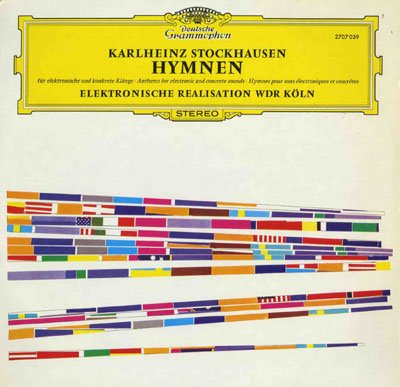
One of his most notable works, is “Hymnen”, a nod to various national anthems (it is divided into four “Regions” each corresponding to a national anthem) and was first performed on November 30, 1967. It must be a challenging work to listen to live; it is long and comes across as somewhat random: it is particularly challenging to listen to a recorded version.  The work consists of a recorded backdrop (tape) which the musicians interact with by improvising and following scored cues provided by the composer.  It is claimed to be a masterpiece by some, but like many of the products of this period created by Stockhausen and his fellow composers, it relies heavily on what the listener brings to the experience.  In a concert hall, with one being part of a seated (captive) audience, one is much more likely to engage with the music than if one puts on an LP or CD of this work.  For me, it’s hard to listen to more than twenty or thirty minutes without feeling compelled to switch to something else, particularly when having a fairly large music library of more accessible music.

Hymnen

Hymnen Recordings

  • youtube (Hymnen Elektronische und Konkrete Musik. Deutsche Grammophon DG 2707039 (2LPs). Reissued on CD as part of Stockhausen Complete Edition 10)
  • BBC Broadcast 2009  and 2016
  • Ausstrahlungen: Andere Welten: 50 Jahre Neue Musik in NRW. Koch / Schwann 2-5037-0 (2 CDs). Includes Hymnen: Dritte Region mit Orchester Radio-Symphonie-Orchester Köln conducted by Peter Eötvös (recorded 1979)
  • Hymnen Elektronische und Konkrete Musik; Hymnen Elektronische und Konkrete Musik mit SolistenAloys Kontarsky (piano), Alfred Ailings and Rolf Gehlhaar (amplified tamtam), Johannes G. Fritsch (electric viola), Harald Bojé (electronium). Stockhausen Complete Edition: Compact Disc 10 A-B-C-D (4 CDs)
  • Hymnen Elektronische Musik mit Orchester. Gürzenich-Orchester der Stadt Köln, conducted by Karlheinz Stockhausen. Stockhausen Complete Edition: Compact Disc 47.

01

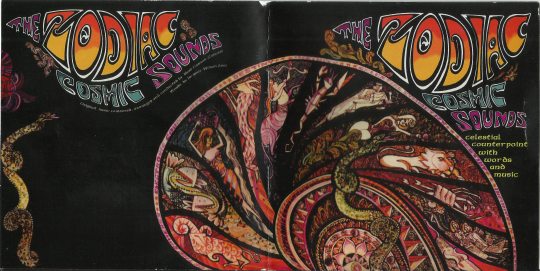
There’s no shortage of far-out pop/rock albums in 1967.  In May 1967, Elektra records releases this narrative concept album (poems read over and integrated into a musical background) of twelve tracks — one for each of the signs of the Zodiac.  Like the the Sun Ra album and Stockhausen’s “Hymnen”, this work benefits from being played in a dark room or with one’s eye’s closed, however, in this case, the producers of this work made sure to include the instructions “Must be Played in the Dark” on the back of the album — and one is well advised to follow such instructions.

From its air-raid like opening to its tranquil conclusion, this album is exploration of 1967 psychedelia, far out, but within convenient reach of most listeners. Notable is the presence of the moog synthesizer, electronic keyboards, sitar, and jazz musician Bud Shank  on bass flute, all in support sixties-styled melodiously cool lyrics read in the most mellow delivery possible. The tracks vary in tone and style and are generally quite interesting  including the more progressive sections of music found in tracks like “Scorpio” with its heavy percussion, dark suspenseful bass line and mixed meter passages and the adventurous “Sagittarius” (also laden with interesting percussion work and a playful mixed meter riff.) One can make the case for this as being both the first rock concept album (it precedes Nirvana “The Story of Simon Simopath by a couple of months) and the first progressive rock album (coming out several months before “Days of Future Passed” and apparently a few days before “Sgt. Peppers.”)  To what degree this adventurous “Zodiac Cosmic Sounds” influences later concept albums, such as The Moody Blues’ “Days of Future Passed” which covers times of the day as opposed to Zodiac signs, is something I invite speculation on. Feel free to muse about this on your own time or in the comments section of this post.

Anyone who prides themselves on understanding the history of progressive rock should consider this album to be required listening. Lyrics are available here.  Album currently not in print, but available used from multiple sources and youtube.

b

Track listing [from Wikipedia]

All lyrics written by Jacques Wilson

  1. “Aries – The Fire-Fighter” – 3:17
  2. “Taurus – The Voluptuary” – 3:38
  3. “Gemini – The Cool Eye” – 2:50
  4. “Cancer – The Moon Child” – 3:27
  5. “Leo – The Lord of Lights” – 2:30
  6. “Virgo – The Perpetual Perfectionist” – 3:05
  7. “Libra – The Flower Child” – 3:28
  8. “Scorpio – The Passionate Hero” – 2:51
  9. “Sagittarius – The Versatile Daredevil” – 2:06
  10. “Capricorn – The Uncapricious Climber” – 3:30
  11. “Aquarius – The Lover of Life” – 3:45
  12. “Pisces – The Peace Piper” – 3:19

Personnel


When drafted

Fifty Year Friday: Far Out 1967, Part One

Silver Apples of the Moon.jpg

Morton Subotnick, “Silver Apples of the Moon”

Morton Subotnick, one of the founders of California Institute of the Arts, co-founded San Francisco Tape Music Center in 1962 , left his teaching post a Mills College and moved to New York City  and accepted an artist-in-residence position at the newly formed Tisch School of the Arts at NYU.  His previous works and performances attracted the attention of the New York City based Nonesuch  label, which provided Subotnick the opportunity to compose the very first electronic work commissioned by a record company.  “Silver Apples of the Moon” was the result and quickly became a best selling “classical music” album and a staple of most university music libraries.

Classical music of that time, and electronic music in particular, generally was inaccessible and avoided traditional use of melody, harmony and rhythms to produce works that seemed more composed by chance, process or mathematical rules than to be products of the heart and soul.  Subotnick breaks with this general trend, balancing the non-traditional sounds with an overall lightheartedness and whimsy, with the first side being more varied and the second side simpler, and somewhat less captivating, with use of rhythmic motifs and a less complex, varied texture and range of sound elements.

Track listing[from Wikipedia]

  1. “Part A” – 16:33
  2. “Part B” – 14:52

Personnel

  • Morton Subotnick – Buchla synthesizer, Liner Notes, Primary Artist
  • Bradford Ellis – Digital Restoration, Mastering, Remixing
  • Michael Hoenig – Mastering, Remixing
  • H.J. Kropp – Cover Design
  • Tony Martin – Illustrations


Mesmerizing-Eye_Psychedelia-A-Musical-Lightshow

The Mesmerizing Eye,  “Psychedelia, a Musical Light Show”

As often the case in the sixties (1960’s rather than a reference to my age), the music produced by the “established” academic artists was often less compelling and relevant than than what was being done elsewhere.   Here we have an album by the obscure band, The Mesmerizing Eye, that in my view has much more to say to the listener than Subotnick’s “Silver Apples of the Moon.”  This is the only album released by The Mesmerizing Eye, and not clear to me if this was really a band, or if this album was a work of one or two people.

Musique concrète is a classification applied to music constructed by mixing various recorded sounds, sometimes environmental and urban sounds, sometimes such sounds with instruments added, but generally with the intent of creating an auditory experience that is produced from a mixture of disparate sounds, that have disparate associations, and that we traditionally hear in various and disparate contexts.   This album draws heavily on that tradition, relying on the medium of tape for the assembly of the final product, yet unlike so many of these type of excursions layered onto tape, there is a general sense of order, meaning, and intent. The album is not only interesting and engaging, but the titles and back-cover liner notes provide additional context and clarity into the music’s relevance and purpose.  For example, from the notes for the third track on side two, “The War for My Mind”: “Too many commercials on TV, too much telling us what to do — go to school, wear a tie, cut our hair.  They want to control our mind.” Right on! This is classic 1967 anti-establishment philosophy!  And, in terms of too many commercials and conformity to the onslaught of commercial messages, more relevant to us today than ever.

The tracks dissolve into each other, with a variety of instruments that varies from track to track.  Instruments include church choir, church organ, church bells, piano, acoustic and electric guitar, trumpet, flute, bagpipes, calliope and additional instruments mixed with various background sounds (including the mandatory crying baby) on other tracks. Under twenty-five minutes, always moving forward with a sense of purpose, and making good use of it’s stereophonic capabilities, this little album leaves many of the works by established academia-blessed composers of the 1950’s and 1960’s in its dust. Difficult to find on LP, impossible to find on CD, this  album is available on YouTube for those that don’t require lossless audio quality:


Tracklist (from discogs.com)

A1 Birth Of A Nation 2:42
A2 Rain Of Terror 2:26
A3 Tempus Fugit 2:09
A4 Opus 71 2:24
A5 Twenty-First Century Express 2:32
B1 May The Bird Of Paradise Fly Up Your Flute 2:10
B2 Requiem For Suzy Creamcheese 2:15
B3 The War For My Mind 1:54
B4 Dear Mom, Send Money 2:08
B5 Exercise In Frustration 2:07

Companies, etc.

Credits


George Russell’s Othello Ballet Suite was recorded in Stockholm in one of the Radio Sweden studios on November 3rd and 4th 1967.  At a little under 30 minutes, this work for orchestra and jazz musicians is performed by 23 musicians including several noteworthy Swedish jazz musicians and the Norwegians Jon Christensen on drums and Jan Garbarek on tenor sax.  Sometimes majestic and beautiful, sometimes wild and exuberantly chaotic, sometimes showcasing individual soloing brilliance, sometimes a collective of orchestral anonymity, this work is adventurous, forward, and bordering on uncivilized, yet alluringly riveting, and mostly coherent.

Even further out is the companion work, “Electronic Organ Sonata No. 1” which was recorded in 1968.  The piece is full of interesting textures and includes many interesting moments, but for me, falls short of the appeal of the ballet suite.

A digital version of the material on this LP is available as part of a 9 CD set, “George Russell ‎– The Complete Remastered Recordings On Black Saint & Soul Note.”

Tracklist (from www.discogs.com)

1 Othello Ballet Suite (Part I)
2 Othello Ballet Suite (Part II)
3 Electronic Organ Sonata No. 1

Credits