Here is the fifth of Zumwalt’s revisions to his set of ten poems in his Sassoon Collection.
v. Auto Tunes
I keep such music in my car No din this side of death can quell; Deep bass booming over tar, And excess forged in death-metal hell.
My dreaming demons will not hear The roar of guns that would destroy; My ears embrace the blasts of fear, Piercing passages of painful joy.
To the world’s end I drove, and found Death in his carnival of high beam flash; But in this torrent I was drowned, And music screeched above the fiendishly beatific headlight-lit fiber-glass, glittering, splintering, metalliferous crash.
— zumwalt (2011, revised 2026)
Admin’s Note: This is the fifth piece in Zumwalt’s ten-poem tribute to poet Siegfried Sassoon, The Sassoon Collection, originally written in 2011, recently revised. Auto Tunes is based on Sassoon’s Secret Music. This tribute traces the exact architecture of Sassoon’s poem, turning his internal refuge from the war (“I keep such music in my brain / No din this side of death can quell”) into a heavy-metal vehicle collision
Here is the fourth of Zumwalt’s revisions to his set of 10 poems in his Sassoon Collection.
iv. Butter and eggs
Robust diners, deftly forking in the fat. O greasy fauna against the heedless tongue Of buffet and banquet days, what sends them gliding through This set of dancing teeth?
Theirs are the hungry cadences between The enraptured chewing of hefty humans that make Heaven in the booth while second helpings simmer; And theirs the faintest whispers that hush the desire.
And they are the airship that floats away Out of the starlit dimness above the moon And they are the most inflexible beings—born To know but this, the phantom glare of fullness.
— zumwalt (2011, revised 2026)
Admin’s Note: This is the fourth piece in Zumwalt’s ten-poem tribute to poet Siegfried Sassoon, The Sassoon Collection, originally written in 2011, recently revised. “Butter and eggs” is loosely based on Sassoon’s “Butterflies.” Zumwalt mirrors the original structure, but alters the tone and content considerably.
Here is the third of Zumwalt’s revisions to his set of 10 poems in his Sassoon Collection.
iii. Blonde
Her head-weak thoughts that once eagerly gave way To looks that leapt from eye to brain and into heart, Weaving unconscious promises of love, Are now thrust outward, dangerously heard from lips to air. And he who has watched one world and loved it all, Star-struck with blindness, an ensnared fiber of pity, With feeble hopes of attracting a returning glance, Now listens with his ear to the rambling noise.
— zumwalt (2011, revised 2026)
Admin’s Note: This is the third piece in Zumwalt’s ten-poem tribute to poet Siegfried Sassoon, The Sassoon Collection, originally written in 2011, recently revised. “Blonde” is loosely based on Sassoon’s “Blind.” It directly tracks Sassoon’s opening (“His headstrong thoughts that once in eager strife / Leapt sure from eye to brain and back to eye”) and his shift in perspective (“And he who has watched his world and loved it all”).
Here is the second of Zumwalt’s revisions to his set of 10 poems in his Sassoon Collection.
ii. A pickle and a black hole
Mass and form had the pickle, sweet, sour, tall and straight; The round black hole collapsing still further than it knew Made its longest shadow with gravity A ghostly bridge ’twixt the pickle and space. But stars, with their continuous day, must pass; And blustering winds will stretch all gherkins for which I’ve no measurements to express the moment of conjunction, a singularity with no exit for stars and pickled cucumbers alike.
— zumwalt (2011, revised 2026)
Admin’s Note: This is the second piece in Zumwalt’s ten-poem tribute to poet Siegfried Sassoon, The Sassoon Collection, originally written in 2011, recently revised. “A pickle and a black hole” is loosely based on Sassoon’s A Poplar and the Moon.”
Zumwalt has provided revisions to his set of 10 poems in the Sassoon Collection. Here is the first:
i. Everyone sang while I fell asleep
voices wailing around the house thud of feet and slam of doors everyone yowling only the clocks wind down
around this small room no sense of the hour crowded with lemonade breath high-pitched voices like hounds in pain as clouds hover over my eyes
fighting sleep with the fork from my dessert plate not yet ready to go where the dreams are built where you take reality with you so as not to be alone dragging it by its rough cotton shirt collar
the blurry faces become blurry voices despite discordance from straying notes the lights descend and siphon colors whirling into a vortex that spins off dimensions like a playlist streaming fragments from the past
drifting towards sleep the hounds now whining like imprisoned puppies the darkness becoming home without furnishings everything fading into peace except for one small lingering concern for everything unfinished
— zumwalt (2011, revised 2026)
Admin’s Note: This is the first piece of Zumwalt’s ten-poem tribute to poet Siegfried Sassoon, The Sassoon Collection, originally written in 2011, recently revised by the author. This poem opens the set by providing a misleading head fake to Sassoon’s Everyone Sang, when in reality the poem is primarily based on Sassoon’s Falling Asleep. Where in the original, Sassoon sustains a hushed, introspective mood using domestic quiet and natural sounds to mirror the speaker’s mental transition from wakefulness to sleep, Zumwalt leans into domestic turmoil and modern-day stress, even throwing in an Emily Dickensen reference for good measure.
I have a list of over 4,000 journals that publish poetry: some do so online, some in print, some do both. As noted in last week’s Thoughtful Thursday column, I enjoy checking out both poetry blogs and poetry sites to read new work. Sometimes these poems fall short of expectations; sometimes they are well worth the effort of hunting them down.
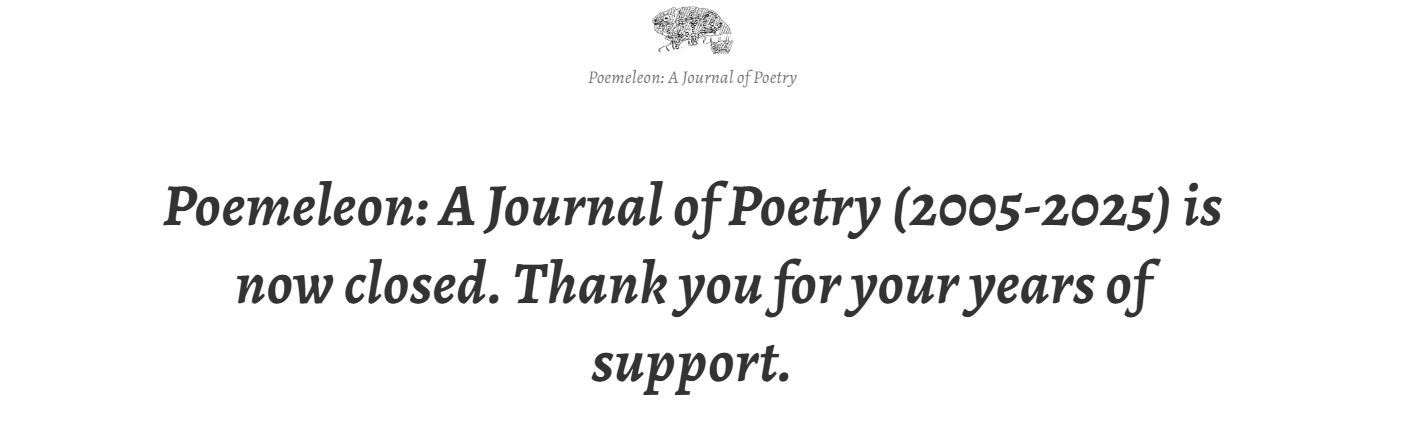
Today, I randomly picked entry 1613 in my poetry list, a journal named Poemeleon. I knew I was in for a treat reading the description of their content: “Quirky/Humorous/Lyric” and “Playful/Lyrical work.” This sounds great, I thought. As readers of this blog know, I am a fan of Zumwalt’s poetry — which generally is more disruptive or snide than lyrical, but is often quirky, humorous, or playful. I am also a fan of Louise Glück for the lyricism, emotional depth, and overall precision of her writing. And she can also be disruptive and humorous, as in her poem Anniversary. I can say the same about Kenneth Koch — precise control, sometimes lyrical, sometimes disruptive, often playful, clever and/or humorous. Well, there are thousands, maybe tens of thousands of such poets, and I clicked on the Poemeloen link to discover some of the lesser-known such poets.
I would like to say that when I first landed on their home page, I was greeted with the above image — the image of the poemeloen, a distinctive and highly specialized clade of a large family of contemporary online journals that champion a diverse range of poetry. And to some degree I was, though it was much smaller. However, what immediately confronted me was the image of the “SORRY WE ARE CLOSED” sign at the top of this blog post.
Above that closed sign was this very small version of their logo and additional text:
Well, in truth, I was pretty undeserving of any thanks. I never supported this site, nor even visited it until today. And now, despite its ability to blend in (or maybe because of its ability to blend in) with its background, it is now another entry in a long list of defunct poetry journals. It could clearly show a range of colorful poetry, and vary what was displayed. But it was eventually overwhelmed by its changing environment: a world where many people have substituted clicking, reacting, and sometimes sharing (though can one really share what isn’t theirs?) for engaged reading.
However, the poems are still there! And their founder’s mission is still intact: “poemeleon seeks to make visible the invisible. By placing disparate poems alongside one another, I aim to highlight not just their contrasts, but their similarities.”
For how long, though? Eventually, the domain will be unfunded, and the poems will not be so easily accessible. I say, “not so easily,” because, thankfully, we have The Internet Archive’s Wayback Machine, which has captured content from this site and its predecessor 296 times between February 23, 2007 and April 20, 2026. Compare that to our site, zumpoems.com which has been saved 217 times between November 1, 2011 and July 8, 2026, and one can feel pretty good that as long as Internet Archive’s Wayback Machine is enabled, all the poems that the site’s editors (there were multiple: https://poemeleon.me/missionandhistory) ended up selecting from the many submissions sent to them over the years will be avaible for those willing to take the extra effort to track them down.
One day, I won’t be around to fund zumpoems.com. At that point, much of Zumwalt’s work will be lost forever — except for the captures of this site in the Internet Archive. How long will that site be around? Maybe it doesn’t matter, as eventually there will be very few people who will still have the ability to read. The poems will still be around, and they can be read out loud by our AI assistants, but will those AI readers ever understand the meaning of even the simplest or most transparent poem to provide a meaningful enough reading to engage even their most receptive user?
I have no plans to stick around to find out, but if AI extends my life long enough, I guess whatever plans I do eventually make may matter very little.
Boy, do I enjoy the act of writing! Is it about capturing thoughts in a more impermeable form than memory? Or is it about the psychological and mental benefits provided by diving deeper into one’s feelings and perspectives and articulating, whether well or poorly, those feelings and perspectives?
And I love reading. For one is exposed to another’s thoughts, feelings, and perspectives, whether it is reading an email or letter from a friend or engaging with the writing of a familiar author or a complete stranger.
I love diving into others’ WordPress blogs. All I have to do is click on the WordPress reader, and I have a selection of blogs I subscribe to or can explore blogs I have never seen before.
As a reader of poetry, I particularly enjoy exploring posts that have been tagged with “Free Verse,” “Poetry,” or “Poem.” Some are well crafted, some are wild and sprawling, but most are interesting, and many have a level of vitality that is often missing in much of the poetry in curated journals.
I could easily list a dozen WordPress poetry blogs that I enjoy visiting. Let’s just take a peek at my favorite tag: https://wordpress.com/tag/free-verse. And what do I see at the top, posted 15 minutes ago — one of my favorite blogs, Ink & rain! As I open today’s post, I first see one of those many wonderful images that appear reliably at the top of each of author Meiling Cheung‘s posts, followed by text in Chinese and English. Now I have no clue how to read Chinese, so I focus on the English column. Today’s poem is exceptional: it uses a sustained metaphor with each phase serving a specific purpose to support the author’s message. The line breaks are well handled, and the tone it sets, gentle and meditative, perfectly echoes its message. There is an overall emotional immediacy and authenticity, which further enhances the evocative and reflective nature of the work.
Besides reading WordPress poems, I visit various online poetry journals (a partial list of which is here), and so right now, let me check my email to see the latest updates.
“Only opaque backings stop mirrors being windows, and windows can be mirrors if on one side it’s bright as an interrogation room while the other’s in darkness. So think of glass as your poems, and light as reason.”
Such a simple observation, but here is the vehicle for the journey this poem takes us on. No need to be bored with my commentary — just check out the poem here: https://stickfigurepoetry.com/issue-22/#analysis-love
“there is a hole in my chest through which we drive our car
to the other side of the world to see the mountains”
With the first glance of this poem, I notice a more or less generic title, no punctuation, no capitalization, regular use of stanzas, reference to a line in Chinese, “万山载雪,明月薄之,月不能光,雪皆呆白,” which I use Google Translate to give me an approximation in English, “Snow blankets the myriad peaks, and the bright moon casts its light upon them; yet the moon cannot make them shine, and the snow remains a dull, lifeless white, ” and, with the exception of the Chinese insert, the use of an accessible, straightforward vocabulary. The work effectively mixes abstractions and images, the modern and the timeless, into a beautifully evocative poem!
I am not particularly fond of that overly common activity of ranking authors, composers, painters, etc. — each has their distinct voice (or voices) and strengths. Still, it is easy enough to make the case that America should consider itself proud to have been the birthplace and home of such a great poet as Wallace Stevens!
So I have a lot to keep me happy and engaged with a breadth of diversity and styles never available before the launch and development of the internet. Please join me in exploring blogs, poetry journals, and the works of revered poets at your own pace, taking your own individual, self-customized journeys.
I am pleased to announce that one of Zumwalt’s poems, “Out of Schlitz,” has been published in Light, the premier online journal for light verse and the oldest and most widely recognized publication in the United States dedicated entirely to witty and humorous poetry. Please visit here: https://lightpoetrymagazine.com/poems-of-the-week/out-of-schlitz/
Text of poem as featured at Light is below.
Poems of the Week
Out of Schlitz
by Zumwalt
“Schlitz Premium, a beer brand that traces its roots to Milwaukee in the 1840s and was once among the largest breweries in the country, is being put ‘on hiatus,’ parent company Pabst Brewing Co. confirmed Friday after Wisconsin Brewing Company announced it would brew the brand’s final batch later this month.” —Fox Business News
With measured trends and spreadsheets came those analysts who killed a name: A brew that tastes of bowling shoes Is poured out as financial news.
Pabst ran the math, it weighed the yield, And marched the yeast right off the field. As taste gets dated, margins shrink: So bid farewell to Granddad’s drink.
But wait ten years, they’ll give us more In high-gloss cans from every store; They’ll charge a fortune for the thrill Of drinking this fermented swill.
— Zumwalt (May 2026)
Published on May 25, 2026
================
Never one to walk away from controversy or beer, Zumwalt has also sent us a revised version of a free verse poem on this topic that he penned earlier last week:
When You’re Out of Schlitz
They have officially placed the yeast on hiatus, a term previously reserved for exhausted child stars and caught-on-mic morning show hosts.
Now, it is gracefully applied to a twelve-ounce can that tastes predominantly of 1974 and bowling shoe rentals.
The pivot was, naturally, data-driven: a team of strategists, hydrating on premium energy drinks marketed as performance optimizers, determined the current legacy yield could no longer justify an aging brew.
So now the fermentation tanks are quietly drained, the hops offered a highly competitive severance package. It isn’t a termination, the press release insists, just a strategic realignment.
Perhaps in a decade, they will exhume Schlitz in a slim, matte-finish can and rebrand it as a premium heritage artifact for postal codes that treat commercial failure as a high-end aesthetic.
Until then, we must manage the sudden loss of this reliably unglamorous liquid as the last can is flattened against the concrete.
This is the seventh consecutive month Zumwalt has been published in this esteemed online journal. Please visit.
This poem is based on this recent news event: “The commonwealth of Pennsylvania is suing Character AI to stop the artificial intelligence platform’s chatbots from representing themselves as licensed medical professionals and providing medical advice.” CBS News
Please note that Zumwalt has indicated that the comment at the bottom of the poem was the editor’s wish to clarify that “algos” not only was short for algorithms but also Greek for “pain” so the reader could better understand the poem’s message.