“To be even inadequately prepared for battle, you have to fight a few first.”
— Zumwalt
“Personal growth does not start with the act of seeking improvement, but with improving the act of seeking. ”
— Zumwalt
Is forcing yourself to do things that are uncomfortable the only way to achieve personal growth? Not at all! You can stay within your comfort area and certainly achieve more skill, greater awareness, better health, or anything else you might consider growth.
If you are comfortable reading fiction, you can achieve quite a bit of development in your understanding of others, the world, human conflict, and in understanding more about yourself. You can even just limit your reading to the works of Dickens or Dostoyevsky and achieve growth. Maybe reading Philip K. Dick novels would be enough. I know I achieved some personal growth as a child reading Dr. Seuss books, and probably would get something out of them today, just re-reading them.
Spending time with a friend or your child, a stranger, or a dog or raccoon (watch out for rabies), is enough to develop personal growth — if you are there, in the moment, and not on automatic pilot like the cars Google and Tesla are developing.
Not so sure eating at an all-you-can eat pizza place would be effective, but don’t rule it out if you are do so with the intent of getting something out of it more than indigestion.
That said, the biggest bang for the buck often occurs when comparing what actions we had taken when staying in our comfort zone and reflecting what actions were available if we had gone outside that comfort zone — and then modifying our actions in the future, even though that is uncomfortable.
You and I do need to consider stepping outside our comfort zone, at least occasionally. It gets us off automatic.
There is another aspect to consider when pushing ourselves to do something uncomfortable. There is the aspect of right and wrong. Avoid doing it if it honestly feels to be the wrong action. If you know it is the right thing to do, use that as a motivator.
Ask a stranger if you can help them carry groceries, as awkward as that may seem. (Don’t just grab the groceries and start walking — that may get you in trouble.) When someone says something that’s not particularly interesting to you, but is to them, pursue their statement with a follow-up question — get to know their point of view better. Getting a better understanding of others may be uncomfortable in some situations, but it will sometimes result in an new or extended understanding.
Don’t shut others off when their political or religious views are different. As crazy as their viewpoint may seem at that time, have them elaborate and see what you can learn from better understanding their point of view.
Whether staying within your comfort zone or extending its boundaries, the main thing is to widen your perspective, knowledge and understanding.
Another way of looking at this is the DIKW pyramid. As an information professional this is something I am well aware of. There are variants on this pyramid, but one I like a lot is the diagram below at conceptdraw.com.
The DIKW is of course, Data, Information, Knowledge and Wisdom. Another cool diagram (below) is from kvaes.files.wordpress.com:
My own take on this is that we don’t have pyramid at all but a recursive cycle of action: Observe, recognize, filter, connect, compare, evaluate, realize, know, understand, act. (Slightly different to some of the DIKW pyramids, I see true understanding as wisdom)
One way to apply this is to think of us being in a synthetic, artificial, simulated, or virtual universe, like in the movie “The Matrix” or as many scientists are now proposing.
We observe (collect data), connect and compare (information), determine/conclude (knowledge), achieve wisdom though understanding brought about by reflection and focusing our knowledge to the reality we believe is there and then take an appropriate action. After the action, we then start the process over again by observing, recognizing, filtering, connecting. comparing, evaluating, realizing, knowing and understanding — understanding more than before, and then taking action. This occurs with a boxer in the boxing ring or a driver in a race car on the racing track — and occurs over, over, and over again. This occurs whether we are playing an old-fashioned mechanical pinball machine in a bar (drinks are on you) or playing a virtual pinball machine on the internet.
So personal growth will happen as long as there is observation and ultimately action to be in a position to observe more. We can speed up the process by observing more and taking action when appropriate and as appropriate. If the action is inappropriate, the universe, synthetic or real, will let us know — maybe not immediately, but at some point. And generally that will not be personal growth, but personal decay — that is, unless we get up, brush ourselves off and start the cycle of “observation through action” all over again.
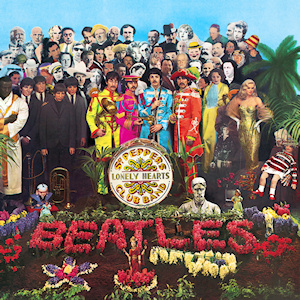
Released on May 26, 1967 in the UK and a week later in the US, this is the album that boldly launched the progressive rock era. If you lived in the US, Canada or UK, and were old enough, it was about fifty years ago today, that you first heard “Sgt. Pepper’s” play — either on a friend’s turntable, your record player or the radio.
One year earlier, The Beach Boys had released “Pet Sounds”, an album that unquestionably influenced the Sgt. Pepper album, and which has an important place in the history of progressive rock. From an interview with Paul McCartney:
“The early surf records…I was aware of them as a musical act, and I used to like all that, but I didn’t get deeply interested in it—it was just a real nice sound…We used to admire the singing, the high falsetto really and the very sort of ‘California’ lyrics.
“It was later…it was Pet Sounds that blew me out of the water. First of all, it was Brian’s writing. I love the album so much. I’ve just bought my kids each a copy of it for their education in life—I figure no one is educated musically ’til they’ve heard that album. I was into the writing and the songs.”
One important McCartney takeaway from Pet Sounds, is the liberation of the bass guitar from playing just the root notes of chords. For non-musicians, a chord can be in basic (root) position, such as C E G C for a simple C major chord, with the lowest note being C, or can be in first inversion, with the lowest note on E, or in second inversion position with the lowest note being on G. Simple pop music often sticks to the bass always playing the root note. On “Sgt. Pepper’s” tracks like “Getting Better” or “Lucy in the Sky with Diamonds”, McCartney will sometimes play the third or fifth note of that chord — or even, in a few cases, play non-chord notes creating temporary musical tension.
Other important characteristics of progressive rock present in “Sgt. Peppers” include carefully crafted arrangements, non-traditional harmonic progressions, modal scales, unusual instruments, tape-based effects and an overall character that creates an artistically unified gestalt even though individual works vary significantly in mood and compositional techniques.
Though we may perceive a unified album, this is still a collection of individual songs, with two songs originally intended for this album, “Strawberry Fields Forever” and “Penny Lane”, not included. “Strawberry Fields Forever” required around fifty-five hours of studio time for completion, thus setting the level of craftsmanship and attention to detail employed for the entire Sgt. Peppers album. The mellotron, an instrument used in later progressive rock albums like King Crimson’s “Court of the Crimson King”, dominates the introduction to”Strawberry Fields.” The use of unusual instrument combinations and arrangements is present in most of the songs on “Sgt. Peppers.”
The album begins with the sounds of delicately light crowd noise and a string section tuning up, just as if one were present in the concert hall for an evening at the symphony. However, this is followed with forceful electric guitar, drums, bass, and emphatic McCartney vocals with audience noise then shifting to the less restrained enthusiasm of a dance hall. This is followed by a quartet of French horns, laughter, and the re-entry of vocals and rock instruments with interspersed applause. This first song, the title song, “Sgt. Pepper’s Lonely Heart Club Band” transforms, without break, to the upbeat, feel-good, relatively conventional, “With a Little Help from My Friends”; Ringo is on vocals, drums and tambourine, George Martin plays Hammond Organ, George Harrison is on lead guitar, Paul McCartney, of course, plays bass, and John Lennon and McCartney handle the chorus and supporting vocals.
The third track on side one, Lucy in the Sky with Diamonds”, starts off with McCartney’s Bach-like broken-chord based melody and includes Harrison on tambura (a fretless, long-necked, Indian stringed instrument) with Ringo adding maracas. “Getting Better” with its pulsating intro and hints of 3 against 2 includes George Martin on amplified pianette (a keyboard instrument that had been left in the studio from a previous recording session), playing it normally by depressing keys and with mallets striking against the strings, Harrison on tambura, and Ringo on congas. The pentatonic-based “Fixing a Hole” includes harpsichord and “She’s Leaving Home”, with its wistful, affective lyrics and music, begins with solo harp, followed by bowed strings with strings, harp and Lennon’s supporting vocals providing that extra Beatles’ magic throughout.
Side one concludes with the studio-crafted masterpiece, “Being For the Benefit of Mr. Kite”, which merges various tape tricks including snippets of tape for particular musical-based sound effects and a section of tape (running at double speed) of Martin playing runs on the Hammond Organ along with Lennon on organ and McCartney on guitar. Instruments include harmonium, piano, Hammond organ, Lowrey organ, harmonica, shaker bells as well as guitar, bass and drums. Listen for the adventurous harmonic swirl and chromatic runs in the two instrumental passages at the one minute and two minute mark which include the sped up tape passage, use of tape snippets (at least one sample sounds reversed) and tape loops. Chromatic-based passages on a pipe organ or calliope, harkening back to Julius Fučík‘s famous “March of the Gladiators“, have often been used to invoke images of the circus, but Martin and the Beatles take this to another level.
On side two, “Within You, Without You”, like the earlier “Revolver” album’s “Love You Too”, invokes Indian Classical music with its use of multiple Indian instruments played by Harrison and skilled Indian musicians. Instruments include sitar,tambura, dilruba (a fretted stringed instrument with sympathetic strings) tabla, svarmandal (multi-stringed zither-like instrument) as well as several violins, two cellos and Harrison’s acoustic guitar. Lennon, McCartney and Ringo sit this one out.
Side two continues with the English music hall influenced “When I am Sixty-Four”, written originally by McCartney on his home piano at age 15 or 16. The original recording was in C Major but McCartney had George Martin raise this up a semitone by speeding the tape so that the song is now in the less common key of D flat. For me, this track stands out as a relief point against the rest of the album, pairing nicely with McCartney’s “Lovely Rita”, and adding an important contrast that elevates this entire album. Not everyone, including John Lennon supposedly, had the same opinion. Listen for the tubular bells played by Ringo and the trio of clarinets arranged by George Martin.
“Lovey Rita” starts off with upbeat guitar and typical Beatles’ backing vocals (“aaahhh”) punctuated nicely by Ringo. Listen for the return of those trademark backup vocals and drums at the 1 minute mark followed by Martin’s honky-tonk-style piano. This slightly distorted piano sound was created by applying tape to the tape capstan to create a wobbly distortion. Also listen to the paper and combs before the vocal phrase “”When it gets dark I tow your heart away”, as well as the John Lennon coda that makes an effective transition to the crowing rooster in “Good Morning.”
John Lennon’s “Good Morning” was evidently inspired by the Kellogg’s Corn Flake Jingle (“Good morning, good morning, the best to you each morning”.) It opens up like a march with accompanying saxophones, followed by Ringo’s heavy-step snare and continues with a marching-band ethos laced here and there with electric guitar and, at the end, animal sounds including dogs, cat, lion, trampling horses and what could very well be the start of a fox hunt, heralded by French horn.
The title track returns, creating energy midway by modulating up a whole tone from F Major to G Major, the key of the opening of “Day in the Life”, which immediately follows. If one is not convinced this album heralds in the era of progressive rock, such an assertion can easily be supported by the five and half minute (short by the average length of later progressive rock songs), multi-section “Day in the Life” with orchestra, harmonium, harp, piano, and alarm clock. Take note of the skyrocketing orchestra passage that binds Lennon’s section (ending with”But I just had to look having read the book. I’d love to turn you on.”) to McCartney’s “Woke up, fell out of bed….” As described in the NY Times: “Mr. Martin’s solution was to take a page out of the playbooks of classical composers like John Cage and Krzysztof Penderecki, who at the time were creating works in which chance played a role. Mr. Martin hired 40 symphonic musicians for a session on Feb. 10, and when they turned up, they found on their stands a 24-bar score that had the lowest notes on their instruments in the first bar, and an E major chord in the last. Between them, the musicians were instructed to slide slowly from their lowest to highest notes, taking care not to move at the same pace as the musicians around them.”
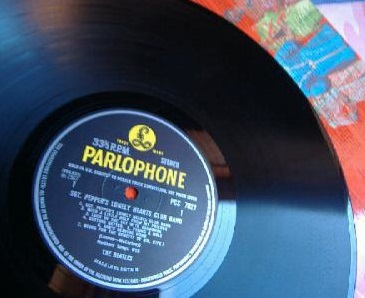
Those with CD versions of this will be missing the last track of the album: the approximately two-second-duration inner grove, which was intentionally ignored by automatic turntables and could only be played on manual turntables. Another feature of the original UK Parlophone LP, not evident on CDs and some US pressings, is that the tracks do not have the typical pop album separation between them and thus the surface of the record is similar to a classical record.
With the Beatles no longer interested in live performance appearances, part of the intent of “Sgt Peppers” was to go beyond music that could be recreated live. The production values and layering of sound influences many later recordings, particularly of notable mention is Queen’s “Night at the Opera.”
People are certainly entitled to have differing opinions on whether “Sgt. Pepper’s” is truly a concept album. The reprise of the title song before “Day in the Life” is not enough to automatically make this so. The songs more or less share similar production values, but clearly are not on a single topic or share melodic or harmonic material. Perhaps if there is a concept, it is the general intent, as on The Beach Boy’s “Pet Sounds” album, to produce a unified set of songs that achieve both a stylistic identity and set a standard of quality that ultimately influences other musicians. For the sake of argument, let’s concede that “Sgt. Peppers” is indeed a concept album.
If we do then agree it is a concept album, it is certainly not accurate to call this the first concept album, as Zappa’s “Freak Out” was released in 1966 and jazz had several concept albums before this including John Coltrane’s “A Love Supreme” from 1965 and Dave Brubeck’s 1959 “Time Out”. There were actually a significant number of themed jazz and exotica albums released in the fifties and one may have to go back to Woody Guthrie’s 1940 album, “Dust Bowl Ballads” to find the first themed record album. If one considers the medium of the “record album” as the means of recording music and the collective music as either a concept or not, then one then finds thousands upon thousands of earlier examples of concept music including Gustav Holst’s “The Planets” of 1918, Gustav Mahler’s “Resurrection Symphony”, Robert Schumann’s Kinderszenen (Scenes From Childhood”), Schubert’s Die schöne Müllerin and Winterreise, Beethoven’s Ninth Symphony, Franz Josef Haydn’s “Philosopher Symphony”, Vivaldi’s “Four Seasons” and numerous operas, including Claudio Monteverdi’s L’Orfeo, which was first performed in 1607 and still performed today. That’s just western music. Concept music can be traced back to many cultures of all continents including the American Indians, many African tribes, Balinese dance-drama and music from the 6th Century operas of the Northern Qi Dynasty of China. And, for all we know dolphins and whales may have developed concept music long before humans ever roamed the earth. (Yes! An opportunity to promote “The Beluga Beliefs” website.)
It’s not the concept album that puts the Beatles in good company, it is the quality of the work, a true group effort of excellence by Paul McCartney, George Martin and the rest of the Beatles.
This is music that transcends the times of the mid sixties and is appreciated now by more people than ever. Such is how we identify great music: it stands the test of time and is accessible and appealing to people from many different cultures and backgrounds.
I’ts been a while since we have posted a new Zumwalt poem, but Zumwalt is alive and well and one never knows when one will receive something in the mail that we can post here.
Appreciate those that still follow this blog and in the meantime, will try to keep this site from completely vanishing from the google search engine by posting now and then.
For those that like music, there are a few pages on this site addressing that topic. They aren’t easy to find, so I will call out one in particular: Must Listen To Music
The author that provided this page, believes that music is music, and that even classifying music as great, good, mediocre and poor is a worthless and impossible activity. However, there is some music you should check out and this is what is listed here.
Whether you have heard everything listed or you haven’t heard any items on the list, you can do the author a favor and in your reply to this post, list music that you think the author should listen to. If I just get one reply back, I will know this site is again attracting readers and can then maybe use this to entice Zumwalt to eventually provide another poem for us to post.
Missing the dead more than, I suspect, they miss me,
I somberly reflect: the most recent, smell terribly and the long departed are more like fallow soil than fellow souls;
I don’t want them to stagger and stumble like the living dead or communicate to me while their face parts fall off;
I want to be around them like when they were at their best.
And so I go to memory,
that slippery, somewhat unscrupulous, disobedient vagabond
that tells the same stories and strays from the truth far too often — each torturous tangle with memory takes something away and provides nothing new —
this is no consolation for so many losses, just needless punishment for keeping company with the only companion that cannot die but only de- ter- i- o- rate.
reciting written scripts
chattering cattle, chewing and spieling
windward whirling, wheeling and dealing
nouns, adjectives, action verbs
headers, disclaimers, inertia verbs
in this tornado of tomato and avocado
of spineless bombast and spiritless bravado
words take slushy, slippery substance
ringing, plinking, plunking, plucking
abrasively invasive: pocket knives and poison ivy
sarah stays the course, naturally
jessie talks her to the ledge, persuasively
It is a bleak, dark, ever-dimming landscape
Pulling all light in and letting out nothing in return
It is a empty, hollow, endlessly winding corridor
Leading ontologically onward with no chance of finality or redemption
one day, the dentist’s drill locks in and won’t let go
one hour, the need to know triumphs over the need to be known
she, sarah, held her course, intentionally
he, jessie, led with talk, aggressively
invasively
inexorably
knowing that enough noise numbs the nerves effectively
permanently
closing the sale
closing the call
but most significantly
closing the office
There is so much to give thanks for this year, both in my personal life and regarding this zumpoems.com site.
Thanks for all those that have visited here! Special thanks for those that take the time to “like” or rate the poems or comment. This is just a wonderful treat.
I never expected so much traffic to this site or so many subscribers. Very thankful for the wider exposure this has given Zumwalt and many of Zumwalt’s poems.
Thanks to wordpress.com for proving such an excellent, easy to use platform.
Special thanks to those that have nominated this blog for the Leibster award. That is a great honor. I have debated about following the instructions of these nominations and creating a post of five blogs, but cannot choose only five from the many, many great sites out there. I have tried to provide a platform for showcasing blogs at http://choiceposts.wordpress.com but I know it is not the same, and the traffic is still relatively low, so not much of a way of providing recognition. Maybe one day… 🙂
Please take a look at those blogs in my blogroll — those are just some of the many great poetry blogs out there. Also have tried to provide links of must read poems at Excellent Articles and Posts.
The best part of blogging has been discovering the wealth of great poetry and articles out there. I never realized how many truly talented poets are out there until starting up this site. I am amazed at people like Brian and claudia that are doing so much to further encourage so many poets (check out their http://dversepoets.com/ site if you haven’t already.) Particularly wish to acknowledge those that always find the time to visit so many poetry sites and provide such encouraging comments to the poets they visit.
Poetry is an activity like jogging or playing tennis that one can do for their own enjoyment, and that in itself is a justification for creating poetry. I particularly admire those that take this activity to the next level, crafting, revising and ultimately creating poems that provide inspiration, joy or just fun entertainment to others. I have found at least a hundred such poets out there, and for me, many of them are creating work much more interesting than the work found in poetry journals.
So, thank you for visiting, and for those that maintain a blog site, thank you even more!
Wishing all that visit, or avoid visiting, or plain don’t know about this site, a Happy Thanksgiving. That applies to everyone, in all countries, even those that have never eaten Turkey (or tofu-Turkey) and never plan to!
If you haven’t visited recently, please check out the latest entry at choiceposts.
Traffic is still pretty low, so promoting it for now on this site. Eventually, choiceposts.wordpress.com will be a great place to shop to find blogs of interest — one just chooses the category and see if they like and relate to the author’s top post — if so, they maybe read the other links for that author and end up following the blog. WordPress doesn’t have anything like this — maybe this will get them to do this themselves and I can stop. Until then, would like to add a post every week or so.
At present nothing queued up for next week. If interested in being showcased just follow the instructions!
This is not just for poetry blogs so feel free to recommend this process to others. If you find a site you really love, feel free to direct them to this link for instructions at choiceposts! Would like to add a good photography site, good science site, good music site, etc.