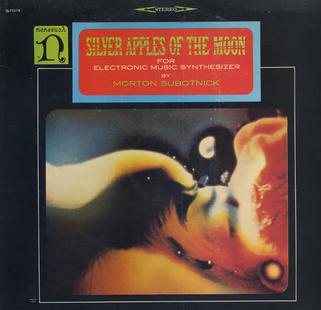
Morton Subotnick, one of the founders of California Institute of the Arts, co-founded San Francisco Tape Music Center in 1962 , left his teaching post a Mills College and moved to New York City and accepted an artist-in-residence position at the newly formed Tisch School of the Arts at NYU. His previous works and performances attracted the attention of the New York City based Nonesuch label, which provided Subotnick the opportunity to compose the very first electronic work commissioned by a record company. “Silver Apples of the Moon” was the result and quickly became a best selling “classical music” album and a staple of most university music libraries.
Classical music of that time, and electronic music in particular, generally was inaccessible and avoided traditional use of melody, harmony and rhythms to produce works that seemed more composed by chance, process or mathematical rules than to be products of the heart and soul. Subotnick breaks with this general trend, balancing the non-traditional sounds with an overall lightheartedness and whimsy, with the first side being more varied and the second side simpler, and somewhat less captivating, with use of rhythmic motifs and a less complex, varied texture and range of sound elements.
Bradford Ellis – Digital Restoration, Mastering, Remixing
Michael Hoenig – Mastering, Remixing
H.J. Kropp – Cover Design
Tony Martin – Illustrations
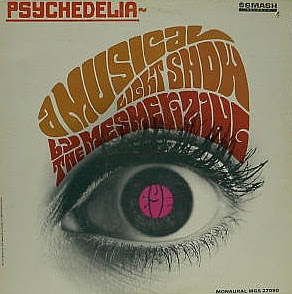
The Mesmerizing Eye, “Psychedelia, a Musical Light Show”
As often the case in the sixties (1960’s rather than a reference to my age), the music produced by the “established” academic artists was often less compelling and relevant than than what was being done elsewhere. Here we have an album by the obscure band, The Mesmerizing Eye, that in my view has much more to say to the listener than Subotnick’s “Silver Apples of the Moon.” This is the only album released by The Mesmerizing Eye, and not clear to me if this was really a band, or if this album was a work of one or two people.
Musique concrète is a classification applied to music constructed by mixing various recorded sounds, sometimes environmental and urban sounds, sometimes such sounds with instruments added, but generally with the intent of creating an auditory experience that is produced from a mixture of disparate sounds, that have disparate associations, and that we traditionally hear in various and disparate contexts. This album draws heavily on that tradition, relying on the medium of tape for the assembly of the final product, yet unlike so many of these type of excursions layered onto tape, there is a general sense of order, meaning, and intent. The album is not only interesting and engaging, but the titles and back-cover liner notes provide additional context and clarity into the music’s relevance and purpose. For example, from the notes for the third track on side two, “The War for My Mind”: “Too many commercials on TV, too much telling us what to do — go to school, wear a tie, cut our hair. They want to control our mind.” Right on! This is classic 1967 anti-establishment philosophy! And, in terms of too many commercials and conformity to the onslaught of commercial messages, more relevant to us today than ever.
The tracks dissolve into each other, with a variety of instruments that varies from track to track. Instruments include church choir, church organ, church bells, piano, acoustic and electric guitar, trumpet, flute, bagpipes, calliope and additional instruments mixed with various background sounds (including the mandatory crying baby) on other tracks. Under twenty-five minutes, always moving forward with a sense of purpose, and making good use of it’s stereophonic capabilities, this little album leaves many of the works by established academia-blessed composers of the 1950’s and 1960’s in its dust. Difficult to find on LP, impossible to find on CD, this album is available on YouTube for those that don’t require lossless audio quality:
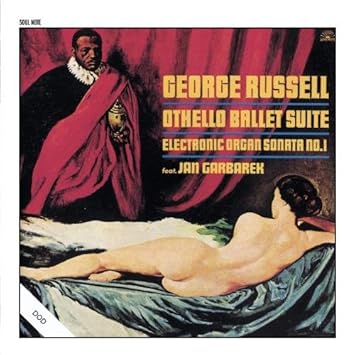
George Russell’s Othello Ballet Suite was recorded in Stockholm in one of the Radio Sweden studios on November 3rd and 4th 1967. At a little under 30 minutes, this work for orchestra and jazz musicians is performed by 23 musicians including several noteworthy Swedish jazz musicians and the Norwegians Jon Christensen on drums and Jan Garbarek on tenor sax. Sometimes majestic and beautiful, sometimes wild and exuberantly chaotic, sometimes showcasing individual soloing brilliance, sometimes a collective of orchestral anonymity, this work is adventurous, forward, and bordering on uncivilized, yet alluringly riveting, and mostly coherent.
Even further out is the companion work, “Electronic Organ Sonata No. 1” which was recorded in 1968. The piece is full of interesting textures and includes many interesting moments, but for me, falls short of the appeal of the ballet suite.
A digital version of the material on this LP is available as part of a 9 CD set, “George Russell – The Complete Remastered Recordings On Black Saint & Soul Note.”
Trained in classical and jazz piano, playing as a teenager in R&B bands, then recording soulful jazz for the Prestige label as a leader, then switching to the Blue Note label, Larry Young records one strong album after another, including the innovative 1965 Unity album with Woody Shaw, Joe Henderson and Elvin Jones which includes a progressive jazz version of the exuberant victory march from Zoltan’s Kodaly’s opera, Háry János.
Young’s 1967 release, “Contrasts”, may not have the stellar personnel of Unity (Larry picks fellow Newark musicians that he knew or played with previously), but the musicianship and chemistry is excellent, and though “Contrasts” is not the classic that “Unity” is, it provides a magnetically engaging first side, and a diverse second side that includes a particularly evocative vocal sung by Althea Young (his wife, which as far as I know appears only one one other album, Young’s next Blue Note album), and ends with a free jazz track, “Means Happiness”. Per the liner notes, Young was particularly fond of this last track, which is based on the word “Hogogugliang.” Unfortunately, an internet search on this term returns no matches, and I can find nothing that elaborates on the purpose or meaning of this track, except for the liner notes, which simply just indicates that “Hogogugliang” means happiness and is derived from Eastern thought.
Fans of modern jazz will not want to miss hearing the first side of this album, or the very tender and beautifully soulful version of Tiomkin’s “Wild is the Wind.”
Track listing[from Wikipedia]
All compositions by Larry Young except as indicated.
William Fischer and Joe Zawinul were first introduced to each other in New Orleans, then, by chance, met a second time in Vienna (Zawinul judging an Austrian sponsored International Jazz Festival and Fischer working on an opera sponsored with a State Department grant), and then once again by chance, met a third time at the Apollo Theater in New York where the got to know each other a little bit. After some musical exploration together, in 1967, they recorded the music on “The Rise and Fall of the Third Stream” — the music composed and notated by William Fisher with one additional title composed by Austrian pianist and composer Friedrich Gulda. (Gulda also composed an interesting theme and variations on the Door’s “Light My Fire” and a Prelude and (jazzy) Fugue performed both by Gulda, and in an altered form during live concerts in the 1970’s, by Keith Emerson.)
Recorded in the latter part of 1967, beginning on October 16th, the “Rise and Fall of the Third Stream” is a thoughtfully composed and arranged album with a non-traditional string quartet (one bass, one cello and two violas), Joe Zawinul on piano, prepared piano, and electric piano, the composer, William Fischer on tenor sax, Jimmy Owens on trumpet, two hard bop jazz drummers, and classically trained Warren Smith on percussion.
Third Stream is the term composer Gunther Schuller coined for music that blends elements of jazz and classical together, or in Schuller’s words exists “about halfway between jazz and classical music”, including jazz-like improvisation. Although the title of this album seems to show a disdain for this term, the music embraces the concept fully, in the very best sense. This is an excellent album from first track to last.
Track listing[from Wikipedia]
“Baptismal” (William Fischer) – 7:37
“The Soul of a Village – Part I” (William Fischer) – 2:13
“The Soul of a Village – Part II” (William Fischer) – 4:12
When I first heard Procol Harum’s “Whiter Shade Of Pale” single in the summer of 1967 on AM radio, I had assumed it was an older song, perhaps from the late 1950s. I was now twelve years old, but still musically very naive with no musical training except listening to AM radio and my very limited 45 collection assembled from the occasional 45 my grandfather gave me (he worked for Firestone and somehow he would sometimes get unused 45’s from the late 1950s) or from one of the few 45s my dad had purchased including two or three 45s of Ethel Merman and cast singing songs from “Annie Get Your Gun”, a Stan Kenton 45 of “Artistry in Rhythm” and a 45 with “Third Man Theme.”
“Whiter Shade of Pale” came and went on the Billboard charts, and I never gave the song or the group much thought, until later in life, when my next door neighbor brought over their “Grand Hotel” album. Well, better late than never, and eventually I purchased their “Salty Dog” album, the A&M reissue of the first album, and their album with the Edmonton Symphony Orchestra. This would be one of those rock groups that didn’t neatly fall into the progressive rock category, and one group that I was never particularly head-over-heels excited with, but I respected and appreciated for the well-written lyrics and well-crafted and arranged compositions.
Their first album, “Procol Harum”, was released around September 1967. The original North American version on Deram includes “Whiter Shade of Pale” and omits “Good Captain Clack”, (also found on the b-side of the “Homborg” single), however the A&M 1972 reissue includes all the tracks of the original UK album plus “Good Captain Clack.”
Gary Booker’s dark baritone voice, along with his keyboards, Matthew Fisher’s Cimmerian organ, Robin Tower’s expressive guitar work and the high quality of Keith Reid’s lyrics and Booker’s compositions make this an engaging album. Highlights include “Whiter Shade of Pale” (included on CDs and on the American LPs), “Conquistador” and “She Wandered Through the Garden Gate”, the guitar passages on “Cerdes” and “A Christmas Carol”, the organ and guitar in “Kaleidoscope”, the organ accompaniment and solos in “Salad Days”, and the Matthew Fisher composition, “Repent Walpurgis” which includes a Bach piano interlude and a couple of notable Trower guitar solos.
Simon Platz – executive producer (for Fly Records)
Eddy Offord, Frank Owen, Gerald Chevin, Keith Grant, Laurence Burridge – engineer
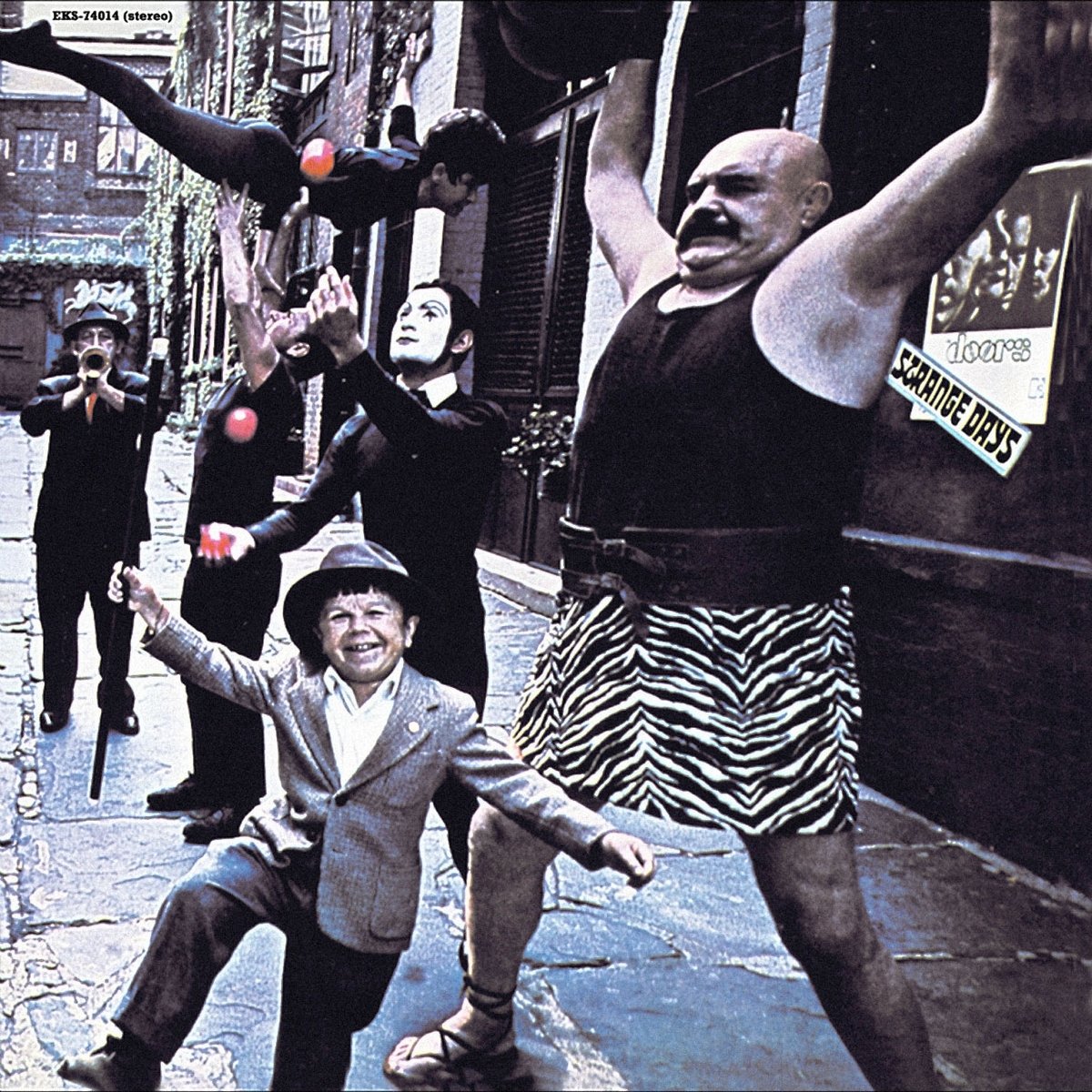
1967 had plenty of colorful, bright shimmering bands providing technicolor, rainbow-glistening music with plenty of upper register sunlight. Procol Harum and the Doors provide a notably contrasting, distinctively dark, often gloomy, sound. They are more Mahler than Mozart, more Buxtehude than Vivaldi. Even the bright spots, “Like People Are Strange” on the Doors second album, absorbs more light than it radiates.
“Strange Days” opens up with a repeating pattern anticipating German space rock, seetting an austere bleakness that is carried throughout the album. The bass guitar intro that opens up “You’re Lost Little Girl” comes from dark subterranean underground caverns, supplemented by atmospheric and Morrison’s moog-synthesizer processed baritone vocals.
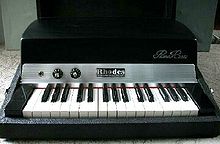
The dark, reflective music continues through the album. “Horse Latitude” breaks the mood as it is more indulgent than germane to the overall mood of the album. “People Are Strange” is more melodic and accessible, more catchy than indispensable, and more of a commercial single than an essential part of the album’s broad fabric, providing relief by breaking the general mood as well as providing an effective mood-based modulation to the upbeat “My Eyes Have Seen You.” Elements of dusk and darkness resume with “I Can’t See Your Face in My Mind” and are nicely concluded with the final track, a nearly 11 minute psychedelic, expansive “When the Music’s Over” with its moog synthesizer, organ and Fender Rhode’s piano bass.
The lyrics, are dark, but at times spirited and environmentally militant. Does Morrison foreshadow his death or the death of our environment?
“When the music’s over
When the music’s over
Turn out the lights
Turn out the lights
Turn out the lights”
….
“Before I sink
Into the big sleep
I want to hear
I want to hear
The scream of the butterfly
…
“What have they done to the earth?
What have they done to our fair sister?
Ravaged and plundered and ripped her and bit her
Stuck her with knives in the side of the dawn
And tied her with fences and dragged her down
I hear a very gentle sound
With your ear down to the ground
We want the world and we want it…
Now
Now?
Now! “
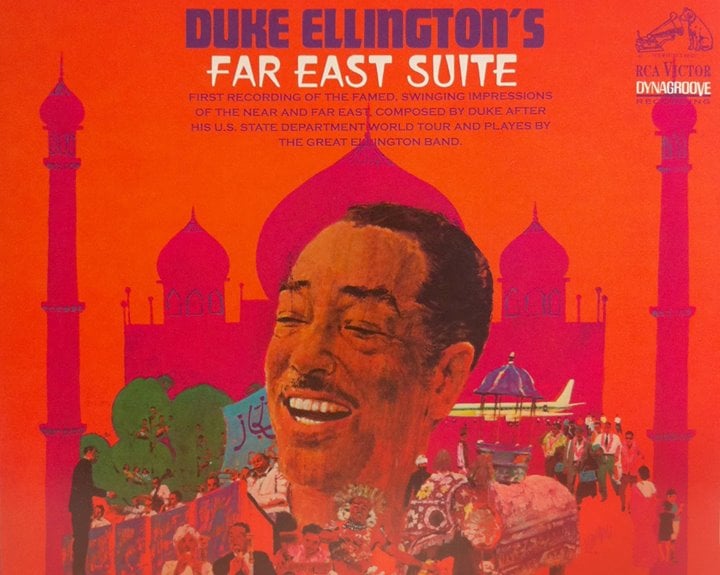
Recorded in December 1966, released in June 1967, and winning a Grammy for Best Instrumental Jazz Performance – Large Group or Soloist with Large Group in 1968,”Far East Suite” is one of the finest concept albums of the 1960’s. A collaboration between Billy Strayhorn and Duke Ellington, as is the case with much of the Ellington catalog between 1939-1967, this work is a set of reflections of the Ellington band’s 1963 world tour that included visits to Syria, Lebanon, Jordan, Iraq Iran, Afghanistan, Pakistan, India, Sri Lanka, and Bangladesh, and then later, their 1964 visit to Japan. All the music with the exception of the last track on the LP, “Ad Lib on Nippon”, is inspired by their 1963 exposure to locations of the Near East. This is not music based on music of those locations, but music inspired by impressions of these locations. The construction and quality of each composition blending crafted arrangements, colorful chords and chord voicings, and including solos that enhance and not detour from the arrangements, make this recording one of the gems of anyone’s LP or CD collection (the CD including alternative takes of tracks 1-3 and track 8.)
Track listing[from Wikipedia]
(All compositions by Ellington & Strayhorn except 9. by Ellington.)
Billy Strayhorn initial inclinations were towards classical music, but the oppressive social barriers at the time made an entry into the classical realm much more difficult than one into the jazz world. Strayhorn was talented enough to excel in either, and given the nature of classical composition in the 1930s-1960s, it’s fair to comment that the more meaningful and relevant new music was being produced as jazz and not the “avant-garde” school music composed for the concert hall and academia, which received limited performance and provided limited commercial recognition and compensation.
Billy Strayhorn was diagnosed with esophageal cancer in 1964, and bravely fought on, continuing to compose, even at the end when hospitalized, with his last year including works like “Blood Count” and “U.M.M.G. (Upper Manhattan Medical Group).” On May 31, 1967, he lived his last day in Billy Strayhorn’s body, but continued to survive through his arrangements, compositions and recordings, with this memorial album, “… And His Mother Called Him Bill”, a timeless work of deep love and respect from Mr. Ellington and his orchestra, providing an everlasting, very personal homage to this great 20th Century giant.
On the original LP, the last track is a fortuitously captured recording of Duke Ellington reflectively playing Strayhorn’s “Lotus Blossom” with bass player Aaron Bell, however the chance recording only has one working microphone and captures only the piano portion of this private performance. Later, a trio version of this was recorded, but the producer found the spontaneous version more emotional and selected that. Both versions are particularly poignant with the solo piano version more personal and the trio version more polished. One can get both versions either in the Duke Ellington Centennial Edition 24 CD set or in the most recent (2016) CD reissue. The tracks on the original LP are all excellent and transcend any stylistic classification. If you love listening to the very best music, whether classical, jazz, rock or anything else, and attentively, actively listen to music, not just having it on as background but diving deeply into its innermost fabric, then you will find this album enormously rewarding.
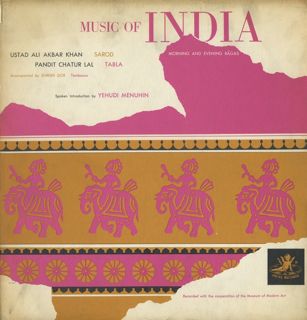
In 1955, with funding support from the Ford Foundation, Yehudi Menuhin hosted the first Indian Classical Music Festival in the United States, The Indian Festival at the Museum of Modern Art in New York City.
Yehudi reached out to Ravi Shankar, who he had met in 1952, to participate, but due to a personal situation, Shankar reluctantly declined and recommended, Ali Akbar Khan, one of finest sarod musicians in India, and Shankar’s brother-in-law. Though Menuhin was not familiar with either Ali Akbar Khan or even the sarod at the time, he took Shankar’s advice and invited Mr. Khan to come to the festival.
Ali Akbar was not so keen on taking the trip to the states. He was not sure how American audiences would react. For the past several years he had been expanding interest in the sarod and instrumental music in general in Western India and had been making good progress. He performed live to receptive audiences in Bombay, worked on films and was making 78 recordings. Thankfully, his friends encouraged him to go and per Khan, “My friends pushed me, more or less, through customs and on to the plane.”
The Modern Museum of Art concert was for April 19, with a recording session scheduled the day before in the Guest House of the museum. This would be the first time that Khan would be able to record more than a 78-length snippet of music, and he was pleased with the final results, the first long playing record of Indian Classical Music.
Soon there we other full length albums produced in the U.S., U.K. and in India of both Hindustani Classical Music and Carnatic Classical Music, or, to over-generalize, classical music of Northern and Southern India. Western classical musicians and composers, jazz artists, and rock musicians all had access to this music and many were intrigued, interested, inspired, or influenced by such music.
So by 1967, there are a number of fine albums released.
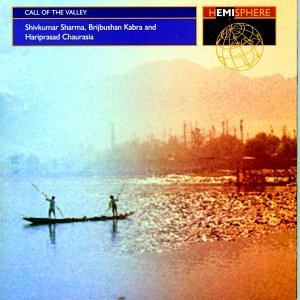
In a sense, this is a conceptual album, with the premise of a given day in the life of Kashmir shepherd as represented by the time of day that is associated with the ragas. (Ragas are classified according to time of day they are suited to, such as daybreak, early morning, late morning, afternoon and early night, late night and midnight ragas.) The choice of instruments and general approach and style further push the boundaries of classical Hindustani music. The combination of santoor (similar to a hammered dulcimer), guitar, bansuri (a wooden transverse flute) and tabla are more within a westerner’s listening experience than sitar, tabla, and a droning tambura. Hariprasad Chaurasia’s magical, engaging melodic lines (on bansuri) along with the overall virtuosity and musicality of the ensemble make this an album that demands not only an initial listening but repeated exploration.
Track listing
Ahir Bhairav/Nat Bhairav
Rag Piloo
Bhoop
Rag Des
Rag Pahadi
Note that the CD contains the following bonus tracks not provided on original LP:
Ghara-Dadra
Dhun-Mishra Kirwani
Bageshwari
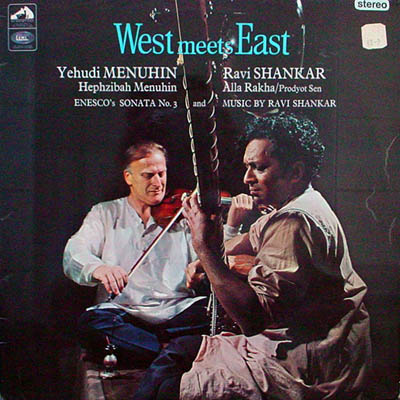
Another release that made a notable commercial impact in the U.S. and the U.K., holding the number one spot on Billboard‘s Best Selling Classical LP’s list for eighteen weeks in 1967, is the Ravi Shankar/Yehudi Menuhin partnership “West Meets East”
On Side One we get the collaboration between the Western violinist, Yehudi Menuhin and the Bengali-born, Hindustani sitarist, Ravi Shankar, Shankar providing the western-notated music for Menuhin to perform from. In the sixties and early seventies Ravi Shankar became a household name in the U.S. for his appearance at Woodstock and his co-organization with George Harrison of the two benefit concerts for Bangladesh at Madison Square Gardens. Shankar also received an Academy Award for the Best Original Music Score for his work on the 1982 movie Gandhi.
Side Two is a performance of one of Enescu’s violin sonatas. Menuhin had studied violin with the famed Romanian composer, conductor, and violinist, and Menuhin performs the work with his sister, Hephzibah Menuhin, on piano. In general, Enescu music deserves more attention, and this sonata is just another excellent work by this talented artist.
Track listing[from Wikipedia]
All selections by Ravi Shankar except where noted.
In 1967, EMI starting releasing an eleven volume, “Music in India” series. The first of this, is a duet between revered sitarist Vilayat Khan and Bismallah Khan on shehnai, which, traditionally, is more appropriate at weddings and festivals than in classical music. However, Bismallah Khan, through his own mastery of the instrument and of Hindustani classical music, elevates the shehnai to an instrument deserving its place and recognition in Hindustani classical music. The combination of sitar and shehnai is a great choice for the first volume of this series as perhaps easier for western ears to embrace a duet between such diverse instruments than an album of just the sitar. As usual with such duets (named jugalbandi which is translated as “entwined twins) there is tabla accompaniment, performed on this album by Shanta Prasad.
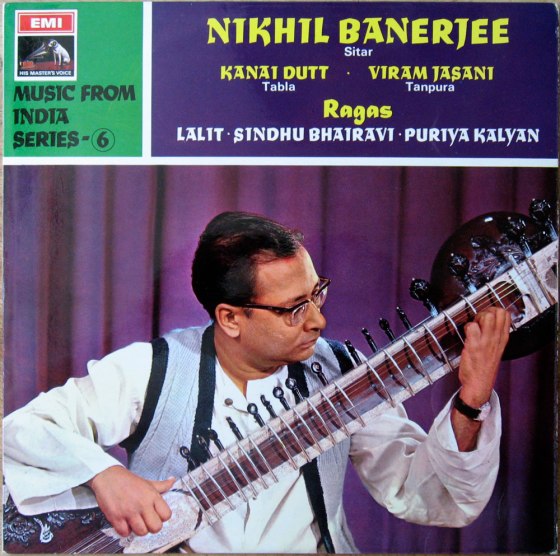
Another important LP from this Music of India series, is volume six with the remarkably skilled Nikhil Banerjee on sitar. This is not a duet like volume one, but more of a solo performance with accompaniment provided by Kanai Dutt on Tabla and Viram Jasani on Tanpura (which provides the basic, foundational drone.)
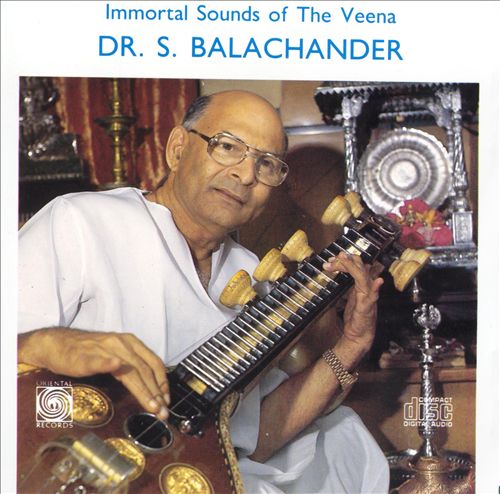
Sundaram Balachander melds his background in Carnatic music with his deep understanding and mastery of Hindustani music to provide a rich, personal voice that borrows from Carnatic vocal traditions. The veena is a particularly intoxicating instrument to listen to, and this is a great recording for showcasing this instrument. Prior to this album, Nonesuch had released an LP of his music in 1965 with mridangam accompaniment.
Abdul Halim Jaffer Khan, is yet another stellar sitar artist, and this 1967 album is nothing short of amazing, particularly side two, a single 18 minute plus raga, with its colorful and exploratory passages. This will be the most difficult recording to find of the ones listed in this post, but is the most representative of traditional Hindustani Classical Music. If you cannot track down a recording, you can find a version currently on youtube:
Jazz fan’s will likely know of Antonio Carlos Jobim two albums with Stan Getz, particularly the first one, Getz/Gilberto containing “Desafinado” and the classic version of “The Girl from Ipanema” with Astrud Gilberto‘s seductive vocals. That first album, added fuel to the already burning fiery desire of Americans to hear and dance to bossa nova, and elevated Jobim to a marketable American music business commodity.
“Wave”, released in 1967, became Jobim’s best selling album, providing smooth, comforting music for middle America and many non-jazz record consumers. The music is well-crafted, well-arranged and well-performed with Jobim playing guitar, piano, celeste and harpsichord, Ron Carter on bass, Urbie Green on trombone, and a small string orchestra with french horn and flute/picolo all providing the most mellow dance music possible. It is not exactly jazz and, in a sense, sets the tone for a genre of music that would be called smooth jazz, a style not demanding listener attention or involvement, but played for its soothing, relaxing qualities. Such smooth or background music became prevalent in shopping centers, in restaurants and in many work places that now added such music or substituted smooth jazz for the previously provided muzak. In 1987, Los Angeles radio stations KMET, once one of the coolest, most progressive album-oriented, FM radio stations in Southern California, changed its letters to KTWV and called itself “The Wave” playing “adult contemporary jazz” becoming one of the un-coolest, most un-progressive stations in the Greater Los Angeles area ultimately influencing other radio stations to take the same path.
Of course, none of the blame should be attributed to this fine Jobim album; it is just worth noting that soon background music became virulently prevalent, irking many musicians that believed music should be actively listened to and not absorbed.
Frank Zappa and his Mothers of Invention did not produce either easy listening music or anything that could be considered conservative. This is the Mothers of Invention’s second studio album and every bit as adventurous as the first including mixed meter and quotes from Stravinsky’s three most famous ballets, “The Firebird”, “Rite of Spring” (“Le Sacre du printemps”) and Petrushka. Each side of the original LP can be viewed as a single piece rather than a set of unrelated tracks due to redeployment and relationship of music material. Humor is a inseparable part of this innovative album that many Zappa fan’s cite as one of their favorites.
Track listing [from Wikipedia]
All tracks written by Frank Zappa.
Side one: “Absolutely Free” (#1 in a Series of Underground Oratorios)
Note that there are several additional musicians on this album including Don Ellis on trumpet on “Brown Shoes Don’t make it”
Another less-than-easy-listening album is Captain Beefheart and his Magic Band’s “Safe as Milk” which starts from a blues foundation but includes uncommon time signatures and unique instrumental divergences. On one hand, a traditional blues fan might prefer to spend their time listening to a true blues album by someone like Howlin’ Wolf rather than this Don Van Vliet (A.K.A Captain Beefheart) psuedo-blues album. However, despite some superficial similarities in Howlin’ Wolf’s and Beefheart’s voices, and “Safe as Milk’s fairly straightforward first track, there are enough deviations here, musically and lyrically, from other more solid blues albums of the time to take this album on its own terms. Guitarist Ry Cooder, having played with Taj Mahal in the short-lived Rising Sons, makes important arrangement and performance contributions. Historically, this is an important album as it captures a band in transition to a more adventurous style that merges blues, free jazz and art-rock into a genre I could only call head-spinning, head-splitting, free-style post-blues
So even though this is much closer to standard fare than later Captain Beefheart albums, it contains a number of adjustments to standard rock/blues that make this an album worth checking out. “Yellow Brick Road” borrows the first part of its melody from “Pop Goes the Weasel” but strays off into its own tune with a mix of innocent and suggestive lyrics. “Autumn Child” pushes into both art-rock and progressive rock territory with its Zappa-like opening and changes in meter, texture, tempo and mood. Electricity” is the stand-out track, with lyrics and music flirting with psychedelia (note the guitar imitating the sitar), blues, bluegrass, and rock, and, once past the brilliant introduction, is very danceable. The rising oscillations of a thermin closes out the song.
Whereas one can put on “Waves” (and even “Absolutely Free” under the right circumstances) and delegate it to the background with little trouble, if one does this with some of the Beefheart “Safe as Milk” tracks like “Electricity”, “Plastic Factory” and “Abba Zaba”, they simply become distracting and annoying; however, play this album on a good audio system that can untangle the aggressive texture into individual and distinctive voices and the music flies by and, if not always pleasant, is unexpectedly absorbing and engaging.
I am having second thoughts about posting these album reviews of music of 1967 — fifty years ago.
One: it’s not easy to write reviews about music: to describe music in words is an impossible activity, and at best one ends up describing their reactions to the music, which, really, is self-centered, possibly narcissistic, and either self-indulgent or masochistic (writing music reviews can be very painful as one recognizes that keystrokes being captured by WordPress fall immeasurably short of the sound waves that are captured by audio recording devices.)
Two: shouldn’t I be writing about recent album releases? To write reviews about albums already accepted as established classics doesn’t help generate income for the musicians (if they are still alive), encourage them to create more music, or provide the service of bringing previously ignored music or musicians to people’s attention.
Three: there are others out there writing music reviews that get less visitors than this blog, and yet their reviews are better, more interesting and more informative. When I have visited such blogs, I am shocked to see posts that range from being hours old to months old without a single like or comment. What keeps them going?
And so I take the time to ask myself, am I providing anything of value to my reader or, if not to my reader, is there anything that I get out of this? And I really don’t know at this point if any single one of my reviews has caused someone to listen to music they would otherwise have missed out on. But I do know, once I take the time to reflect on it, that I do get something out all of this: knowing that I need to write something, I am listening to this music differently than I normally would. I am not only listening intently, but with the need to find something I can communicate out to someone else.
During much of my regular music listening, I listen seriously, and I direct my attention directly on the music. I am seated. I am not dancing, driving, cooking, or watching sports with the sound turned down. I am a human receiver, trying to absorb and enjoy as much of the music as possible. When I listen to music I am planning to write about, I am no longer in receiver mode, but in explorer mode. I am looking for places to pitch a tent, clues for sources of water, tracks of game in the vicinity, evidence of past occupants or current inhabitants. I am reaching out, straining my eyes to see the distance, taking notes mentally; I normally don’t do any of these things when I am listening for enjoyment.
And so knowing that I must write about what I am listening to changes the listening experience. If it is a digital source, I might even pause, rewind and replay. I find myself looking for strengths and weaknesses in the music instead of taking it on it’s own terms. It’s like the difference between dating someone for the enjoyment of their company and dating to determine an appropriate life partner.
And there is the selection of material. When I listen for enjoyment, I pick something I am in the mood for, or something I just bought, or something that will provide a unique experience. When I am writing a post about one of the best albums of 1967, the selection process is limited to that year, and I have to find something that is pretty good and that others will enjoy. When listening, I ask myself, is this album good enough to mention as a “Fifty Year Friday” album, and if the answer is no, the album has served it’s purpose as a candidate and either I tolerantly listen to the end, or I stop and put on something else.
And to select an album, I review all potential choices: albums in my collection I have heard dozens of times, both as an dedicated listener and as background to other activities, as well as albums that I purchased, and never played — or played the first track — or continued past the first track but made secondary while reading liner notes, reading a book, or doing something else.
And so we come to this Velvet Underground album. I know this is a good group: a very important group in its place in the history of music. And I was a fan of Lou Reed’s “Transformer” album, at least marginally, having heard it a few times in 1973 and 1974. And so, back in the early 1990’s, when I would buy a few dozen CDs every month, mostly jazz and classical, I saw this in the local mega-bookstore bin, and not having a single Velvet Undergound CD, and knowing this was supposedly a good one, I immediately bought it with a few dozen other CDs. When I got home, this CD had to compete with a previously purchased 18 CD set of Nat King Cole, a Chet Baker CD, the complete Bill Holiday on Verve, a 6 CD T-Bone Walker set, a Captain Beefheart CD and several new classical CDs. Neither the Velvet Underground nor the Captain Beefheart won me over after the first couple of tracks, so I set them aside, meaning to listen to them soon, but never doing so.
But now, in 2017, looking for worthwhile albums from 1967, I select this previously neglected CD, and listen to it with full attention. And to my surprise, it is a musical treasure.
If Sgt. Pepper’s is the first example of progressive rock, “The Velvet Underground & Nico” is the first example of Art-Rock, at least that I know of. I am not always a fan of so-called Art Rock — it can get on my nerves, but like the genre, free-jazz, when it is done right, it is great — when it is just an excuse for lack of structure, vision, content, it is like so much of the so-called classical “Avant-Garde” (neither classical or particularly innovative) of the 1950’s, 1960’s and 1970’s — a waste of valuable listening time.
This album, though, has direction, intensity, texture, form, structure. There is a sense that there is a canvas with dimensions in space and time that is being systematically addressed with points, dabs, strokes, shades, groupings and contrasts.
“Sunday Morning” is the last song recorded for the album, but it makes sense for it to open the album as it is most accessible and apparently disarmingly innocent of all the songs. The celesta provides a music-box like introduction, to a peaceful, tranquil tune with lyrics that belie the musical serenity:
“Sunday morning And I’m falling I’ve got a feeling I don’t want to know”
This is a song that could have gotten substantial airplay. Perhaps it didn’t due to the contrast between the pleasantly serene melody and the disheartening lyrics. Perhaps it didn’t because of Lou Reed’s distinct half-spoken and sometimes imperfect intonation. Or perhaps there were commercial reasons or lack of the necessary behind-the-scenes connections.
The musically bucolic first track is contrasted with a rough, repetitive, blues based “Waiting for the Man.” The lyrics are again bleak, portraying a New York City heroin addict, looking to score from his dealer.
Since music is generally my main focus, let’s get the lyrics out of way. Lou Reed’s writing is direct, brutally honest, and of its time. These are not the clever, playful, roundabout lyrics we find in most of the more socially-relevant music of the time. This is a much more accurate, even painful, representation of reality. Lou Reed connects with life’s realities rather than just observes or comments on life:
“I’m waiting for my man Twenty-six dollars in my hand Up to Lexington, one, two, five Feel sick and dirty, more dead than alive I’m waiting for my man
“Hey, white boy, what you doin’ uptown? Hey, white boy, you chasin’ our women around? Oh pardon me sir, it’s the furthest from my mind I’m just lookin’ for a dear, dear friend of mine I’m waiting for my man”
The music here is frantic, with hints of barrelhouse piano transformed into a pounding commentary on withdrawal and drug dependency. This is not pleasant music. This is musical drama.
Lou Reed is sometimes flat, and occasionally here or there sharp, but, thankfully, he wavers more like a gymnast maintaining equilibrium on the balance beam, his pitch violations compensated by his confident and appropriate delivery of the text which unfailingly communicates the intrinsic meaning and essence inherent in the words. Not the case with Nico. At the insistence of Andy Warhol, Nico was added to the band to perform lead vocals on a few of the tracks as well as some backing vocals. On the third track of the album, the wistful ballad, “Femme Fatale”, the combination of being out of tune and lack of consistent expression erode her voice’s timbral strengths inviting one to consider how much better the album would have been with Lou Reed replacing her lead vocal assignments.
It is with “Venus in Furs” that this album takes off into another musical sphere. Not only is the focus on the substance, with a given mood and direction deftly and often roughly crafted for each track, but we get a range of music styles — some of that immediate time period and some hinting at the near future.
One can identify the influences in this album: Bob Dylan, blues, rock and roll, rhythm and blues, free jazz (Lou was a fan of Cecil Taylor), classical avant garde, modernism and experimental music (Cale studied with Humphrey Searle, and after coming to the U.S, had ties to Iannis Xenakis, John Cage and La Monte Young), British Invasion, British Skiffle, Indian and eastern music (note the drone and guitar in “Venus in Furs”), and possibly the New York Hypnotic School. More to the point are the many hints and foreshadowings of future styles of music including minimalism, psychedelic, glam rock, art rock, progressive rock, punk, goth, and grunge. I will take bets on Velvet Underground having influenced Peter Hamill, David Bowie, PJ Harvey and groups like the Residents (at least a little), Explosions in the Sky, Sex Pistols, Joy Division, U2, Sonic Youth, Talking Heads, Nick Cave and the Bad Seeds, R.E.M. and countless others.
Track listing[from Wikipedia]
All tracks written by Lou Reed except where noted.
Ami Hadami (credited as Omi Haden) – T.T.G. Studios engineer
Gary Kellgren – Scepter Studios engineer (uncredited)
Norman Dolph – Scepter Studios engineer (uncredited)
John Licata – Scepter Studios engineer (uncredited)
Gene Radice – post-production editor, remixer
David Greene – post-production editor, remixer
For those that want to hear additional Lou Reed compositions from this time period, they can listen to “Chelsea Girl”, Nico’s solo album recorded in 1966 after “Velvet Underground & Nico”, and released in October 1967. The name of the album is a reference to Andy Warhol‘s 1966 film Chelsea Girls, in which Nico starred and includes a Lou Read composition of that same name. Besides Lou Reed, John Cale and Sterling Morrison making contributions, we also get two Jackson Browne compositions and his guitar on five of the tracks. Jackson Browne was providing back up for Nico’s small venue performances in 1966, and romantically involved with her until 1968.
Nico’s vocals are slightly better than on the Velvet Underground album, but there are still serious problems with pitch and in providing appropriate emotional delivery of the lyrics. The string arrangements, instrumental backing, and strength of the compositions help alleviate some of Nico’s performance shortcomings.
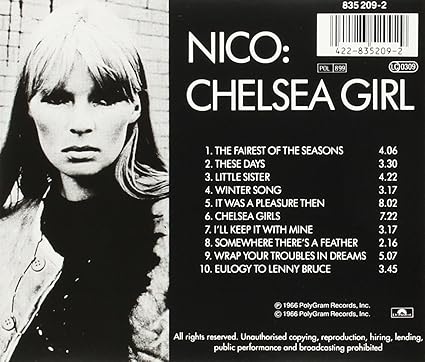
Track listing[from Wikipedia]
Side A
“The Fairest of the Seasons” (Jackson Browne, Gregory Copeland) – 4:06
“I’ll Keep It With Mine” (Bob Dylan) – 3:17 Note: this song was recorded by Dylan in 1965 but remained unreleased on any of his own albums until the 1985 Biograph set.
“Somewhere There’s a Feather” (Jackson Browne) – 2:16
“One positive thought produces millions of positive vibrations.” — John Coltrane
Coltrane’s left us fifty years ago on July 27, 1967. He played, improvised, and composed music for a number of essential albums including “Blue Train”, “Bags and Train” with Milt Jackson, “Giant Steps”, “Thelonious Monk with John Coltrane”, “My Favorite Things”, “Live at the Village Vanguard”, “Duke Ellington & John Coltrane”, “Coltrane live at Birdland” with an incomparable version of “Afro Blue”, the one of a kind “John Coltrane and Johnny Hartman” album, and the classic “A Love Supreme.” Also of note is the June 1965 session (released in 1970) as the album “Transition” with the title track being essential to fans of the music contained in a”Love Supreme.” There is also music recorded in 1967, released years after Coltrane’s death, that could be classified as Free Jazz including “The Olatunji Concert: The Last Live Recording” recorded on April 23, 1967. It’s interesting to compare a 1963 live version of “My Favorite Things” to the 1967 version:
Thank-you, Mr. John Coltrane for the all this incredible music you provided.
Twenty-six year old department store model, Grace Slick, a graduate of Palo Alto High and resident of the Bay area (San Francisco Bay area) after reading an article about one of the local bands, Jefferson Airplane, in the San Francisco Chronicle newspaper, went to see them live where they played regularly (“The Matrix”, a club on Fillmore Avenue) and was soon inspired to start a band, with her husband, his brother, and three others.
This band, “The Great Society”, named after LBJ‘s set of programs to address unjust social conditions, soon opened for other more established Bay Area groups including Jefferson Airplane, and eventually attracted the attention of Columbia Records which offered them a recording contract at about the same time that the Jefferson Airplane was looking to replace their female vocalist, Signe Toly Anderson. Mrs. Anderson, an expecting mother, felt that she could no longer tour with the band and take care of a newborn and so gave notice, informing the public, on October 15, 1966 with words befitting any flower-power child: “I want you all to wear smiles and daisies and box balloons. I love you all. Thank you and goodbye.”
Grace Slick left her band, which not being able to continue without her, disbanded, and she joined Jefferson Airplane, bringing with her two particularly notable songs: the Great Society’s lead guitarist’s medium-tempo song “Someone to Love” and her own drug-inspired composition, “White Rabbit.”
Jefferson Airplane embraced both Grace’s powerful singing and these two tunes, which they re-arranged, maybe not for the better, but certainly with greater commercial appeal.
“Surrealistic Pillow”, Jefferson’s Airplane’s second album and the first album with Grace Slick takes advantage of Grace’s high-energy vocals from the very first track, where her background vocals are of more interest than Marty Balin’s main vocals and perhaps the main melody itself. The second track, is “Somebody to Love”, played with more force and at a faster tempo than the Great Society arrangement.
This album also includes a song that Marty Balin wrote originally for Tony Bennett: “I wrote it to try to meet Tony Bennett. He was recording in the next studio. I admired him, so I thought I’d write him a song. I never got to meet him, but the Airplane ended up doing it.” Jerry Garcia plays guitar on several tracks for this album including the short repetitive electric guitar phrase heard here:
“Today” is followed by the evocative, marijuana-paced (and perhaps marijuana-influenced) Balin composition “Comin’ Back to Me.”
Side 2 starts with “3/5 of a Mile in 10 Second”, more for dancing then listening. “DCBA” is relaxed and with somewhat puzzling lyrics:
“It’s time you walked away and set me free”
but later
“I take great peace in your sitting there Searching for myself, I find a place there.”
and then in the middle of this
“Here in crystal chandelier, I’m home. Too many days, I’ve left unstoned. If you don’t mind happiness Purple-pleasure fields in the sun. Ah, don’t you know I’m runnin’ home. Don’t you know I’m runnin’ home (to a place to you unknown? )”
“How do you feel” is one of those innocuous feel-good songs that would be comfortably at home on an album by The Mamas and Papas or The Association. “Embryonic Journey” is an excellent acoustic guitar instrumental, composed as part of a guitar workshop in Santa Clara by Jorma Kaukonen three years before he was invited to join Jefferson Airplane band by friend and fellow-classmate Paul Kantner.
The penultimate cut of the album, is the standout “White Rabbit”, rearranged musically to be succinct, focused, rhythmic and eerily similar to Ravel’s Bolero. No concessions were made lyrically:
“One pill makes you larger And one pill makes you small And the ones that mother gives you Don’t do anything at all: Go ask Alice When she’s ten feet tall.
“And if you go chasing rabbits And you know you’re going to fall Tell ’em a hookah-smoking caterpillar Has given you the call: Call Alice When she was just small.
“When the men on the chessboard Get up and tell you where to go And you’ve just had some kind of mushroom And your mind is moving low: Go ask Alice I think she’ll know.
“When logic and proportion Have fallen sloppy dead And the White Knight is talking backwards And the Red Queen’s off with her head Remember what the dormouse said: ‘Feed your head. Feed your head.'”
I think it is at this point in time, more or less, that the commercial interests of the major music labels became more important than censorship of music with anti-establishment lyrics. During the last eight weeks of summer, it seemed that one could not turn on Southern California AM radio without “Light My Fire” or “White Rabbit” being played at least once in any given hour. As a twelve-year old, I knew something was changing in the world around me as an older culture began to buckle under the weight of newer ideals — even if those ideals were plainly self-indulgent.
“Surrealistic Pillow” ends with a trippy, protypical Haight-Ashbury tune, “Plastic Fantastic Lover”, mocking the ascendancy of the boob tube:
“Her neon mouth with the blinkers-off smile Nothing but an electric sign You could say she has an individual style She’s part of a colorful time.
“Secrecy of lady-chrome-covered clothes You wear cause you have no other But I suppose no one knows You’re my plastic fantastic lover.
“Her rattlin’ cough never shuts off Is nothin’ but a used machine Her aluminum finish, slightly diminished Is the best I ever have seen.
“Cosmetic baby plugged into me I’d never ever find another; I realize no one’s wise To my plastic fantastic lover.
“The electrical dust is starting to rust Her trapezoid thermometer taste; All the red tape is mechanical rape Of the TV program waste.
“Data control and IBM Science is mankind’s brother But all I see is drainin’ me On my plastic fantastic lover.”
Music can transcend time, be a document of its time, or both. “Surrealistic Pillow” is indisputably an important musical document of its time. As as listener, you must decide if it transcends time. For those of us that grew up with this music, it tends to take us back in time, which, I suppose, is as valid way as any to transcend time.
Marty Balin – vocals, guitar, album design, lead vocals on “Today”, “Comin’ Back To Me” and “Plastic Fantastic Lover”, co-lead vocals on “She Has Funny Cars”, “My Best Friend” and “Go To Her”
Grace Slick – vocals, piano, organ, recorder, lead vocals on “Somebody To Love” and “White Rabbit”, co-lead vocals on “She Has Funny Cars”, “My Best Friend”, “D. C. B. A.-25” and “Go To Her”
Skip Spence – drums on “Don’t Slip Away”, “Come Up the Years”, and “Chauffeur Blues” (UK only)
Additional personnel
Jerry Garcia – “spiritual advisor”; guitar on “Today”, “Comin’ Back to Me”, “Plastic Fantastic Lover”, “In the Morning”, and “J. P. P. McStep B. Blues”
“If the doors of perception were cleansed, everything would appear to man as it is, infinite. For man has closed himself up, till he sees all things through narrow
chinks of his cavern.” William Blake from “The Marriage of Heaven and Hell”
The Doors formed in 1965, in Los Angeles, signing in 1966 with folk-music label, Elektra, after Columbia failed to secure a producer for their first album. Their name was inspired by Aldous Huxley’s book “The Doors of Perception”, which recounts Huxley’s mescaline experiences and borrows its title from the William Blake poem, “The Marriage of Heaven and Hell.” This first album of theirs was released in January of 1967.
The album opens up with a promise, premise and pronouncement to “Break On Through to the Other Side.” This first track, as do many on the album, opens up in layer by layer (instrument by instrument) with John Densmore ‘s drums, staggered bass in first the left (guitar bass line) and then right channel (keyboard bass line), Jim Morrison’s vocals, Robby Krieger‘s guitar and eventually Ray Manzarek‘s organ setting a standard of expectation for the rest of the album. Less than 2 1/2 minutes, the track is over — just the right length — leaving the listener hungry for more.
This album, in general, is dark, emphatic, reflective, well-thought out and a precursor to later American heavy metal (Iron Butterfly, Steppenwolf, and to some degree even bands like Blue Oyster Cult.) Much of the music is blues-based, some adhering closely to that foundation (“Back Door Man”), some straying quite far but keeping the essence of the three chord pattern (“Soul Kitchen”) and some seemingly far removed but yet still with a blues essence. Within this wide range, all of this music has a freshness and originality to it, sometimes provided by Kreiger’s distillation of late sixties guitar, sometimes by Manzarek’s often ornate keyboards and sometimes from the overall arrangement.
Not enough can be said about “Break On Through to the Other Side”, and so I will say no more.
“Soul Kitchen” is a sexy, bouncy bluesy piece, with what was in 1967 pretty explicit lyrics. “The Crystal Ship” is lyrical, dramatic, intimate and in a minor key with a mystically evocative keyboard section. “Twentieth Century Fox” is a clever title, not about a movie studio, but of course, to the “fashionably lean” “queen of cool” in-control modern woman well described in the lyrics:
“No tears, no fears,
No ruined years, no clocks;
She’s a twentieth century fox, oh yeah!”
The fifth track, “Alabama Song” is from the Kurt Weill opera Rise and Fall of the City of Mahagonny ( Bertolt Brecht lyrics) and I suspect the lion’s share of arrangement credit goes to Manzarek who plays the zither-like marxophone and keyboards. Note that nearly ever-present, oompah-oompah, ironic lilt — the essence of which resurfaces in at least a couple of 1970’s English progressive rock albums.
Not much needs to be said about “Light My Fire”, thanks goodness, for words poorly can capture the spirit of this song, it’s historic, seamlessly interwoven blend of jazz, baroque and rock elements, and its influence on early metal and early progressive rock bands.
“Back Door Man” is pure blues, written by Willie Dixon and previously known for the 1960 Howlin’ Wolf version. “Back Door” is a prominent reference in earlier blues music and refers to sneaking in the back door of a house when the unsuspecting husband is at work or out and about.
“I Looked at You” is another song that starts by adding layers. It is almost a prototypical mid-sixties go-go dance number until that first brief detour (modulation at “cause it’s too late”), quickly shifting back to its initial state (“we’re on our way and we can’t turn back”) with a wonderful go-go style organ that follows. Here again we have a hint of baroque music embedded in what is essentially sixties pop.
“End of Night”, a soothing minor/modal ballad in the midst of more stormy tracks, begins with a hint of spooky, Bartok-like nacht-musik into a leisurely blend of guitar and Morrison vocals.
“Take It as It Comes” starts with no introduction, appropriate to both the title and opening words of “Time to live.” It starts of with a e minor seventh chord which effectively creates the drive and resulting uplift for the next section (modulation to A minor at “Take it easy, baby. Take it as it comes”) and the short baroque-like organ solo. A second ornate organ solo is followed by more vocals from Morrison (“Go real slow. You like it more and more. Take it as it comes. Specialize in havin’ fun”) and a quick, final flourish to end.
“The End” attempts to rise up to the height of the opening track, and would come very close, with its tender opening and exotic, Indian-influenced (voiced by guitar), expansive instrumental section. The trouble is that after a few minutes, Morrison’s mumbling detracts from otherwise meditative, highly spiritual music. Granted, Morrison is reaching for the furthest corners of personal discovery, but the track would have worked better if he stopped after the melancholic exposition:
“This is the end, beautiful friend
This is the end, my only friend, the end
Of our elaborate plans, the end
Of everything that stands, the end
No safety or surprise, the end
I’ll never look into your eyes, again”
which sets up the remaining instrumental exploration and inner-reflection nicely.
That said, this Morrison self-indulgence is only a minor weakness and doesn’t detract from the excellence and revolutionary nature of this album. When we talk about drugs, sex, and rock and roll, this album encompasses all three: from the name of the band, to the surprisingly suggestive lyrics (common enough for blues, but not so common for the mass media of 1967), to the self-assertive, unapologetic, counter-culture music.
One of my fondest memories of my first year of college was listening in the library’s music listening room in the fall of 1973 with my first-semester girlfriend (and my continuing lifelong friend since sixth grade) to Zappa’s “We’re Only in it for the Money” and this very first Jimi Hendrix album.
A week earlier, I had listened to “Are You Experienced” for the very first time in that same library but on headphones. I had previously bought two Hendrix albums in high school, “Cry of Love” and “Rainbow Bridge”, and was curious how this compared to those two albums and “Electric Ladyland”, all three of which I thought highly of. I remember studying the album cover of “Are You Experienced”, front and back, before putting the LP on the no-frills turntable and then donning the mediocre, highly uncomfortable library headphones. The first track was “Purple Haze”, and though primitive in comparison to songs on “Cry of Love”, captured me completely. The lyrics lacked the imagery and imagination of later Hendrix lyrics and the sound over those cheap library headphones sounded rough and muddy, but the forceful and potent guitar-riff introduction was as magical as a Wagner leitmotif: a compelling opening to any album, effectively locking any exit from the listening room door until the end of side two.
That first overall impression of this album was not entirely positive. I missed the studio slickness and more sophisticated lyrics of the later albums, and found the music to be dated, a relic of the drug-crazed, psychedelic late sixties. Nonetheless, I was certainly impressed enough to want to share with my on-campus and off-campus friend a week later as we checked out this album and were able to grab one of the two listening rooms that had speakers, and also, a room where we could stretch out a bit and listen to this much as at home, except for the “No food allowed” sign and the narrow window in the door to allow us to be observed by passerbys.
Until a few days ago, I hadn’t heard this album since college, so in preparation to write a blog post on this work, I got out a previously unheard high-quality vinyl German pressing (let’s not discuss how many vinyl records I have collected that I have not yet listened to or how they, along with way too many CDs, have taken up the better portion of two bedrooms) and, without looking at the contents, started to listen to it from beginning to end.
“That’s old age and memory,” I thought, as “Foxy Lady” danced out of the loudspeakers. I picked up the cover and, noticed even more to my surprise, that “Purple Haze” was missing from side 1 and side 2. Yes, indeed, my memory is going bad, but it’s not hallucinogenic! As patience is a virtue of old age, I continued listening, noticing the absence of “Hey Joe” and “The Wind Cries Mary” and the addition of tracks I had never remembered hearing in my life: first “Can You See Me” and then “Remember” on side two. These two new tunes were indeed an unexpected and rather rewarding discovery, but as soon as the album was over, not owning a CD of this to compare, I went to the internet and found the different listing of tracks for the North American version and the UK/European version. Relieved, now, that I still had a few weeks more until onset of dementia, I obtained a standard 16 bit redbookCD which had all the tracks from both albums and a few bonus tracks.
Glad to be able to listen again to the original album I knew, but with seriously better audio than in the library music room, I was taken back through time with that introductory riff of “Purple Haze” – clearly the only way to introduce Hendrix’s first album.
This is a modern blues song — and I mean modern! The whole album, even the one track not written by Hendrix (“Hey Joe”) strays varying distances away from traditional blues, yet shares 99.9 % of the DNA. Like a blues song, or Chopin’s or Beethoven’s funeral marches, “Purple Haze” is slow paced, inevitable and unstoppable. Hendrix creates tension with his approach to fingering, chord voicings, use of controlled distortion, his overall guitar technique, and emphatically pushing out the boundaries of comfort and predictability. The spirit of the music is assisted ably by Noel Redding’s bass (including passing tones between root notes and various rhythmic subtleties) and Mitch Mitchell’s driving, energetic, yet calculatingly controlled drumming.
And, as I remembered, these lyrics are not at the level of later Hendrix lyrics, yet still, there is a undeniable unity with the music:
“Purple haze, all in my brain;
Lately things they don’t seem the same.
Actin’ funny, but I don’t know why;
Excuse me while I kiss the sky.
“Purple haze, all around;
Don’t know if I’m comin’ up or down.
Am I happy or in misery?
What ever it is, that girl put a spell on me.
“Help me
Help me,
Oh, no, no.”
For some odd reason, music critics of that time stretched and reached to make drug connections when none where evident. These lyrics are about being smitten — whether naturally or through other means, like voodoo, is open to discussion — but drugs don’t seem to be relevant here.
Musically, one could argue that drugs opened up vistas and viewpoints for composers and musicians that allowed such innovation. Maybe there is truth here (Chopin took opium for tuberculosis, Berlioz took opium, many jazz musicians had drug encounters or severe drug dependencies) and maybe not, but one cannot create genius from drugs or elevate mediocre musicians and composers up to the next level. One can certainly make the case that drug use ultimately works against musicians at all levels. That said, let others more knowledgeable address this drug topic, and the impact of drugs on music, I will just delight in the amazing music handed down to us from those inspired geniuses, whether inspired divinely, materially or through some other means.
And there is much to delight in during the course of this album. The second track, “Manic Depression” has this wild instrumental where Hendrix’s guitar climbs up by thirds (outlining E flat minor seventh chord) for four notes and then frenziedly disperses in a truly manic solo. This rising four note motif then collapses into a three-note pattern incorporated in the next verse:
“Well I think I’ll go turn myself off and a go on down.
(All the way down.)
Really ain’t no use in me hanging around.
(Oh, I gotta see you.)
“Music sweet music
I wish I could caress and a kiss, kiss;
Manic depression is a frustrating mess”
and undergoes additional transformation, collapsing into two notes and then back to four with the feedback-punctuated finish.
“Hey Joe” continues the inevitable march forward, with a joyous, celebratory instrumental interlude enhanced by the ensuing, buoyant backing vocals.
“Love or Confusion” is dominated by the guitar work and resulting drama. In contrast to all that came before “May This Be Love” is a lush ballad showing off the gentle, intimate side of Hendrix. Ending side one is the ironically initially exuberant “I Don’t Live Today”, followed with darkly, depressing passages weaving back and front, side to side.
Side two opens up with the second leisurely-paced ballad, “The Wind Cries Mary.” Hendrix’s nonchalant, conversational vocals work well here. Nothing here is unnatural or forced, with a simple but beautiful guitar solo in the middle and a tranquil calming ending providing a momentary opportunity to catch a breath before jumping into the up tempo “Fire.”
“Fire” opens up with one of those iconic Hendrix guitar intros that foreshadow, and perhaps creates, heavy metal. Mitchell’s level of energy, creativity and collaboration is not only up to the assignment, but raises the intensity and is integral to the overall character and aesthetics. Redding provides spurts and phrases of growling, rhythmic bass.
“Third Stone from the Sun” is a psychedelic sound painting. It’s foundation is a lyrical, almost placid, watercolor theme mixed with half-speed spoken vocals:
“Star Fleet to scout ship, please give your position. Over.”
‘”I am in orbit around the third planet from the star called the Sun. Over”
“You mean it’s the Earth? Over.”
“Positive. it is known to have some form of intelligent species. Over”
“I think we should take a look.”
Regular speed:
“Strange beautiful grass of green with your majestic silken seas.
Your mysterious mountains, I wish to see closer.
May I land my kinky machine?”
Half-speed:
“Although your world wonders me with you majestic superior cackling hen,
Your people I do not understand, so to you I wish to put and end
And you’ll never hear surf music again.”
“That sounds like a lie to me.
Come on man, let’s go home.'”
(Not very sure of this last section and pieced it together from internet references.)
The spoken vocals are sunken deep into the texture making this a instrumental jam that flirts with some of the qualities of a sound collage, particularly at the end.
The penultimate track, “Foxy Lady”, begins with guitar crescendo metamorphosing into a sexy, provocative ostinato supporting the main melody. The highlight is the guitar solo at 1:48, yearning and screeching passionate longing with a repeat of the chorus. A forty-five second coda finishes off the piece with the diminuendo at the end providing symmetry to the opening.
There are three tracks in the European album not present in the original North American version. The first, “Red House”, is a twelve-bar blues song. For non-musicians, this is a standard blues form that is prevalent in blues, rock and roll, rock, and jazz to such an extent that it can be very annoying or boring to listen unless the composition has something special such as unusual melody, humorous or particularly engaging lyrics, substitution chords , stellar execution and performance, or effective, interesting solos on top of those chords. From the start, with Hendrix abstracted guitar intro, this is more than a throwaway blues song. In this early Hendrix recording, with this common blues structure and set of standard blues chords, we can identify much of what makes Hendrix performances so engaging. The guitar work is the primary focal point for both the leisurely and experienced listener, but part of the equation to make this work includes the support from Redding on a modified rhythm guitar and Mitchell’s minimal but steady drums as well Hendrix’s direct and personable vocal delivery. Hendrix vocals are distinctly impressive throughout his brief recorded career — not because of range, intonation, smoothness or quality of his physical vocal instrument, but because of his pacing, rhythmic delivery, warmth, directness, naturalness and conversational nature of his communication. Hendrix, in general doesn’t perform — he communicates. As once noted by Thelonious Monk to Steve Lacy, “A genius is the one most like himself.” Monk, Beethoven, Charlie Parker, and John Coltrane all deserve special acknowledgment for being themselves in achieving their beyond-Mount-Everest level of genius. Hendrix is not that far behind them.
“Can You See Me” and “Remember” certainly deserved their inclusion on the original European LP. “Can You See Me” is a driving, upbeat number with plenty of fluid chemistry between the trio. “Remember” is a moderately-fast paced ballad with an uplifting instrumental after the first two verses and chorus. The two key changes in this work provide the necessary emotional momentum to maintain the listener’s interest.
The last and most significant track on both the North American and the European original albums is “Are Your Experienced.” Backward drums and guitar immediately establish non-conformity at the same time as providing a stable foundation for the lead guitar and lyrics, and a sense of exoticness found in other mid-sixties rock albums that borrow or reference aspects of Indian Classical music.
It has been decades since I heard this amazing work, and with extra years came a different perspective on the lyrics. Previously I had assumed the experience referenced here was either drug-related or sexual, supported by the last line of the lyrics “Not necessarily stoned, but beautiful”, but its worth considering experience on a more spiritual level — above and beyond the physical plane of corporeal existence. Back in college, I was a bit puzzled with the phrase “have you ever been experienced.” That didn’t make sense on the surface — for if one had previously had experience with whatever Hendrix is defining as experience, then one should still be experienced. Why is this not “have you experienced” instead of the past perfect form of “have you ever been experienced?” Today, I see two additional angles: “Have you ever been experienced” meaning “has someone else experienced you” and “have you ever, such as in a past life, been experienced?” The first could be sexual, but could also mean one is their essential self and not a likeness or projection of something they are pretending to be or want to be perceived as. Or it could mean “have you provided others experience”, such as a musician being experienced by their audience. This second deals with states of existence such that one could be experienced in one state (such as in one lifetime or plane of existence) and not in the other. We can then extend this metaphysical reflection and go off in many more directions, but the simple point here is that the lyrics provide a level of interpretation appropriate to psychedelic or transcendental frameworks.
It’s also totally in keeping with the contents of this album for me to consider that the album is asking its musical contemporaries “Have you even been experienced?” Not played as background music, not listened to casually, but fully experienced across all possible dimensions.
Dave Siddle – engineering on “Manic Depression,” “Can You See Me,” “Love or Confusion,” “I Don’t Live Today,” “Fire,” “Remember,” “Hey Joe,” “Stone Free,” “Purple Haze,” “51st Anniversary,” and “The Wind Cries Mary”
Eddie Kramer – engineering on “The Wind Cries Mary,” “Are You Experienced?,” and “Red House”; additional engineering on “Love or Confusion,” “Fire,” “Third Stone from the Sun,” and “Highway Chile”
Mike Ross – engineering on “Foxy Lady,” “Red House,” and “Third Stone from the Sun”