Seventy Year Saturday: 1956, Part Three
There are so very few jazz greats that I have seen in person. Not quite sure why. As a teenager, I was a big fan of Duke Ellington, becoming acquainted with him by checking out LPs from the city library on the other side of town. I loved his recordings from the 1940s, from his commercial hits like “A Slip of the Lip” to his more elaborate pieces like the “Black, Brown and Beige” suite. I also purchased a budget 3 LP Stan Kenton set, which was in my listening rotation along with classical and rock LPs. However, I had no idea what bebop, hard bop, or much about any style of jazz beyond the forties. That changed with college, and I began to go to a few jazz concerts, but considering the wealth of talent that came into the Los Angeles and Orange County area, as well as regulars I didn’t see, like Bobby Hutcherson, I saw only a fraction of the artists I could have seen. Thanks to a close friend, I did get to see Sonny Stitt and a number of local jazz artists like the jazz trio, Illiad.
At some point, I even saw Milt Jackson. It seems to me that I might have seen him at the Lighthouse in Hermosa Beach around 1976 — but I cannot verify it. He also played at other venues during this time. And maybe the memory is fabricated. This is the issue with old age.
But as old as I am, I can enjoy Milt Jackson on LP, CD and streaming services! Here’s a look at recordings from 1956 where he was the vibraphonist for the Modern Jazz Quartet, or that the MJQ pianist John Lewis recorded.
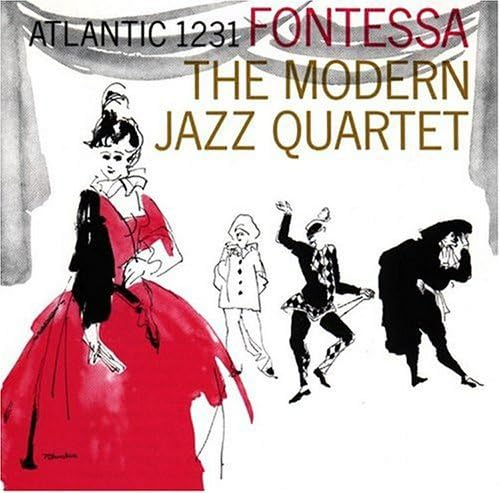
The Modern Jazz Quartet: Fontessa
The blend between classical and jazz elements goes back to several decades earlier than 1956, with classical composers incorporating jazz elements (Darius Milhaud in 1919, Gershwin/Grofe with Rhapsody in Blue in 1925) and jazz composers like Duke Ellington writing works like “Creole Rhapsody” in 1931 and Symphony in Black in 1935. Stan Kenton championed the incorporation of classical music elements: his chief arranger in the 1940s, Pete Rugolo, wrote works like “Artistry in Rhythm” and “Artistry in Bolero” for the Stan Kenton band, which continued to mix modern classical and modern jazz elements with works like Bob Graettinger’s “City of Glass.” And then there was Dave Brubeck and his octet, which released several notable works during 1946-1950, including “Fugue on Bop Themes.”
John Lewis had an extensive classical music background, studying classical piano starting at age seven and earning both a bachelor’s degree and a master’s degree in music, focusing on both piano performance and musical composition. He brings both his advanced piano technique and compositional skills to his Modern Jazz Quartet recordings, as well as his solo recordings.
Recorded in January 1956, Fontessa was the first Modern Jazz Quartet album released in 1956, and their first on the Atlantic label, which issued the LP in both mono and stereo versions. Unfortunately, the stereo version, despite its impressive soundstage, has some audible engineering defects. The mono version sounds great, and I suppose it is quite possible with today’s AI-driven technology to create a stereo version of the mono, based not on the audio content of the stereo, but just based on data about the stereo image itself. Hopefully that happens. AI needs to do a few decent things to partly balance out all the danger it poses.
AI’s currently unfulfilled potential aside, I am delighted with my mono version, starting with, yes, a jazz fugue, “Versailles”, with Percy Heath on bass working his butt off to keep up with the contrapuntal interaction between John Lewis on piano and Milt Jackson on vibraphone, with Connie Kay providing unobtrusive support on drums. This is followed by one of my favorite ballads, “Angel Eyes,” with Milt Jackson adjusting the motor of his vibraharp to the minimum revolutions per second to provide a shimmering, haunting effect. It’s worth noting that, though “vibraphone” is the term we use for these types of instruments today, in the early days of the instrument, the manufacturers had specific names. The Leedy Manufacturing Company created the first of these instruments, with a prototype in 1921 and a commercial version in 1924 under the proprietary name of “Vibraphone.” In 1927, the J.C. Deagan company released a technically superior product that they named the “Vibraharp,” with the bars made of an aluminum alloy for a warmer tone, a tone-sustaining pedal, and a layout matching the keyboard of the piano. The Deagan product set the tone (sorry, dear reader…) for the instrument, with other manufacturers producing similar products (for example, the Vibra-Celeste). Milt Jackson played the Deagan Vibraharp, and today we call such instruments just vibraphones or even “vibes” with “vibes” commonly used instead of “vibraphone.”
Another standout track on the album is “Fontessa,” an eleven-minute suite showcasing the musical subtleties of the quartet. Ending the album with more of a bebop flair is the well-known Dizzy Gillespie tune, “Woody’n You.” Overall, this is an excellent album showing the range of the quartet.
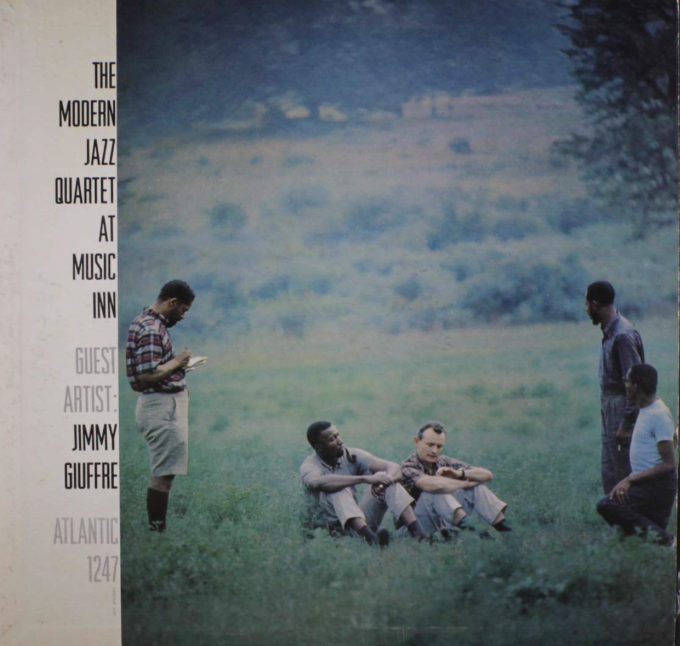
The Modern Jazz Quartet: At Music Inn
Although it was recorded on August 28, 1956, and released later that year, this is not truly a live concert album but rather a closed recording session, and it is unclear whether there were multiple takes. This is not to be confused with their 1959 “At Music Inn,” which is a true live album and includes Sonny Rollins on a couple of tracks. For this album, we have Jimmy Giuffre playing clarinet on three tracks. The group continues to develop their highly refined MJQ sound starting with a rendition of Gershwin’s “Oh Bess, Oh Where’s My Bess,” followed by a new jazz fugue by John Lewis, “A Fugue for Music Inn,” where Giuffre takes the first voice, followed by Milt Jackson, then John Lewis. Though not quite as amazing as the previous album, there is a lot to love here all the way to the last track, a variation on “God Rest Ye Merry Gentlemen” which opens with some intricate contrapuntal passages and Percy Heath providing some bowed bass lines.
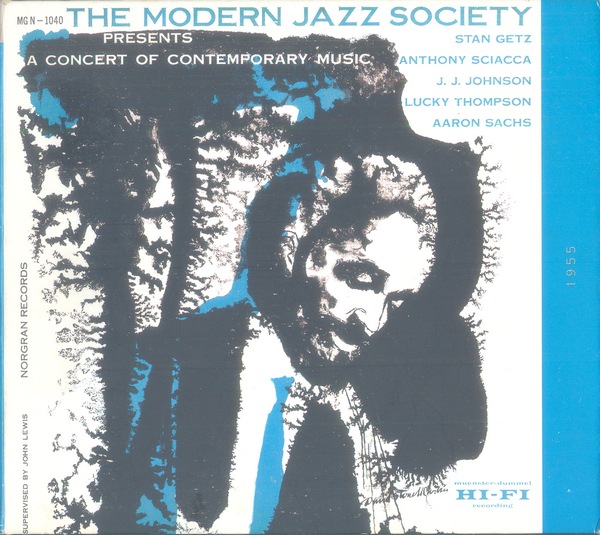
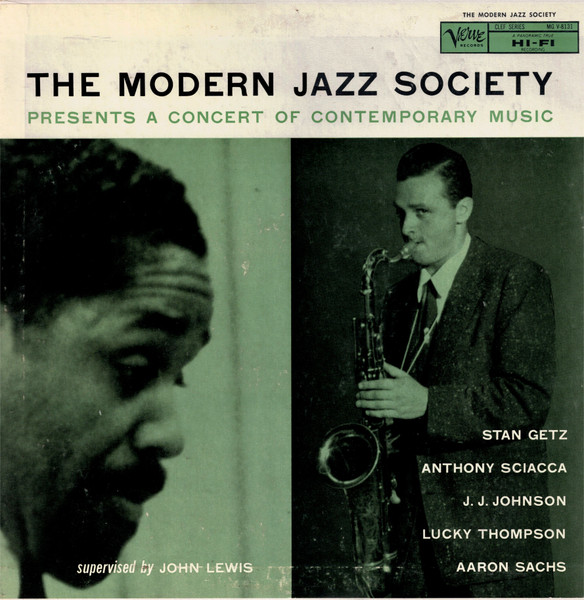
John Lewis: The Modern Jazz Society Presents a Concert of Contemporary Music
Recorded on March 14, 1955 (before I was born) and released in 1956 (after I was born), this is one of the most important and musically enriching lesser-known jazz albums of the 1950s. When I say lesser-known, I need to qualify that, as the Penguin Jazz Guide awards it four stars and its select “crown,” which transcends that maximum four-star rating to indicate the album’s essential or profound historical status.
You can be the judge if this is an essential album (I strongly feel it is not just an essential jazz album, but an essential album for any music lover), but there is no debate on its historical importance: this is the very first Third Stream album — recorded and released, as one would expect, before the term Third Stream was invented. It is always the case that the music comes first and that the label comes later. In this case, the label came pretty quickly, coined in 1957 by one of the participants and arrangers of this album, Gunther Schuller.
What is Third Stream? Basically, it is a blend of classical music and jazz — in Schuller’s words, “the result of two tributaries,” with Third Stream being between these two — getting contributions from both. Schuller’s definition implies that works like Gershwin’s Rhapsody in Blue are Third Stream. Some would assert that Third Stream is more of a synthesis where both classical and jazz are combined seamlessly, and that is clearly an attribute of this album. Whether there were other Third Stream works before this album or not, this LP album is the first that I know of that is a collection of individual works written specifically for a given album. All that said, labels are often more a matter of convenience than accuracy, and the same holds true with “Third Stream.”
And as we use “Classical” as part of the definition of “Third Stream,” I have to acknowledge that coming up with an airtight definition of “Classical Music” is even more problematic. There is non-notated classical music we have lost forever (Bach, Beethoven, Liszt, or Messiaen for audiences of varying sizes); there is classical music that requires sections of improvisation by ensemble members; there is classical music written for a single performance, sometimes with the music saved, sometimes discarded, and so on. In general, the most useful way to label music is in terms of quality, perhaps providing stars (****) like various journals do. That is, of course, a subjective evaluation, and even by scanning through the album ratings summaries on Wikipedia entries, one finds quite a variance in ratings, this album being one example with AllMusic.com giving one of the finest works of the 20th Century three out of five stars compared to the highest rating that we mentioned earlier from the Penguin Guide to Jazz.
For some reason, I feel more inclined to label a piece third stream if I hear a flute, bassoon, clarinet, or French horn. All four are present on this album, along with Getz and Lucky Thompson alternating on tenor sax, and J.J. Johnson on trombone (perfect choice), Percy Heath on bass and Connie Kay on percussion. John Lewis has composed all the pieces, with arrangement duties shared between him and Gunther Schuller. The five pieces on the album all immerse and saturate the listener in well-deployed tonal colors, a tribute to the composer, arrangers, and performers. The music includes solos, and one of the compositions is an infectious, over five-minute jazz fugue. The 1999 Verve\/Polygram CD release of this album includes three bonus rehearsal tracks, including a rehearsal of J.J. Johnson’s “Turnpike.”
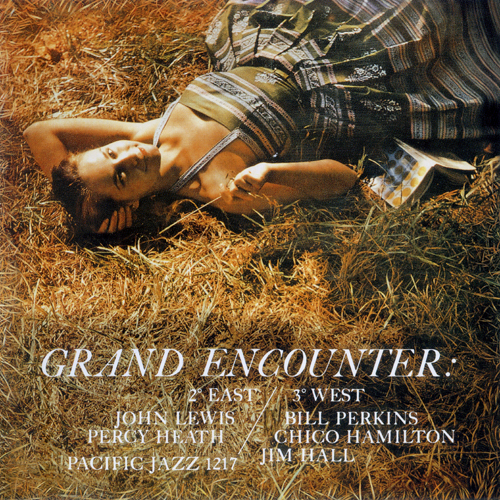
John Lewis: Grand Encounter (2° East / 3° West)
Recorded on Feb 10, 1956, and released in November of 1956, this album is quite a contrast to The Modern Jazz Society Present album, composed of five standards and just one John Lewis original, and featuring an ensemble of just five musicians: John Lewis and Percy Heath, bandmates of the Modern Jazz Quartet representing the East, and Chico Hamilton, Jim Hall (then a member of the Chico Hamilton Quintet), and Bill Perkins (with Stan Kenton at the time) representing the West.
The album is one of John Lewis’s best. I find it a thorny proposition to identify any musician as underrated, but in terms of general public awareness, John Lewis has to be one of the most underrated pianists of all time. He is economical and supportive as appropriate, providing minimal but substantial support for soloists. On this album, Bill Perkins shines, with nothing in the way of his restrained yet beautifully resonant tone. He pairs perfectly with Jim Hall, both on Hall’s solos and in their melodic interactions. Lewis’s solos are generally restrained, clear, and elegant, with the melodic lines immaculately emphasized by singing tone for both legato and portato passages. His inventiveness serves to contribute to an overall effect and avoid disruptive displays of virtuosity — something I enjoy in its proper place, but way too often done at the expense of continuity and coherence.
The one John Lewis composition fits in perfectly with the five standards and is a quintessential example of cool and elegant jazz. If we label The Modern Jazz Society Presents album as Third Stream, I think we can accurately label this album as cool jazz. It seamlessly blends both East Coast and West Coast jazz elements. It is ideal for dedicated listening or for relaxing on a Sunday afternoon, whether giving it full attention or dividing attention between the music and a novel — with minimal attention on the novel.


