Zumwalt Poems Online

Archive for the ‘Rock’ Category

Fifty Year Friday: Eli and the Thirteenth Confession

laura a 2 41uT5mOnVoL._SY355_

“I’m not interested in conventional limitations when it comes to my songwriting” — Laura Nyro (Liner Notes to Stoned Soul Picnic: The Best of Laura Nyro <1997>)

Eli and the Thirteenth Confession, the second album of Lauro Nyro, released March 3, 1968, was as distinct as any album of 1968, eschewing formula-based songs and enriched with personal, intimate lyrics fitted into soulful, boundary-free music.  Here the music is first: this is not a work of a singer-songwriter that set poetry to music, but a musician, who wrote music that was poetry.  The words may not qualify for any Nobel prizes, but they melodically fit into the contour of the music more perfectly and naturally than that of any 1960’s pop, folk or rock singer-songwriter before her. This music flows naturally, sometimes with effortlessly applied tempo shifts and alterations, and at no point do the lyrics ever get in the way of the musical content, but instead, either get unconditionally absorbed or are truly music themselves.

And in the midst of an era (1967-1968) of some of the most creative and unconventional, but commercially successful music ever captured in recording studios, we have an album of music that is as fiercely independent as anything by Frank Zappa, Harry Nilsson, Van Dyke Parks, Al Kooper, Velvet Underground, The Doors, or The Jefferson Airplane.

This album, though, was not a notable commercial success, reaching no further than the 181st position (“181” is not a typo) on the Billboard pop album chart. Yet, the reach was there in influencing other singer-songwriters that were to make their own impacts shortly after this, or even much later, including Todd Rundgren, Joni Mitchell, Carole King, Elton John, Kate Bush, Melissa Manchester, Joanna Newsome, Tori Amos. and many, many more.  In fact, so influential is this album, that listening to it today, it sounds more like a product of the early 1970s than just about any rock, pop, or folk album that I can think of that was recorded and released in 1968.  (Please challenge me in the comments, if you feel otherwise.)

Listening to this work on Youtube or via a streaming service, undercuts the high production and sound quality.  Best to listen to this in LP, CD or SACD format. A CD of Eli and the Thirteenth Confession with three bonus tracks is available at online retailers for around $5.00, a bargain difficult to pass up.  However, if you can find a copy of the Audio Fidelity SACD release, that is the one to get, as the sound is exceptional.

On a personal note, I prefer Laura Nyro’s original renditions over any covers of her works I have heard through the years. It’s great that her songs received greater airplay and were exposed to a larger audience, with the accompanying economic benefits for the composer, but aren’t the originals more complete and satisfying?  In this original version of “Eli’s Coming” we get no hint of the darker nature inherent in the lyrics (Eli representing something beyond just a heartthrob or hearbreaker, but perhaps, heartache, loss, disappointment, or defeat) — instead we get gospel-hysteria celebration, not of the coming of Christ, but of the coming of Eli, that one guy that is currently everything and unquestionably inspires both submission and devotion.

And how can one not marvel at Nyro’s vocal delivery, her effective melodic range, extensive tone-color range, and finely-varied emotional range?  As a singer-songwriter, she excels at both the songwriting and singing roles.

And on a more important personal note, my thoughts go to anyone at war with cancer or the families that have suffered a loss from cancer.  I have a friend whose sister was overtaken by ovarian cancer, the same insidious disease that ended the life of both Laura Nyro and her mother at the age of 49. As I type this, my thoughts are with my friend and her family. Medicine is making substantial progress against various forms of cancer, and we all hope we see more progress made more rapidly than ever. Having a healthy lifestyle may reduce the risk of some or even all types of cancer, but it does not eliminate that risk.  Please consider joining me in making a donation to the Ovarian Cancer Research Fund (90% of your donation is directed to scientific research) or another worthy  organization, such as the Cancer Research Institute whose funding assisted in the development of  the HPV vaccine, which can help prevent some types of cervical cancer.

LauraCNN

Track Listing [from Wikipedia]

All tracks written by Laura Nyro.

Side one

No.

Title

Length

1. “Luckie” 3:00
2. “Lu” 2:44
3. Sweet Blindness 2:37
4. “Poverty Train” 4:16
5. “Lonely Women” 3:32
6. Eli’s Comin’ 3:58

Side two

No.

Title

Length

7. “Timer” 3:22
8. Stoned Soul Picnic 3:47
9. “Emmie” 4:20
10. “Woman’s Blues” 3:46
11. “Once It Was Alright Now (Farmer Joe)” 2:58
12. “December’s Boudoir” 5:05
13. “The Confession” 2:50

Personnel

Fifty Year Friday: Pete Seeger, Mason Williams, Roy Harper

Mason Williams

Many of us that grew up in the sixties wouldn’t miss a chance to watch the Smother Brothers Comedy Hour on Sunday night from 1967 to its censor-driven cancellation in 1969.  The show was musically noteworthy for including rock and musical groups that the other variety shows were uncomfortable with (including Cream, Harry Belafonte, The Doors, The Who, Buffalo Springfield, The Cast of Hair, The Jefferson Airplane, and Steppenwolf) , and ending the national blacklisting of Pete Seeger on February 25, 1968. Other musical guests were the Electric Prunes, George Harrison,  Donovan, The Byrds, Judy Collins, Joan Baez, Simon and Garfunkel, Ravi Shankar, Ike and Tina Turner, and the Julliard String Quartet.

Mason Williams was the head writer for the show and was often responsible for the incorporating of younger talent into the writing staff, including Rob Reiner, Bob Einstein Carl Gottlieb, and Steve Martin, who even made an on-camera appearance.

Mason made several on-camera appearances, most notably for his composition, “Classical Gas”, which became a hit single.  “Classical Gas,” originally titled “Classical Gasoline”, appears on Mason Williams’ Warner Brothers album, The Mason Williams Phonograph Record, and is by far the stand out track, a classic rendition of a clearly timeless work.

During 1968 there was a pronounced divide, perhaps greater than any time in Western Music history, between the music the younger generation embraced and what their parents and grandparents found acceptable.  “Classical Gas”  bridged that gap,  topping the easy listening charts as well as holding the number two spot on the pop charts for two consecutive weeks wedged between hits by The Doors and The Fifth Dimension.

Check out the following two videos:  “Classical Gas” set to a video of the greatest art works, and Mason Williams spot on the Smother Brothers addressing censorship.


Roy Harper: Come Out Fighting Ghengis Smith

R-2195980-1283548704.jpeg

Released either in late 1967 or early 1968 (I really cannot find an exact date for this), is Roy Harper’s second album.  Notable is Harper’s compelling guitar work, unusual lyrics, crafted melodies and the blending of Harper’s guitar with orchestra.   Looking back in time, this is a weaker album than the first one, “Sophisticated Beggar”, but the reality is very few people purchased that first album when it had originally been released. Fortunately, a representative from Columbia Records did hear that first album, and signed Roy Harper for this second one. Better albums will follow, but one can find much of interest, particularly the first track, “Freak Street.”  This Columbia produced album served to provide a wider audience to Harper who would have an influence over many other artists including Ian Anderson, Joanna Newsom, Jimmy Page and Al Stewart.

Link to track list

Fifty Year Friday: David Axelrod, Electric Prunes and Mass in F Minor

masspapr

In 1967, the previously unknown, recently formed, L.A. band, The Electric Prunes, grabbed public recognition with the quintessential psychedelic top 40 hit,  Annette Tucker’s and lyricist Nancie Mantz’s “I Had Too Much to Dream Last Night.” Soon the Prunes were guests on TV, miming performances to their big hit, and touring the country.

in 1968, the band’s manager Lenny Poncher, their producer Dave Hassinger, and the Reprise Records  management, determined  that the Electric Prunes would record some type of concept album from material provided by producer/composer/arranger David Axelrod.  Axelrod was given the freedom to compose whatever he thought most appropriate, with the hopes of furthering the Prunes’ name recognition.

The final material composed by Axelrod, a psychedelic setting of the Latin Mass, with sections crafted for appropriate freely-expressive, acid-rock improvisation, ultimately required the band to be augmented by studio musicians.  Also, since the band was as much of a commodity (producer Dave Hassinger owned the rights to the name at that time) as individual members, this particular formation of Electric Prunes would soon be replaced by other musicians.

However, we did get a rather interesting, if less than stellar, concept album — a rock mass, a couple of years after Vince Guaraldi’s Jazz mass (see below) and three years before Leonard’s Bernstein’s mass (originally intended to be a modern setting of a traditional mass, but ultimately realized as a stage work.)


Though uneven, this Electric Prune’s Mass in F Minor is worth listening to.  It uses an abbreviated form of the mass, but still has the major sections. The Kyrie Eleison is later included in the film Easy Rider.  The Credo and Agnus Dei are the most interesting. Though most music historians would not classify this as progressive rock, this is, for 1968,  a musically progressive setting of the mass.  Also, this album should get a nod for being a concept album, including symphonic instruments, and some notable guitar work.  One can check out a lower quality audio version on youtube:


Fifty Year Friday: Spirit

51m6df7irtl


Randy California, born Randy Wolfe, was a native Calfornian, born in Los Angeles, but when his step-dad, jazz drummer Ed Cassidy  (the gentleman with the bald head in the left upper portion of their first album cover; a drummer that played gigs with Cannonball Adderly, Gerry Mulligan, Art Pepper, Roland Kirk, and Lee Konitz and was a founding member of  Rising Sons with Taj Mahal and Ry Cooder) had some work lined up in New York City, the family moved to an apartment complex in Queens in 1966.  Randy soon met Jimi Hendrix and then played with Hendrix that very summer  as a member of Jimmy James and the Blue Flames.   It was while they were playing together, that Hendrix started calling Randy Wolfe, “Randy California” and another Randy in the band, Randy Palmer, “Randy Texas.”

Randy Wolfe took the “Randy California” name back west, forming Red Roosters with his step-dad, a band that eventually evolved into “Spirits Rebellious” and then just Spirit. Randy was sixteen years old. Besides Randy and Ed, Spirit included composer, keyboard player and lead vocalist, Jay Ferguson, Mark Andes on bass and backing vocals, (who later played with Ferguson in Jo Jo Gunne in the early 1970s, Firefall in the late 1970’s and Heart in the 1980s.) and John Locke (who later joined Nazareth in the 1980’s) also on keyboards. Randy was still sixteen when Spirit’s first album, “Spirit”, was released on January 22, 1968.

None of the songs on Spirit’s debut album are typical pop songs, most having more of an jazz or a psychedelic or progressive rock ethos, with a prevailing ABA form with the B section being a instrumental, partly improvisational section providing contrast to the more traditional song-like A section. The last track, “Elijah”, due to its extended length, stretches out the ABA concept to a rondo-like form (ABACADAEA) with improvised passages between the recurring theme.

All the tracks on the album are notable, with 9 of the 11  songs written or co-written by Ferguson.  “Elijah” was written by John Locke;  Randy California wrote one of the tracks, “Taurus”, a well-written, nicely arranged instrumental following the Andes/Ferguson song, “Mechanical World”, the only track with single status on the album.

“Taurus” opens up with a orchestral introduction that floats into a soft, relaxing two-part theme which is played twice (this not being one of the tracks with ABA form on the album.)  The striking part of the first half of the theme is its similarity to Zeppelin’s
“Stairway to Heaven.”  The casual listener may very well consider that Zeppelin borrowed Taurus for that beautiful guitar intro in “Stairway”, particularly if  that listener is aware that Zeppelin opened for Spirit in several 1968 concerts, that Zeppelin included material from the first track of the same Spirit album, “Fresh Garbage” in a medley they performed live, that Page is on record as stating that he had owned several Spirit albums, and that there are over a dozen noteworthy cases of  Jimmy Page and Robert Plant “borrowing without credit” material from other artists.

So similar is the connection between “Taurus” and “Stairway” that ultimately in 2014, the estate of Randy California brought a copyright infringement suit against Led Zeppelin. Randy California had drowned in the Pacific Ocean in 1997, at the age of only 45, when swimming into the ocean to save his twelve-year old son from a rip current.  Though giving up his life in the effort, Randy managed to push his son to safety.  Now seventeen years after his death, lawyers for his estate planned to get a co-writing credit for Randy on “Stairway to Heaven.”

Unfortunately, the judge would not allow the jury to hear side-by-side comparisons of “Taurus” and “Stairway to Heaven.” Instead, he only allowed the performance of the two songs on keyboard by a hired musician using as the source the registered sheet music  from the Library of Congress, music that differed from the final version on the recordings. Also ruled inadmissible were expert witnesses that were lined up to talk about sixteen instances of Jimmy Page’s past use of uncredited material, the judge ruling that any past plagiarism, alleged or actual, was not relevant to this particular case in question.  Adding to this was the odd approach and personality of the prosecuting attorney for the California estate, who quickly exasperated the judge and who scored important points for the defense when questioning Page about his being influenced by the Disney/Mary Poppins song ” Chim Chim Cher-ee”.

The jury ruled in favor of the defense, and certainly there are notable differences in the two passages: the “Stairway” melody goes to A at the end of the first chord and then on to B of the next chord while “Taurus”, less remarkably, descends to A and then G#.  If they jury had heard actual recordings, its seems almost certain they would have ruled otherwise.

Personally, I am glad to have both songs as part of our musical legacy and understand how easy it is to come up with the descending chromatic chord progression used in these two songs — something anyone could accidentally discover in the course of composing by hitting sequentially descending notes for their bass line.  I am also sympathetic to how common it is to put together a song based on something one had heard a long time ago and unintentionally brought into their composing process as so clearly happened with George Harrison’s “My Sweet Lord” — just an unintended revisiting of “She’s So Fine.”  In the case with “Taurus”, it seems Jimmy Page had heard that song several times, forgotten about it, started to play with the chord progressions and went in the direction of a recreation of something close to what his subconscious mind was already familiar with.  In my view, a living Randy California wasn’t particularly interested in who got credit, but his descendants, perhaps needing or wanting money, had a greater interest in assignment of authorship.

You can check out the video below for a good explanation of how these two songs are similar (and differ) in their sharing of the passage in question. If you have any thoughts on this Spirit album, or thoughts on the similarities of “Taurus” and “Stairway to Heaven” please don’t hesitate comment.  Also what are some of your favorite albums from 1968?  I know one of mine is still a few months away from being fifty years old, and plan to discuss that if I even if I have lost all my remaining, exceedingly patient readers by then.


Click her for track listing [from Wikipedia]


Fifty Year Friday: Acid Rock, Hard Rock and Heavy Metal

images

Anyone that has unquestioning faith in the definitions in dictionaries, only needs to look up the entry Heavy Metal.

Webster defines Heavy Metal as follows: “Loud and harsh sounding rock music with a strong beat; lyrics usually involve violent or fantastic imagery.”

Merriam Webster defines Heavy Metal as : “Energetic and highly amplified electronic rock music having a hard beat.”

Dictionary.com defines it as “Aggressive and heavily amplified rock music, commonly performed by groups that wear spectacular or bizarre costumes.”

Oxford Dictionary: “A type of highly amplified harsh-sounding rock music with a strong beat, characteristically using violent or fantastic imagery.”

Cambridge Dictionary: “A style of rock music with a strong beat, played very loudly using electric guitars.”

McMillan Dictionary “A type of loud rock music that developed in the 1970s, played on drums and electric guitars.”

Collins provides this definition: “Heavy metal is a type of hard rock (they define hard rock as “a type of very loud rock music with a fast beat.”) characterized by violent, shouted lyrics.”

Since heavy metal bands’ songs, particularly their instrumentals, don’t always have violent lyrics and the band’s vocalists usually sing rather than shout the lyrics (except for some specific subgenres such as Thrash and Metalcore), this brings into question the trustworthiness of the Collins definition.  We can also question McMillan’s and Cambridge’s definitions requiring electric guitars as there are a few lesser known groups that don’t include guitar and given the capabilities of electronic keyboards, there is no technical or musical reason why a heavy metal band requires a guitarist to competently and effectively play heavy metal.

If one considers heavy metal as a style of music, than lyrics and costumes become additive, and thus the Webster and dictionary.com definitions are problematic. Merriam Webster’s  “Energetic and highly amplified electronic rock music having a hard beat.” is the most inclusive definition, overly-inclusive by a wide margin, and embraces many songs of hard rock, techno, 1980’s dance bands, progressive rock, jazz-rock, and on and on.

And what about ballads? Many well-known heavy metal bands often include one ballad on their albums, some of these songs being poignant, plaintive or wistfully reflective.  These songs are neither loud nor harsh and though sometimes they are in fairly strict  tempo, the beat is rarely the dominating component.

Given these definitions we don’t have a chance of identifying when the first heavy metal songs were written or what was the first heavy metal bands.

And if we go with various self-proclaimed experts on heavy metal we encounter a variety of viewpoints with many conflicts — some consider Deep Purple and Led Zeppelin heavy metal, others indicate they are not even close but are just hard rock groups. Some require heavy metal bands to have complex, classically-influenced musical material, but there is a problem with such a characterization when examining some of the groups or songs in various top 10 lists including this Rolling Stones’ readers’ poll of the top 10 metal bands of all time.   It seems that if heavy metal has a definition, it should come from the fans and musicians.

So without a guiding definition, and having experienced first hand the evolution that took place from the early British Invasion rock groups through the advent of psychedelic rock, acid rock, hard rock, progressive rock and what are the first somewhat-agreed-upon (but far from consensus) heavy metal bands, I think I am as unqualified as anyone else to make a few observations.

We noted in an earlier post that “Hapshash and the Coloured Coat” included the term “heavy metal kids” in their 1967 album.  This did not have anything to do with music but was borrowed from William Burroughs 1961 novel The Soft Machine’s describing the character Uranian Willy as “the Heavy Metal Kid” — a reference to the final stage of drug addiction, which in Burroughs’ words “is not so much vegetable as mineral.”

It’s also necessary to put into context the term “heavy metal thunder” used in Steppenwolf’s “Born to Be Wild” written by Mars Bonfire. Mars (Dennis Edmonton, born Dennis Eugene McCrohan) originally wrote this song as a ballad, perhaps when he was with the Sparrows, the group that more-or-less evolved into Steppenwolf in 1967.  Steppenwolf, now without Mars as a band member, modified and recorded the song as an up-tempo rocker, but without any intent for the phrase “heavy metal thunder” to reference any genre of music. (“I like smoke and lightning, heavy metal thunder, racing with the wind, and the feeling that I’m under.)

It’s possible that the use of the term heavy metal to identify a style of music had some connection to a recognition of the appropriateness of the name of Iron Butterfly and their equally appropriately named debut album, “Heavy” — with the “heavy metal” label solidified by the unabashedly unapproved, one-upmanship upgrade of Iron Butterfly’s name by Led Zeppelin.   Or perhaps it was partly a nod to the metal strings of the electric guitar. Clearly the term “heavy” was in common use at this time and could mean either “profound” (“that’s one heavy concept, man…”), serious, or intense.  Heavy metal, when considering its original meaning and usage, can arguably be interpreted to just mean “intense rock.”  If one, even slightly, gives this definition some due, one must consider Jimi Hendrix’s first album, recorded in late 1966 and early 1967, and released in May of 1967, to have at least two heavy metal tracks with “Fire” and, what some people do acknowledge as the first heavy metal song ever, “Purple Haze.”  Cream’s second album, recorded in May 1967, includes a couple of candidates also with “Tales of Brave Ulysses” and the generally melodic, but forceful “Sunshine of Your Love.”  And there are notable heavy metal elements in the “Who Sell Out” including some of Pete Townshend’s guitar work, the use of power chords, and Keith Moon’s aggressive percussion technique.

All that said, there is no evidence that the term “heavy metal” was yet being used to refer to a style of music at the start or by the end of January 1968.  Nonetheless, we do find bands recording in 1967 that specialized or focused on a harder, more aggressive sound, some of them blues-based, some of them more inventive and capable of greater range in their harmonic vocabulary.  Generally these early bands were not very good.  This reminds me of a conversation I had with a good friend who thought little of Led Zeppelin.  “There’s a lot worse bands”, was my reply to his summarily dismissing the group.  “That’s a scary thought,” was his reply.  And, I guess, even scarier still, is that one can say that they are not too impressed by the debut albums of Californian bands Blue Cheer, Iron Butterfly or Steppenwolf that were released in January of 1968, and my reply would be “there’s a lot worse albums” — and I would grant you the right to counter with “that’s a particularly scary thought” and have no more rebuttal than I had when my friend made that comment decades ago about Led Zeppelin.

Nonetheless, if one accepts the dictionary definitions of Heavy Metal we do find that these three albums released in January 1968, San Francisco’s Blue Cheer’s Vincebus Eruptum (quasi-Latin which I leave open for your interpretation as the best as I can make out is something like “The eruption’s conquest”), San Diego’s Iron Butterfly’s Heavy , and L.A. area band, Steppenwolf’s Steppenwolf, qualify as either early heavy metal or a predecessor to heavy metal music.

Of these three albums, the strongest and most musical is the Iron Butterfly debut.  Unfortunately there is little of lasting interest in the self-titled Steppenwolf album, outside of the AM radio hit, “Born to Be Wild”, the respectable “Everybody’s Next One”, and the interesting, emphatic arrangement of Hoyt Axton’s “The Pusher.”  Blue Cheer’s Vincebus Eruptum, mostly blues-based, also has some moments, particularly with the guitar work and drumming (which on the last track is much like a homage to how Keith Moon would sound leading a marching band.) With its rough, unbridled, and somewhat uneven musicianship,  this Blue Cheer album serves well as a case-study of 1960’s garage rock as well a foreshadowing of punk, stoner rock and grunge.

But one thing was clear, with these three albums the heavy-metal genie was out of the bottle (Geniebus Eruptum, if you will) and bands as diverse as Led Zeppelin, Black Sabbath, Deep Purple, and later groups like Metallica, Nirvana and Dream Theater would be beneficiaries of this first wave of higher atomic-numbered, more intensive rock.

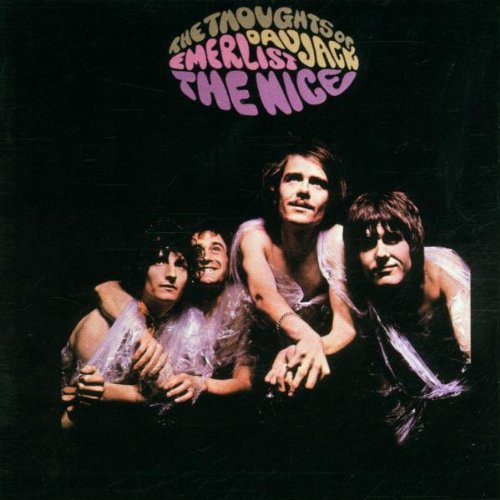
Fifty Year Friday: The Nice “The Thoughts of Emerlist Davjack”

Recorded around October 1967 and released sometime in 1968 between January and March (as best as I can determine), this aggressively adventurous album effectively fuses elements of psychedelia, acid rock, jazz and classical music, establishing this in many progressive rock fans’ mind as one of the first true progressive rock albums.

The first track, “Flower King of Flies” is not inherently different than early Pink Floyd, except perhaps for the level of unbridled energy present, and the second song, the title track, is basically a bubbly, upbeat pop tune, performed , once again with unusual energy and a high level of musicianship.  The third track, though, borders on the harder edged rock often provided by the early blues-based metal bands; there is rugged guitar work and precise, yet perfectly spontaneously-sounding, organ work from Keith Emerson.

It isn’t until the fourth track, a 4/4 arrangement of Dave Brubeck’s mostly 9/8 “Blue Rondo à La Turk”, dominated by the acid-rock, Hammond organ work that is the centerpiece of this instrumental, that the album falls more into the progressive rock realm. Included are glissandos, a J.S. Bach toccata reference , controlled distortion, and a climatic building towards the recap (the Brubeck Rondo theme), which frenziedly finishes the last ninety seconds, maintaining a perpetual, inexhaustible torrent of energy.

“War and Peace” opens up the second side with a level of focus and direction more typical in straight-ahead jazz than expected of a sixties’ rock group. With the exception of Jimi Hendrix and, perhaps, Cream, this is the closest that anyone gets to the soon-to-be-prevalent heavy metal sound in a 1967 recording, notwithstanding a quote of a Bach Brandenburg concerto.

“Tantalizing Maggie” continues along the hard-rock, nearly heavy-metal frame of mind, with a modulating, exploratory, instrumental, B section that gives way to a modified recap of the A section with classical references that finish the piece.

“Dawn” straddles the line between an avant-garde concert piece and sixties psychedelia,  with sprinkled fragments closer to free jazz and baroque classical than to rock music.

The last track, “The Cry of Eugene”, is a beautiful ballad laced with elements of both psychedelic rock and the concert hall providing a suitable close to a varied, interesting, and well-executed album.  Emerson may be the standout here, but Jackson, O’List, and Davison all contribute significantly with energy and passion.

CD versions of the original LP include additional material with some releases including alternative versions of tracks as well as Nice’s rendition of Leonard Bernstein’s America, an essential for progressive rock lovers.

LP Track listing [from Wikipedia]

Side one

  1. “Flower King of Flies” (Keith EmersonLee Jackson) – 3:19
  2. “The Thoughts of Emerlist Davjack” (Emerson, David O’List) – 2:49
  3. “Bonnie K” (Jackson, O’List) – 3:24
  4. “Rondo” (Dave Brubeck, Emerson, O’List, Brian Davison, Jackson) – 8:22

Side two

  1. “War and Peace” (Emerson, O’List, Davison, Jackson) – 5:13
  2. “Tantalising Maggie” (Emerson, Jackson) – 4:35
  3. “Dawn” (Davison, Emerson, Jackson) – 5:17
  4. “The Cry of Eugene” (Emerson, Jackson, O’List) – 4:36

Personnel

emerson_3593551k1

Seventy Year Saturday: 1947

With the world recovering from the worst war ever, World War II, and the cold war just starting, 1947 was a year of many musical landmarks.

In classical music, there are new operas by Benjamin Britten (Albert Herring),  Gian Carlo Menotti (The Telephone) Francis Poulenc (Les mamelles de Tiresias), and Virgil Thomson (The Mother of Us All.)  Sergei Prokofiev completes his  6th Symphony (Op. 111) reflecting the tragedies of World War II, and condemned by the Soviet government for its modernism. Arnold Schoenberg completes  A Survivor from Warsawthe grim story of a holocaust survivor during his ordeal in a Nazi concentration camp.  Other notable works composed in 1947 include the following completed compositions:  Samuel Barber – Knoxville: Summer of 1915, Vagn Holmboe – Symphony No. 6, Aram Khachaturian – 3rd SymphonyWitold Lutosławski – Symphony No. 1, Heitor Villa-Lobos – String Quartet No. 11William Walton – String Quartet in A minor —  and  Edgard Varèse – unfinished work, Tuning Up, a parody of the orchestra tuning process before the start of a concert.

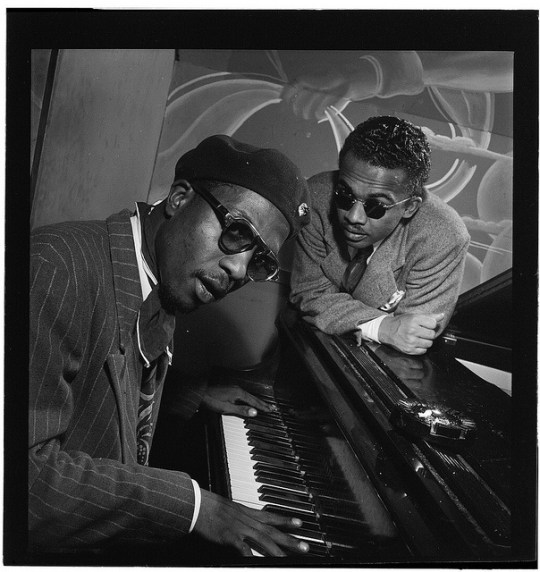
In jazz, bebop artists continue to gain the attention of listeners, Thelonious Monk, at age thirty, records several masterpieces for Blue Note including Ruby My Dear, Off Minor, Well You Needn’t, In Walked Bud (a tribute to Bud Powell, based on the chord progressions of Irving Berlin’s Blue Skies”), and the incredible ‘Round About Midnight.  Wardell Grey and Dexter Gordon record The Chase, and Dexter Gordon and Teddy Edwards record The Duel. Charlie Parker, Max Roach and Miles Davis record several sides together under various names (Charlie Parker All Stars, Miles Davis All Stars, Original Charlie Parker Quintet) in combination with various other musicians such as Bud Powell, Duke Jordan, John Lewis, and J.J. Johnson.  Parker also records tracks with trumpeters Dizzy Gillespie, Fats Navarro,  Howard McGhee, saxophonists Wardell Gray, Shorty Rogers, pianists Erroll Garner, Dodo Marmarosa, Russ Freeman, guitarist Barney Kessel,  bassist Red Callender,  and others, leaving some incredible recordings for future generations to marvel over.

233d036334877bde1789e1f9b396962e-thelonious-monk-jazz-musicians

For those that were around New York City to catch live music, they could see the aforementioned Miles Davis All-Stars at the Savoy, Louis Armstrong at Carnegie Hall with his big band, and The Count Basie Orchestra at the Paradise Club in Atlantic City or at the Strand Theater in Lakewood, New Jersey, supporting Billie Holiday.

For musical theater lovers in London in 1947, Annie Get Your Gun (Irving Berlin) opened at the Coliseum on June 7 and ran for 1304 performances and Oklahoma! (Rodgers & Hammerstein) opened at the Theatre Royal on April 29 and ran for 1543 performances.

Of the many babies born in 1947, notable future rock composers and musicians include David Bowie and folk singer Sandy Denny, born in January, Derek Shulman and John Weathers of Gentle Giant born in February, Elton John in March, Steve Howe and Iggy Pop in April,  Ronnie Wood, Mick Fleetwood and Mickey Finn (T.Rex) in June, Brian May (Queen), Arlo Guthrie, Peter Banks (Yes, Flash), Mitch Mitchell (The Jimi Hendrix Experience) and Carlos Santana in July, Ian Anderson in July, Marc Bolan and Meat Loaf in September,  Bob Weir (Grateful Dead) and Laura Nyro in September, Greg Lake and Joe Walsh in November and Gregg Allman, Jeff Lynne (Electric Light Orchestra) and Burton Cummings in December.

In movies, we have the timeless Christmas movie, Miracle on 34th Street, as well as The Bishop’s Wife with Cary Grant and Loretta Lynn and It Happened on Fifth Avenue.

The next few years would bring major changes all over the world. Fortunately that world as it was in 1947 has been well documented in records, movies and books.


Fifty Year Friday: Singer/Songwriters; Additional Groups and Artists

mi0001915547


Singer/Songwriters

2017 is soon coming to a close, and so must our fifty year anniversary reflection on 1967.  If we had started these posts earlier in 1967, instead of starting mid-year, we could have highlighted many more albums.  Those we chose were personal favorites. Some of those not included are also worth noting.

1967 provide of wealth of albums by singer songwriters from Arlo Guthrie and his  captivating “Alice’s Restaurant” album to Van Dyke Parks first album, “Song Cycle.”

Warner Brothers Records hired Van Dyke Parks with high hopes based on his previous work with Harper’s Bizarre, The Byrds, Tim Buckley, and Paul Revere & the Raiders, and then spared no costs for Parks to record his album — racking up session hours and using a full orchestra.  When “Song Cycle” was played for the president of Warner Bros. Records, his reaction was apparent confusion: “Song Cycle?  Okay — where are the songs, then?” The label didn’t release the album until December 1967, a year after it was recorded, until, as the story goes, Jac Holzman of Elektra records offered to buy if from Warner Bros.   Once released, it’s sales where less than expected, and prompted Warner Bros.  to run full page newspaper and magazine advertisements that said they “lost $35,509 on ‘the album of the year’ (dammit)” and offered owners of the album the chance to send in their worn-out LPs of “Song Cycle” in exchange for two new copies, so one could be passed on to a friend.

Harry Nilsson authors his second album, Pandemonium Shadow Show, originally intended to be titled after Ray Bradbury’s “Something Wicked This Way Comes”, which is a mix of Nilsson songs and several covers including two Lennon/McCartney songs. Nilsson’s droll lyrics and musical arrangements provide character to a well-executed and produced album.  The album includes the definitive version of Nilsson’s “Without Her”, sparsely arranged with flute, electric bass, strummed guitar and cello. The album fared better in Canada then in the US, eventually catching the attention of  Beatles publicist Derek Taylor who sent copies to the Beatles.  Purportedly, John Lennon listened to the album over and over again, playing it back to back for a total of 36 consecutive hours.

1967 provided the release of two Bob Dylan albums, Dylan’s eighth studio album “John Wesley Harding”, an album filled with songs that appear were written first as poetry and then Dylan added music to them, and a greatest hits album compiling classic Dylan songs from his first seven albums.  For many of us, born between 1954 and 1960  this was our first exposure to Dylan besides what was played on AM radio.

Also for many of us born in that mid to late fifties time frame, the great North American singer songwriter of our time was not American Bob Dylan, but Canadian Roberta Joan “Joni” Mitchell.  At this time, Joni had not recorded an album but, after moving to the U.S. and performing in various clubs, was gaining attention from these performances and in several of her songs that more established artists recorded.

The most notable 1967 Joni Mitchell song, was recorded by Judy Collins on her 1967 album Wildflowers album (released in 1968.)  This song, “Both Sides Now”, would reach #8 on the U.S. pop singles, making it Judy Collins biggest hit and being the most contributing fact to the Wildflowers album peaking at the number 5 best selling album on December 1968.

Laura Nyro  released her debut album,  More Than a New Discovery Recorded in 1966, initially released in 1967, and then reissued in 1969 and again in 1973, this album showcases Nyro’s songwriting skill and versatility with many of the songs being covered by other artists, including “And When I Die” (Blood Sweat and Tears), Wedding Bell Blues” and “Blowin’ Away” (The Fifth Dimension), and “Stoney End” (Barbara Streisand.)

Recorded in 1966 and early 1967 the Deram label releases Cat Stevens’ first album,  Matthew and Son The album makes the UK Top 10, and has several successful singles. Later that year,  Stevens records New Masters which is released in December 1967, and sells significantly less copies than the first album.

Also in 1967, Tim Buckley released his second album, his most popular and generally most acclaimed album, Goodbye and Hello.   Tim Hardin released his second album,  simply titled Tim Hardin 2.  Leonard Cohen’s releases his first album, the captivating and engaging Songs of Leonard Cohen, after Judy Collins’ recording of his song “Suzanne” brought Cohen to the attention of legendary record producer  John Hammond. Cohen’s debut album begins with “Suzanne” and includes several fairly profound songs like “The Stranger Song”, “Sisters of Mercy”, and “Stories of the Street” as well as the well known “So Long, Marianne” referencing his close companion, Marianne Ihlen.

leonard_cohen_-_1967_songs_of_leonard_cohen

Additional Notable Albums of 1967

The Beach Boys release two excellent albums, Smiley Smile and Wild Honey.  

Pretty Things releases their distinctly interesting, and accessible “Emotions” album, full of life and musical vibrancy with brass instruments adding further energy. Recorded in late 1966, and early 1967, it did not sell well, perhaps this was a result of ineffective distribution or marketing or perhaps the album was a bit ahead of its time, sounding more like it was recorded in 1968 or early 1969.

The first album of what many consider the first rock supergroup, Cream, sets the stage for later heavy rock bands (and by extension, heavy metal bands) with their second album, Disraeli Gears. Though there were many influences that spawned hard rock and heavy metal, Cream had a significant impact on many such younger rock musicians.

r-1358659-1496055161-7572-jpeg

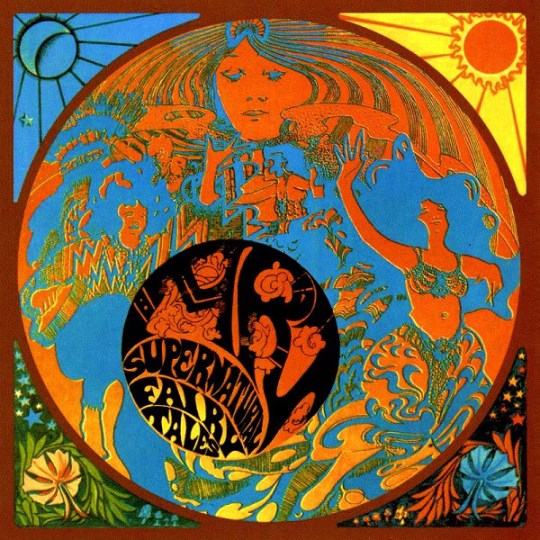
Art (Art essential being an earlier formation of the group, Spooky Tooth), infuses rivulets of blues and wisps of psychedelia into their only album, Supernatural Fairy Tales  creating a thick-textured album, perfumed with an aroma of cannabis. Earlier to the recording of this album, several of the same musicians under the name “Hapshash and the Coloured Coat”  recorded an album earlier in 1967, titled “Featuring The Human Host And The Heavy Metal Kids” — this being, as far as I can tell, the first reference to “heavy metal.”

Other notable albums, many heavily psychedelic (and some incorporating elements of free jazz) were released by groups such as 13th Floor Elevators, The Aggregation, Ten Years After, AMM, Chocolate Watchband, Clear Light, Country Joe and the Fish, The Grateful Dead, Kaleidoscope, Mesmerizing Eye, Moby Grape, Orbital, Pearls Before Swine, Red Krayola (The Parable of Arable Land), Rupert’s People, Sagittarius, The Seeds, Sly and the Family Stone, Sopwith Camel, Spontaneous Music Ensemble, Steppeulvene, Strawberry Alarm Clock, The Animals, The Beethoven Soul, The Box, The Ceyleib People, The Easybeats, The Factory, The Fire Escape, The Freak Scene, The Incredible String Band, The Lefte Bank, The Motions, The Serpent Power, The Smoke, Smoky Robinson and the Miracles, The Turtles (Happy Together), The West Coast Pop Art Experimental Band, The Yardbirds, Thomas Edisun’s Electric Light Bulb Band, Vanilla Fudge, and various more accessible or highly commercial groups like The Association, The Grass Roots, The Ventures, The Monkees (put together for a U.S. television series), and The Young Rascals.

This only scratches the surface.  I have not mentioned artists like Albert King (Born Under a Bad Sign), Nina Simone, Miles Davis, John Coltrane (Expression), Sam Rivers, Charles Tyler (Eastern Man Alone), Bill Dixon, Blue Mitchell, Freddie Hubbard, Gary Burton, Graham Collier, Herbie Mann, Roland Kirk, Marvin Gaye, Magic Sam, Otis Spann,  John Mayall, Miriam Makeba, Van Morrison, Stevie Wonder, Buddy Tate, and many others, some of which I have covered in previous “Fifty Year Friday” posts: there are a number of incredible jazz albums as well as blues, rhythm and blues, and soul music albums.

Though the term progressive rock is more formerly applied to many of the more adventurous and classically influenced bands of the early 1970s, for my money 1967 was the childhood of progressive rock with the birth perhaps occurring in 1966 with Beach Boys Pet Sounds, the Beatles’ Revolver and many psychedelia-tinged albums released in 1967, but recorded at the end of 1966. I challenge anyone to deny the progressiveness of Jimi Hendrix, The Beatles, Procol Harum, Van Dyke Parks, or even groups like The Who, The Beach Boys, or The Doors.

This was a vital period in the expansion and diversification of rock music, the like of which has not been seen since.  Fortunately for us, even albums that were nearly impossible to get a hold of in 1967 are now relatively readily available, not only on CD, or in some cases freshly, pressed LPs, but also available through streaming services or on Youtube.

Most importantly, have a happy and fulfilling 2018, and don’t neglect to broadly explore the immensity of great music available to those of us alive today.

r-1380897-1388699693-7737-jpeg


Previous Fifty Year Friday Posts for the year 1967:

The Beatles: Sgt Peppers

The Beatles: Magical Mystery Tour

Jimi Hendrix: Are you Experienced

Jimi Hendrix: Axis: Bold as Love

The Who: The Who Sell Out

Moody Blues: Days of  Future Passed

Byrds, Hollies and Buffalo Springfield

Love “Forever Changes”

Far Out 1967, Part One

Far Out 1967, Part Two

Nirvana “The Story of Simon Simopath; The Kinks “Something Else”

Dizzy Gillespie in 1967

Larry Young “Contrasts”; Joe Zawinul, “The Rise and Fall of the Third Stream”

Procol Harum “Procol Harum and The Doors “Strange Days”

Billy Strayhorn and Duke Ellington

Arthur Rubinstein, Pink Floyd

Marta Argerich and Carlos Paredes

David Bowie, Marc Bolan, John’s Children

John Coltrane, Jefferson Airplane

Thelonious Monk, McCoy Tyner

Hindustani Classical Music

The Doors: The Doors

The Velvet Underground

Aretha Franklin, Simon Dupree and the Big Sound

Mahler recordings

Rolling Stones: Between The Buttons

Jobim, Zappa, Beefheart

Fifty Year Friday: The Who Sell Out

blog_the-who-sell-out-lp

“Power pop is what we play—what the Small Faces used to play, and the kind of pop the Beach Boys played in the days of ‘Fun, Fun, Fun‘ which I preferred.” Pete Townshend (1967)

Somewhere in the mid sixties, rock and roll was replaced with rock.  The rock and roll music of the fifties, primarily based on blues and variations of blues chord sequences, slowly was overshadowed by music that was more message and substance oriented. The Beach Boys classic “Fun, Fun, Fun”, and the 1967 masterwork “Good Vibrations” is clearly Rock and Roll. The Beatles’ “Lucy in the Sky With Diamonds” is clearly rock.  I don’t recall the year, but sometime in the late sixties, I started correcting my dad when he referred to rock music as “rock ‘n roll” — I disdained Rock and Roll as a relic and lower form of music,  and loved Rock for its broad musical diversity and, for the best of it, it’s reach beyond dance music to serious listening music.

The Who, part of the British Invasion, deviated from what was pretty much a rock and roll group in 1965, opening their first album “My Generation” with “Out in the Street” immediately followed with James Brown’s “I Dont’ Mind” and songs like “The Good’s Gone”,  “La-L-La Lies”, “Please, Please, Please”, “It’s Not True”,  and Bo Diddley’s “I’m A Man. ” However, like the Beatles, there were significant forays into a newer musical expression as hinted in “A Legal Matter” and in the instrumental “Ox.” By their second album, we get true rock pieces like John Entwistle’s classic “Boris the Spider.  By the third album, “The Who Sell Out”, an imaginative concept album that includes commercials interspersed throughout, mocking the format of commercial radio stations, The Who are a seasoned rock group writing and performing rock compositions, making use of such “power pop” chord progressions, modulations, and power chords (chords structures found in earlier Who songs such as”My Generation” and “Boris the Spider” — chords that just have the root and fifth — this not only omits the note that provides the major or minor quality of a traditional triad, but produces a simpler harmonic footprint producing an especially powerful effect when played loudly) that create a sound that is easily identifiable as the sound of The Who.  This is not the power pop of rock and roll, but power pop that is part of the new rock music movement.

The album opens strikingly, and aligning with it’s wanton-commercialism concept, with a jingle followed by John “Speedy” Keen’s (a friend of Who main songwriter and guitarist Pete Townshend) “Armenia, City in the Sky” — starting out much like a radio ad, lyrically, with “If you’re troubled and you can’t relax” but soon followed with more mind-altering-like lyrics and with a 1967 psychedelic and imaginatively crafted arrangement including backwards french horn bursts and various guitar effects.

“Mary Anne with the Shaky Hand” is both melodically appealing and lyrically bold (“Mary-Anne with the shaky hands — what they’ve done to a man, those shaky hands.”) Musically, “Odorono” is even more notable, forging towards the musical style perfected on their next album and yet done as a deodorant jingle.  If one doubts the genius of Pete Townshend to align music and lyrics without compromising either, this is prima facie evidence of his capabilities, as is the track that follows: “Tattoo” a tune that could work very well as jingle for the Tattoo industry.

“Our Love Was” is an ethereal gem, maintaining energy and vibrancy to the end, with Entwistle’s French Horn providing just one of many elements that make this arrangement special.

The Who’s 1967 hit, and arguably the best song of the album, if not of Townshend’s career, is “I Can See for Miles”, punctuated perfectly by Keith Moon’s drums and cymbals.

The second side, is also excellent and includes  “I Can’t Reach You”, “Relax”,  Entwistle’s chromatically-flavored, organ-accompanied “Silas Stingy”,  the beautiful “Sunrise” and the Who’s second miniature rock opera, “”Rael (1 and 2)”, even shorter than their first mini-rock opera, “”A Quick One, While He’s Away” on their previous album.

Released in the UK in December 1967 and the US on Jan 7th, 1968, some of the musical techniques employed in “The Who Sell Out” will be more fully explored in their 1969 full-length rock opera,  “Tommy”, which also further develops  musical material in the songs “Sunrise” and “Rael.”  Though this album was only marginally successful in the US when first released, climbing no higher than the 48th spot on the Billboard album chart, perhaps due to its unusual jingle-based concept, it is one of the best albums of 1967, music that should be explored by those looking to better understand the history of rock (as opposed to  rock and roll) or just looking for some well written, enjoyable power pop music.

Track listing and song credits

Last week’s Fifty Year Friday


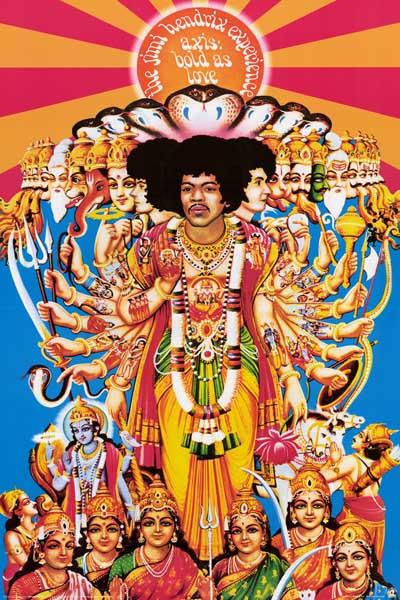
Fifty Year Friday: The Jimi Hendrix Experience “Axis: Bold as Love”

1200x630bb

Recorded in May and June 1967, and released in December 1967, composer, lyricist and guitarist, Jimi Hendrix shows a stunning amount of development since the recordings sessions (October 1966 through April 1966) of the first album, “Are You Experienced?”

The opening of the first track of “Axis: Bold as Love” borders on the puerile, yet to the rescue with the entrance of Hendrix’s guitar at the thirty-three second mark, we are assured of the exceptional.  Based on just the contents of the last eighty seconds of this first track, one can effortlessly make the case that Hendrix says far more in this one brief passage than can be found in Stockhausen’s entire “Hymen” (covered here in an earlier post.)

From there on, this album neatly blends the accessible with cutting edge guitar work and effective “interactiveness” (“interaction” is too weak of a word to use here) between bass, drums and Hendrix guitar.  With “Up From the Skies” we get a more relaxed, self-confident Hendrix on vocals than on the previous album, but still with more advanced and interesting instrumental passage work, indicative of much of his work in his later albums.  “Spanish Castle Magic” picks up musically from where “Foxy Lady” left off. Notable here is the bass/drums musical punctuation which becomes such a prevalent device in progressive rock and heavy metal (particularly Led Zeppelin which Hendrix purportedly never much cared for,  considering them excess baggage — a group that stole from others.  The closest to a direct Hendrix quote on this topic, attributed by Keith Altham and published in Melody Maker, shortly after Hendrix’s death in September 1970, was “I don’t think much of Led Zeppelin—I don’t think much of them. Jimmy Page is a good guitar player.”)

The album continues with “Spanish Castle Magic”, which again shows a more developed and innovative approach then the first album’s excellent “Fire”, including Hendrix adding a backward guitar track  Though the next two songs,  “Wait Until Tomorrow” and “Ain’t No Telling” are not particularly musically interesting, the arrangement adds enough life to make them solid dance selections.  And, as consistent through this album, Hendrix lyrics and guitar work take these works well above the ordinary.

“Little Wing”, a beautiful ballad, and “If Six Was Nine” are classics.  “You’ve Got Me Floating” is a positive and upbeat diversion, with Graham Nash and Move band members providing the back-up vocals in the chorus. Introduced with backward guitar, “Castles Made of Sand” provides us with another reflective Hendrix ballad. The next song, “She’s So Fine”, is written by bassist Noel Redding, and is a prototypical English rock song, with a Who-like chorus, and some interesting guitar from Hendrix. The Hendrix guitar solo at the end is just enough to provide justification for its inclusion.

“One Rainy Wish” starts out ballad-like in 3/4 (with a 4/4 and 5/4 measure added to enhance a dreamy introduction), lushful and soulful, then modulates into a heavy metal exuberant 4/4 chorus and then back to the A section with a fade out coda. “Little Miss Lover” includes Hendrix use of a wah-wah pedal, an effect that would be adapted by countless rock guitarists later on.

A craftsman and perfectionist, Hendrix and his vision for this album was somewhat compromised with the objective of producer Chas Chandler, which basically was to get to the final take as efficiently and quickly as possible.  Thankfully, the final track, “Bold As Love” (with lyrics openly confessing that the negative emotions are, unfortunately, as capable of being as bold as love, and limiting us in giving and receiving love) was not rushed — with at least twenty-seven takes, and four different endings tried. The song starts off, casually, then shifts to an anthem-like chorus, with the effective interplay between the verse and chorus — the chorus triumphant, celebrating victoriously, and apparently ending the piece — but instead rather providing the embers for an Olympian coda, which rises like that mythical Phoenix, accompanied by mellotron and transcendental guitar, to provide a majestic finale to a song and an album unlike any other released in 1967.

One may be tempted to ask how musical history would have been different if Chas Chandler had produced “Sgt. Peppers” and George Martin had produced “Axis: Bold as Love.”  But like all such silly speculation (what if Lekeu age 24, had lived as long as Schubert, age 31, and Schubert had lived as long as Mozart, 35,  and Mozart had lived as long as Chopin 39, and Chopin had lived as long as Beethoven, 56, and Beethoven had lived as long as Stravinsky, 88) time is much better spent listening to those musical masterpieces left to us by the musical masters of their time.   “Axis: Bold as Love” is one of those masterpieces.

pst1087hend_4c446e7e-9fbf-486c-9e6d-4250c8270a7c_grande