It is my pleasure to announce that this month’s Fifty Year Friday is provided by guest author Leo the Deacon.
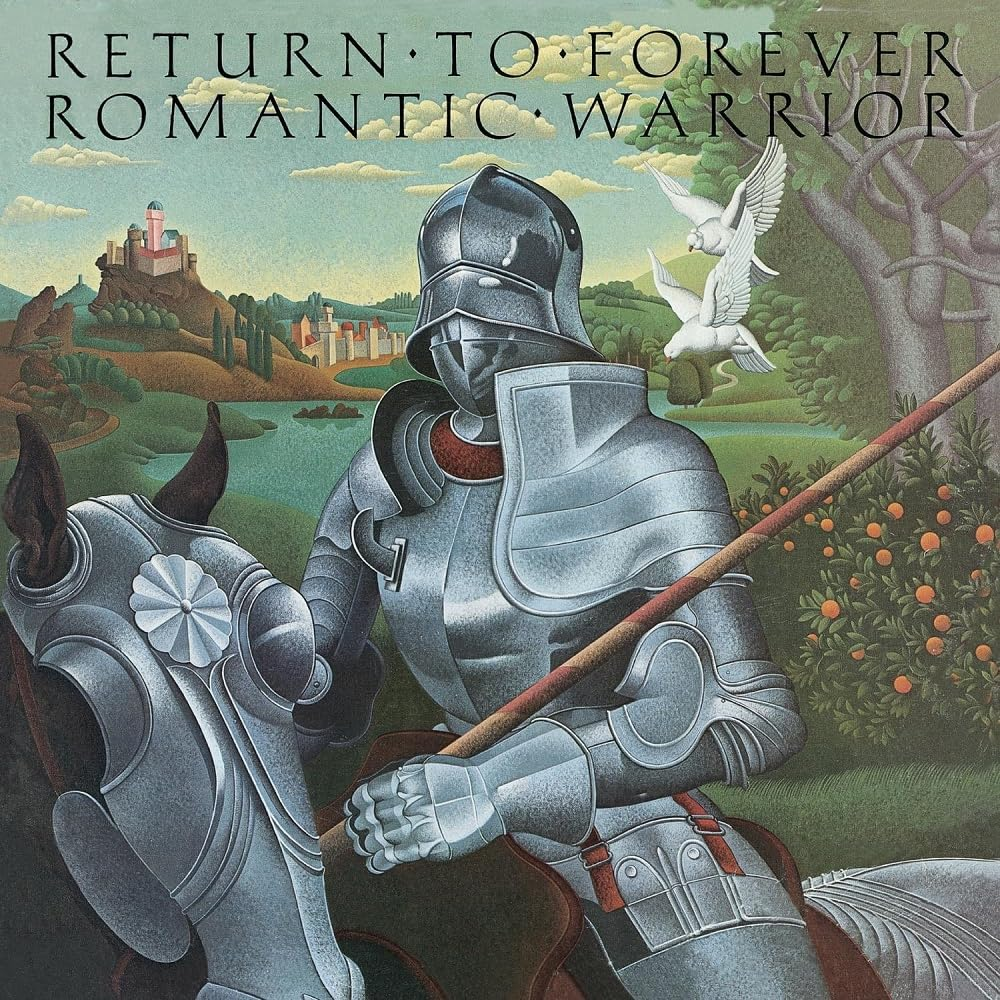
Return to Forever: Romantic Warrior
Ask the average person, a regular Joe, what the signature music of the 1970s was, and dollars to doughnuts, the answer you will get is disco. And to be sure, it was a phenomenon—the inevitable populist backlash to progressive rock, the best of which (think Gentle Giant, King Crimson, or Emerson, Lake, & Palmer), challenged its listeners to do just that: listen. Just listen. But, as Pascal declared, “All of man’s misfortune comes from one thing, which is not knowing how to sit quietly in a room.” Too many of my generation just wanted to dance, and disco’s Dionysian impulse trumped the Apollonian appeal of prog rock. Full transparency here: as disco came to dominate the college social scene in the late ‘70s, I was put at a distinct disadvantage. I like to think that I have some redeeming virtues, but physical grace would not be one of them. Diffident with the ladies, all I had to offer was a fondness for words and a sense of humor, neither of which was easy to deploy in the thumpa-thumpa of a disco club, where one was expected to strut and flex and display his plumage like some desperate bird of paradise in the New Guinea jungle. Yes, I’m still bitter…
Disco may have gotten all the attention, but at the risk of being accused of looking for a pony in a dung heap, I would argue that the 1970s produced another signature sound: the amalgam of jazz and progressive rock known as jazz fusion. Pioneered by vibraphonist Gary Burton with his Duster album in 1967 and legitimated in 1969 by Miles Davis’ In a Silent Way, fusion grew in prominence and popularity in the 1970s as jazz musicians sought a way forward from the esoteric wilderness of avant-garde and free jazz, seeking a style that would attract an audience. The result was a body of excellent jazz that held musical sway for a decade until a wave of talented young jazz musicians such as Wynton Marsalis and Terence Blanchard revived and modernized hard bop and post-bop jazz. (Yes, I am aware that Marsalis also championed “neo-bop” although I am not convinced that neo-bop differs significantly from post-bop; it is as much an attitude as it is a musical genre.)
The topic today, though, is 1970s fusion and, from my eccentric point of view, three albums in particular stand out as emblematic of that time and style: The Mahavishnu Orchestra’s Visions of the Emerald Beyond, Jean-Luc Ponty’s Aurora, and Return to Forever’s Romantic Warrior. I can already hear the outraged cries of “What? No Weather Report? No Pat Metheny or Herbie Hancock?” Cool down, take a deep breath. They are all worthy. I freely confess that my trinity of iconic fusion albums is subjective and idiosyncratic. It is heavily weighted toward the context in which I encountered the music and the associations it retains in memory. For me, the opening notes of any one of Visions of the Emerald Beyond, Aurora, or Romantic Warrior transport me to 1976. In those days, I and my roommate—we called him Wildman—would lounge around the backyard firepit immolating hot dogs while the sun set and we listened to the latest jazz cascade from the speakers propped up in the windows of my garage apartment. We lived in the easy penury of college kids, feasting on hot dogs and box macaroni and cheese, dreaming of the days when we would have real jobs and real money—not recognizing how good we already had it.
Romantic Warrior was one of Wildman’s albums; we played it to death. Representing the full ripening of Chick Corea’s fusion project called Return to Forever, Romantic Warrior was probably the best of the three iconic albums. It features Corea on keyboards, both electronic and acoustic; Al DiMeola, a newcomer to the band, on guitars; Stanley Clarke brandishes the various basses employed, and Lenny White commands a range of drums. Most of the compositions, and the longest ones, are by Corea, but each of the other three band members contributes one composition apiece. Too many cooks spoil the broth goes the old adage, but not this time: the six discrete compositions of Romantic Warrior fit each other like the tesserae of a mosaic. Had it been indifferently executed, Romantic Warrior could have been just an anthology of loosely similar pieces, but instead they achieve a synergy that makes it greater than the sum of its parts.
The album opens with Corea’s “Medieval Overture,” but this is no Hildegard von Bingen antiphon. Instead, it acts as a kind of framing device, establishing a mood or atmosphere for the album. Corea’s electronic keyboards burst energetically, like the atoms popping in the core of a reactor, and are soon joined by Di Meola’s guitar, and White’s driving drum work. The energetic opening gradually morphs into a more languid, mysterious passage—this is medieval the way Game of Thrones or Lord of the Rings is medieval, emphasizing the mystical and the fantastic, where dragons lurk in the blank spaces of maps and demons seek your soul. Soon enough, though, Corea’s popping keyboards bring us back into the light, preparing us for the next adventure.
That adventure would be Lenny White’s funky “Sorceress,” in which DiMeola’s guitar tends to come to the forefront, frequently using Corea’s keyboards as a stable platform for guitar riffs as well as for Clarke’s insistent bass. Di Meola’s guitar keens and soars even more prominently—as one might expect—in “Majestic Dance” which is Di Meola’s contribution to this musical chanson de geste. Those who lean more to the “rock” side of jazz-rock, will gravitate to “Majestic Dance” and “Sorceress,” and perhaps to “The Magician” as well, Stanley Clarke’s piece in which he demonstrates what can be done with an electric bass.
The center of gravity of the album, though, is the title cut, another of Corea’s compositions and the second longest on the album. My traditional biases are showing here, but the genius of “Romantic Warrior,” the third of six compositions on the album, is that it is acoustic, and Corea’s piano playing is turned loose. This acoustic gem, held fast in an electronic setting, shows Corea mastering the essence of fusion without plugging into the power grid.
The album Romantic Warrior is brought to a dénouement with Corea’s “Duel of the Jester and the Tyrant (Parts I and II).” This cut does not bring the album to a full circle musically, but it provides a climax or resolution to it. Like the opening “Medieval Overture, ” “Duel” helps to frame the whole album and brings it to a satisfying conclusion. Again, Corea’s keyboards stand out to me; in “Part I” of this last cut one can detect, I think, a subtle Latin flavor infused in his playing, a faint foreshadowing, perhaps, of his more explicit My Spanish Heart, which he would release under his own name in October of 1976.
In Romantic Warrior, Return to Forever reached its apogee; it is hard to point to another RTF album, good though they were, that achieves quite the same level of musical craftsmanship and creative symbiosis. At the time, though, Wildman and I did not think in such grandiose terms. Cash-strapped and barely fledged as we were, Romantic Warrior was a small, accessible luxury. To us, it was simply a tasty album, perfect for kicking back while a stealthy chill permeated the dusk, and a fitting soundtrack for charring hot dogs and boasting of all the great things we would do.
— Leo the Deacon
Discover more from zumpoems
Subscribe to get the latest posts sent to your email.

Comments on: "Fifty Year Friday: August 1976; Return to Forever: Romantic Warrior" (2)
Excellent review of an outstanding album. 👍
LikeLiked by 1 person
stoneyfish,
Totally agree. We were very fortunate to get Leo to write this for us. I hope we get future contributions from him. He is fairly busy, so it’s a real treat to get material from him, plus that gives me a break from writing Fifty Year Friday. 🙂
LikeLiked by 1 person