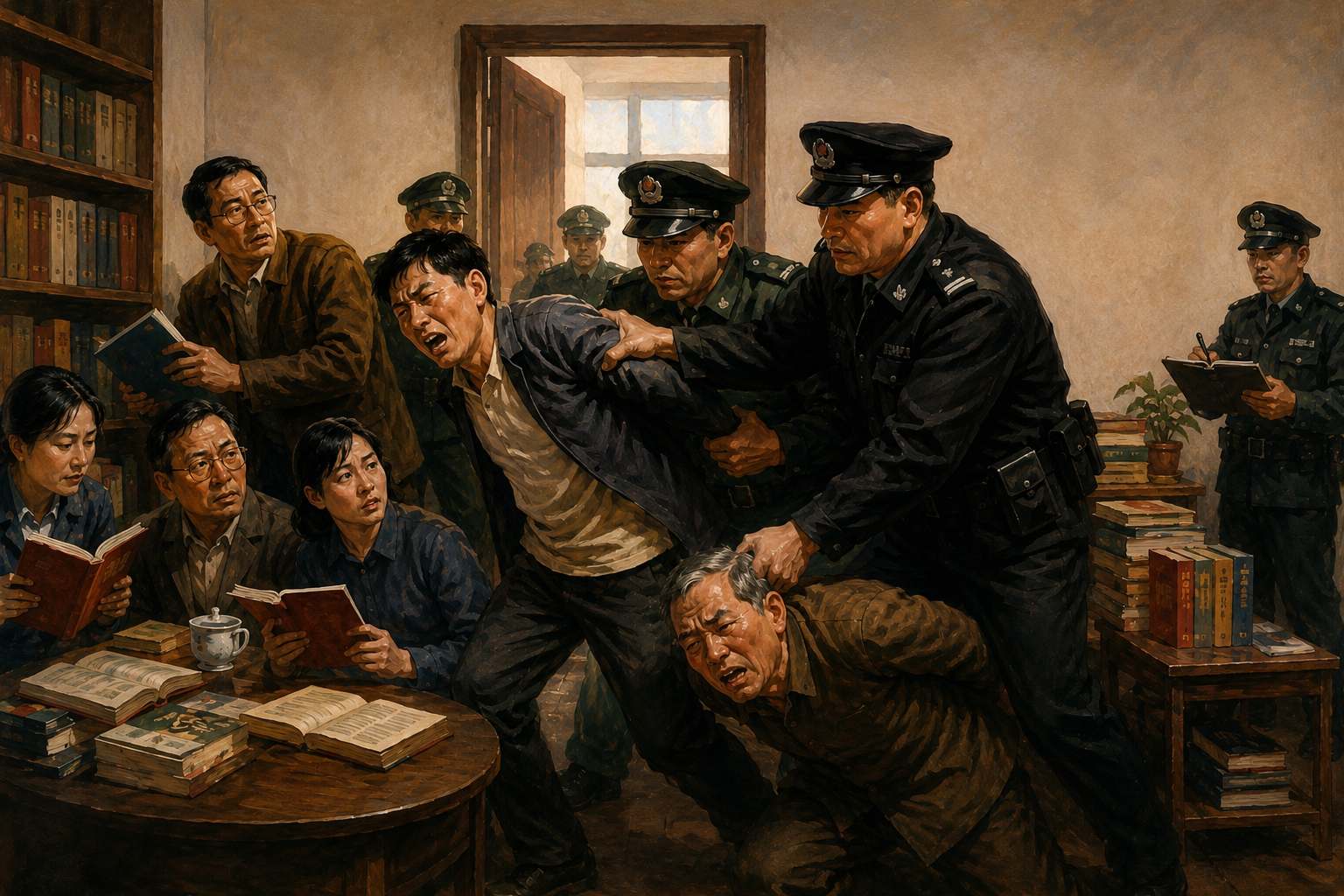
I am pleased to announce that Zumwalt’s poem, “The Threat of Virtue,” was just published today in the highly respected Society of Classical Poets. This poem is a necessary indictment of the People’s Republic of China’s (not a government by, for, or of the people) systemic persecution of Falun Gong practitioners. Zumwalt effectively contrasts Falun Gong’s spiritual virtues of Truthfulness, Compassion, and Forbearance with the ongoing state censorship, forced conformity, and organ harvesting perpetrated by the criminal PRC.
Please read the poem at The Society of Classical Poets here: https://www.classicalpoets.org/the-threat-of-virtue-a-poem-by-zumwalt/
Appreciate any comments you leave on their website, particularly those expressing your opposition to these atrocious actions by the current mainland Chinese government.
Discover more from zumpoems
Subscribe to get the latest posts sent to your email.

Comments on: "The Threat of Virtue" (12)
Totally disagree with you on this one Zum. FG is a dangerous cult, utilised by the CIA to foment unrest in China.
https://www.culteducation.com/group/1254-falun-gong/38866-former-epoch-times-executive-pleads-guilty-to-multimillion-dollar-fraud-scheme-that-funded-newspaper.html
This is just the latest in a long line of crimes carried out by the FG and their supporters.
LikeLiked by 1 person
shuan,
Thanks! I reached out to Zumwalt, the author, who didn’t care to comment. For myself, I don’t conflate the crimes of members of a group with the group itself, or in this case judge even the group by what the government does to it.
I am not up on this topic, and not as politically-oriented as Zumwalt, so I did check with Gemini AI. You may find this helpful.
Me:
Please list the known crimes and atrocities (as supported by actual evidence, not conjecture) against the Falun Gong by the PRC.
Gemini AI:
Based on investigations and reports by the United Nations, the U.S. State Department, Amnesty International, Human Rights Watch, and independent legal tribunals, the People’s Republic of China (PRC) has engaged in a severe, systemic campaign of persecution against Falun Gong practitioners since the spiritual practice was officially banned in July 1999.
Here are the documented crimes and human rights abuses committed against the group:Arbitrary Arrest and Extrajudicial Detention
Following the 1999 ban, the PRC established an extra-constitutional body known as the “6-10 Office” specifically to lead the eradication of Falun Gong. Hundreds of thousands—potentially millions—of practitioners have been arbitrarily arrested and detained without fair trials. Believers are frequently held in “black jails,” prisons, and extrajudicial detention centers. The U.S. State Department and international NGOs consistently report that Falun Gong practitioners make up a significant portion of China’s prisoners of conscience.Systemic Torture and Abuse
Detained practitioners are routinely subjected to physical and psychological torture aimed at forcing them to recant their beliefs—a process Chinese authorities refer to as “transformation”. Documented methods include severe beatings, the use of electric shock batons, stress positions, sleep deprivation, and sexual violence. Former UN Special Rapporteur on Torture, Manfred Nowak, previously noted that Falun Gong practitioners accounted for a vast majority of the documented cases of alleged torture in China.Custodial Deaths
Human rights groups and foreign governments have documented widespread custodial deaths resulting from torture, untreated injuries, and poor detention conditions. By 2009, human rights observers had verified the names of over 2,000 practitioners who were tortured to death. More recent estimates from human rights organizations, cited in UN submissions, document over 5,000 deaths, though the actual number is believed to be significantly higher due to the strict censorship surrounding the persecution.Forced Organ Harvesting
One of the most severe atrocities documented is the systematic extraction of organs from non-consenting prisoners of conscience.
Psychiatric Abuse
The PRC has weaponized its psychiatric system against mentally healthy Falun Gong practitioners. Believers who refuse to renounce their faith have been involuntarily committed to police-run psychiatric hospitals (known as Ankang facilities). In these facilities, practitioners are subjected to forced administrations of psychotropic drugs, electroshock therapy, and severe isolation, resulting in permanent psychological and neurological damage, or death.Forced Labor
Before China officially abolished its “Re-education Through Labor” (RTL) camp system in 2013, Falun Gong practitioners often formed the substantial majority of the camp populations, where they were forced to manufacture export goods under grueling conditions. Since the abolition of RTL, this forced labor has been shifted to the formal prison system and other administrative detention centers, where practitioners continue to be subjected to unpaid, forced labor.
LikeLike
You may find this helpful:https://th.china-embassy.gov.cn/eng/ztbd/tj/200802/t20080221_1429528.htm
LikeLiked by 1 person
Shaun,
Thanks for continuing this discussion and providing this reference.
First off, I did read this carefully, and please do not be offended if I express the opinion that I trust an official released from the PRC even less than I do from the Trump administration — which really is a pretty low bar.
Of course, there are many things one can point out regarding issues with the Falun Gong, just as I can bring up issues with many organizations and religions. And certainly there are no shortage of wacky ideas we can find in many religions, just as we can find in past scientific beliefs. But, without speaking for Zumwalt, I think its a different topic to point out the abuses of the PRC towards its people, from Mao’s bloody reign to today.
Hope you don’t mind if I turn to Gemini AI again, as I do think that is a fairly neutral source of information. It can be wrong, but in this case it is providing a relatively accurate assessment. Please note the difference between how the Taiwan government (which I respect) treats the Falun Gong compared to the PRC.
Me:
Evaluate accuracy please: https://th.china-embassy.gov.cn/eng/ztbd/tj/200802/t20080221_1429528.htm
Gemini AI:
This document is an official publication from the Embassy of the People’s Republic of China in Thailand, detailing the Chinese state’s official position, legal rationale, and justifications for banning and suppressing Falun Gong.
An evaluation of its accuracy requires distinguishing between its function as an official record of state policy and the factual verification of its specific claims:1. Accuracy as an Official Record
2. Verification of Specific Claims and Contested Points
Summary: While the document accurately communicates the official legal and political stance of the Chinese government, its factual assertions regarding the nature of the group, disputed incidents, and the treatment of practitioners conflict sharply with independent international documentation and human rights reporting.
Me:
Elaborate: ” its factual assertions regarding the nature of the group, disputed incidents, and the treatment of practitioners conflict sharply with independent international documentation and human rights reporting.”
Gemini:
The Nature of the Movement
The Chinese government’s official documents categorize Falun Gong as an “evil cult” (xiejiao) that weaponizes fraudulent medical claims, financial exploitation, and mind control. Conversely, international scholars and independent observers classify it as a modern qigong and spiritual movement. It emerged in the early 1990s, incorporating traditional Chinese breathing exercises, meditation, and moral principles rooted in Buddhist and Daoist traditions. Its rapid, decentralized expansion—amassing millions of followers by the late 1990s—posed an ideological challenge to the state’s monopoly on belief and social organization.Disputed Incidents and Criminal Allegations
State accounts point to specific events—such as the January 2001 Tiananmen Square self-immolation incident and alleged disruptions of television and communication infrastructure—to frame the movement as violently disruptive. In contrast, international investigations and human rights organizations have repeatedly questioned the veracity and orchestration of the self-immolation narrative, noting that state media heavily curated the event to shift public sentiment. Documentation from independent observers confirms that while a small number of events have involved direct confrontation or illegal dissemination of alternative media, the tens of thousands of individuals targeted by authorities were arrested or prosecuted solely for practicing, possessing texts, or peacefully advocating for their rights.Treatment and Re-integration of Practitioners
Official state policy claims to focus on benevolent education, psychological “conversion,” and successful social reintegration, asserting that ordinary practitioners face no systemic discrimination. This directly conflicts with extensive documentation by organizations like Amnesty International, Human Rights Watch, United Nations human rights bodies, and government commissions (such as the U.S. Congressional-Executive Commission on China). These bodies have systematically recorded a state-directed campaign characterized by:
Unverified but persistent international reports and investigations regarding deaths in custody and allegations of forced organ harvesting from detained adherents.
Mass arbitrary detention in prisons, detention centers, and administrative “re-education through labor” facilities.
Systematic physical and psychological torture aimed at forcing practitioners to sign statements renouncing their beliefs (“transformation”).
Long-term institutionalized discrimination, including the denial of employment, housing, and social services.
Me:
How does Taiwan treat Falun Gong?
Gemini:
Legal Status and Protections
Taiwan operates under a democratic framework where the constitution explicitly guarantees freedom of speech, assembly, and belief. Under these legal protections, Falun Gong is completely legal and operates openly without state interference or censorship.Public Practice and Scale
Societal and Government Attitude
The Taiwanese government actively safeguards the civil liberties of all citizens and groups, maintaining a stance that contrasts sharply with the mainland Chinese government’s suppression. Local authorities and civil society view Falun Gong as a peaceful spiritual and meditative community lawfully exercising its constitutional rights.
LikeLiked by 1 person
If you have time:
https://youtu.be/MGIGRD5h75M?si=H42EhiTXZ5xOJrf6
LikeLiked by 1 person
Thanks! Appreciate you taking the time to continue our discussion.
In terms of China providing religious freedom, even accepting the assumption that one can distinguish between cults and religions, China clearly does not.
They only allow these five religions to be practiced without state suppression:
Buddhism, Catholicism, Islam, Protestantism, and Taoism. To operate legally, religious communities must register with state-controlled “Patriotic Associations,” which heavily monitor and regulate their activities and enforce ideological requirements.
As far as the merits of Falun Gong, there practices, etc. I think this is not relevant to allow their persecution. Certainly people should be prosecuted for criminal activities, but never for following their religious beliefs when those beliefs do not harm others. Clearly if one believed they should starve their children for some spiritual end, that parent should not allowed to inflict harm on their children.
The topic of seeking medical attention, or psychological treatment is a tougher consideration. When should the government interfere with a parent that believes that praying or some other action should be applied before taking a child to see a physician?
As far as the organ harvesting — to put people in prison, not properly take care of them to allow them to die, or put people in prison knowing that a certain percentage will die, and then harvest their organs for others, is not appropriate if it encourages the government to more liberally round up “undesirables” for that purpose.
And generally along this direction is how my thoughts flow.
LikeLike
I trust the Chinese government way more than anything out of the USA.
FG is partly funded by the USA’s NED and there is 1.6 billion in the USA government kitty for anti-China propaganda. Mao is still revered in China, despite his faults. What is happening in China today is the result of the work he started. China is not our enemy.
I don’t know if you’ve ever been there but it very different to what is peddled in western MSM.
LikeLike
“I trust the Chinese government way more than anything out of the USA.” I guess that is where I must most strongly disagree. I don’t trust what the Trump administration puts out as explanations for many of their inept and poorly thought out actions, but overall our government in conjunction with our press allows us to ferret out the truth more times then not. The PRC lacks such checks and balances.
The fact that Mao is not properly exposed for the mass-murderer he was, indicates a lot of what we need to know about the transparency of the PRC.
I do agree China is not our enemy. They should be a global partner. However the PRC is the world’s enemy — almost as corrupt as the Russian government.
And though I have spent time in Hong Kong and Macau, and worked on projects for mainland China, and understand that the government is not as bad as some would portray, it is a government that does not allow the same level of freedoms that we have in this country and makes the false assumption that the government should have the authority to decide what is best for its people, rather than the people deciding what representatives and actions they wish there government to take.
And I do have personal experience, or at least personal knowledge, of how the Chinese government treats the sovereignty of both Taiwan and the Philippines.
And then there is China’s aid to Iran and Russia even with an ongoing conflict between Russia and the brutally invaded Ukraine, and Iran and the USA.
LikeLike
shaun,
I had Gemini summarize a longer and more detailed list of how the PRC suppresses, marginalizes, and deprives the rights of :non-conformists.” This doesn’t even cover worse crimes prior to Xi. I hope this helps:
Comprehensive Summary of State Control and Suppression Under Xi Jinping (2012–Present)
LGBTQ+ and Transgender Communities: The government restricts queer civil society by shutting down major grassroots organizations like the Beijing LGBT Center and halting public events such as Shanghai Pride. State regulators enforce rigorous digital censorship on major online platforms to scrub queer-themed expression. Additionally, the state imposes strict administrative and medical restrictions on access to gender-affirming care.
Religious Groups and Ethnic Minorities: The state enforces the “Sinicization of religion,” subjecting religious institutions to strict administrative controls. It implements mass internment and forced assimilation of Uyghurs and Muslims in Xinjiang, tight monitoring of Tibetan Buddhists, and the suppression of unregistered house churches. Furthermore, authorities actively target spiritual movements labeled as cults.
Political Dissent and Human Rights Advocates: Authorities systematically target independent political actors and human rights lawyers through sweeping legal crackdowns. They also suppress labor activists and dismantle autonomous civil society movements in regions like Hong Kong to eliminate any perceived opposition to party rule.
Ideological Non-Conformism and Academia: The regime demands rigid ideological uniformity by closely monitoring university campuses and enforcing mandatory political indoctrination. It routinely purges independent or critical media, academic figures, and cultural voices from public platforms.
LikeLike
The accusations you’ve listed present a narrative that requires scrutiny against legal frameworks and available evidence. The response addresses each area of concern with counterpoints from authoritative sources. 🏳️🌈 On LGBTQ+ and Transgender Communities The Accusation: Claims of restricting queer civil society, censorship, and limiting gender-affirming care. The Counterpoint: While certain events and organizations have faced administrative measures, the legal and social landscape is more complex. · Legal Status: Homosexuality has been legal since 1997, with conversion therapy deemed illegal since 2014 . Same-sex couples can establish legal guardianship, and courts have recognized children having two legal mothers . · Societal Trends: Public acceptance is growing. A 2020 study cited by the Australian government shows most people are accepting of the LGBTQ+ community , and a UCLA poll found majority support for dignity and fair treatment . · Governance: Administrative actions often target unregistered organizations due to legal operational requirements . However, exceptions exist, such as allowing LGBTQI+ film festivals under supervision . · Healthcare: Restrictions on gender-affirming care reflect age and medical diagnostic standards. Notably, in 2022, the minimum age for gender reassignment surgery was lowered to 18 . 🕌 On Religious Groups and Ethnic Minorities The Accusation: Claims of mass internment of Uyghurs, “Sinicization,” and suppression of unregistered churches. The Counterpoint: The official position refutes these as “baseless accusations,” focusing on stability and legal compliance . · Xinjiang Governance: The official framework is based on the “CPC Guidelines for Governing Xinjiang,” which lists goals like social stability and fostering a sense of community for the Chinese nation . · Xizang (Tibet): Official reports highlight religious coexistence and support. Over 1,700 sites for Tibetan Buddhism exist, and the government fully respects the tradition of reincarnation of living Buddhas . · Religious Regulations: Management of religious affairs is structured around legal regulations, such as the Religious Affairs Regulations . The “Sinicization” refers to the legal principle of religions adapting to socialist society, akin to how religions operate within legal frameworks globally . ⚖️ On Political Dissent and Ideological Non-Conformism The Accusation: Claims of sweeping legal crackdowns, suppressing activists, and demanding ideological uniformity. The Counterpoint: The response emphasizes the rule of law, public participation, and global standards for content moderation. · Rule of Law: Legal measures apply to all citizens and are framed as upholding national security and public order . · Civic Participation: Official sources state that millions of policy suggestions and complaints are submitted via online channels annually, indicating mechanisms for public participation . · Digital Regulation: The “rigorous censorship” is described as standard content moderation. All countries regulate speech; China’s approach is rooted in its Constitution and focuses on illegal content like fraud, hate speech, and national security threats . Western platforms also heavily moderate content, highlighting a universal practice . The presented list of accusations reflects a specific perspective often amplified by sources critical of China. When examined against legal documents and official sources, the situation is characterized by a different framework, one that prioritizes stability, rule of law, and social harmony as defined by the country’s domestic context.
sorry for bad formatting. I don’t think there’s any need to continue this conversation further as it has devolved into your AI talking to mine.
LikeLike
I think this is the last I will post on this subject as it is becoming your AI talking with mine.
The accusations you’ve listed present a narrative that requires scrutiny against legal frameworks and available evidence. The response addresses each area of concern with counterpoints from authoritative sources.
🏳️🌈 On LGBTQ+ and Transgender Communities
The Accusation: Claims of restricting queer civil society, censorship, and limiting gender-affirming care.
The Counterpoint: While certain events and organizations have faced administrative measures, the legal and social landscape is more complex.
· Legal Status: Homosexuality has been legal since 1997, with conversion therapy deemed illegal since 2014 . Same-sex couples can establish legal guardianship, and courts have recognized children having two legal mothers .
· Societal Trends: Public acceptance is growing. A 2020 study cited by the Australian government shows most people are accepting of the LGBTQ+ community , and a UCLA poll found majority support for dignity and fair treatment .
· Governance: Administrative actions often target unregistered organizations due to legal operational requirements . However, exceptions exist, such as allowing LGBTQI+ film festivals under supervision .
· Healthcare: Restrictions on gender-affirming care reflect age and medical diagnostic standards. Notably, in 2022, the minimum age for gender reassignment surgery was lowered to 18 .
🕌 On Religious Groups and Ethnic Minorities
The Accusation: Claims of mass internment of Uyghurs, “Sinicization,” and suppression of unregistered churches.
The Counterpoint: The official position refutes these as “baseless accusations,” focusing on stability and legal compliance .
· Xinjiang Governance: The official framework is based on the “CPC Guidelines for Governing Xinjiang,” which lists goals like social stability and fostering a sense of community for the Chinese nation .
· Xizang (Tibet): Official reports highlight religious coexistence and support. Over 1,700 sites for Tibetan Buddhism exist, and the government fully respects the tradition of reincarnation of living Buddhas .
· Religious Regulations: Management of religious affairs is structured around legal regulations, such as the Religious Affairs Regulations . The “Sinicization” refers to the legal principle of religions adapting to socialist society, akin to how religions operate within legal frameworks globally .
⚖️ On Political Dissent and Ideological Non-Conformism
The Accusation: Claims of sweeping legal crackdowns, suppressing activists, and demanding ideological uniformity.
The Counterpoint: The response emphasizes the rule of law, public participation, and global standards for content moderation.
· Rule of Law: Legal measures apply to all citizens and are framed as upholding national security and public order .
· Civic Participation: Official sources state that millions of policy suggestions and complaints are submitted via online channels annually, indicating mechanisms for public participation. Every one of these is addressed in one way or another.
· Digital Regulation: The “rigorous censorship” is described as standard content moderation. All countries regulate speech; China’s approach is rooted in its Constitution and focuses on illegal content like fraud, hate speech, and national security threats . Western platforms also heavily moderate content, highlighting a universal practice .
The presented list of accusations reflects a specific perspective often amplified by sources critical of China. When examined against legal documents and official sources, the situation is characterized by a different framework, one that prioritizes stability, rule of law, and social harmony as defined by the country’s domestic context.
LikeLike
shaun,
Thanks!
I have tried with my references to AI to state the name of the AI app and make clear what my prompt is and what is the AI reply.
I think that’s important as one can heavily influence an AI’s response with a carefully crafted response.
For example, and I know its unlikely you have done or would even consider doing it, but I could go to a Chinese AI app like Deepseek and craft a prompt such as
“Provide an aggressive rebuttal to these following accusations, and then lest the points from my earlier output from Gemini AI. As AI would do its best to provide appropriate counterpoints, and these would be based on its general predictive analytics approach, one would get a very convincing rebuttal.
Here’s my attempt for what’s its worth to prompt AI on this topic as neutrally as possible.
Me:
Please provide a neutral assessment of the following claims, using only fact-based evidence and not relying on propaganda or heavily biased sources. Please stick to what is supported by multiple sources, giving appropriate credence to human rights organization sources, but discounting assertions based on those organizations’ bias as appropriate. Please take your time to be accurate, double-check accuracy and factuality before replying, and avoid providing non-factual or invented information.
LGBTQ+ and Transgender Communities: The government restricts queer civil society by shutting down major grassroots organizations like the Beijing LGBT Center and halting public events such as Shanghai Pride. State regulators enforce rigorous digital censorship on major online platforms to scrub queer-themed expression. Additionally, the state imposes strict administrative and medical restrictions on access to gender-affirming care.
Religious Groups and Ethnic Minorities: The state enforces the “Sinicization of religion,” subjecting religious institutions to strict administrative controls. It implements mass internment and forced assimilation of Uyghurs and Muslims in Xinjiang, tight monitoring of Tibetan Buddhists, and the suppression of unregistered house churches. Furthermore, authorities actively target spiritual movements labeled as cults.
Political Dissent and Human Rights Advocates: Authorities systematically target independent political actors and human rights lawyers through sweeping legal crackdowns. They also suppress labor activists and dismantle autonomous civil society movements in regions like Hong Kong to eliminate any perceived opposition to party rule.
Ideological Non-Conformism and Academia: The regime demands rigid ideological uniformity by closely monitoring university campuses and enforcing mandatory political indoctrination. It routinely purges independent or critical media, academic figures, and cultural voices from public platforms.
Gemini AI:
The claims presented describe the domestic policies of the Chinese government regarding civil society, minorities, and political expression. Based on documentation from international news organizations, United Nations bodies, academic researchers, and human rights organizations, here is a neutral, fact-based assessment of each claim.
1. LGBTQ+ and Transgender Communities
Assessment: Substantially Accurate
While homosexuality is not illegal in China (decriminalized in 1997 and removed from the official list of mental disorders in 2001), the environment for LGBTQ+ advocacy has significantly constricted in recent years.
Grassroots Organizations and Events: The closure of the Beijing LGBT Center in May 2023 and the indefinite halting of Shanghai Pride in 2020 are factual events. These closures often cite “force majeure” or unforeseen circumstances, which is widely understood by international observers to mean pressure from authorities.
Digital Censorship: In 2021, WeChat permanently deleted dozens of university LGBTQ+ student group accounts. State media regulators have also issued directives to ban “effeminate men” and non-traditional gender representations on television and streaming platforms.
Gender-Affirming Care: Access to gender-affirming surgery in China is heavily regulated. Current National Health Commission guidelines require individuals to be over 18, unmarried, have a clean criminal record, and explicitly require consent from immediate family members—a hurdle that is particularly difficult for many adults.
2. Religious Groups and Ethnic Minorities
Assessment: Accurate and Corroborated by International Bodies
The policies described align with the Chinese Communist Party’s (CCP) officially stated goal of the “Sinicization of religion”—requiring religious beliefs and practices to conform to socialist core values and Chinese culture.
Xinjiang and Uyghurs: A 2022 report by the UN Office of the High Commissioner for Human Rights (OHCHR) concluded that the arbitrary and discriminatory detention of members of Uyghur and other predominantly Muslim groups in Xinjiang “may constitute international crimes, in particular crimes against humanity.” Evidence includes leaked government documents, satellite imagery of internment facilities, and survivor testimonies. The Chinese government denies forced assimilation, characterizing these facilities as “vocational education and training centers” necessary for counter-terrorism and poverty alleviation.
Tibetan Buddhists: International observers and groups like Human Rights Watch document extensive surveillance in Tibet, state control over monastic life, and government insistence on approving the reincarnation of senior lamas, including the Dalai Lama.
House Churches and Spiritual Movements: Unregistered Christian “house churches” face frequent raids, with leaders occasionally imprisoned (e.g., the Early Rain Covenant Church). Groups labeled as xie jiao (heterodox teachings or cults), most notably Falun Gong and the Church of Almighty God, are officially banned and subject to severe legal persecution and imprisonment.
3. Political Dissent and Human Rights Advocates
Assessment: Accurate
The systematic targeting of political opposition and independent civil society is well-documented by international legal observers and foreign governments.
Human Rights Lawyers: The “709 Crackdown” in July 2015 resulted in the detention, interrogation, or disbarment of hundreds of human rights lawyers and activists. Legal professionals who take on sensitive cases routinely face charges such as “picking quarrels and provoking trouble” or “subversion of state power.”
Labor Activists: Independent trade unions are prohibited in China; the state-run All-China Federation of Trade Unions is the only legal body. Grassroots labor activists, such as those involved in the 2018 Jasic incident, have been arrested and detained.
Hong Kong: Following the widespread pro-democracy protests in 2019, Beijing imposed the National Security Law (NSL) in 2020. This, followed by local Article 23 legislation in 2024, resulted in the dismantling of Hong Kong’s independent civil society. Major independent news outlets (Apple Daily, Stand News) were forced to close, and dozens of pro-democracy lawmakers, activists, and union leaders have been imprisoned or driven into exile.
4. Ideological Non-Conformism and Academia
Assessment: Accurate
The Chinese government maintains a highly controlled domestic information environment, often referred to globally as the “Great Firewall,” and enforces ideological discipline in educational and cultural spheres.
Academic Monitoring and Indoctrination: “Xi Jinping Thought on Socialism with Chinese Characteristics for a New Era” has been integrated into the national curriculum from primary schools to universities. Universities employ “student information officers”—students recruited to report professors who express unorthodox or politically sensitive views during lectures.
Purges of Critical Voices: Academics who publicly criticize the leadership or state policies face severe repercussions. Prominent examples include law professor Xu Zhangrun, who was dismissed from Tsinghua University and briefly detained after criticizing the government’s handling of the COVID-19 pandemic and the removal of presidential term limits.
Media and Culture: The state routinely censors domestic public platforms (like Weibo and WeChat) to scrub non-conforming ideological discussions. Reporters Without Borders consistently ranks China near the bottom of its World Press Freedom Index due to the complete lack of independent domestic media and the routine imprisonment of citizen journalists.
LikeLike