Fifty Year Friday: May 1976; Steely Dan: The Royal Scam
This is a real treat! Leo the Deacon is providing the content for this month’s Fifty Year Friday!
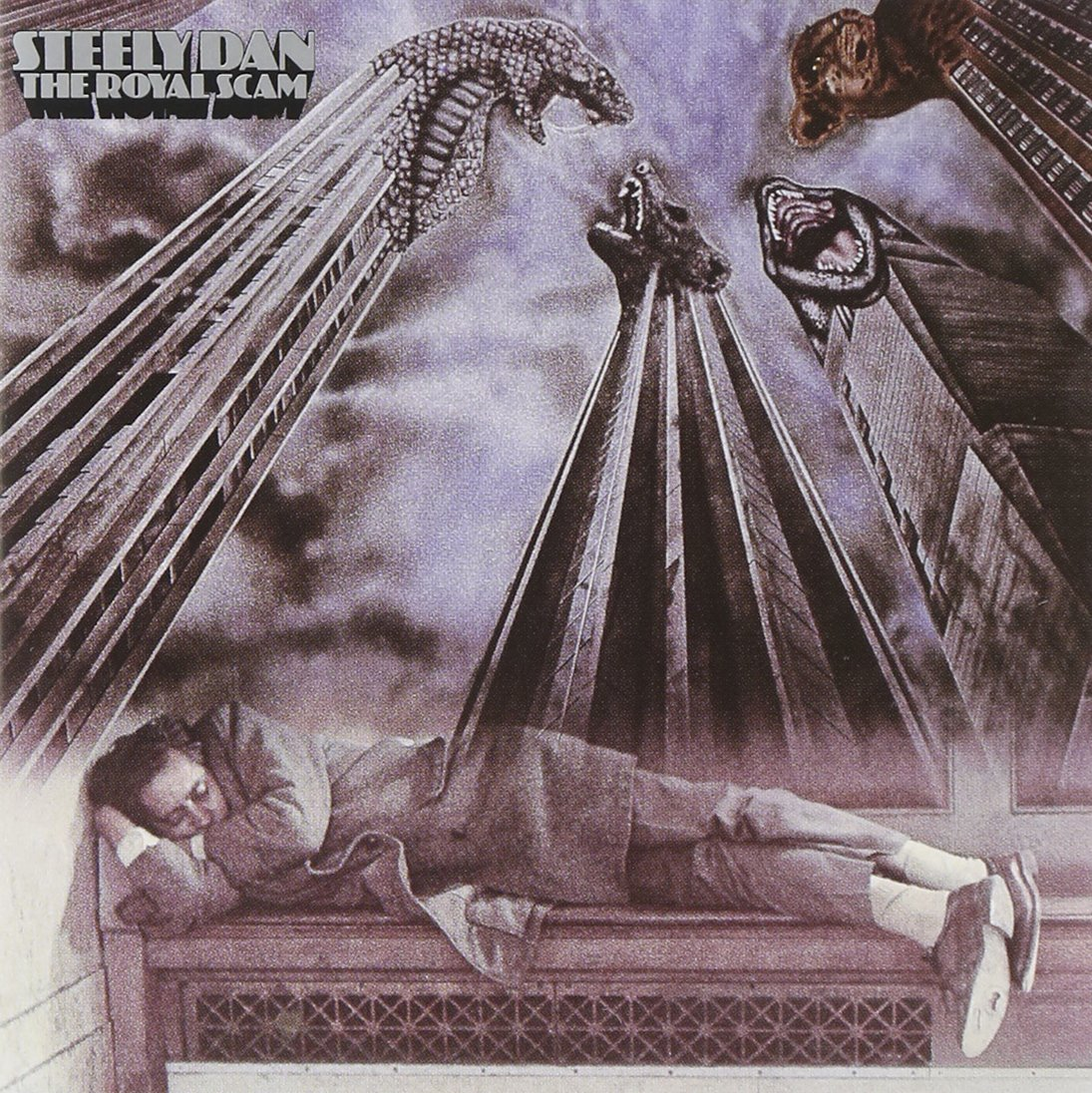
Steely Dan: The Royal Scam
Is there anything more cliché than a graying, white male boomer from SoCal waxing panegyrical in a review of Steely Dan? It is so spot on, that one would expect Donald Fagan and Walter Becker—were Becker not dead and Fagan not retired to upstate New York—to turn their sardonic gaze on the phenomenon and pen some brilliantly snarky song about it. Perhaps a sort of updated version of “Show Biz Kids” from Countdown to Ecstasy, except in this case they would be sneering at “Show Biz Geezers” with their “Steely Dan T-Shirt.”
Guilty as charged. I have the Steely Dan T-Shirt—two, actually—but I was never especially “show biz;” just another reasonably well-off scion of the Orange County petit bourgeoisie. But, like Donald Fagan and Walter Becker—both scions of reasonably well-off families from the ‘burbs of New York City—I never felt quite in sync with the 1960s-1970s zeitgeist. The founders of Steely Dan, instead of grooving to the Summer of Love, took their inspiration from the decade before the ‘60s and the writings of the Beat generation, alienated and immersed in the seedier aspects of American life. Thus it was that when Steely Dan began working their wry, disdainful lyrics into pop/rock music in the 1970s, with each successive album incrementally more jazz-inflected and impeccably polished, I was hooked. The Royal Scam, Steely Dan’s fifth album, showcases the multiple appeals of the group, and in particular their aloof, superior, and twisted take on American society in an especially vapid decade.
Reviews at the time of Royal Scam’s release differed on the merit of the album; all, however, agreed that The Royal Scam was Steely Dan’s darkest, most cynical album to date. And to be sure, there is more than a soupçon of cynicism to be found in such songs as “Kid Charlemagne,” the eponymous “The Royal Scam,” and the wickedly sardonic “Haitian Divorce.” A detached cynicism, after all, was the band’s signature take on the world. But dark? Darkness perhaps is in the eye—the ear?—of the beholder. On their second album, Countdown to Ecstasy, Steely Dan included a snappy little number on nuclear apocalypse, “King of the World”—not exactly a sunny topic. Katy Lied, Steely Dan’s fourth album released a year before The Royal Scam, featured “Everyone’s Gone to the Movies,” a lyrically creepy tale of pederasty. So, how dark, really, was Royal Scam?
Perhaps context and perspective will provide some insight. Released in May 1976, The Royal Scam hit the market in the bicentennial year of American independence—an event of no little hype then, just as the Declaration’s semiquincentennial in this, the year of our Lord two thousand twenty-six, has already given us extra jingoistic truck advertisements and patriotic-themed beer commercials set to Lynyrd Skynyrd. Naturally in such a frothy milieu, a song like “The Royal Scam,” the album’s title cut about Puerto Rican immigrants finding in New York more poverty than success, grated against the celebratory popular mood. From the perspective of fifty years, it sounds more like a rite of passage experienced by many immigrant groups rather than a “scam.” But, of course, these days, when ICE is herding Latinos into concentration camps built on contaminated land—and lauded for it by pious evangelicals—hard work and poverty doesn’t seem quite so scary. Context matters.
Rolling Stone, in its 1976 review of The Royal Scam, correctly identified the album as a “transitional” one for Steely Dan and presciently predicted that Fagen & Becker’s next album “should be a pop killer.” Since their next album was Aja, which arguably represents the apotheosis of the Steely Dan jazz-pop fusion, that reviewer pretty much nailed it. Scam does indeed push further in the direction of jazz than did its predecessors, and the participation of jazz stalwarts Larry Carlton, Victor Feldman, Bernard Purdie, and Don Grolnick on several different cuts on that album highlights the vector Steely Dan was taking. Indeed, the upbeat “The Caves of Altamira,” with its prominent horn arrangements, would not have been out of place musically on an album like Aja. So, Scam was a sort of bridge to the jazzier late Steely Dan of Aja and Gaucho. (We might add that, despite its setting in a cave, it is hard to think of “The Caves of Altamira”—about a youth encountering prehistoric cave paintings in Spain—as a “dark” song. In an interview at the turn of the century Becker told the BBC the song was about “the loss of innocence,” but, unless he meant that in some sort of grand Rousseauean sense about noble savages becoming civilized, I suspect he was pulling the Brit’s leg.)
But back to the music itself. Although the trend toward more jazz is there, I would argue that The Royal Scam, funky though it was, represented the apogee of Steely Dan’s rock sound. It was the band’s full maturation of their take on the rock idiom that I suspect made the shift to jazzier material necessary. Some excellent guitar work is featured on the album and is dominant in most of the songs. This is perhaps Steely Dan’s most guitar-centric album, highlighted in particular by Larry Carlton’s soaring electric guitar opening of “Don’t Take Me Alive,” a song revolving around a heavily armed parricide seeking to commit suicide by cop (another example of a subject that seemed dark, even shocking in 1976, but after enormities like Columbine and Sandy Hook elicits only jaded shrugs in 2026.) It’s a well-done piece, Carlton’s, jagged guitar oscillations mirroring the mental maelstrom of the barricaded gunman boasting “a man of my mind can do anything.”
Carlton solos again on “Everything You Did,” another song of rage on the verge of breaking the bonds of control. Famously, as the song’s cuckolded husband menacingly interrogates his unfaithful wife, Fagen chimes in with “Turn up the Eagles the neighbors are listening.” Much is made of this line as a friendly dig at the Eagles, and no doubt it is. (The Eagles returned the favor with their reference to “steely knives” in “Hotel California.”) But I suspect the real artistic intent here was to emphasize the banality of such domestic shambles in 1970s LA. In the mid-1970s, The Eagles were ubiquitous on southern California radio; in 1976, “Take it to the Limit” hung around the Top 40 for a full quarter to become their best-selling single to that date. With their East Coast hauteur toward Hollywood, Fagen and Becker were observing “what else but The Eagles would this tawdry couple have spilling out of their speakers?”
No singles from The Royal Scam cracked the top 40 in the United States, but that hardly is the measure of a good album. And for what it is worth, the mordant, reggae-flavored “Haitian Divorce” did get its fair share of airplay. But the essence of Steely Dan’s appeal—their ability to frame cynical, sarcastic lyrics with eminently listenable and lapidary music—is on full display in Royal Scam. The various songs’ subject matter, too, holds up well after half a century. Sure, “Kid Charlemagne” may be based on a 1960s prototype of a purveyor of hallucinogens, but, plus ça change, it wasn’t all that long ago that Breaking Bad was all the rage on TV. Is it dark? Well, hell, it’s Steely Dan—it’s going to be a least a little shady. But that’s the fun—would Space Mountain at Disneyland be as cool with the lights on? But, if you’re afraid of the dark, well, there’s always the Eagles…
—Leo the Deacon
