“If the doors of perception were cleansed, everything would appear to man as it is, infinite. For man has closed himself up, till he sees all things through narrow
chinks of his cavern.” William Blake from “The Marriage of Heaven and Hell”
The Doors formed in 1965, in Los Angeles, signing in 1966 with folk-music label, Elektra, after Columbia failed to secure a producer for their first album. Their name was inspired by Aldous Huxley’s book “The Doors of Perception”, which recounts Huxley’s mescaline experiences and borrows its title from the William Blake poem, “The Marriage of Heaven and Hell.” This first album of theirs was released in January of 1967.
The album opens up with a promise, premise and pronouncement to “Break On Through to the Other Side.” This first track, as do many on the album, opens up in layer by layer (instrument by instrument) with John Densmore ‘s drums, staggered bass in first the left (guitar bass line) and then right channel (keyboard bass line), Jim Morrison’s vocals, Robby Krieger‘s guitar and eventually Ray Manzarek‘s organ setting a standard of expectation for the rest of the album. Less than 2 1/2 minutes, the track is over — just the right length — leaving the listener hungry for more.
This album, in general, is dark, emphatic, reflective, well-thought out and a precursor to later American heavy metal (Iron Butterfly, Steppenwolf, and to some degree even bands like Blue Oyster Cult.) Much of the music is blues-based, some adhering closely to that foundation (“Back Door Man”), some straying quite far but keeping the essence of the three chord pattern (“Soul Kitchen”) and some seemingly far removed but yet still with a blues essence. Within this wide range, all of this music has a freshness and originality to it, sometimes provided by Kreiger’s distillation of late sixties guitar, sometimes by Manzarek’s often ornate keyboards and sometimes from the overall arrangement.
Not enough can be said about “Break On Through to the Other Side”, and so I will say no more.
“Soul Kitchen” is a sexy, bouncy bluesy piece, with what was in 1967 pretty explicit lyrics. “The Crystal Ship” is lyrical, dramatic, intimate and in a minor key with a mystically evocative keyboard section. “Twentieth Century Fox” is a clever title, not about a movie studio, but of course, to the “fashionably lean” “queen of cool” in-control modern woman well described in the lyrics:
“No tears, no fears,
No ruined years, no clocks;
She’s a twentieth century fox, oh yeah!”
The fifth track, “Alabama Song” is from the Kurt Weill opera Rise and Fall of the City of Mahagonny ( Bertolt Brecht lyrics) and I suspect the lion’s share of arrangement credit goes to Manzarek who plays the zither-like marxophone and keyboards. Note that nearly ever-present, oompah-oompah, ironic lilt — the essence of which resurfaces in at least a couple of 1970’s English progressive rock albums.
Not much needs to be said about “Light My Fire”, thanks goodness, for words poorly can capture the spirit of this song, it’s historic, seamlessly interwoven blend of jazz, baroque and rock elements, and its influence on early metal and early progressive rock bands.
“Back Door Man” is pure blues, written by Willie Dixon and previously known for the 1960 Howlin’ Wolf version. “Back Door” is a prominent reference in earlier blues music and refers to sneaking in the back door of a house when the unsuspecting husband is at work or out and about.
“I Looked at You” is another song that starts by adding layers. It is almost a prototypical mid-sixties go-go dance number until that first brief detour (modulation at “cause it’s too late”), quickly shifting back to its initial state (“we’re on our way and we can’t turn back”) with a wonderful go-go style organ that follows. Here again we have a hint of baroque music embedded in what is essentially sixties pop.
“End of Night”, a soothing minor/modal ballad in the midst of more stormy tracks, begins with a hint of spooky, Bartok-like nacht-musik into a leisurely blend of guitar and Morrison vocals.
“Take It as It Comes” starts with no introduction, appropriate to both the title and opening words of “Time to live.” It starts of with a e minor seventh chord which effectively creates the drive and resulting uplift for the next section (modulation to A minor at “Take it easy, baby. Take it as it comes”) and the short baroque-like organ solo. A second ornate organ solo is followed by more vocals from Morrison (“Go real slow. You like it more and more. Take it as it comes. Specialize in havin’ fun”) and a quick, final flourish to end.
“The End” attempts to rise up to the height of the opening track, and would come very close, with its tender opening and exotic, Indian-influenced (voiced by guitar), expansive instrumental section. The trouble is that after a few minutes, Morrison’s mumbling detracts from otherwise meditative, highly spiritual music. Granted, Morrison is reaching for the furthest corners of personal discovery, but the track would have worked better if he stopped after the melancholic exposition:
“This is the end, beautiful friend
This is the end, my only friend, the end
Of our elaborate plans, the end
Of everything that stands, the end
No safety or surprise, the end
I’ll never look into your eyes, again”
which sets up the remaining instrumental exploration and inner-reflection nicely.
That said, this Morrison self-indulgence is only a minor weakness and doesn’t detract from the excellence and revolutionary nature of this album. When we talk about drugs, sex, and rock and roll, this album encompasses all three: from the name of the band, to the surprisingly suggestive lyrics (common enough for blues, but not so common for the mass media of 1967), to the self-assertive, unapologetic, counter-culture music.
One of my fondest memories of my first year of college was listening in the library’s music listening room in the fall of 1973 with my first-semester girlfriend (and my continuing lifelong friend since sixth grade) to Zappa’s “We’re Only in it for the Money” and this very first Jimi Hendrix album.
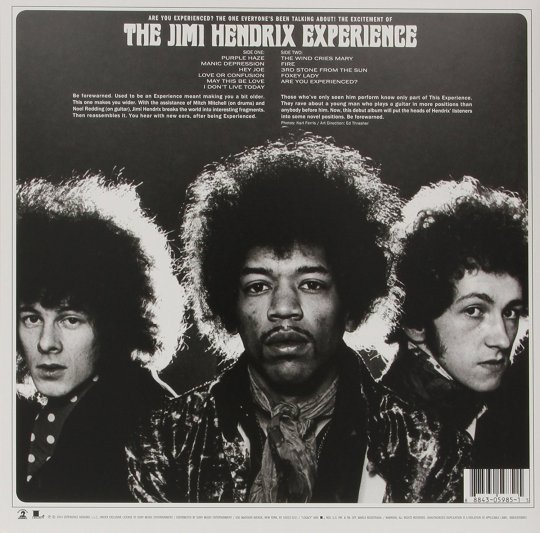
A week earlier, I had listened to “Are You Experienced” for the very first time in that same library but on headphones. I had previously bought two Hendrix albums in high school, “Cry of Love” and “Rainbow Bridge”, and was curious how this compared to those two albums and “Electric Ladyland”, all three of which I thought highly of. I remember studying the album cover of “Are You Experienced”, front and back, before putting the LP on the no-frills turntable and then donning the mediocre, highly uncomfortable library headphones. The first track was “Purple Haze”, and though primitive in comparison to songs on “Cry of Love”, captured me completely. The lyrics lacked the imagery and imagination of later Hendrix lyrics and the sound over those cheap library headphones sounded rough and muddy, but the forceful and potent guitar-riff introduction was as magical as a Wagner leitmotif: a compelling opening to any album, effectively locking any exit from the listening room door until the end of side two.
That first overall impression of this album was not entirely positive. I missed the studio slickness and more sophisticated lyrics of the later albums, and found the music to be dated, a relic of the drug-crazed, psychedelic late sixties. Nonetheless, I was certainly impressed enough to want to share with my on-campus and off-campus friend a week later as we checked out this album and were able to grab one of the two listening rooms that had speakers, and also, a room where we could stretch out a bit and listen to this much as at home, except for the “No food allowed” sign and the narrow window in the door to allow us to be observed by passerbys.
Until a few days ago, I hadn’t heard this album since college, so in preparation to write a blog post on this work, I got out a previously unheard high-quality vinyl German pressing (let’s not discuss how many vinyl records I have collected that I have not yet listened to or how they, along with way too many CDs, have taken up the better portion of two bedrooms) and, without looking at the contents, started to listen to it from beginning to end.
“That’s old age and memory,” I thought, as “Foxy Lady” danced out of the loudspeakers. I picked up the cover and, noticed even more to my surprise, that “Purple Haze” was missing from side 1 and side 2. Yes, indeed, my memory is going bad, but it’s not hallucinogenic! As patience is a virtue of old age, I continued listening, noticing the absence of “Hey Joe” and “The Wind Cries Mary” and the addition of tracks I had never remembered hearing in my life: first “Can You See Me” and then “Remember” on side two. These two new tunes were indeed an unexpected and rather rewarding discovery, but as soon as the album was over, not owning a CD of this to compare, I went to the internet and found the different listing of tracks for the North American version and the UK/European version. Relieved, now, that I still had a few weeks more until onset of dementia, I obtained a standard 16 bit redbookCD which had all the tracks from both albums and a few bonus tracks.
Glad to be able to listen again to the original album I knew, but with seriously better audio than in the library music room, I was taken back through time with that introductory riff of “Purple Haze” – clearly the only way to introduce Hendrix’s first album.
This is a modern blues song — and I mean modern! The whole album, even the one track not written by Hendrix (“Hey Joe”) strays varying distances away from traditional blues, yet shares 99.9 % of the DNA. Like a blues song, or Chopin’s or Beethoven’s funeral marches, “Purple Haze” is slow paced, inevitable and unstoppable. Hendrix creates tension with his approach to fingering, chord voicings, use of controlled distortion, his overall guitar technique, and emphatically pushing out the boundaries of comfort and predictability. The spirit of the music is assisted ably by Noel Redding’s bass (including passing tones between root notes and various rhythmic subtleties) and Mitch Mitchell’s driving, energetic, yet calculatingly controlled drumming.
And, as I remembered, these lyrics are not at the level of later Hendrix lyrics, yet still, there is a undeniable unity with the music:
“Purple haze, all in my brain;
Lately things they don’t seem the same.
Actin’ funny, but I don’t know why;
Excuse me while I kiss the sky.
“Purple haze, all around;
Don’t know if I’m comin’ up or down.
Am I happy or in misery?
What ever it is, that girl put a spell on me.
“Help me
Help me,
Oh, no, no.”
For some odd reason, music critics of that time stretched and reached to make drug connections when none where evident. These lyrics are about being smitten — whether naturally or through other means, like voodoo, is open to discussion — but drugs don’t seem to be relevant here.
Musically, one could argue that drugs opened up vistas and viewpoints for composers and musicians that allowed such innovation. Maybe there is truth here (Chopin took opium for tuberculosis, Berlioz took opium, many jazz musicians had drug encounters or severe drug dependencies) and maybe not, but one cannot create genius from drugs or elevate mediocre musicians and composers up to the next level. One can certainly make the case that drug use ultimately works against musicians at all levels. That said, let others more knowledgeable address this drug topic, and the impact of drugs on music, I will just delight in the amazing music handed down to us from those inspired geniuses, whether inspired divinely, materially or through some other means.
And there is much to delight in during the course of this album. The second track, “Manic Depression” has this wild instrumental where Hendrix’s guitar climbs up by thirds (outlining E flat minor seventh chord) for four notes and then frenziedly disperses in a truly manic solo. This rising four note motif then collapses into a three-note pattern incorporated in the next verse:
“Well I think I’ll go turn myself off and a go on down.
(All the way down.)
Really ain’t no use in me hanging around.
(Oh, I gotta see you.)
“Music sweet music
I wish I could caress and a kiss, kiss;
Manic depression is a frustrating mess”
and undergoes additional transformation, collapsing into two notes and then back to four with the feedback-punctuated finish.
“Hey Joe” continues the inevitable march forward, with a joyous, celebratory instrumental interlude enhanced by the ensuing, buoyant backing vocals.
“Love or Confusion” is dominated by the guitar work and resulting drama. In contrast to all that came before “May This Be Love” is a lush ballad showing off the gentle, intimate side of Hendrix. Ending side one is the ironically initially exuberant “I Don’t Live Today”, followed with darkly, depressing passages weaving back and front, side to side.
Side two opens up with the second leisurely-paced ballad, “The Wind Cries Mary.” Hendrix’s nonchalant, conversational vocals work well here. Nothing here is unnatural or forced, with a simple but beautiful guitar solo in the middle and a tranquil calming ending providing a momentary opportunity to catch a breath before jumping into the up tempo “Fire.”
“Fire” opens up with one of those iconic Hendrix guitar intros that foreshadow, and perhaps creates, heavy metal. Mitchell’s level of energy, creativity and collaboration is not only up to the assignment, but raises the intensity and is integral to the overall character and aesthetics. Redding provides spurts and phrases of growling, rhythmic bass.
“Third Stone from the Sun” is a psychedelic sound painting. It’s foundation is a lyrical, almost placid, watercolor theme mixed with half-speed spoken vocals:
“Star Fleet to scout ship, please give your position. Over.”
‘”I am in orbit around the third planet from the star called the Sun. Over”
“You mean it’s the Earth? Over.”
“Positive. it is known to have some form of intelligent species. Over”
“I think we should take a look.”
Regular speed:
“Strange beautiful grass of green with your majestic silken seas.
Your mysterious mountains, I wish to see closer.
May I land my kinky machine?”
Half-speed:
“Although your world wonders me with you majestic superior cackling hen,
Your people I do not understand, so to you I wish to put and end
And you’ll never hear surf music again.”
“That sounds like a lie to me.
Come on man, let’s go home.'”
(Not very sure of this last section and pieced it together from internet references.)
The spoken vocals are sunken deep into the texture making this a instrumental jam that flirts with some of the qualities of a sound collage, particularly at the end.
The penultimate track, “Foxy Lady”, begins with guitar crescendo metamorphosing into a sexy, provocative ostinato supporting the main melody. The highlight is the guitar solo at 1:48, yearning and screeching passionate longing with a repeat of the chorus. A forty-five second coda finishes off the piece with the diminuendo at the end providing symmetry to the opening.
There are three tracks in the European album not present in the original North American version. The first, “Red House”, is a twelve-bar blues song. For non-musicians, this is a standard blues form that is prevalent in blues, rock and roll, rock, and jazz to such an extent that it can be very annoying or boring to listen unless the composition has something special such as unusual melody, humorous or particularly engaging lyrics, substitution chords , stellar execution and performance, or effective, interesting solos on top of those chords. From the start, with Hendrix abstracted guitar intro, this is more than a throwaway blues song. In this early Hendrix recording, with this common blues structure and set of standard blues chords, we can identify much of what makes Hendrix performances so engaging. The guitar work is the primary focal point for both the leisurely and experienced listener, but part of the equation to make this work includes the support from Redding on a modified rhythm guitar and Mitchell’s minimal but steady drums as well Hendrix’s direct and personable vocal delivery. Hendrix vocals are distinctly impressive throughout his brief recorded career — not because of range, intonation, smoothness or quality of his physical vocal instrument, but because of his pacing, rhythmic delivery, warmth, directness, naturalness and conversational nature of his communication. Hendrix, in general doesn’t perform — he communicates. As once noted by Thelonious Monk to Steve Lacy, “A genius is the one most like himself.” Monk, Beethoven, Charlie Parker, and John Coltrane all deserve special acknowledgment for being themselves in achieving their beyond-Mount-Everest level of genius. Hendrix is not that far behind them.
“Can You See Me” and “Remember” certainly deserved their inclusion on the original European LP. “Can You See Me” is a driving, upbeat number with plenty of fluid chemistry between the trio. “Remember” is a moderately-fast paced ballad with an uplifting instrumental after the first two verses and chorus. The two key changes in this work provide the necessary emotional momentum to maintain the listener’s interest.
The last and most significant track on both the North American and the European original albums is “Are Your Experienced.” Backward drums and guitar immediately establish non-conformity at the same time as providing a stable foundation for the lead guitar and lyrics, and a sense of exoticness found in other mid-sixties rock albums that borrow or reference aspects of Indian Classical music.
It has been decades since I heard this amazing work, and with extra years came a different perspective on the lyrics. Previously I had assumed the experience referenced here was either drug-related or sexual, supported by the last line of the lyrics “Not necessarily stoned, but beautiful”, but its worth considering experience on a more spiritual level — above and beyond the physical plane of corporeal existence. Back in college, I was a bit puzzled with the phrase “have you ever been experienced.” That didn’t make sense on the surface — for if one had previously had experience with whatever Hendrix is defining as experience, then one should still be experienced. Why is this not “have you experienced” instead of the past perfect form of “have you ever been experienced?” Today, I see two additional angles: “Have you ever been experienced” meaning “has someone else experienced you” and “have you ever, such as in a past life, been experienced?” The first could be sexual, but could also mean one is their essential self and not a likeness or projection of something they are pretending to be or want to be perceived as. Or it could mean “have you provided others experience”, such as a musician being experienced by their audience. This second deals with states of existence such that one could be experienced in one state (such as in one lifetime or plane of existence) and not in the other. We can then extend this metaphysical reflection and go off in many more directions, but the simple point here is that the lyrics provide a level of interpretation appropriate to psychedelic or transcendental frameworks.
It’s also totally in keeping with the contents of this album for me to consider that the album is asking its musical contemporaries “Have you even been experienced?” Not played as background music, not listened to casually, but fully experienced across all possible dimensions.
Dave Siddle – engineering on “Manic Depression,” “Can You See Me,” “Love or Confusion,” “I Don’t Live Today,” “Fire,” “Remember,” “Hey Joe,” “Stone Free,” “Purple Haze,” “51st Anniversary,” and “The Wind Cries Mary”
Eddie Kramer – engineering on “The Wind Cries Mary,” “Are You Experienced?,” and “Red House”; additional engineering on “Love or Confusion,” “Fire,” “Third Stone from the Sun,” and “Highway Chile”
Mike Ross – engineering on “Foxy Lady,” “Red House,” and “Third Stone from the Sun”