Released on May 1, 1969, Clouds, is the second album from singer/songwriter extraordinaire, Joni Mitchel.
With impressive blend of strong songs including the likes of “Chelsea Morning”, “I Don’t Know Where I Stand”, the musically radiant ‘Songs of Aging Children Come” and the lyrically emotive “Both Sides, Now”, Clouds is one of those classic albums that appeals to casual and thoughtful listeners alike. By the middle of the 1970s, it seemed as if almost every baby boomer young woman between 18 and 25 had a copy. The acoustic guitar work sparkles, and the lyrics range from solid to perfection. To this very day, I consider “Both Sides Now” to be one of the best examples of simple, accessible, and straightforward, yet significantly meaningful, lyrics seamlessly blended with the equivalent level of music into one of the most memorable pop songs ever. What are some of your favorites from this album?
Everything came together for Sly Stone and his group in the all-out, upbeat, funkadelic Stand! album, released on May 3, 1969. Sly Stone scores big musically and lyrically including the most funky music recorded up to that point in time and a relevant social consciousness befitting a late sixties album.
Track listing [From Wikipedia]
All songs written, produced and arranged by Sly Stone for Stone Flower Productions.
Greg Errico – drums, background vocals on “I Want to Take You Higher”
Little Sister (Vet Stone, Mary McCreary, Elva Mouton) – background vocals on “Stand!”, “Sing a Simple Song”, “Everyday People” and “I Want to Take you Higher”
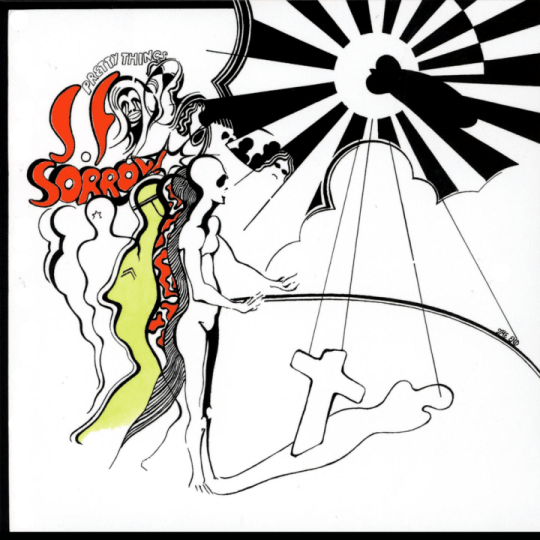
Recorded from November 1967 to September 1968 in Abbey Road Studios, The Pretty Thing’s S.F. Sorrow, initially largely ignored but now generally considered a classic, was released in the UK in December 1968, and then not released in the U.S. until the middle of 1969. Panned by the Rolling Stone’s Lester Bangs as an “ultra-pretentious” concept album, the album received limited attention for years. Its poor reception and lack of sales precipitated founder and lead guitarist into leaving the band for a period of nearly a decade.
There seems to be many contributing factors to the album’s commercial failure: the lack of promotion, the late release of the album in the States (coming out after, rather than before, The Who’s superior, more opera-like concept album, Tommy), bad reviews, and the dark, despondent subject matter, allegorical and tragic, with its primary character named Sebastian Sorrow. Also, heavily influenced by the Beatles’ Sgt. Peppers and “Fool on the Hill”, its musical language is that of the psychedelic rock of late 1967 and 1968, now losing much of its mass popularity. By the time of the album’s release, the major proponents, adherents, and imitators of psychedelic rock were moving on to hard rock, progressive rock, or heavy metal. These and other reasons caused the album to be pretty much ignored until reissued by Edsel records in the late 1980s on vinyl and then on CD in the early 1990s.
I purchased a S.F. Sorrow CD around 1992 and set it aside for some time, coming back to it recently, taking the time to appreciate what it had to offer and its historical significance — not so important as an early concept album — remember Nirvana’s 1967 album as well as other concept albums, including Sgt. Peppers, Days of Future Passed, and The Who Sell Out preceding it — but as one of the last carefully-crafted psychedelic albums of the sixties — and one that looks forward towards hard rock, progressive rock, and heavy metal — three of the most prevailing, and commercially viable, offshoots of the psychedelic rock era.
The Beatles’ influence, particularly from Sgt Peppers and singles like “Fool on the Hill”, is strong — the second track borrows elements from “Norwegian Wood” through “For the Benefit of Mr. Kite”, and the third track, “I am the Walrus” and “Good Morning” — yet, this is an album that incorporates and absorbs those influences more than mimics.
More to the point, is the quality of the album which starts out strong and builds to the end without weakness or filler; even the somewhat musique-concrete “Well of Destiny” (possibly influenced by the transitional section of “Day in the Life” ) serving its purpose in the musical narrative. The arrangements, variety, and appropriateness of instrumentation further elevates the quality of the album, and in fact are usually of greater interest than the melodic/harmonic content of the songs themselves. (Perhaps the best song on the album, is the most simply arranged one, the poignant, “Loneliest Person”)
Though this album is very much a product of 1967 and 1968 sensibilities and styles, there are passages and techniques that anticipate other works of 1969 and the early seventies. One can hear hints at later music from the Beatles-influenced Electric Light Orchestra (especially in “Trust”) and Badfinger to Benefit-era Jethro Tull (“Private Sorrow”) to the Who’s Tommy (“The Journey” and the intro to “Old Man Going”) to Queen. The most remarkable similarity is to the heavy metal, bass-dominated style of Black Sabbath in “Old Man Going” which also includes a short hard-rock electric guitar.
The CD release includes some notable bonus tracks, including “Defecting Grey” , a commercially unsuccessful single from this time period.
Track listing [from Wikipedia]
Side One
1. “S.F. Sorrow Is Born” Phil May, Dick Taylor, Wally Waller 3:12
2. “Bracelets of Fingers” May, Taylor, Waller 3:41
3. “She Says Good Morning” May, Taylor, Waller, Twink 3:23
4. “Private Sorrow” May, Taylor, Waller, Jon Povey 3:51
5. “Balloon Burning” May, Taylor, Waller, Povey 3:51
6. “Death” May, Taylor, Waller, Povey, Twink 3:05
Side Two
7. “Baron Saturday” May, Taylor, Waller 4:01
8. “The Journey” May, Taylor, Waller, Twink 2:46
9. “I See You” May, Taylor, Waller 3:56
10. “Well of Destiny” May, Taylor, Waller, Povey, Twink, Norman Smith 1:46
11. “Trust” May, Taylor, Waller 2:49
12. “Old Man Going” May, Taylor, Waller, Povey, Twink 3:09
13. “Loneliest Person” May, Taylor, Waller, Twink 1:29 Bonus tracks
14. “Defecting Grey” May, Taylor, Waller 4:27
15. “Mr. Evasion” May, Taylor, Waller, Twink 3:26
16. “Talkin’ About the Good Times” May, Taylor, Waller 3:41
17. “Walking Through My Dreams” May, Taylor, Waller, Povey 3:35
18. “Private Sorrow” (Single version) May, Taylor, Waller, Povey 3:50
19. “Balloon Burning” (Single version) May, Taylor, Waller, Povey 3:45
20. “Defecting Grey” (Acetate recording) May, Taylor, Waller 5:10
Wally Waller – bass, guitar, vocals, wind instruments, piano
Jon Povey – organ, sitar, Mellotron, percussion, vocals
Skip Alan – drums (on some tracks, quit during recording)
Twink – drums (on some tracks, replaced Alan), vocals
Led Zeppelin: Led Zeppelin
With the semantic essence of heavy metal captured in the group’s name, its hard to dispute that Led Zeppelin forged a new path down the nascent arena of hard rock and heavy metal. With a name remarkably similar to Iron Butterfly, and a similar, but more promising, blues-based musical DNA, we have the beginnings of what would soon be the quintessential hard rock group influencing predecessors like Free to countless successors like Aerosmith, Metallica, Queen, Alice Kooper, Guns N’ Roses and countless emulators that never landed a major recording contract.
From the opening guitar and drums in the opening track, “Good Times, Bad Times”, there is a focus, crispness and intensity not present in many of the blues-based rock albums immediately preceding this one. My first experience with this album was when my next door neighbor brought it over for me to capture on my reel-to-reel tape deck for my own, limited music library. Based on my friend’s direction, I recorded the tracks he thought worth putting on tape, securing the more accessible tracks, like”Good Times, Bad Times”, “Babe I’m Going to Leave You” and “Communication Breakdown” but leaving out a couple I would not listen to again for decades — the last two tracks of side two. Fortunately, since my friend had fairly good taste, we recorded all of side one, including the mysteriously dark and heavy, “Dazed and Confused”, a well-written composition, starting with, and repeating, a chromatically-descending chord sequence. Though credited to Jimmy Page on the album, the work is mostly based on a song by the same name on a 1967 album by Jake Holmes, which the Yardbirds (a group that included Jimmy Page for a while) had originally “borrowed.” If you haven’t heard the Jake Holmes version, do yourself a favor and take the time to listen to it below.
Side Two of Led Zeppelin starts with a majestic organ solo by John Paul Jones as part of the captivating beginning of “Your Time Is Gonna Time.” Unfortunately, the verse is much stronger than a weak, almost annoying, chorus that detracts from the rest of the work.
The next track, one which we also recorded for my repeated listening pleasure was “Black Mountain Side” based on an arrangement of the Irish folk song “Down by Blackwaterside” taught to Jimmy Page by Al Stewart. This is followed by “Communication Breakdown”, later to become an AM radio hit. For me, this title always brings to mind that famous phase in Cool Hand Luke — “What we’ve got here is a failure to communicate.”
The last two tracks are probably what my friend would have referred to as the band just jamming, but listening to these again, I appreciate the quality musicianship and the overall mood. That said, I can’t particularly bemoan not having grown up with these two tracks as part of the musical soundtrack of my high school years (1969-1973.)
Though I have mixed feelings about this album, which has many strong points, but is certainly guilty of not properly crediting others, a common enough practice in the Renaissance and Baroque days of music, but not so acceptable in the late 1960s, I would pick this in an instant over contemporary albums by Steppenwolf and Iron Butterfly. Do I regularly, or, on average, once-a-decade listen to this? Not really; I find the later Led Zeppelin albums more appealing — and I pretty much don’t listen to those due to all the more interesting jazz, rock and classical music that contends for my limited listening time. However, that said, prior to posting this Fifty Year Friday entry, I did truly enjoy listening to this first “L-Zep” (modern transformation of their name) once again (and then a second time), forty-nine and a half years later after first hearing all of it, and making a copy of it for my own use, just as Jimmy Page had made a copy of both “Dazed and Confused” and “Down by Blackwaterside” for Led Zeppelin’s own use on their very first album.
Expectations is high on the new release of a previously unreleased 1963 studio session of saxophonist John Coltrane’s quartet called ”Both Directions At Once: The Lost Session”. It is yet another possible piece of the musical jigsaw puzzle that Coltrane left for his fans to discover after his early death in 1967 at 40 years […]
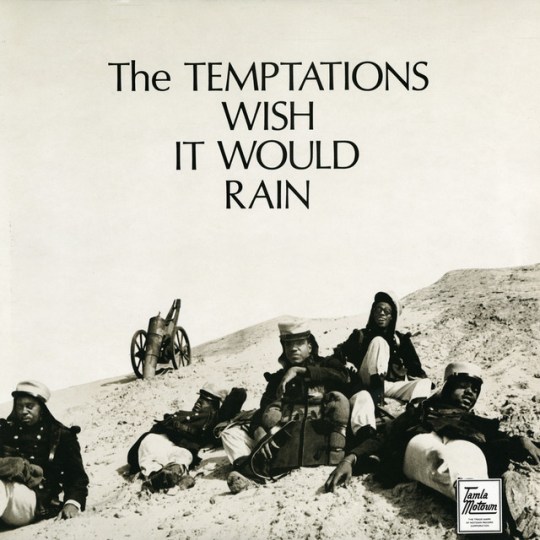
This excellent album captures the Temptations’ smooth, soulful, and often passionate sound. It is the last album produced by Smokey Robinson and the final album with Ruffin, Kendricks, and bass singer Melvin Franklin taking turns on lead vocal: Mr. Ruffin being dismissed due to disruptive behavior, including insistence on the group’s name being changed to “David Ruffin and the Temptations” mimicking the name change of the Supremes to Diana Ross and The Supremes.
Besides the excellent vocals, we have the Motown studio musicians, named at the time as the Soul Brothers by Motown CEO Berry Gordy, Jr, but not credited on this album or other such albums of the era, and historically referred to as the “Funk Brothers”, in top form.
“If you want to find the truth in life, don’t pass music by.” — Eric Burdon
Eric Burdon and the Animals were effective performers at the 1967 Monterey Pop Festival. They recorded “Monterrey”, written about the festival’s performers. Perhaps this was the first rock song written about a concert event (before Joni Mitchell’s “Woodstock” or Deep Purple’s “Smoke on the Water.”) The lyrics are weak, and Burdon even gets Ravi Shankar’s name wrong (“Shanknar”) but there is something special to this song that barely made it to the fifteenth spot on the US pop charts. It opens up with solo koto (or perhaps a similar instrument like the Chinese guzheng) and includes snippets of instrumental sound-painting as some the musicians that performed at the festival are described. In addition, woodwinds and strings are added. It really is a celebration of the time, helped by the lyrics general naiveté and the song’s relentless, expanding energy, as it picks up tempo as it progresses.
The album containing “Monterrey”, The Twain Shall Meet, was released in May of 1968 and is a solid and capable mixture of hard and psychedelic rock, and has much in common with the first albums of harder rock groups and some of the progressive rock groups that followed soon after. If one ignores the weakness in the lyrics and focuses on the music, this album provides a intriguing historical perspective on the early days of hard rock and provides insight into the transition from hard rock to what is commonly labelled as progressive rock.
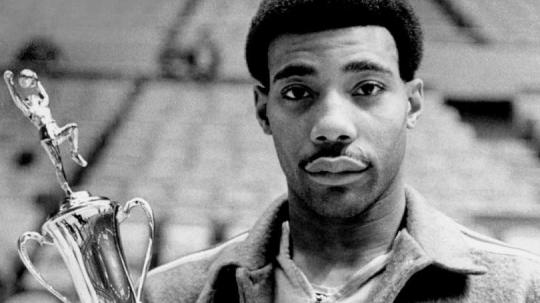
Connie Hawkins and the Pittsburgh Pipers defeated Larry Brown and the New Orleans Buccaneers in the seventh game of the very first ABA playoff in front of 11,000 fans, up considerably from their average attendance of around 3,000. Worth mentioning is the price paid for the New Orleans Bucs franchise: exactly $1000.
In other basketball news, the Los Angeles Lakers beat previous Western champion, the San Francisco Warriors, and the Boston Celtics defeated previous NBA champions, Wilt Chamberlain and the 76ers (with Wilt’s getting 34 rebounds in game 7 but his teammates shooting poorly and Wilt receiving limited touches on offense) to meet in the finals where the Lakers (with Jerry West, Elgin Baylor, Archie Clark, and Gail Goodrich) lost the seven game series for the fifth time in seven years to the Celtics, this time in six games.
Wilt Chamberlain, perhaps still upset about the 76ers previously withdrawing a verbal commitment to give Chamberlain part ownership of the team, would demand a trade, indicating the possibility of going to the ABA, and soon Chamberlain would be sent to the Lakers for Archie Clark, Darrall Imhoff, and Jerry Chambers.
This was the first and last year of the ABA Anaheim Amigos, purchased for $30,000 and sold less than a year later for $450,000, renamed to the Los Angeles Stars, and moved from the Anaheim convention Center to the LA Sports Center.
Pioneers of psychedelic soul and greatly influential to the course of funk and jazz-rock, San Francisco’s Sly and the Family Stone, led by composer, arranger, and producer Sly Stone releases their second solid album, Dance to the Music, on April 27, 1968. Sly’s original intent was more in the direction of psychedelic soul, but was urged by CBS’s Clive Davis to make the album pop friendly. Despite any musical compromises, Sly Stone is unwavering in emphasizing peace, love, and social harmony.
Track listing [from Wikipedia]
All songs written by Sylvester Stewart and produced and arranged by Sly Stone for Stone Flower Productions.
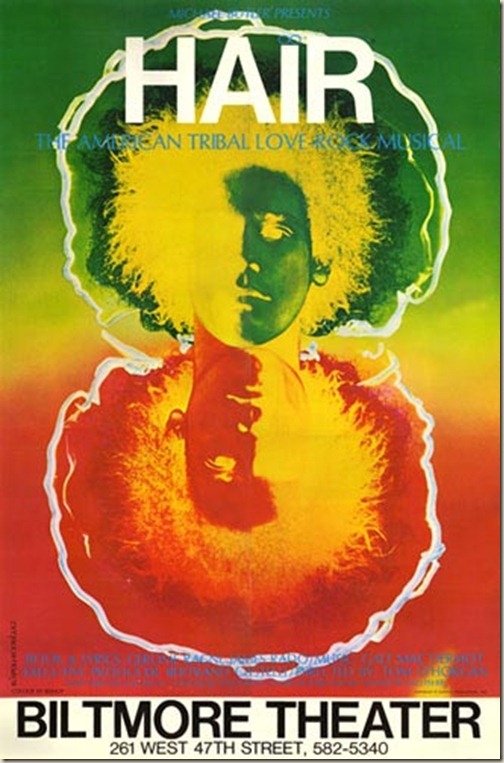
Starting as an off-Broadway music in 1967, Hair opened on Broadway on April 29, 1968 at the Biltmore Theatre in the middle of the theater district. Known for songs like “Aquarius”, “Hair”, “Easy to be Hard”, “Good Morning Starshine”, and “The Flesh Failures” aka “Let the Sun Shine In” as well as it’s nude scene (nudity onstage was legal, but only if the actors were not moving, and this restriction was appropriately incorporated as the actors undressed under a parachute-like fabric and then sang the remainder of the song motionless), this book-less musical (no story) stitches together scenes addressing topics of that day such as hair length, the Vietnam war, race and sexual freedom.
Songs [from Wikipedia]
The score had many more songs than were typical of Broadway shows of the day. Most Broadway shows had about six to ten songs per act; Hair’s total is in the thirties. This list reflects the most common Broadway lineup.
Though generally not a fan of free jazz, I do enjoy the music I have purchased and heard from Cecil Taylor, Ornette Coleman, Don Cherry and Sam Rivers. I also find John Coltrane’s forays into free jazz particularly appealing, but let’s face it, John Coltrane could have made interesting music just playing rising and falling whole tone scales.
There is also a spectrum of free jazz from semi-structured to complete chaos. Eric Dolphy’s Out to Lunch album is the kind of free jazz that I love the most — it has much in common with traditional jazz and it doesn’t sound chaotic or random, but unfolds logically and musically. I am generally a fan of Sun Ra and have no challenges setting aside time to listen to his explorations into free jazz.
As I music major, I listened to hours of the so-called avant-garde including Boulez, Stockhausen, Crumb, Xenakis, and many others. Truthfully, I like this type of music better than much of what is played today on the top 40 radio stations, but not by a lot. My interest in second-half twentieth century classical music gravitated towards composers like Oliver Messiaen or the minimalists, like Philip Glass.
However, listening to a wide range of music expands one’s appreciation for music in general and listening to the so-called avant-garde, aleatoric (music based on chance), or free-jazz expands one’s ability to listen fully and comprehensively. I once spent a little bit of time around John Cage in Europe, attending concerts and talking with him, and I learned much about how to listen to and appreciate music, organized sounds, random sounds, and the wide array of sensory input available to us. I do enjoy hearing the rain against the house, or the sounds of wind in a forest or the music of the ocean when out on the deck of a ship. And the beauty of music is not only determined from the labor and skill of the composer, but from the skill of each and every once of us to organize the sounds we perceive into a meaningful experience.
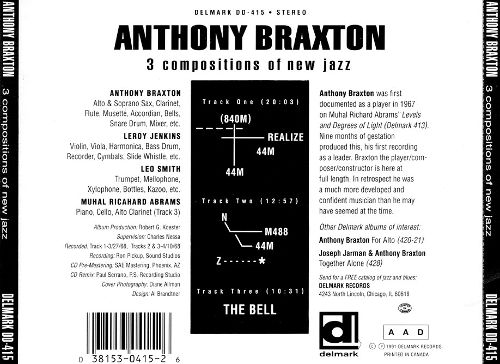
And so, though I prefer Anthony Braxton’s occasional excursions into standard jazz over his completely free jazz recordings, I still respect the talent and the skills he applies to free jazz, starting with his very first album as a leader, 3 Compositions of New Jazz, recorded in March and April 1968. And I still value the part I personally play in making a coherent, and hopefully, enjoyable or even uplifting experience, when listening to this or any other work of music.
And there is a lot of talent and skill that has gone into the three tracks on 3 Compositions of New Jazz. The variety (wide arrange of sounds, textures, and instruments employed by the four musicians) and the thoughtful quality of the music, makes this worthy of an initial listening, even if you then set it aside for a decade or more — or never pick it up again. What works best for me, is the second track on side two, Ishmael Wadada Leo Smith’s “The Bell”, which I find attractive for its purity and beauty. And in general, I particularly like Leroy Jenkins violin and viola playing throughout this album.
Am I impressed by how Braxton and team abandon conventionality and move forward with bold freedom? Not so. Braxton was twenty-three when this was recorded, and such youthful musical courage is not unexpected. What is unexpected is the amount of variety, artfulness, and ability to make such unstructured music work and hold one’s attention.
Do I recommend this? Not necessarily. There are plenty of other jazz and even free-jazz albums I find more appealing. Is this of historic importance? Perhaps. It is noteworth for its place in the musical landscape of 1968 and its blend of what is very much a John Cage approach with jazz music, but I suspect the history of free jazz would have been much the same if Delmark had shelved this album and failed to release it until forty years later.
Music is never completely driven by chance, unless it is generated by chance and performed by a computer, and this music, even with the following of the simple diagrams provided to the musicians for the first two tracks, is less about chance and more about musical and spiritual expression without the confinements of a set sequences of chord changes, a verse and chorus or other melodic framework, or recurring rhythmic patterns. What is of interest here is just as engaging and potentially captivating as sitting outside of Penn Station in New York and watching hundreds of people a minute go on their way to work, listening to the birds sing in the forest, or listening to strangers’ conversations on a bus, subway, or in a restaurant. It’s certainly better than listening to most radio talk shows, watching most youtube videos, or being bombarded repeatedly by some of the popular music of today or even some of the lower-quality popular music played on AM radios fifty years ago.
Track listing [from Wikipedia]
All tracks written by Anthony Braxton, except where noted.
#
Title
Length
1
“(840m)-Realize-44M-44M (Composition 6 E)”
20:03*
2
“N-M488-44M-Z (Composition 6 D)”
12:57*
3
“The Bell” (Leo Smith)
10:31
*These first two tracks are graphically titled. This is an attempt to translate the title.
Recorded at Sound Studios, Chicago, IL on March 27 (track 1) and April 10 (tracks 2 & 3), 1968
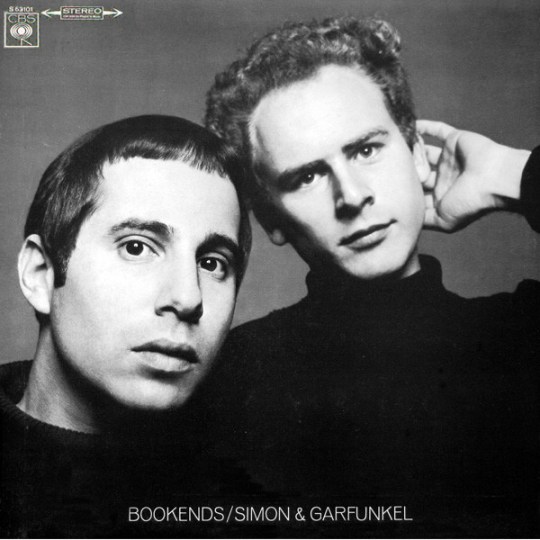
Released on April 3, 1968, it wasn’t until summer of 1968 that I first heard this album. My sister had left it out on the top of my dad’s large mono hi-fidelity set, and alone in the living room, I took the record sleeve out of the outer cover and the vinyl contents out of its record sleeve, put it on the only quality turntable in the house, and one of the better ones on the block, turned on the machine, guided the tonearm to the beginning and while still standing in front of the hi-fi, became totally ensnared by this work of musical art.
The album opens with a solo acoustic guitar prelude intimating that this is not going to be just a collection of songs, but something more – an organized musical statement. The second track, with Moog synthesizer setting the general ambiance, and thick reverb and choir providing the texture, is dark and grey, much in keeping with the black and white cover, and sets an encompassing atmosphere of bleakness, alienation and separation which carries on even through the last, more upbeat, song of the album.
This is very much Paul Simon’s Sgt. Peppers album — a concept album without a concrete concept, establishing coherence and a unified whole based on the quality of the songs, their arrangements, and, even going further than Sgt. Pepper, on a consistency of style in both the music and lyrics. There is a deep seriousness in this music far beyond the previous Simon and Garfunkel albums: the music is shadowy and gloomy but rich in textures and images similar to some of the more detailed and complex art-deco black-and-white photography such as one of Edward Striochen’s photos as shown below:
“America”, “Hazy Shade of Winter”, and “At the Zoo” may be uptempo and full of rhythm and the essence of rock music — listen to Yes’s flashy, kaleidoscopic realization of “America” — but these are inherently dark compositions with all intrusively brighter colors filtered out to expose the true underlying monochrome content. Should I venture to compare this album general effect to one of Mahler’s works? Perhaps there is merit for such a comparison, but these tracks belong to 1968 not to a time eighty years earlier, and the most appropriate comparisons are to music of 1968. Like Sgt. Pepper’s, this album could not have been made with the normal limitations placed on studio time for most rock artists. Thankfully, Simon and Garfunkel had a clause in their contract specifying the label’s obligation to provide the necessary funding for the studio time, and the duo took advantage of this with hours and hours spent on perfecting the final product with multiple takes and significant dollars spent on that studio time as well as money spent on the incorporation of additional instruments and the musicians playing them.
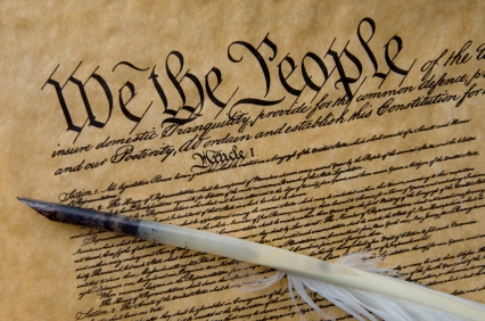
April 4, 1968, was a day of great tragedy: the assassination of Dr. Martin Luthor King Jr. Further tragedy followed with rioting and violence across 125 cities that took the lives of 39 people and injured many, many more. As with so many tragedies, good followed including the passage of the previously stalled Civil Rights Act of 1968 which now made it federal crime to “by force or by threat of force, injure, intimidate, or interfere with anyone … by reason of their race, color, religion, or national origin” as well as directly addressing an area where millions had previously been treated unfairly by being “the first effective law against discrimination in the sale and rental of housing in the United States of America” making fair housing “the unchallenged law of the land.” For this reason, the Civil Rights Act of 1968, is also known as the Fair Housing Act.
Mr. Backlash, Mr. Backlash, Just who do think I am? You raise my taxes, freeze my wages And send my son to Vietnam. You give me second class houses And second class schools. Do you think that all the colored folks Are just second class fools? Mr. Backlash, I’m gonna leave you With the backlash blues. When I try to find a job To earn a little cash All you got to offer Is your mean old white backlash But the world is big Big and bright and round And it’s full of folks like me Who are black, yellow, beige and brown. Mr. Backlash, I’m gonna leave you With the backlash blues. Mr. Backlash, Mr. Backlash Just what do you think I got to lose? I’m gonna leave you With the backlash blues You’re the one will have the blues Not me, just wait and see.
Dr King’s voice was never silenced — it lived on the the memories of the many that heard him and lives on today in recordings and videos readily available all over the internet — and Dr. King inspired many others to speak out on the necessity of equal opportunity and freedom for all — a work that is very much still in progress today.
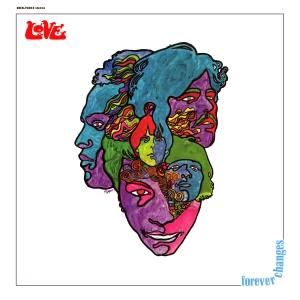
This is an album that was pretty much ignored in November of 1967 when released on the Elektra label. This is the third and final album of a Los Angeles based group called “Love”, though this really is mostly the work of Arthur Lee, singer/songwriter/guitarist, with a couple of songs contributed by Bryan MacLean, another member of the group, the rhythm guitarist, who provides leads vocals on compositions.
From the start, with it’s acoustic opening, there is an intimacy to the album with its well-crafted and fresh-sounding arrangements. There are elements of the west-coast rock sound of 1967, folk-rock, and interestingly, English rock: it shares some characteristics found in the 1967 Moody Blue’s “Days of Future Passed”, Genesis’ 1969 album “Genesis to Revelation” as well as sharing some stylistic traits with The Who and The Kinks. That said, this is an original, very much non-derivative album that holds up well under repeated playings.
Hailed by some as one of the great masterpieces of 1967, this is an album that anyone that loves late sixties rock or loves what is often called “proto-prog” should check out, even if it doesn’t end up being one of your top 10 or even top 40 albums of 1967.
First and most important: Happy Birthday, John Birks “Dizzy” Gillespie. Born one hundred years ago, on October 21, 1917 and blessing us music lovers with his presence until Jan 6, 1993, leaving a catalog of excellent to must-listen-to music for many generations of listeners.
I was lucky enough to see him live in Oslo, Norway in 1978 and hear him and his group play “Night in Tunisia.” He was personable, relaxed, and loved being in front of a small auditorium of very attentive listeners. The music was excellent and the time raced by. At the end, I realized how lucky I was to get a ticket that very evening an hour or two before the performance, and thus be able to witness such amazing music. I am also thankful that I had a friend, who earlier, in California, had persuaded me to go with him to listen to jazz artists like Sonny Stitt and Milt Jackson, leading my onto the path of developing my love for bebop.
You see, Dizzy was one of the founding fathers of bebop, along with other giants like Charlie Parker, Thelonious Monk, and Bud Powell. The recordings he made in the 1940s with Charlie Parker are essential listening, and are as an important part of musical history as the premiere of Stravinsky’s “Rite of Spring” (aka “Le Sacre du printemps”), Alban Berg’s two amazing operas, or the British Invasion and the rise of The Beatles and development of progressive rock.
We are very fortunate that on October 1st, 1967, three sets of music were recorded at the Village Vanguard, the famous jazz New York City jazz club. The Solid State LP includes three tracks, one from each set, with Dizzy, Pepper Adams on baritone saxophone, Ray Nance on violin, Chick Corea on piano, Richard Davis on bass, and, on drums, Elvin Jones on “Dizzy’s Blues”, and Mel Lewis on the other two tracks. Later, Solid State releases two more LPs of material, which Blue Note later releases on CD in a 2 CD set.
This music is not to be missed, the musicians are excellent and the playing is riveting. If you want to sample the first LP released by Solid State, you can find it on youtube:
Track listing (all compositions by Dizzy Gillespie)
Dizzy’s Blues (aka”Birk’s Works”) – 14:30 (This is edited and the complete, nearly eighteen minute version is available on the Blue Note 2 CD set)
“Blues for Max” – 9:10
“Tour de Force” – 9:45 (This is edited and the complete, nearly twelve minute version is available on the Blue Note 2 CD set)
Elvin Jones (on Dizzy’s Blues), Mel Lewis (on “Blues for Max, “Tour de Force”), drums
As great as this music is, I would advise to supplement it with another live album, “Sweet Low, Sweet Cadillac.” The Impulse record label brings together recordings from three different concerts in May 1967, one in NYC and two in L.A. to provide another glimpse of what a Dizzy-led 1967 live performance was like. The playfulness and charm of the master is captured as well as some great music. This is the only recording I have where Dizzy sings, and, though not at the level as the 1967 Village Vanguard recordings, this is a treat not to be missed.
Track listing[from Wikipedia]
All compositions by Dizzy Gillespie except as indicated
This 1967 recording contains two of the most popular Twentieth Century piano concertos, full of energy from one of the brightest classical music stars of the 1960’s, the twenty-six year old Argentine, Marta Argerich. An impressive pianist since her early teens, winning both the Geneva International Music Competition and the Ferruccio Busoni International Competition at the age of 18 within three weeks of each other, Marta teams up with conductor Claudio Abbado and the Berlin Philharmonic to provide a stunning, wild-ride performance of Prokofiev’s Third Piano Concerto. This LP also contains the Ravel G Major Piano Concerto, a work influenced by George Gershwin and the jazz music of the 1920s. What sounds like an inspired, spontaneous work, was a work of intense labor and craftsmanship. Writing music”, noted Ravel, “is seventy-five percent an intellectual activity.”
TRACKS
Serge Prokofieff (1891-1953) Piano Concerto No. 3 in C Major, Op. 26
1. Andante – Allegro
2. Theme and Variations
3. Allegro ma non troppo
Maurice Ravel (1875-1937) Piano Concerto in G Major
1. Allegramente
2. Adagio assai
3. Presto
This is Carlos Paredes first album, yet is is an unquestionable masterpiece. Paredes plays an instrument called the Portuguese guitar, a twelve steel-stringed instrument, popularly used in Fado music (Portuguese folk music) known for its expressive and often wistful qualities. In this album we are treated to both Paredes’ amazing virtuosity as well as his gift for serious composition. Each work displays an individual character and identity and invites repeated listenings. If you don’t usually sample the youtube videos sometimes provided, its worth making an exception here:
Tracks for “Guitarra portuguesa”
Variações em Ré maior
Porto Santo
Fantasia
Melodia N.2
Dança
Canção verdes anos
Divertimento
Romance N.1
Romance N.2
Pantomima
Melodia N.1









 \
\


Written
on June 23, 2018