Zumwalt Poems Online

Archive for the ‘Progressive Rock’ Category

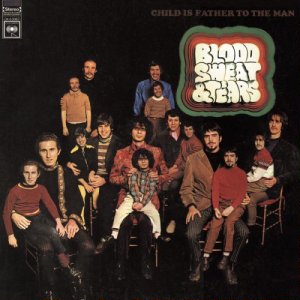
Fifty Year Friday: Tony Scott – Music for Yoga Meditations and Other Joys; Al Kooper, Blood, Sweat & Tears – Child Is Father to the Man
Tony Scott Yoga

As a jazz instrument, the clarinet can excel from the hottest of jazz styles to the coolest and laid back genres of jazz, but there is something inherently cool, soft and tender in the lower and mid range of the clarinet that lends itself particularly well to more impressionistic. more reflective, and more introspective music.   As bebop extended into various flavors of cool jazz, Tony Scott first appeared on the jazz scene recording with Miles Davis and other jazz musicians on three tracks for “Sassy” Sarah Vaughan’s 1950 album, Sarah Vaughan In Hi-Fi. In 1953, he recorded a 10 inch album for Brunswick, “Music After Midnight”, with the music including elements bebop, cool and swing, showcasing the clarinet as well as the talents of now well-known jazz greats, bassist Milt Hinton and drummer Philly Joe Jones, as well as the versatile and gifted pianist Dick Katz.

In December 1959 , Tony Scott visited Japan and recorded some music for a radio program with Yasko Nakashima.  When Tony asked Yasko if she would like to do some improvisation around the scale (set of notes) of the previous piece they had played, she deferred, not having a background in improvising: improvisation not being a component of traditional Japanese classical music.  He then turned to the conductor of the ensemble, Shinichi Yuize, a koto player, who, though, had not previously improvised publicly, was willing to give it a go.  Four years later, in early 1964, during Tony’s last visit to Japan, Shinichi Yuize, shakuhachi artist, Hozan Yamamoto and Tony recorded what many consider the first New Age album, Music for Zen Meditation.

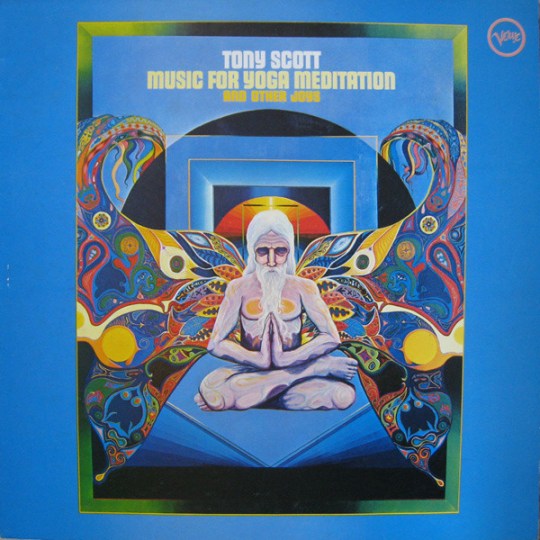
No additional albums appeared to have been recorded or released by Tony Scott, until February 1968, when Music for Yoga Meditation and Other Joys was recorded. American Collin Walcott, student of Ravi Shankar, and later Paul Horn associate and then member of Oregon  plays sitar pairing up with Tony Scott who is on clarinet. This album, with its wide stereo separation and forwardness of the clarinet and sitar,  comes more closely to being New Age material then the 1964 “Zen” album which is more a blend of jazz and true classical Japanese music.

For whatever reason, Verve waited until 1972 to release Music for Yoga Meditation and Other Joys.

Track listing [from Wikipedia]

  1. “Prahna (Life Force)” – 4:15
  2. “Shiva (The Third Eye)” – 5:06
  3. “Samadhi (Ultimate Bliss)” – 4:49
  4. “Hare Krishna (Hail Krishna)” – 6:15
  5. “Hatha (Sun and Moon)” – 3:40
  6. “Kundalina (Serpent Power)” – 4:42
  7. “Sahasrara (Highest Chakra)” – 3:10
  8. “Triveni (Sacred Knot)” – 3:20
  9. “Shanti (Peace)” – 2:48
  10. “Homage to Lord Krishna” – 5:04
  • All music composed by Tony Scott

Personnel

Production

Blood,Sweat&TearsChildIsFathertotheMan

Musician, Producer and songwriter, Al Kooper, put together the first jazz-rock group, Blood, Sweat and Tears, recording Child is the Father to Man in late 1967, with Columbia releasing the album on February 21, 1968.  Though this album is far more pop and rock than jazz, there are some jazz elements, including Randy Brecker on trumpet and flugelhorn supplemented with  saxophone, trombone and an additional trumpet.  Kooper provides the starting point from which the later versions of BS&T evolve, and paves the way for other jazz-rock ensembles like Chicago, Chase and Lighthouse.

Al Kooper departed from BS&T shorted after the release of this album, apparently due to creative differences, with his next project the bluesy jam album Super Session with Mike Bloomfield and Stephen Stills.

Personnel [from Wikipedia]

Blood, Sweat & Tears

  • Randy Brecker – trumpet, flugelhorn
  • Bobby Colomby – drums, percussion; backing vocals (tracks 4, 10)
  • Jim Fielder – bass guitar, fretless bass guitar
  • Dick Halligan – trombone
  • Steve Katz – guitars; lead vocals (tracks 3, 8); backing vocals (tracks 3); lute (track 6)
  • Al Kooper – organ, piano; lead vocals (tracks 2, 4-7, 9-12); ondioline (track 8)
  • Fred Lipsius – piano, alto saxophone
  • Jerry Weiss – trumpet, flugelhorn; backing vocals (track 4)

Additional musicians

  • Anahid Ajemian – violin
  • Fred Catero – sound effects
  • Harold Coletta – viola
  • Paul Gershman – violin
  • Al Gorgoni – organ, guitar, vocals
  • Manny Green – violin
  • Julie Held – violin
  • Doug James – shaker
  • Harry Katzman – violin
  • Leo Kruczek – violin
  • Harry Lookofsky – violin
  • Charles McCracken – cello
  • Melba Moorman – choir, chorus
  • Gene Orloff – violin
  • Valerie Simpson – choir, chorus
  • Alan Schulman – cello
  • John Simon – organ, piano, conductor, cowbell
  • The Manny Vardi Strings

Production

  • Producers: Bob Irwin, John Simon
  • Engineer: Fred Catero
  • Mixing: John Simon
  • Mastering: Vic Anesini
  • Arrangers: Fred Catero, Al Gorgoni, Fred Lipsius, Alan Schulman, John Simon
  • Art direction: Howard Fritzson
  • Photography: Bob Cato, Don Hunstein
  • Packaging: Michael Cimicata

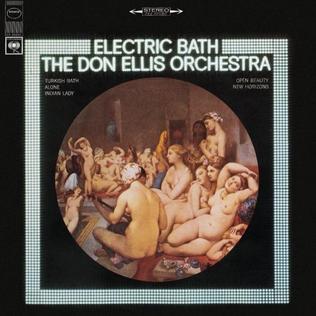
Fifty Year Friday: The Don Ellis Orchestra “Electric Bath”

electric_bath

Is it possible that the first truly progressive rock album was not a rock album, but a jazz album?  For those that adamantly insist that the most adventurous and exploratory rock music of 1967 and early 1968 is really not progressive rock but “proto-prog, such prog fundamentalists often require that any music to be considered true progressive rock must display a relatively high level of musicianship and deploy mixed meter or unusual time signatures, 20th century instruments, a wide range of dynamics and instrumental combinations, effects such as tape loops or use of quarter tones, and extended length tracks painting a colorful, sonically rich landscape.  If we buy into such requirements, then perhaps we should consider this modern big-band jazz album recorded in September 1967 and released either in late 1967 or early 1968, to validly qualify as the first progressive rock album.

In terms of quality and excitement, The Don Ellis Orchestra’s “Electric Bath” should please any “Close to the Edge”, “In the Court of the Crimson King”, “Thick as A Brick”, “Selling England By the Pound”,  “Brain Salad Surgery”. or “Power and the Glory” fan.

A progressive rock album has to start with a fervently vigorous or otherwise bigger-than-life immersive track such as King Crimson’s “21st Century Schizoid Man”, Genesis’s “Watcher of the Skies”, or the opening to ELP’s Tarkus.  “Indian Lady” is just that with its fanfare opening, a meter of alternating 3 and 2,  and a strong distinct theme running relentlessly forward, swinging ferociously with a indisputably bluesy orientation.  We also have sitar, electric piano, and most notably, Don Ellis on a four-valve quarter-tone enabled trumpet.

The second track, “Alone”, by far the shortest at less than six minutes, is a basically a samba, a musical form from Brazil that became so popular in the mid sixties, but in 5/4 time without any sense of awkwardness, but just the opposite, fully liberated and unconstrained.

Ending the first side is the brilliant “Turkish Bath” with sitar and a exotically distorted reeds sounding not so much like instruments from Turkey, but from an even more exotic location, probably from another planet in some remote solar system. Sitar and quarter-tones contribute to the appropriate balance of spices.

“Open Beauty” open side two of the original LP, and provides appropriate contrast and musical reflection.  Elegantly executed by the band, this composition is haunting, surreal and evocative, with ebbs and flows of intensity until a little over two-thirds of the way in when we get a tape-delay Don Ellis solo  which initially echoes with layered fifths and then more adventurously explores into more expressive and polyphonically combative territory.

The last track, “New Horizons” is the strongest, longest and most remarkably inventive of the album with relentless energy driven by a 17/8 5-5-7 pattern with amazing ensemble and solo trumpet passages.  The work unfolds like a story with contrast and subplots ending with explosive energy winding down into an emphatic, punctuated coda.

This album should appeal to anyone that loves adventurous and well-written, arranged and performed music whether their preference is classical, progressive rock, progressive heavy metal, be-bop or big band jazz.

Track listing [from Wikipedia]

All compositions by Don Ellis except as indicated

  1. “Indian Lady” – 8:06
  2. “Alone” (Hank Levy) – 5:32
  3. “Turkish Bath” (Ron Myers) – 10:16
  4. “Open Beauty” – 8:29
  5. “New Horizons” – 12:20
  6. “Turkish Bath” [Single] (Myers) – 2:52 Bonus track on CD reissue
  7. “Indian Lady” [Single] – 2:58 Bonus track on CD reissue

Personnel

Fifty Year Friday: David Axelrod, Electric Prunes and Mass in F Minor

masspapr

In 1967, the previously unknown, recently formed, L.A. band, The Electric Prunes, grabbed public recognition with the quintessential psychedelic top 40 hit,  Annette Tucker’s and lyricist Nancie Mantz’s “I Had Too Much to Dream Last Night.” Soon the Prunes were guests on TV, miming performances to their big hit, and touring the country.

in 1968, the band’s manager Lenny Poncher, their producer Dave Hassinger, and the Reprise Records  management, determined  that the Electric Prunes would record some type of concept album from material provided by producer/composer/arranger David Axelrod.  Axelrod was given the freedom to compose whatever he thought most appropriate, with the hopes of furthering the Prunes’ name recognition.

The final material composed by Axelrod, a psychedelic setting of the Latin Mass, with sections crafted for appropriate freely-expressive, acid-rock improvisation, ultimately required the band to be augmented by studio musicians.  Also, since the band was as much of a commodity (producer Dave Hassinger owned the rights to the name at that time) as individual members, this particular formation of Electric Prunes would soon be replaced by other musicians.

However, we did get a rather interesting, if less than stellar, concept album — a rock mass, a couple of years after Vince Guaraldi’s Jazz mass (see below) and three years before Leonard’s Bernstein’s mass (originally intended to be a modern setting of a traditional mass, but ultimately realized as a stage work.)


Though uneven, this Electric Prune’s Mass in F Minor is worth listening to.  It uses an abbreviated form of the mass, but still has the major sections. The Kyrie Eleison is later included in the film Easy Rider.  The Credo and Agnus Dei are the most interesting. Though most music historians would not classify this as progressive rock, this is, for 1968,  a musically progressive setting of the mass.  Also, this album should get a nod for being a concept album, including symphonic instruments, and some notable guitar work.  One can check out a lower quality audio version on youtube:


Fifty Year Friday: Spirit

51m6df7irtl


Randy California, born Randy Wolfe, was a native Calfornian, born in Los Angeles, but when his step-dad, jazz drummer Ed Cassidy  (the gentleman with the bald head in the left upper portion of their first album cover; a drummer that played gigs with Cannonball Adderly, Gerry Mulligan, Art Pepper, Roland Kirk, and Lee Konitz and was a founding member of  Rising Sons with Taj Mahal and Ry Cooder) had some work lined up in New York City, the family moved to an apartment complex in Queens in 1966.  Randy soon met Jimi Hendrix and then played with Hendrix that very summer  as a member of Jimmy James and the Blue Flames.   It was while they were playing together, that Hendrix started calling Randy Wolfe, “Randy California” and another Randy in the band, Randy Palmer, “Randy Texas.”

Randy Wolfe took the “Randy California” name back west, forming Red Roosters with his step-dad, a band that eventually evolved into “Spirits Rebellious” and then just Spirit. Randy was sixteen years old. Besides Randy and Ed, Spirit included composer, keyboard player and lead vocalist, Jay Ferguson, Mark Andes on bass and backing vocals, (who later played with Ferguson in Jo Jo Gunne in the early 1970s, Firefall in the late 1970’s and Heart in the 1980s.) and John Locke (who later joined Nazareth in the 1980’s) also on keyboards. Randy was still sixteen when Spirit’s first album, “Spirit”, was released on January 22, 1968.

None of the songs on Spirit’s debut album are typical pop songs, most having more of an jazz or a psychedelic or progressive rock ethos, with a prevailing ABA form with the B section being a instrumental, partly improvisational section providing contrast to the more traditional song-like A section. The last track, “Elijah”, due to its extended length, stretches out the ABA concept to a rondo-like form (ABACADAEA) with improvised passages between the recurring theme.

All the tracks on the album are notable, with 9 of the 11  songs written or co-written by Ferguson.  “Elijah” was written by John Locke;  Randy California wrote one of the tracks, “Taurus”, a well-written, nicely arranged instrumental following the Andes/Ferguson song, “Mechanical World”, the only track with single status on the album.

“Taurus” opens up with a orchestral introduction that floats into a soft, relaxing two-part theme which is played twice (this not being one of the tracks with ABA form on the album.)  The striking part of the first half of the theme is its similarity to Zeppelin’s
“Stairway to Heaven.”  The casual listener may very well consider that Zeppelin borrowed Taurus for that beautiful guitar intro in “Stairway”, particularly if  that listener is aware that Zeppelin opened for Spirit in several 1968 concerts, that Zeppelin included material from the first track of the same Spirit album, “Fresh Garbage” in a medley they performed live, that Page is on record as stating that he had owned several Spirit albums, and that there are over a dozen noteworthy cases of  Jimmy Page and Robert Plant “borrowing without credit” material from other artists.

So similar is the connection between “Taurus” and “Stairway” that ultimately in 2014, the estate of Randy California brought a copyright infringement suit against Led Zeppelin. Randy California had drowned in the Pacific Ocean in 1997, at the age of only 45, when swimming into the ocean to save his twelve-year old son from a rip current.  Though giving up his life in the effort, Randy managed to push his son to safety.  Now seventeen years after his death, lawyers for his estate planned to get a co-writing credit for Randy on “Stairway to Heaven.”

Unfortunately, the judge would not allow the jury to hear side-by-side comparisons of “Taurus” and “Stairway to Heaven.” Instead, he only allowed the performance of the two songs on keyboard by a hired musician using as the source the registered sheet music  from the Library of Congress, music that differed from the final version on the recordings. Also ruled inadmissible were expert witnesses that were lined up to talk about sixteen instances of Jimmy Page’s past use of uncredited material, the judge ruling that any past plagiarism, alleged or actual, was not relevant to this particular case in question.  Adding to this was the odd approach and personality of the prosecuting attorney for the California estate, who quickly exasperated the judge and who scored important points for the defense when questioning Page about his being influenced by the Disney/Mary Poppins song ” Chim Chim Cher-ee”.

The jury ruled in favor of the defense, and certainly there are notable differences in the two passages: the “Stairway” melody goes to A at the end of the first chord and then on to B of the next chord while “Taurus”, less remarkably, descends to A and then G#.  If they jury had heard actual recordings, its seems almost certain they would have ruled otherwise.

Personally, I am glad to have both songs as part of our musical legacy and understand how easy it is to come up with the descending chromatic chord progression used in these two songs — something anyone could accidentally discover in the course of composing by hitting sequentially descending notes for their bass line.  I am also sympathetic to how common it is to put together a song based on something one had heard a long time ago and unintentionally brought into their composing process as so clearly happened with George Harrison’s “My Sweet Lord” — just an unintended revisiting of “She’s So Fine.”  In the case with “Taurus”, it seems Jimmy Page had heard that song several times, forgotten about it, started to play with the chord progressions and went in the direction of a recreation of something close to what his subconscious mind was already familiar with.  In my view, a living Randy California wasn’t particularly interested in who got credit, but his descendants, perhaps needing or wanting money, had a greater interest in assignment of authorship.

You can check out the video below for a good explanation of how these two songs are similar (and differ) in their sharing of the passage in question. If you have any thoughts on this Spirit album, or thoughts on the similarities of “Taurus” and “Stairway to Heaven” please don’t hesitate comment.  Also what are some of your favorite albums from 1968?  I know one of mine is still a few months away from being fifty years old, and plan to discuss that if I even if I have lost all my remaining, exceedingly patient readers by then.


Click her for track listing [from Wikipedia]


Fifty Year Friday: Acid Rock, Hard Rock and Heavy Metal

images

Anyone that has unquestioning faith in the definitions in dictionaries, only needs to look up the entry Heavy Metal.

Webster defines Heavy Metal as follows: “Loud and harsh sounding rock music with a strong beat; lyrics usually involve violent or fantastic imagery.”

Merriam Webster defines Heavy Metal as : “Energetic and highly amplified electronic rock music having a hard beat.”

Dictionary.com defines it as “Aggressive and heavily amplified rock music, commonly performed by groups that wear spectacular or bizarre costumes.”

Oxford Dictionary: “A type of highly amplified harsh-sounding rock music with a strong beat, characteristically using violent or fantastic imagery.”

Cambridge Dictionary: “A style of rock music with a strong beat, played very loudly using electric guitars.”

McMillan Dictionary “A type of loud rock music that developed in the 1970s, played on drums and electric guitars.”

Collins provides this definition: “Heavy metal is a type of hard rock (they define hard rock as “a type of very loud rock music with a fast beat.”) characterized by violent, shouted lyrics.”

Since heavy metal bands’ songs, particularly their instrumentals, don’t always have violent lyrics and the band’s vocalists usually sing rather than shout the lyrics (except for some specific subgenres such as Thrash and Metalcore), this brings into question the trustworthiness of the Collins definition.  We can also question McMillan’s and Cambridge’s definitions requiring electric guitars as there are a few lesser known groups that don’t include guitar and given the capabilities of electronic keyboards, there is no technical or musical reason why a heavy metal band requires a guitarist to competently and effectively play heavy metal.

If one considers heavy metal as a style of music, than lyrics and costumes become additive, and thus the Webster and dictionary.com definitions are problematic. Merriam Webster’s  “Energetic and highly amplified electronic rock music having a hard beat.” is the most inclusive definition, overly-inclusive by a wide margin, and embraces many songs of hard rock, techno, 1980’s dance bands, progressive rock, jazz-rock, and on and on.

And what about ballads? Many well-known heavy metal bands often include one ballad on their albums, some of these songs being poignant, plaintive or wistfully reflective.  These songs are neither loud nor harsh and though sometimes they are in fairly strict  tempo, the beat is rarely the dominating component.

Given these definitions we don’t have a chance of identifying when the first heavy metal songs were written or what was the first heavy metal bands.

And if we go with various self-proclaimed experts on heavy metal we encounter a variety of viewpoints with many conflicts — some consider Deep Purple and Led Zeppelin heavy metal, others indicate they are not even close but are just hard rock groups. Some require heavy metal bands to have complex, classically-influenced musical material, but there is a problem with such a characterization when examining some of the groups or songs in various top 10 lists including this Rolling Stones’ readers’ poll of the top 10 metal bands of all time.   It seems that if heavy metal has a definition, it should come from the fans and musicians.

So without a guiding definition, and having experienced first hand the evolution that took place from the early British Invasion rock groups through the advent of psychedelic rock, acid rock, hard rock, progressive rock and what are the first somewhat-agreed-upon (but far from consensus) heavy metal bands, I think I am as unqualified as anyone else to make a few observations.

We noted in an earlier post that “Hapshash and the Coloured Coat” included the term “heavy metal kids” in their 1967 album.  This did not have anything to do with music but was borrowed from William Burroughs 1961 novel The Soft Machine’s describing the character Uranian Willy as “the Heavy Metal Kid” — a reference to the final stage of drug addiction, which in Burroughs’ words “is not so much vegetable as mineral.”

It’s also necessary to put into context the term “heavy metal thunder” used in Steppenwolf’s “Born to Be Wild” written by Mars Bonfire. Mars (Dennis Edmonton, born Dennis Eugene McCrohan) originally wrote this song as a ballad, perhaps when he was with the Sparrows, the group that more-or-less evolved into Steppenwolf in 1967.  Steppenwolf, now without Mars as a band member, modified and recorded the song as an up-tempo rocker, but without any intent for the phrase “heavy metal thunder” to reference any genre of music. (“I like smoke and lightning, heavy metal thunder, racing with the wind, and the feeling that I’m under.)

It’s possible that the use of the term heavy metal to identify a style of music had some connection to a recognition of the appropriateness of the name of Iron Butterfly and their equally appropriately named debut album, “Heavy” — with the “heavy metal” label solidified by the unabashedly unapproved, one-upmanship upgrade of Iron Butterfly’s name by Led Zeppelin.   Or perhaps it was partly a nod to the metal strings of the electric guitar. Clearly the term “heavy” was in common use at this time and could mean either “profound” (“that’s one heavy concept, man…”), serious, or intense.  Heavy metal, when considering its original meaning and usage, can arguably be interpreted to just mean “intense rock.”  If one, even slightly, gives this definition some due, one must consider Jimi Hendrix’s first album, recorded in late 1966 and early 1967, and released in May of 1967, to have at least two heavy metal tracks with “Fire” and, what some people do acknowledge as the first heavy metal song ever, “Purple Haze.”  Cream’s second album, recorded in May 1967, includes a couple of candidates also with “Tales of Brave Ulysses” and the generally melodic, but forceful “Sunshine of Your Love.”  And there are notable heavy metal elements in the “Who Sell Out” including some of Pete Townshend’s guitar work, the use of power chords, and Keith Moon’s aggressive percussion technique.

All that said, there is no evidence that the term “heavy metal” was yet being used to refer to a style of music at the start or by the end of January 1968.  Nonetheless, we do find bands recording in 1967 that specialized or focused on a harder, more aggressive sound, some of them blues-based, some of them more inventive and capable of greater range in their harmonic vocabulary.  Generally these early bands were not very good.  This reminds me of a conversation I had with a good friend who thought little of Led Zeppelin.  “There’s a lot worse bands”, was my reply to his summarily dismissing the group.  “That’s a scary thought,” was his reply.  And, I guess, even scarier still, is that one can say that they are not too impressed by the debut albums of Californian bands Blue Cheer, Iron Butterfly or Steppenwolf that were released in January of 1968, and my reply would be “there’s a lot worse albums” — and I would grant you the right to counter with “that’s a particularly scary thought” and have no more rebuttal than I had when my friend made that comment decades ago about Led Zeppelin.

Nonetheless, if one accepts the dictionary definitions of Heavy Metal we do find that these three albums released in January 1968, San Francisco’s Blue Cheer’s Vincebus Eruptum (quasi-Latin which I leave open for your interpretation as the best as I can make out is something like “The eruption’s conquest”), San Diego’s Iron Butterfly’s Heavy , and L.A. area band, Steppenwolf’s Steppenwolf, qualify as either early heavy metal or a predecessor to heavy metal music.

Of these three albums, the strongest and most musical is the Iron Butterfly debut.  Unfortunately there is little of lasting interest in the self-titled Steppenwolf album, outside of the AM radio hit, “Born to Be Wild”, the respectable “Everybody’s Next One”, and the interesting, emphatic arrangement of Hoyt Axton’s “The Pusher.”  Blue Cheer’s Vincebus Eruptum, mostly blues-based, also has some moments, particularly with the guitar work and drumming (which on the last track is much like a homage to how Keith Moon would sound leading a marching band.) With its rough, unbridled, and somewhat uneven musicianship,  this Blue Cheer album serves well as a case-study of 1960’s garage rock as well a foreshadowing of punk, stoner rock and grunge.

But one thing was clear, with these three albums the heavy-metal genie was out of the bottle (Geniebus Eruptum, if you will) and bands as diverse as Led Zeppelin, Black Sabbath, Deep Purple, and later groups like Metallica, Nirvana and Dream Theater would be beneficiaries of this first wave of higher atomic-numbered, more intensive rock.

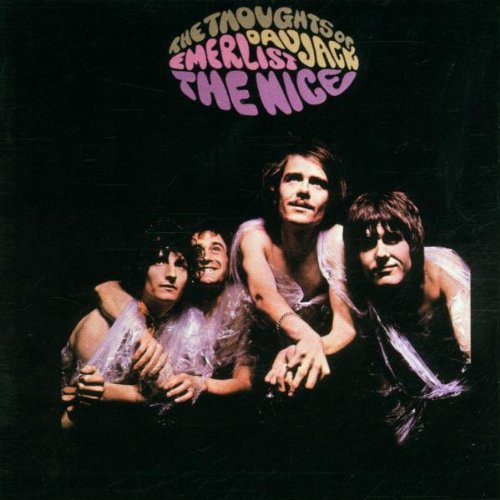
Fifty Year Friday: The Nice “The Thoughts of Emerlist Davjack”

Recorded around October 1967 and released sometime in 1968 between January and March (as best as I can determine), this aggressively adventurous album effectively fuses elements of psychedelia, acid rock, jazz and classical music, establishing this in many progressive rock fans’ mind as one of the first true progressive rock albums.

The first track, “Flower King of Flies” is not inherently different than early Pink Floyd, except perhaps for the level of unbridled energy present, and the second song, the title track, is basically a bubbly, upbeat pop tune, performed , once again with unusual energy and a high level of musicianship.  The third track, though, borders on the harder edged rock often provided by the early blues-based metal bands; there is rugged guitar work and precise, yet perfectly spontaneously-sounding, organ work from Keith Emerson.

It isn’t until the fourth track, a 4/4 arrangement of Dave Brubeck’s mostly 9/8 “Blue Rondo à La Turk”, dominated by the acid-rock, Hammond organ work that is the centerpiece of this instrumental, that the album falls more into the progressive rock realm. Included are glissandos, a J.S. Bach toccata reference , controlled distortion, and a climatic building towards the recap (the Brubeck Rondo theme), which frenziedly finishes the last ninety seconds, maintaining a perpetual, inexhaustible torrent of energy.

“War and Peace” opens up the second side with a level of focus and direction more typical in straight-ahead jazz than expected of a sixties’ rock group. With the exception of Jimi Hendrix and, perhaps, Cream, this is the closest that anyone gets to the soon-to-be-prevalent heavy metal sound in a 1967 recording, notwithstanding a quote of a Bach Brandenburg concerto.

“Tantalizing Maggie” continues along the hard-rock, nearly heavy-metal frame of mind, with a modulating, exploratory, instrumental, B section that gives way to a modified recap of the A section with classical references that finish the piece.

“Dawn” straddles the line between an avant-garde concert piece and sixties psychedelia,  with sprinkled fragments closer to free jazz and baroque classical than to rock music.

The last track, “The Cry of Eugene”, is a beautiful ballad laced with elements of both psychedelic rock and the concert hall providing a suitable close to a varied, interesting, and well-executed album.  Emerson may be the standout here, but Jackson, O’List, and Davison all contribute significantly with energy and passion.

CD versions of the original LP include additional material with some releases including alternative versions of tracks as well as Nice’s rendition of Leonard Bernstein’s America, an essential for progressive rock lovers.

LP Track listing [from Wikipedia]

Side one

  1. “Flower King of Flies” (Keith EmersonLee Jackson) – 3:19
  2. “The Thoughts of Emerlist Davjack” (Emerson, David O’List) – 2:49
  3. “Bonnie K” (Jackson, O’List) – 3:24
  4. “Rondo” (Dave Brubeck, Emerson, O’List, Brian Davison, Jackson) – 8:22

Side two

  1. “War and Peace” (Emerson, O’List, Davison, Jackson) – 5:13
  2. “Tantalising Maggie” (Emerson, Jackson) – 4:35
  3. “Dawn” (Davison, Emerson, Jackson) – 5:17
  4. “The Cry of Eugene” (Emerson, Jackson, O’List) – 4:36

Personnel

emerson_3593551k1

Fifty Year Friday: The Who Sell Out

blog_the-who-sell-out-lp

“Power pop is what we play—what the Small Faces used to play, and the kind of pop the Beach Boys played in the days of ‘Fun, Fun, Fun‘ which I preferred.” Pete Townshend (1967)

Somewhere in the mid sixties, rock and roll was replaced with rock.  The rock and roll music of the fifties, primarily based on blues and variations of blues chord sequences, slowly was overshadowed by music that was more message and substance oriented. The Beach Boys classic “Fun, Fun, Fun”, and the 1967 masterwork “Good Vibrations” is clearly Rock and Roll. The Beatles’ “Lucy in the Sky With Diamonds” is clearly rock.  I don’t recall the year, but sometime in the late sixties, I started correcting my dad when he referred to rock music as “rock ‘n roll” — I disdained Rock and Roll as a relic and lower form of music,  and loved Rock for its broad musical diversity and, for the best of it, it’s reach beyond dance music to serious listening music.

The Who, part of the British Invasion, deviated from what was pretty much a rock and roll group in 1965, opening their first album “My Generation” with “Out in the Street” immediately followed with James Brown’s “I Dont’ Mind” and songs like “The Good’s Gone”,  “La-L-La Lies”, “Please, Please, Please”, “It’s Not True”,  and Bo Diddley’s “I’m A Man. ” However, like the Beatles, there were significant forays into a newer musical expression as hinted in “A Legal Matter” and in the instrumental “Ox.” By their second album, we get true rock pieces like John Entwistle’s classic “Boris the Spider.  By the third album, “The Who Sell Out”, an imaginative concept album that includes commercials interspersed throughout, mocking the format of commercial radio stations, The Who are a seasoned rock group writing and performing rock compositions, making use of such “power pop” chord progressions, modulations, and power chords (chords structures found in earlier Who songs such as”My Generation” and “Boris the Spider” — chords that just have the root and fifth — this not only omits the note that provides the major or minor quality of a traditional triad, but produces a simpler harmonic footprint producing an especially powerful effect when played loudly) that create a sound that is easily identifiable as the sound of The Who.  This is not the power pop of rock and roll, but power pop that is part of the new rock music movement.

The album opens strikingly, and aligning with it’s wanton-commercialism concept, with a jingle followed by John “Speedy” Keen’s (a friend of Who main songwriter and guitarist Pete Townshend) “Armenia, City in the Sky” — starting out much like a radio ad, lyrically, with “If you’re troubled and you can’t relax” but soon followed with more mind-altering-like lyrics and with a 1967 psychedelic and imaginatively crafted arrangement including backwards french horn bursts and various guitar effects.

“Mary Anne with the Shaky Hand” is both melodically appealing and lyrically bold (“Mary-Anne with the shaky hands — what they’ve done to a man, those shaky hands.”) Musically, “Odorono” is even more notable, forging towards the musical style perfected on their next album and yet done as a deodorant jingle.  If one doubts the genius of Pete Townshend to align music and lyrics without compromising either, this is prima facie evidence of his capabilities, as is the track that follows: “Tattoo” a tune that could work very well as jingle for the Tattoo industry.

“Our Love Was” is an ethereal gem, maintaining energy and vibrancy to the end, with Entwistle’s French Horn providing just one of many elements that make this arrangement special.

The Who’s 1967 hit, and arguably the best song of the album, if not of Townshend’s career, is “I Can See for Miles”, punctuated perfectly by Keith Moon’s drums and cymbals.

The second side, is also excellent and includes  “I Can’t Reach You”, “Relax”,  Entwistle’s chromatically-flavored, organ-accompanied “Silas Stingy”,  the beautiful “Sunrise” and the Who’s second miniature rock opera, “”Rael (1 and 2)”, even shorter than their first mini-rock opera, “”A Quick One, While He’s Away” on their previous album.

Released in the UK in December 1967 and the US on Jan 7th, 1968, some of the musical techniques employed in “The Who Sell Out” will be more fully explored in their 1969 full-length rock opera,  “Tommy”, which also further develops  musical material in the songs “Sunrise” and “Rael.”  Though this album was only marginally successful in the US when first released, climbing no higher than the 48th spot on the Billboard album chart, perhaps due to its unusual jingle-based concept, it is one of the best albums of 1967, music that should be explored by those looking to better understand the history of rock (as opposed to  rock and roll) or just looking for some well written, enjoyable power pop music.

Track listing and song credits

Last week’s Fifty Year Friday


Fifty Year Friday: Decca Panoramic Sound, Deram; Moody Blues “Days of Future Passed”

91e2plus49l-_sl1500_The listener of recorded music of the first six decades of the twentieth century will notice the leaps in improvement of recordings over those decades.  And though the sound improvements that took place in the sixties were not as dramatic as those before, progress did continue in creating more realistic and/or more engaging recordings.

Decca recording engineers experimented with ways of improving stereo recordings. They created a technique called “Decca Panoramic Sound” which created more depth and sound positioning.  Previously,  stereo recordings of jazz, folk and rock albums usually ended up with some music on the right channel, some on the left and some in the center (for example, the Beatles’ stereo version of Rubber Soul or Revolver.)  This not only made the music sound artificial but created a sense of detachment of parts from a natural whole.   With “Decca Panoramic Sound” or Deramic sound, for short, a more natural representation of a performance was possible, achieved primarily through a pairing of four-track tape recorders (later replaced by a true 8 track recording set-up) allowing engineering techniques that could place the content of any track at virtually any point of a left-to-right sound field.

Decca then launched Deram Records to realize this potential for rock, folk and easy-listening recordings.  In October 1967, six easy listening albums (“Strings in the Night, “Brass in the Night”, etc.)  were released using this new approach. Soon afterwards, as Deram continued to sign more interesting artists, in November 1967, Deram released the orchestra-backed, ambitious album Days of Future Passed by the Moody Blues.

Originally, the story goes, the Deram’s intent was to have the Moody Blues record a version of Dvorak’s New World Symphony.  Fortunately, the band had more interest in  their own original material and recorded what some people consider to be the first progressive rock album ever and others consider to be the first true rock concept album. (For those that read the post on Nirvana’s Simon Simopath’s concept album, although Nirvana’s album was released a month earlier, The Moody Blue’s album’s first session occurred in May 1967, two months before Nirvana’s recording session for “Simon.”  In terms of determining what is progressive rock, that is perhaps a topic for another post.)

Though basically an album of the psychedelic era, with its mellotron, tambura, sitar, spoken poetry,  pastoral, mellow musical elements, colorful lyrics, symbolic use of a single day to represent a higher abstraction, and psychotropically-flavored album cover, this is also album that blurs the boundaries between rock and classical music, which along with its use of a song cycle on the life of a given day, high quality music, and musical coherence creating a sense of a single work as opposed to a set of songs, establishes this is a work with more than just a commercial objective:  a work with an artistic purpose — a common characteristic found in these musically progressive albums of 1967.

Side 1: The Day Begins 5:45; Dawn: Dawn Is A Feeling 3:50; The Morning: Another Morning 3:40;  Lunch Break: Peak Hour 5:21

Side 2: The Afternoon: Forever Afternoon (Tuesday?) 8:25; Evening: The Sun Set: Twilight Time 6:39; The Night: Nights In White Satin 7:41

More complete track listing from Wikipedia

Musicians

The Moody Blues:


Fifty Year Friday: Far Out 1967, Part Two

10-sun-ra-w710-h473

If one is looking to highlight the best representation of “Far Out” in jazz music, one may very well settle with placing the spotlight on musician and philosopher Sun Ra, more formally known as Le Sony’r Ra.

Born in Birmingham, Alabama in May 1914 with the more mundane name of “Herman Poole Blount”, and early on nicknamed “Sonny”, Sun Ra was a precocious and highly intelligent child soon writing his own compositions at the age of twelve as well as exhibiting good sight reading skills and piano technique.  Living in Birmingham,  he was able to hear many famous bands and jazz artists including Fletcher HendersonDuke Ellington, and Fats Waller.  It is said that Sun Ra, much like other gifted musicians like Wolfgang Mozart, had the ability to hear a single performance (in this case a big band performance) and then later accurately transcribe the music that had played.  He attended college for a year on a scholarship as a music education major, but dropped out: according to Sun Ra this being due to an extra-terrestrial  experience as initiated by aliens.

In Sun Ra’s own words: “They wanted me to go to outer space with them. They were looking for somebody who had that type of mind. They said it was quite dangerous because you had to have the perfect discipline. I’d have to go up with no part of my body touching outside of the beam….It looked like a giant spotlight shining down on me, and I call it ‘transmolecularization’ — my whole body was changed into something else…. I call that an energy transformation because I wasn’t in human form. I thought I was there, but I could see through myself.

“Then I landed on a planet I identified as Saturn. First thing I saw was something like … a long rail of a railroad track coming out of the sky, … then I  found myself in a huge stadium, and I was sitting up in the last row, in the dark… They called my name, and I didn’t move. They called me name again, and I still didn’t answer. Then all at once they teleported me, and I was down on that stage with them. They wanted to talk with me. They had one little antenna on each ear. A little antenna over each eye. They talked to me. They told me to stop [my college music teacher training] because there was going to be great trouble in schools. There was going to be trouble in every part of life….”

After leaving college, Sun Ra formed his own band, “The Sonny Blount Orchestra”, with intense rehearsals only surpassed by Sun Ra’s own committment to music. When drafted in 1942, Sun Ra declared himself a conscientious objector, ultimately ending up performing alternative civilian service, assigned to forestry work during the day and played the piano at night.

In 1945 he moved to Chicago, part of the wave of migration of American slave descendants from the south to the north and got a job arranging for Fletcher Henderson in 1946. He also had work accompanying Billie Holiday and played in a trio with saxophonist Coleman Hawkins and violinist Stuff Smith.

In 1952, Sun Ra forms a “space trio” and changes his name to “Le Sony’r Ra” — the trio later becoming an orchestra, the Sun Ra Arkestra, as he starts to simply refers to himself as Sun Ra.  In 1957, he and his friend and business manager, Alton Abraham, establish the “Le Saturn Records” label, perhaps the first African-American record label. From 1957-1966, album after album is released, with well over one hundred albums recorded during Sun Ra’s career.  Sun Ra’s catalog displays a wide range of musical styles.  Some notable titles include the 1957 release, “Super-Sonic Jazz” with some particularly unusual albums in the mid-sixties, including not only his free-jazz or more exotic material, but even more accessible albums like  “Impressions Of a Patch Of Blue” with Walt Dickerson, and the Sun Ra Blues Project’s “Batman and Robin”, both from 1966.

Less accessible, and one of his furthest-out albums, is his LP, “Strange Strings”, recorded in 1966 and released in 1967.

The first track “Worlds Approaching”, is brilliant — one of those original works that defy categorization: structured, somewhat tonal, dramatic, and ablaze with intensity and energy. This is music that might have really come from Outer Space!

The second track of the first side “Strings Strage, and the entire second side, “Strange Strings”,  share common ground with some of the “concert hall” aleatoric music (music that incorporates elements of chance) of the 1950’s and 1960’s. Basically, after assembling the widest and wildest variety of string instruments  including UkulelesMandolinsKotosKoras, Pipas and any other string instruments that could be located, supplemented by a sheet of metal, and miked “sun columns” (golden metal tubes with rubber bottoms), Sun Ra assembled his orchestra, the Sun Ra Arkestra, distributed the instruments, and told his musicians: “You’re playing from ignorance–it’s an exercise in ignorance. We’re going to play what you don’t know and what you don’t know is huge”, both acknowledging their lack of training and experience in playing these instruments and instructing them to perform music representing their general metaphysical ignorance.

It’s clearly music that would be more interesting to experience live than on an LP or CD.  It’s noteworthy that these are talented musicians, experienced in free jazz expression, and guided during the performance by some direction from their leader. It’s also particularly interesting that no effort was made to tune these instruments and so the result is extreme microtonal free jazz.

From a historical perspective, it’s important to acknowledge Sun Ra’s role in Afrofuturism and in asserting his own and others’ civil rights.   Groundbreaking individuals like Sun Ra and George Russell extended the role of the African-American jazz musician from on-demand performers to innovators, thought leaders and philosophy- artists.

Track listing [from Wikipedia]

12″ Vinyl

All songs by Sun Ra
Side A:

  1. “Worlds Approaching”
  2. “Strings Strange”

Side B:

  1. “Strange Strings”

Musicians

  • Sun Ra – electric piano, lightning drum, timpani, squeaky door, strings
  • Marshall Allen – oboe, alto saxophone, strings
  • John Gilmore – tenor saxophone, strings
  • Danny Davis – flute, alto saxophone, strings
  • Pat Patrick – flute, baritone saxophone, strings
  • Robert Cummings – bass clarinet, strings
  • Ali Hassan – trombone, strings
  • Ronnie Boykins: bass viol
  • Clifford Jarvis – timpani, percussion
  • James Jacson – log drums, strings
  • Carl Nimrod – strings
  • Art Jenkins – space voice, strings

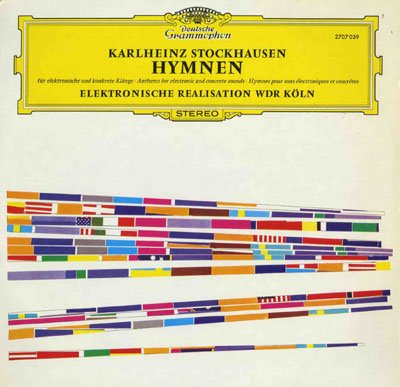
One of the leading modern composers during the 1960s and 1970s, Karlheinz Stockhausen is one of the fifty-plus people displayed on the Beatles Sgt. Pepper’s cover, and the only musician or composer on the landmark cover besides the Beatles and Bob Dylan.

One of his most notable works, is “Hymnen”, a nod to various national anthems (it is divided into four “Regions” each corresponding to a national anthem) and was first performed on November 30, 1967. It must be a challenging work to listen to live; it is long and comes across as somewhat random: it is particularly challenging to listen to a recorded version.  The work consists of a recorded backdrop (tape) which the musicians interact with by improvising and following scored cues provided by the composer.  It is claimed to be a masterpiece by some, but like many of the products of this period created by Stockhausen and his fellow composers, it relies heavily on what the listener brings to the experience.  In a concert hall, with one being part of a seated (captive) audience, one is much more likely to engage with the music than if one puts on an LP or CD of this work.  For me, it’s hard to listen to more than twenty or thirty minutes without feeling compelled to switch to something else, particularly when having a fairly large music library of more accessible music.

Hymnen

Hymnen Recordings

  • youtube (Hymnen Elektronische und Konkrete Musik. Deutsche Grammophon DG 2707039 (2LPs). Reissued on CD as part of Stockhausen Complete Edition 10)
  • BBC Broadcast 2009  and 2016
  • Ausstrahlungen: Andere Welten: 50 Jahre Neue Musik in NRW. Koch / Schwann 2-5037-0 (2 CDs). Includes Hymnen: Dritte Region mit Orchester Radio-Symphonie-Orchester Köln conducted by Peter Eötvös (recorded 1979)
  • Hymnen Elektronische und Konkrete Musik; Hymnen Elektronische und Konkrete Musik mit SolistenAloys Kontarsky (piano), Alfred Ailings and Rolf Gehlhaar (amplified tamtam), Johannes G. Fritsch (electric viola), Harald Bojé (electronium). Stockhausen Complete Edition: Compact Disc 10 A-B-C-D (4 CDs)
  • Hymnen Elektronische Musik mit Orchester. Gürzenich-Orchester der Stadt Köln, conducted by Karlheinz Stockhausen. Stockhausen Complete Edition: Compact Disc 47.

01

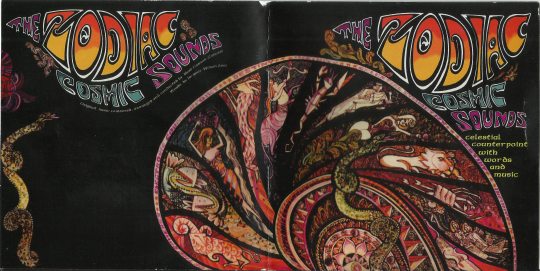
There’s no shortage of far-out pop/rock albums in 1967.  In May 1967, Elektra records releases this narrative concept album (poems read over and integrated into a musical background) of twelve tracks — one for each of the signs of the Zodiac.  Like the the Sun Ra album and Stockhausen’s “Hymnen”, this work benefits from being played in a dark room or with one’s eye’s closed, however, in this case, the producers of this work made sure to include the instructions “Must be Played in the Dark” on the back of the album — and one is well advised to follow such instructions.

From its air-raid like opening to its tranquil conclusion, this album is exploration of 1967 psychedelia, far out, but within convenient reach of most listeners. Notable is the presence of the moog synthesizer, electronic keyboards, sitar, and jazz musician Bud Shank  on bass flute, all in support sixties-styled melodiously cool lyrics read in the most mellow delivery possible. The tracks vary in tone and style and are generally quite interesting  including the more progressive sections of music found in tracks like “Scorpio” with its heavy percussion, dark suspenseful bass line and mixed meter passages and the adventurous “Sagittarius” (also laden with interesting percussion work and a playful mixed meter riff.) One can make the case for this as being both the first rock concept album (it precedes Nirvana “The Story of Simon Simopath by a couple of months) and the first progressive rock album (coming out several months before “Days of Future Passed” and apparently a few days before “Sgt. Peppers.”)  To what degree this adventurous “Zodiac Cosmic Sounds” influences later concept albums, such as The Moody Blues’ “Days of Future Passed” which covers times of the day as opposed to Zodiac signs, is something I invite speculation on. Feel free to muse about this on your own time or in the comments section of this post.

Anyone who prides themselves on understanding the history of progressive rock should consider this album to be required listening. Lyrics are available here.  Album currently not in print, but available used from multiple sources and youtube.

b

Track listing [from Wikipedia]

All lyrics written by Jacques Wilson

  1. “Aries – The Fire-Fighter” – 3:17
  2. “Taurus – The Voluptuary” – 3:38
  3. “Gemini – The Cool Eye” – 2:50
  4. “Cancer – The Moon Child” – 3:27
  5. “Leo – The Lord of Lights” – 2:30
  6. “Virgo – The Perpetual Perfectionist” – 3:05
  7. “Libra – The Flower Child” – 3:28
  8. “Scorpio – The Passionate Hero” – 2:51
  9. “Sagittarius – The Versatile Daredevil” – 2:06
  10. “Capricorn – The Uncapricious Climber” – 3:30
  11. “Aquarius – The Lover of Life” – 3:45
  12. “Pisces – The Peace Piper” – 3:19

Personnel


When drafted

Fifty Year Friday: Nirvana “The Story of Simon Simopath; The Kinks “Something Else”

SimonSimopath.jpg

Recorded in July 1967 and released in October, before The Who’s “The Who Sell Out”, Van Park’s “Song Cycle”, or The Moody Blues “Days of Future Passed”, this album is more than just a collection of songs around a theme or concept; unlike many concept albums of 1967, this is a musical story — really the first such rock album to do this.

This is a story that mixes fantasy, allegory and science fiction.  It takes place in a psychedelic future, a six-dimensional city where Simon Simopath is a discontented little “citizen-boy” who more than anything wants to grow wings and fly.   Set before the turn of the 20th Century, his parents, like many parents of millennials, encourage Simon, telling him he can do anything he wants to do.  As one might guess, and as said to be the case with many millennials, Simon, on leaving school drifts from job to job, “unable to derive fulfillment from his work”, depressed for not having wings.  This results in a breakdown and Simon is hospitalized.  Unfortunately, mental therapy is not any more advanced in 1999 than it was in 1967, and Simon is released without results after six days.

Fortunately for Simon, he writes the Ministry of Dreams for the chance to take a supersonic space jockey test and passes, thus winning his wings, so to speak.  But note, we are still on side one with six more songs to go in this relatively short, approximately 25 1/2 minute album.

Not counting the studio musicians and the orchestra, Nirvana (this is the original group called Nirvana — not  Kurt Cobain‘s Nirvana that later settled out of court to pay for also using this name) is basically a singer-songwriter team of Irish musician Patrick Campbell-Lyons and Greek composer Alex Spyropoulos, who share vocal duties on this album. Campbell-Lyons also plays guitar and Spyropoulos is on keyboards.  Simon Simopath, overall, looks past the style typical the rock groups of 1967 towards that sparkling, creatively arranged pop-rock blend that George Martin and the Beatles perfected with Sgt. Pepper and that continues into the seventies with groups like Supertramp and XTC.  It shares qualities that one finds two years later in late 1969 in the Who’s Tommy (for example, the song “We Can Help You”) and even later in 1972 in the musical “Pippin.”

Track listing[from Wikipedia]

  • All songs written by Patrick Campbell-Lyons and Alex Spyropolous
  1. “Wings of Love” – 3:20
  2. “Lonely Boy” – 2:31
  3. “We Can Help You” – 1:57
  4. “Satellite Jockey” – 2:35
  5. “In the Courtyard of the Stars” – 2:36
  6. “You Are Just the One” – 2:07
  7. “Pentecost Hotel” – 3:06
  8. “I Never Found a Love Like This” – 2:50
  9. “Take This Hand” – 2:17
  10. “1999” – 2:09

The 2003 Universal Island Remasters collection includes both stereo and mono versions of the album on one disc. This release contains several bonus tracks:

  • 11. “I Believe in Magic” (b-side to “Tiny Goddess”)
  • 12. “Life Ain’t Easy” (previously unreleased version)
  • 13. “Feelin’ Shattered” (b-side to “Pentecost Hotel”)
  • 14. “Requiem to John Coltrane” (b-side to “Wings of Love”)

All songs composed by Patrick Campbell-Lyons and Alex Spyropoulos

Personnel

  • Patrick Campbell-Lyons – guitar and vocals
  • Ray Singer – guitar
  • Alex Spyropoulos – piano, keyboards and vocals
  • Michael Coe – French horn and viola
  • Brian Henderson – bass
  • Peter Kester – drums
  • David Preston – drums
  • Patrick Shanahan – drums
  • Sylvia A. Schuster – cello

Production notes

  • Chris Blackwell – executive producer
  • Brian Humphries – engineer
  • Syd Dale – conductor

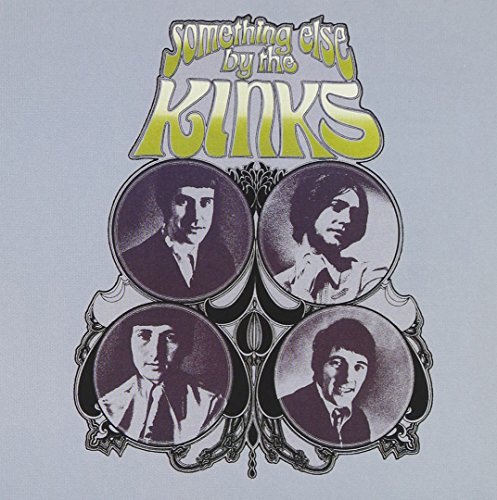
About halfway through their four year ban from performing in the U.S., something that deprived the group of significant financial opportunities during their prime years, the Kinks released their fifth studio album around September 1967.

The music is immediately accessible and Ray Davies’ clever lyrics reflect upon English social situations, characters, and topics with a particularly English point of view.   Top tracks include “David Watts”, “Death of a Clown”, “Two Sisters” and “Waterloo Sunset.”

Nicki Hopkins, who adds vitality to the 1967 Rolling Stones’ “Between the Buttons” with his lively piano contributions, also takes this Kink’s album to another level starting with the opening seconds of “David Watts” and continuing with piano-infused improvements on several other tracks including the second track,  “Death of a Clown.”

“Two Sisters” includes harpsichord (not sure if this is Ray Davies or Nicki) and strings. “No Return” successfully incorporates elements of Bossa Nova with appropriate melody chord changes and nylon stringed acoustic guitar. “Situation Vacant” includes more Nicki Hopkin’s piano, some Ray Davies’ organ, and Dave Davies’ guitar, but it is the lyrics that most diverge from typical pop fare capturing the dynamics between husband, position, and an “ambitious” mother-in-law.”

Side two begins with the simple but catchy Dave Davies’ “Love me till (sic) the Sun Shines”, followed by a partly-psychedelic “Lazy Old Sun.” Dave Davies’ “Funny Face” is well arranged and includes an effective contrasting bridge-like section, similar to something Brian Wilson might compose.

“Waterloo Sunset” is one of Ray Davies’ best compositions ever, lyrically and musically, and brings a praiseworthy album to an effective close.

Track listing[Wikipedia]

All tracks written by Ray Davies, unless otherwise noted.

Side one
No. Title Writer(s) Length
1. David Watts 2:32
2. Death of a Clown Dave Davies, R. Davies 3:04
3. Two Sisters 2:01
4. “No Return” 2:03
5. “Harry Rag” 2:16
6. “Tin Soldier Man” 2:49
7. “Situation Vacant” 3:16
Side two
No. Title Writer(s) Length
1. “Love Me till the Sun Shines” D. Davies 3:16
2. “Lazy Old Sun” 2:48
3. “Afternoon Tea” 3:27
4. “Funny Face” D. Davies 2:17
5. “End of the Season” 2:57
6. Waterloo Sunset 3:15

Personnel