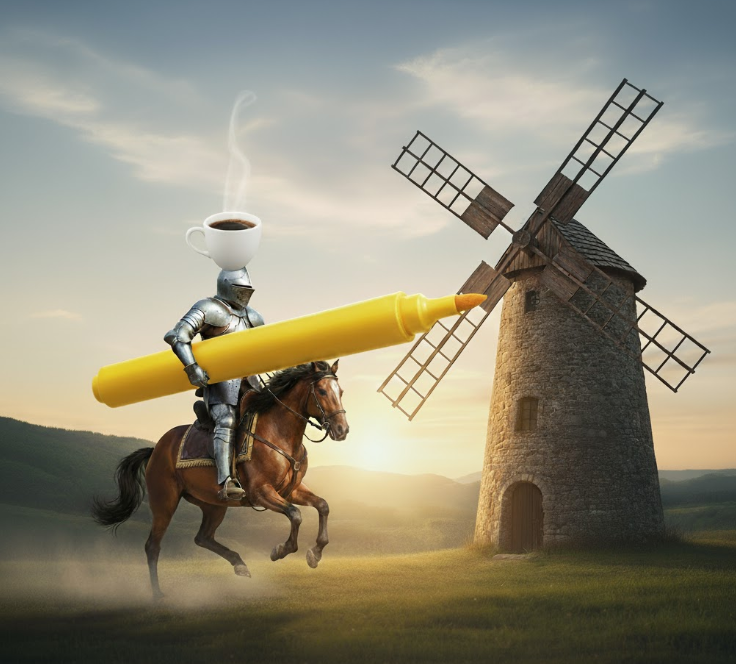
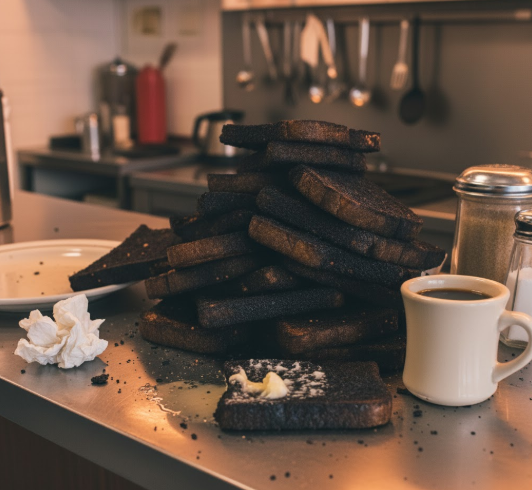
Feckless Degeneracy with some Windmill Jousting – an epic in several belches –
Belch the First – by way of prolegomena
Of arms and the man I sing id est, of a man with arms and hands for that matter and nothing to do with them other than push gliding yellow felt across the faceless fees of contract physicians dealing the new deal daily to the deaf shipbuilders and jet mechanics and the incompetent OSHA oafs of Oshkosh and Oklahoma Sucking the blood of the body politic politely with a yellow felt pen Felt pen is all he’s felt lately so come, muse for someone should and tell of the student-cum-bureaucrat the man with arms and hands with nothing to do but pay bills and perhaps go blind
Belch the Second – in medias res (so what else is new?)
A brown caffeine haze like the stained inversion layer of womb-city L.A. swirled buzzing beneath his 4:30 AM skull like a Santa Ana locked in Aeolus’ cave bleary blurry burned home to Germantown where the rosy-cheeked firm-breasted wives of the power-corridor stalkers make their living doing T.V. ads for Cheer Wisk Breeze and disposable douches Brown and nondescript his mentality and the 2 unkempt letters on his unkempt bed from an unkempt friend a mad composer Beethoven of software UNIVAC of the mad pipes and unorthodox tunes and keeper of a faith in which all have lost faith but a miniscule few
Insanity issues from the violated envelopes rushing leaping prancing like a horde of lusting shoppers at Macy's white sale bringing back the shades, demons, ghosts, apparitions, & specters of times past when mastodons stalked the earth and loons reigned, then, and rationality belonged to serfs and the lords of bats sat wiggo and lecherous in a Coco’s booth sucking the bean and contemplating rape Jolly jester gestures jump from penciled pages and in a laughing gasp grabbed the felt pen pusher by corduroy lapels howling "Write! for the faith is dwindling like a soft candle-stump its fleeting flame flickering faintly from a shriveled wick.
Write! For I am playing pool and snooker with a drunken busboy Lothario the 2 of us Lear and his fool leering and fooling around with a round girl and her quoit-visaged female companion. Write! for the roundtable is broken with the tennis player salesman for Bridgeford talking Tupperware and household appliances as he flies to Dallas. With the great beard Sleaze of times past Falstaff with a joint now playing it cool in high finance at the bastion of upper-middle class white vacuity in Watts. With the genius leader of liberated wit doing a Ulysses gig in Asia beaming knowledge into little brown people and contrition, obscurity for the white man’s burden. Write! for it’s been so long, I find tacos erotic and Don Jose’s threw me out for fondling a quesadilla. Write! Right?”
“Right.” Thus murmured the pen-pusher toddling, tottering off to sleep to wake with the sun and, at the school the afternoon next he gripped his pen violently determined and thought Thank God Freud is dead.
Belch the Third — Arlington National Cemetery is my disco
So the student who feeds himself with a yellow felt pen and writes arcane monographs of the arabesque convolutions of the politics in Riyadh and Jiddah essayed assessed saying sayings not quite sane what he means is what he said Sotos speaks so to speak.
An auspicious year the best of the 20th Sophocles’ 3 Stooges Clotho & her Cronies gave the Greek grief early tried to hand him a couple of brooches to do a number on his bespectacled orbs but he’d seen that one before So they packed up their spinning wheel and headed for Ft. Lauderdale lawn chair lounging but not until his transmission got up and walked away from his Merc 18 miles west of Phoenix to the tune of half a thousand clams If it wasn’t for the pen pusher’s plastic money and smiling despair he’d be flipping burgers on Camelback Avenue Wearing a Marlboro Stetson snakeskin pasture pounders and calling home the T.V. and Gideon Bible at the El Rokay Lodge.
Jojo's has crept like mildew across a map and Visa-financed peasant lunches kept the moustache nourished all across the continent.
Back to the city of marble buildings and minds with few marbles where the town namesake “Father of His Country” has a phallic monument to mock the yellow felt-pen scrivener whose social life is on display next to the stuffed dodo at the Smithsonian and labeled “Extinct.”
Well, can’t complain one supposes, even though the only thing between the student bureaucrat and a morals rap is an iron will and saltpeter for breakfast.
Lots of late nocturnal revelry with Eve’s daughters watching omelets feed a Charybdis appetite, or catching two-dollar talkies at the Circle. Taystee Diner, bean brew, juke box jokes as Hall & Oates, Simon & Garfunkel and Queen eat my quarters Coupla babes a lanky blonde, a petite brunette (I’m a blonde sorta, maybe). [If you’re a blonde I’m Grover Cleveland] But the pen-pusher knows, through the cruel anvil of experience, never argue with a woman Their logic makes minds' Minotaur maze looks like I-10 between Quartzite and Phoenix so peace dictates saying he’s been out late with 2 buxom blondes (and call the pen-pusher Grover Cleveland). Fun ladies and dynamite looks socko boffo knockouts but as for romance my social life is in formaldehyde at D.C. morgue waiting for someone to identify it.
Belch the Fourth — Ambition rides the Metro, but still can’t get a seat.
Thrice has the world spun encompassing ol’ Sol in completed circuits since the Golden Greek marched east like Alexander to conquer Persia-on-the-Potomac Thrice. Most of those who entered grad school with the golden Greek (before he cultivated the yellow felt pen to streak the beige bilious bills at Fran Perkins' Annex (on 14th & NY, NW) Most of those who dared demonic dementia to cut academia’s umbilical with a sheepskin rectangle have and got spewed into limbo
Alexander pushes the yellow felt pen and checks the views on the Strait of Hormuz holding court Doing okay if you are a tortoise All done excepting 100 pages of shoveling so let’s look for birth in May ’82 unless alma mater aborts Meantime there’s always yellow felt pens and green enough money
It all adds up to the bottom line which is the theory of relativity flattened in the templates of grad school to wit master programs stretch like taffy over time the faster you work and time goes gossamer tenuous and ephemeral and e...t...e...r...n...i...t...y is the... last... gasp... of... pondering... postgraduate... programs while your transcript grins and yawns at once
Belch the Fifth — if life gives you meatballs, make albóndigas
Beckoning from beyond the lips of an unborn year are the evergreen plastic vegetables that live only in refrigerators on display at Sears & Montgomery Ward Come come We are the vegetables of legitimacy of actuality and your folks’ approval eat and could we interest you in life insurance?
Rustling from behind in those dim glow worm grottos at the base of your mind are the petrified relics Memories of a golden age long tarnished return return return unused portion of your life for a *full refund* Slapping your back with ghostly hands guffaws Why be a frog when you make one helluva tadpole?
Polystyrene peas aren’t going to make it Julia Child or no Yet you can’t keep the cranium small while the cerebrum expands unless you want to grow lobes out your ears
The abyss between the plastic veggies and petrified pasts is the only place to call home and keep your honor
The bricks and mortar of this balancing house are words the hardshells of deranged thoughts that maintain continuity with the solid past and laugh like a strait-jacket model making time at Camarillo State: the faceless featureless chaos of the unraveling future.
Belch the Last — by way of epilogue
The song is done, Muse, evaporated like Borden’s milk and the balance in my checking account the yellow felt pen pusher pushes on staining audiologist indices and the lives he has touched like a Mexican dinner The time-space continuum has swallowed the Golden Greek yellow felt pen and all and he inches along the cosmic alimentary canal
But soft like that Mexican dinner cheap and satisfying he may return with an acrid burp to remind the party of what once was.
I once loved this world–my world–which danced with emdashes– the best kind– at end of lines– seemed so clean– went directly to the heart –or at start of lines or–in-between
now, it is the mark of the beast, and I accept the notice to cease and desist: doing my best to return to, and better learn, the effective incorporation of proper punctuation.
–zumwalt (October 2025)
And then Zumwalt made a slight revision to align with this news story: It’s been discussed online for some time how ChatGPT’s excessive use of em dashes are more like a bug than a feature. Finally, Sam Altman and team have come to the rescue. As discussed in this November 14th news story, Sam Altman posted on X, a few minutes before midnight on November 13th: “Small-but-happy win: If you tell ChatGPT not to use em-dashes in your custom instructions, it finally does what it’s supposed to do!”
I once loved this world–my world–which danced with em dashes– the best kind– at end of lines– seemed so clean– went directly to the heart –or at start of lines or—in-between.
Now, it is the mark of the beast, and I accept Sam’s notice to cease and desist: doing my best to implement on request the effective incorporation of proper punctuation.
I never liked them anyways And THEY ALWAYS came with a safety cap for something that’s not now very safe
The bottle always asserted its authority just two wait this long if you really want more
Treated me like a child even though it said “extra strength”
I am not pregnant that’s hard for a man particularly in their sixties but what’s not good for a goose is maybe even worse for a gander.
I live with pain constantly Bad neighbors Bad news and so — pretty bad headaches…
I can easily explore better options no warnings on dosages I well know what works well and even if I have a brutal headache the next morning and mess up the car driving At least I had me some fun.
Discrimination lies with concentration Machinations, machinations equilibrium staggers— Smell the breath of industry—intoxicated fumes Has the ignition point been reached? Atomize before the vestigial globules are digested and Odovacar pulverizes the wall
Orange! Hellish pastels screaming unknown genius and hint at hidden chortles While nicotine nimbi scud and stain And we suck slyly, slyly sweetened caffeine and wait for it to reach crit mass in our body-plexus-pit How’d we find this sticky formica stop anyway? We iron out our cerebral wrinkles Observe the threading warp and woof And still can’t discern how we got in Or where they hid the exit So all you know is that its always open– Isn’t this the graveyard shift?– And the cross-eyed waitress will bring a misspelled, miscalculated mistaken check when dinner’s over whining whining wining and dining Somebody waste that skinny kid if he won’t stop bellowing Disagreeable distaste in distinct decibels Disgusting! The food may slither down your maw like greasy lint But can’t we at least eat in peace? A garish cosmos of flickering neon and cretin muzak It seems as if everything was drawn from the maniac cook’s Primordial soup The proper proprietor leans in languishing linger leisure Across the register Smiling slightly as he strokes his beard, unconcerned Christ! Is this morbid midnight meal a subtle jest Or is he just plain stupid?
Soft gentle beauty leaning against the window Fostering a belief that loneliness is loveliness what is good must start with pain A perfect state of perfect mind.
Cool pleasant sand Lies in a land unknown play and fun is wasted time and idle are the satisfied. A self-constructed sterilized cell for working days And nights towards a goal that cannot be achieved. the rain and sun are both the same. Is this a way of life?
      Treading on thin lines
   Like a marginal ropewalker
         A lively rosalia
Imitates the chains of population
         And a farandola
   Is forced to associate
         With septuplets.
         Grapes and fapes
   And berries and cherries
     Are often used in wine
   While the stronger stuff
        Will bear no fruit
            But would rather
  Base its structure on grain.
    A foundation falters when
               The edifice
                   Is too
                     Tall
And that is why there are
                                            building codes
                                 And yet laws may be broken
       And in      such              disasters
                           Man's fate will tumble like a
                                           hippopotamus on
                                                       ice.


— Zumwalt (1974)
The Lecture: The Hippopotamus on Ice
Greetings, poetry lovers. Today we continue our journey through the works of Zumwalt with his 1973 poem, “Overflow.” If our last lecture on “They’ve Stripped the Forest for Babble” explored a world freezing under the weight of meaningless information, “Overflow” examines the structures that contain that information — our social, intellectual, and even artistic systems. The poem is a profound meditation on scale, a warning against the oversized and unnatural edifices of modern life. It argues that we have built systems so large and so sterile that their collapse is not only inevitable, but will also be utterly absurd.
We will trace the poem’s argument through its three distinct movements: from the precarious state of the individual within an overwhelming collective, through a brilliant metaphor on the nature of systems, to the final, unforgettable vision of collapse.
I. The Precarious Individual and the Overwhelming Collective
The poem opens with an image of profound instability:
Treading on thin lines Like a marginal ropewalker
This is the state of the modern individual. We are not on solid ground, but performing a delicate balancing act on the “thin lines” of societal rules and expectations. The word “marginal” is interesting, serving multiple purposes — marginal room for error, the rope is a margin, etc. but also hinting that the ropewalker is not the star of the show, but a peripheral, almost irrelevant figure, precariously suspended over a metaphorical void.
Now, Zumwalt gives us two really beautiful and strange juxtapositions here to illustrate the crushing weight of the collective. He writes:
A lively rosalia Imitates the chains of population And a farandolaIs forced to associate With septuplets.
Let’s stop on that word rosalia. If you are into insects, you might recognize “rosalia” as the scientific name for a genus of a type of longhorn beetle. Maybe Zumwalt was aware of this, maybe not, but forget the beetle definition; the musical one is the one that is relevant. In music, a rosalia is a melodic sequence that gets repeated, moving up or down the scale one step at a time. It’s a pattern. And while it can be engaging and interesting, it can also become incredibly predictable and boringly robotic if overused — an aesthetic trap.
So when Zumwalt says this musical chain “imitates the chains of population,” he’s crafting a brilliant metaphor for oppressive conformity, the sound of a society stuck on repeat.
And he then cleverly “transposes” this idea of a chain from the musical to the physical with the image of the “farandole,” a joyful, chaotic, communal chain dance where people link arms, guided by a leader. But in this world, the dance — or more accurately, this instance of those dancing this dance — is “forced to associate / With septuplets.” This is the poem’s central, absurd crisis. Imagine the leader of that winding dance, our “marginal ropewalker,” trying to guide the chain through its intricate patterns while simultaneously being forced to carry seven infants. One baby would be a challenge. Two a struggle. Seven a complete catastrophe.
What Zumwalt seems to be saying is that in this world of “overflow,” our most organic forms of art and community are being crushed. The lively musical pattern becomes a robotic trap, and the joyful community dance is saddled with an impossible, life-choking burden. Given the era’s anxieties about a population explosion, the “septuplets” are not just a random number; they are a symbol of a world producing more than it can possibly sustain. It’s a vision where our artistic and social structures are doomed to collapse, not from an external attack, but from being overloaded from within.
II. The Wine and the Grain: A Metaphor for Systems
Having established the plight of the individual, Zumwalt pivots to the poem’s philosophical core, presenting a masterful metaphor for two different kinds of systems:
Grapes and fapes And berries and cherries Are often used in wine While the stronger stuff Will bear no fruit But would rather Base its structure on grain.
Here, he contrasts wine with distilled spirits. Wine is made from fruit — grapes, berries, even the nonsensical “fapes,” which hints that even the natural is being corrupted. Wine is an organic system, rooted in nature, terroir, and tradition. It is variable, complex, and “fruitful.”
The “stronger stuff” — spirits like whiskey or vodka — is based on grain. It is a product of agriculture, industry, and technology (the still). It is more potent, more pure in its alcoholic strength, more uniform, and ultimately sterile — it “will bear no fruit.”
This is Zumwalt’s framing of the modern world. We have abandoned the complex, nuanced, sometimes weaker but fruitful “wine-based” systems (tradition, organic community, art) in favor of the more powerful, efficient, and structured, but ultimately sterile, “grain-based” systems (ideology, mass production, raw data). We have traded the vineyard for the factory.
III. The Inevitable and Absurd Collapse
The final section of the poem shows the consequence of this choice. Having built our world on these “stronger,” grain-based systems, we have created edifices of immense size and terrifying fragility.
A foundation falters when The edifice Is too Tall
The very structure of the poem on the page mimics a tall, teetering building, a brilliant piece of formal irony. These oversized systems are inherently unstable. Our attempts to secure them are flimsy:
And that is why there are building codes And yet laws may be broken
The “building codes” are our laws, our regulations, our ethical frameworks — society’s desperate attempt to keep our own creations from collapsing. But Zumwalt adds the cynical, inevitable truth: “And yet laws may be broken.” Our safeguards are fallible.
This leads to the final, unforgettable image of what this collapse will look like:
And in such disasters Man’s fate will tumble like a hippopotamus on ice.
This is Zumwalt at his most devastatingly brilliant. The collapse of our grand, sophisticated civilization is not a noble, epic tragedy. It is not a graceful fall. It is the fall of a hippopotamus on ice. Hippos are creatures of immense size and power, and maybe from a absurdist viewpoint, extra-large relatives of barnyard pigs. So put ice skates on one of them, which would be a feat in itself, and we have this clumsy, completely out of its natural element, ungulate, trying to maintain balance but ultimately, and inevitably, headed, or maybe “rear-ended” — that’s a bad pun, I take it back — headed, and looking utterly, ridiculously pathetic, perhaps — headed for a fall. The image is both terrifying and darkly hilarious.
“Overflow” is Zumwalt’s warning about the hubris of scale. It argues that by pursuing over-amplified production over moderate levels of production, artifice over art, and size over stability, we have created a world that is precarious for the individual and destined for a collapse that will be stripped of all dignity. Our fate, he suggests, is not to burn out in a blaze of glory, but to slip, flail, and crash with the absurd, pathetic comedy of a hippo on a frozen pond.