Zumwalt Poems Online


2evhqIn launching a Google search for lists of Jazz albums of 1967, one finds lists like this that include many fine albums:

1967

  1. Sun Ra: Atlantis (1967)
  2. Gary Burton: A Genuine Tong Funeral (1967)
  3. Sam Rivers: Dimensions And Extensions (1967)
  4. Roscoe Mitchell: Old Quartet (1967)
  5. Bill Dixon: Intents And Purposes (1967)
  6. George Russell: Othello Ballet Suite (1967)
  7. Muhal Richard Abrams: Levels and Degrees of Light (1967)
  8. Archie Shepp: The Magic of Ju-Ju (1967)
  9. Jackie McLean: New and Old Gospel (1967)
  10. Roland Kirk: The Inflated Tear (1967)
  11. Don Ellis: Electric Bath (1967)
  12. John Coltrane: Interstellar Space (1967)
  13. Frank Wright: Your Prayer (1967)
  14. Spontaneous Music Ensemble: Withdrawal (1967)
  15. Peter Broetzmann: For Adolph Sax (1967)
  16. Chick Corea: Now He Sings Now He Sobs (1967)
  17. Miles Davis: Nefertiti (1967)
  18. Don Ellis: Live in 3 2/3/4 Time (1967)
  19. Jackie McLean: Demon’s Dance (1967)
  20. Miles Davis: Sorcerer (1967)
  21. Gary Burton: Duster (1967)
  22. John Coltrane: Expression (1967)
  23. McCoyTyner: The Real McCoy (1967)
  24. Wayne Shorter: Schizophrenia (1967)
  25. Lee Konitz: Duets (1967)
  26. Paul Bley: Virtuosi (1967)
  27. Lester Bowie: Numbers 1 & 2 (1967)
  28. Paul Bley: Ballads (1967)

(from http://www.scaruffi.com/jazz/60.html#1967)

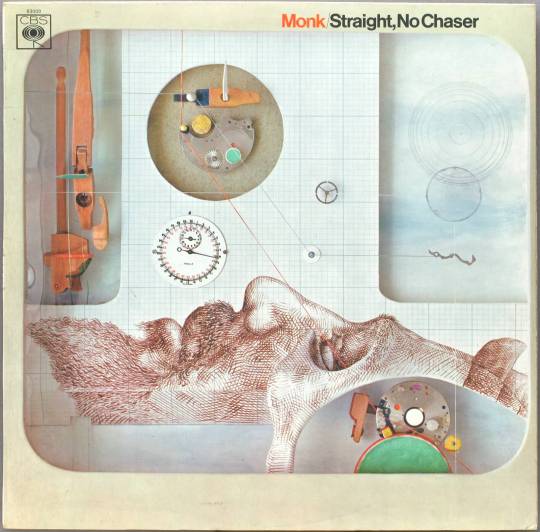
However, notably missing from all such lists (I have seen) is one of the best jazz albums of 1967, Thelonious Monk’s “Straight No Chaser.”

Why is this? Why do fairly knowledgeable jazz listeners fail to include an album of such exceptional music?

The clear-cut answer is that Monk is competing against himself.

By 1947, when Monk first started recording for Blue Note, five days after his thirtieth birthday, his style, approach and individual voice were already established, making those Blue Note recordings exceptional statements by a fully mature artist. From 1947 to 1951, many of the most celebrated Monk compositions were captured forever for all of us: “Ruby, My Dear”,  “Well, You Needn’t”, “Round Midnight”, “Evidence”, “Misterioso”, “Epistrophy”, “Criss Cross” and “Straight, No Chaser.”

Over the next two and half decades, as jazz in general continued to expand beyond Bebop with Hard Bop, Cool, West Coast Jazz, Third Stream, Post Bop, Soul Jazz and Fusion, Monk’s approach and stylistic traits remained relatively stable.  In the sixties, Monk was no longer viewed by some as a unique innovator, but rather, just simply unique. The innovation was there — not stylistic, but in playing freshly, honestly, and incisively, continuing to balance silence against sound and expressing himself naturally, logically and directly.  His music still evolved, but slowly. and more in terms of refinement than in alignment with the other changes happening in jazz.

By this album, “Straight, No Chaser”, Monk has established a continued level of excellence — connecting directly and succinctly. That this was one of the best albums of the year could only be overlooked by those comparing this music to Monk’s work from the late 1940’s on the Blue Note label, recognizing the historical influence of that music and finding no such historical significance in this 1967 Columbia album.

The personnel for this album:

Clearly, the quality of the only non-rhythm section soloist (Monk goes way beyond being part of a rhythm section, of course) is going to have a considerable impact on the overall merit and quality of this recording, and Charlie Rouse, at this point, after working with Monk since 1959, has become the ideal tenor sax partner.  In one sense, he is an extension of Monk’s brilliance, and yet he still has his own voice and ideas.

The album I am using for this trek back through time is the LP version without the bonus tracks available on the CD version.

  1. “Locomotive” (Thelonious Monk)
  2. “I Didn’t Know About You” (Duke Ellington)
  3. “Straight, No Chaser” (Thelonious Monk)
  4. “Japanese Folk Song (Kōjō no Tsuki)” (Rentarō Taki)
  5. “Between the Devil and the Deep Blue Sea” (Harold Arlen)
  6. “We See” (Thelonious Monk)

“Locomotive”, opens the album, slow and steady, initially creating a sound picture of a locomotive chugging out of the station and then giving way to one of those “every note counts” Monk solos, a solo that is cognizant of, and at points includes fragments of, the original melody.  Rouse solos follows with Monk accompanying and the piece ends in typical bebop fashion, repeating the opening section.

The fourth track, “Japanese Folk Song” is particularly of note. On the LP the length is around 11 minutes.  On the CD reissue, the length is listed at 16:42, indicating that the LP version has been edited.  The folk song melody that opens the piece is Rentarō Taki’s “Kojo No Tsuki” (The Moon Over the Desolate Castle), originally written in 1901 as a school-book lesson in “Songs for High School Students”, and later recorded in the 1920’s becoming a well-known tune throughout Japan that was so associated with Japanese nationalism that the tune was banned by the Allies during their post WWII occupation of Japan.

Monk takes the original tune and twists it with syncopation, runs and Monk’s own distinct dynamic approach to striking the keys. Rouse comes in playing the melody eerily evenly on the beat before journeying more distantly away. At the 4 1/2 minute mark on the LP we have the start of an extended, mesmerizing solo by Monk.  (I am guessing this is where the edit is, dropping out a solo by Rouse to accommodate the time limitations of the LP.)  The last 3 minutes Rouse and Monk wind their way to the finish with interwoven, intertwined, Monk-trademark counterpoint before a brief and satisfying coda.

“The Real McCoy” is McCoy Tyner’s seventh album, but please notice that the label is no longer Impulse but Blue Note.  Blue Note Records, founded in 1939, historically seems to be the label that takes artists to their next level and so it is here with Tyner, who had recorded his last album with John Coltrane in 1965 and was not aligned with the direction Coltrane was pursuing.  Tyner: ” All I could hear was a lot of noise. I didn’t have any feeling for the music, and when I don’t have feelings, I don’t play.”

Well, there’s not any dispute about Tyner playing on this album. From the opening upbeat, contemporary “Passion Dance” to the more traditional “Blues on the Corner” spiced with Tyner’s harmonics and his energetic, almost frenetic solo, this is an excellent album.

With Tyner are three world-class jazz artists:

I am often disinterested in the obligatory bass solo (whether that is once each track or even, as in this case, once on an album), but Ron Carter, is always exceptional as he shows here on his solo, in the introspective second track, “Contemplation.”

Elvin Jones was the ideal drummer for the many Coltane albums he is on, and an excellent fit for Tyner’s compositions and Tyner’s playing.

Joe Henderson made important contributions on Blue Note albums starting in 1963, appearing on important albums for Grant Green, Andrew Hill, Horace Silver and Lee Morgan as well as Larry Young’s incomparable “Unity” album. He shimmers and sparkles on this album with inventive, engaging and compelling soloing and ensemble work.

If one compares the quality of Tyner’s piano work to Monk’s, which, of course, really isn’t fair to either artist, Tyner does come in second place in terms of overall musical intensity and economy of expression. This is evident in the exceptional track “Contemplation.” From almost the beginning Tyner includes these short repeated scalar phrases (some would call this “noodling”) which, unfortunately, remind me a little too much of some of the soloing filler of the guitarists in the 1980’s hair bands, and is not so distant to some of the unnecessary busy-ness that one can even find in earlier pianists like Art Tatum.  This is only a slight distraction, and less annoying on repeated listenings of this track; particularly as Tyner treats this as an integral part of the composition and so once one has heard the composition, these quick spurts of adjacent notes become part of the performance’s fabric.

Putting such a minor quibble aside, Tyner has put together a diverse set of compositions. The modal “Passion Dance” is exceptionally vibrant and vital. “Contemplation” is an introspective ballad.  “Four by Five” is an aggressive, wild work starting with a 4 against 5 theme and highlighted by amazing soloing by Joe Henderson. From the Blue Note Liner Notes: “McCoy explains … ‘Four By Five receives its title because the melody is constructed as if there’s a middle -it’s in 4/4 on the outside and 5/4 on the inside. But we improvise as if there weren’t a middle; we improvise only in 4/4’.”

“Search for Peace” is a soothing statement about the value of peacefulness and tranquility.  The album ends with a casual, relaxed blues-based tune, “Blues on the Corner”, nicely wrapping up an album that covers a range of emotions and attitudes, accessible and yet solidly fresh, modern music for 1967 that is as engaging today as ever.

Track listing 

All compositions by McCoy Tyner

  1. “Passion Dance” – 8:45
  2. “Contemplation” – 9:10
  3. “Four by Five” – 6:35
  4. “Search for Peace” – 6:25
  5. “Blues on the Corner” – 6:05
“To be even inadequately prepared for battle, you have to fight a few first.”

— Zumwalt

   “Personal growth does not start with the act of seeking improvement, but with improving the act of seeking. ” 

— Zumwalt

Is forcing yourself to do things that are uncomfortable the only way to achieve personal growth?  Not at all! You can stay within your comfort area and certainly achieve more skill, greater awareness, better health, or anything else you might consider growth.

If you are comfortable reading fiction, you can achieve quite a bit of development in your understanding of others, the world, human conflict, and in understanding more about yourself.  You can even just limit your reading to the works of Dickens or Dostoyevsky and achieve growth.  Maybe reading Philip K. Dick novels would be enough. I know I achieved some personal growth as a child reading Dr. Seuss books, and probably would get something out of them today, just re-reading them.

Spending time with a friend or your child, a stranger, or a dog or raccoon (watch out for rabies), is enough to develop personal growth — if you are there, in the moment, and not on automatic pilot like the cars Google and Tesla are developing.

Not so sure eating at an all-you-can eat pizza place would be effective, but don’t rule it out if you are do so with the intent of getting something out of it more than indigestion.

That said, the biggest bang for the buck often occurs when comparing what actions we had taken when staying in our comfort zone and reflecting what actions were available if we had gone outside that comfort zone — and then modifying our actions in the future, even though that is uncomfortable.

You and I do need to consider stepping outside our comfort zone, at least occasionally.  It gets us off automatic.

There is another aspect to consider when pushing ourselves to do something uncomfortable.  There is the aspect of right and wrong.  Avoid doing it if it honestly feels to be the wrong action.  If you know it is the right thing to do, use that as a motivator.

Ask a stranger if you can help them carry groceries, as awkward as that may seem. (Don’t just grab the groceries and start walking — that may get you in trouble.)  When someone says something that’s not particularly interesting to you, but is to them, pursue their statement with a follow-up question — get to know their point of view better.  Getting a better understanding of others may be uncomfortable in some situations, but it will sometimes result in an new or extended understanding.

Don’t shut others off when their political or religious views are different. As crazy as their viewpoint may seem at that time, have them elaborate and see what you can learn from better understanding their point of view.

Whether staying within your comfort zone or extending its boundaries, the main thing is to widen your perspective, knowledge and understanding.

Another way of looking at this is the DIKW pyramid.  As an information professional this is something I am well aware of.  There are variants on this pyramid, but one I like a lot is the diagram below at conceptdraw.com.


The DIKW is of course, Data, Information, Knowledge and Wisdom.  Another cool  diagram (below) is from kvaes.files.wordpress.com:

My own take on this is that we don’t have pyramid at all but a recursive cycle of action:  Observe, recognize, filter, connect, compare, evaluate, realize, know, understand, act.  (Slightly different to some of the DIKW pyramids, I see true understanding as wisdom)

Act

One way to apply this is to think of us being in a synthetic, artificial, simulated, or virtual universe, like in the movie “The Matrix” or as many scientists are now proposing.

We observe (collect data), connect and compare (information), determine/conclude (knowledge), achieve wisdom though understanding brought about by reflection and focusing our knowledge to the reality we believe is there and then take an appropriate action.  After the action, we then start the process over again by observing, recognizing, filtering, connecting. comparing, evaluating, realizing, knowing and understanding — understanding more than before, and then taking action.  This occurs with a boxer in the boxing ring or a driver in a race car on the racing track — and occurs over, over, and over again. This occurs whether we are playing an old-fashioned mechanical pinball machine in a bar (drinks are on you) or playing a virtual pinball machine on the internet.

So personal growth will happen as long as there is observation and ultimately action to be in a position to observe more. We can speed up the process by observing more and taking action when appropriate and as appropriate. If the action is inappropriate, the universe, synthetic or real, will let us know — maybe not immediately, but at some point.  And generally that will not be personal growth, but personal decay — that is, unless we get up, brush ourselves off and start the cycle of “observation through action” all over again.


doors_h

“If the doors of perception were cleansed, everything would appear to man as it is, infinite. For man has closed himself up, till  he sees all things through narrow
chinks of his cavern.” William Blake from “The Marriage of Heaven and Hell”

The Doors formed in 1965, in Los Angeles, signing in 1966 with folk-music label, Elektra, after Columbia failed to secure a producer for their first album.  Their name was inspired by Aldous Huxley’s book “The Doors of Perception”, which recounts Huxley’s mescaline experiences and borrows its title from the William Blake poem, “The Marriage of Heaven and Hell.”  This first album of theirs was released in January of 1967.

The album opens up with a promise, premise and pronouncement to “Break On Through to the Other Side.”  This first track, as do many on the album,  opens up in layer by layer (instrument by instrument) with John Densmore ‘s drums, staggered bass in first the left (guitar bass line) and then right channel (keyboard bass line), Jim Morrison’s vocals, Robby Krieger‘s  guitar and eventually Ray Manzarek‘s organ setting a standard of expectation for the rest of the album. Less than 2 1/2 minutes, the track is over — just the right length — leaving the listener hungry for more.

This album, in general, is dark, emphatic, reflective, well-thought out and a precursor to later American heavy metal (Iron Butterfly, Steppenwolf, and to some degree even bands like Blue Oyster Cult.)  Much of the music is blues-based, some adhering closely to that foundation (“Back Door Man”), some straying quite far but keeping the essence of the three chord pattern (“Soul Kitchen”) and some seemingly far removed but yet still with a blues essence. Within this wide range, all of this music has a freshness and originality to it, sometimes provided by Kreiger’s distillation of late sixties guitar, sometimes by Manzarek’s often ornate keyboards and sometimes from the overall arrangement.

Not enough can be said about “Break On Through to the Other Side”, and so I will say no more.

“Soul Kitchen” is a sexy, bouncy bluesy piece, with what was in 1967 pretty explicit lyrics. “The Crystal Ship” is lyrical, dramatic, intimate and in a minor key with a mystically evocative keyboard section.  “Twentieth Century Fox” is a clever title, not about a movie studio, but of course, to the “fashionably lean” “queen of cool” in-control modern woman well described in the lyrics:

“No tears, no fears,
No ruined years, no clocks;
She’s a twentieth century fox, oh yeah!”

The fifth track, “Alabama Song” is from the Kurt Weill opera Rise and Fall of the City of Mahagonny ( Bertolt Brecht lyrics) and I suspect the lion’s share of arrangement credit goes to Manzarek who plays the zither-like marxophone and keyboards. Note that nearly ever-present, oompah-oompah, ironic lilt — the essence of which resurfaces in at least a couple of 1970’s English progressive rock albums.

Not much needs to be said about “Light My Fire”, thanks goodness, for words poorly can capture the spirit of this song, it’s historic, seamlessly interwoven blend of jazz, baroque and rock elements, and its influence on early metal and early progressive rock bands.

“Back Door Man” is pure blues, written by  Willie Dixon and previously known for the 1960 Howlin’ Wolf version.  “Back Door” is a prominent reference in earlier blues music and refers to sneaking in the back door of a house when the unsuspecting husband is at work or out and about.

“I Looked at You” is another song that starts by adding layers.  It is almost a prototypical mid-sixties go-go dance number until that first brief detour (modulation at “cause it’s too late”), quickly shifting back to its initial state (“we’re on our way and we can’t turn back”) with a wonderful go-go style organ that follows. Here again we have a hint of baroque music embedded in what is essentially sixties pop.

“End of Night”, a soothing minor/modal ballad in the midst of more stormy tracks,  begins with a hint of spooky, Bartok-like nacht-musik into a leisurely blend of guitar and Morrison vocals.

“Take It as It Comes” starts with no introduction, appropriate to both the title and opening words of “Time to live.” It starts of with a e minor seventh chord which effectively creates the drive and resulting uplift for the next section (modulation to A minor at “Take it easy, baby. Take it as it comes”) and the short baroque-like organ solo.  A second ornate organ solo is followed by more vocals from Morrison (“Go real slow. You like it more and more. Take it as it comes. Specialize in havin’ fun”) and a quick, final flourish to end.

“The End” attempts to rise up to the height of the opening track, and would come very close, with its tender opening and exotic, Indian-influenced (voiced by guitar), expansive instrumental section.  The trouble is that after a few minutes, Morrison’s mumbling detracts from otherwise meditative, highly spiritual music.  Granted, Morrison is reaching for the furthest corners of personal discovery, but the track would have worked better if he stopped after the melancholic exposition:

“This is the end, beautiful friend
This is the end, my only friend, the end
Of our elaborate plans, the end
Of everything that stands, the end
No safety or surprise, the end
I’ll never look into your eyes, again”

which sets up the remaining instrumental exploration and inner-reflection nicely.

That said, this Morrison self-indulgence is only a minor weakness and doesn’t detract from the excellence and revolutionary nature of this album. When we talk about drugs, sex, and rock and roll, this album encompasses all three: from the name of the band, to the surprisingly suggestive lyrics (common enough for blues, but not so common for the mass media of 1967), to the self-assertive, unapologetic, counter-culture music.

door-back-album-cover-elektra

TRACKS

(From Wikipedia)

All tracks written by the Doors (Jim MorrisonRay ManzarekRobby Krieger, and John Densmore), except where noted.

All tracks written by the Doors (Jim MorrisonRay ManzarekRobby Krieger, and John Densmore), except where noted.

Side A
No. Title Length
1. Break On Through (To the Other Side) 2:29
2. “Soul Kitchen” 3:35
3. The Crystal Ship 2:34
4. “Twentieth Century Fox” 2:33
5. Alabama Song (Whisky Bar)” (writers: Bertolt BrechtKurt Weill) 3:20
6. Light My Fire 7:06
Side B
No. Title Length
7. Back Door Man” (writers: Willie Dixon) 3:34
8. “I Looked at You” 2:22
9. “End of the Night” 2:52
10. “Take It as It Comes” 2:23
11. The End 11:41

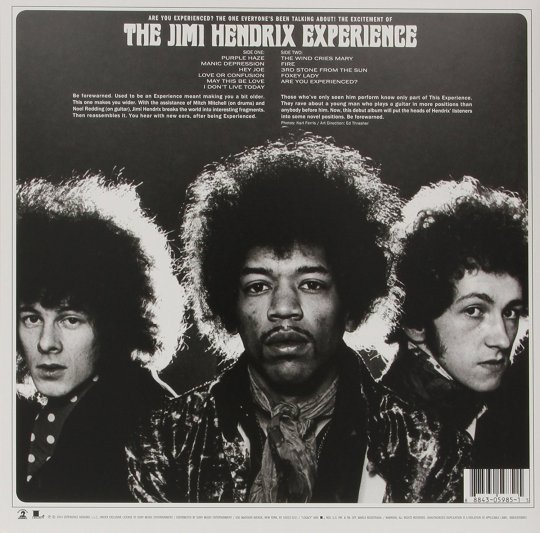
are_you_experienced_-_us_cover-edit

One of my fondest memories of my first year of college was listening in the library’s music listening room in the fall of 1973 with my first-semester girlfriend (and my continuing lifelong friend since sixth grade) to Zappa’s “We’re Only in it for the Money” and this very first Jimi Hendrix album.

A week earlier, I had listened to “Are You Experienced” for the very first time in that same library but on headphones. I had previously bought two Hendrix albums in high school, “Cry of Love” and “Rainbow Bridge”, and was curious how this compared to those two albums and “Electric Ladyland”, all three of which I thought highly of.  I remember studying the album cover of “Are You Experienced”, front and back, before putting the LP on the no-frills turntable and then donning the mediocre, highly uncomfortable library headphones. The first track was “Purple Haze”, and though primitive in comparison to songs on “Cry of Love”, captured me completely. The lyrics lacked the imagery and imagination of later Hendrix lyrics and the sound over those cheap library headphones sounded rough and muddy, but the forceful and potent guitar-riff introduction was as magical as a Wagner leitmotif: a compelling opening to any album, effectively locking any exit from the listening room door until the end of side two.

That first overall impression of this album was not entirely positive.  I missed the studio slickness and more sophisticated lyrics of the later albums, and found the music to be dated, a relic of the drug-crazed, psychedelic late sixties. Nonetheless, I was certainly impressed enough to want to share with my on-campus and off-campus friend a week later as we checked out this album and were able to grab one of the two listening rooms that had speakers, and also, a room where we could stretch out a bit and listen to this much as at home, except for the “No food allowed” sign and the narrow window in the door to allow us to be observed by passerbys.

Until a few days ago, I hadn’t heard this album since college, so in preparation to write a blog post on this work, I got out a previously unheard high-quality vinyl German pressing (let’s not discuss how many vinyl records I have collected that I have not yet listened to or how they, along with way too many CDs,  have taken up the better portion of two bedrooms) and, without looking at the contents, started to listen to it from beginning to end.

“That’s old age and memory,” I thought, as “Foxy Lady” danced out of the loudspeakers. I picked up the cover and, noticed even more to my surprise, that “Purple Haze” was missing from side 1 and side 2.  Yes, indeed, my memory is going bad, but it’s not hallucinogenic! As patience is a virtue of old age, I continued listening, noticing the absence of “Hey Joe” and “The Wind Cries Mary” and the addition of tracks I had never remembered hearing in my life: first “Can You See Me”  and then “Remember” on side two. These two new tunes were indeed an unexpected and rather rewarding discovery, but as soon as the album was over, not owning a CD of this to compare, I went to the internet and found the different listing of tracks for the North American version and the UK/European version. Relieved, now, that I still had a few weeks more until onset of dementia, I obtained a standard 16 bit redbook CD which had all the tracks from both albums and a few bonus tracks.

Glad to be able to listen again to the original album I knew, but with seriously better audio than in the library music room, I was taken back through time with that introductory riff of “Purple Haze” – clearly the only way to introduce Hendrix’s first album.

This is a modern blues song — and I mean modern!  The whole album, even the one track not written by Hendrix (“Hey Joe”) strays varying distances away from traditional blues, yet shares 99.9 % of the DNA. Like a blues song, or Chopin’s or Beethoven’s funeral marches, “Purple Haze” is slow paced, inevitable and unstoppable.  Hendrix creates tension with his approach to fingering, chord voicings, use of controlled distortion, his overall guitar technique, and emphatically pushing out the boundaries of comfort and predictability.  The spirit of the music is assisted ably by Noel Redding’s bass (including passing tones between root notes and various rhythmic subtleties) and Mitch Mitchell’s driving, energetic, yet calculatingly controlled drumming.

And, as I remembered, these lyrics are not at the level of later Hendrix lyrics, yet still, there is a undeniable unity with the music:

“Purple haze, all in my brain;
Lately things they don’t seem the same.
Actin’ funny, but I don’t know why;
Excuse me while I kiss the sky.

“Purple haze, all around;
Don’t know if I’m comin’ up or down.
Am I happy or in misery?
What ever it is, that girl put a spell on me.

“Help me
Help me,
Oh, no, no.”

For some odd reason, music critics of that time stretched and reached to make drug connections when none where evident. These lyrics are about being smitten — whether naturally or through other means, like voodoo, is open to discussion — but drugs don’t seem to be relevant here.

Musically, one could argue that drugs opened up vistas and viewpoints for composers and musicians that allowed such innovation.  Maybe there is truth here (Chopin took opium for tuberculosis, Berlioz took opium, many jazz musicians had drug encounters or severe drug dependencies) and maybe not, but one cannot create genius from drugs or elevate mediocre musicians and composers up to the next level.   One can certainly make the case that drug use ultimately works against musicians at all levels.  That said, let others more knowledgeable address this drug topic, and the impact of drugs on music, I will just delight in the amazing music handed down to us from those inspired geniuses, whether inspired divinely, materially or through some other means.

And there is much to delight in during the course of this album.   The second track, “Manic Depression” has this wild instrumental where Hendrix’s guitar climbs up by thirds (outlining E flat minor seventh chord) for four notes and then frenziedly disperses in a truly manic solo. This rising four note motif then collapses into a three-note pattern incorporated in the next verse:

“Well I think I’ll go turn myself off and a go on down.
(All the way down.)
Really ain’t no use in me hanging around.
(Oh, I gotta see you.)

“Music sweet music
I wish I could caress and a kiss, kiss;
Manic depression is a frustrating mess”

and undergoes additional transformation, collapsing into two notes and then back to four with the feedback-punctuated finish.

“Hey Joe” continues the inevitable march forward, with a joyous, celebratory instrumental interlude enhanced by the ensuing, buoyant backing vocals.

“Love or Confusion” is dominated by the guitar work and resulting drama. In contrast to all that came before “May This Be Love” is a lush ballad showing off the gentle, intimate side of Hendrix. Ending side one is the ironically initially exuberant “I Don’t Live Today”, followed with darkly, depressing passages weaving back and front, side to side.

Side two opens up with the second leisurely-paced ballad, “The Wind Cries Mary.” Hendrix’s nonchalant, conversational vocals work well here.  Nothing here is unnatural or forced, with a simple but beautiful guitar solo in the middle and a tranquil calming ending providing a momentary opportunity to catch a breath before jumping into the up tempo “Fire.”

“Fire” opens up with one of those iconic Hendrix guitar intros that foreshadow, and perhaps creates, heavy metal. Mitchell’s level of energy, creativity and collaboration is not only up to the assignment, but raises the intensity and is integral to the overall character and aesthetics.  Redding provides spurts and phrases of growling, rhythmic bass.

“Third Stone from the Sun” is a psychedelic sound painting.  It’s foundation is a lyrical, almost placid, watercolor theme mixed with half-speed spoken vocals:

“Star Fleet to scout ship, please give your position. Over.”
‘”I am in orbit around the third planet from the star called the Sun. Over”
“You mean it’s the Earth? Over.”
“Positive. it is known to have some form of intelligent species. Over”
“I think we should take a look.”

Regular speed:

“Strange beautiful grass of green with your majestic silken seas.
Your mysterious mountains, I wish to see closer.
May I land my kinky machine?”

Half-speed:

“Although your world wonders me with you majestic superior cackling hen,
Your people I do not understand, so to you I wish to put and end
And you’ll never hear surf music again.”
“That sounds like a lie to me.
Come on man, let’s go home.'”

(Not very sure of this last section and pieced it together from internet references.)

The spoken vocals are sunken deep into the texture making this a instrumental jam that flirts with some of the qualities of a sound collage, particularly at the end.

The penultimate track, “Foxy Lady”, begins with guitar crescendo metamorphosing into a sexy, provocative ostinato supporting the main melody. The highlight is the guitar solo at 1:48, yearning and screeching passionate longing with a repeat of the chorus. A forty-five second coda finishes off the piece with the diminuendo at the end providing symmetry to the opening.

There are three tracks in the European album not present in the original North American version.  The first, “Red House”, is a twelve-bar blues song.   For non-musicians, this is a standard blues form that is prevalent in blues, rock and roll, rock, and jazz to such an extent that it can be very annoying or boring to listen unless the composition has something special such as unusual melody, humorous or particularly engaging lyrics, substitution chords , stellar execution and performance, or effective, interesting solos on top of those chords. From the start, with Hendrix abstracted guitar intro, this is more than a throwaway blues song.  In this early Hendrix recording, with this common blues structure and set of standard blues chords, we can identify much of what makes Hendrix performances so engaging. The guitar work is the primary focal point for both the leisurely and experienced listener, but part of the equation to make this work includes the support from Redding on a modified rhythm guitar and Mitchell’s minimal but steady drums as well Hendrix’s direct and personable vocal delivery.   Hendrix vocals are distinctly impressive throughout his brief recorded career — not because of range, intonation, smoothness or quality of his physical vocal instrument, but because of his pacing, rhythmic delivery, warmth, directness, naturalness and conversational nature of his communication. Hendrix, in general doesn’t perform — he communicates. As once noted by Thelonious Monk to Steve Lacy, “A genius is the one most like himself.” Monk, Beethoven, Charlie Parker, and John Coltrane all deserve special acknowledgment for being themselves in achieving their beyond-Mount-Everest level of genius.  Hendrix is not that far behind them.

“Can You See Me” and “Remember” certainly deserved their inclusion on the original European LP.  “Can You See Me” is a driving, upbeat number with plenty of fluid chemistry between the trio.  “Remember” is a moderately-fast paced ballad with an uplifting instrumental after the first two verses and chorus.  The two key changes in this work provide the necessary emotional momentum to maintain the listener’s interest.

The last and most significant track on both the North American and the European original albums is “Are Your Experienced.”  Backward drums and guitar immediately establish non-conformity at the same time as providing a stable foundation for the lead guitar and lyrics, and a sense of exoticness found in other mid-sixties rock albums that borrow or reference aspects of Indian Classical music.

It has been decades since I heard this amazing work, and with extra years came a different perspective on the lyrics.  Previously I  had assumed the experience referenced here was either drug-related or sexual, supported by the last line of the lyrics “Not necessarily stoned, but beautiful”,  but its worth considering experience on a more spiritual level — above and beyond the physical plane of corporeal existence.  Back in college, I was a bit puzzled with the phrase “have you ever been experienced.” That didn’t make sense on the surface —  for if one had previously had experience with whatever Hendrix is defining as experience, then one should still be experienced. Why is this not “have you experienced” instead of the past perfect form of “have you ever been experienced?”   Today, I see two additional angles:  “Have you ever been experienced” meaning “has someone else experienced you” and “have you ever, such as in a past life, been experienced?” The first could be sexual, but could also mean one is their essential self and not a likeness or projection of something they are pretending to be or want to be perceived as. Or it could mean “have you provided others experience”, such as a musician being experienced by their audience. This second deals with states of existence such that one could be experienced in one state (such as in one lifetime or plane of existence) and not in the other.  We can then extend this metaphysical reflection and go off in many more directions, but the simple point here is that the lyrics provide a level of interpretation appropriate to psychedelic or transcendental frameworks.

It’s also totally in keeping with the contents of this album for me to consider that the album is asking its musical contemporaries “Have you even been experienced?” Not played as background music, not listened to casually, but fully experienced across all possible dimensions.

81cjrxwslpl-_sl1500_

FROM WIKIPEDIA:

Original UK and international edition

All tracks written by Jimi Hendrix.

Side one
No. Title Length
1. Foxy Lady 3:22
2. Manic Depression 3:46
3. Red House 3:44
4. “Can You See Me” 2:35
5. “Love or Confusion” 3:17
6. I Don’t Live Today 3:58
Side two
No. Title Length
7. May This Be Love 3:14
8. Fire 2:47
9. Third Stone from the Sun 6:50
10. “Remember” 2:53
11. Are You Experienced? 4:17

Original North American edition[edit]

All tracks written by Jimi Hendrix except where noted.

Side one
No. Title Length
1. Purple Haze 2:46
2. Manic Depression 3:46
3. Hey Joe” (Billy Roberts) 3:23
4. “Love or Confusion” 3:15
5. May This Be Love 3:14
6. I Don’t Live Today 3:55
Side two
No. Title Length
7. The Wind Cries Mary 3:21
8. Fire 2:34
9. Third Stone from the Sun 6:40
10. Foxy Lady 3:15
11. Are You Experienced? 3:55

Personnel

Jimi Hendrix Experience

Additional personnel

  • The Breakaways – backing vocals on “Hey Joe”
  • Chas Chandlerproducer
  • Dave Siddle – engineering on “Manic Depression,” “Can You See Me,” “Love or Confusion,” “I Don’t Live Today,” “Fire,” “Remember,” “Hey Joe,” “Stone Free,” “Purple Haze,” “51st Anniversary,” and “The Wind Cries Mary”
  • Eddie Kramer – engineering on “The Wind Cries Mary,” “Are You Experienced?,” and “Red House”; additional engineering on “Love or Confusion,” “Fire,” “Third Stone from the Sun,” and “Highway Chile”
  • Mike Ross – engineering on “Foxy Lady,” “Red House,” and “Third Stone from the Sun”

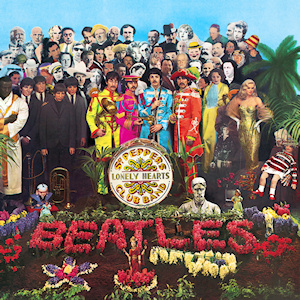
sgt-_pepper27s_lonely_hearts_club_band

Sgt. Pepper’s Lonely Hearts Club Band

Released on May 26, 1967 in the UK and a week later in the US, this is the album that boldly launched the progressive rock era.  If you lived in the US, Canada or UK, and were old enough, it was about fifty years ago today, that you first heard “Sgt. Pepper’s” play — either on a friend’s turntable, your record player or the radio.

One year earlier, The Beach Boys had released “Pet Sounds”, an album that unquestionably influenced the Sgt. Pepper album, and which has an important place in the history of progressive rock.  From an interview with Paul McCartney:

“The early surf records…I was aware of them as a musical act, and I used to like all that, but I didn’t get deeply interested in it—it was just a real nice sound…We used to admire the singing, the high falsetto really and the very sort of ‘California’ lyrics.

“It was later…it was Pet Sounds that blew me out of the water. First of all, it was Brian’s writing. I love the album so much. I’ve just bought my kids each a copy of it for their education in life—I figure no one is educated musically ’til they’ve heard that album. I was into the writing and the songs.”

One important McCartney takeaway from Pet Sounds, is the liberation of the bass guitar from playing just the root notes of chords. For non-musicians, a chord can be in basic (root) position, such as C E G C for a simple C major chord, with the lowest note being C, or can be in first inversion, with the lowest note on E, or in second inversion position with the lowest note being on G.  Simple pop music often sticks to the bass always playing the root note.   On “Sgt. Pepper’s” tracks like “Getting Better” or “Lucy in the Sky with Diamonds”, McCartney will sometimes play the third or fifth note of that chord — or even, in a few cases, play non-chord notes creating temporary musical tension.

Other important characteristics of progressive rock present in “Sgt. Peppers” include carefully crafted arrangements, non-traditional harmonic progressions, modal scales, unusual instruments, tape-based effects and an overall character that creates an artistically unified gestalt even though individual works vary significantly in mood and compositional techniques.

Though we may perceive a unified album, this is still a collection of individual songs, with two songs originally intended for this album, “Strawberry Fields Forever” and “Penny Lane”, not included. “Strawberry Fields Forever” required around fifty-five hours of studio time for completion, thus setting the level of craftsmanship and attention to detail employed for the entire Sgt. Peppers album. The mellotron, an instrument used in later progressive rock albums like King Crimson’s “Court of the Crimson King”, dominates the introduction to”Strawberry Fields.” The use of unusual instrument combinations and arrangements is present in most of the songs on “Sgt. Peppers.”

sgt-gl-st-b

The album begins with the sounds of delicately light crowd noise and a string section tuning up, just as if one were present in the concert hall for an evening at the symphony. However, this is followed with forceful electric guitar, drums, bass, and emphatic McCartney vocals with audience noise then shifting to the less restrained enthusiasm of a dance hall. This is followed by a quartet of French horns, laughter, and the re-entry of vocals and rock instruments with interspersed applause.  This first song, the title song, “Sgt. Pepper’s Lonely Heart Club Band” transforms, without break, to the upbeat, feel-good, relatively conventional,  “With a Little Help from My Friends”; Ringo is on vocals, drums and tambourine, George Martin plays Hammond Organ, George Harrison is on lead guitar, Paul McCartney, of course, plays bass, and John Lennon and McCartney handle the chorus and supporting vocals.

The third track on side one, Lucy in the Sky with Diamonds”, starts off with McCartney’s Bach-like broken-chord based melody and includes Harrison on tambura (a fretless, long-necked, Indian stringed instrument) with Ringo adding maracas.  “Getting Better” with its pulsating intro and hints of 3 against 2 includes George Martin on amplified pianette (a keyboard instrument that had been left in the studio from a previous recording session), playing it normally by depressing keys and with mallets striking against the strings, Harrison on tambura, and Ringo on congas.  The pentatonic-based “Fixing a Hole” includes harpsichord and “She’s Leaving Home”, with its wistful, affective lyrics and music, begins with solo harp, followed by bowed strings with strings, harp and Lennon’s supporting vocals providing that extra Beatles’ magic throughout.

Side one concludes with the studio-crafted masterpiece, “Being For the Benefit of Mr. Kite”, which merges various tape tricks including snippets of tape for particular musical-based sound effects and a section of tape (running at double speed) of Martin playing runs on the Hammond Organ along with Lennon on organ and McCartney on guitar. Instruments include harmonium, piano, Hammond organ, Lowrey organ, harmonica, shaker bells as well as guitar, bass and drums.  Listen for the adventurous harmonic swirl and chromatic runs in the two instrumental passages at the one minute and two minute mark which include the sped up tape passage, use of tape snippets (at least one sample sounds reversed) and tape loops. Chromatic-based passages on a pipe organ or calliope, harkening back to Julius Fučík‘s famous “March of the Gladiators“,  have often been used to invoke images of the circus, but Martin and the Beatles take this to another level.

On side two, “Within You, Without You”, like the earlier “Revolver” album’s “Love You Too”, invokes Indian Classical music with its use of multiple Indian instruments played by Harrison and skilled Indian musicians.  Instruments include sitar, tambura, dilruba (a fretted stringed instrument with sympathetic strings) tabla, svarmandal (multi-stringed zither-like instrument) as well as several violins, two cellos and Harrison’s acoustic guitar. Lennon, McCartney and Ringo sit this one out.

Side two continues with the English music hall influenced “When I am Sixty-Four”, written originally by McCartney on his home piano at age 15 or 16.  The original recording was in C Major but McCartney had George Martin raise this up a semitone by speeding the tape so that the song is now in the less common key of D flat.  For me, this track stands out as a relief point against the rest of the album, pairing nicely with McCartney’s “Lovely Rita”, and adding an important contrast that elevates this entire album.  Not everyone, including John Lennon supposedly, had the same opinion. Listen for the tubular bells played by Ringo and the trio of clarinets arranged by George Martin.

“Lovey Rita” starts off with upbeat guitar and typical Beatles’ backing vocals (“aaahhh”) punctuated nicely by Ringo. Listen for the return of those trademark backup vocals and drums at the 1 minute mark followed by Martin’s honky-tonk-style piano. This slightly distorted piano sound was created by applying tape to the tape capstan to create a wobbly distortion.  Also listen to the paper and combs before the vocal phrase “”When it gets dark I tow your heart away”, as well as the John Lennon coda that makes an effective transition to the crowing rooster in “Good Morning.”

John Lennon’s “Good Morning” was evidently inspired by the Kellogg’s Corn Flake Jingle (“Good morning, good morning, the best to you each morning”.)  It opens up like a march with accompanying saxophones, followed by Ringo’s heavy-step snare and continues with a marching-band ethos laced here and there with electric guitar and, at the end, animal sounds including dogs, cat, lion, trampling horses and what could very well be the start of a fox hunt, heralded by French horn.

The title track returns, creating energy midway by modulating up a whole tone from F Major to G Major, the key of the opening of “Day in the Life”, which immediately follows. If one is not convinced this album heralds in the era of progressive rock, such an assertion can easily be supported by the five and half minute (short by the average length of later progressive rock songs), multi-section “Day in the Life” with orchestra, harmonium, harp, piano, and alarm clock. Take note of the skyrocketing orchestra passage that binds Lennon’s section (ending with”But I just had to look having read the book. I’d love to turn you on.”) to McCartney’s “Woke up, fell out of bed….”  As described in the NY Times: “Mr. Martin’s solution was to take a page out of the playbooks of classical composers like John Cage and Krzysztof Penderecki, who at the time were creating works in which chance played a role. Mr. Martin hired 40 symphonic musicians for a session on Feb. 10, and when they turned up, they found on their stands a 24-bar score that had the lowest notes on their instruments in the first bar, and an E major chord in the last. Between them, the musicians were instructed to slide slowly from their lowest to highest notes, taking care not to move at the same pace as the musicians around them.”

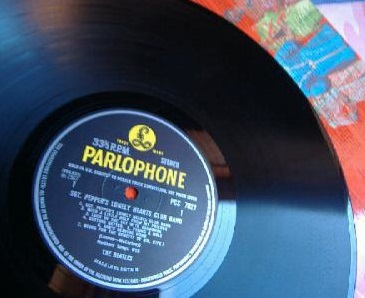
Those with CD versions of this will be missing the last track of the album: the approximately two-second-duration inner grove, which was intentionally ignored by automatic turntables and could only be played on manual turntables.  Another feature of the original UK Parlophone LP,  not evident on CDs and some US pressings, is that the tracks do not have the typical pop album separation between them and thus the surface of the record is similar to a classical record.

sgtp record

With the Beatles no longer interested in live performance appearances, part of the intent of “Sgt Peppers” was to go beyond music that could be recreated live.  The production values and layering of sound influences many later recordings, particularly of notable mention is Queen’s “Night at the Opera.”

People are certainly entitled to have differing opinions on whether “Sgt. Pepper’s” is truly a concept album.  The reprise of the title song before “Day in the Life” is not enough to automatically make this so.  The songs more or less share similar production values, but clearly are not on a single topic or share melodic or harmonic material.  Perhaps if there is a concept,  it is the general intent, as on The Beach Boy’s “Pet Sounds” album, to produce a unified set of songs that achieve both a stylistic identity and set a standard of quality that ultimately influences other musicians. For the sake of argument, let’s concede that “Sgt. Peppers” is indeed a concept album.

If we do then agree it is a concept album, it is certainly not accurate to call this the first concept album, as Zappa’s “Freak Out” was released in 1966 and jazz had several concept albums before this including John Coltrane’s “A Love Supreme” from 1965 and Dave Brubeck’s 1959 “Time Out”.  There were actually a significant number of themed jazz and exotica albums released in the fifties and one may have to go back to Woody Guthrie’s 1940 album,  “Dust Bowl Ballads” to find the first themed record album.  If one considers the medium of the “record album” as the means of recording music and the collective music as either a concept or not, then one then finds thousands upon thousands of earlier examples of concept music including Gustav Holst’s “The Planets” of 1918, Gustav Mahler’s “Resurrection Symphony”, Robert Schumann’s Kinderszenen (Scenes From Childhood”), Schubert’s Die schöne Müllerin and WinterreiseBeethoven’s Ninth Symphony, Franz Josef Haydn’s “Philosopher Symphony”, Vivaldi’s “Four Seasons” and numerous operas, including Claudio Monteverdi’s L’Orfeo, which was first performed in 1607 and still performed today.  That’s just western music.  Concept music can be traced back to many cultures of all continents including the American Indians, many African tribes, Balinese dance-drama and music from the 6th Century operas of the Northern Qi Dynasty of China.  And, for all we know dolphins and whales may have developed concept music long before humans ever roamed the earth.  (Yes!  An opportunity to promote “The Beluga Beliefs” website.)

It’s not the concept album that puts the Beatles in good company, it is the quality of the work, a true group effort of excellence by Paul McCartney, George Martin and the rest of the Beatles.

This is music that transcends the times of the mid sixties and is appreciated now by more people than ever.  Such is how we identify great music: it stands the test of time and is accessible and appealing to people from many different cultures and backgrounds.

sgtpeppergatefold

TRACK LISTING (from Wikipedia)

Side one
No. Title Lead vocals Length
1. Sgt. Pepper’s Lonely Hearts Club Band McCartney 2:02
2. With a Little Help from My Friends Starr 2:44
3. Lucy in the Sky with Diamonds Lennon 3:28
4. Getting Better McCartney 2:48
5. Fixing a Hole McCartney 2:36
6. She’s Leaving Home McCartney with Lennon 3:35
7. Being for the Benefit of Mr. Kite! Lennon 2:37
Side two
No. Title Lead vocals Length
1. Within You Without You Harrison 5:04
2. When I’m Sixty-Four McCartney 2:37
3. Lovely Rita McCartney 2:42
4. Good Morning Good Morning Lennon 2:41
5. Sgt. Pepper’s Lonely Hearts Club Band (Reprise) Lennon, McCartney and Harrison 1:19
6. A Day in the Life Lennon and McCartney 5:39
Total length: 39:52

Track lengths and lead vocals per Mark Lewisohn and Ian MacDonald.

Fifty Year Fridays

Stealing a page — no,  a series of pages — from fellow blogger, Rich Kamerman at kamertunesblog, the current administrator of this site will be posting a new post each Friday covering a single album from 1967.

In the meantime, check out Mr. Kamerman’s blog and these other review sites:

jazzreview.com

planethugill.com

progreport.comprogreport.com

classicalcdreview.com

musicweb-international.com

classical-cd-reviews.com

pitchfork.com

jazzviewscdreviews.weebly.com

progressivemusicplanet.comprogressivemusicplanet.com

jazzwax.com/

Please reply with any CD review sites you would like to recommend.  The more, the better!

Note from administrator

I’ts been a while since we have posted a new Zumwalt poem, but Zumwalt is alive and well and one never knows when one will receive something in the mail that we can post here.

Appreciate those that still follow this blog and in the meantime, will try to keep this site from completely vanishing from the google search engine by posting now and then.

For those that like music, there are a few pages on this site addressing that topic.  They aren’t easy to find, so I will call out one in particular: Must Listen To Music

The author that provided this page, believes that music is music, and that even classifying music as great, good, mediocre and poor is a worthless and impossible activity.  However, there is some music you should check out and this is what is listed here.

Whether you have heard everything listed or you haven’t heard any items on the list, you can do the author a favor and in your reply to this post, list music that you think the author should listen to.  If I just get one reply back, I will know this site is again attracting readers and can then maybe use this to entice Zumwalt to eventually provide another poem for us to post.


Another Zumwalt quote

When art imitates life by eating and reproducing, we are in trouble.

– Zumwalt.

MID-FLIGHT

MID-FLIGHT

We rush, a black throng,
Straight upon darkness:
Motes and missions scattered
By the arc’s rays.

Over the bridge fluttering,
It is theater-time,
No one heeds.

Lost amid greyness
We will sleep all night;
And in the morning
Coming forth, we will shake wet wings
Over the settled dust of to-day.

The sky reflects its open expanse to make us larger
The city hurls its cobbled streets after us,
To drive us faster.

Ascertain the darkness
Before endless processions
Of lamps
Push us back.
A clock with quivering hands
Leaps to the trajectory-angle of our departure.

We leave behind pale traces of achievement:
Fires that we kindled but were too tired to put out,
Broad gold fans brushing softly over dark walls,
Stifled uproar of night.

We are already cast forth:
The signal of our departure
Jerks down before we have learned to where we are to go.

— Zumwalt (2011)

Unicosm

Unicosm

some like to read the railroad tracks
reflect on journeys past
some gaze at the sky
anticipate upcoming cloud formations

Some discuss running away
what chases them
what ensnares them in place

Each creates their own universes
Storing them up
Or discarding them in the dumpster with scattered package wrapping and useless electronics

— Zumwalt (2016)