Zumwalt Poems Online

Archive for the ‘Music & Musings’ Category

Thoughtful Thursday: What to observe?

“The more we look, the more to see: altering this reality”  — Zumwalt

In order to interpret, evaluate and ultimately understand, one has to observe.

Concept3

However, there is so much out there to observe.  It’s overwhelming.  So we run into an apparent paradox: one must know, to some degree, what to observe, yet one cannot know without first observing, interpreting, recognizing, filtering, connecting, comparing, evaluating and have some level of realization.

And so one cannot ever start from scratch. There will always be some initial observation from earlier or from others that one relies on in order to determine what next to observe.

Observing then becomes a process of narrowing down and expanding what one observes.  To be efficient this is not a random process, but one driven by the formulation of an objective.

For example, “I need to eat” is an objective.  With that objective one then observes — or collects data — in areas that will be more likely to provide the necessary input to increase one’s success at an action designed to obtain food for eating.

If we are a retail chain,  like Kohl’s, Macy’s or Sears, we must determine our objective.  Is it to increase revenue, lower costs, or increase profit margin.? Or is it a less basic objective like increase in-store traffic or increase brand awareness which may be considered an objective in order to achieve the more specific objective of increased revenue through building customer loyalty?

Having a hypothesis can help narrow down what to observe, but a hypothesis should not be formulated too early in the process or opportunities to achieve an objective can be missed.   Instead it is best to look for patterns in the data, and then determine what is a likely hypothesis based on that data as opposed to starting with an hypothesis and thus missing the opportunity of identifying more likely hypotheses.

For example, if my objective is to cross a river and I start with the hypothesis that one can cross the river on a structure that floats on water, I may miss out on noticing that 200 yards downstream someone has built a bridge, or the river becomes shallow enough to cross on foot, or that the river becomes an underground stream.

So important to keep the objective in mind, identify what data can be collected (what can be observed), and not prematurely limit the data that one will analyze.

With companies like JC Penney and Macy’s currently fighting against declining same- store sales, it seems like they missed out on observing several years ago how Amazon was increasing book sales and ultimately positioning itself to sell other items online — items that were also sold in shopping mall department stores.  What were they observing? What was their hypothesis?

Five year stock chart for JC Penney
jcp

Five year stock chart for Macy’sm5y

At this point, have these companies learned the hard way what data they need to look at?  (If so, now may be a good time to buy their stocks.  If not, expect further losses for JCPenney and further same store sale declines for Macy’s.)

There is a lot out there to observe.  The first step is to clearly understand one’s objective and then focus on observing those things that will help achieve that objective.  For music, if one wants to dance, observe (listen to) the beat  — this means focus on the drums and the bass, If one wants wants to play along, focus on what the chord progressions are for the verse and chorus.  If one wants to ignore the music, focus on something besides the music.

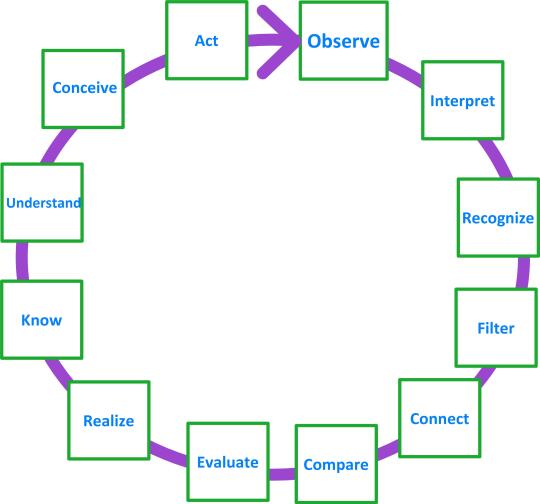
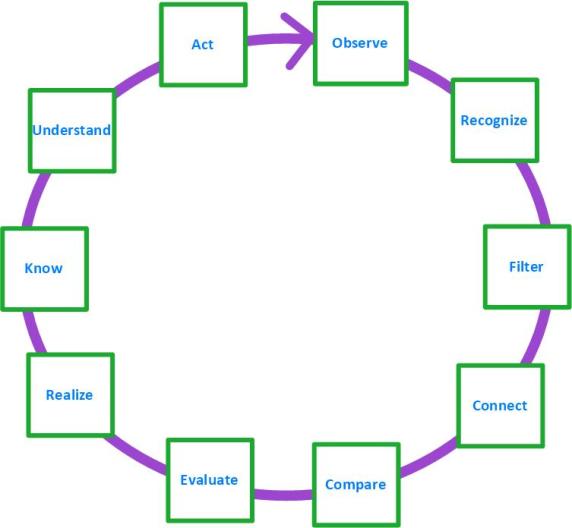
Don’t worry about formulating an hypothesis until we has examined enough relevant data for that intended objective to see what are recurring patterns.  Fortunately in the data analysis world there is software (Artificial Intelligence, Machine Learning) that can identify patterns in the data.  Without software, one can take notes, reflect and follow the steps in my diagram below: observe a significant amount of data, recognize what are the patterns that appear relevant to your objective, filter out the irrelevant data to focus on that data that has the patterns of interest, evaluate that data, understand its nature and then form a plan of action to gather or observe more of that data as necessary.

Concept3

Eventually one can form a hypothesis and scrutinize that hypothesis each time one goes through the “comparison”, “evaluate” and “realize” steps to know if that hypothesis is correct or not.  If that hypothesis is not appropriate, then one needs to formulate a better hypothesis that is aligned with previously collected data and will predict future observations.  There is no such thing, though, as a correct hypothesis — there is only a workable hypothesis — one that provides the necessary guidance to act successfully. Where people get in trouble is when they stubbornly or subconsciously hold on to a premise or hypothesis that is not successfully predicting outcomes and then continue to act on that premise or hypothesis as if it was reliable.

No belief is important enough to hold on to when it doesn’t align with verified observations. Such beliefs end up doing everyone more harm than good.

Fifty Year Friday: Rolling Stones “Between the Buttons”

betweenthebuttonsuk

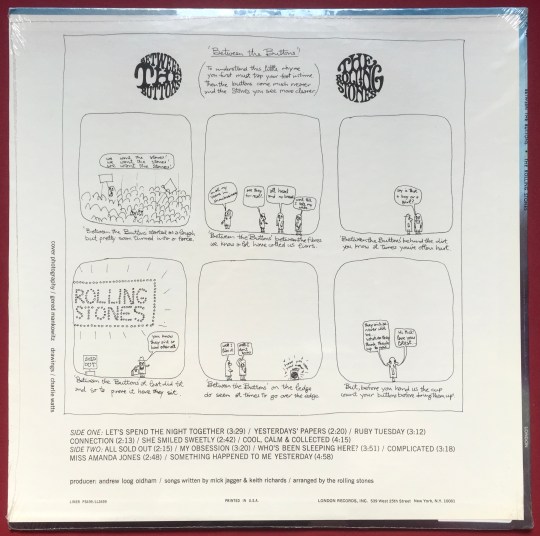
Prior to checking this album, Between The Buttons, out of our local public library sometime around 1969, I had never heard anything by the Stones except what I heard on low-fidelity AM radio.  I was surprised to find the consistency of quality songs on the album — and how appealing each track was.

The album I heard was the American version which starts out with the three tracks that I had previously heard on the radio: “Let’s Spend the Night Together”, “Yesterday’s Papers” and “Ruby Tuesday.”

If  you are looking to pick one of the two best Rolling Stones’ songs ever, “Ruby Tuesday” seems a must, with its dreamy, reflective, beautifully A minor melodic verse and the upbeat, celebratory verse (in the relative major key) — and “Let’s Spend the Night Together” deserves serious consideration.  If this album contained nothing more, it would be worthwhile to have in one’s collection.

After these first three songs on side one, we get “Connection”, a solid, steady-beat rock song, “She Smiled Sweetly”,  a sensitive ballad, and “Cool, Calm & Collected” with its ragtime-like piano-dominated verse (representing the successful, material-based elements of life) and it’s Indian-influenced chorus (representing the spiritual sentiment of “cool, calm, collected” that tag-team throughout the tune to its accelerating frenzy climax.

Side two may not be as strong as side one, and doesn’t hold up as well to repeated listenings, but is still generally good with “Who’s Been Sleeping Here” and “Something Happened to Me Yesterday” with its English Musical Hall quality and steady march beat. Please note Nicki Hopkins incredibly important contributions on piano to both “Cool Calm Collected” and “Something Happened to Me Yesterday.”

AMERICAN ALBUM TRACK LISTING [from Wikipedia]

Side one
No. Title Length
1. Let’s Spend the Night Together 3:38
2. Yesterday’s Papers 2:01
3. Ruby Tuesday 3:16
4. Connection 2:08
5. “She Smiled Sweetly” 2:44
6. “Cool, Calm & Collected” 4:17
Side two
No. Title Length
7. “All Sold Out” 2:17
8. “My Obsession” 3:20
9. “Who’s Been Sleeping Here?” 3:55
10. “Complicated” 3:15
11. “Miss Amanda Jones” 2:48
12. Something Happened to Me Yesterday 4:5

Personnel [from Wikipedia]

As per the American release:

The Rolling Stones
  • Bill Wyman – bass guitar (2, 3, 6-12), double bass (3)
Additional musicians

70770433-origpic-81fd29

Thoughtful Thursday: Preconceptions

most_miscon

“You must challenge your preconceptions or they will challenge you” — Penny A.Proctor (You may hear this first quote in the upcoming new Star Trek series on CBS taken from a short story by Penny A. Proctor)

“Mistakenly thinking you know usually results in not knowing mistaken thinking later on.” — Zumwalt

IQ tests sometimes contain questions that, though not particularly hard, will not be answered correctly if one falls back on preconceptions rather than solving the problem on its own terms: doing the work rather than taking a short cut by falling back on what one accepts as given truths

A bat and a ball cost $1.10 in total. The bat costs $1 more than the ball. How much does the ball cost?

If one starts with preconceptions, one goes for the easy answer.  If one just works through this without jumping at the misleading “short cut” then one gets the correct answer.

If one even checks their preconceived wrong answer, then they will soon have the right answer.  The wrong answer of 10 cents for the ball doesn’t stand up as 10 cents for the ball, plus one dollar extra than the price of the ball for the bat at $1.10 sums up to $1.20.

One way to solve the problem is rely on simple algebra:

x (price of ball); y (price of bat)

x + 1.00 = y  –> y-x = 1.00

x + y = 1.10 –> y+x = 1.10

Add these 2 equations up and we get 2y – 2.10  or y = 1.05 so the bat is $1.05 and the ball is .05.

Even if we don’t use algebra but try a few guesses, checking our guesses will eventually get us to the right number.

But the way that life works for most of us, most of the time, is that we make assumptions and never ever check them, making decisions on top of bad assumptions.

Bill is stalking Mary. Mary is stalking John. Bill is married, but John is not. Is a married person stalking an unmarried person?

  1. Yes
  2. No
  3. Cannot be determined from the given information

Once again, if we fall into the trap of lazy thinking, we may never work through this problem finding the right answer and end up agreeing with 80% of people that choose answer #3. It really doesn’t matter that we don’t know Mary’s marital status.  If she is single, it is then Bill, the married person, that is looking at an unmarried person, and if she is married, then Mary is the married person looking at an unmarried person.

We rarely object to an instance of a person saying “that’s my spouse” (“that’s my wife”, “that’s my husband”) or “that’s my child.”  And so, it’s no issue to say “that’s my dog” or “that’s my cat.”  But we would object to saying “I am the owner of this husband” or “I am the owner of this child.”  Should we also object to one saying “I am this dog’s owner.” Does one own the dog or is it a partnership? If the dog runs away, the “owner” can get the pet back.  The “owner” can decide to trade the dog for money or put the dog to sleep. In ancient Greece and in 19th century America, people owned other people, and could trade them and even put them to death.  The people in the past re-examined ownership of people and determined this was unacceptable in any way, shape or form.  Should we examine our relationships with our pets, or just accept our preconceptions and continue on.

Anchoring is a sales and marketing ploy that takes advantage of our tendency to have preconceptions.  This is very common in the cruise industry where cruise lines offer “limited” 2-for-1 permanent cruise sales or have a brochure starting price that’s double (or more) than the actually offered price:cruise3

Preconceptions are the most troublesome when we don’t know about them. In doing data analysis it’s the bad data that we don’t know about the messes up the results.  Any belief that one doesn’t examine for its accuracy (maybe not examined as one isn’t aware of the belief or thinks it is correct) will influence one’s final decisions and analyses, often making actions based on such decisions and analysis worse than random actions. Anchor prices are used to take advantage of our tendency to lock on to the earliest data we have about something and to subconsciously put more weight or more credence in the earlier or earliest obtained data than later data, even though analytically we often chose to prefer more recent data over older data.

Take the time to examine what data is used to make an important decision and challenge the validity of that data.  By identifying the bad data or erroneous preconceptions and not using them to base a decision on,  one can significantly increase their likelihood of acting appropriately.


Fifty Year Friday: Jobim “Wave”; Zappa, “Absolutely Free”; Beefheart “Safe as Milk”


wave

Jazz fan’s will likely know of Antonio Carlos Jobim two albums with Stan Getz, particularly the first one, Getz/Gilberto containing “Desafinado” and the classic version of “The Girl from Ipanema” with  Astrud Gilberto‘s seductive vocals.    That first album, added fuel to the already burning fiery desire of Americans to hear and dance to bossa nova, and elevated Jobim to a marketable American music business commodity.

“Wave”, released in 1967, became Jobim’s best selling album, providing smooth, comforting music for middle America and many non-jazz record consumers. The music is well-crafted, well-arranged and well-performed with Jobim playing guitar, piano, celeste and harpsichord, Ron Carter on bass, Urbie Green on trombone, and a small string orchestra with french horn and flute/picolo all providing the most mellow dance music possible.   It is not exactly jazz and, in a sense, sets the tone for a genre of music that would be called smooth jazz,  a style not demanding listener attention or involvement, but played for its soothing, relaxing qualities.  Such smooth or background music became prevalent in shopping centers, in restaurants and in many work places that now added such music or substituted smooth jazz for the previously provided muzak. In 1987, Los Angeles radio stations KMET, once one of the coolest, most progressive album-oriented,  FM radio stations in Southern California, changed its letters to KTWV and called itself “The Wave” playing “adult contemporary jazz” becoming one of the un-coolest, most un-progressive stations in the Greater Los Angeles area ultimately influencing other radio stations to take the same path.

Of course, none of the blame should be attributed to this fine Jobim album; it is just worth noting that soon background music became virulently prevalent, irking many musicians that believed music should be actively listened to and not absorbed.

Track listing[from Wikipedia]

All tracks composed by Antônio Carlos Jobim.

  1. Wave” – 2:56
  2. “The Red Blouse” – 5:09
  3. “Look to the Sky” – 2:20
  4. “Batidinha” – 3:17
  5. Triste” – 2:09
  6. “Mojave” – 2:27
  7. “Diálogo” – 2:55
  8. “Lamento” (lyrics by Vinicius de Moraes) – 2:46
  9. “Antigua” – 3:10
  10. “Captain Bacardi” – 4:29


frankzappa-absolutelyfree

Frank Zappa and his Mothers of Invention did not produce either easy listening music or anything that could be considered conservative.   This is the Mothers of Invention’s second studio album and every bit as adventurous as the first including mixed meter and quotes from Stravinsky’s three most famous ballets, “The Firebird”, “Rite of Spring” (“Le Sacre du printemps”) and Petrushka.  Each side of the original LP can be viewed as a single piece rather than a set of unrelated tracks due to redeployment and relationship of music material.  Humor is a inseparable part of this innovative album that many Zappa fan’s cite as one of their favorites.

Track listing [from Wikipedia]

All tracks written by Frank Zappa.

Side one: “Absolutely Free” (#1 in a Series of Underground Oratorios)
No. Title Length
1. Plastic People 3:40
2. “The Duke of Prunes” 2:12
3. “Amnesia Vivace” 1:01
4. “The Duke Regains His Chops” 1:45
5. “Call Any Vegetable” 2:19
6. “Invocation & Ritual Dance of the Young Pumpkin” 6:57
7. “Soft-Sell Conclusion” 1:40
Side two: “The M.O.I. American Pageant” (#2 in a Series of Underground Oratorios)
No. Title Length
1. “America Drinks” 1:52
2. “Status Back Baby” 2:52
3. “Uncle Bernie’s Farm” 2:09
4. “Son of Suzy Creamcheese” 1:33
5. Brown Shoes Don’t Make It 7:26
6. America Drinks & Goes Home 2:43

Personnel[from Wikipedia]

Note that there are several additional musicians on this album including Don Ellis on trumpet on “Brown Shoes Don’t make it”


safeasmilk-bds1001-covers

Another less-than-easy-listening album is Captain Beefheart and his Magic Band’s “Safe as Milk” which starts from a blues foundation but includes uncommon time signatures and unique instrumental divergences. On one hand, a traditional blues fan might prefer to spend their time listening to a true blues album by someone like Howlin’ Wolf rather than this Don Van Vliet (A.K.A Captain Beefheart) psuedo-blues album. However, despite some superficial similarities in Howlin’ Wolf’s and Beefheart’s voices, and “Safe as Milk’s fairly straightforward first track, there are enough deviations here, musically and lyrically, from other more solid blues albums of the time to take this album on its own terms. Guitarist Ry Cooder, having played with Taj Mahal in the short-lived Rising Sons, makes important arrangement and performance contributions. Historically, this is an important album as it captures a band in transition to a more adventurous style that merges blues, free jazz and art-rock into a genre I could only call head-spinning, head-splitting, free-style post-blues

So even though this is much closer to standard fare than later Captain Beefheart albums, it contains a number of adjustments to standard rock/blues that make this an album worth checking out.  “Yellow Brick Road” borrows the first part of its melody from “Pop Goes the Weasel” but strays off into its own tune with a mix of innocent and suggestive lyrics. “Autumn Child” pushes into both art-rock and progressive rock territory with its Zappa-like opening and changes in meter, texture, tempo and mood.  Electricity” is the stand-out track, with lyrics and music flirting with psychedelia (note the guitar imitating the sitar), blues, bluegrass, and rock, and, once past the brilliant introduction, is very danceable. The rising oscillations of a thermin closes out the song.


Whereas one can put on “Waves” (and even “Absolutely Free” under the right circumstances) and delegate it to the background with little trouble, if one does this with some of the Beefheart “Safe as Milk” tracks like “Electricity”, “Plastic Factory” and “Abba Zaba”, they simply become distracting and annoying; however, play this album on a good audio system that can untangle the aggressive texture into individual and distinctive voices and the music flies by and, if not always pleasant, is unexpectedly absorbing and engaging.

Track listing[from Wikipedia]

All songs written by Herb Bermann and Don Van Vliet except where noted.

Side one
No. Title Length
1. “Sure ‘Nuff ‘n Yes I Do” 2:15
2. “Zig Zag Wanderer” 2:40
3. “Call on Me” (Van Vliet) 2:37
4. “Dropout Boogie” 2:32
5. “I’m Glad” (Van Vliet) 3:31
6. Electricity 3:07
Side two
No. Title Length
7. “Yellow Brick Road” 2:28
8. “Abba Zaba” (Van Vliet) 2:44
9. “Plastic Factory” (Van Vliet, Bermann, Jerry Handley) 3:08
10. “Where There’s Woman” 2:09
11. “Grown So Ugly” (Robert Pete Williams) 2:27
12. “Autumn’s Child” 4:02


Personnel 
[fromWikipedia]

Captain Beefheart and his Magic Band
  • Don Van Vliet – lead vocals, harmonica, marimba, arrangements
  • Alex St. Clair Snouffer – guitar, backing vocals, bass, percussion
  • Ry Cooder – guitar, bass, slide guitar, percussion, arrangements
  • Jerry Handley – bass (except 8, 10), backing vocals
  • John French – drums, backing vocals, percussion
Additional musicians

Thoughtful Thursday: Observing, Comparison and Evaluating

“Knowingly, and unknowingly, I relentlessly measure everything you do,
And that’s okay, as long as I don’t then pretend that I have ever measured you.”
— Zumwalt

“Accuracy of observation is the equivalent of accuracy of thinking.” — Wallace Stevens

We can observe what one does or what they have.

We cannot observe who they are.  We are basically limited to observing what they do and have. And usually, we only see a very small percentage of that.

But even if we saw everything, 7 days a week, 24 hours a day, we would be left with only seeing manifestations and phenomena, not the essence of who people truly are.  We may know it’s safe or dangerous to be around this or that person in this or that circumstance, but we have no direct understanding of those people, we make the leap from observing what they do to who they are.

So its pointless to compare ourselves to others.  We can compare what we do to what someone else does.  Or we can compare what someone has to what we have.  Just don’t fool yourself that you can compare yourself to anyone else.

The truth is that you cannot measure anyone.  You can measure their body. You can measure the size or weight of their brain, their heart, their stomach.  With the right equipment, you could even count the number of neurons in their brain, the number of synaptic connections, and, if using top-of-the-line (though still futuristic) equipment, the number of neurotransmitters and their motion and chemical composition.

To say the heart, the stomach or the brain is the person is a large leap of illogic and foolishness.  To say the body (containing the heart, stomach, brain and several gallons of water) is the person is also not true.  Maybe removing an appendix, a few skin cells, a couple of liters of water, or consuming a bit too much at a cruise ship buffet changes the viewpoint or experience of the person , but so can reading a book or watching a movie or interacting with someone else — and we don’t confuse the books on your bookshelf or your friends and family with you.  Or do we?  Yes, we often do! Since we cannot observe you, we observe things around you and use these are proxies for measuring you.

Be careful that what you observe is relevant to what you evaluate.  Do not observe the behavior of ducks in the park and assume that you have collected pertinent data to evaluate the behavior of wolves in the wild.  Do not observe the behavior of a person, and assume that you can evaluate the person: you can only evaluate their behavior.

Data seduces us.  We see data and we sometimes don’t stop to see if this data is relevant, complete or appropriate for our analysis.  Our process of drawing conclusions may be sound, but if we are not observing what we need to observe, then we cannot expect valid comparisons or evaluations and this in turn will impact our understanding and any subsequent action.

Concept3


Fifty Year Friday: Velvet Underground “The Velvet Underground & Nico”; Nico “Chelsea Girl”

mi0000832128

I am having second thoughts about posting these album reviews of music of 1967 — fifty years ago.

One: it’s not easy to write reviews about music: to describe music in words is an impossible activity, and at best one ends up describing their reactions to the music, which, really, is self-centered, possibly narcissistic, and either self-indulgent or masochistic (writing music reviews can be very painful as one recognizes that keystrokes being captured by WordPress fall immeasurably short of the sound waves that are captured by audio recording devices.)

Two: shouldn’t I be writing about recent album releases? To write reviews about albums already accepted as established classics doesn’t help generate income for the musicians (if they are still alive), encourage them to create more music, or provide the service of bringing  previously ignored music or musicians to people’s attention.

Three: there are others out there writing music reviews that get less visitors than this blog, and yet their reviews are better, more interesting and more informative. When I have visited such blogs, I am shocked to see posts that range from being hours old to months old without a single like or comment. What keeps them going?

And so I take the time to ask myself, am I providing anything of value to my reader or, if not to my reader, is there anything that I get out of this?  And I really don’t know at this point if any single one of my reviews has caused someone to listen to music they would otherwise have missed out on.  But I do know, once I take the time to reflect on it, that I do get something out all of this: knowing that I need to write something, I am listening to this music differently than I normally would. I am not only listening intently, but with the need to find something I can communicate out to someone else.

During much of my regular music listening, I listen seriously, and I direct my attention directly on the music. I am seated.  I am not dancing, driving, cooking, or watching sports with the sound turned down.  I am a human receiver, trying to absorb and enjoy as much of the music as possible. When I listen to music I am planning to write about, I am no longer in receiver mode, but in explorer mode.  I am looking for places to pitch a tent, clues for sources of water, tracks of game in the vicinity, evidence of past occupants or current inhabitants.  I am reaching out, straining my eyes to see the distance, taking notes mentally; I normally don’t do any of these things when I am listening for enjoyment.

And so knowing that I must write about what I am listening to changes the listening experience.  If it is a digital source, I might even pause, rewind and replay. I find myself looking for strengths and weaknesses in the music instead of taking it on it’s own terms. It’s like the difference between dating someone for the enjoyment of their company and dating to determine an appropriate life partner.

And there is the selection of material.  When I listen for enjoyment, I pick something I am in the mood for, or something I just bought, or something that will provide a unique experience.  When I am writing a post about one of the best albums of 1967, the selection process is limited to that year, and I have to find something that is pretty good and that others will enjoy.  When listening, I ask myself, is this album good enough to mention as a “Fifty Year Friday” album, and if the answer is no, the album has served it’s purpose as a candidate and either I tolerantly listen to the end, or I stop and put on something else.

And to select an album, I review all potential choices: albums in my collection I have heard dozens of times, both as an dedicated listener and as background to other activities, as well as albums that I purchased, and never played — or played the first track — or continued past the first track but made secondary while reading liner notes, reading a book, or doing something else.

And so we come to this Velvet Underground album. I know this is a good group: a very important group in its place in the history of music.  And I was a fan of Lou Reed’s “Transformer” album, at least marginally, having heard it a few times in 1973 and 1974. And so, back in the early 1990’s, when I would buy a few dozen CDs every month, mostly jazz and classical, I saw this in the local mega-bookstore bin,  and not having a single Velvet Undergound CD, and knowing this was supposedly a good one, I immediately bought  it with a few dozen other CDs.  When I got home, this CD had to compete with a previously purchased 18 CD set of Nat King Cole, a Chet Baker CD, the complete Bill Holiday on Verve, a 6 CD T-Bone Walker set, a Captain Beefheart CD and several new classical CDs. Neither the Velvet Underground nor the Captain Beefheart won  me over after the first couple of tracks, so I set them aside, meaning to listen to them soon, but never doing so.

But now, in 2017, looking for worthwhile albums from 1967, I select this previously neglected CD, and listen to it with full attention. And to my surprise, it is a musical treasure.

If Sgt. Pepper’s is the first example of progressive rock, “The Velvet Underground & Nico” is the first example of Art-Rock, at least that I know of.  I am not always a fan of so-called Art Rock — it can get on my nerves, but like the genre of free-jazz, when it is done right, it is great — when it is just an excuse for lack of structure, vision, content, it is like so much of the so-called classical “Avant-Garde” (neither classical or particularly innovative) of the 1950’s, 1960’s and 1970’s — a waste of valuable listening time.

This album, though, has direction, intensity, texture, form, structure.  There is a sense that there is a canvas with dimensions in space and time that is being systematically addressed with points, dabs, strokes, shades, groupings and contrasts.

“Sunday Morning” is the last song recorded for the album, but it makes sense for it to open the album as it is most accessible and apparently disarmingly innocent of all the songs.  The celesta provides a music-box like introduction, to a peaceful, tranquil tune with lyrics that belie the musical serenity:

“Sunday morning
And I’m falling
I’ve got a feeling
I don’t want to know”

This is a song that could have gotten substantial airplay.  Perhaps it didn’t due to the contrast between the pleasantly serene melody and the disheartening lyrics. Perhaps it didn’t because of Lou Reed’s distinct half-spoken and sometimes imperfect intonation. Or perhaps there were commercial reasons or lack of the necessary behind-the-scenes connections.

The musically bucolic first track is contrasted with a rough, repetitive, blues based “Waiting for the Man.” The lyrics are again bleak, portraying a New York City heroin addict, looking to score from his dealer.

Since music is generally my main focus, let’s get the lyrics out of way.  Lou Reed’s writing is direct, brutally honest, and of its time.  These are not the clever, playful, roundabout lyrics we find in most of the more socially-relevant music of the time. This is a much more accurate, even painful, representation of reality.  Lou Reed connects with life’s realities  rather than just observes or comments on life:

“I’m waiting for my man
Twenty-six dollars in my hand
Up to Lexington, one, two, five
Feel sick and dirty, more dead than alive
I’m waiting for my man

“Hey, white boy, what you doin’ uptown?
Hey, white boy, you chasin’ our women around?
Oh pardon me sir, it’s the furthest from my mind
I’m just lookin’ for a dear, dear friend of mine
I’m waiting for my man”

The music here is frantic, with hints of barrelhouse piano transformed into a pounding commentary on withdrawal and drug dependency.  This is not pleasant music.   This is musical drama.

Lou Reed is sometimes flat, and occasionally here or there sharp, but, thankfully, he wavers more like a gymnast maintaining equilibrium on the balance beam, his pitch violations compensated by his confident and appropriate delivery of the text which unfailingly communicates the intrinsic meaning and essence inherent in the words. Not the case with Nico.  At the insistence of Andy Warhol, Nico was added to the band to perform lead vocals on a few of the tracks as well as some backing vocals.  On the third track of the album, the wistful ballad, “Femme Fatale”, the combination of being out of tune and lack of consistent expression erode her voice’s timbral strengths inviting one to consider how much better the album would have been with Lou Reed replacing her lead vocal assignments.

It is with “Venus in Furs” that this album takes off into another musical sphere. Not only is the focus on the substance, with a given mood and direction deftly and often roughly crafted for each track, but we get a range of music styles — some of that immediate time period and some hinting at the near future.

One can identify the influences in this album: Bob Dylan, blues, rock and roll, rhythm and blues, free jazz (Lou was a fan of Cecil Taylor), classical avant garde, modernism and experimental music (Cale studied with Humphrey Searle, and after coming to the U.S, had ties to Iannis Xenakis, John Cage and La Monte Young), British Invasion, British Skiffle, Indian and eastern music (note the drone and guitar in “Venus in Furs”), and possibly the New York Hypnotic School.  More to the point are the many hints and foreshadowings of future styles of music including minimalism, psychedelic, glam rock, art rock, progressive rock, punk, goth, and grunge.  I will take bets on Velvet Underground having influenced Peter Hamill, David Bowie, PJ Harvey and groups like the Residents (at least a little), Explosions in the Sky, Sex Pistols, Joy Division, U2, Sonic Youth, Talking Heads, Nick Cave and the Bad Seeds, R.E.M. and countless others.

Track listing[from Wikipedia]

All tracks written by Lou Reed except where noted.

Side A
No. Title Writer(s) Length
1. Sunday Morning Lou Reed, John Cale 2:54
2. I’m Waiting for the Man 4:39
3. Femme Fatale 2:38
4. Venus in Furs 5:12
5. Run Run Run 4:22
6. All Tomorrow’s Parties 6:00
Side B
No. Title Writer(s) Length
7. Heroin 7:12
8. There She Goes Again 2:41
9. I’ll Be Your Mirror 2:14
10. The Black Angel’s Death Song Lou Reed, John Cale 3:11
11. European Son Reed, Cale, Sterling MorrisonMaureen Tucker 7:46

Personnel

On the original album:

Production

  • Andy Warhol – producer
  • Tom Wilson – post-production supervisor, “Sunday Morning” producer
  • Ami Hadami (credited as Omi Haden) – T.T.G. Studios engineer
  • Gary Kellgren – Scepter Studios engineer (uncredited)
  • Norman Dolph – Scepter Studios engineer (uncredited)
  • John Licata – Scepter Studios engineer (uncredited)
  • Gene Radice – post-production editor, remixer
  • David Greene – post-production editor, remixer

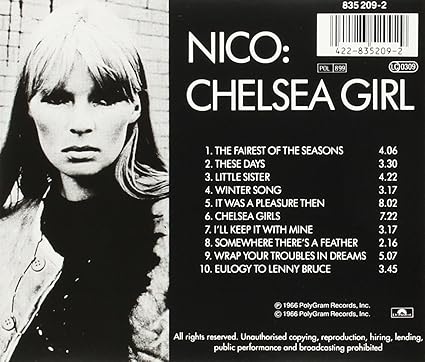
For those that want to hear additional Lou Reed compositions from this time period, they can listen to “Chelsea Girl”, Nico’s solo album recorded in 1966 after “Velvet Underground & Nico”, and released in October 1967. The name of the album is a reference to Andy Warhol‘s 1966 film Chelsea Girls, in which Nico starred and includes a Lou Read composition of that same name. Besides Lou Reed, John Cale and Sterling Morrison making contributions, we also get two Jackson Browne compositions and his guitar on five of the tracks. Jackson Browne was providing back up for Nico’s small venue performances in 1966, and romantically involved with her until 1968.

Nico’s vocals are slightly better than on the Velvet Underground album, but there are still serious problems with pitch and in providing appropriate emotional delivery of the lyrics.  The string arrangements, instrumental backing, and strength of the compositions help alleviate some of Nico’s performance shortcomings.

Track listing[from Wikipedia]

Side A

  1. “The Fairest of the Seasons” (Jackson Browne, Gregory Copeland) – 4:06
  2. These Days” (Jackson Browne) – 3:30
  3. “Little Sister” (John CaleLou Reed) – 4:22
  4. “Winter Song” (John Cale) – 3:17
  5. “It Was a Pleasure Then” (Lou Reed, John Cale, Christa Päffgen) – 8:02

Side B

  1. Chelsea Girls” (Lou Reed, Sterling Morrison) – 7:22
  2. I’ll Keep It With Mine” (Bob Dylan) – 3:17 Note: this song was recorded by Dylan in 1965 but remained unreleased on any of his own albums until the 1985 Biograph set.
  3. “Somewhere There’s a Feather” (Jackson Browne) – 2:16
  4. “Wrap Your Troubles in Dreams” (Lou Reed) – 5:07
  5. “Eulogy to Lenny Bruce” (Tim Hardin) – 3:45

Personnel

Technical

Thoughtful Thursday: Feeling the Future

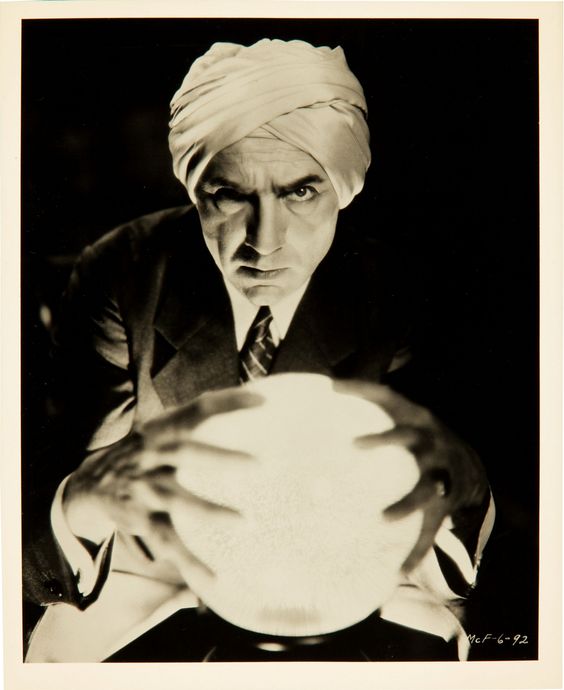
bela lugosi

People like us, who believe in physics, know that the distinction between past, present and future is only a stubbornly persistent illusion.”  — Albert Einstein

You, predictable reader, follow these words and I know that what you read next is what I write now.” — Zumwalt

It’s a poor sort of memory that only works backwards”  — From “Through the Looking Glass” by Lewis Caroll

Time may not be what it seems.  Sometimes what we assume is true is not: our senses may initially lead us to believe the sun revolves around the earth, but if we observe beyond what is most self-evident, and carefully examine a wider range of data then we must conclude that the earth revolves around the sun. As in the case with planetary bodies,  it may be that our sense of time is based on our frame of reference and not a true understanding of reality.

Physics has provided evidence during our lifetime that the future can determine the past.  The most famous example is the “quantum eraser” experiment. One can google this or check out this article: http://iheartintelligence.com/2017/01/20/quantum-experiment-present-past/.  One can even try this experiment at home: https://www.scientificamerican.com/slideshow/a-do-it-yourself-quantum-eraser/\

Is there any chance of sensing the future?  Some studies, like the famous, but controversial and legitimately challenged, Cornell University trials indicate this may be possible: http://dbem.ws/FeelingFuture.pdf

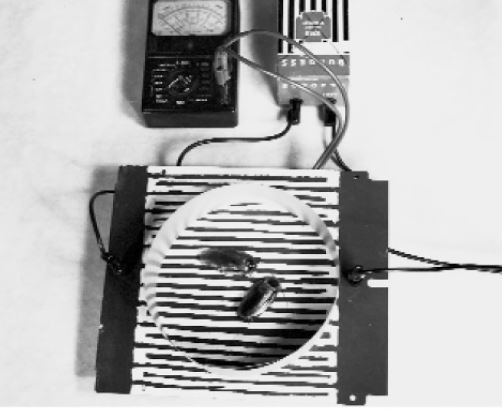
As a graduate student in music, perhaps as a break from listening to too much atonal music, I became interested in parapsychology experiments, and read numerous journals in our large college library covering this topic. There were a couple of experiments with cockroaches that really impressed me. One was an experiment by Helmut Schmidt in which he placed various laboratory animals on a divided electrical grid with a 50% chance of the shock going to the area where the animal was.  Schmidt recorded that in most trials (and these trials included hundreds of shocks), the gerbil, guinea pig or other small animal ended up being shocked around 48 to 49 percent of the time.  Schmidt was a sloppy researcher and it is not clear if this statistically significant number was due to Schmidt’s own psi abilities influencing the outcomes, or the animal’s psi abilities protecting themselves. When he put cockroaches to the test, he found they ended up being shocked 52 percent of the time as opposed to the expected 50 percent of the time. Schmidt admitted his particular dislike of cockroaches, and so it is not clear if the cockroaches were masochistic or whether it was Schmidt’s distaste for them that influenced the outcome.

Schmidt

A later researcher, revising Schmidt’s experiment, placed the cockroaches on a divided grid, with one or the other side receiving a shock and providing the cockroaches the freedom and time to travel to one side or the other.  In this experiment, the researcher recorded whether the cockroaches ended up on the side that received the electrical charge or the side that did not get the charge. Again, the result was that the cockroaches got shocked around 51 to 52 percent of the time depending on the set of trials. Were the cockroaches anticipating the future, even if there actions were not in their best interests? Or was the researcher somehow still influencing the cockroaches to get punished slightly more than expected?  Perhaps it doesn’t matter, as neither the various Schmidt experiments nor this follow-up experiment with the divided grid was ever able to be consistently replicated with the same significant results.

In the recent, and earlier referenced, Cornell set of experiments,  the most interesting ones, (okay — I concede that some may find the salacious-content experiments more interesting), are the two similar experiments addressing “Retroactive Facilitation of Recall.”  Basically the subjects are asked to look at a set of words. After this is done,  they are given a recall test (not being told about this beforehand) and each participant’s ability to recall what they have memorized is recorded.  The computer selects, randomly, half the words the subjects had previously looked at as study material, and then the students study these words.  It turns out the subjects do much better on recalling the words they had studied after the test then those they had not. Basically, this proves that if one is unable to find time to study for a test beforehand, they can always study after the test and improve their test scores — at least slightly.  (This is why, when I pick losing lottery ticket numbers, I always carefully study the winning numbers and carefully commit them to memory to increase my chances of having picked the right numbers in the first place: if I am/was successful, I not only get some extra pocket-change, but get back any time I had spent studying those numbers.)

The key here, from a very practical standpoint, is not whether others can sometimes sense the future, but whether you or I can sense the future and, if possible, how best to develop that ability.   As one might guess (or sense), there are many online opportunities to research this further. Now that I told you this, I have increased your chances of already knowing this, and I suspect that you are thinking to yourself that, yes, you already knew this, and you really don’t need to waste you time reading this blog which isn’t disclosing anything new to you at all. This of course, is what you are thinking now that you have read this. If you had read a blog on politics or music, instead, you wouldn’t be thinking this at all. If you had read a blog on politics, you probably wouldn’t even be thinking.

Back to the present, please. Let’s take a look at one particular online test:  http://www.psychicscience.org/staring.aspx

First, do the practice trial to get a sense of how simple this experiment/test is.

When doing an actual trial, my only advice is to not base your guesses on what already happened, but what you feel is about to happen.  In other words, don’t let three or four blank screens in a row bias you to select the “staring” screen based on some misunderstanding of probability.  Stay in the present and realize each display has a fifty-fifty chance of being either blank or a staring screen and don’t let what occurred before influence your decision/guess/prediction. Just feel whether you will be stared at or not and then pick your choice based on that feeling. (This may be the same sensation you get when you feel someone on the other side of the room is staring at you.  I often get this feeling when I shout and yell at the waiter or waitress in the restaurant — or when they yell at me.)

Also, best to stay relaxed and let yourself get in “the zone.” Don’t let a string of successes put pressure on you. If you feel such pressure, it may be best to take a break and come back. The screen will wait for you. (If you need to take a break, you can read some Zumwalt poems liked by previous readers. Note that any poems you click “like” on may influence anyone that read them in the past to have clicked “like” also.)

Developing an ability to feel what will happen next, may be like developing any skill.  It takes repeated practice, day after day, for an allocated time each and every day.  It is very similar to ear training exercises like this one: http://pitchimprover.com/index.php?type=Relative

After doing this http://www.psychicscience.org/staring.aspx exercise every day, for several months, please let me know if you have seen any improvement.  If so, it may motivate me to do the same. If you can’t seem to improve your ability to see into the future, don’t feel bad, at least knowing this limitation in the future should translate in your spending less time on these exercises in the here and now — or even not bothering to read this blog post.


Fifty Year Friday: John Coltrane; Jefferson Airplane “Surrealistic Pillow”

Coltrane1

“One positive thought produces millions of positive vibrations.” — John Coltrane

Coltrane’s left us fifty years ago on July 27, 1967.   He played, improvised, and composed music for a number of essential albums including “Blue Train”, “Bags and Train” with Milt Jackson, “Giant Steps”, “Thelonious Monk with John Coltrane”, “My Favorite Things”, “Live at the Village Vanguard”, “Duke Ellington & John Coltrane”, “Coltrane live at Birdland” with an incomparable version of “Afro Blue”, the one of a kind “John Coltrane and Johnny Hartman” album, and the classic “A Love Supreme.” Also of note is the June 1965 session (released in 1970) as the album “Transition” with the title track being essential to fans of  the music contained in a”Love Supreme.”  There is also music recorded in 1967, released years after Coltrane’s death, that could be classified as Free Jazz including “The Olatunji Concert: The Last Live Recording” recorded on April 23, 1967. It’s interesting to compare a 1963 live version of “My Favorite Things” to the 1967 version:

Thank-you, Mr. John Coltrane for the all this incredible music you provided.

Twenty-six year old department store model, Grace Slick, a graduate of Palo Alto High and resident of the Bay area (San Francisco Bay area) after reading an article about one of the local bands, Jefferson Airplane, in the San Francisco Chronicle newspaper, went to see them live where they played regularly (“The Matrix”, a club on Fillmore Avenue) and was soon inspired to start a band, with her husband, his brother, and three others.  

This band, “The Great Society”, named after LBJ‘s set of programs to address unjust social conditions, soon opened for other more established Bay Area groups including Jefferson Airplane, and eventually attracted the attention of Columbia Records which offered them a recording contract at about the same time that the Jefferson Airplane was looking to replace their female vocalist, Signe Toly Anderson.  Mrs. Anderson, an expecting mother, felt that she could no longer tour with the band and take care of a newborn and so gave notice, informing the public, on October 15, 1966 with words befitting any flower-power child: “I want you all to wear smiles and daisies and box balloons. I love you all. Thank you and goodbye.”

Grace Slick left her band, which not being able to continue without her, disbanded, and she joined Jefferson Airplane, bringing with her two particularly notable songs: the Great Society’s lead guitarist’s medium-tempo song “Someone to Love” and her own drug-inspired composition, “White Rabbit.”

Jefferson Airplane embraced both Grace’s powerful singing and these two tunes, which they re-arranged, maybe not for the better, but certainly with greater commercial appeal.

“Surrealistic Pillow”, Jefferson’s Airplane’s second album and the first album with Grace Slick takes advantage of Grace’s high-energy vocals from the very first track, where her background vocals are of more interest than Marty Balin’s main vocals and perhaps the main melody itself. The second track, is “Somebody to Love”, played with more force and at a faster tempo than the Great Society arrangement.

This album also includes a song that Marty Balin wrote originally for Tony Bennett: “I wrote it to try to meet Tony Bennett. He was recording in the next studio. I admired him, so I thought I’d write him a song. I never got to meet him, but the Airplane ended up doing it.” Jerry Garcia plays guitar on several tracks for this album including the short repetitive electric guitar phrase heard here:  


“Today” is followed by the evocative, marijuana-paced (and perhaps marijuana-influenced) Balin composition “Comin’ Back to Me.”

Side 2 starts with “3/5 of a Mile in 10 Second”, more for dancing then listening.  “DCBA” is relaxed and with somewhat puzzling lyrics:

“It’s time you walked away and set me free”

but later

“I take great peace in your sitting there
Searching for myself, I find a place there.”

and then in the middle of this

“Here in crystal chandelier, I’m home.
Too many days, I’ve left unstoned.
If you don’t mind happiness
Purple-pleasure fields in the sun.
Ah, don’t you know I’m runnin’ home.
Don’t you know I’m runnin’ home (to a place to you unknown? )”

“How do you feel” is one of those innocuous feel-good songs that would be comfortably at home on an album by The Mamas and Papas or The Association. “Embryonic Journey” is an excellent acoustic guitar instrumental, composed as part of a guitar workshop in Santa Clara by Jorma Kaukonen three years before he was invited to join Jefferson Airplane band by friend and fellow-classmate Paul Kantner.

The penultimate cut of the album, is the standout “White Rabbit”, rearranged musically to be succinct, focused, rhythmic and eerily similar to Ravel’s Bolero.  No concessions were made lyrically:

“One pill makes you larger
And one pill makes you small
And the ones that mother gives you
Don’t do anything at all:
Go ask Alice
When she’s ten feet tall.

“And if you go chasing rabbits
And you know you’re going to fall
Tell ’em a hookah-smoking caterpillar
Has given you the call:
Call Alice
When she was just small.

“When the men on the chessboard
Get up and tell you where to go
And you’ve just had some kind of mushroom
And your mind is moving low:
Go ask Alice
I think she’ll know.

“When logic and proportion
Have fallen sloppy dead
And the White Knight is talking backwards
And the Red Queen’s off with her head
Remember what the dormouse said:
‘Feed your head.
Feed your head.'”

I think it is at this point in time, more or less, that the commercial interests of the major music labels became more important than censorship of music with anti-establishment lyrics.   During the last eight weeks of summer, it seemed that one could not turn on Southern California AM radio without “Light My Fire” or “White Rabbit” being played at least once in any given hour. As a twelve-year old, I knew something was changing in the world around me as an older culture began to buckle under the weight of newer ideals — even if those ideals were plainly self-indulgent.

“Surrealistic Pillow” ends with a trippy, protypical Haight-Ashbury tune, “Plastic Fantastic Lover”, mocking the ascendancy of the boob tube:

“Her neon mouth with the blinkers-off smile
Nothing but an electric sign
You could say she has an individual style
She’s part of a colorful time.

“Secrecy of lady-chrome-covered clothes
You wear cause you have no other
But I suppose no one knows
You’re my plastic fantastic lover.

“Her rattlin’ cough never shuts off
Is nothin’ but a used machine
Her aluminum finish, slightly diminished
Is the best I ever have seen.

“Cosmetic baby plugged into me
I’d never ever find another;
I realize no one’s wise
To my plastic fantastic lover.

“The electrical dust is starting to rust
Her trapezoid thermometer taste;
All the red tape is mechanical rape
Of the TV program waste.

“Data control and IBM
Science is mankind’s brother
But all I see is drainin’ me
On my plastic fantastic lover.”

Music can transcend time, be a document of its time, or both.  “Surrealistic Pillow” is indisputably an important musical document of its time. As as listener, you must decide if it transcends time. For those of us that grew up with this music, it tends to take us back in time, which, I suppose, is as valid way as any to transcend time.

Track listing (from Wikipedia)

Side one
  1. She Has Funny Cars” (Jorma KaukonenMarty Balin) – 3:14
  2. Somebody to Love” (Darby Slick) – 3:00
  3. “My Best Friend” (Skip Spence) – 3:04
  4. Today” (Balin, Paul Kantner) – 3:03
  5. Comin’ Back to Me” (Balin) – 5:23
Side two
  1. “3/5 of a Mile in 10 Seconds” (Balin) – 3:45
  2. “D.C.B.A.–25” (Kantner) – 2:39
  3. “How Do You Feel” (Tom Mastin) – 3:34
  4. Embryonic Journey” (Kaukonen) – 1:55
  5. White Rabbit” (Grace Slick) – 2:32
  6. “Plastic Fantastic Lover” (Balin) – 2:39

Personnel (from Wikipedia)

  • Marty Balin – vocals, guitar, album design, lead vocals on “Today”, “Comin’ Back To Me” and “Plastic Fantastic Lover”, co-lead vocals on “She Has Funny Cars”, “My Best Friend” and “Go To Her”
  • Jack Casady – bass guitarfuzz bassrhythm guitar
  • Spencer Dryden – drumspercussion
  • Paul Kantner – rhythm guitar, vocals, lead vocals on “How Do You Feel”, co-lead vocals on “My Best Friend”, “D. C. B. A.-25” and “Go To Her”
  • Jorma Kaukonen – lead guitar, lead vocals on “Come Back Baby” and “In The Morning”
  • Grace Slick – vocals, piano, organrecorder, lead vocals on “Somebody To Love” and “White Rabbit”, co-lead vocals on “She Has Funny Cars”, “My Best Friend”, “D. C. B. A.-25” and “Go To Her”
  • Signe Toly Anderson – lead vocals on “Chauffeur Blues” (UK only)
  • Skip Spence – drums on “Don’t Slip Away”, “Come Up the Years”, and “Chauffeur Blues” (UK only)
Additional personnel

Thoughtful Thursday: Interpretation and steps prior to Action

In the previous post, I presented my own take on the DIKW pyramid as something useful for both business improvement, and if one is so inclined, self-improvement. I proposed a model that, rather than address, “Data”, “Information”, “Knowledge”, “Wisdom”, focused on the transformation of data into action.

I really had eleven steps originally, but to prior to finalizing the post, I thought best to simplify by collapsing one of the steps, “Interpret” into “Evaluate.”

Act

On reflection, “Interpret” is a necessary step much of the time.  For example, if the data quality is compromised, then one has to interpret that into usable commodity.  And collapsing it into “Evaluate” was not very appropriate as interpretation must occur very early on, not only before “Evaluate” but before “Recognize.”  For example, one is in a foreign country and one hears some strange words, then one must look them up in Google Translate (or have an app translate them) into a language one understands before one recognizes what is being said.

There is another adjustment needed besides adding “Intepret”.

After one understands, then one can act. But there are steps that are either are part of act or happen before action and these include preparation and planning. I still have these as a part of “Act” — preparing and planning are actions — but have added a missing step, “Conceive” which must occur before any action,  whether that action is preparation, creating a plan, or something as non-conscious and mechanical as clenching one’s teeth before the start of a race or taking a deep breath before speaking.

Here is an improved or enhanced version of the earlier diagram, starting with “Observe” and ending with “Act” — which can then be followed by additional observation.


Concept3

Is this accurate? How can this be improved?  Appreciate your thoughts in the comments.

Fifty Year Friday: Thelonious Monk “Straight, No Chaser”; McCoy Tyner “The Real McCoy”


2evhqIn launching a Google search for lists of Jazz albums of 1967, one finds lists like this that include many fine albums:

1967

  1. Sun Ra: Atlantis (1967)
  2. Gary Burton: A Genuine Tong Funeral (1967)
  3. Sam Rivers: Dimensions And Extensions (1967)
  4. Roscoe Mitchell: Old Quartet (1967)
  5. Bill Dixon: Intents And Purposes (1967)
  6. George Russell: Othello Ballet Suite (1967)
  7. Muhal Richard Abrams: Levels and Degrees of Light (1967)
  8. Archie Shepp: The Magic of Ju-Ju (1967)
  9. Jackie McLean: New and Old Gospel (1967)
  10. Roland Kirk: The Inflated Tear (1967)
  11. Don Ellis: Electric Bath (1967)
  12. John Coltrane: Interstellar Space (1967)
  13. Frank Wright: Your Prayer (1967)
  14. Spontaneous Music Ensemble: Withdrawal (1967)
  15. Peter Broetzmann: For Adolph Sax (1967)
  16. Chick Corea: Now He Sings Now He Sobs (1967)
  17. Miles Davis: Nefertiti (1967)
  18. Don Ellis: Live in 3 2/3/4 Time (1967)
  19. Jackie McLean: Demon’s Dance (1967)
  20. Miles Davis: Sorcerer (1967)
  21. Gary Burton: Duster (1967)
  22. John Coltrane: Expression (1967)
  23. McCoyTyner: The Real McCoy (1967)
  24. Wayne Shorter: Schizophrenia (1967)
  25. Lee Konitz: Duets (1967)
  26. Paul Bley: Virtuosi (1967)
  27. Lester Bowie: Numbers 1 & 2 (1967)
  28. Paul Bley: Ballads (1967)

(from http://www.scaruffi.com/jazz/60.html#1967)

However, notably missing from all such lists (I have seen) is one of the best jazz albums of 1967, Thelonious Monk’s “Straight No Chaser.”

Why is this? Why do fairly knowledgeable jazz listeners fail to include an album of such exceptional music?

The clear-cut answer is that Monk is competing against himself.

By 1947, when Monk first started recording for Blue Note, five days after his thirtieth birthday, his style, approach and individual voice were already established, making those Blue Note recordings exceptional statements by a fully mature artist. From 1947 to 1951, many of the most celebrated Monk compositions were captured forever for all of us: “Ruby, My Dear”,  “Well, You Needn’t”, “Round Midnight”, “Evidence”, “Misterioso”, “Epistrophy”, “Criss Cross” and “Straight, No Chaser.”

Over the next two and half decades, as jazz in general continued to expand beyond Bebop with Hard Bop, Cool, West Coast Jazz, Third Stream, Post Bop, Soul Jazz and Fusion, Monk’s approach and stylistic traits remained relatively stable.  In the sixties, Monk was no longer viewed by some as a unique innovator, but rather, just simply unique. The innovation was there — not stylistic, but in playing freshly, honestly, and incisively, continuing to balance silence against sound and expressing himself naturally, logically and directly.  His music still evolved, but slowly. and more in terms of refinement than in alignment with the other changes happening in jazz.

By this album, “Straight, No Chaser”, Monk has established a continued level of excellence — connecting directly and succinctly. That this was one of the best albums of the year could only be overlooked by those comparing this music to Monk’s work from the late 1940’s on the Blue Note label, recognizing the historical influence of that music and finding no such historical significance in this 1967 Columbia album.

The personnel for this album:

Clearly, the quality of the only non-rhythm section soloist (Monk goes way beyond being part of a rhythm section, of course) is going to have a considerable impact on the overall merit and quality of this recording, and Charlie Rouse, at this point, after working with Monk since 1959, has become the ideal tenor sax partner.  In one sense, he is an extension of Monk’s brilliance, and yet he still has his own voice and ideas.

The album I am using for this trek back through time is the LP version without the bonus tracks available on the CD version.

  1. “Locomotive” (Thelonious Monk)
  2. “I Didn’t Know About You” (Duke Ellington)
  3. “Straight, No Chaser” (Thelonious Monk)
  4. “Japanese Folk Song (Kōjō no Tsuki)” (Rentarō Taki)
  5. “Between the Devil and the Deep Blue Sea” (Harold Arlen)
  6. “We See” (Thelonious Monk)

“Locomotive”, opens the album, slow and steady, initially creating a sound picture of a locomotive chugging out of the station and then giving way to one of those “every note counts” Monk solos, a solo that is cognizant of, and at points includes fragments of, the original melody.  Rouse solos follows with Monk accompanying and the piece ends in typical bebop fashion, repeating the opening section.

The fourth track, “Japanese Folk Song” is particularly of note. On the LP the length is around 11 minutes.  On the CD reissue, the length is listed at 16:42, indicating that the LP version has been edited.  The folk song melody that opens the piece is Rentarō Taki’s “Kojo No Tsuki” (The Moon Over the Desolate Castle), originally written in 1901 as a school-book lesson in “Songs for High School Students”, and later recorded in the 1920’s becoming a well-known tune throughout Japan that was so associated with Japanese nationalism that the tune was banned by the Allies during their post WWII occupation of Japan.

Monk takes the original tune and twists it with syncopation, runs and Monk’s own distinct dynamic approach to striking the keys. Rouse comes in playing the melody eerily evenly on the beat before journeying more distantly away. At the 4 1/2 minute mark on the LP we have the start of an extended, mesmerizing solo by Monk.  (I am guessing this is where the edit is, dropping out a solo by Rouse to accommodate the time limitations of the LP.)  The last 3 minutes Rouse and Monk wind their way to the finish with interwoven, intertwined, Monk-trademark counterpoint before a brief and satisfying coda.

“The Real McCoy” is McCoy Tyner’s seventh album, but please notice that the label is no longer Impulse but Blue Note.  Blue Note Records, founded in 1939, historically seems to be the label that takes artists to their next level and so it is here with Tyner, who had recorded his last album with John Coltrane in 1965 and was not aligned with the direction Coltrane was pursuing.  Tyner: ” All I could hear was a lot of noise. I didn’t have any feeling for the music, and when I don’t have feelings, I don’t play.”

Well, there’s not any dispute about Tyner playing on this album. From the opening upbeat, contemporary “Passion Dance” to the more traditional “Blues on the Corner” spiced with Tyner’s harmonics and his energetic, almost frenetic solo, this is an excellent album.

With Tyner are three world-class jazz artists:

I am often disinterested in the obligatory bass solo (whether that is once each track or even, as in this case, once on an album), but Ron Carter, is always exceptional as he shows here on his solo, in the introspective second track, “Contemplation.”

Elvin Jones was the ideal drummer for the many Coltane albums he is on, and an excellent fit for Tyner’s compositions and Tyner’s playing.

Joe Henderson made important contributions on Blue Note albums starting in 1963, appearing on important albums for Grant Green, Andrew Hill, Horace Silver and Lee Morgan as well as Larry Young’s incomparable “Unity” album. He shimmers and sparkles on this album with inventive, engaging and compelling soloing and ensemble work.

If one compares the quality of Tyner’s piano work to Monk’s, which, of course, really isn’t fair to either artist, Tyner does come in second place in terms of overall musical intensity and economy of expression. This is evident in the exceptional track “Contemplation.” From almost the beginning Tyner includes these short repeated scalar phrases (some would call this “noodling”) which, unfortunately, remind me a little too much of some of the soloing filler of the guitarists in the 1980’s hair bands, and is not so distant to some of the unnecessary busy-ness that one can even find in earlier pianists like Art Tatum.  This is only a slight distraction, and less annoying on repeated listenings of this track; particularly as Tyner treats this as an integral part of the composition and so once one has heard the composition, these quick spurts of adjacent notes become part of the performance’s fabric.

Putting such a minor quibble aside, Tyner has put together a diverse set of compositions. The modal “Passion Dance” is exceptionally vibrant and vital. “Contemplation” is an introspective ballad.  “Four by Five” is an aggressive, wild work starting with a 4 against 5 theme and highlighted by amazing soloing by Joe Henderson. From the Blue Note Liner Notes: “McCoy explains … ‘Four By Five receives its title because the melody is constructed as if there’s a middle -it’s in 4/4 on the outside and 5/4 on the inside. But we improvise as if there weren’t a middle; we improvise only in 4/4’.”

“Search for Peace” is a soothing statement about the value of peacefulness and tranquility.  The album ends with a casual, relaxed blues-based tune, “Blues on the Corner”, nicely wrapping up an album that covers a range of emotions and attitudes, accessible and yet solidly fresh, modern music for 1967 that is as engaging today as ever.

Track listing 

All compositions by McCoy Tyner

  1. “Passion Dance” – 8:45
  2. “Contemplation” – 9:10
  3. “Four by Five” – 6:35
  4. “Search for Peace” – 6:25
  5. “Blues on the Corner” – 6:05