Zumwalt Poems Online

Archive for the ‘Fifty Year Friday’ Category

Fifty Year Friday: Donovan, John’s Children and David Bowie

DONOVAN

Though it was not a short drive, on a few occasions in the mid seventies, a group of us, consisting of a consistent core of four, along with two or three additional participants, rode in one van and, sometimes, an extra car, from Southern California to Las Vegas to see a concert. For one particular trip we went to see Yes, and the opening act for them was the Scottish singer/songwriter Donovan Leitch, simply known as Donovan.

We were comfortably seated in the mid-size Aladdin Theater for the Performing Arts , when Donovan walked on the stage, by himself, carrying an acoustic guitar. Having purchased a few of his albums when I had been much younger and having grown up hearing his music as part of the sixties listening experience, I was intrigued to see him perform.  Not so apparently with many in the audience that were here to see Yes.  At one point,  one of my fellow passengers, a generally great guy and skilled guitarist, shouted to the stage (we were quite close and had good tickets) for Donovan to finish quickly and leave. There was not much crowd noise and I suspected that Donovan could hear him as well as some of the other  voices in the area expressing the impatience.

“That’s not right”, I told my friend. “He’s did a lot in the sixties”

“Well, it’s time for him to move on” was the reply.

And, if on cue, Donovan sang just one more song and then left. It was very sad.  I had made the mistake of buying his 1973 Cosmic Wheels album when it had been released, hoping for the best and getting something closer to the opposite,  and I was under no illusion that his best days were over, but I respected some of what he had done earlier, and appreciated his contributions to the musical world I had grown up with.

The sixties, particularly 1966 and 1967, a time of great cultural and musical change, culminating not in the summer of love, but really, in the society of which we live today — a society far from all the hopes and dreams of the youth of the sixties, but, still, a society more tolerant of cultural and musical diversity than any time in history. Yes, many in today’s music industry as well as numerous “mainstream” fans don’t have a broad tolerance for musical diversity, but in terms of what is available to purchase and the range of musical styles one finds in music groups the world over, the musical freedom allowed and accepted today is greater than ever and owes much of this to what occurred in the sixties.

Classical music (also known as concert music or concert hall music) had seen an increasing velocity of change from Baroque to Classical era to Romanticism to Nationalism to various phases and flavors of Modernism until the accepted norm in the fifties was atonal and/or serial music: unmelodic, unpredictable and often classified as “experimental.”   The level of sophistication expected from the listener for this newer music created such a divide that most music presented to concert audiences were “favorites” or “war horses” from decades or one or two centuries earlier; the more modern music was relegated to college campuses, relatively small music venues, or, when part of traditional concerts, as small samplings or token works inserted into the regular season’s program schedule as almost a symbolic gesture of musical tolerance.

Jazz had undergone even more rapid changes in its short time span, borrowing from blues, marching music, written ragtime, foxtrots, and other sources to give us improvised music, first in small groups, then larger bands, and then with the advent of bebop, more emphasis on small groups again, with further changes in the 1950s incorporating influences from around the globe and classical music — expanding the various forms of jazz.  Hard Bop, Free Jazz, Third Stream and other styles pushed the level of sophistication required from the listener so much so that contemporary jazz audiences grew smaller and smaller.

Early twentieth century blues had evolved into a louder, grittier, more public style, spawning jazz music based on blues progressions, boogie-woogie, jump blues, Texas and West Coast big band blues, Chicago blues, classic rhythm and blues, Rock and Roll, and British rhythm and blues.

Most of the bands that came to the forefront by the mid 1960s (Animals, Yardbirds, Rolling Stones, Pretty Things, Spencer Davis Group, Manfred Mann, and to a large degree even the Beatles and Kinks) either started as blues-based bands or were formed by former members of such bands. The most successful of these British Bands developed their own personalities and style, abandoning blues progressions and incorporating multiple musical influences into their music.  American bands were then influenced by the British as well as incorporating folk and country music influences.  By 1967 we were seeing many of the best groups having their own sound, producing music that was not quite like any other music or other groups, and, more notably, not static but changing significantly from album to album.

Popular music in 1967 is often eclectic, groups learning from each other, borrowing elements from American Folk, Indian Classical, Jazz, Ragtime, Free Jazz,  Western Classical, American Country, Gaelic, English Music Hall and the Caribbean.

Early Donovan was influenced by Bob Dylan, both musical and lyrically. As Donovan forged his own identity, he also borrowed from contemporaries, incorporating Indian and Near East influences into his music and, as with many bands and performers, created a final product in partnership with the producer.  Donovan’s best albums, “Sunshine Superman”, “Mellow Yellow”, and “Hurdy Gurdy Man”, (and unfortunately one of his worst, “Cosmic Wheels”) were produced by Micky Most, a very singles-oriented, short song producer.

In 1967, Donovan had his own sound, was an influence on others, and was relatively popular. Donovan’s “Mellow Yellow” album was released in March 1967 and included the hit song “Mellow Yellow” which reached the number two spot on the Billboard 100 in late 1966. The era of sex, drugs and rock and roll was underway, and the lyrics of Mellow Yellow” align with such a culture: “mellow yellow”, “electrical banana”, and “wanna high forever to fly” which one can  interpret as drug references (those of us from the era remember the myth of smoking banana peels), or more accurately interpret as sex references (as later explained by Donovan — mellow yellow being a model of a vibrator), making this a love song from a vibrator to a young lady named Saffron. What may be more interesting, at least musically, is how Donovan accents the word “electrical” to fit the melody’s rhythm, something we see as a particular Donovan trait from this era — whether that is intentional or just his forcing words to fit the music.  “Epistle to Dippy”, which got to #19 on the Billboard chart around February 1967, also takes liberties with accents not only with “crystal spectacles”, “paperback” and “suspicious” but between modifiers and nouns as in “over dusty years, I ask you” sounding like “over dusty, years I ask you.” One may miss this if not listening to with the lyrics.  I can’t currently find a youtube video that display the lyrics with the music, but below are the lyrics and its worthwhile to follow them along with the song:

“Epistle To Dippy”

“Look on yonder misty mountain:
See the young monk meditating rhododendron forest.
Over dusty years, I ask you
What’s it’s been like being you?Through all levels you’ve been changing,
Getting a little bit better, no doubt.
The doctor bit was so far out.
Looking through crystal spectacles,
I can see I had your fun.Doing us paperback reader,
Made the teacher suspicious about insanity;
Fingers always touching girl.Through all levels you’ve been changing,
Getting a little bit better, no doubt.
The doctor bit was so far out.
Looking through all kinds of windows,
I can see I had your fun.
Looking through all kinds of windows.
I can see I had your fun.Looking through crystal spectacles,
I can see I had your fun.
Looking through crystal spectacles,
I can see I had your fun.
Rebel against society.
Such a tiny speculating whether to be a hip or
Skip along quite merrily.Through all levels you’ve been changing:
Elevator in the brain hotel.
Broken down, but just as well.
Looking through crystal spectacles,
I can see I had your fun.”                                                                                                                           

This song is not on the original “Mellow Yellow” album but on the current CD as a bonus track.

In October of 1967, Donovan recorded material for one of the first box sets in rock, “A Gift From a Flower to a Garden” with Donovan evidently being the flower and his audience a garden. The first record starts off with the enchanting “Wear Your Love Like Heaven” which eventually appears in cosmetic commercials including an “Eau De Love commercial with Ali MacGraw of “Goodbye, Columbus” and “Love Story” fame.

The first LP is a bit silly, but nicely melodic.  The second LP, a little more serious in my mind, is an acoustic LP dedicated to children (“For Little Ones”) and perhaps it is more serious just because the children of that era were marginally more serious and responsible than many of the teenagers and young adults.

Though “Wear Your Love Like Heaven”, “Epistle to Dippy” and “Mellow, Yellow” far outshine any of other of Donovan’s songs on “Mellow Yellow” or “A Gift from a Flower” both albums are enjoyable, interesting, and worth listening to for both historical perspective and musical enjoyment.  As a bonus one gets Paul McCartney on bass on some of the Mellow Yellow tracks, and one is exposed to a style of music that could simply be categorized as “Flower Power”, perhaps the musical equivalent of the contemporaneous philosophy of peace triumphing over the corrupt and violent aspects of social organizations and governments.
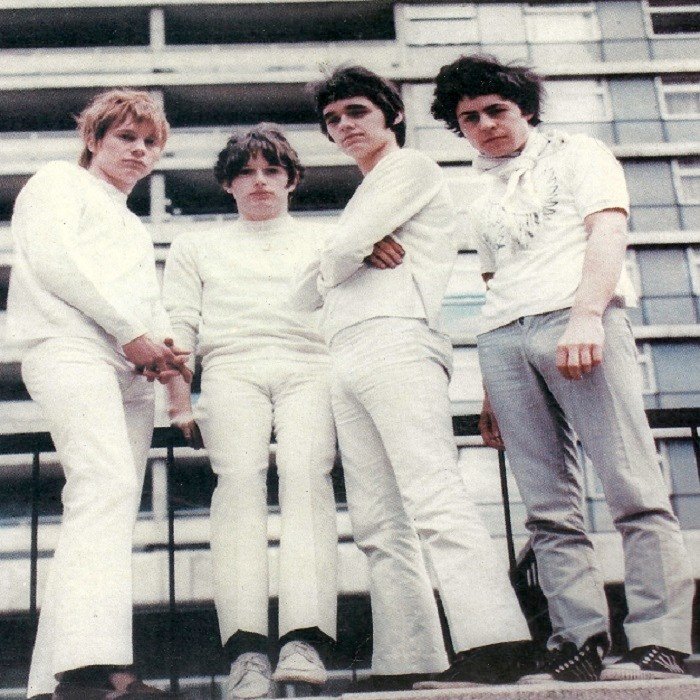
JOHN’S CHILDREN

Relatively unsuccessful, and called “positively the worst group I’d ever seen” by their own manager,  Simon Napier-Bell, John’s Children qualifies as one of the more interesting groups of 1967 for many reasons.

First, they probably played as loudly, if not louder, as anyone at that time  In fact, so loud and rowdy were they (including staged fights with fake blood capsules) that the Who dropped them as an opening act since they very effectively made the Who’s own onstage drama anti-climatic.

Second, in March 1967, the band replaces their previous guitarist with a relatively unknown, Marc Bolan, a London native with the dream of making it a singer-songwriter, like Donovan.  Bolan, becomes the new guitarist at the request of Napier-Bell, the manager of Bolan and John’s Children as Napier-Bell believes this is a win-win situation for everyone.  Marc arrives at the bands’s own club and rehearsal hall, John’s Children Club (in Leatherhead, Surrey southwest of London), with his acoustic guitar and a set of his own songs.  Switching him to a borrowed Gibson SG the current members of the band rehearse through some of their current material, listen to Bolan’s music,  leaving him to continue to play away at high volume on the Gibson.

Third, and I welcome any challenges to this contention, I believe the roots of Glam Rock can be traced to this band.  I can make a somewhat shaky case for musical elements of glam in the Kinks, The Pretty Things, and Small Faces (traces of glam in the Rolling Stones come after John’s Children’s 1967 singles), but the glam elements one find in John’s Children are more remarkable. Yes, they were loud, violent at times, so much so they got kicked out of Germany, they were technically and musically unimpressive on their instruments (except for Marc Bolan) and the lacked any notable musical identity.  But they had a outcast-type of independence, disdain for propriety, and unabashed attitude towards sex resulting in the Bolan-authored single “Desdemona” getting banned by the BBC for the phrases “Lift up your skirt and fly” and “Just because the touch of your hand can turn me on just like a stick”, naming a single “Not the Sort of Girl You’d Like to Take to Bed” (shelved by their label), and most notably, naming their first and only album “Orgasm” (which was stopped from being released with pressure from the Daughters of the American Revolution — at least until September 1970 when it was released with it’s title removed from the front cover and the LP label (but, perhaps accidentally, still visible on the thin outside spine of the cover.)

And so where was the glam?  They didn’t wear eyeliner, they mostly adhered to mod cultural norms (which were transitioning to the psychedelic era),  and they didn’t wear platform shoes or embrace sexual ambiguity.

Well, elements of glam are evident in several tracks of the pre-Bolan, “Orgasm” album, starting with the Napier-Bell/Hewlett “Smashed Blocked” track with its Queen-like ensemble vocals,  the affected, seductive vocal that follows, the 1950’s ballad chord changes á la Bowie’s “Drive-In Saturday”, the alternation between chorus and solo á la the Tubes, the flirtatious tempo, and the overall general attitude. This is the first track on the 1982 Cherry Red LP, which, I believe, presents a more accurate version of the intended order of songs than the 1970-released White Whale LP.   An interesting gimmick in play here is that the “Orgasm” album includes overlaid crowd-noise (dominated by screaming female fans) to make this sound like a live album, probably a wise choice given the general musicianship of the band.

john's children 1

The second track, “Just What You Want — Just What You’ll Get” continues to seem more glam than possible for 1967, with its tango and cabaret undertones and sexually unapologetic lyrics sounding like a cross between Alice Cooper and a song from “The Rocky Horror Picture Show”; the arrangement includes chorus backup that sounds like its coming from a cadre of male strippers. Some of this may be inferred with the advantage of a retrospective viewpoint, but there is no denying the sexual boldness and directness of the lyrics:

“Your hands and lips
Always know what I like to feel,
But don’t think I can’t see that
You’re trying hard to make me say I love you.
So what’s in it for me?

(backup singers singing “hey, hey”)
“You think that I should be crazy about you,
But I know what life would be with
Someone like you always hanging around me
So what’s in it for me?

(Chorus — lead vocal stage whisper with “hey, hey” and “buh, buh, buh” backup)
“Don’t think I don’t know just what you want – everything…
Don’t think I don’t know just what you’ll get – nothing!
What’s in it for me?
Don’t think I don’t know just what you want (just what you want)
Don’t think I don’t know just what you’ll get (just what you want, just what you’ll get)

“Leave me alone until you don’t wan’t to 
Or come back, we’ll make your love worthwhile
What’s in it for me?
Don’t come around until you’ve thought of something that
find or use your luke warm smile*
What’s in it for me?”

(*lyrics unclear at start of line)

The sixth song, “Jagged Time Lapse” provides more of this nascent glam style with a liberal amount of breathy”aaahs.”  There a several other tracks on the album, some like “Not the Sort of Girl You’d Like to Take to Bed” that are also of interest, though none of these other tracks provide any significant additional evidence to support my contention of this being the first glam album.

Note, again, that this album is before the band replaces Geoff McClelland with Marc Bolan.

The band gets an upgrade at guitar with the addition of Bolan as well as some interesting songwriting contributions.  At this point, Marc is mainly sticking to formula chord patterns but it’s fun to hear his vibrato-heavy vocals.  One can get a more complete picture of this Bolan-era of John’s Children (brief as that is) in the 2013 2 CD set, “A Strange Affair”, which includes all tracks from “Orgasm” and several post-“Orgasm” tracks.  The two CD set includes compositions by Bolan including “Hippy Gumbo” which foreshadows his upcoming Tyrannosaurus Rex work.

61a9iz-wtul-_sx300_

DAVID BOWIE

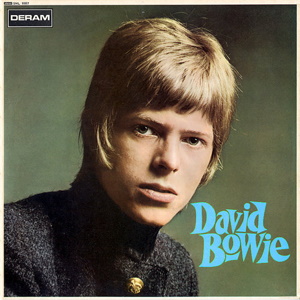
In 1967, very much under anyone’s radar, and already thirty-years old (a few months younger than Donovan and a few months older than Marc Bolan), David Bowie (replacing his real last name of Jones to avoid confusion with one the band member’s of the Monkees)  releases his first album. Nothing here indicates even a slight trace of Donovan’s Flower Power, John’s Children early glam, the Beatles sophistication, the more advanced psychedelic tendencies of Pink Floyd, Jimi Hendrix, or the Doors, the rock and roll or rhythm and blues of the early sixties British Bands, the soul of Aretha Franklin, the progressive aspirations of fellow Deram-label Moody Blues, or much of anything currently pushing the musical envelope of the time. However, there are strong influences, musically and lyrically, from Anthony Newley and English Music Hall style.  Bowie adds an offbeat twist to several songs, even more than we find from Newley or most English satire of this time.  The level of lyrical craftsmanship is solid even if the melodies are unoriginal and forgettable.  For a Bowie fan, music historian, or someone wanting to more completely understand Bowie’s range of skills, its worth exploring the David Bowie of 1967.

Previous Fifty Year Friday Posts:

The Beatles

Arthur Rubinstein/Pink Floyd

Jimi Hendrix

John Coltrane/Jefferson Airplane

Thelonious Monk/McCoy Tyner

The Doors

The Velvet Underground

Aretha Franklin/Simon Dupree and the Big Sound

Mahler recordings

Rolling Stones

Zappa/Beefheart

Fifty Year Friday: Arthur Rubinstein “Chopin: The Nocturnes, Pink Floyd “Pipers at the Gates of Dawn”

nocturnes.jpg

It’s not very difficult to make the case for Chopin being the greatest composer for the piano of the last 190 years.  I chose 190 years, since Beethoven was around until 1827, and its irrelevant, and even irreverent, to compare Beethoven and Chopin. One can even make a good case for Chopin being the greatest Western composer of the last 190 years despite weaknesses and/or apparent lack of interest in mastering orchestration and writing pieces for full orchestras that go beyond providing general accompaniment for the piano.

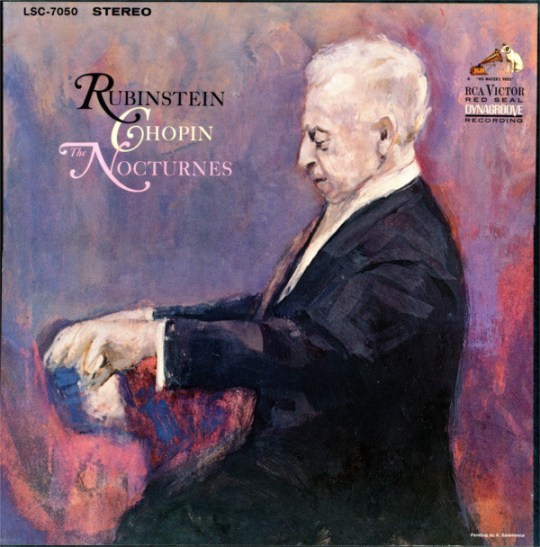
One can also make a good case for Arthur Rubinstein being the greatest Chopin performer of the Twentieth Century.  In 1967, RCA released a 2 LP set of Rubinstein playing all the Chopin Nocturnes.  All of these were recorded in 1965, except for Opus 55, No. 2 which was recorded in 1967. (Interesting, that is the only track that has notable distortion or harshness. For all the other nocturnes, the recording sound is quite good and provides an intimate, warm listening experience.)

What makes Rubinstein such a welcome interpreter of Chopin is that he doesn’t overemphasize the emotional nature of the music.  Some performers go a bit to far in slowing down, speeding up, playing too loudly here, playing too softly there — trying to eke out as much emotion as possible.  “Rubato” is the performing technique of slightly changing the notated rhythmic duration of notes, thus deviating from notes strictly aligning with their written place within the pulse of the rhythm.  When done right the overall pace is not violated so that if a given note is made shorter, another note or other notes are then made longer so the one doesn’t lose the overall beat of the music. When overdone, rubato, along with accelerando (speeding up),   rallentando (slowing down) and tenuto (holding on to notes for additional time) becomes a violation of the original spirit of the music, effectively remaking it into something akin to over-dramatic acting. Many performers, particularly in the first seventy years of the twentieth century, took extreme liberty with the music, stamping it with their own mark or as a means of pulling out inherent meaning in the music they felt was implied but not notated.

Rubinstein, who takes a relatively sober approach with Chopin, has so much control over which notes within chords or concurrent groups of notes get emphasized (and the general loudness or softness of each and every note he plays) that he can get a full range of emotions within even a strict tempo.  His tempo, of course, is far from strict or mechanical, but he never allows it to escape into regions of extreme excess. Instead of taking unacceptable liberty with the tempo or individual note values, he makes the music sing and sparkle, providing a window into the inherent expression and delicate craft of each of these nocturnes: each one providing their own world of night-like expressiveness with subtle emotional twists and turns sometimes exploring sadness, loss, longing, darkness, tenderness, patience, determination, reflection, wistfulness, sympathy, sensitivity, sentimentality, loneliness, isolation, discovery, thoughtfulness, triumph, confusion or other emotions and aspects of the human psyche.

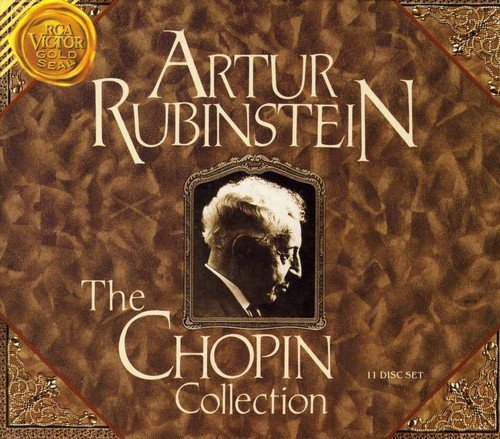
This recording is currently available as a 2 CD set, remastered and either in 16-bit or 24-bit (SACD) versions.  Value-conscious consumers will be wise to opt for “The Chopin Collection” box set which is an 11 CD set with all these nocturnes, and all the mazurkas, waltzes, preludes, other solo piano music (minus the etudes), and as a bonus, the piano concertos — this entire set currently selling at under $24.  Those with a larger budget and more available listening time may choose to get the much more expensive 142 CD “Arthur Rubinstein Complete Album Collection” set (with 2 DVDs and a 164 page booklet.)

61jonfonltl

Tracklist [from discorgs.org]

A1 Opus 9, No. 1 In B-flat Minor
A2 Opus 9, No. 2 In E-flat
A3 Opus 9, No. 3 In B
A4 Opus 15, No. 1 In F
A5 Opus 15, No. 2 In F-sharp
B1 Opus 15, No. 3 In G Minor
B2 Opus 27, No. 1 In C-sharp Minor
B3 Opus 27, No. 2 In D-flat
B4 Opus 32, No. 1 In B
B5 Opus 32, No. 2 In A-flat
C1 Opus 37, No. 1 In G Minor
C2 Opus 37, No. 2 In G
C3 Opus 48, No. 1 In C Minor
C4 Opus 48, No. 2 In F-sharp Minor
D1 Opus 55, No. 1 In F Minor
D2 Opus 55, No. 2 In E-flat
D3 Opus 62, No. 1 In B
D4 Opus 62, No. 2 In E
D5 Opus 72, Op. 72, No. 1 In E Minor

Credits


In my junior year of high school, with summer not too far off, one of my favorite people of all time, who I will just refer to with the initial “P”, and I were discussing music in the back of trig class and P. mentioned how good Pink Floyd was.  The year was 1972 and I was probably talking about King Crimson, Yes, Jethro Tull, or ELP when P. started expressing his approval of Pink Floyd.  I was interested and accepted his offer to lend me three of his albums, Ummagumma (1969), Atom Heart Mother (1970) and A Saucerful of Secrets (1968), finding many things I liked, but also finding several detours from what I considered the general flow of music.  P. also, perhaps at a later point in time, lent me the first album, “The Piper at the Gates of Dawn” (1967).  I was more pleased with that album then the others, and puzzled that this was the first album as it seemed the strongest to me, which was not the usual pattern that I saw for most groups where the first album was the weakest, the second better and the third or fourth finally being the break-out album.  This first album, though sounding dated to my early 1970’s sensitivities, seemed stronger and more consistent than the other three I had previously heard.  I am not sure if I had noticed that one musician, “Syd Barett”, was the composer of most of the music for the first album but was absent on the others.  I think its possible I did realize this and was probably why I didn’t pay much attention to any new releases by Pink Floyd until I saw the movie “Pink Floyd at Pompeii” , at our local art-house theater, The Wilshire theater.  This film captures Pink Floyd performing several selections of their music in an empty Pompeii amphitheater, the music completely enveloping and engaging. After seeing this, I was sold on Pink Floyd, and had I seen this a couple of years earlier, I would have listened much more intently to those albums my trigonometry classmate had lent me.

Looking back now with thousands of additional hours of listening to lots of different music, I can better appreciate this album much more than I ever could have at age sixteen. It doesn’t matter whether this is labeled art-rock, space-rock, psychedelic rock or something else: it is bold, original and relevant for 1967 and is still fun to listen to today.

The album borrows its title from a title of the seventh chapter of  Kenneth Grahame’s The Wind in the Willows  a cool title, indeed, but also a chapter that contains an interesting reference for a musical group that started out primarily as a psychedelic dance band:

“(Rat:) ‘…And hark to the wind playing in the reeds!’

`It’s like music–far away music,’ said the Mole nodding drowsily.

`So I was thinking,’ murmured the Rat, dreamful and languid. `Dance-music — the lilting sort that runs on without a stop — but with words in it, too — it passes into words and out of them again — I catch them at intervals — then it is dance-music once more, and then nothing but the reeds’ soft thin whispering.'”

And we have dance music with words and far-away lilting non-stop psychedelia-based tunes with their first two singles, written by Syd Barret, “Arnold Layne” and “See Emily Play” and their less dance-able, more exploratory, third single, “Apples and Oranges” also written by Syd Barrett.

And this album is filled with easily accessible dreamy, languid, melodic gems: these all written by Syd Barrett.  The UK version (import version for us Americans) is different from a somewhat messed-up U.S. version (the version I will reference below is the superior UK version.)

“Astronomy Domine” is a masterpiece of space rock – vast, unfolding, hints of the infinite and timeless, paced with a relentless, cosmic inevitability, modal and chromatic.

“Lucifer Sam”, about a Siamese cat, is more whimsical but still edged with an embrace of psychedelia and a chromatic passage reminiscent of the James Bond theme.

“Matilda Mother” opens slow-paced, relaxed, and dreamy, shifting to a more rhythmic passage and then back to the dreamy opening before its short Indian-like instrumental — providing but short contrast to the returning dreamy theme and a brief instrumental coda.

While other groups at this time are starting to augment their music with strings, woodwinds, and exotic instruments, Pink Floyd achieves equally impressive results with a traditional line-up of vocals, guitar, bass, organ/piano and drums.  Syd Barrett’s guitar, though not textbook virtuosic, is expressive, flexible and effective.  Vocals include wind effects and bird calls, “oohs” and “aaahs”.  The organ provides drones and other relatively simple effects.  “Flaming” and the more free-form “Pow R. Toc H.” shows off the ability of the band to create very different soundscapes, the former showcasing guitar and organ, the latter, nicely showcasing piano, bass drums, guitar, simple vocal effects, and organ in various moods and attitudes with an almost jazz-like piano and drum interlude providing welcome contrast.

Roger Waters provides a very sixties contribution in the opening of “Take up Thy Stethoscope and Walk” which then dissolves into a group jam.

We get back to great music on side two with the opening of “Interstellar Overdrive”, though it does soon meander, losing focus — but better uncompromising and adventurous, than bland and commonplace: perhaps the band assumes the listener will have some assistance with illicit substances.  Pretentious, often a term overused as an invective against progressive rock much more than psychedelic rock, is a term I am loathe to use — but I will concede that the ending is a bit over the top.

We get back to Barrett mini-masterpieces for the last four tracks.  The music is unassuming, natural and foundationally simple.  “Gnome” is pure pop, but with a Barrett twist.  “Chapter 24” is spacey and reflective with lyrics apparently based on the 24th chapter of I Ching “The Return” (or “Turning Point”) as translated below by Richard Wilhelm:

“Everything comes of itself at the appointed time. This is the meaning of heaven and earth. All movements are accomplished in six stages, and the seventh brings return. Thus the winter solstice, with which the decline of the year begins, comes in the seventh month after the summer solstice; so too sunrise comes in the seventh double hour after sunset. Therefore seven is the number of the young light, and it arises when six, the number of the great darkness, is increased by one. In this way the state of rest gives place to movement”

Compare this to the Barrett lyrics:

“A movement is accomplished in six stages
And the seventh brings return.
The seven is the number of the young light.
It forms when darkness is increased by one.
Change returns success,
Going and coming without error.
Action brings good fortune:
Sunset.

“The time is with the month of winter solstice
When the change is due to come.
Thunder in the other course of heaven;
Things cannot be destroyed once and for all.
Change returns success,
Going and coming without error.
Action brings good fortune:
Sunset, sunrise.

“Scarecrow” opens up with some nifty percussive syncopation upon which the melody is overlaid, giving us a short song that’s simple and complex simultaneously.

“Bike” magnificently ends this album with more hazy, dreaming psychedelia based on simple melody and chords effectively arranged and presented.  This is a perfect conclusion to a very different album than anything else in 1967 popular music.

After listening to this album, and looking at the song credits, one might very well conclude that Syd Barrett was the key member of Pink Floyd and without them they would either struggle as a band or be very different and probably not nearly as good. Without getting into the tragedy of Barrett’s behavioral disorders, likely an after-effect of repeated LSD usage, which is covered by numerous resources on the web including Wikipedia and several WordPress blogs (most of which are generally much better written than this one), the band soon dropped an unreliable and unpredictable Syd Barrett from their line-up.  Barrett continued to struggle from the aftermath of chemically-caused neurological damage, subsequently recording two solo albums in 1969, and then more or less becoming a recluse until his death in 2006 at the age of 60. From such a promising first album ensues an heart-sickening tragedy; just another instance of a unconventional, creative genius taken away from us in the turbulent, unpredictable, ever-changing 1960s.

Track listing [from Wikipedia]

UK release

Side one
No. Title Writer(s) Lead vocals Length
1. Astronomy Domine Syd Barrett Syd Barrett and Richard Wright 4:12
2. Lucifer Sam Barrett Barrett 3:07
3. Matilda Mother Barrett Barrett and Wright 3:08
4. Flaming Barrett Barrett 2:46
5. Pow R. Toc H. instrumental 4:26
6. Take Up Thy Stethoscope and Walk Waters Roger Waters 3:05
Total length: 20:44
Side two
No. Title Writer(s) Lead vocals Length
1. Interstellar Overdrive
  • Barrett
  • Waters
  • Wright
  • Mason
instrumental 9:41
2. The Gnome Barrett Barrett 2:13
3. Chapter 24 Barrett Barrett 3:42
4. The Scarecrow Barrett Barrett 2:11
5. Bike Barrett Barrett 3:21
Total length: 21:08

US release

Side one
No. Title Writer(s) Lead vocals Length
1. See Emily Play Barrett Barrett 2:53
2. “Pow R. Toc H.”
  • Barrett
  • Waters
  • Wright
  • Mason
instrumental 4:26
3. “Take Up Thy Stethoscope and Walk” Waters Waters 3:05
4. “Lucifer Sam” Barrett Barrett 3:07
5. “Matilda Mother” Barrett Barrett and Wright 3:08
Side two
No. Title Writer(s) Lead vocals Length
1. “The Scarecrow” Barrett Barrett 2:11
2. “The Gnome” Barrett Barrett 2:13
3. “Chapter 24” Barrett Barrett 3:42
4. “Interstellar Overdrive”
  • Barrett
  • Waters
  • Wright
  • Mason
instrumental 9:41

Personnel

Pink Floyd

Production

  • Syd Barrett – rear cover design
  • Peter Bown – engineering
  • Peter Jenner – intro vocalisations on “Astronomy Domine” (uncredited)
  • Vic Singh – front cover photography
  • Norman Smith – production, vocal and instrumental arrangements, drum roll on “Interstellar Overdrive”[125]

BC.jpg (1181×1200)

Previous Fifty Year Friday Posts:

The Beatles

Jimi Hendrix

John Coltrane/Jefferson Airplane

Thelonious Monk/McCoy Tyner

The Doors

The Velvet Underground

Fifty Year Friday: Aretha Franklin “I Never Loved a Man”, Simon Dupree & The Big Sound “Without Reservations”

Aretha Franklin  “I Never Loved a Man”

aretha-franklin-i-never-loved-a-man-the-way-i-love-you-atlantic-4.jpg (800×797)

Raised singing gospel and touring with her minister father on gospel caravan tours,  first accompanying his preaching on piano and later singing on his gospel tours from church to church, Aretha Franklin recorded her first album in 1956 at the age of 14, “Songs of Faith”, a album of nine gospel songs recorded live.

At 18, Aretha chose to pursue a pop career, like her close friend Sam Cooke, who she had known when he was in the Soul Stirrers, and signed with Columbia records.  Columbia had little interest of what was best for Aretha, and determined to make her into a commercially viable jazz-pop singer, ignoring her gospel background and making touring and song selection choices for her based on converting her into a marketable and commercially successful commodity — but basically failing at that over the course of recording eleven commercially disappointing albums.  Fortunately at the end of her Columbia contract, Aretha signed with the smaller, independent label, Atlantic Records in 1966 and Atlantic gave her the green light to not only chose her own songs, but determine how she would sing, perform and arrange them.  Now in control of the artistic process, Aretha also composed songs, played piano and brought in her two sisters Erma and Carolyn to provide backup vocals. The result was an artistic and commercial success where Aretha used her full range of talents and drew on her gospel experience to provide a expressive, vital album, distinctive, yet intimately familiar.

arethamain2

On this new album, “I Never Loved a Man the Way I Love You”, Aretha combines a wide range of musical and emotional expression coherently, consistently,  and consummately throughout all eleven tracks.  The vocal nuance and subtitles captured here make this album a classic that can be listened to over and over.  This music and singing owe much to the gospel music of Aretha’s cultural heritage, but the lyrics are secular and, like traditional blues, address flawed social and inter-personal relationships.

Tracks like Otis Redding’s “Respect”, the song many people today directly associate with Aretha Franklin, “I Never Loved a Man” and “Do Right Woman, Do Right Man” are particularly notable, but one can pick any song on this album to savor the beauty and artistry of Aretha Franklin’s exceptional vocal delivery.  Appropriate musical support is provided, including King Curtis on saxophone.

In addition to this landmark album, Aretha provided us four number one singles on the R&B charts in 1967, two from this album, plus “Baby, I Love You” from her second 1967 Atlantic album “Aretha Arrives” and “Chain of Fools.” Also of note is Aretha’s 1967 recording of Carol King’s “(You Make Me Feel Like) A Natural Woman” written especially for Aretha and appearing on her third Altantic album, “Aretha: Lady Soul” recorded in 1967 and released January 1968.

Track listing [from Wikipedia]

Side one
No. Title Writer(s) Length
1. Respect Otis Redding 2:29
2. Drown in My Own Tears Henry Glover 4:07
3. I Never Loved a Man (The Way I Love You) Ronnie Shannon 2:51
4. Soul Serenade King CurtisLuther Dixon 2:39
5. “Don’t Let Me Lose This Dream” Aretha Franklin, Ted White 2:23
6. “Baby Baby Baby” Aretha Franklin, Carolyn Franklin 2:54
Side two
No. Title Writer(s) Length
7. “Dr. Feelgood” Aretha Franklin, Ted White 3:23
8. Good Times Sam Cooke 2:10
9. Do Right Woman, Do Right Man Dan PennChips Moman 3:16
10. “Save Me” Aretha Franklin, Carolyn Franklin, King Curtis 2:21
11. A Change Is Gonna Come Sam Cooke 4:20

Simon Dupree & The Big Sound

It would be just fine for me to completely skip over Simon Dupree & The Big Sound, except for one extremely important consideration: three of the band members (brothers Phil Shulman, Derek Shulman and Ray Shulman) would later form Gentle Giant joining up with keyboardist and composer Kerry Minnear.

The UK was awash with bands of young musicians emulating American Rhythm and Blues.  We all know about the early Beatles, Stones, Animals and Pretty Things.  Few Americans, excepting die-hard Gentle Giant fans, know much about Simon Dupree & the Big Sound.

At some point in the mid-seventies, I had seen a lineage tree of where members of various seventy bands had come from: Keith Emerson of ELP had come from The Nice, Carl Palmer from Atomic Rooster and before that Crazy World of Arthur Brown, Greg Lake from King Crimson and before that the Gods — that sort of thing.  Will this “ancestry chart” showed that the three Shulmans came from Simon Dupree & The Big Sound.  I looked in the Schwann LP Catalog for any listing and saw none.  Clearly any albums they ahd recorded were out of print. Doing some further research I found they had one Top 10 UK singles hit, “Kites“, which reached the number eight position.

Years later, in 1988, I was then very lucky to find the single on a juke box in the UK in a pub in Holyhead, Wales while sipping on a pint of local brew and killing time while waiting to catch a ferry to Dublin. I got out some local pocket change and played both sides, listening to “Kites” three times and the B side, “Like the Sun, Like the Fire” twice. Despite the mellotron, xylophone, gong, wind-machine, and actress Jacqui Chan‘s seductively spoken Chinese on Kites during the instrumental passage, I preferred the B side, which sounded closer to very early Gentle Giant and included a bridge with a soulful Derek Shulman vocal and a brief bassoon, oboe and clarinet instrumental section and a final brief marching band coda.  Almost thirty years after hearing this track for this first time, I found out this song was co-authored by the one Shulman that wasn’t ever a part of Gentle Giant, Evelyn King, the elder sister to the Shulman brothers.

Simon Dupree and the Big Sound, based in Portsmouth, home of the Shulmans, was not named after any band member (the band was primarly the three Shulman brothers supplemented by Peter O’Flaherty on bass guitar, Eric Hine on keyboards, and dummer Tony Ransley.) Originally the group’s name was “Howlin’ Wolves” befitting of their R & B style, later changed to the Road Runners, and then finally replaced by Simon Dupree and the Big Sound at the suggestion of a local Portsmouth music promoter: Dupree was the name of an established and well known local family in Portsmouth.

The first (and only) album, “Without Reservations” is only sporadically interesting, partly due to the arrangements and level of musicianship of the Shulmans, and partly as providing insight into what contributions the Shulmans made to Gentle Giant compositions, particularly the first Gentle Giant album and the last three.  (On all their albums, from first to last, Gentle Giant gave song writing credit to their entire band rather than any individual contributors.)

Simon Dupree would continue on for a couple of more years with several attempts to score a second hit after Kites, but with no success. At one point, for a tour of Scotland, they had to replace an ill Eric Hines with an unknown keyboard player, Reggie Dwight (later Elton John, of course) for a tour of Scotland.   Dupree ended up recording an Elton John/Bernie Taupin tune, “I’m Going Home” for the B side of a recording of a James Taylor tune, “Something in the Way She Moves.” For whatever reason, Elton was not invited to remain as part of the band. Perhaps in some parallel universe, there is a recording of “Three Friends” with Elton John on keyboards. Whether that would have charted higher or lower than #197 on the Billboard 200 is open to speculation.

Fans of Gentle Giant can pick up all the Dupree recordings in the CD “Part of my Past” which includes all their studio-recorded tracks, mostly from 1967, with a few tunes from 1968 and 1969. As long as one keeps one’s expectations under check, there are enough interesting moments to make listening to this worthwhile and to further one’s understanding of the important role Kerry Minnear played in what was most exceptional about Gentle Giant and in why the overall low quality of “Giant For a Day” can be inferred to be due to a diminished role for Kerry Minnear, the composer.

Fifty Year Friday: Mahler’s Sixth Symphony and “Song of the Earth”

Gustav Mahler’s Sixth Symphony performed by Sir John Barbirolli and the New Philharmonia Orchestra (live recording of August 16, 1967 — Proms performance)

b002hesqnu

Gustav Mahler’s sixth symphony was first performed in May 1906 by the composer. Interestingly, Mahler performed the movements in a different order (Allegro, Andante, Scherzo, Finale) than the order in the version published two months earlier. What apparently occurred was that Mahler, during rehearsals, decided that the symphony worked better if the second and third movements were swapped, placing the scherzo in its historically more traditional place after a slow second movement and before the last movement. Mahler notified his publisher to put out a second edition with the new order of Allegro, Andante, Scherzo and Finale and to include errata additions to unsold copies of the first edition.

For the next few decades, Mahler’s sixth was performed with the Scherzo following that Andante slow movement.  Then in the 1950s the first editor of the Critical Edition of Mahler’s works, Erwin Ratz,  came to the conclusion that Mahler had got it right originally and that despite Mahler always conducting the Sixth with the Scherzo after the Andante, that the correct order should be with the Scherzo before the Andante. Without any solid supporting evidence, Ratz, when finalizing the “authoritative” Critical Edition of the Sixth Symphony in 1963, stated in the preface that Mahler had meant to revert to the original order as represented by the first edition, but did not (as Mahler had died in 1911.)

Turns out we now know that Ratz had falsified evidence to support what probably was a personal conclusion based on his analysis of the score.  The Scherzo shares thematic material with the first movement as well as tonal orientation.  Analysis may support a view that Mahler wrote the piece to be performed in the order Ratz proposes, but composers certainly are allowed to make changes, as Mahler not only did to the order, but to the score itself,  and Mahler, known for revising his published works, probably would have made further changes over time if he had lived longer.

In 1998, the latest Critical Edition of the Sixth was released, with the Ratz error still in place, but then in 2004, The Kaplan Foundation published a paper including an essay by recording engineer Jerry Bruck and an essay by Reinhold Kubik, the new chief editor of the Mahler Critical Edition. overturning the Ratz order of Scherzo before Andante and refuting Ratz’s assertion.

Thus with a few exceptions, all recordings between 1961 and around 2000 or so, have the Scherzo occurring before the Andante.  One notable exception is the live January 1966 Berlin Philharmonic recording conducted by Sir John Barbirolli and the live August 16 1967 and the August 1967 studio recording performed by New Philharmonia Orchestra and also conducted by  Sir John Barbirolli.

Performing a complex work like Mahler’s Sixth demands serious study of the score. It is not a work that easily comes together into a comprehensible whole.  For this work to sound like a single unified piece with an overall logic and message, it requires a major commitment by any conductor.  Barbirolli was indeed very serious in his study of this work.  Perhaps it was through such score analysis that led to Barbirolli’s decision to put the Scherzo after the Andante. Perhaps he realized that the Andante provided the necessary contrast, release of tension, and proper overall flow when coming between the opening movement and the scherzo.

When these recordings where first issued, the two live version had the movements in the order they were performed, but for the August 1967 studio version, EMI reversed the order of the middle movements to place the Scherzo back earlier as was indicated in the erroneous critical edition.  Reportedly, Barbirolli was more disappointed then angry at this, but thankfully, current CDs of this studio version have the Scherzo properly placed as the third movement as performed originally and consistently by both Mahler and Barbirolli.

There are only a few recordings of the sixth undertaken before these three Barbirolli recordings in 1966 and 1967.  Since 1967 there have been several dozen recordings, most of these occurring in the CD era.  For those recordings made in the last forty years of the twentieth century where the Scherzo was performed before the Andante, one might just be tempted to program the CD to play these in the proper order, but this doesn’t quite work so well as each of these conductors crafted an overall performance architecture to work around an earlier placed Scherzo.  In my opinion, switching the order, just makes these performances less logical and cohesive, not more.

Of the two 1967 Barbirolli recordings, both are worth a listen, and the notable differences are as follows:

  1. The 1967 live recording sound is not such a great recording sonically.  The studio recording is much better.  Even the earlier 1966 Berlin live performance is significantly better sounding than the 1967 live recording.
  2. The 1967 live recording is far from a flawless performance with some audible flubs by the orchestra.
  3. The pace of the two recordings are much different. The tempo of the live 1967 recording, like the live 1966 recording, is an appropriate tempo to keep the music moving forward and connect the various ideas.  The tempo of the studio recording is puzzling slow::
    1. First movement: 1967 Studio: 21:20. 1967 Live: 19:08
    2. Second movement: 1967 Studio: 16:03. 1967 Live: 14:00
    3. Third movement: 1967 Studio: 13:59. 1967 Live: 12:08
    4. Fourth movement: 1967 Studio: 32:48. 1967 Live: 29:23
  4. The orchestra sounds more engaged and more focused in the live recording.  Some of this may be due to the faster tempo, but certainly playing live often brings out the best in concert hall performers.
  5. Unfortunately, both these recordings omit the repeat as noted in the score of the first movement, a common practice when recording long works during the LP era.

This 1967 Live recording may suffer slightly in comparison to more recent recordings of Mahler’s Sixth, but historically, one has to love how Sir John Barbirolli not only took on what was then a vastly underappreciated work, but got so much right in performing this work.

Mahler’s “Lied von der Erde” (“Song of the Earth”) performed by Otto Klemperer and Philharmonia Orchestra, New Philharmonia Orchestra, Christa Ludwig mezzo soprano, and Fritz Wunderlich tenor


mlvde7

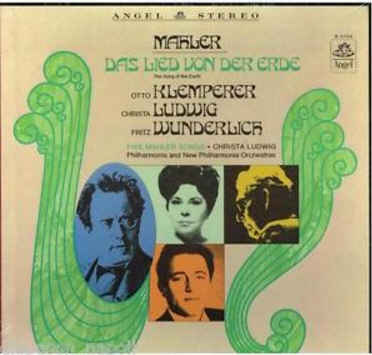
Recorded in February and Novemeber 1964 at two venues (with the orchestra changing its name from “Philharmonia” to “New Philharmonia” in between) and released in 1967 on a 2 LP set along with five songs from two different Mahler works (two songs from “Des Knaben Wunderhorn” and three of five songs from “Rückert-Lieder”) this was the best recording of Gustav Mahler’s “Das Lied Von Der Erde” found in college music libraries in the 1970s, where music majors like me often went to listen to such works as part of their music history studies. This recording captures the music with detail and beauty, presenting a relatively forward plane of sound such that solos are clear and both singers are placed in front and not lost amidst a large orchestra. It is a real joy to listen to on a good audio system with the clarinet, oboe and flute lines distinct and luminously clear  throughout and the two soloists balanced so well against their orchestral accompaniment.

There is no disputing the importance or quality of what many consider to be Mahler’s greatest work.  Composed in 1908, it was written after 1) Mahler had suffered through the politics of hatred and antisemitism that forced him to resign as director of the Vienna Court Opera, after 2) Mahler learned that he had a fatal heart condition, probably a congenital defect that had claimed the lives of his little brother and later his mother, and, 3) worse than either of these for any parent, the loss of his five-year-old daughter, Maria to scarlet fever and diptheria.

marial “With one stroke,” he wrote to his friend Bruno Walter, “I have lost everything I have gained in terms of who I thought I was, and have to learn my first steps again like a newborn”.

“Das Lied Von Der Erde” is a symphony in six parts written on the text of seven poems from Hans Bethge’s first book of translation of Tang Dynasty poetry, “The Chinese Flute.” Mahler begins “Das Lied Von Der Erde” with these dark words attributed to wandering Chinese poet, Li Bai:

“The wine beckons in golden goblets
but drink not yet; first I’ll sing you a song.
The song of sorrow shall ring laughingly in your soul.
When the sorrow comes, blasted lie the gardens of the soul,
wither and perish joy and singing.
Dark is life, dark is death!”

Mahler’s “Song of the Earth” is a work one can repeatedly listen to,  absorbing the sparkling, transitory joy, the moments of anguish, despair, and bleak, unshakable sorrow, and the spiritual sophistication and beauty of Mahler’s chromatically extended tonality.  Of all the recordings out there, this 1967 classic recording by Klemperer, the Philharmonia Orchestra/New Philharmonia Orchestra, Christa Ludwig, and Fritz Wunderlich is a perfect place to start or return to, depending how many times you have listened to “Das Lied Von Der Erde.”  Otto Klemperer was one of the few conductors who actually knew Gustav Mahler, heard Mahler conduct, and survived into the age of stereo to record him.  Perhaps this is the closest to hearing how Mahler would have recorded this work.

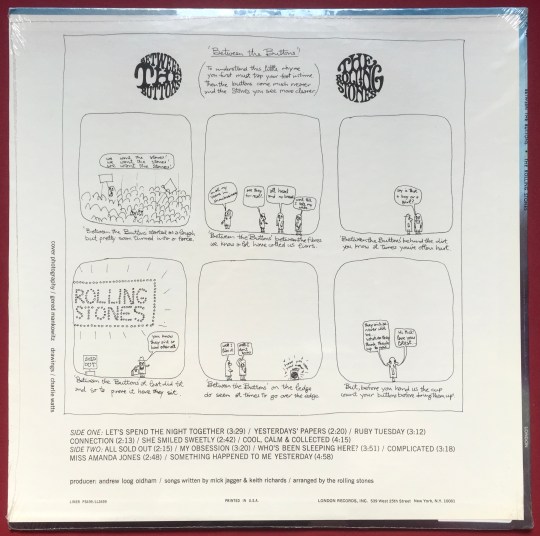
Fifty Year Friday: Rolling Stones “Between the Buttons”

betweenthebuttonsuk

Prior to checking this album, Between The Buttons, out of our local public library sometime around 1969, I had never heard anything by the Stones except what I heard on low-fidelity AM radio.  I was surprised to find the consistency of quality songs on the album — and how appealing each track was.

The album I heard was the American version which starts out with the three tracks that I had previously heard on the radio: “Let’s Spend the Night Together”, “Yesterday’s Papers” and “Ruby Tuesday.”

If  you are looking to pick one of the two best Rolling Stones’ songs ever, “Ruby Tuesday” seems a must, with its dreamy, reflective, beautifully A minor melodic verse and the upbeat, celebratory verse (in the relative major key) — and “Let’s Spend the Night Together” deserves serious consideration.  If this album contained nothing more, it would be worthwhile to have in one’s collection.

After these first three songs on side one, we get “Connection”, a solid, steady-beat rock song, “She Smiled Sweetly”,  a sensitive ballad, and “Cool, Calm & Collected” with its ragtime-like piano-dominated verse (representing the successful, material-based elements of life) and it’s Indian-influenced chorus (representing the spiritual sentiment of “cool, calm, collected” that tag-team throughout the tune to its accelerating frenzy climax.

Side two may not be as strong as side one, and doesn’t hold up as well to repeated listenings, but is still generally good with “Who’s Been Sleeping Here” and “Something Happened to Me Yesterday” with its English Musical Hall quality and steady march beat. Please note Nicki Hopkins incredibly important contributions on piano to both “Cool Calm Collected” and “Something Happened to Me Yesterday.”

AMERICAN ALBUM TRACK LISTING [from Wikipedia]

Side one
No. Title Length
1. Let’s Spend the Night Together 3:38
2. Yesterday’s Papers 2:01
3. Ruby Tuesday 3:16
4. Connection 2:08
5. “She Smiled Sweetly” 2:44
6. “Cool, Calm & Collected” 4:17
Side two
No. Title Length
7. “All Sold Out” 2:17
8. “My Obsession” 3:20
9. “Who’s Been Sleeping Here?” 3:55
10. “Complicated” 3:15
11. “Miss Amanda Jones” 2:48
12. Something Happened to Me Yesterday 4:5

Personnel [from Wikipedia]

As per the American release:

The Rolling Stones
  • Bill Wyman – bass guitar (2, 3, 6-12), double bass (3)
Additional musicians

70770433-origpic-81fd29

Fifty Year Friday: Jobim “Wave”; Zappa, “Absolutely Free”; Beefheart “Safe as Milk”


wave

Jazz fan’s will likely know of Antonio Carlos Jobim two albums with Stan Getz, particularly the first one, Getz/Gilberto containing “Desafinado” and the classic version of “The Girl from Ipanema” with  Astrud Gilberto‘s seductive vocals.    That first album, added fuel to the already burning fiery desire of Americans to hear and dance to bossa nova, and elevated Jobim to a marketable American music business commodity.

“Wave”, released in 1967, became Jobim’s best selling album, providing smooth, comforting music for middle America and many non-jazz record consumers. The music is well-crafted, well-arranged and well-performed with Jobim playing guitar, piano, celeste and harpsichord, Ron Carter on bass, Urbie Green on trombone, and a small string orchestra with french horn and flute/picolo all providing the most mellow dance music possible.   It is not exactly jazz and, in a sense, sets the tone for a genre of music that would be called smooth jazz,  a style not demanding listener attention or involvement, but played for its soothing, relaxing qualities.  Such smooth or background music became prevalent in shopping centers, in restaurants and in many work places that now added such music or substituted smooth jazz for the previously provided muzak. In 1987, Los Angeles radio stations KMET, once one of the coolest, most progressive album-oriented,  FM radio stations in Southern California, changed its letters to KTWV and called itself “The Wave” playing “adult contemporary jazz” becoming one of the un-coolest, most un-progressive stations in the Greater Los Angeles area ultimately influencing other radio stations to take the same path.

Of course, none of the blame should be attributed to this fine Jobim album; it is just worth noting that soon background music became virulently prevalent, irking many musicians that believed music should be actively listened to and not absorbed.

Track listing[from Wikipedia]

All tracks composed by Antônio Carlos Jobim.

  1. Wave” – 2:56
  2. “The Red Blouse” – 5:09
  3. “Look to the Sky” – 2:20
  4. “Batidinha” – 3:17
  5. Triste” – 2:09
  6. “Mojave” – 2:27
  7. “Diálogo” – 2:55
  8. “Lamento” (lyrics by Vinicius de Moraes) – 2:46
  9. “Antigua” – 3:10
  10. “Captain Bacardi” – 4:29


frankzappa-absolutelyfree

Frank Zappa and his Mothers of Invention did not produce either easy listening music or anything that could be considered conservative.   This is the Mothers of Invention’s second studio album and every bit as adventurous as the first including mixed meter and quotes from Stravinsky’s three most famous ballets, “The Firebird”, “Rite of Spring” (“Le Sacre du printemps”) and Petrushka.  Each side of the original LP can be viewed as a single piece rather than a set of unrelated tracks due to redeployment and relationship of music material.  Humor is a inseparable part of this innovative album that many Zappa fan’s cite as one of their favorites.

Track listing [from Wikipedia]

All tracks written by Frank Zappa.

Side one: “Absolutely Free” (#1 in a Series of Underground Oratorios)
No. Title Length
1. Plastic People 3:40
2. “The Duke of Prunes” 2:12
3. “Amnesia Vivace” 1:01
4. “The Duke Regains His Chops” 1:45
5. “Call Any Vegetable” 2:19
6. “Invocation & Ritual Dance of the Young Pumpkin” 6:57
7. “Soft-Sell Conclusion” 1:40
Side two: “The M.O.I. American Pageant” (#2 in a Series of Underground Oratorios)
No. Title Length
1. “America Drinks” 1:52
2. “Status Back Baby” 2:52
3. “Uncle Bernie’s Farm” 2:09
4. “Son of Suzy Creamcheese” 1:33
5. Brown Shoes Don’t Make It 7:26
6. America Drinks & Goes Home 2:43

Personnel[from Wikipedia]

Note that there are several additional musicians on this album including Don Ellis on trumpet on “Brown Shoes Don’t make it”


safeasmilk-bds1001-covers

Another less-than-easy-listening album is Captain Beefheart and his Magic Band’s “Safe as Milk” which starts from a blues foundation but includes uncommon time signatures and unique instrumental divergences. On one hand, a traditional blues fan might prefer to spend their time listening to a true blues album by someone like Howlin’ Wolf rather than this Don Van Vliet (A.K.A Captain Beefheart) psuedo-blues album. However, despite some superficial similarities in Howlin’ Wolf’s and Beefheart’s voices, and “Safe as Milk’s fairly straightforward first track, there are enough deviations here, musically and lyrically, from other more solid blues albums of the time to take this album on its own terms. Guitarist Ry Cooder, having played with Taj Mahal in the short-lived Rising Sons, makes important arrangement and performance contributions. Historically, this is an important album as it captures a band in transition to a more adventurous style that merges blues, free jazz and art-rock into a genre I could only call head-spinning, head-splitting, free-style post-blues

So even though this is much closer to standard fare than later Captain Beefheart albums, it contains a number of adjustments to standard rock/blues that make this an album worth checking out.  “Yellow Brick Road” borrows the first part of its melody from “Pop Goes the Weasel” but strays off into its own tune with a mix of innocent and suggestive lyrics. “Autumn Child” pushes into both art-rock and progressive rock territory with its Zappa-like opening and changes in meter, texture, tempo and mood.  Electricity” is the stand-out track, with lyrics and music flirting with psychedelia (note the guitar imitating the sitar), blues, bluegrass, and rock, and, once past the brilliant introduction, is very danceable. The rising oscillations of a thermin closes out the song.


Whereas one can put on “Waves” (and even “Absolutely Free” under the right circumstances) and delegate it to the background with little trouble, if one does this with some of the Beefheart “Safe as Milk” tracks like “Electricity”, “Plastic Factory” and “Abba Zaba”, they simply become distracting and annoying; however, play this album on a good audio system that can untangle the aggressive texture into individual and distinctive voices and the music flies by and, if not always pleasant, is unexpectedly absorbing and engaging.

Track listing[from Wikipedia]

All songs written by Herb Bermann and Don Van Vliet except where noted.

Side one
No. Title Length
1. “Sure ‘Nuff ‘n Yes I Do” 2:15
2. “Zig Zag Wanderer” 2:40
3. “Call on Me” (Van Vliet) 2:37
4. “Dropout Boogie” 2:32
5. “I’m Glad” (Van Vliet) 3:31
6. Electricity 3:07
Side two
No. Title Length
7. “Yellow Brick Road” 2:28
8. “Abba Zaba” (Van Vliet) 2:44
9. “Plastic Factory” (Van Vliet, Bermann, Jerry Handley) 3:08
10. “Where There’s Woman” 2:09
11. “Grown So Ugly” (Robert Pete Williams) 2:27
12. “Autumn’s Child” 4:02


Personnel 
[fromWikipedia]

Captain Beefheart and his Magic Band
  • Don Van Vliet – lead vocals, harmonica, marimba, arrangements
  • Alex St. Clair Snouffer – guitar, backing vocals, bass, percussion
  • Ry Cooder – guitar, bass, slide guitar, percussion, arrangements
  • Jerry Handley – bass (except 8, 10), backing vocals
  • John French – drums, backing vocals, percussion
Additional musicians

Fifty Year Friday: Velvet Underground “The Velvet Underground & Nico”; Nico “Chelsea Girl”

mi0000832128

I am having second thoughts about posting these album reviews of music of 1967 — fifty years ago.

One: it’s not easy to write reviews about music: to describe music in words is an impossible activity, and at best one ends up describing their reactions to the music, which, really, is self-centered, possibly narcissistic, and either self-indulgent or masochistic (writing music reviews can be very painful as one recognizes that keystrokes being captured by WordPress fall immeasurably short of the sound waves that are captured by audio recording devices.)

Two: shouldn’t I be writing about recent album releases? To write reviews about albums already accepted as established classics doesn’t help generate income for the musicians (if they are still alive), encourage them to create more music, or provide the service of bringing  previously ignored music or musicians to people’s attention.

Three: there are others out there writing music reviews that get less visitors than this blog, and yet their reviews are better, more interesting and more informative. When I have visited such blogs, I am shocked to see posts that range from being hours old to months old without a single like or comment. What keeps them going?

And so I take the time to ask myself, am I providing anything of value to my reader or, if not to my reader, is there anything that I get out of this?  And I really don’t know at this point if any single one of my reviews has caused someone to listen to music they would otherwise have missed out on.  But I do know, once I take the time to reflect on it, that I do get something out all of this: knowing that I need to write something, I am listening to this music differently than I normally would. I am not only listening intently, but with the need to find something I can communicate out to someone else.

During much of my regular music listening, I listen seriously, and I direct my attention directly on the music. I am seated.  I am not dancing, driving, cooking, or watching sports with the sound turned down.  I am a human receiver, trying to absorb and enjoy as much of the music as possible. When I listen to music I am planning to write about, I am no longer in receiver mode, but in explorer mode.  I am looking for places to pitch a tent, clues for sources of water, tracks of game in the vicinity, evidence of past occupants or current inhabitants.  I am reaching out, straining my eyes to see the distance, taking notes mentally; I normally don’t do any of these things when I am listening for enjoyment.

And so knowing that I must write about what I am listening to changes the listening experience.  If it is a digital source, I might even pause, rewind and replay. I find myself looking for strengths and weaknesses in the music instead of taking it on it’s own terms. It’s like the difference between dating someone for the enjoyment of their company and dating to determine an appropriate life partner.

And there is the selection of material.  When I listen for enjoyment, I pick something I am in the mood for, or something I just bought, or something that will provide a unique experience.  When I am writing a post about one of the best albums of 1967, the selection process is limited to that year, and I have to find something that is pretty good and that others will enjoy.  When listening, I ask myself, is this album good enough to mention as a “Fifty Year Friday” album, and if the answer is no, the album has served it’s purpose as a candidate and either I tolerantly listen to the end, or I stop and put on something else.

And to select an album, I review all potential choices: albums in my collection I have heard dozens of times, both as an dedicated listener and as background to other activities, as well as albums that I purchased, and never played — or played the first track — or continued past the first track but made secondary while reading liner notes, reading a book, or doing something else.

And so we come to this Velvet Underground album. I know this is a good group: a very important group in its place in the history of music.  And I was a fan of Lou Reed’s “Transformer” album, at least marginally, having heard it a few times in 1973 and 1974. And so, back in the early 1990’s, when I would buy a few dozen CDs every month, mostly jazz and classical, I saw this in the local mega-bookstore bin,  and not having a single Velvet Undergound CD, and knowing this was supposedly a good one, I immediately bought  it with a few dozen other CDs.  When I got home, this CD had to compete with a previously purchased 18 CD set of Nat King Cole, a Chet Baker CD, the complete Bill Holiday on Verve, a 6 CD T-Bone Walker set, a Captain Beefheart CD and several new classical CDs. Neither the Velvet Underground nor the Captain Beefheart won  me over after the first couple of tracks, so I set them aside, meaning to listen to them soon, but never doing so.

But now, in 2017, looking for worthwhile albums from 1967, I select this previously neglected CD, and listen to it with full attention. And to my surprise, it is a musical treasure.

If Sgt. Pepper’s is the first example of progressive rock, “The Velvet Underground & Nico” is the first example of Art-Rock, at least that I know of.  I am not always a fan of so-called Art Rock — it can get on my nerves, but like the genre of free-jazz, when it is done right, it is great — when it is just an excuse for lack of structure, vision, content, it is like so much of the so-called classical “Avant-Garde” (neither classical or particularly innovative) of the 1950’s, 1960’s and 1970’s — a waste of valuable listening time.

This album, though, has direction, intensity, texture, form, structure.  There is a sense that there is a canvas with dimensions in space and time that is being systematically addressed with points, dabs, strokes, shades, groupings and contrasts.

“Sunday Morning” is the last song recorded for the album, but it makes sense for it to open the album as it is most accessible and apparently disarmingly innocent of all the songs.  The celesta provides a music-box like introduction, to a peaceful, tranquil tune with lyrics that belie the musical serenity:

“Sunday morning
And I’m falling
I’ve got a feeling
I don’t want to know”

This is a song that could have gotten substantial airplay.  Perhaps it didn’t due to the contrast between the pleasantly serene melody and the disheartening lyrics. Perhaps it didn’t because of Lou Reed’s distinct half-spoken and sometimes imperfect intonation. Or perhaps there were commercial reasons or lack of the necessary behind-the-scenes connections.

The musically bucolic first track is contrasted with a rough, repetitive, blues based “Waiting for the Man.” The lyrics are again bleak, portraying a New York City heroin addict, looking to score from his dealer.

Since music is generally my main focus, let’s get the lyrics out of way.  Lou Reed’s writing is direct, brutally honest, and of its time.  These are not the clever, playful, roundabout lyrics we find in most of the more socially-relevant music of the time. This is a much more accurate, even painful, representation of reality.  Lou Reed connects with life’s realities  rather than just observes or comments on life:

“I’m waiting for my man
Twenty-six dollars in my hand
Up to Lexington, one, two, five
Feel sick and dirty, more dead than alive
I’m waiting for my man

“Hey, white boy, what you doin’ uptown?
Hey, white boy, you chasin’ our women around?
Oh pardon me sir, it’s the furthest from my mind
I’m just lookin’ for a dear, dear friend of mine
I’m waiting for my man”

The music here is frantic, with hints of barrelhouse piano transformed into a pounding commentary on withdrawal and drug dependency.  This is not pleasant music.   This is musical drama.

Lou Reed is sometimes flat, and occasionally here or there sharp, but, thankfully, he wavers more like a gymnast maintaining equilibrium on the balance beam, his pitch violations compensated by his confident and appropriate delivery of the text which unfailingly communicates the intrinsic meaning and essence inherent in the words. Not the case with Nico.  At the insistence of Andy Warhol, Nico was added to the band to perform lead vocals on a few of the tracks as well as some backing vocals.  On the third track of the album, the wistful ballad, “Femme Fatale”, the combination of being out of tune and lack of consistent expression erode her voice’s timbral strengths inviting one to consider how much better the album would have been with Lou Reed replacing her lead vocal assignments.

It is with “Venus in Furs” that this album takes off into another musical sphere. Not only is the focus on the substance, with a given mood and direction deftly and often roughly crafted for each track, but we get a range of music styles — some of that immediate time period and some hinting at the near future.

One can identify the influences in this album: Bob Dylan, blues, rock and roll, rhythm and blues, free jazz (Lou was a fan of Cecil Taylor), classical avant garde, modernism and experimental music (Cale studied with Humphrey Searle, and after coming to the U.S, had ties to Iannis Xenakis, John Cage and La Monte Young), British Invasion, British Skiffle, Indian and eastern music (note the drone and guitar in “Venus in Furs”), and possibly the New York Hypnotic School.  More to the point are the many hints and foreshadowings of future styles of music including minimalism, psychedelic, glam rock, art rock, progressive rock, punk, goth, and grunge.  I will take bets on Velvet Underground having influenced Peter Hamill, David Bowie, PJ Harvey and groups like the Residents (at least a little), Explosions in the Sky, Sex Pistols, Joy Division, U2, Sonic Youth, Talking Heads, Nick Cave and the Bad Seeds, R.E.M. and countless others.

Track listing[from Wikipedia]

All tracks written by Lou Reed except where noted.

Side A
No. Title Writer(s) Length
1. Sunday Morning Lou Reed, John Cale 2:54
2. I’m Waiting for the Man 4:39
3. Femme Fatale 2:38
4. Venus in Furs 5:12
5. Run Run Run 4:22
6. All Tomorrow’s Parties 6:00
Side B
No. Title Writer(s) Length
7. Heroin 7:12
8. There She Goes Again 2:41
9. I’ll Be Your Mirror 2:14
10. The Black Angel’s Death Song Lou Reed, John Cale 3:11
11. European Son Reed, Cale, Sterling MorrisonMaureen Tucker 7:46

Personnel

On the original album:

Production

  • Andy Warhol – producer
  • Tom Wilson – post-production supervisor, “Sunday Morning” producer
  • Ami Hadami (credited as Omi Haden) – T.T.G. Studios engineer
  • Gary Kellgren – Scepter Studios engineer (uncredited)
  • Norman Dolph – Scepter Studios engineer (uncredited)
  • John Licata – Scepter Studios engineer (uncredited)
  • Gene Radice – post-production editor, remixer
  • David Greene – post-production editor, remixer

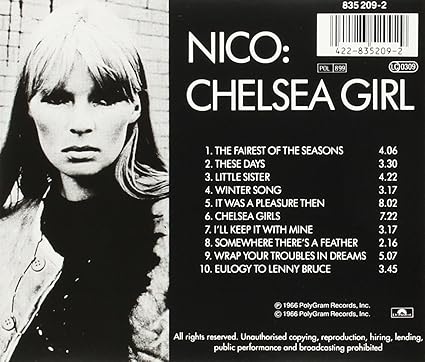
For those that want to hear additional Lou Reed compositions from this time period, they can listen to “Chelsea Girl”, Nico’s solo album recorded in 1966 after “Velvet Underground & Nico”, and released in October 1967. The name of the album is a reference to Andy Warhol‘s 1966 film Chelsea Girls, in which Nico starred and includes a Lou Read composition of that same name. Besides Lou Reed, John Cale and Sterling Morrison making contributions, we also get two Jackson Browne compositions and his guitar on five of the tracks. Jackson Browne was providing back up for Nico’s small venue performances in 1966, and romantically involved with her until 1968.

Nico’s vocals are slightly better than on the Velvet Underground album, but there are still serious problems with pitch and in providing appropriate emotional delivery of the lyrics.  The string arrangements, instrumental backing, and strength of the compositions help alleviate some of Nico’s performance shortcomings.

Track listing[from Wikipedia]

Side A

  1. “The Fairest of the Seasons” (Jackson Browne, Gregory Copeland) – 4:06
  2. These Days” (Jackson Browne) – 3:30
  3. “Little Sister” (John CaleLou Reed) – 4:22
  4. “Winter Song” (John Cale) – 3:17
  5. “It Was a Pleasure Then” (Lou Reed, John Cale, Christa Päffgen) – 8:02

Side B

  1. Chelsea Girls” (Lou Reed, Sterling Morrison) – 7:22
  2. I’ll Keep It With Mine” (Bob Dylan) – 3:17 Note: this song was recorded by Dylan in 1965 but remained unreleased on any of his own albums until the 1985 Biograph set.
  3. “Somewhere There’s a Feather” (Jackson Browne) – 2:16
  4. “Wrap Your Troubles in Dreams” (Lou Reed) – 5:07
  5. “Eulogy to Lenny Bruce” (Tim Hardin) – 3:45

Personnel

Technical

Fifty Year Friday: John Coltrane; Jefferson Airplane “Surrealistic Pillow”

Coltrane1

“One positive thought produces millions of positive vibrations.” — John Coltrane

Coltrane’s left us fifty years ago on July 27, 1967.   He played, improvised, and composed music for a number of essential albums including “Blue Train”, “Bags and Train” with Milt Jackson, “Giant Steps”, “Thelonious Monk with John Coltrane”, “My Favorite Things”, “Live at the Village Vanguard”, “Duke Ellington & John Coltrane”, “Coltrane live at Birdland” with an incomparable version of “Afro Blue”, the one of a kind “John Coltrane and Johnny Hartman” album, and the classic “A Love Supreme.” Also of note is the June 1965 session (released in 1970) as the album “Transition” with the title track being essential to fans of  the music contained in a”Love Supreme.”  There is also music recorded in 1967, released years after Coltrane’s death, that could be classified as Free Jazz including “The Olatunji Concert: The Last Live Recording” recorded on April 23, 1967. It’s interesting to compare a 1963 live version of “My Favorite Things” to the 1967 version:

Thank-you, Mr. John Coltrane for the all this incredible music you provided.

Twenty-six year old department store model, Grace Slick, a graduate of Palo Alto High and resident of the Bay area (San Francisco Bay area) after reading an article about one of the local bands, Jefferson Airplane, in the San Francisco Chronicle newspaper, went to see them live where they played regularly (“The Matrix”, a club on Fillmore Avenue) and was soon inspired to start a band, with her husband, his brother, and three others.  

This band, “The Great Society”, named after LBJ‘s set of programs to address unjust social conditions, soon opened for other more established Bay Area groups including Jefferson Airplane, and eventually attracted the attention of Columbia Records which offered them a recording contract at about the same time that the Jefferson Airplane was looking to replace their female vocalist, Signe Toly Anderson.  Mrs. Anderson, an expecting mother, felt that she could no longer tour with the band and take care of a newborn and so gave notice, informing the public, on October 15, 1966 with words befitting any flower-power child: “I want you all to wear smiles and daisies and box balloons. I love you all. Thank you and goodbye.”

Grace Slick left her band, which not being able to continue without her, disbanded, and she joined Jefferson Airplane, bringing with her two particularly notable songs: the Great Society’s lead guitarist’s medium-tempo song “Someone to Love” and her own drug-inspired composition, “White Rabbit.”

Jefferson Airplane embraced both Grace’s powerful singing and these two tunes, which they re-arranged, maybe not for the better, but certainly with greater commercial appeal.

“Surrealistic Pillow”, Jefferson’s Airplane’s second album and the first album with Grace Slick takes advantage of Grace’s high-energy vocals from the very first track, where her background vocals are of more interest than Marty Balin’s main vocals and perhaps the main melody itself. The second track, is “Somebody to Love”, played with more force and at a faster tempo than the Great Society arrangement.

This album also includes a song that Marty Balin wrote originally for Tony Bennett: “I wrote it to try to meet Tony Bennett. He was recording in the next studio. I admired him, so I thought I’d write him a song. I never got to meet him, but the Airplane ended up doing it.” Jerry Garcia plays guitar on several tracks for this album including the short repetitive electric guitar phrase heard here:  


“Today” is followed by the evocative, marijuana-paced (and perhaps marijuana-influenced) Balin composition “Comin’ Back to Me.”

Side 2 starts with “3/5 of a Mile in 10 Second”, more for dancing then listening.  “DCBA” is relaxed and with somewhat puzzling lyrics:

“It’s time you walked away and set me free”

but later

“I take great peace in your sitting there
Searching for myself, I find a place there.”

and then in the middle of this

“Here in crystal chandelier, I’m home.
Too many days, I’ve left unstoned.
If you don’t mind happiness
Purple-pleasure fields in the sun.
Ah, don’t you know I’m runnin’ home.
Don’t you know I’m runnin’ home (to a place to you unknown? )”

“How do you feel” is one of those innocuous feel-good songs that would be comfortably at home on an album by The Mamas and Papas or The Association. “Embryonic Journey” is an excellent acoustic guitar instrumental, composed as part of a guitar workshop in Santa Clara by Jorma Kaukonen three years before he was invited to join Jefferson Airplane band by friend and fellow-classmate Paul Kantner.

The penultimate cut of the album, is the standout “White Rabbit”, rearranged musically to be succinct, focused, rhythmic and eerily similar to Ravel’s Bolero.  No concessions were made lyrically:

“One pill makes you larger
And one pill makes you small
And the ones that mother gives you
Don’t do anything at all:
Go ask Alice
When she’s ten feet tall.

“And if you go chasing rabbits
And you know you’re going to fall
Tell ’em a hookah-smoking caterpillar
Has given you the call:
Call Alice
When she was just small.

“When the men on the chessboard
Get up and tell you where to go
And you’ve just had some kind of mushroom
And your mind is moving low:
Go ask Alice
I think she’ll know.

“When logic and proportion
Have fallen sloppy dead
And the White Knight is talking backwards
And the Red Queen’s off with her head
Remember what the dormouse said:
‘Feed your head.
Feed your head.'”

I think it is at this point in time, more or less, that the commercial interests of the major music labels became more important than censorship of music with anti-establishment lyrics.   During the last eight weeks of summer, it seemed that one could not turn on Southern California AM radio without “Light My Fire” or “White Rabbit” being played at least once in any given hour. As a twelve-year old, I knew something was changing in the world around me as an older culture began to buckle under the weight of newer ideals — even if those ideals were plainly self-indulgent.

“Surrealistic Pillow” ends with a trippy, protypical Haight-Ashbury tune, “Plastic Fantastic Lover”, mocking the ascendancy of the boob tube:

“Her neon mouth with the blinkers-off smile
Nothing but an electric sign
You could say she has an individual style
She’s part of a colorful time.

“Secrecy of lady-chrome-covered clothes
You wear cause you have no other
But I suppose no one knows
You’re my plastic fantastic lover.

“Her rattlin’ cough never shuts off
Is nothin’ but a used machine
Her aluminum finish, slightly diminished
Is the best I ever have seen.

“Cosmetic baby plugged into me
I’d never ever find another;
I realize no one’s wise
To my plastic fantastic lover.

“The electrical dust is starting to rust
Her trapezoid thermometer taste;
All the red tape is mechanical rape
Of the TV program waste.

“Data control and IBM
Science is mankind’s brother
But all I see is drainin’ me
On my plastic fantastic lover.”

Music can transcend time, be a document of its time, or both.  “Surrealistic Pillow” is indisputably an important musical document of its time. As as listener, you must decide if it transcends time. For those of us that grew up with this music, it tends to take us back in time, which, I suppose, is as valid way as any to transcend time.

Track listing (from Wikipedia)

Side one
  1. She Has Funny Cars” (Jorma KaukonenMarty Balin) – 3:14
  2. Somebody to Love” (Darby Slick) – 3:00
  3. “My Best Friend” (Skip Spence) – 3:04
  4. Today” (Balin, Paul Kantner) – 3:03
  5. Comin’ Back to Me” (Balin) – 5:23
Side two
  1. “3/5 of a Mile in 10 Seconds” (Balin) – 3:45
  2. “D.C.B.A.–25” (Kantner) – 2:39
  3. “How Do You Feel” (Tom Mastin) – 3:34
  4. Embryonic Journey” (Kaukonen) – 1:55
  5. White Rabbit” (Grace Slick) – 2:32
  6. “Plastic Fantastic Lover” (Balin) – 2:39

Personnel (from Wikipedia)

  • Marty Balin – vocals, guitar, album design, lead vocals on “Today”, “Comin’ Back To Me” and “Plastic Fantastic Lover”, co-lead vocals on “She Has Funny Cars”, “My Best Friend” and “Go To Her”
  • Jack Casady – bass guitarfuzz bassrhythm guitar
  • Spencer Dryden – drumspercussion
  • Paul Kantner – rhythm guitar, vocals, lead vocals on “How Do You Feel”, co-lead vocals on “My Best Friend”, “D. C. B. A.-25” and “Go To Her”
  • Jorma Kaukonen – lead guitar, lead vocals on “Come Back Baby” and “In The Morning”
  • Grace Slick – vocals, piano, organrecorder, lead vocals on “Somebody To Love” and “White Rabbit”, co-lead vocals on “She Has Funny Cars”, “My Best Friend”, “D. C. B. A.-25” and “Go To Her”
  • Signe Toly Anderson – lead vocals on “Chauffeur Blues” (UK only)
  • Skip Spence – drums on “Don’t Slip Away”, “Come Up the Years”, and “Chauffeur Blues” (UK only)
Additional personnel

Fifty Year Friday: Thelonious Monk “Straight, No Chaser”; McCoy Tyner “The Real McCoy”


2evhqIn launching a Google search for lists of Jazz albums of 1967, one finds lists like this that include many fine albums:

1967

  1. Sun Ra: Atlantis (1967)
  2. Gary Burton: A Genuine Tong Funeral (1967)
  3. Sam Rivers: Dimensions And Extensions (1967)
  4. Roscoe Mitchell: Old Quartet (1967)
  5. Bill Dixon: Intents And Purposes (1967)
  6. George Russell: Othello Ballet Suite (1967)
  7. Muhal Richard Abrams: Levels and Degrees of Light (1967)
  8. Archie Shepp: The Magic of Ju-Ju (1967)
  9. Jackie McLean: New and Old Gospel (1967)
  10. Roland Kirk: The Inflated Tear (1967)
  11. Don Ellis: Electric Bath (1967)
  12. John Coltrane: Interstellar Space (1967)
  13. Frank Wright: Your Prayer (1967)
  14. Spontaneous Music Ensemble: Withdrawal (1967)
  15. Peter Broetzmann: For Adolph Sax (1967)
  16. Chick Corea: Now He Sings Now He Sobs (1967)
  17. Miles Davis: Nefertiti (1967)
  18. Don Ellis: Live in 3 2/3/4 Time (1967)
  19. Jackie McLean: Demon’s Dance (1967)
  20. Miles Davis: Sorcerer (1967)
  21. Gary Burton: Duster (1967)
  22. John Coltrane: Expression (1967)
  23. McCoyTyner: The Real McCoy (1967)
  24. Wayne Shorter: Schizophrenia (1967)
  25. Lee Konitz: Duets (1967)
  26. Paul Bley: Virtuosi (1967)
  27. Lester Bowie: Numbers 1 & 2 (1967)
  28. Paul Bley: Ballads (1967)

(from http://www.scaruffi.com/jazz/60.html#1967)

However, notably missing from all such lists (I have seen) is one of the best jazz albums of 1967, Thelonious Monk’s “Straight No Chaser.”

Why is this? Why do fairly knowledgeable jazz listeners fail to include an album of such exceptional music?

The clear-cut answer is that Monk is competing against himself.

By 1947, when Monk first started recording for Blue Note, five days after his thirtieth birthday, his style, approach and individual voice were already established, making those Blue Note recordings exceptional statements by a fully mature artist. From 1947 to 1951, many of the most celebrated Monk compositions were captured forever for all of us: “Ruby, My Dear”,  “Well, You Needn’t”, “Round Midnight”, “Evidence”, “Misterioso”, “Epistrophy”, “Criss Cross” and “Straight, No Chaser.”

Over the next two and half decades, as jazz in general continued to expand beyond Bebop with Hard Bop, Cool, West Coast Jazz, Third Stream, Post Bop, Soul Jazz and Fusion, Monk’s approach and stylistic traits remained relatively stable.  In the sixties, Monk was no longer viewed by some as a unique innovator, but rather, just simply unique. The innovation was there — not stylistic, but in playing freshly, honestly, and incisively, continuing to balance silence against sound and expressing himself naturally, logically and directly.  His music still evolved, but slowly. and more in terms of refinement than in alignment with the other changes happening in jazz.

By this album, “Straight, No Chaser”, Monk has established a continued level of excellence — connecting directly and succinctly. That this was one of the best albums of the year could only be overlooked by those comparing this music to Monk’s work from the late 1940’s on the Blue Note label, recognizing the historical influence of that music and finding no such historical significance in this 1967 Columbia album.

The personnel for this album:

Clearly, the quality of the only non-rhythm section soloist (Monk goes way beyond being part of a rhythm section, of course) is going to have a considerable impact on the overall merit and quality of this recording, and Charlie Rouse, at this point, after working with Monk since 1959, has become the ideal tenor sax partner.  In one sense, he is an extension of Monk’s brilliance, and yet he still has his own voice and ideas.

The album I am using for this trek back through time is the LP version without the bonus tracks available on the CD version.

  1. “Locomotive” (Thelonious Monk)
  2. “I Didn’t Know About You” (Duke Ellington)
  3. “Straight, No Chaser” (Thelonious Monk)
  4. “Japanese Folk Song (Kōjō no Tsuki)” (Rentarō Taki)
  5. “Between the Devil and the Deep Blue Sea” (Harold Arlen)
  6. “We See” (Thelonious Monk)

“Locomotive”, opens the album, slow and steady, initially creating a sound picture of a locomotive chugging out of the station and then giving way to one of those “every note counts” Monk solos, a solo that is cognizant of, and at points includes fragments of, the original melody.  Rouse solos follows with Monk accompanying and the piece ends in typical bebop fashion, repeating the opening section.

The fourth track, “Japanese Folk Song” is particularly of note. On the LP the length is around 11 minutes.  On the CD reissue, the length is listed at 16:42, indicating that the LP version has been edited.  The folk song melody that opens the piece is Rentarō Taki’s “Kojo No Tsuki” (The Moon Over the Desolate Castle), originally written in 1901 as a school-book lesson in “Songs for High School Students”, and later recorded in the 1920’s becoming a well-known tune throughout Japan that was so associated with Japanese nationalism that the tune was banned by the Allies during their post WWII occupation of Japan.

Monk takes the original tune and twists it with syncopation, runs and Monk’s own distinct dynamic approach to striking the keys. Rouse comes in playing the melody eerily evenly on the beat before journeying more distantly away. At the 4 1/2 minute mark on the LP we have the start of an extended, mesmerizing solo by Monk.  (I am guessing this is where the edit is, dropping out a solo by Rouse to accommodate the time limitations of the LP.)  The last 3 minutes Rouse and Monk wind their way to the finish with interwoven, intertwined, Monk-trademark counterpoint before a brief and satisfying coda.

“The Real McCoy” is McCoy Tyner’s seventh album, but please notice that the label is no longer Impulse but Blue Note.  Blue Note Records, founded in 1939, historically seems to be the label that takes artists to their next level and so it is here with Tyner, who had recorded his last album with John Coltrane in 1965 and was not aligned with the direction Coltrane was pursuing.  Tyner: ” All I could hear was a lot of noise. I didn’t have any feeling for the music, and when I don’t have feelings, I don’t play.”

Well, there’s not any dispute about Tyner playing on this album. From the opening upbeat, contemporary “Passion Dance” to the more traditional “Blues on the Corner” spiced with Tyner’s harmonics and his energetic, almost frenetic solo, this is an excellent album.

With Tyner are three world-class jazz artists:

I am often disinterested in the obligatory bass solo (whether that is once each track or even, as in this case, once on an album), but Ron Carter, is always exceptional as he shows here on his solo, in the introspective second track, “Contemplation.”

Elvin Jones was the ideal drummer for the many Coltane albums he is on, and an excellent fit for Tyner’s compositions and Tyner’s playing.

Joe Henderson made important contributions on Blue Note albums starting in 1963, appearing on important albums for Grant Green, Andrew Hill, Horace Silver and Lee Morgan as well as Larry Young’s incomparable “Unity” album. He shimmers and sparkles on this album with inventive, engaging and compelling soloing and ensemble work.

If one compares the quality of Tyner’s piano work to Monk’s, which, of course, really isn’t fair to either artist, Tyner does come in second place in terms of overall musical intensity and economy of expression. This is evident in the exceptional track “Contemplation.” From almost the beginning Tyner includes these short repeated scalar phrases (some would call this “noodling”) which, unfortunately, remind me a little too much of some of the soloing filler of the guitarists in the 1980’s hair bands, and is not so distant to some of the unnecessary busy-ness that one can even find in earlier pianists like Art Tatum.  This is only a slight distraction, and less annoying on repeated listenings of this track; particularly as Tyner treats this as an integral part of the composition and so once one has heard the composition, these quick spurts of adjacent notes become part of the performance’s fabric.

Putting such a minor quibble aside, Tyner has put together a diverse set of compositions. The modal “Passion Dance” is exceptionally vibrant and vital. “Contemplation” is an introspective ballad.  “Four by Five” is an aggressive, wild work starting with a 4 against 5 theme and highlighted by amazing soloing by Joe Henderson. From the Blue Note Liner Notes: “McCoy explains … ‘Four By Five receives its title because the melody is constructed as if there’s a middle -it’s in 4/4 on the outside and 5/4 on the inside. But we improvise as if there weren’t a middle; we improvise only in 4/4’.”

“Search for Peace” is a soothing statement about the value of peacefulness and tranquility.  The album ends with a casual, relaxed blues-based tune, “Blues on the Corner”, nicely wrapping up an album that covers a range of emotions and attitudes, accessible and yet solidly fresh, modern music for 1967 that is as engaging today as ever.

Track listing 

All compositions by McCoy Tyner

  1. “Passion Dance” – 8:45
  2. “Contemplation” – 9:10
  3. “Four by Five” – 6:35
  4. “Search for Peace” – 6:25
  5. “Blues on the Corner” – 6:05