Zumwalt Poems Online

Posts tagged ‘Herbie Hancock’

Genesis: Selling England By the Pound, The Who: Quadrophenia, and much, much more; Fifty Year Friday: October 1973

Genesis: Selling England By the Pound

Released on either September 29, 1973, or more likely October 5, 1973, “Selling England by The Pound” stands as one of the finest progressive rock albums of the 1970s. The sound is superior to that of their previous album, “Foxtrot,” and the music maintains the same level of excellence. It adeptly balances instrumental passages with vocal sections, blending humor (seen in tracks like “The Battle of Epping Forest” and “Aisle of Plenty”) with more serious compositions.

“Firth of Fifth” (note the humor in the title, which is a reference to Firth of Forth , the fjord of the Forth river, in Scotland, north and northwest of Edinburgh) is my favorite track, particularly due to is introductory theme on piano, later reprised by the group, but there is not a single weak moment on the entire album — and quite an album it is, with seven perfectly realized tracks totaling over fifty-eight minutes of magnificent music.

The Who: Quadrophenia

Released on October 19, 1973, this is the Who’s masterpiece about teenage alienation, angst, attitude, and the multiple personalities vying for integration into the evolving identity of an individual. It also addresses the weaknesses within the UK social system and the moments of solace that British youth of the 1960s sought and found in music and by the seaside. Moreover, this work is an astounding musical achievement, characterized by skillful thematic reiteration. Its musical content can be enjoyed both on a visceral level and intellectually, making it enduringly captivating upon repeated listens. Notably, the lyrics were deftly incorporated into music that was apparently written first, and Townshend has delivered exceptionally well-crafted lyrics that serve as the narrative backbone.

Effectively, this is a rock opera set in 1965, centering around a singular British youth, inspired by conversations Pete Townshend had with early fans of The Who. A significant distinction is that, unlike “Tommy,” which featured two songs by John Entwistle, one by Keith Moon, and a reworking of a Sonny Boy Williamson tune, all the original material here is authored by Pete Townshend. The emphasis is on “initial”, since Townshend intentionally provided a framework of lyrics, melody and chords that would develop into final arrangements through Townshend’s working with the band and the studio equipment to achieve the final product. So though Townshend deserves appropriate credit here for the authorship of this impressive work, it is The Who, as a band, that must be recognized for making this an enduring classic.

For those interested in additional information on this great album, please check out this track-by-track review by Caryn Rose written back in 2013 for Quadrophenia‘s 40th anniversary: Track-By-Track Review
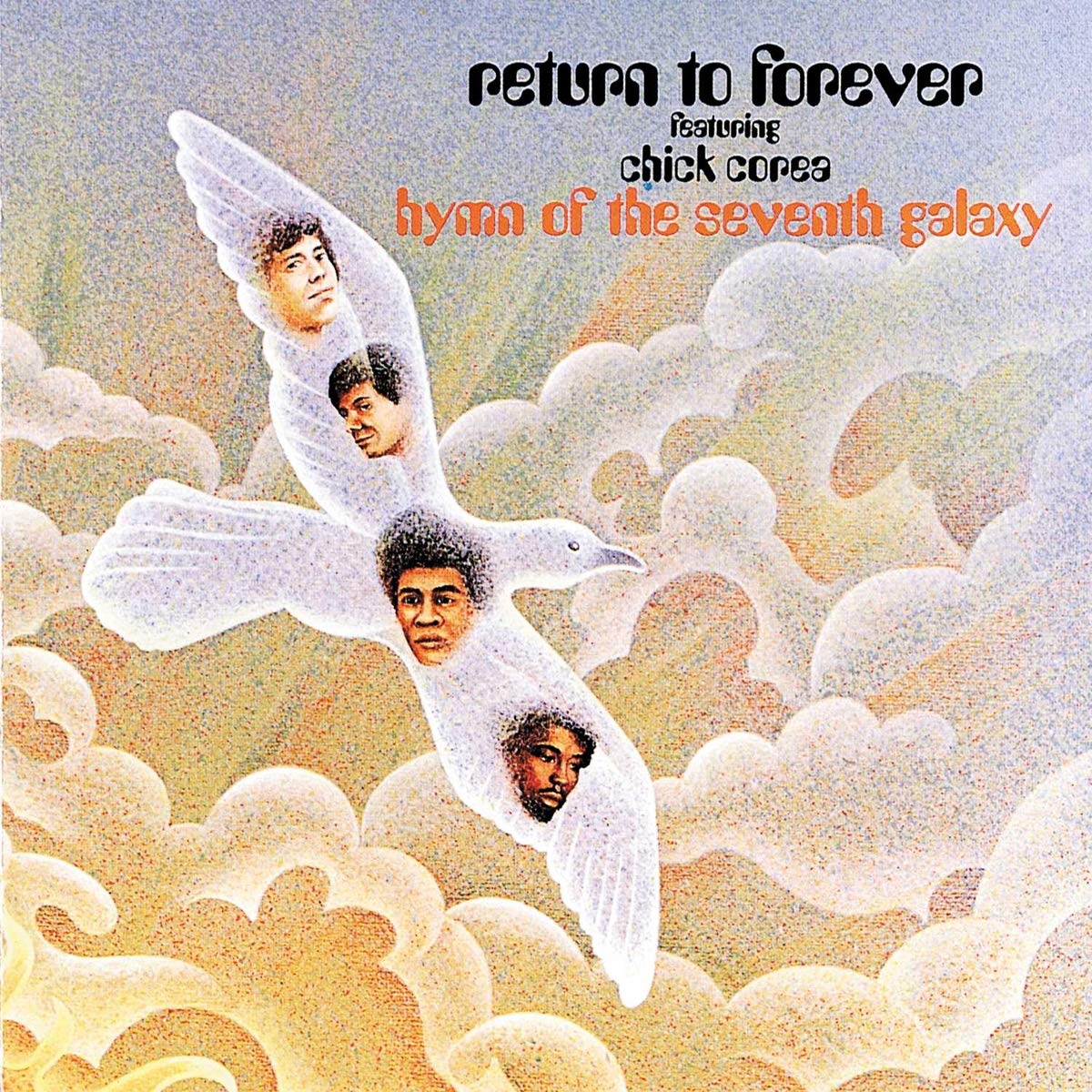
Return to Forever: Hymn of the Seventh Galaxy

Released sometime in October 1973, this third album from Return to Forever magically and masterfully weaves together elements of jazz, fusion and progressive rock. Chick Corea dazzling keyboards and his other worldly — no, make that other galactic — compositions just radiate throughout this album. Fellow band members, Stanley Clarke, Lenny White and Bill Connors are equally up to the challenge, with Mr. Clark providing a wonderfully radiant composition of his own, “After the Cosmic Rain” and exhibiting Olympic-level mastery on electric bass. The coup de grâce is the last track, “The Game Maker”, breathtakingly piloting us over intricate, wondrously, shifting musical landscapes.
Elton John: Goodbye Yellow Brick Road

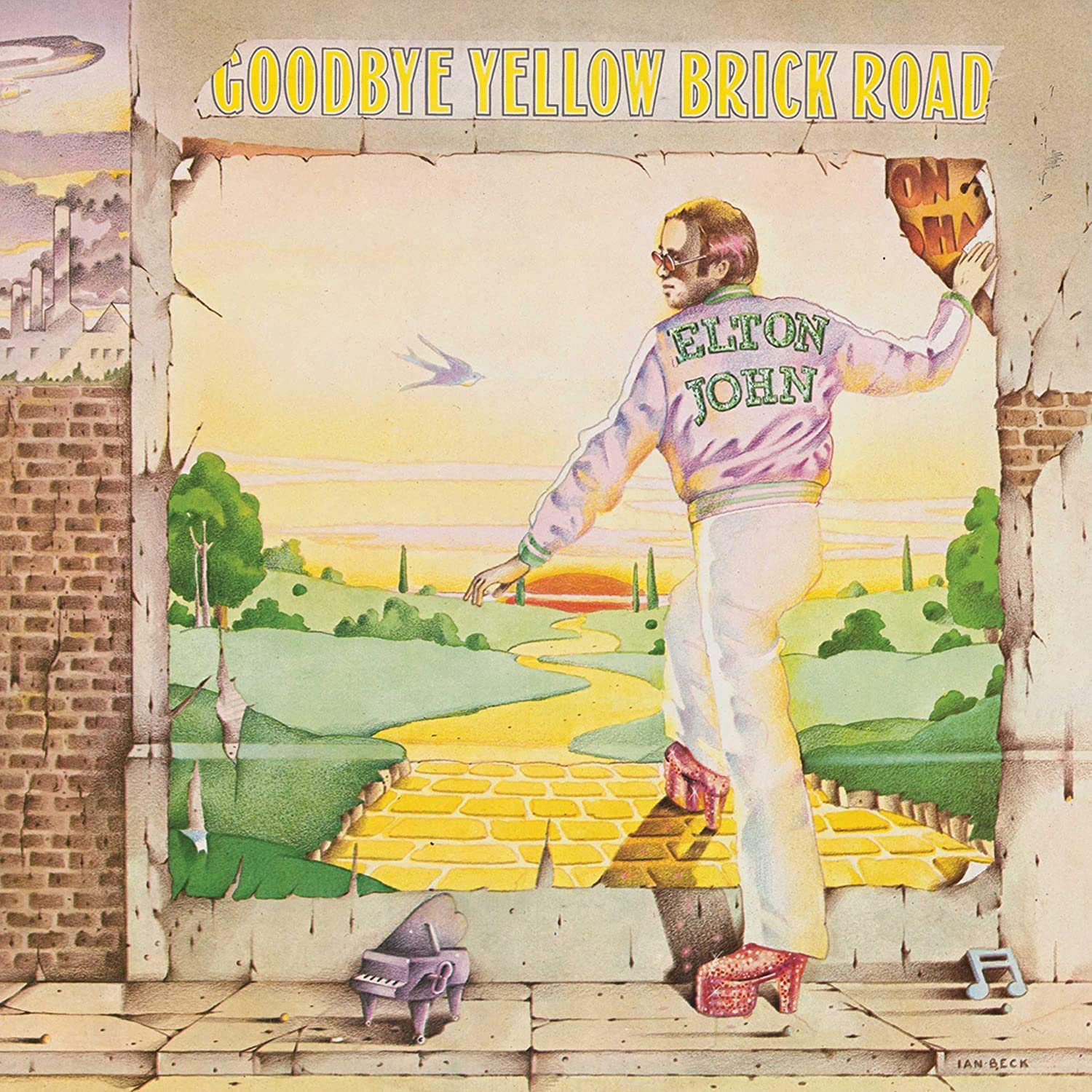
The one obstacle that prevented The Who’s Quadrophenia ever getting to the number one album spot in the UK or in the US, was the multi-million-sales avalanche of Elton John’s Goodbye Yellow Brick Road, released on October 5, 1973, almost two weeks before Quadrophenia. Of the slightly over one hundred million copies of albums Elton has sold, Goodbye Yellow Brick Road accounts for over thirty-one million, and continues to sell in substantial quantities to new Elton John fans today.

Rather than compose music and then fit lyrics into the music, Elton John’s method in the 1970’s, like that of many songwriters, was to take already written lyrics, in Elton’s case partnering with Bernie Taupin, and then create music too complement those lyrics. Considering the nature of many of Taupin’s lyrics, it is rather incredible that Elton created so many highly popular and widely-appealing songs from the initial material. Goodbye Yellow Brick Road, in a sense a loose or partial concept album, provides insight into Elton’s range of compositional skills, with the initial track, “Funeral For A Friend:, being one of his rare instrumentals, providing a glimpse into the depth of his creativity when not bound by lyrics. This instrumental introduction is effectively paired with “Love Lies Bleeding” providing an almost progressive-rock opening for the album.

Overall the album is quite good and along with his two albums from 1970 (Elton John and Tumbleweed Connection) and his live album from that period (17-11-70) are a set of his works I hold in high esteem. Now, though the first side and last side of the original 2 LP “GYBR” is indispensable, as is the first track of side two, and the last track of side three, the material in between could be omitted, to get a very fine single LP album, at a total length of around 45 minutes. Now some may wish to further add another track like “The Ballad of Danny Bailey (1909–34)” resulting in an album that still comfortably adheres to standard LP limits. That said, the CD, containing over 76 minutes of the original material, is now sold at roughly the same price as other Elton John albums from the early seventies — so even though a slimmer, arguably better album could be achieved, what’s the point — given how effortless it is to replay favored tracks on a CD or to skip those not currently of interest.
Billy Cobham: Spectrum

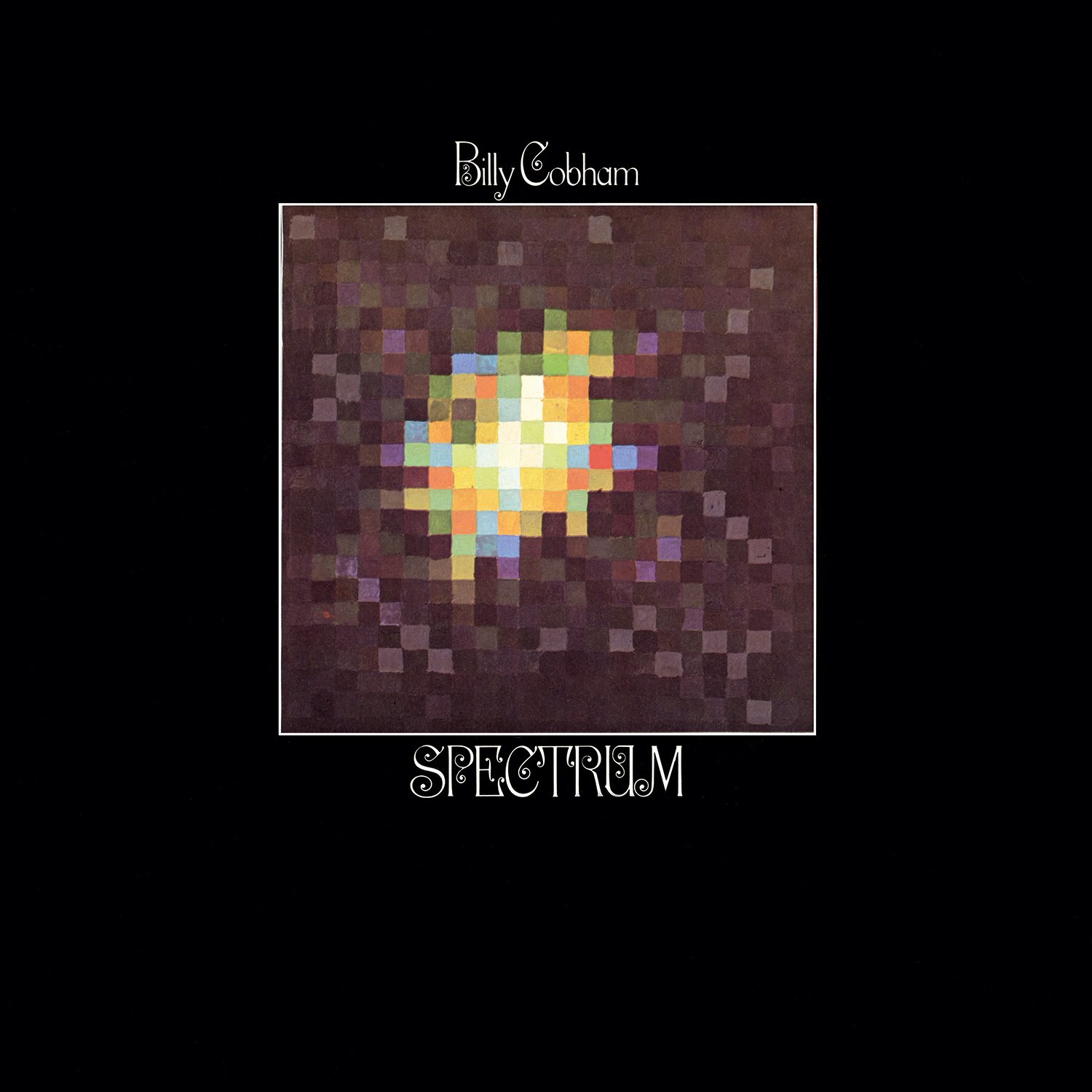
Spectrum, Billy Cobham’s first album as a leader, released October, 1, 1973, is as impressive and important as any fusion album of 1973. The combination of Cobham and Jan Hammer dominate the album, and the supporting resources, particularly Tommy Bolin who is present on over half of the musical material, round out this excellent work. Album includes duets between Cobham and Hammer, Hammer soloing on acoustic piano on the beautiful ballad, “To the Woman but it is the longer tracks, and several lengthier tracks including the opening track, “Quadrant 4” full of energy and purpose, “Stratus” with remarkable bass work from Leland Sklar, and the fast-paced, electrically-charged title track, “Spectrum” with Joe Farrell on sax and flute, and Jimmy Owens on trumpet and flugelhorn.
Gryphon: Gryphon

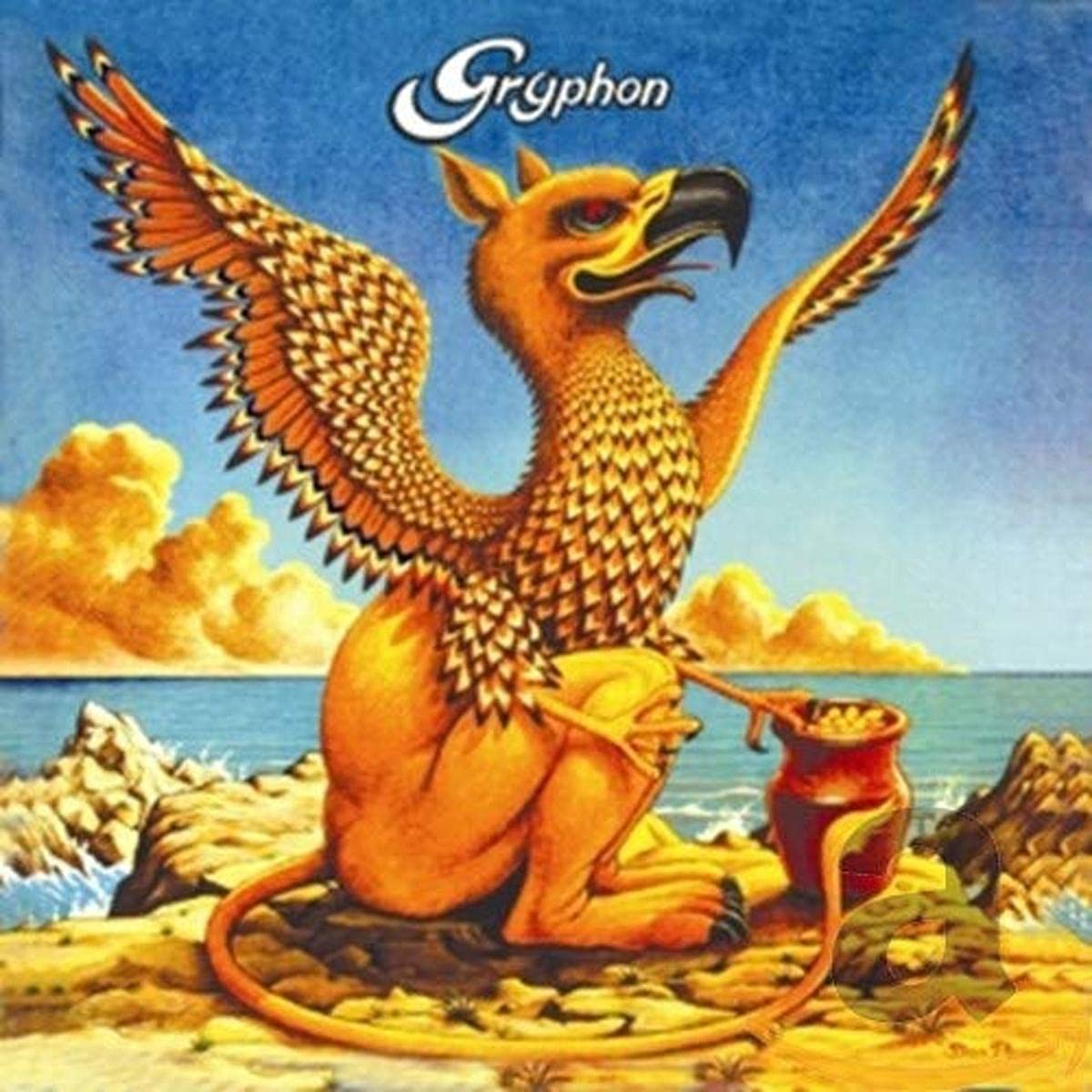
Gryphon’s first album is a unique blend of folk and rock, incorporating both modern elements (guitar, bass, bassoon, trombone, drums) and earlier musical instrumentation (mandolin, recorder, crumhorn) into a successful set of songs. In late 1973, there were several folk rock groups, such as Fairport Convention, Steeleye Span, and Pentangle, but Gryphon, with two of the group members—Brian Gulland and Richard Harvey, both graduates of London’s Royal College of Music—distinguish themselves through a level of originality that transcends replicating traditional Celtic folk harmonies and melodies. Their occasional use of late 19th-century and 20th-century dissonance, not found in traditional English, Irish, Scottish, or Welsh music, coupled with their colorful and sometimes unconventional instrumentation, creates a new sound that effectively captures and maintains the listener’s attention. Later, the group would develop a more progressive-rock sound, but this first album is a fine one, deserving to be enjoyed and appreciated on its own terms.

Renaissance: Ashes are Burning

Renaissance’s fourth album, “Ashes are Burning,” was released on October 10, 1973. The album opens with full intensity, featuring the instrumental introduction of “Can You Understand?” This segues into the introspective acoustic main section, accompanied by some orchestration, showcasing Annie Haslam’s spellbinding vocals. The introductory material returns to conclude the piece. Such artistry and high-quality musical content are defining characteristics of this album, effectively blending classical, folk, and rock elements. The album concludes with the majestically crafted and musically uplifting “Ashes are Burning,” providing an emotionally captivating ending to a highly enjoyable album.
Herbie Hancock: Head Hunters

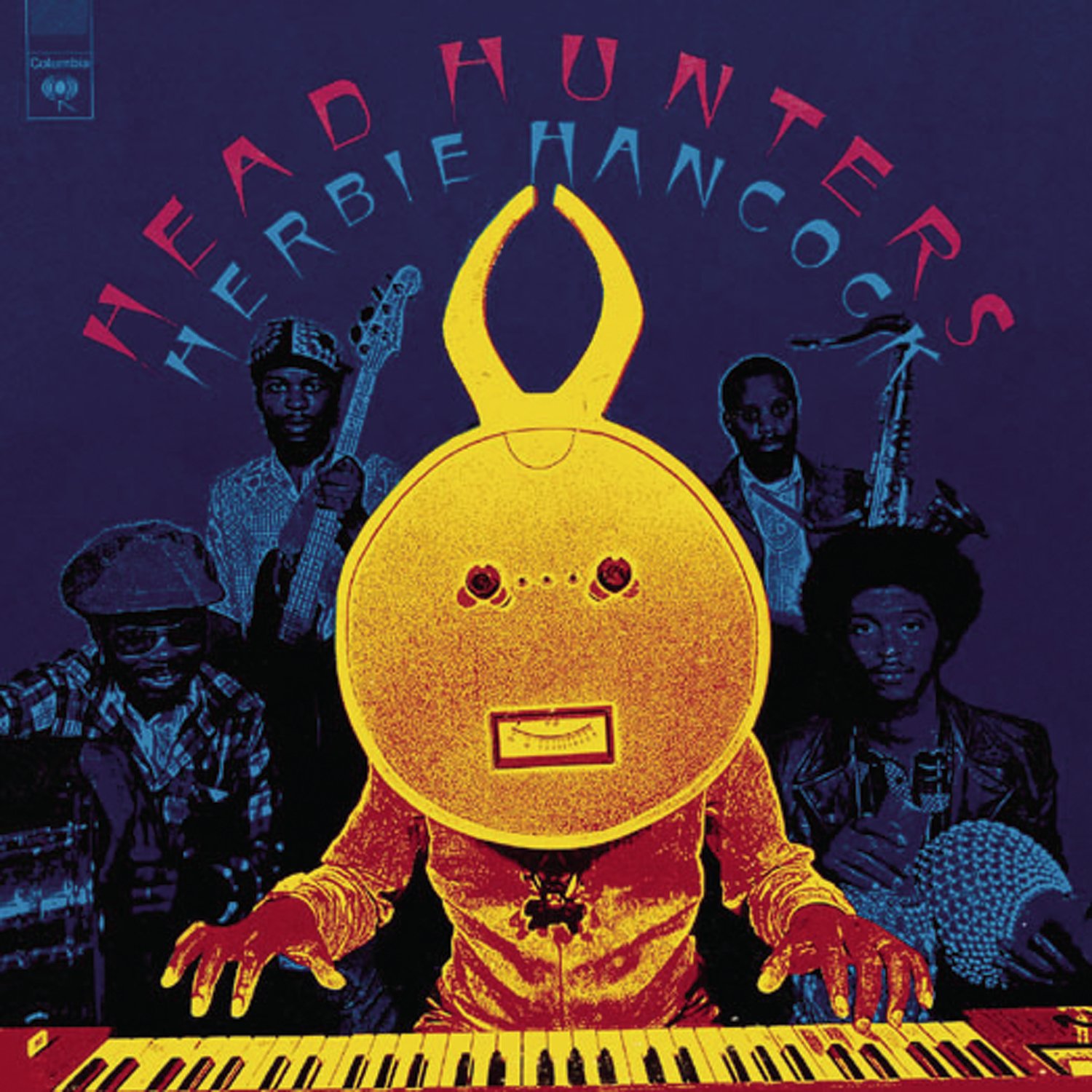
Released on October 26, 1973, and recorded the previous month, this landmark album signifies a conscious shift in direction for Mr. Hancock. It departs from his previous, more progressive and adventurous modal-based music, embracing a solidly tonal funky style of jazz. For this endeavor, he replaced all the members of his previous sextet except for himself and the talented Bennie Maupin on reeds. Remarkably, this jazz album achieved significant commercial success, foreshadowing George Benson’s stunning commercial breakthrough three years later.

The album starts off with “Chameleon,” featuring its initial foundation of two relentlessly repeated bass figures. However, the music is far from stagnant; it organically develops as it progresses, with the bass occasionally taking a secondary role but always remaining fundamental to the overall forward motion. The improvisation, while solidly jazz-based, aligns with a generally funky mood. Toward the end of “Chameleon,” we encounter sparkling chord changes reminiscent of a chameleon changing its exterior color, yet it retains its essential nature—similar to the music—concluding with a more static, funky ending. This is followed by an abstracted, funky rendition of Hancock’s classic, “Watermelon Man,” creatively presented to sound fresh, innovative, and slightly futuristic.

Side two starts with “Sly,” a vibrant homage to Sly Stone that includes some wild, abandoned, but clearly intricate interplay between Maupin’s sax and Hancock’s keyboards. This dynamic exchange offers all the excitement and vigor of the free jazz of the era, yet within a tonal, structured framework—making it accessible to a wide range of listeners. The album concludes with the reflective jazz tone poem, “Vein Melter,” seemingly representing the impact of heroin. The sense of time is significantly slowed by the floating, detached music, free from earthly worries or concerns. Notice the slow beat that initiates, persists, and concludes the track, possibly symbolizing the futility of the heroin experience. This second side, featuring “Sly” and “Vein Melter,” stands as one of the best single LP sides of any album from the 1970s.

Kraftwerk: Ralf und Florian

Released sometime in October1973, Ralf und Florian is the third studio album by the soon-to-be influential German electronic music pioneers, Kraftwerk. At this time there group is just the two former students of Düsseldorf’s Robert Schumann Conservatorium, Ralf Hütter and Florian Schneider The album is influenced heavily by “classical” or conservatory/university ideas about electronic music, but it is clear that a more accessible element is added into their works. This is far from their pop-flavored, and very influential, fourth album, but it still holds a special place in the band’s discography, marking that important transitional phase between their early “experimental” electronic work and the groundbreaking sound they would later be known for. The most intriguing work on the colorfully diverse side one is the pattern-based “Kristallo.” The second side open with “Tanzmusik”, which comes the closest to the music of their next album, with its lighthearted texture, vocoder-enhanced vocals and relentless drive. The album concludes strongly with the longest track, the relatively accessible “Ananas Symphonie” (“Pineapples Symphony”) with the vocoder, this time, used to modulate their voices to sound detached and machine-like. Ironically, though, the piece also creates a relaxing, mediative soundscape reminiscent of a tropical island — pineapples and traces of seashore sounds included.
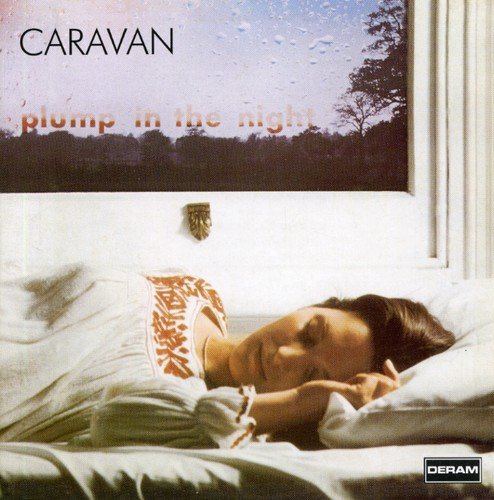
Caravan: For Girls That Grow Plump in the Night; Lou Reed: Berlin

With changes to their lineup, the loss of bassist Richard Sinclair and keyboardist Steve Miller and the addition of Richard’s cousin, Dave Sinclair on keyboards, and Geoff Richardson on viola, Caravan moves away from the more progressive, jazz-infused sound of their previous album, to a less progressive sound infused with some pop elements of the late sixties The highlight of this fifth studio album, released on October 5th, 1973, is the medley on the last track, “L’Auberge Du Sanglier / A Hunting We Shall Go / Pengola / Backwards / A Hunting We Shall Go – Reprise”, which includes strong guitar work from Pye Hastings, impressive electric viola and cello from Richardson and Paul Buckmaster, respectively, some sensitive acoustic piano from Dave Sinclair and a solid orchestral arrangement from John Bell and Martyn Ford.

Also, on October 5, 1973, Lou Reed releases his poignant concept album, Berlin. Though not as melodically memorable as his previous album, and with some musical content from earlier works recycled or redeployed, the album is still deserving of attention. The last track, in particular, provides an affecting and fitting conclusion to the work.
Pink Floyd, King Crimson, Tom Waits, Led Zeppelin, Tangerine Dream; Fifty Year Friday: March 1973

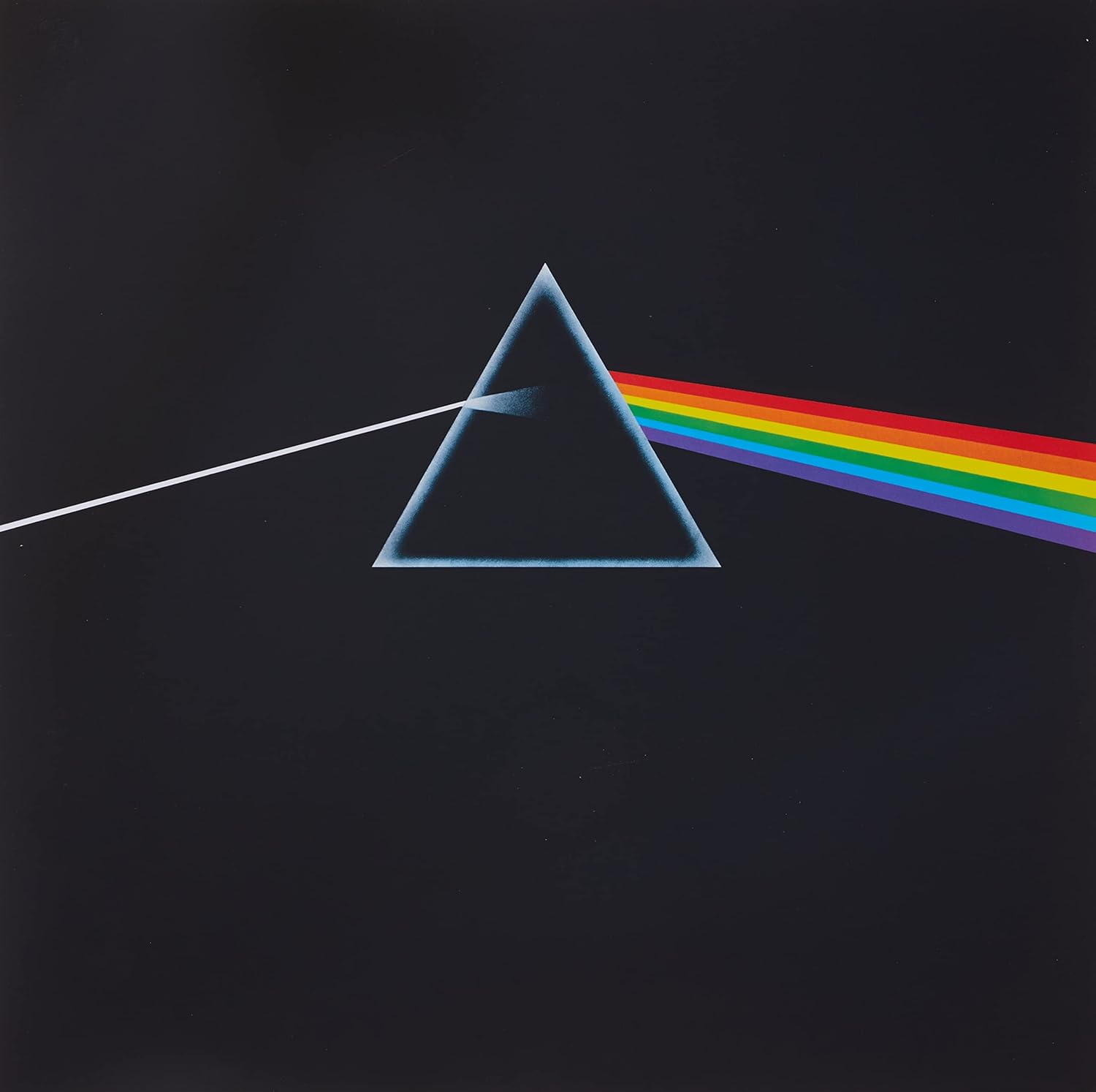
Pink Floyd: Dark Side of the Moon

Few progressive rock albums have had such great appeal across a wide section of the music loving public as Dark Side of the Moon, released March 1, 1973. Casual Listeners, Hard Rockers, Stoners, Prog heads, Music Majors, and just about anyone with more than 10 rock albums in their collection, had a decent chance of owning this timeless classic, an album as likely as any other album to be in the collection of anyone from age 17 to 25 during the mid 1970.

Despite a collection of diverse material with varying levels of contribution from each band member, Dark Side of the Moon has a cohesiveness, largely due to Alan Parson’s proficiency and creativity as an engineer. Just as Parsons significantly contributed to the Beatles’ Abbey Road sense of musical unity despite an understandable lack of shared thematic material between tracks, with one exception, the same result is achieved here: an album that holds up nicely as a single work as opposed to a collection of unrelated tracks. If it has been sometime since you have last heard it, get it out, put it on the best equipment possible (don’t just stream it a suboptimal bitrate or listen to it through low quality headphones or speakers) and enjoy one of the great musical works of our time.

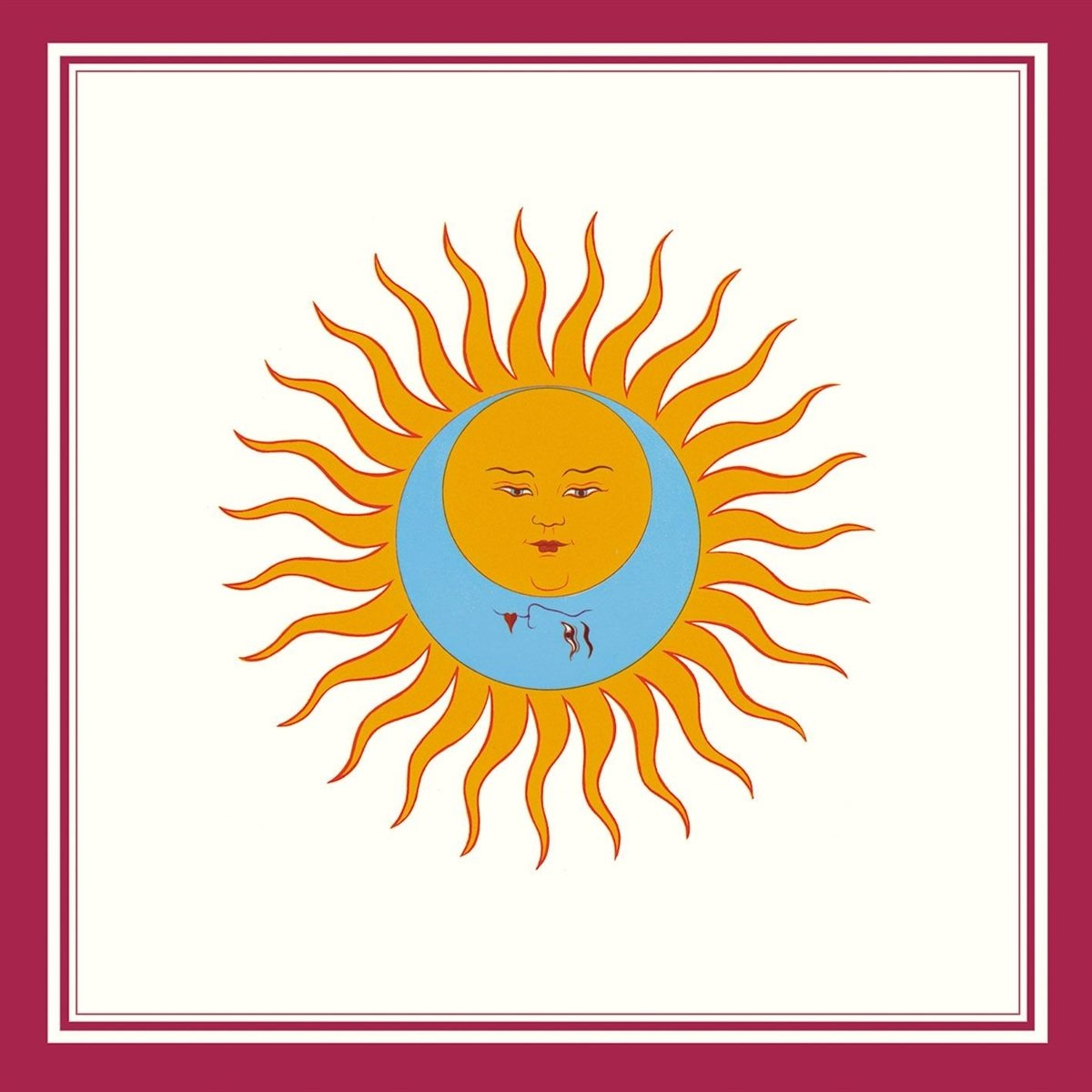
King Crimson: Lark’s Tongue in Aspic

Released on March 23, 1973, King Crimson’s fourth album is less accessible than their previous three studio albums, but the level of musicianship and improvisation are better, with the two parts of Lark’s Tongue in Aspic that open and close the album being particularly impressive.

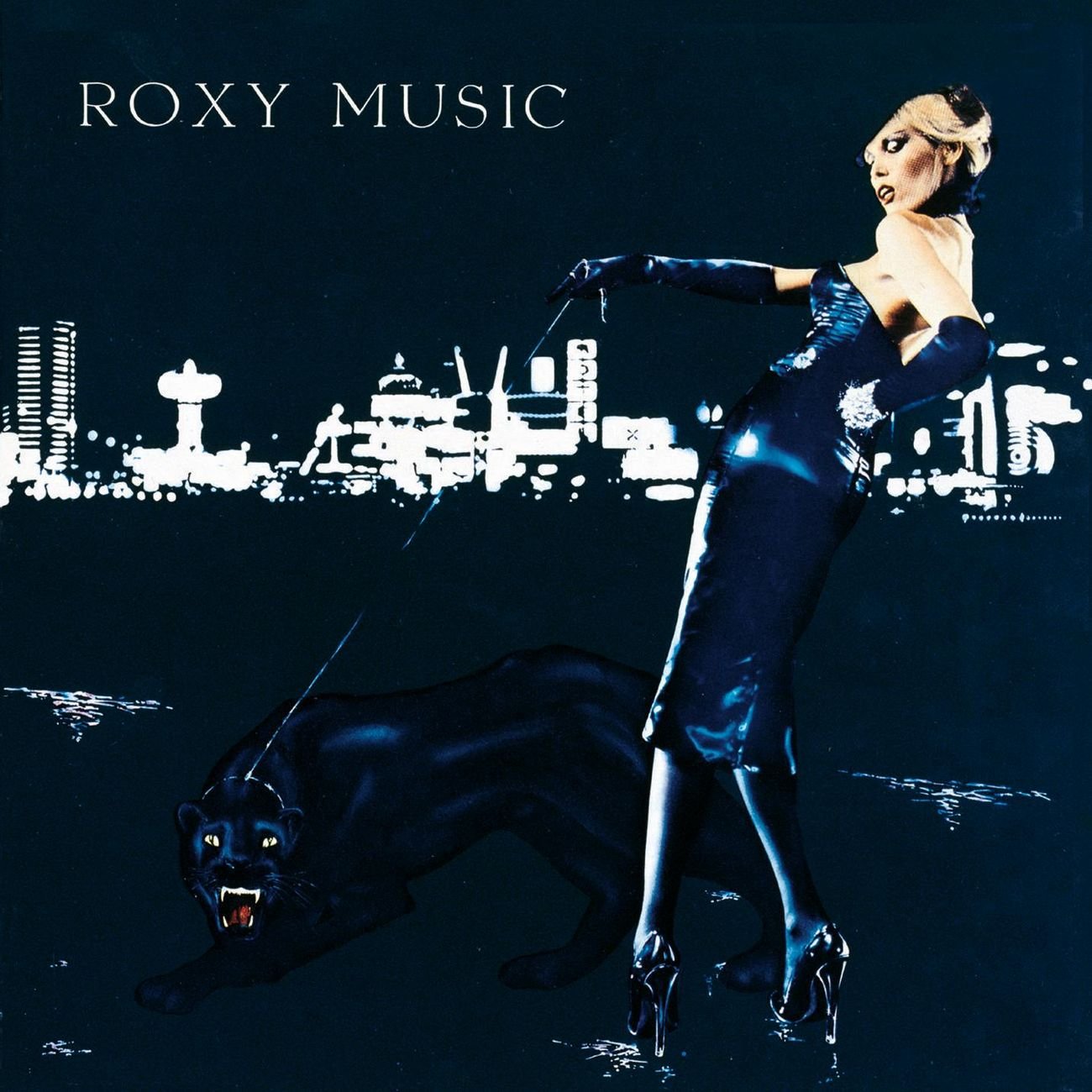
Roxy Music: For Your Pleasure

Before the release of Queen’s first album, or Bowie’s Aladdin Sane, we had this Roxy Music’s For Your Pleasure, released on March 23,1973, adventurously combining art rock, glam rock, and a range of experimental sound techniques into a cohesive, very enjoyable and very well executed work of art. Throughout the entirety of the album, Roxy Music’s musicianship is highly focused and expertly executed, serving as an essential component of the band’s overall artistic vision. Phil Manzanera is amazing on guitar, and Andy Mackay sax provide richness and additional depth, with strong compositions, foundational keyboard work and distinct, nuanced and expressive vocals from Bryan Ferry.

Alice Cooper: Billion Dollar Babies

Released on Feb. 25, 1973, Alice Cooper’s sixth studio album is also his finest with an effective mix of hard rock, glam, and non-traditional topics, some of which were competently exploited for Alice Cooper’s live theatrics. Including four singles, the two standout tracks on the album are “Elected” which was released in September of 1972 prior to the Nixon-McGovern election contest and “Billion Dollar Babies”, released several months after the album’s debut and features Donovan providing effective glam-style vocals including Donovan’s falsetto reaching his upper limit.

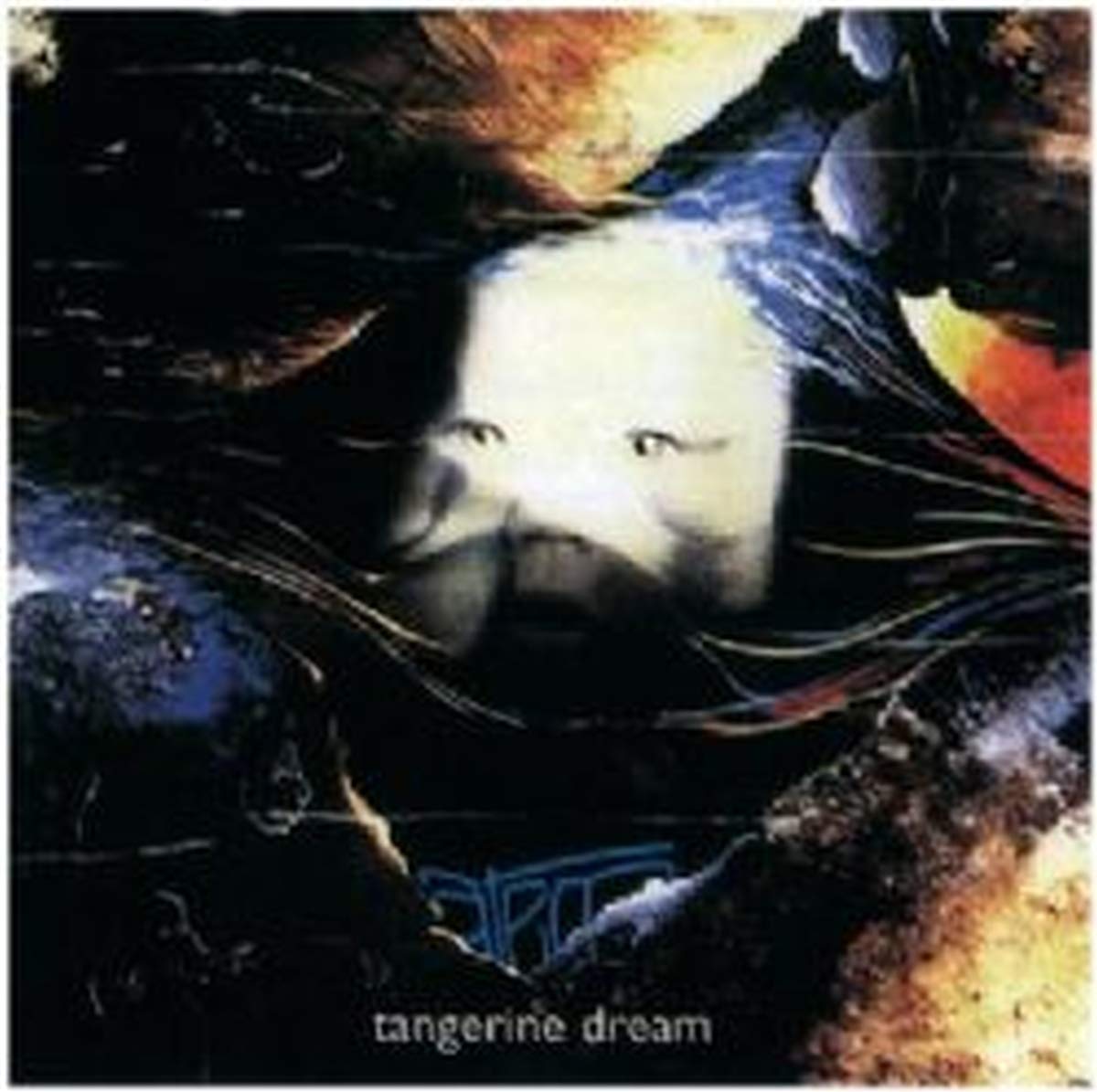
Tangerine Dream: Atem

Atem, released their fourth album, Atem, in March of 1973, one of the most impressive works of electronic music, providing a more interesting and substantial listening experience than most of the works by the academic-based classical composers who had been creating electronic sound compositions since the publishing of Luigi Russolo‘s “Art of the Noises” in 1913. The opening title track takes up the first side with three tracks on the second side, each compelling, each a story with the sound caringly shaped and crafted to provide a self-contained complete musical journey.

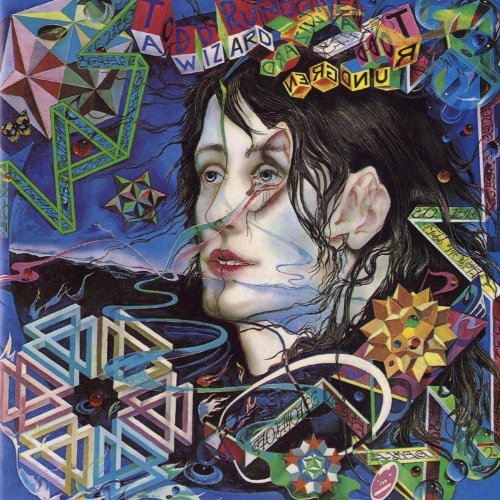
Todd Rundgren: A Wizard, A True Star

With 1973 being one of the most innovative periods in music, Todd Rundgren’s fourth album, A Wizard, A True Star, is about as ingenious, original and imaginative as any album of the 1970s. The first side is the musical equivalent of “Mr. Toad’s Wild Ride”, apparently madly reckless, yet never careening off the rails. “International Feel” starts and ends that first side, with a myriad of sparkling, brilliantly shimmering musical excursions thrown in between. The second side is mellower, allowing the listener to finally relax with a reflective, sympathetic re-creation of four 1960s R&B classic singles, and a memorable anthem, “Just One Victory”, bringing this one of a kind album to a close.

Rundgren’s engineering and production is historically impressive, taking advantage of various vocal and instrumental layering and effective editing. Additional richness is added by both the array of and the arrangement of instrumental timbre. And as an extra bonus to all this, the album is over twenty-six minutes on the first side, and almost thirty minutes on the second side — something matched by some of the classical records I had at the time, but not even approached by any of the single LP rock records in my collection.

One of my music teachers and I were talking about progressive rock around 1977 or 1978 and he was emphasizing how hard it was to predict what music would be canonized in the distant future. Much to my surprise he referenced Todd Rundgren, indicating his familiarity with contemporary, non-“academic” music, by casually remarking that “for all we know Todd Rundgren may be just a footnote in musical history fifty to hundred years from now.” Well, fifty years have passed, and I think it’s safe to say that Todd Rundgren will be encountered by those exploring the music of the 1970s, not as a footnote, but as a musical and engineering wizard, if not a true star.

Electric Light Orchestra: ELO 2

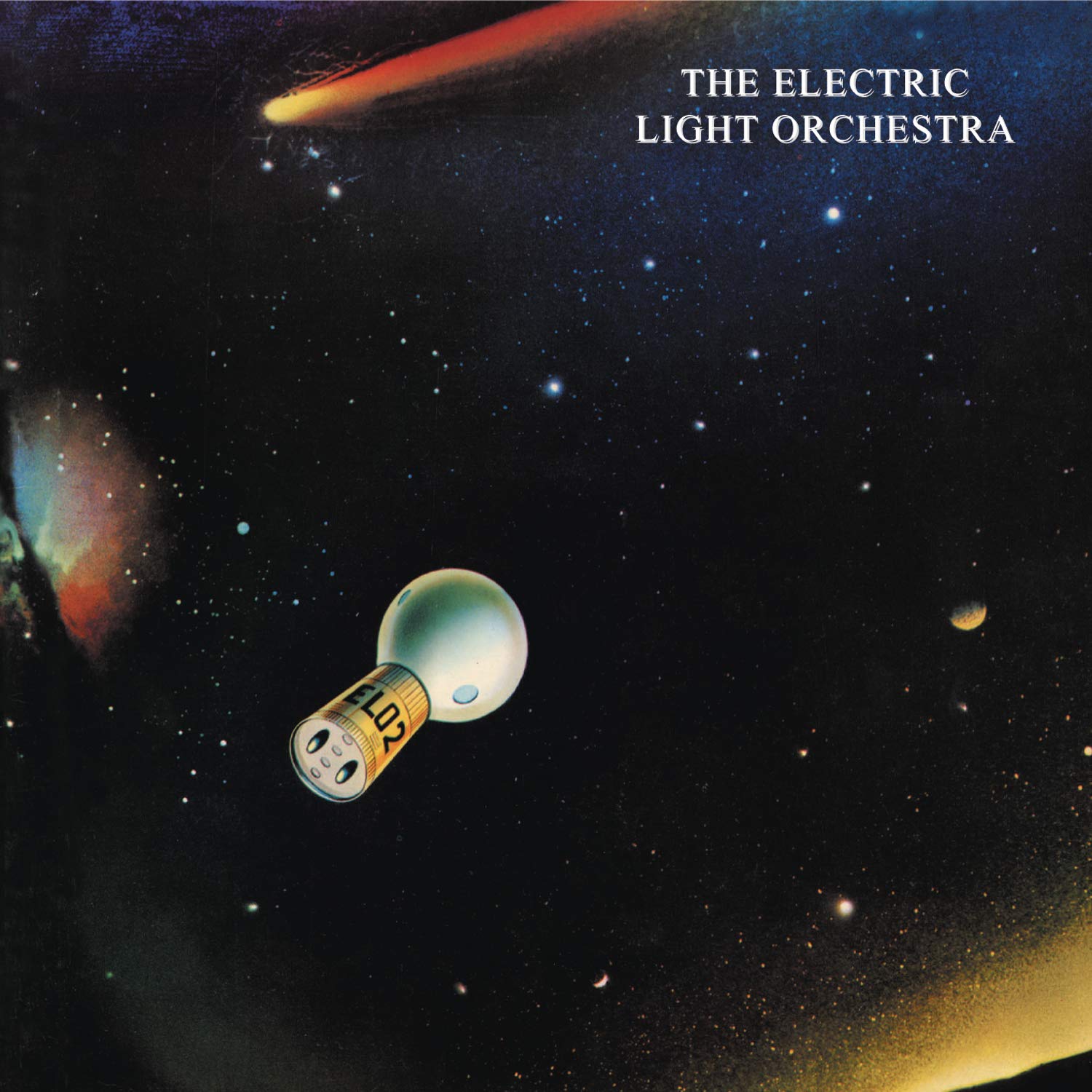
Though not as ambitious or consistently appealing as the first album, or with anything that equals “10538 Overture“, ELO 2, released March 2, 1973, has many fine moments with generally more emphasis on smoother, more conventional orchestration. Particularly good is the opening track, “In Old England Town (Boogie No. 2)” and its second-side counterpart, “From the Sun to the World (Boogie No. 1)”, the latter incorporating true boogie-woogie components. Also worthy of note, is the seven-minute (or eight-minute arrangement in the U.S.) of Chuck Berry’s “Roll Over Beethoven.” A four and a half minute single version of it got substantial airplay in the UK, charting as high as number six, while in the states, a slightly shorter version, got some AM airplay starting in late April of 1973, climbing as high as 42 on the Billboard singles chart. In Southern California several FM stations regularly played the full-length album cut during the spring and summer of 1973, providing greater exposure in terms of airplay, even if not in terms of audience reached. Besides being a fairly spirited and compelling cover of the original tune, the work incorporates the famous motif of the first movement of Beethoven’s Fifth Symphony, perhaps unintentionally inspiring (though no evidence to support such an assertion) Walter Murray’s 1976 disco-hit, “A Fifth of Beethoven.”

Led Zeppelin: Houses of the Holy

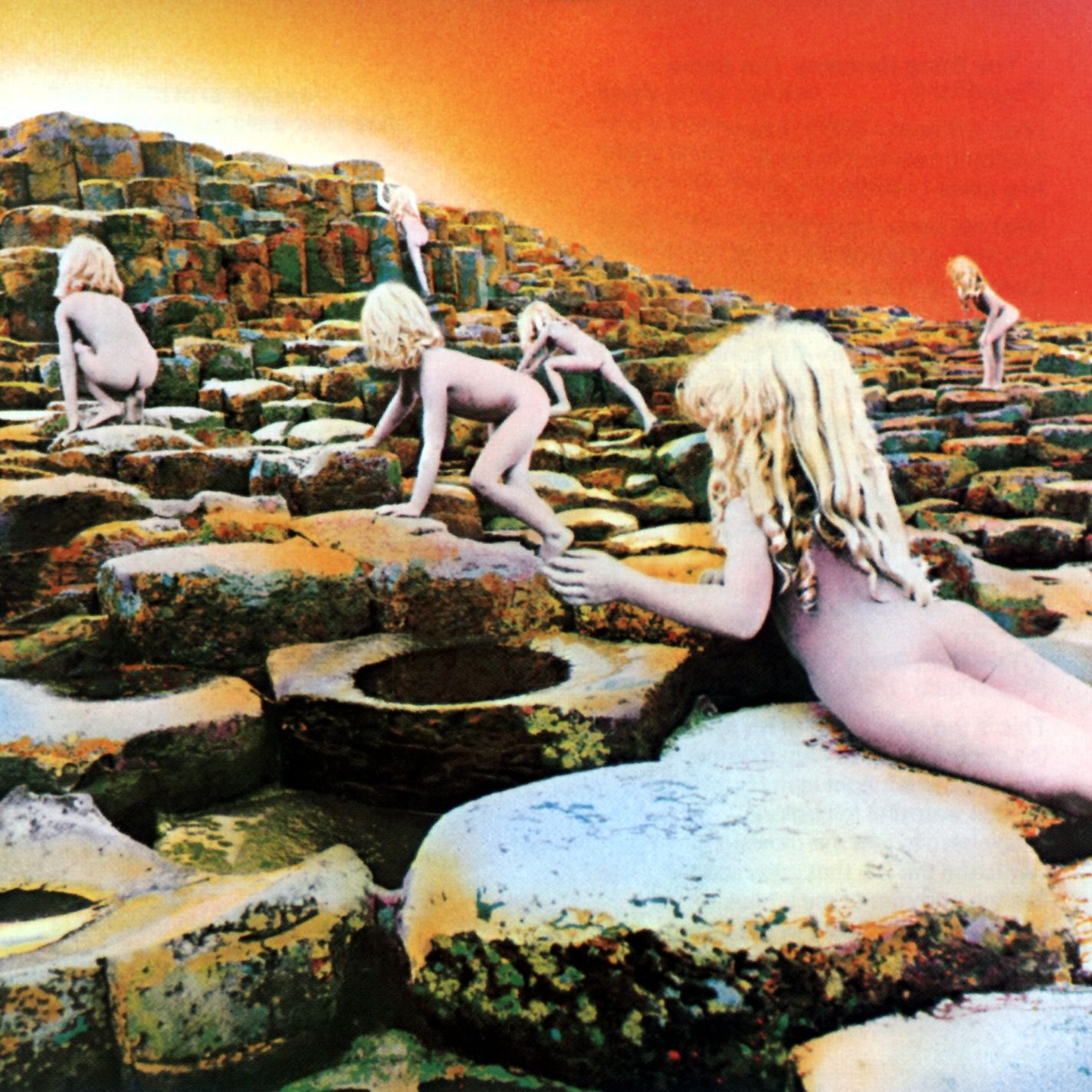
Once again, Led Zeppelin eschews just copying what made their previous album successful, creatively exploring new musical techniques and pathways, but as often the case not shy to incorporate notable musical elements of contemporaries and past predecessors. The overall result is an excellent hard-rock album that nicely balances acoustic and electric components and that successfully incorporates reggae, R&B, funk and even some classical and progressive influences.

Tom Waits: Closing Time

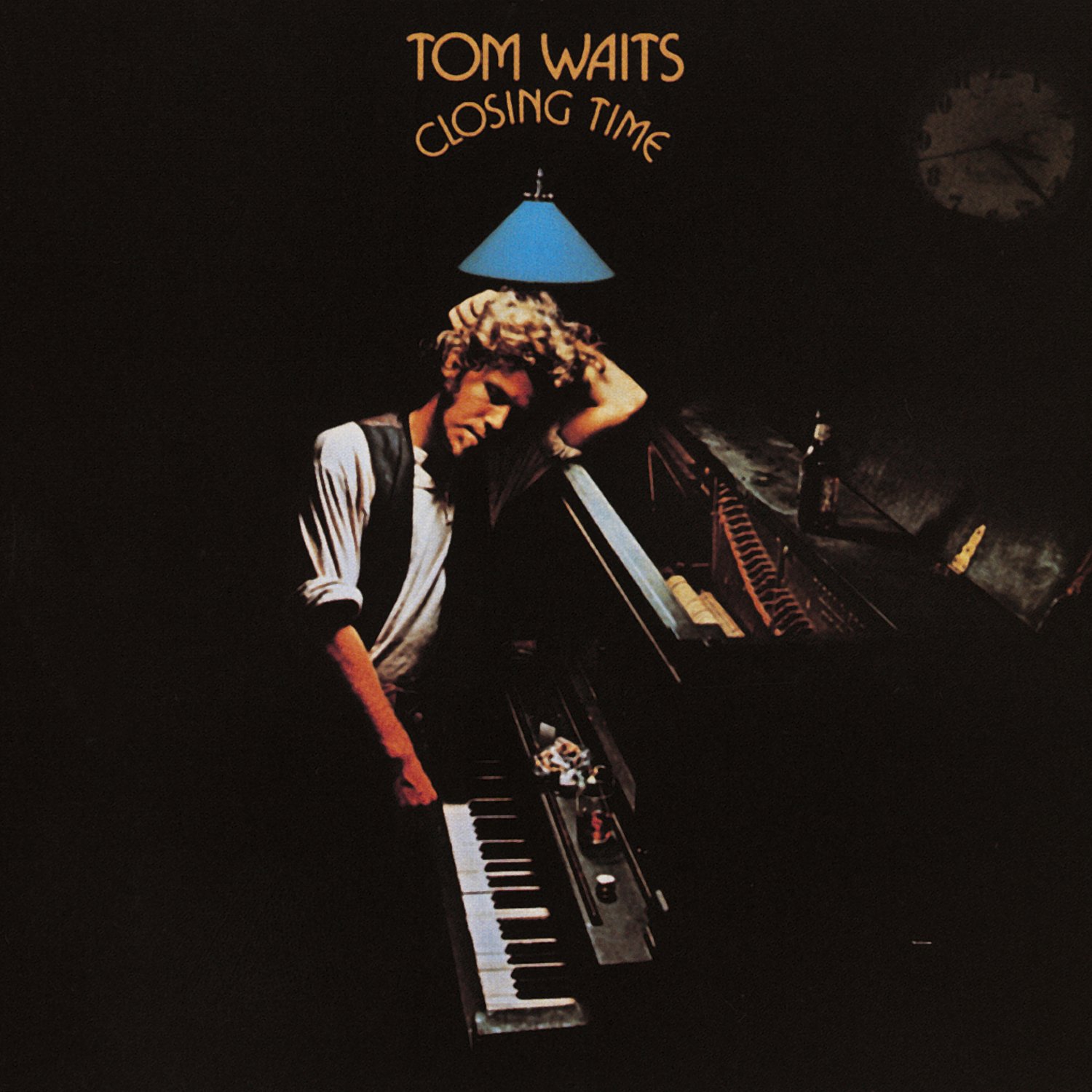
Tom Waits’ debut album, Closing Time, was released on March 6, 1973, receiving limited attention. Though largely folk-based music with some country, jazz and blues influences, what is most notable is how the music supports the lyrics and how each work, independent and finished, come together into a quasi-concept album of isolation, loneliness and dependency. Whereas an artist like Randy Newman comments on the darker side of life with a isolated, somewhat remote detachment, Waits incorporates a very distinctive viewpoint not only within each song but makes it as a necessary component of the content, the character often representing someone not really getting the implication of the commentary, making the song’s meaning even more apparent. Each song works nicely, there is not a bad song on the album — the opening track received some minor airplay as a single, well deserved and eventually covered by the Eagles, but, curiously, there are better candidates to have captured greater airplay if that had been the Asylum label’s focus. However, this is an album best heard from start to finish, enjoying such the varying emotional shading and of each song with “Martha”, “Rosie”, and the evocative ballad, “Grapefruit Moon” being three of my favorites pieces of the whole experience.

John Cale: Paris 1919

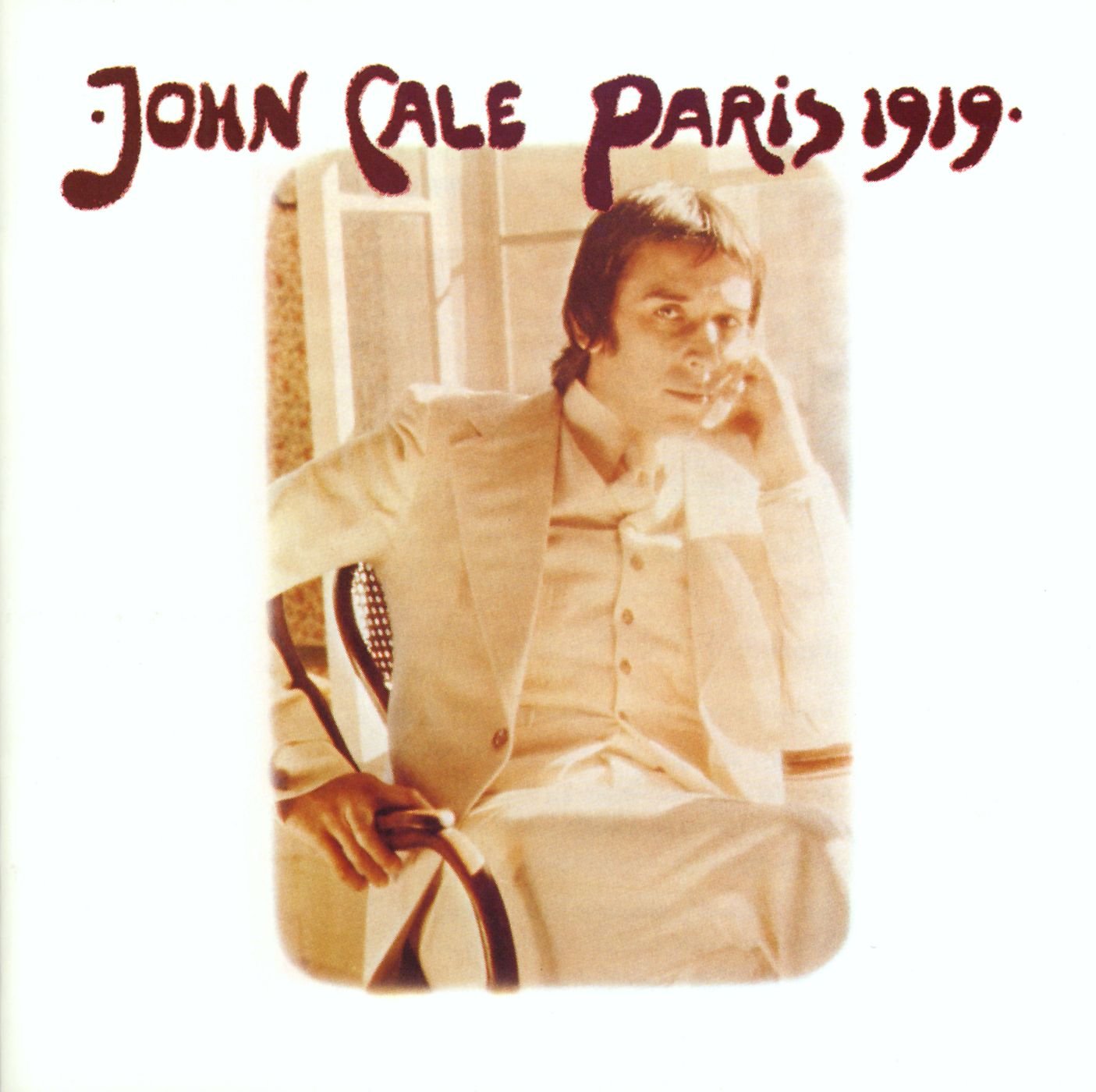
Released around March 1973, Paris 1919 is a remarkable work, consistent and enjoyable throughout with generally strong lyrics including Cale’s freewheeling imagery in the first track, “Child’s Christmas in Wales” and his historical references in various songs. The most impressive work is the title track, but the other tracks are all praiseworthy, particularly the last track with its memorable fragile opening of whispered vocals and electric piano building up with energy for what promises to be a strong dramatic ending, but even more appropriately tapers off into another moment of delicacy to provide a fine closing to the entire album.

Herbie Hancock: Sextant

The first track, the stunningly pointillistic “Rain Dance” is like nothing ever recorded previously, either in jazz, rock, fusion or academic electronic music. Furthermore, it makes full use of the stereo sound-field materializing packets of sounds in various, hovering points of space in the listening room, some of the pinpoint sounds coming within the expected stereo field, but others unexplainably occurring well out of the usual and expected speaker-range territory. This wonderful first track, is then followed by the two remaining tracks that, though closer to traditional fare that melds jazz, rock and funk elements, still are pretty far out there, effectively incorporating synthesizers and other electronics with trumpet, trombone, sax, bass and drums. Sextant was not a commercial success, and I never remember seeing this in anyone’s record collection — and wasn’t even in my own collection until recently.

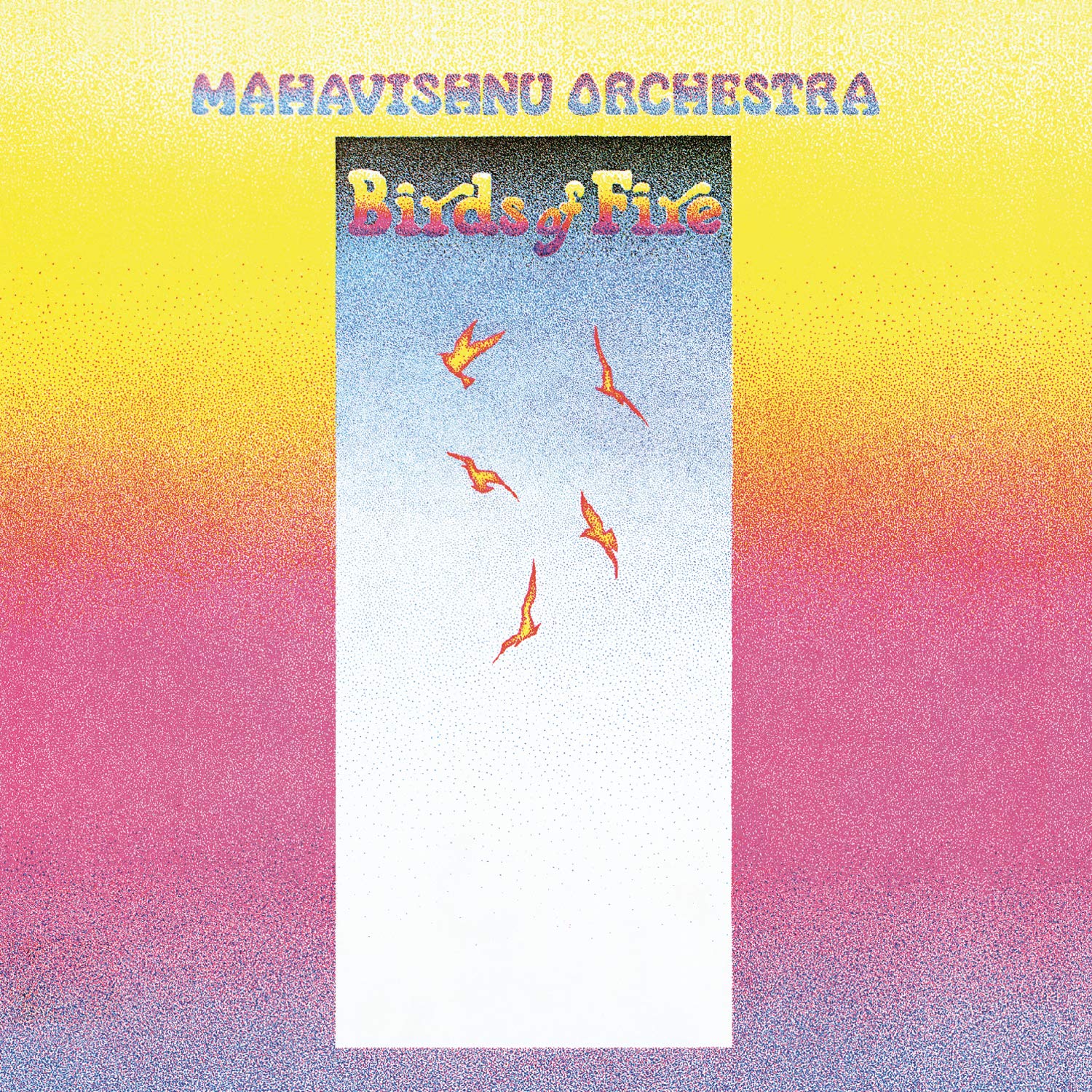
Mahavishnu Orchestra: Birds of Fire

Though Herbie Hancock’s Sextant sold relatively few copies, the opposite was true of Mahavishnu’s Orchestra’s Birds of Fire: it was in several of my friends collections and soon I would buy my own copy. This is one of the finest albums of 1973, appealing to jazz and progressive rock fans alike — and beyond — for anyone in love with electric guitar virtuosity this was a must have. Besides McLaughlin’s guitar, there is unfaltering, propulsive percussion work from Billy Cobham, keyboards from Jan Hammer, and violin work that provides a perfect compliment to McLaughlin contributions. A classic album of unerringly invigorating and captivating instrumental music.

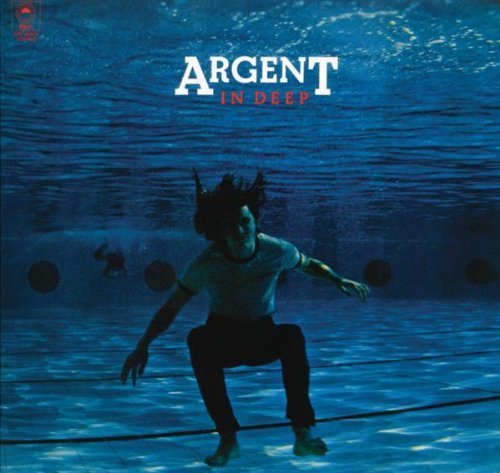
Argent: In Deep

Argent releases their fourth studio album on March 5, 1973, and though there is nothing to match the organ solo in Altogether Now, there are still some good piano and organ work from Rod Argent. The first side is mostly written by Russ Ballard and includes a semi-hit rock anthem, “God Gave Rock and Roll to You”, which was later picked up and modified by Kiss for the soundtrack to Bill & Ted’s Bogus Journey and “It’s Only Money” part one and two. The second side is mostly written by Rod Argent and Chris White and is substantially closer to a progressive rock than the first side, with “Be Glad” and “Candles on the River” being the most adventurous.

Procol Harum: Grand Hotel; Steeleye Span: Parcel of Rogues; Faces: Oh La La

Other notable albums released in March include Procol Harum’s elegant and grandly orchestrated Grand Hotel, overall their most consistent and cohesive album, Steeleye Span’s spirited and well-produced, prog-tinged folk album, Parcel of Roques, and the Faces earthy, energetic Oh La La.

Fifty Year Friday: In A Silent Way


in a silent way-72067-001.jpg (2)

MILES DAVIS: IN A SILENT WAY

Recorded in one session on Feb 18, 1969 as three performances, “Shhh/Peaceful”, “In A Silent Way”, “It’s About That Time”, then edited by Ted Macero (with apparently minimal input from Miles Davis) into two compositions in ABA form, one for each side, In A Silent Way, was released on July 30, 1969, peaking at number 134 on Billboard’s Top LPs chart.  The music is available today in both the edited form, which for a long time was all that listeners were familiar with, and in its original form.

What is striking about either the edited or original form, is the original style of both the music and the musical approach to structure and form that was deployed.  The album version differs considerably than the original takes.  For “Shhh”/”Peaceful” the original starts off with a whole-tone sort of motif (with traces of the flat-second Dorian mode) on which the entire work unfolds.  There is this amazing guitar work from McLaughlin and a brief but luxuriantly melodic Davis/Shorter passage.  All of this is dropped from the album version, which begins with the initial statement of another theme from the original take (about ninety seconds) followed with the restatement of this theme that occurs during the last four and a half minutes of the original, then followed with earlier material.  Whereas the original is multi-thematic and provides more contrast, the album version is more mono-thematic and ambient in nature.  It is basically in A B A form, resembling the Sonata form found in Mozart, Haydn and Beethoven era music, with the middle section analogous to a development section.

On the second side of the album, Teo Maceo continues to aggressively edit the original music, once again creating an ABA structure by taking the group’s performance of Davis’s simplified version of Zawinul’s “In A Silent Way” for the A section and using Davis and Zawinul’s collaborative “It’s about That Time” as the B section.  The results provides us with an impressionistic A section, and a quasi-bluesy, slightly funky B section, with a perfect repeat (as it is just a copy) of the original A section.

Though a transitional style for Davis, this landmark ambient jazz album would have considerable influence on many styles of music in the next few years ranging from other jazz or jazz-ambient artists to a subset of progressive rock groups, particularly several of the so-called Kraut-rock bands including Can, Cluster, Tangerine Dream, Amon Duul II, to Brian Eno to a number of New Age artists to even several modern “classical music” composers.  It’s tempting to debate the artistic pros and cons and the artistic merit of the original music versus the final edited album, but it was that final edited album that was the sole source of this music for musicians and music lovers during the last five months of 1969, all of the seventies, the eighties and the nineties.   Commercial music is often notable for its externally enforced limitations, but in 1969 in particular, music markedly stood out for its bold exploration outside of established boundaries, with In A Silent Way being one of the best examples of music liberated and unencumbered from the realm of retail-driven mechanical patterns and formulas, purposefully, yet seemingly spontaneously, creating a new and unconfined expanse of musical expression.

Side One

“Shhh”/”Peaceful” (Miles Davis)  18:16

Side Two

“In A Silent Way/It’s About That Time” (Joe Zawinul, Miles Davis)  19:52

Musicians


Fifty Year Friday: Power to the People, The Giant is Awakened, Empty Sky, At San Quentin, and Charisma


joe-henderson3jpg

Joe Henderson: Power to the People

Recorded in late May of 1969, Power the Power stands out distinctly from both those late-sixties partly-commercially friendly hard bop albums and the bevy of free-jazz albums being recorded in 1968 and 1969.  It opens with one of the most sensually gorgeous jazz ballads of the era, the beautifully lush Black Narcissus with Herbie Hancock’s Fender Rhodes electric piano providing the appropriate ambient backdrop. Henderson’s tenor work here is stunningly elegant as he shapes his lines with a rare level of delicate control.  And though “Black Narcissus” is the highlight here for me, Ron Carter’s “Opus One-Point-Five” is also particularly beautiful with Henderson’s tone capable of the most nuanced reflection and introspection.  Hancock is on acoustic piano, and Jack DeJohnette’s percussion fits in perfectly.

Despite all this beauty, on cannot overlook the other tracks including an updated version of Henderson’s Monk-influenced “Isotope” that Henderson and Hancock had previously recorded in 1964 for the “Inner Urge” album.  As a Thelonious Monk fan, this resonates with my personal music sensibilities, and so very glad to have both the longer 1964 version and this version. “Lazy Afternoon” swings effortlessly, “Afro-Centric” is hard-edged, modally adventurous hard bop, and “Foresight and Afternoon” omits keyboards with the trio charging into the realm of free jazz territory.  The title track, “Power to the People”, is also adventurous, with a modern hard-bop theme, aggressively inventive improvisations, and sparking electric piano work by Hancock. Now if I had to change one thing about this album, I would have liked to have a second version of “Power to the People” included with Mr. Hancock on acoustic piano. That would be one way to make an amazing album even more incredible!

Track listing [from Wikipedia]

All compositions by Joe Henderson, except where noted.

  1. “Black Narcissus” – 4:50
  2. “Afro-Centric” – 7:00
  3. “Opus One-Point-Five” (Ron Carter) – 4:56
  4. “Isotope” – 4:53
  5. “Power to the People” – 8:42
  6. “Lazy Afternoon” (MorossLatouche) – 4:33
  7. “Foresight and Afterthought (An Impromptu Suite in Three Movements)” – 7:33

Recorded on May 23 (2, 5) and May 29 (all others), 1969.

Personnel


horacetapscott1802420518horacetapscottB1

Horace Tapscott: The Giant is Awakened

Recorded on the first three days of April 1969, released later that year to negligible sales and then not reissued until 2015, The Giant is Awakened is Horace Tapscott’s first album as a leader, with not another album in his name until 1978, by Tapscott’s choice, as he was reportedly disappointed in being excluded from the mixing process of this album despite assurances to the contrary.  Reportedly, Tapscott was particularly dissatisfied with the over-emphasis on the piano, which aggressively stands out whether soloing or providing accompaniment. The two basses could have been brought out more, particularly in passages where one is bowing and the other is being plucked.

The album finds middle ground between standard hard bop and extreme free jazz as nicely exemplified in highly structure and rhythmically-driven “The Giant is Awakened.”  This is also Arthur’s Blythe’s first recording, but his distinct alto playing is evident even at this point in his career as he provides an orchestra’s worth of tension and forward momentum in the first track, preceding Tapscott’s unrestrained and exploratory solo. Blythe also contributes the composition “For Fat’s” with its Monk-like opening theme and its freer contrasting section —  the two themes rotating in a straightforward ABABA form.  The third track,  the relentlessly rhythmic “The Dark Tree” is particularly appropriate for showcasing Tapscott fearless piano technique. The final track, “Niger’s Theme”  begins with a distinct, angular melody that then gives way to Blythe’s almost chaotic, but brilliant, free improvisation, followed by some pungent and highly accentuated piano.  This returns to an extended restatement of the main theme, with a suitable diminuendo bringing an accessible, engaging, and adventurous album to a pleasant but decisive close.

Tapscott Giant (3)

Track listing [From Wikipedia]

All compositions by Horace Tapscott except as indicated

  1. “The Giant is Awakened” – 17:23
  2. “For Fats” – 2:20
  3. “The Dark Tree” – 7:01
  4. “Niger’s Theme” – 11:55

Personnel


Empty SkyA1ou+ufLWyL._SL1500_

Elton John: Empty Sky

Recorded in December of 1968 through April 1969, Elton John’s first album was released in the UK on June 6th 1969.  Like many baby boomers in the States, my first exposure to Elton John was his self-titled second album, which at the time I purchased it, I believed to be his first.  It wasn’t until a few months after I had purchased Tumbleweed Connection, that I saw Empty Sky in the import section, and as it was at a reasonable price for an import album, $3.99,  I bought it.  I listened to it once, put it aside, listened to it again, but never took a strong liking to it as I had with those second and third albums, which, along with Yellow Brick Road, are what I consider to be the best of his long, productive career.

That said, Empty Sky is still a good album, with well-written lyrics by Bernie Taupin, skillfully set to music by Elton John.  Yes, the second and third albums have stronger songs, and also benefit from the wealth of quality musicians that contribute as well as Gus Dudgeon’s accomplished production — Empty Sky lacks anything approaching “Your Song”, “Take Me To the Pilot”, or “Burn Down the Mission”, does not have the same production values or range of contributing musicians — and appears to be constrained by a lower budget.

My favorite songs are the opening (and title) track, “Empty Sky,” “Western Ford Gateway,” which sounds similar to content from Tumbleweed Connection, and “Hymn 2000,” which would fit in nicely on the second album.  The last track has a jazz-blues section, which would provide a nice ending to the album, except for the intrusion of a collage of snippets from each track that provides a musical flashback — a puzzling approach, but something repeated by both Gentle Giant (“In a Glass House”) and Queen (“Jazz”), with Gentle Giant keeping their snippets to a little under two seconds each, for a total length of nine seconds (not counting the few seconds of shattering glass) compared to the nearly two-minute recap on Empty Sky.  (In regards to Gentle Giant and Elton John, Elton, when still Reginald Dwight, played with Simon Dupree and the Big Sound for a couple of months when their regular keyboard player, Eric Hine, was ill.  The Shulman brothers and Reggie got along great, and recorded Elton and Bernie Taupin’s “I’m Going Home” as mentioned here.)

Track listing [From Wikipedia]

All songs written by Elton John and Bernie Taupin.

Side one

  1. “Empty Sky” – 8:28
  2. “Val-Hala” – 4:12*
  3. “Western Ford Gateway” – 3:16
  4. “Hymn 2000” – 4:29

Side two

  1. “Lady What’s Tomorrow” – 3:10
  2. “Sails” – 3:45
  3. “The Scaffold” – 3:18
  4. Skyline Pigeon” – 3:37
  5. “Gulliver/Hay Chewed/Reprise” – 6:59*

Personnel

  • Elton John – vocals, piano, organ, Fender Rhodes, harpsichord
  • Caleb Quaye – electric guitar, acoustic guitar, congas
  • Tony Murray – bass guitar
  • Roger Pope – drums, percussion
  • Nigel Olsson – drums on “Lady What’s Tomorrow”
  • Don Fay – saxophone, flute
  • Graham Vickery – harmonica


johnny cash sq1.jpeg (2)

Johnny Cash At San Quentin

Whereas Elton John was just getting to his first album, Johnny Cash was tackling his thirty-first. If you had any relatives in 1969 or the early seventies that were partial to country music, there’s a good chance that this album would be in their collection, and for good reason: it is an exceptionally engaging live album, recorded on February 24, 1969, just two days before Cash’s 47th birthday, and released on June 4, 1969.  Those of us with any memory of 1969, will recall the repeated playing on the airwaves of this live concert’s version of Shel Silverstein’s cleverly-written “A Boy Named Sue”, and the bleeping out of “son of a *****” — how quaint censorship was back then.

Track Listing [From Wikipedia]

Side one
1. “Wanted Man” (Bob Dylan) 3:24
2. “Wreck of the Old 97” (arranged by Cash, Bob Johnston, Norman Blake) 2:17
3. “I Walk the Line” (Johnny Cash) 3:13
4. “Darling Companion” (John Sebastian) 6:10
5. “Starkville City Jail” (Johnny Cash) 2:01

Side two
1. “San Quentin” (Johnny Cash) 4:07
2. “San Quentin” (performed a second time at the audience’s request) (Johnny Cash) 3:13
3. “A Boy Named Sue” (Shel Silverstein) 3:53
4. “(There’ll Be) Peace in the Valley” (Thomas A. Dorsey) 2:37
5. “Folsom Prison Blues” (Johnny Cash) 1:29

Personnel

lee morgan (2).jpg

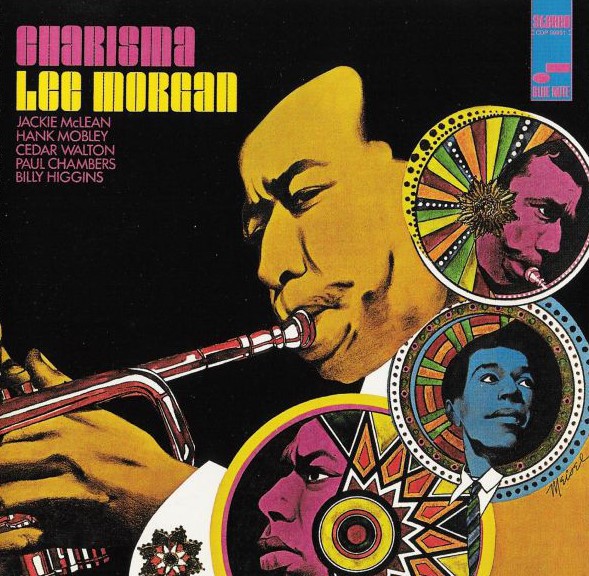
Lee Morgan: Charisma

With a lineup that immediately ensures a high level of quality, Charisma was recorded in 1966, but not released until May 1969.  Compared to the plethora of free jazz albums being released in 1969, this may seem embarrassingly accessible to more sophisticated jazz listeners, but there is nothing embarrassing about the quality of the musicianship and the level of improvisation. One can scarcely go wrong with any Lee Morgan Blue Note album, so given that everyone must own a copy of his 1963 Sidewinder album with Joe Henderson as well as the 1964 Search for the New Land with Wayne Shorter, Grant Green and Herbie Hancock, it seems reasonable one would be able to find a place in their music collection for an album where Lee Morgan teams up with Jackie McLean, Hank Mobley, Cedar Walton, Paul Chambers and Billy Higgins, particularly when it is also on Blue Note and is this good!

The album starts with “Hey Chico”, one of those mid-sixties blues-based jazzed numbers tailored for AM radio, though it never got such exposure, followed by, what for me, is the gem on the album, “Somethin’ Cute”,  rich in great solos, particularly the alto solo from Jackie Mac. Walton is exemplary on the lovely ballad, “Rainy Night”, and the fourth track, is another of those relatively simple, commercially friendly tunes, upbeat and perfect for the excellent soloing after the initial statement — particularly impressive is Lee Morgan’s trumpet solo.  This is followed by another Duke Pearson tune, with particularly notable solos by Morgan and Walton.  The last track, “The Double Up”, provides a nice symmetry against the opening track, and includes strong solos by Morgan and Mobley and a notable solo by Walton against the horns.  Chambers and Higgins are excellent, with Higgins flavoring these performances with unobtrusive ranges of shading and percussive hues and tints that lie almost below the range of general perception yet significantly contributes to the overall impact.


Track listing [From Wikipedia]

All compositions by Lee Morgan except where noted

  1. “Hey Chico” – 7:17
  2. “Somethin’ Cute” – 5:39
  3. “Rainy Night” (Walton) – 5:39
  4. “Sweet Honey Bee” (Pearson) – 6:54
  5. “The Murphy Man” (Pearson) – 7:34
  6. “The Double Up” – 6:01

Personnel


Fifty Year Friday: Roy Ayers, Stoned Soul Picnic; Eric Burdon & The Animals, Every One of Us

Stoned Soul Picnic.jpeg

About the time that the Fifth Dimension released their single of Laura Nyro’s “Stoned Soul Picnic”, Roy Ayers recorded tracks for his second album on June 20, 1968  that included Nyro’s tune and would be named for that song. The session and the released album also included three originals, Jobim’s “Wave” and Ron Miller and Orlando Murdon’s “For Once in My Life” (previously recorded by Tony Bennett [#91 on the pop singles chart] and several Motown Artists including the Temptations, before Stevie Wonder’s hit version would be released later that year.) Sometimes these jazz covers of pop hits are just a waste of time to listen to, but not here.

Roy Ayer’s opens the album with his own composition, “A Rose for Cindy”, which starts off like free jazz before dissolving into a sensual chromatic passage that precedes the main section of a thoughtful and introspective ballad.  Notable here is the excellent soloing and interplay between the participants. Hubert Laws and Herbie Hancock are both particularly attuned to the character of the piece and provide an appropriate, impressionistic sensibility that make this the most memorable track on the album.

“Stoned Soul Picnic is vibrant and funky with Evan’s mallet work, Law’s flute, Ron Carter’s bass, Hancock’s keyboard work (he plays what sounds like a Hammond B-3) and Charles Tolliver’s trumpet essential to the sense of freedom and exuberance that permeates this version.  This is followed by a surprisingly engaging and inescapably immersive version of  “Wave” with Miroslav Vitouš replacing Ron Carter for the rest of the album, and strong solos from Gary Bartz and, as the case on every track here, Herbie Hancock.

“For Once in My Life” is treated tenderly. but not over-delicately, followed by Tolliver’s upbeat “Lil’s Pardise” highlighted by Ayer’s vibe solo and Hancock’s piano solo.  The album concludes with Edwin’ Birdsong’s evocative “What the People Say” with introspective yet enchanting solos by Ayers and Laws. Overall, an excellent post-bop album characterized by overall beauty and unaffected optimism.

Track listing [from Wikipedia]

  1. “A Rose for Cindy” (Roy Ayers) – 8:56
  2. Stoned Soul Picnic” (Laura Nyro) – 2:50
  3. Wave” (Antônio Carlos Jobim) – 7:59
  4. For Once in My Life” (Ron Miller, Orlando Murden) – 3:50
  5. “Lil’s Paradise” (Charles Tolliver) – 6:33
  6. “What the People Say” (Edwin Birdsong) – 8:09

Personnel

animals eoou.jpeg

This is not a particularly strong album by the Animals. Listening to this today, it seems there is more filler than essential components, though the political statement Burdon makes on side two is pretty remarkable given the inherent expectations by the record label for a high level of commercial appeal from a group as well known as this.  And there is commercial appeal in “White Houses”, which hints at Caribbean rhythmic and melodic influences, and in the group’s initially very dark, then bluesy and rocking rendition of “St. James’ Infirmary”, a follow-up of sorts to the groups’ very successful version of “The House of the Rising Sun.”

The main item of note, particularly for historical interest, is Burdon’s “Year of the Guru” somewhat modeled after Dylan’s  “Subterranean Homesick Blues”, but with more of a rock than folk character — sounding more like rap music than can reasonably be expected for 1968.  Certainly there are other cases for early “proto-rap”, but “Year of the Guru” sounds too much ahead of its time instrumentally and vocally to be categorically overlooked, particularly in light of the social commentary of the lyrics:

“My leader said son you’d better get yourself together
Never mind the fools who know what we’re getting into
But a forty mile walk would do us both a world of good
And he sat down and watched me take off down the road.”

…..

“Now here I sit in a state-run asylum
Limitless, friendless but much more together
I decided to do some good book readin’
About the art of people leadin’
Now I’m the leader and they’re being led
What’s the matter if they’re crazy till you hear what I’ve said
Being the leader is really where its at
But just how long can a good thing last
Oh, oh leader
Oh, oh leader
Now listen to this baby
This is the year of the guru
Now the thing to do is to ask yourself
What can a guru do for me?
Then you say to yourself
I gotta get a guru”


Track listing [from Wikipedia]

All selections written by Eric Burdon except where indicated.

Side 1 

  1. White Houses” (4:43)
  2. “Uppers and Downers” (0:24)
  3. “Serenade to a Sweet Lady” (John Weider) (6:17)
  4. “The Immigrant Lad” (6:15)
  5. “Year of the Guru” (5:25)

Side 2 

  1. St. James Infirmary” (Traditional, arranged by Eric Burdon) (4:15)
  2. “New York 1963-America 1968” (Eric Burdon, Zoot Money) (19:00)

Personnel 


Fifty Year Friday: Herbie Hancock, Speak Like a Child; The Web, Fully Interlocking; Deep Purple, Grateful Dead

web cover_5115101992017_r

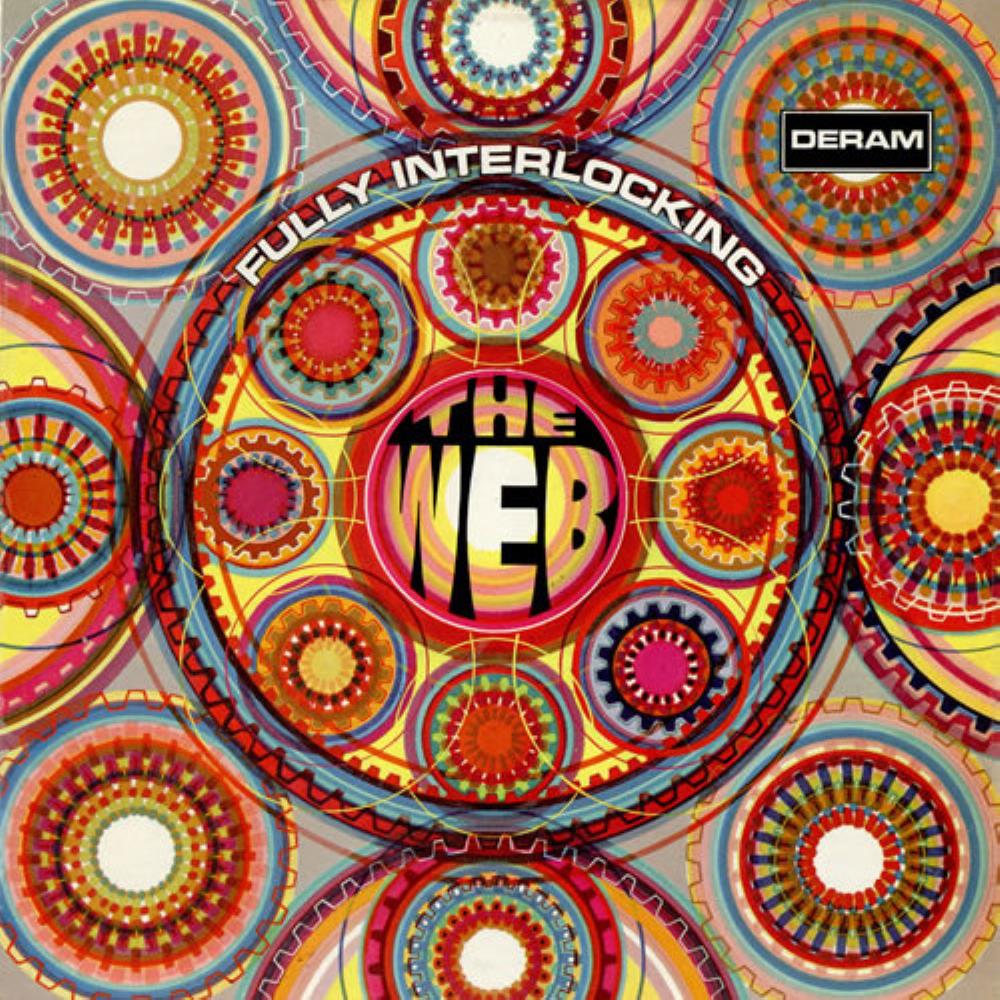
The Web; Fully Interlocking

Released by Deram sometime in 1968, The Web’s debut album, Fully Interlocking, is both an early jazz-rock album and an early progressive rock album. Though no home run is scored under either of these uniforms, credit must be given for the moments of sophistication and the early foray into the two new styles of rock music that would soon surge in popularity. In accordance with the title, the music is interlocking with no silence between tracks.  Track 4, Green Side Up,  is particularly notable as a fully-formed prog rock instrumental, with King Crimson-like rhythmic punctuation (this before King Crimson’s first-ever rehearsal in January 1969), a Robert Wyatt-like second theme, and effective saxophone and bass guitar lines. No progressive rock fan should miss hearing this.

The band included two guitars, two percussionist, an electric bass, and Tom Harris who played sax and flute. There was one American, their dedicated vocalist, John L. Watson, who was quite good, but sounded more like a lounge singer than a rock or progressive rock vocalist. (Later Watson would be replaced by singer and keyboardist Dave Lawson who would eventually join Greenslade.)

Some of the music sounds dated, such as their attempted single, “Wallpaper”, and some doesn’t live up to its conceptual promise such as the “War and Peace” suite, but this generally ignored album contains much of interest, both musically and historically.  Three bonus tracks are available on CD, and the first two of these are not to be missed.  “I’m A Man”, predates Chicago’s version on the first album, and works perfectly for Watson, who provides a strong rhythm-and-blues delivery.  The similarities between this and the later Chicago version, are striking, and one wonders if someone from Chicago or Columbia records had somehow heard The Web’s version first.  The second track, is Billie Holiday’s “God Bless the Child”,  also sounding strikingly similar to the Blood, Sweat and Tears’ version that was recorded in October 1968.

This album, only obtainable as a used LP in previous decades, is available as a CD, mp3s, or from a streaming service. It’s worth checking out for anyone that has an interest in rock, jazz-rock, or progressive rock history.

Tracks Listing [from progarchives.com]

1. City of Darkness (2:55)
2. Harold Dubbleyew (3:10)
3. Hatton Mill Morning (3:37)
4. Green Side Up (2:02)
5. Wallpaper (2:40)
6. Did You Die Four Years Ago Tonight? (2:20)
7. Watcha Kelele (3:57)
8. Reverend J. McKinnon (2:55)
9. Sunday Joint (2:03)
10. War or Peace (9:56) :
– a. Theme 2:11
– b. East Meets West 2:39
– c. Battle Scene 0:38
– d. Conscience 2:00
– e. Epilogue 2:28

Total time 35:35

Bonus tracks on 2008 remaster:
11. I’m A Man (3:33)
12. God Bless The Child (5:00)
13. To Love Somebody (3:29)

Line-up / Musicians from progarchives.com

– John L. Watson / vocals
– John Eaton / guitar
– Tony Edwards / guitar
– Tom Harris / sax, flute
– Dick Lee-Smith / bass, congas
– Kenny Beveridge / drums
– Lennie Wright / vibes, congas, claves

With:
– Terry Noonan / orchestra direction & arrangements


HH1MI0000442216

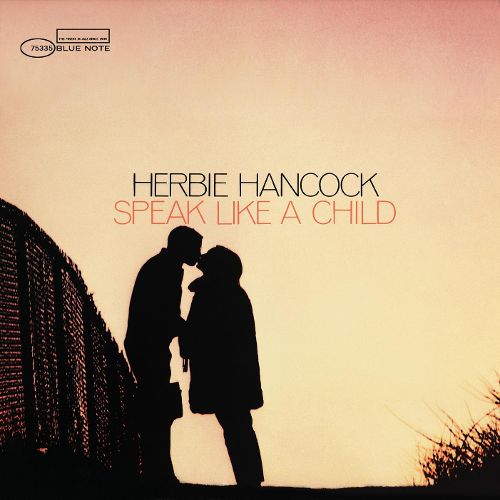
Recorded in March 1968 and released a few months later, this is Herbie Hancock’s first album as a leader since his classic Maiden Voyage, recorded 3 years earlier.  The album starts out with a calmer version of “Riot” than that recorded on Miles Davis;’s Neferiti, and ends with “The Sorcerer”, a composition on Davis’s 1967 “Sorcerer” album.  In between these tracks we have compositions relating to childhood, three by Hancock and one by Ron Carter — the Ron Carter piece being different in character and not including the alto flute, flugelhorn and bass trombone present on the  rest of the album.

Track listing[from Wikipedia]

All compositions by Herbie Hancock, except as indicated.

Side A:

  1. “Riot” – 4:40
  2. “Speak Like a Child” – 7:50
  3. “First Trip” (Ron Carter) – 6:01

Side B:

  1. “Toys” – 5:52
  2. “Goodbye to Childhood” – 7:06
  3. “The Sorcerer” – 5:36


Personnel

herbie-hancock-speak-like-a-child-uk-bn-back-cover-1800-ljc


Shades of Deep Purple


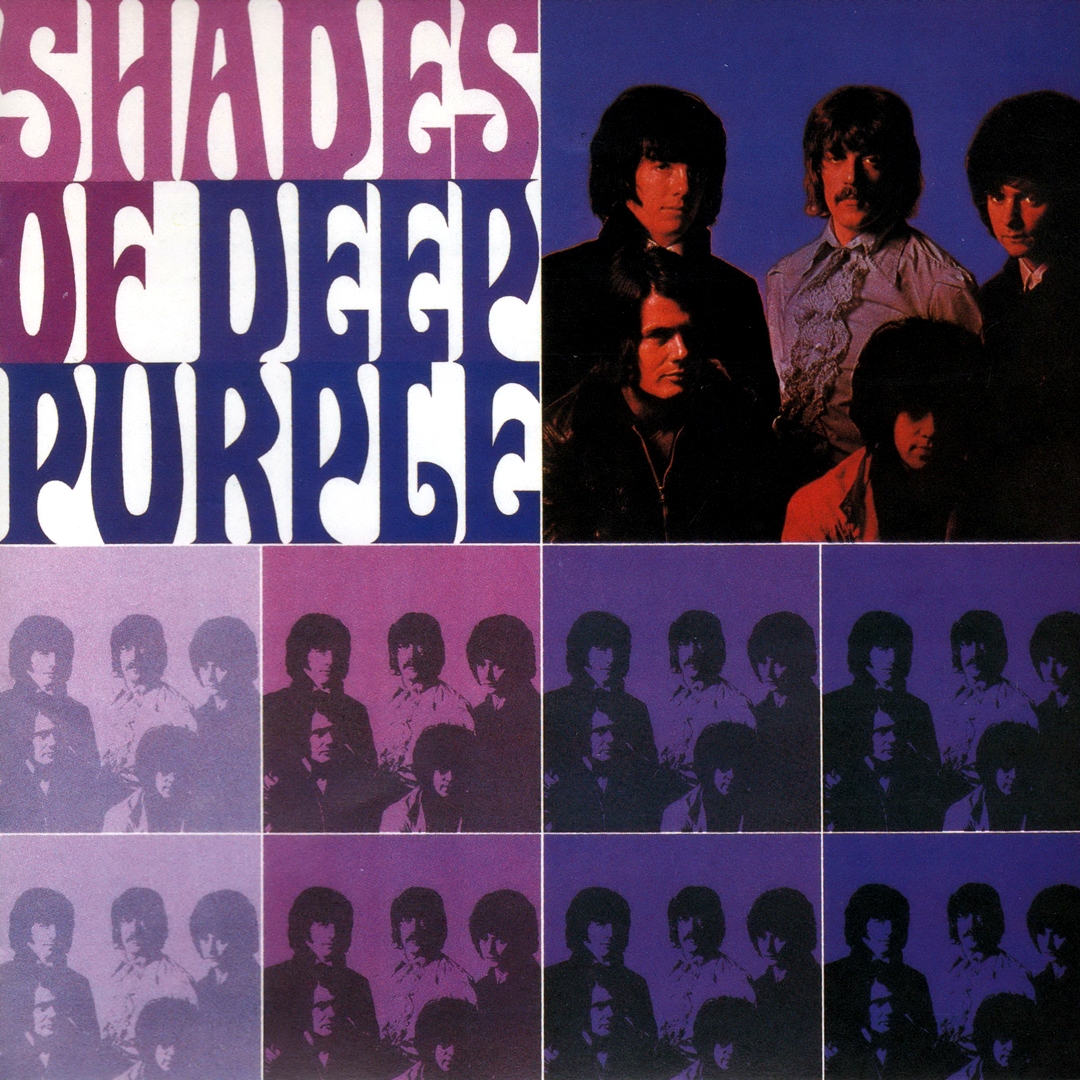
Deep Purple: Shades of Deep Purple

In their debut album, recorded in three days in May of 1968, and released on July 17, 1968, Deep Purple comes out swinging, providing exuberant hard rock with multiple glimpses of early heavy metal and progressive rock.

This album didn’t do well at all in the UK, but due to the single, “Hush”, which received significant airplay in the States, and reached the #4 slot, Shades of Deep Purple sold fairly well in the U.S., staying for 23 weeks on the Billboard top 200 album list and peaking at #24 in November, 1968.

The arpeggiated keyboard-led opening, interlude, and return included amongst the garden- variety chord progressions of “One More Rainy Day” is historically notable as this simple, but effective, compositional technique soon becomes a significant part of the musical vocabulary found in 1970s progressive rock.  Also, common to early progressive rock, is the quoting of classical music — in this case, Rimsky-Korsakov’s  Scheherezade, which provides the material for “Prelude: Happiness”, followed by Deep Purple’s take on Cream’s “I’m So Glad” based on the Skip James 1930’s tune.

Deep Purple would tour the U.S. while their album was climbing the charts, making a name for themselves, and establishing the appeal of this new style of rock music.  Below is a replica (from Dirk Kahler’s Deep Purple Tour Page) of the Oct. 18 ticket for their engagement as an opening act for Cream’s two night appearance at the Fabulous Forum.

deep purple ticket

Tracks Listing [from progarchives.com]

1. And The Address (4:38)
2. Hush (4:24)
3. One More Rainy Day (3:40)
4. Prelude: Happiness / I’m So Glad (7:19)
5. Mandrake Root (6:09)
6. Help (6:01)
7. Love Help Me (3:49)
8. Hey Joe (7:33)

Total time 43:33

Bonus tracks on 2000 remaster:
9. Shadows (Outtake) (3:38)
10. Love help me (Instrumental version) (3:29)
11. Help (Alternate take) (5:23) *
12. Hey Joe (BBC Top Gear session, 14 January 1969) (4:05) *
13. Hush (Live US TV, 1968) (3:53) *

* Previously unreleased

Line-up / Musicians

– Rod Evans / lead vocals
– Ritchie Blackmore / guitars
– Jon Lord / Hammond organ, backing vocals
– Nick Simper /bass, backing vocals
– Ian Paice / drums

0066___grateful_dead___anthem_of_the_sun_by_sunsetcolors-dag1wxs.jpg

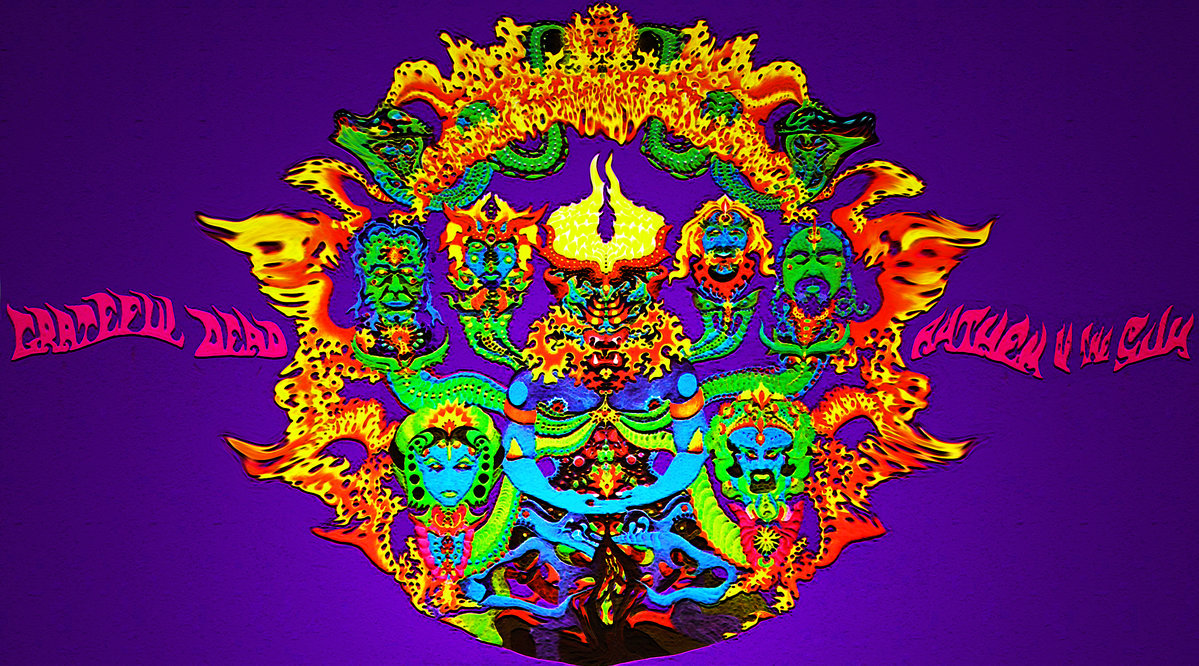
Grateful Dead: Anthem of the Sun

A day after the release of Shades of Deep Purple, Grateful Dead’s second album, Anthem of the Sun, was released on July 18, 1968.  Very different than their first album, which was mostly rock and roll and blues rock, this second album has more folk-rock, bluegrass,  psychedelic and progressive elements including a suite-like first track. Micky Hart’s addition to the band as their new percussionist appears to extend their boundaries as does their bold approach of mixing live and studio versions for the content of each track, focusing on achieving an overall aesthetic product that delineated the separate instruments but also achieved a sense of immediacy and freedom present in live shows. Throughout, there is an interesting mix of studio segments and additions with live material and improvised passages like the quote of Donovan’s “There is a Mountain” on side two’s “Alligator.”  Note that there are two versions of this album: the original mix from 1968 and a 1971 more commercial, and more commonly available, remix.  Released earlier this week, the 50th anniversary edition of Anthem of the Sun includes both the 1968 and 1971 mixes, remastered, on the first CD,  with additional live tracks from a 10/22/1967 concert at Winterland, San Francisco.

Track listing

Side one

#

Title

Length

1.

That’s It for the Other One” (Jerry GarciaBill KreutzmannPhil LeshRon McKernanBob WeirTom Constanten)

  • I. Cryptical Envelopment (Garcia)
  • II. Quadlibet for Tenderfeet (Garcia, Kreutzmann, Lesh, McKernan, Weir)
  • III. The Faster We Go, the Rounder We Get (Kreutzmann, Weir)
  • IV. We Leave the Castle (Constanten)

7:40

2.

“New Potato Caboose” (Lesh, Robert Petersen)

8:26

3.

Born Cross-Eyed” (Weir)

2:04

Side two

#

Title

Length

4.

“Alligator” (Lesh, McKernan, Robert Hunter)

11:20

5.

“Caution (Do Not Stop on Tracks)” (Garcia, Kreutzmann, Lesh, McKernan, Weir)

9:37

Personnel

Grateful Dead

Additional personnel

Production

  • Grateful Dead – producers, arrangers
  • David Hassinger – producer
  • Dan Healy – executive engineer
  • Bob Matthews – assistant engineer

Fifty Year Friday: Miles Davis Quintet “Nefertiti”


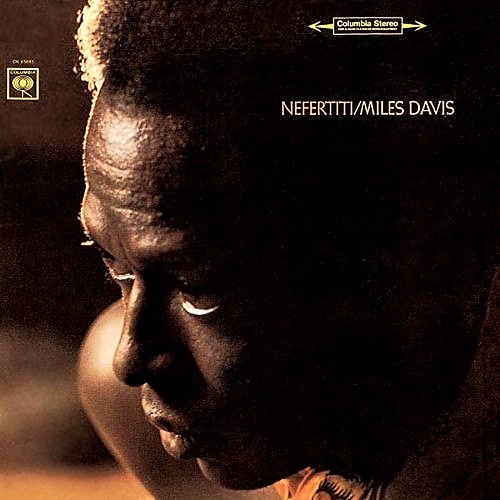
0000765885

Recorded in June and July of 1967 and released, as best as I can determine, around February 1968, give or  take a month, Nefertiti is the ever-exploring, adventurous Miles Davis’s last all-acoustic instrument album. I also consider this one of the first albums to take significant steps into both Fusion and New Age territory.

Miles Davis time at Julliard is partially evident here (just as Tony Scott’s time at Julliard is partially evident in what some consider the very first New Age record, the 1964 album, Music for Zen Meditation.)  Miles seems to infuse Bartok and Satie, whose music he admired, into some of this work,  as well as possibly (this is maybe a reach on my part, based only on the nature of some of the rhythmic and melodic patterns) Olivier Messiaen.  Miles also drives his fellow musicians to further reaches of creativity producing a work like no other work recorded in 1967 or released in 1968.  Some call this free-bop, and there are elements of free jazz present, but overall this is generally an accessible album, very much a predecessor to the fusion jazz and progressive-jazz psychedelic/rock-impressionism that will soon follow in so many albums of the 1970s.

The title track, “Nefertiti”, recorded on June 7, 1967 as a single take, is named after the Egyptian queen, Neferneferuaten Nefertiti who, with her Pharoah husband, brought about a religious revolution in Egypt by narrowing religious worship from many gods to only one. And with this first track, “Nefertiti”, there is a singularity of focus.  Missing are solos from the trumpet and saxophone.  Instead, the two instruments blend into an ambient, cleverly crafted circular sonic stream (well done, Wayne Shorter!), much as when drifting into alternative realms of consciousness prior to sleep.  The piano, bass and drums provides the greater variety and commentary here, the entire work thoroughly and unapologetically breaking from the traditional be-bop approach to ensemble sections and solos.  We have a strong case for this being jazz minimalism despite the richness of material provided by Herbie Hancock, Ron Carter and Tony Williams, based on the foundational, hardly perceptible variations provided by Miles and Wayne Shorter.

“Fall”, “Pinocchio” (two takes) and “Riot” were recorded on July 19, 1967, two days after John Coltrane’s death.  This tragic and monumental event shapes the nature of the performances of these works, particularly Miles’ solos.  The other tracks on the Nefertiti album,”Hand Jive” and “Madness”, are more extroverted and were recorded on June 22 and June 23, respectively.  Though this album may not have been conceived as a whole work (the amazing “Water Babies”, the sharp-edged”Capricorn” and the reflective, surreal “Sweet Pea” [this last a perfect fit for the Nefertiti album] were also recorded during these sessions and released years later, in 1976),  it comes together nicely and provides a general mood of near-mystical introspection.  The performances by all members of the quartet border on mythical, with Miles inspiring and encouraging his fellow musicians in reaching further levels of excellence.

This a particularly subtle, perhaps initially elusive, album — one that many will not fall in love with on the first listening.  Not as accessible as the previous album, the 1967 Sorcerer, it is often considered to be more substantial: pushing jazz into an unexplored territory that soon becomes part of the language of not only jazz, but rock, fusion, progressive rock, new age, and late twentieth century classical music.   Darken the room and give Nefertiti your undivided attention when listening, if not already a devoted fan.

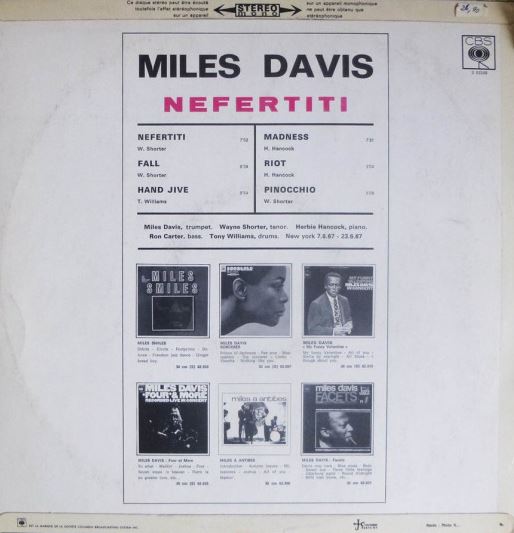
Side One:
 “Nefertiti”  — Wayne Shorter  (7:52)
“Fall” —  Wayne Shorter (6:39) 
“Hand Jive” — Tony Williams (8:54)
Side Two:
“Madness” —  Herbie Hancock  (7:31)
“Riot” —  Herbie Hancock (3:04)
“Pinocchio” — Wayne Shorter (5:08)

miles 2Capture