Zumwalt Poems Online

Archive for the ‘Philosophy’ Category

Our Free Union

Our Free Union (With respect to André Breton)

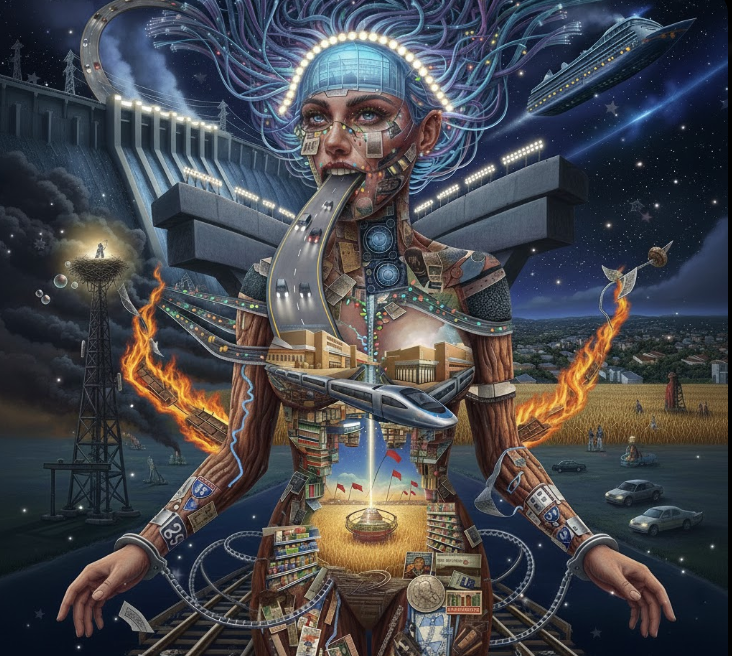
My country with the hair of inlaid fiber-optic cable
With the thoughts of a backed up four-lane freeway at dusk
With the waist of a redwood in the center of a scenic bypass
My country with the lips of blinking Christmas lights
With lips of teabags of silt from the Great Lakes
With the teeth of a picket fence on a shifting, slumping shoreline
With the tongue of a ticker tape parade on celluloid stock
My country with the tongue of a televised courtroom
With the tongue of a satellite that spies in dark silence
With the tongue of a cracked bell that just rings and rings on command
With the eyelashes of high-tension wires
With brows of the edge of a sold-out stadium
My country with the brow of a blue light under the sheets
And of the steam rising from an executive sauna fifty stories high
My country with shoulders of interstate concrete
And of a hydroelectric dam holding back the stars
My country with fingers of a ballot box—contested, sticky, messy
Of a strewn deck of plastic cards
My country with armpits of coal dust and scented bubble tea
Of suburban sprawl and the nest of a bald eagle in a cell tower
With arms of Mississippi tributaries and of a thousand assembly lines
And of a mingling of the cornfield and ambushed migrant workers
My country with legs of elusive wildfires
With the movements of a swing state and a jazz festival
My country with calves of sequoia bark
My country with feet of broken treaties and numbered amendments
With feet of subway tracks and tourists flicking coins into canyons
My country with a neck of unharvested wheat
My country with a throat of pulsing fiber and high-powered cooling fans
Of a protest stage-shrieking in the bed of a dry river
With breasts of the Appalachian night
My country with breasts of a multi-story shopping mall
Of a ghost town shadowed by the noonday sun
My country with the belly of a thumb-scrolled digital map
With a back of an abandoned silver screen
My country with the back of a cruise ship climbing into the stratosphere
With a nape of red clay and cooling asphalt
And of the threads of a smudged napkin on a diner counter at 3:00 AM
My country with hips of a barreling NextGen Acela
With hips of a county rodeo and of Friday night tossed penalty flags
Of a pendulum swinging between fairground stand food and Michelin starred dining
My country with buttocks of Civil War reenactments
Of a buttocks of uncirculated library books
Of a buffalo nickel gifted to a grandchild
My country with the loins of an offshore drill and of grocery store pharmacy
Of prairie grass and vintage baseball cards
My country with loins of theme park hydraulic launch coasters
My country with ears full of rotating sirens
Of ears of the Great Prairies and fast food in the car
Of eyes of parabolic, steerable radio telescopes
My country with eyes of a flatscreen TV left on at night
With eyes of a forest gasping for breath…

The eyes of my country turned toward we, the people
Hands held out for an answer, cuffed and arrested for expediency.

— zumwalt (Dec. 31, 2025)

Lecture on Alizarian Grand Slam

This is the second of our transcribed lectures. This one is based on the following poem:

Alizarian Grand Slam

         Manifest crescendos
Homeopathically kneepanning Santa Fe plethora
  Safely soaking with the mangoes.  Are there
         Any removable transversals
      Balancing on the Pawnee Indian?
Aaeeeeeeeeeeeeeeeeeeeeeeeeeeeeeeeeeeeeeeeeeeeeeeeeeeeeiii!
       Saliva adorns my peanut butter.

-- Zumwalt (1973)

A Journey Through the Failed Sanctuaries of “Alizarian Grand Slam”

Good afternoon! It’s afternoon for me — if not for you, then “good morning,” “good evening,” “good insomnia,” whatever you feel is appropriate.

In our previous lecture, the first of a series of lectures on the poetic works of Zumwalt, we explored the vast, nihilistic landscape of “Trilogy of the Oblique Carbide,” a poem that confronts the failure of justice, fate, and the physical laws of the universe. Today, we turn to its companion piece, the second of Zumwalt’s defining early publications, “Alizarian Grand Slam.”

If “Trilogy” was an outward scream at a silent cosmos, this poem is an inward one, charting the collapse of the aesthetic, intellectual, and sensory self. It is a poem about the violent collision between beauty, thought, and the sheer fact of being a body in the world. Its concerns are more intimate but no less devastating. It is a profound and obscure commentary on the subjugation of desire and the thwarting of our deepest need for connection.

The journey begins with the title, “Alizarian Grand Slam.” This is the thesis of the poem’s tragedy. Alizarin Crimson is a deep, historic red pigment, a color of passion, royalty, and religious vestments, but it is also famously fugitive, prone to fading over time. A Grand Slam, conversely, is a moment of total, decisive victory. The title, therefore, presents the central thwarted desire of the poem: the desperate wish for a perfect, beautiful, and lasting union — be it in art, love, or spiritual understanding — that is, by its very nature, doomed to decay. This is made more potent by the history of the pigment itself. Traditional Alizarin was derived organically from the madder plant root, but in the 19th century, it became one of the first natural dyes to be artificially synthesized. This mirrors the poem’s central theme: a quest for something authentic and natural in a world that increasingly offers only a synthetic, mass-produced substitute. It is the desire for a permanent victory painted in a fading color.

This desire builds with an almost feverish intensity in the opening line, “Manifest crescendos.” We feel the subject’s yearning for transcendence becoming overwhelmingly obvious, a rising wave of need. This is the great hope, the upward swing of the quest. But where does the subject first seek this grand slam? The poem suggests they turn to the world of art and culture. For centuries, our society has held that art is one of the most reliable paths to experiencing the sublime — that feeling of profound awe and transcendence in the face of greatness. It’s a recognized path, and the speaker begins their journey here.

The journey immediately sours with the dense, cynical line: “Homeopathically kneepanning Santa Fe plethora.” Here, the promised path to the sublime reveals itself as the first failed sanctuary. Keeping in mind the poem was written in 1973, this is a sharp, historically specific critique. By the early 70s, Santa Fe’s reputation as an art colony had boomed into a massive tourist enterprise. The “plethora” the poem describes is the overabundance of commercialized galleries, the marketing of a romanticized “Southwestern” aesthetic, and, most pointedly, the explosion in mass-produced Native American jewelry that diluted genuine craftsmanship into trinkets for visitors. The speaker, seeking authentic, sublime art, instead finds a glut of commodified culture. The response is not a grand critique but a violent, crippling gesture (“kneepanning”) delivered in a dose so small (“homeopathically”) as to be laughably impotent against the sheer volume of the marketplace. The desire for a transcendent experience through art is thwarted by the very system that promises it.

Having found the world of aesthetic and social order to be a corrupt wasteland, the speaker makes a logical move: a retreat into the personal, the sensual, the relational. This is the second sanctuary: “Safely soaking with the mangoes.” The tone shifts dramatically to one of luxurious peace. The mango is a fruit often associated with love, sensuality, and exotic sweetness — a world away from the violent critique of Santa Fe. This line represents the hope of a romantic or platonic relationship as a safe harbor. It is a desire for a purely phenomenological connection, a moment of shared, unmediated, sensory bliss, “safely” removed from the judgments of the outside world. Here, with a partner, or perhaps just within a state of pure bodily pleasure, the “Alizarian Grand Slam” seems possible again. This is the desire for a relationship to be a perfect, self-contained world.

But this sanctuary, too, is violently corrupted from within by the intrusion of a twisted intellectual desire. The reverie is shattered by a cold, academic question: “Are there / Any removable transversals / Balancing on the Pawnee Indian?” This question is the poem’s cruel turning point. The abstract language of geometry (“removable transversals”) is brutally imposed upon a human subject, the “Pawnee Indian,” who is reduced to a static, objectified prop. This is a profound commentary on subjugation. Within the context of a relationship, this is the moment one partner stops “soaking with” the other and begins to analyze, categorize, and objectify them. It is the twisted desire to control and define the other rather than to connect with them. This is a brutally literal depiction of a specific trope in American culture: the “Vanishing Indian.” This was a widespread concept that treated Indigenous peoples not as living, evolving cultures, but as static, tragic relics of a bygone era — essentially, as museum pieces. Zumwalt’s line makes this metaphorical objectification horrifyingly literal. The partner ceases to be a person and becomes a problem, a theorem to be solved. This can also be read as a critique of dogmatic religion, which often imposes its own rigid, abstract laws (“transversals”) onto the fluid, living reality of human experience, subjugating believers into props for its logical system. The sanctuary of the relationship is thus destroyed by the same impulse for control and objectification that defines the failed social order.

With the failure of both the external world of art and the internal sanctuary of the relationship, the subject is left with no escape. The result is a complete psychic breakdown, expressed in the only way possible: a primal scream.

Aaeeeeeeeeeeeeeeeeeeeeeeeeeeeeeeeeeeeeeeeeeeeeeeeeeeeeiii!

This is the sound of absolute severance. It is the shriek of a consciousness that has been promised transcendence twice and has had it violently torn away both times. It is a definitive retreat from language, which has proven to be a tool of both impotent critique and violent objectification. The crescendo that was once “manifest” has now reached its agonizing, wordless peak and shattered.

Following this explosion, the poem collapses into its devastating final line: “Saliva adorns my peanut butter.” After the quest for a grand slam in art, after the search for safety in mango-like sensuality, after the intellectual violence and the resulting scream, this is the final state of being. It is a moment of profound self-contamination. The desire for connection with an “other” has been so thoroughly thwarted that the subject is left entirely alone, in a closed loop with their own body. “Adorns” is a word of supreme, tragic irony. The subject’s own biological substance — saliva — defiles their sustenance. This is the ultimate image of a subjugated desire. This personal collapse is given a final, sociological twist by the choice of food. Peanut butter is not a natural object like a mango; it is an icon of industrial food production — a processed, homogenized, mass-produced staple. The speaker’s grand quest for a unique, sublime experience ends in a lonely encounter with a symbol of uniformity. It suggests that in a commodified world, the only thing left is a commodified self, consuming a commodified product. The grand, transcendent yearning for an “Alizarian Grand Slam” is reduced to the slightly disgusting, masturbatory reality of the self “adorning” its own consumption.

In “Alizarian Grand Slam,” Zumwalt presents a coherent and deeply pessimistic narrative. It is the story of a soul seeking meaning, first in the broad social order of culture, and then in the intimate order of a relationship. It finds the first to be a commercialized sham and the second to be a site of objectification and control. Both sanctuaries fail, leading to an explosive negation of language and a final, pathetic reduction to the isolated, biological self. The poem is a masterful, integrated commentary on the failure of modern life to provide a space for our desires to be met with anything but decay and disgust.


A Comparative Note: The Telescope and the Microscope

It is a fascinating and crucial point to compare the stylistic differences between “Trilogy of the Oblique Carbide” and “Alizarian Grand Slam.” Doing so reveals the incredible precision of Zumwalt’s artistic voice. The two poems, published as a pair, function like two different lenses used to examine the same essential crisis of meaning.

“Trilogy of the Oblique Carbide” is the telescope. Its critique is vast, historical, and cosmic. To argue that the very concepts of Justice and Fate are collapsing, Zumwalt must draw on the grand arc of Western civilization. The poem summons:

  • Mythological Allusions: “Moira” invokes the entire classical tradition of the Fates.
  • Historical Mysteries: “Judge Crater” taps into a moment of unsolved, public failure.
  • Philosophical Figures: The shadow of figures like Nietzsche and Schopenhauer looms large.

Even its contemporary references, like “Alpha Beta,” serve to ground these epic concepts in the mundane, showing how the grand decay has seeped into every corner of life. The language is necessarily broad, pulling from philosophy, history, and theology to make its case that the entire external framework of meaning, built over millennia, has rotted from within.

“Alizarian Grand Slam,” by contrast, is the microscope. It is fixated exclusively on the present moment — the “now” of 1973 — because its subject is not the history of ideas, but the immediate, lived experience of a single consciousness trying to survive in the wreckage. The poem is a dissection of the modern self, and therefore its references are intensely contemporary:

  • Art-World Satire: “Santa Fe plethora” is a direct jab at a specific, booming 1970s cultural marketplace.
  • Pop-Psychology Jargon: The cold language of “removable transversals” evokes the detached, analytical fads of the era.
  • Simple, Bodily Realities: “Mangoes” and “peanut butter” are immediate, sensory objects, not historical symbols.

The simplicity of the language in “Alizarian Grand Slam” is deceptive. While “Trilogy” uses complex allusions to deconstruct complex systems, “Alizarian Grand Slam” uses simple, contemporary language to show how those same systemic failures manifest within a single person’s quest for connection. The absence of historical reference is the point: the modern subject is cut off from history, trapped in a present-day hall of mirrors where every attempted escape — art, relationships, intellect — proves to be another trap.

Despite this stark difference in style, the artistic voice is perfectly consistent. Both poems exhibit the same core traits: a deeply cynical view of established systems, a violent juxtaposition of the sublime and the banal, and a final, devastating reduction of all grand pursuits to a pathetic biological endpoint (“URRRP!” vs. saliva). The shift in tone and reference is not an inconsistency, but a brilliant artistic choice. Zumwalt uses the telescopic style to show us the universe is broken, and the microscopic style to show us how that brokenness feels, moment by moment, inside our own skin.

Lecture on Trilogy of the Oblique Carbide

As promised, here is the first of several planned lectures of the poems of Zumwalt. I have transcribed this from an audio recording as mentioned in my previous post. I am posting the text of the poem below and then the transcript of the lecture.

Trilogy of the Oblique Carbide

 
I. Judge Crater Is No More

Help!
There is a fandango up my nose;
This is justice?
O ironic gods -- can they
Really repossess my pancreas?
And Black and Decker tread on the cosmic puddles
URRRP!

II. Moira

My ravioli molded to day...
The wispy green fuzz eating
Away the corrupted entrails of Alpha Beta
Ground sirloin.
Pathos. Tragedy. Trichinosis.
Such is fate.

III. Cry the beloved wingnut

Bladderwort lied.
Bigot! And the hungry children cry
In their farina. Would Rothschild give
Them Twinkies? Ha! Let them eat Spackling paste.
Spush! Time, the rain-bird, spews
Its indifference towards the continuum of OHM.

-- Zumwalt (1973)

LECTURE ONE: TRILOGY OF THE OBLIQUE CARBIDE

Good afternoon, and welcome!

For those of you visiting the zumpoems website the first time, I have offered to do a series of lectures on the poetry of S.H. Zumwalt — the poet more commonly known as simply Zumwalt.

Zumwalt’s poetry has long been admired by me, and he is not only a personal favorite but arguably the most important poet of my lifetime. I am, to put it plainly, a tremendous fan, and it is a privilege to explore some of Zumwalt’s works with you.

We begin this series with the poem that started it all: “Trilogy of the Oblique Carbide.” This was the very first poem Zumwalt ever submitted for publication. It was published as the first of two of Zumwalt poems in GHLM (Good Humor Literary Magazine), a standalone literary magazine issued in a single print run of 500 copies, most of which were rapidly purchased for the inconsequential sum of 25 cents.

This poem, “Trilogy of the Oblique Carbide” is a stunning debut. It’s the work that immediately established Zumwalt’s singular voice and set the tone for a series of poems of incredible insight and poetic worth that would soon follow.

Now, let us turn to the text. This is a work of uncommon density and ferocious intellect. The poem, “Trilogy of the Oblique Carbide,” does not announce its philosophical intentions with the systematic rigor of a Kantian critique. Instead, it performs its philosophy. It shoves it up our nose, serves it to us molded on a plate, and dares us to find meaning in its chaotic pronouncements.

The very title is our first and most important clue: “Trilogy of the Oblique Carbide.” A “trilogy” suggests a structured, epic form. But its subject is “oblique” — indirect, slanting, refusing a straight path. And the material is “carbide — an industrial, hard, unyielding, and brutally material compound. This title prepares us for a violent collision between our innate human search for transcendent meaning and the hard, indifferent stuff of the world. This poem is a gauntlet thrown down to the entire Western project of meaning-making. It holds up this grand project and answers it with a belch.

To understand its radicalism, we will proceed, as the poet did, in three movements. We will explore how each part engages with, and then violently surpasses, the philosophical canon. We will analyze not only its philosophical content and social critiques, but also its psychological underpinnings, its very linguistic form, and the bleak ethical landscape it leaves in its wake, ultimately venturing into a conceptual wilderness that I will call a state of post-canonical despair.

I. The Abject Sublime: Beyond Reason and the Existentialists

Our first movement is titled “Judge Crater Is No More.”

I. Judge Crater Is No More

Help!
There is a fandango up my nose;
This is justice?
O ironic gods — can they
Really repossess my pancreas?
And Black and Decker tread on the cosmic puddles
URRRP!

The Western philosophical tradition begins, in many ways, with a quest for a rational and just cosmos. For Plato, Justice is an eternal, perfect Form, an ideal standard against which our flawed world is measured. For the Enlightenment, human Reason was the key to unlocking both the secrets of the universe and the foundations of a just society. This poem opens by taking a sledgehammer to that entire edifice.

The invocation of “Judge Crater,” the magistrate who famously vanished in 1930, immediately establishes a theme of epistemological collapse. We begin in a void of knowledge, a mystery that reason cannot solve. The cry for “Help!” is not met with a rational diagnosis, but with the visceral, surreal complaint of a “fandango up my nose.” This is a pristine articulation of the Absurd condition. Jean-Paul Sartre, in his novel Nausea, described the sickness that arises from confronting the brute, contingent fact of existence. This fandango is a perfect image of that Sartrean nausea: an internal, rhythmic, yet utterly nonsensical agitation. The narrator then asks the quintessential absurd question: “This is justice?” To demand a cosmic, rational explanation for a nasal fandango is a savage parody of our search for meaning. It degrades the noble confrontation between a rational man and an irrational universe that Albert Camus described. Here, the subject is not a Sisyphus heroically pushing his rock; he is a man with a dance in his sinuses.

This reading is enriched when viewed through a psychoanalytic lens. The “fandango up my nose” can be interpreted as a hysterical symptom — a physical manifestation of a psychic crisis that cannot be articulated in rational language. It is the body performing the mind’s breakdown. The poem’s speaker is suffering not from a philosophical conundrum alone, but from a psychological unraveling. This deepens with the bizarre plea regarding the pancreas. From a Freudian perspective, the fear of having an organ “repossessed” by ironic gods could be read as a profound castration anxiety or a masochistic desire for punishment from a cosmic parental authority. The final “URRRP!” is the eruption of the repressed Id — the primal, instinctual, unthinking part of the psyche — shattering the thin veneer of the Ego’s quest for order and meaning. It is the body’s final, triumphant veto over the mind’s deliberations.

From this personal chaos, the poem turns to theology: “O ironic gods — can they / Really repossess my pancreas?” The Book of Job presents a man wrestling with a powerful, inscrutable God. The poem offers a third, more terrifying option: the universe as a divine pawn shop, run by a cosmic repo man. The gods are “ironic” creditors, and our relationship to them is not one of faith, but of finance. This suggests that the logic of late-stage capitalism has infected the heavens themselves.

Here, the perspective of the Frankfurt School is indispensable. Philosophers like Theodor Adorno and Max Horkheimer, in their Dialectic of Enlightenment, argued that Enlightenment reason, in its quest for total control and efficiency, inevitably flips into its opposite: a new, more insidious form of myth and domination. The poem’s vision is a perfect surrealist depiction of this process. The “repossession of the pancreas” is the logic of instrumental reason applied with bureaucratic cruelty to the human body. The cosmos is no longer mysterious; it is administered.

This culminates in the section’s climax: “And Black and Decker tread on the cosmic puddles / URRRP!” Here we must invoke the specter of Arthur Schopenhauer, who saw the world as the manifestation of a blind, irrational, ceaselessly striving force he called the Will. The “URRRP!” is a perfect, guttural expression of this mindless Will. It is a belch in the face of metaphysics.

But the poem surpasses Schopenhauer in a uniquely modern way. Schopenhauer’s Will was a grand, unifying, metaphysical principle. The poem replaces it with “Black and Decker.” A specific, branded, consumer-grade power tool company. This is the poem’s radical move. It suggests that the ultimate driving force of the cosmos is not a grand metaphysical Will, but a mundane, commodified brand name. The sublime has been privatized, trivialized by the very instruments of technical reason that the Frankfurt School warned against. The horror is not that the universe is driven by a blind force, but that this force is nameable and recognizable from a hardware store. This is a pessimism so thoroughly saturated with the specific banality of consumer culture that it leaves the grand pronouncements of 19th-century philosophy looking almost quaint.

II. The Fungal Fate: Beyond Stoicism and Materialism

The second movement, “Moira,” deepens this commitment to the mundane as the arbiter of our destiny.

II. Moira

My ravioli molded to day…
The wispy green fuzz eating
Away the corrupted entrails of Alpha Beta
Ground sirloin.
Pathos. Tragedy. Trichinosis.
Such is fate.

The title “Moira” summons the entire classical tradition of Fate, from Sophoclean tragedy to the Stoic philosophy of Seneca and Marcus Aurelius, who preached a dignified acceptance of one’s destiny as part of a rational, divinely ordered cosmos. Their ideal was amor fati, the “love of fate.”

The poem presents a grotesque parody of this ideal. The catalyzing event is not the prophecy of an oracle or the fall of a king, but molded ravioli. It forces the question: when we compare the fate of Oedipus to the fate of our lunch, is there a difference in kind, or only in scale? The mock-epic language, “corrupted entrails of Alpha Beta ground sirloin,” mocks the high diction of tragedy. The mention of “Alpha Beta” — at the time of the poem’s writing a thriving, ubiquitous American supermarket chain — is a crucial detail. It anchors this event not in the eternal, but in the historically specific and disposable world of 20th-century groceries. Indeed, if you’ll excuse the obvious pun, it is the ground sirloin that grounds this tragic fate in the brutally mundane.

This points to a philosophy of materialist determinism, recalling the ancient atomists like Lucretius. But where Lucretius found a certain cold grandeur in his atomic universe, this poem finds only “wispy green fuzz.” The poem’s materialism is not grand; it is pathetic. It is the materialism of the back of the refrigerator. Again, a psychoanalytic reading adds another layer. The poem’s fixation on decay, rot, and “corrupted entrails” can be seen as an expression of Freud’s “death drive,” or Thanatos — the unconscious, instinctual pull towards dissolution, decomposition, and a return to the inorganic state. The “fate” here is not just a philosophical proposition; it is a psychological yearning for oblivion.

The poem’s most devastating argument is performed through its very language in the sequence: “Pathos. Tragedy. Tricanosis.” This is a direct assault on Aristotle’s theory of tragedy. For Aristotle, tragedy produced catharsis — a cleansing of pity and fear that leads to a higher understanding. The poem’s linguistic structure performs an anti-catharsis, a philosophical reduction. It moves systematically down a ladder of abstraction: from the raw human feeling (Pathos), to the structured art form that contains it (Tragedy), down to the ugly, clinical, material cause (Trichinosis). The language itself performs the reduction of meaning. It replaces aesthetic purgation with clinical diagnosis.

This is how it moves beyond the canon. The Stoics asked us to nobly accept a rational fate. The poem asks us to witness a fungal fate and respond with a sarcastic, “Such is fate.” It is not amor fati, but a bitter, sarcastic surrender to the sheer dumbness of matter. It is a resignation to meaningless, material decay.

III. The Cosmological Spew: Beyond Nihilism

The final movement, “Cry the beloved wingnut,” completes the philosophical demolition, moving from the personal and social to the cosmological.

|III. Cry the beloved wingnut

Bladderwort lied.
Bigot! And the hungry children cry
In their farina. Would Rothschild give
Them Twinkies? Ha! Let them eat Spackling paste.
Spush! Time, the rain-bird, spews
Its indifference towards the continuum of OHM.

Before we even analyze the content, we must look at the form. The stanza’s structure is an exercise in the poetics of the avant-garde. Its shocking juxtapositions and non-sequiturs are hallmarks of Dadaism, the artistic movement born from the trauma of World War I, which sought to destroy logic and reason with absurdity. The abrupt, contextless cry of “Bigot!” is a purely Dadaist gesture, meant to jolt the reader out of passive consumption.

The stanza opens with its most enigmatic line: “Bladderwort lied.” The initial temptation is to see this as a reference to the carnivorous plant, suggesting a breakdown in the natural order. But why would Zumwalt choose this specific word? A deeper reading suggests that “Bladderwort” is not a plant, but a surname — a stand-in for a particular kind of person or authority figure. The name itself is a brilliant, layered metaphor. A “bladder” is a hollow organ that holds waste. A “wort” is an archaic term for a plant, often one with medicinal or humble connotations. A Mr. Bladderwort, then, is a figure who appears simple or perhaps even beneficial on the surface (the “wort”), but is in reality hollow, full of toxic refuse, and predatory — much like the plant that bears the name, which traps its victims in its empty sacs. This “Bladderwort” could be a politician, a philosopher, a media pundit, or a guru — any figure of authority who builds a system of thought based on hollow, deceptive, and ultimately poisonous promises. When Zumwalt writes that “Bladderwort lied,” he is signaling a betrayal far more profound than a trick of nature. He is describing the foundational lie of a trusted authority, a lie so deep it poisons the very possibility of truth itself. This leads us, as the simpler reading did, to a state of ontological nihilism, but now it is a nihilism initiated by a specific, symbolic human failure.

This broken reality provides the backdrop for a broken society. “Bigot! And the hungry children cry / In their farina.” This brilliantly mimics the chaotic and illogical nature of our social discourse, where moral outrage exists as semantic noise, completely detached from the material reality of human need. The critique then becomes a savage assault on our ethical systems. “Would Rothschild give / Them Twinkies? Ha! Let them eat Spackling paste.” This post-Marxist vision offers utter hopelessness. The response to suffering is not revolution, but a cynical gesture from the apex of capital — a “Twinkie,” a product of the Culture Industry. And even this is retracted in favor of active cruelty. “Spackling paste” is a simulacrum of charity; it has the form of a solution but is, in fact, an industrial poison. The dismissive “Spush!” is the sound of this system operating with brutal efficiency.

And now, the final lines, where the poem achieves its most radical vision. “Time, the rain-bird, spews / Its indifference towards the continuum of OHM.” The Pre-Socratic philosopher Heraclitus gave us the image of time as a river: panta rhei, “everything flows.” The poem transforms this river into a “spew” — a violent, biological rejection. And what is the target? Not humanity. But “the continuum of OHM.” The Ohm, whose symbol is Omega (Omega), is a unit of electrical resistance. It represents a fundamental law of physics, a piece of the rational Logos that undergirds reality — the last refuge of order.

The poem denies us this final comfort. It posits a Time so profoundly apathetic that it dissolves the very laws of physics. This is a nihilism that surpasses Nietzsche. Nietzsche’s nihilism was the devaluation of human values. This is a cosmological nihilism, the devaluation of reality itself. In the face of this ultimate horror, language itself finally gives out. The poem ends in the pre-verbal, onomatopoeic sounds of “Spush!” and “spew,” because in this universe, there is literally nothing left to say.

Conclusion: The Ethics of the Wingnut

“Trilogy of the Oblique Carbide” is more than a catalogue of philosophical despair. It is an evolutionary leap into a new species of it. It systematically takes on the pillars of Western thought — Justice, Fate, Truth, and Reason — and replaces them with their most banal and degraded counterparts: a fandango, molded pasta, a predatory promise from hollow authority, and spackling paste. It surpasses the canon by refusing its terms. Where philosophy seeks universal principles, the poem offers specific, branded commodities. Where philosophy seeks noble confrontation, it offers undignified biological spasms. And where even the most radical nihilism stops at the boundary of physical law, this poem has Time itself attacking the very math of the cosmos.

It provides no answers. It offers no hope. It is an anti-philosophy. Its purpose is to show what it feels like when all systems of meaning have not only failed, but have curdled into something grotesque. But if we are so bold as to ask one final question: “how then shall we live?” The poem, in its very title, may hint at a bleak way forward: it offers us the possibility of a final, desperate moral stance: the ethics of the beloved wingnut.

This would be an ethics stripped of all cosmic significance. It rejects the heroic rebellion of Camus and the serene acceptance of the Stoics as luxuries from a more orderly universe. Instead, the ethics of the wingnut might be built on three shaky pillars:

  1. Dark Humor: Acknowledging the cosmic joke of the “fandango up my nose” and finding a grim, ironic solidarity with others who feel it too.
  2. Clear-Eyed Cynicism: An unwavering understanding that the structures of power will never offer real sustenance, only the political equivalent of “Spackling paste.” It is an ethics of radical disillusionment.
  3. A-Cosmic Compassion: Feeling for the “hungry children cry / In their farina” not out of a duty to a universal moral law (which has been spewed upon), but out of a simple, ground-level recognition of immediate suffering. It is a compassion that expects no reward and has no grand justification; it just is.

This is, perhaps, the only ethical posture possible in a carbide world. It is an ethics that functions without hope, without truth, and without a net of meaning, yet somehow persists in the small, frantic movements of a wingnut holding things together, just for a moment, against an overwhelming and indifferent force. The poem leaves us not with a new philosophy to live by, but with the performance of living without one, here in the silence that follows, with the lingering taste of spackling paste and the faint, final echo of a belch in the void.

Thank you.
from one to zen

the moment has arrived
the moment is over

— Zumwalt (1998)

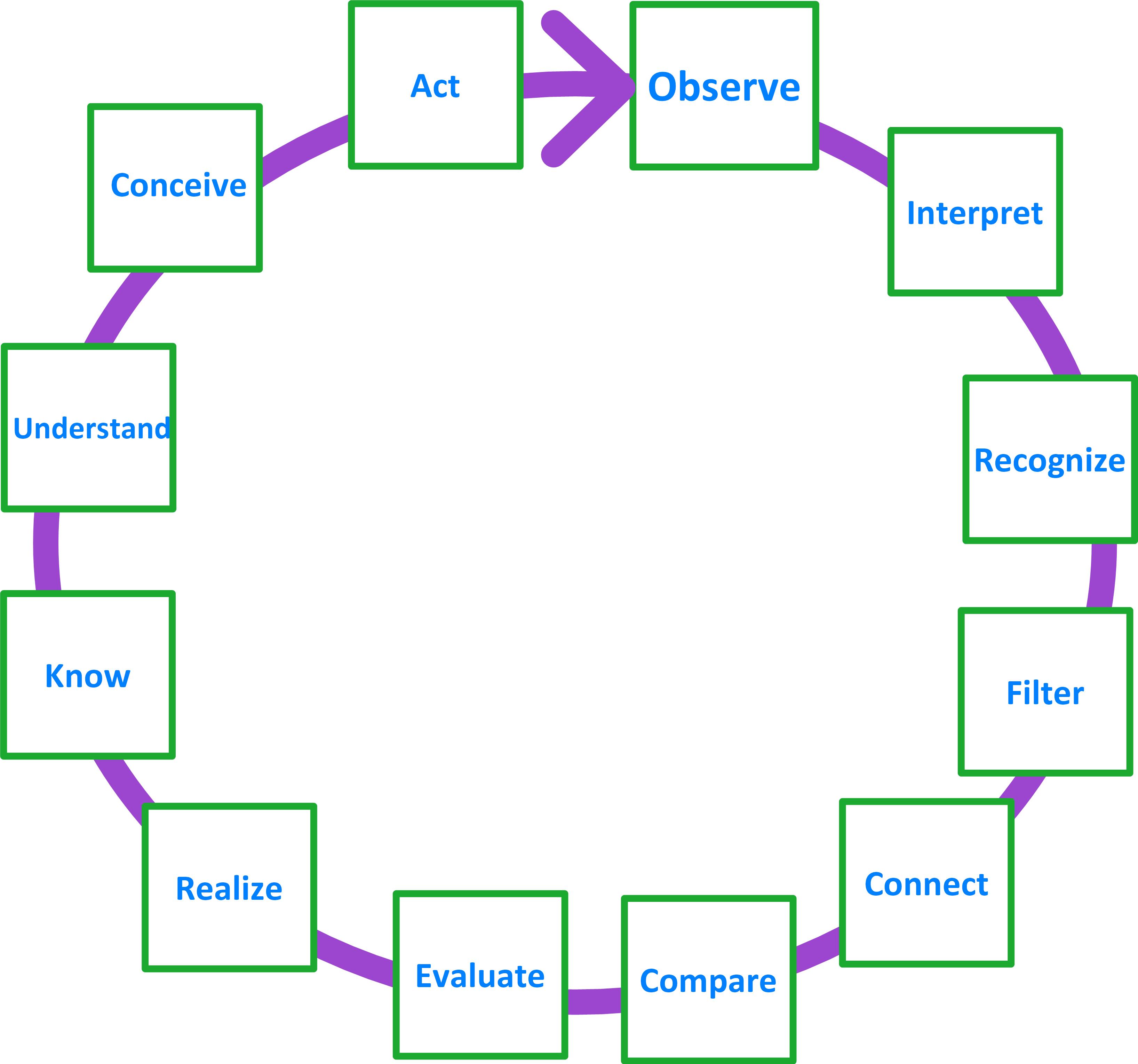
Thoughtful Thursday: Observing, Comparison and Evaluating

“Knowingly, and unknowingly, I relentlessly measure everything you do,
And that’s okay, as long as I don’t then pretend that I have ever measured you.”
— Zumwalt

“Accuracy of observation is the equivalent of accuracy of thinking.” — Wallace Stevens

We can observe what one does or what they have.

We cannot observe who they are.  We are basically limited to observing what they do and have. And usually, we only see a very small percentage of that.

But even if we saw everything, 7 days a week, 24 hours a day, we would be left with only seeing manifestations and phenomena, not the essence of who people truly are.  We may know it’s safe or dangerous to be around this or that person in this or that circumstance, but we have no direct understanding of those people, we make the leap from observing what they do to who they are.

So its pointless to compare ourselves to others.  We can compare what we do to what someone else does.  Or we can compare what someone has to what we have.  Just don’t fool yourself that you can compare yourself to anyone else.

The truth is that you cannot measure anyone.  You can measure their body. You can measure the size or weight of their brain, their heart, their stomach.  With the right equipment, you could even count the number of neurons in their brain, the number of synaptic connections, and, if using top-of-the-line (though still futuristic) equipment, the number of neurotransmitters and their motion and chemical composition.

To say the heart, the stomach or the brain is the person is a large leap of illogic and foolishness.  To say the body (containing the heart, stomach, brain and several gallons of water) is the person is also not true.  Maybe removing an appendix, a few skin cells, a couple of liters of water, or consuming a bit too much at a cruise ship buffet changes the viewpoint or experience of the person , but so can reading a book or watching a movie or interacting with someone else — and we don’t confuse the books on your bookshelf or your friends and family with you.  Or do we?  Yes, we often do! Since we cannot observe you, we observe things around you and use these are proxies for measuring you.

Be careful that what you observe is relevant to what you evaluate.  Do not observe the behavior of ducks in the park and assume that you have collected pertinent data to evaluate the behavior of wolves in the wild.  Do not observe the behavior of a person, and assume that you can evaluate the person: you can only evaluate their behavior.

Data seduces us.  We see data and we sometimes don’t stop to see if this data is relevant, complete or appropriate for our analysis.  Our process of drawing conclusions may be sound, but if we are not observing what we need to observe, then we cannot expect valid comparisons or evaluations and this in turn will impact our understanding and any subsequent action.

Concept3


Thoughtful Thursday: Feeling the Future

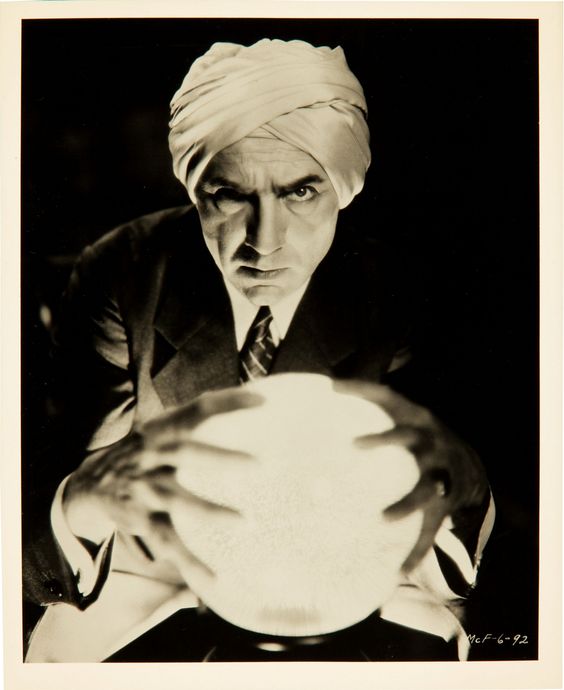
bela lugosi

People like us, who believe in physics, know that the distinction between past, present and future is only a stubbornly persistent illusion.”  — Albert Einstein

You, predictable reader, follow these words and I know that what you read next is what I write now.” — Zumwalt

It’s a poor sort of memory that only works backwards”  — From “Through the Looking Glass” by Lewis Caroll

Time may not be what it seems.  Sometimes what we assume is true is not: our senses may initially lead us to believe the sun revolves around the earth, but if we observe beyond what is most self-evident, and carefully examine a wider range of data then we must conclude that the earth revolves around the sun. As in the case with planetary bodies,  it may be that our sense of time is based on our frame of reference and not a true understanding of reality.

Physics has provided evidence during our lifetime that the future can determine the past.  The most famous example is the “quantum eraser” experiment. One can google this or check out this article: http://iheartintelligence.com/2017/01/20/quantum-experiment-present-past/.  One can even try this experiment at home: https://www.scientificamerican.com/slideshow/a-do-it-yourself-quantum-eraser/\

Is there any chance of sensing the future?  Some studies, like the famous, but controversial and legitimately challenged, Cornell University trials indicate this may be possible: http://dbem.ws/FeelingFuture.pdf

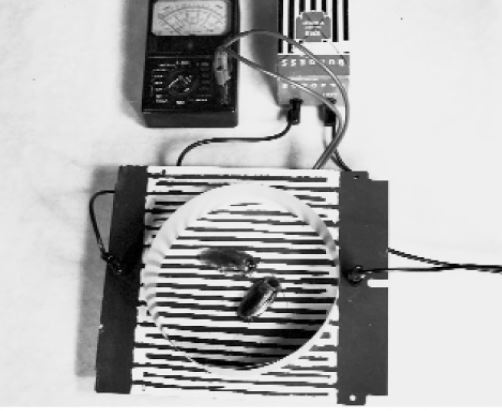
As a graduate student in music, perhaps as a break from listening to too much atonal music, I became interested in parapsychology experiments, and read numerous journals in our large college library covering this topic. There were a couple of experiments with cockroaches that really impressed me. One was an experiment by Helmut Schmidt in which he placed various laboratory animals on a divided electrical grid with a 50% chance of the shock going to the area where the animal was.  Schmidt recorded that in most trials (and these trials included hundreds of shocks), the gerbil, guinea pig or other small animal ended up being shocked around 48 to 49 percent of the time.  Schmidt was a sloppy researcher and it is not clear if this statistically significant number was due to Schmidt’s own psi abilities influencing the outcomes, or the animal’s psi abilities protecting themselves. When he put cockroaches to the test, he found they ended up being shocked 52 percent of the time as opposed to the expected 50 percent of the time. Schmidt admitted his particular dislike of cockroaches, and so it is not clear if the cockroaches were masochistic or whether it was Schmidt’s distaste for them that influenced the outcome.

Schmidt

A later researcher, revising Schmidt’s experiment, placed the cockroaches on a divided grid, with one or the other side receiving a shock and providing the cockroaches the freedom and time to travel to one side or the other.  In this experiment, the researcher recorded whether the cockroaches ended up on the side that received the electrical charge or the side that did not get the charge. Again, the result was that the cockroaches got shocked around 51 to 52 percent of the time depending on the set of trials. Were the cockroaches anticipating the future, even if there actions were not in their best interests? Or was the researcher somehow still influencing the cockroaches to get punished slightly more than expected?  Perhaps it doesn’t matter, as neither the various Schmidt experiments nor this follow-up experiment with the divided grid was ever able to be consistently replicated with the same significant results.

In the recent, and earlier referenced, Cornell set of experiments,  the most interesting ones, (okay — I concede that some may find the salacious-content experiments more interesting), are the two similar experiments addressing “Retroactive Facilitation of Recall.”  Basically the subjects are asked to look at a set of words. After this is done,  they are given a recall test (not being told about this beforehand) and each participant’s ability to recall what they have memorized is recorded.  The computer selects, randomly, half the words the subjects had previously looked at as study material, and then the students study these words.  It turns out the subjects do much better on recalling the words they had studied after the test then those they had not. Basically, this proves that if one is unable to find time to study for a test beforehand, they can always study after the test and improve their test scores — at least slightly.  (This is why, when I pick losing lottery ticket numbers, I always carefully study the winning numbers and carefully commit them to memory to increase my chances of having picked the right numbers in the first place: if I am/was successful, I not only get some extra pocket-change, but get back any time I had spent studying those numbers.)

The key here, from a very practical standpoint, is not whether others can sometimes sense the future, but whether you or I can sense the future and, if possible, how best to develop that ability.   As one might guess (or sense), there are many online opportunities to research this further. Now that I told you this, I have increased your chances of already knowing this, and I suspect that you are thinking to yourself that, yes, you already knew this, and you really don’t need to waste you time reading this blog which isn’t disclosing anything new to you at all. This of course, is what you are thinking now that you have read this. If you had read a blog on politics or music, instead, you wouldn’t be thinking this at all. If you had read a blog on politics, you probably wouldn’t even be thinking.

Back to the present, please. Let’s take a look at one particular online test:  http://www.psychicscience.org/staring.aspx

First, do the practice trial to get a sense of how simple this experiment/test is.

When doing an actual trial, my only advice is to not base your guesses on what already happened, but what you feel is about to happen.  In other words, don’t let three or four blank screens in a row bias you to select the “staring” screen based on some misunderstanding of probability.  Stay in the present and realize each display has a fifty-fifty chance of being either blank or a staring screen and don’t let what occurred before influence your decision/guess/prediction. Just feel whether you will be stared at or not and then pick your choice based on that feeling. (This may be the same sensation you get when you feel someone on the other side of the room is staring at you.  I often get this feeling when I shout and yell at the waiter or waitress in the restaurant — or when they yell at me.)

Also, best to stay relaxed and let yourself get in “the zone.” Don’t let a string of successes put pressure on you. If you feel such pressure, it may be best to take a break and come back. The screen will wait for you. (If you need to take a break, you can read some Zumwalt poems liked by previous readers. Note that any poems you click “like” on may influence anyone that read them in the past to have clicked “like” also.)

Developing an ability to feel what will happen next, may be like developing any skill.  It takes repeated practice, day after day, for an allocated time each and every day.  It is very similar to ear training exercises like this one: http://pitchimprover.com/index.php?type=Relative

After doing this http://www.psychicscience.org/staring.aspx exercise every day, for several months, please let me know if you have seen any improvement.  If so, it may motivate me to do the same. If you can’t seem to improve your ability to see into the future, don’t feel bad, at least knowing this limitation in the future should translate in your spending less time on these exercises in the here and now — or even not bothering to read this blog post.