Tom Waits, Van Der Graaf Generator, Steve Hackett; Fifty Year Friday: September and October 1975
Welcome back to Fifty Year Friday! It is my great pleasure to announce that our first entry is by an esteemed and respected writer who, for reasons we won’t question, has graciously agreed to provide material for us under the nom de guerre of Leo The Deacon. If you can navigate a substantial drop in quality, a few of my own Fifty Year Friday entries follow. Enjoy!
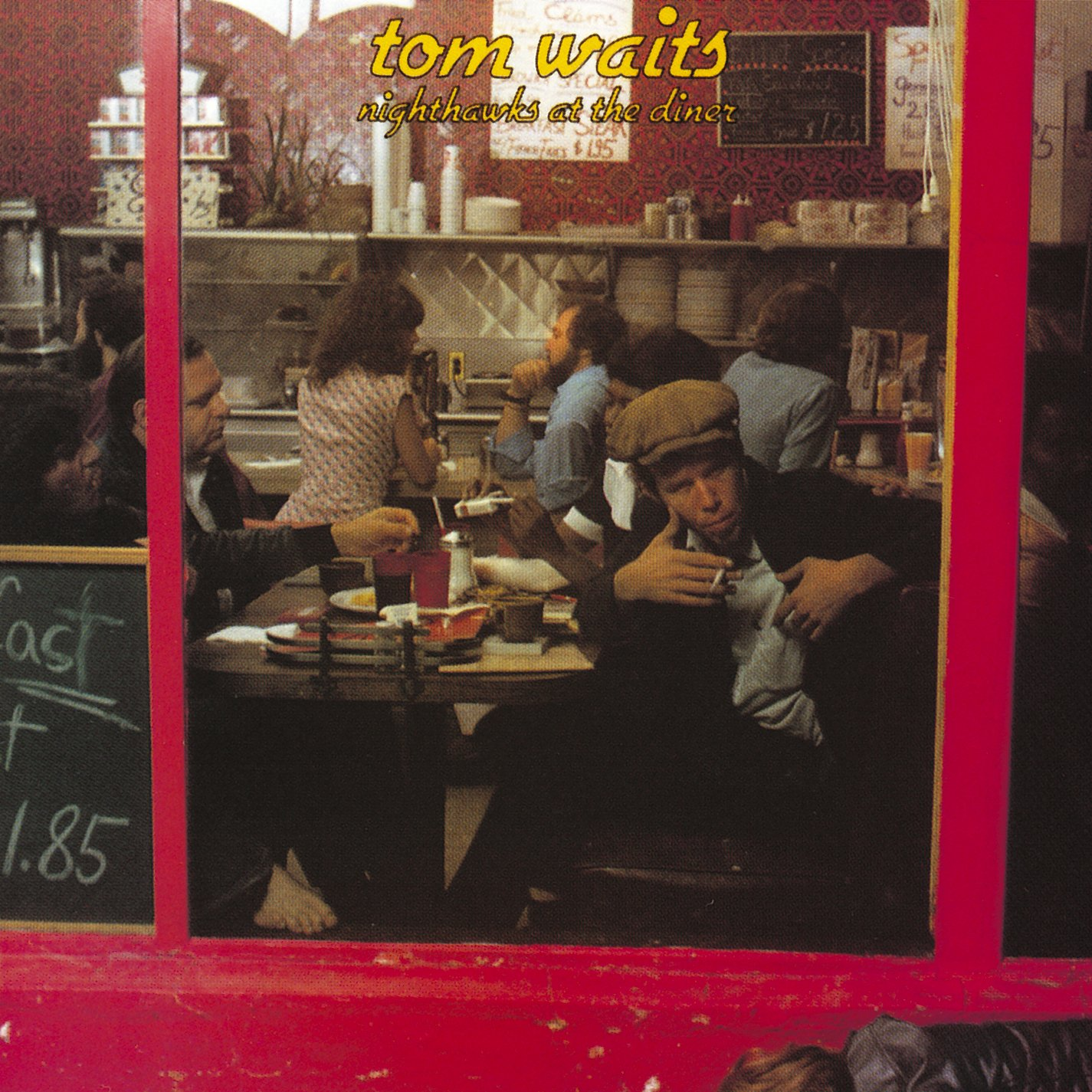
Tom Waits: Nighthawks at the Diner
If ever there was an artist and an album deserving of the rubric sui generis, it is Tom Waits and this, his third album Nighthawks at the Diner. At a time—October 1975—when progressive rock was on the cusp of going to seed, disco was poised to go mainstream, and Wayne Shorter and Chick Corea had set aside post-bop to explore jazz-rock fusion, Waits came out with a two-disc album in which he performs mostly original songs, backed up by a quartet of first-rate Los Angeles jazz sidemen, in front of a small live audience. As a bookish 20-year-old who never quite embraced rock music—despite the earnest and occasionally successful efforts of the curator of this blog to interest me in such groups as Emerson, Lake, and Palmer, King Crimson, and Gentle Giant—I found Waits’ wry, atmospheric, jazz-inflected compositions a subversive challenge to the hegemony of rock and roll. Nighthawks appealed not just to the emotions, but to the head. It did not hurt that his profane, salacious, and very funny banter between songs was well calculated to engage the sensibilities of college guys whose weekends, more often than not, were spent in the company of other dateless young men.
So is Nighthawks a jazz production, or a singer/songwriter presentation? Yes. Here’s where it gets interesting, because throughout the performance Waits meanders about the intersection of several genres: jazz, singer/songwriter compositions, spoken word, a bit of stand-up comedy. Hell, in the cut “Big Joe and Phantom 309” Waits even covers a country-music song by Red Sovine about a ghostly trucker. The entire album is a musical Venn diagram of multiple converging circles. One can’t even call it a “live” album, exactly, because it was recorded in a studio, but in front of an audience hand-picked by the producer to convey the feel of a live performance. It’s not quite authentic but it works, especially as it allows the listener to experience the entire Waits shtick: the guttural banter, the jokes, the wordplay, and the music.
The mood is set from the get-go in the opening intro, with the quartet playing a bluesy vamp featuring Jim Hughart’s walking bass and short, honking arabesques by Pete Christlieb on the sax. The sound is that of a cool, if jaded, house band at a burlesque club and Waits reinforces the conceit by welcoming the audience to the fictitious “Rafael’s Silver Cloud Lounge,” and thanking the stripper who ostensibly warmed up the audience and put a charge into Waits’ libido. He continues with some introductory jokes about late nights and coming home after three months to find everything in his refrigerator has “turned into a science project.” As he talks, Waits elegantly elides into the first song, “Emotional Weather Report,” which is more rhythmic spoken word recitation than it is singing. He bemoans the “tornado watches…in the western region of my mental health” and declares that “It’s cold out there—colder than the ticket-taker’s smile at the Ivar Theater on a Saturday night.” Jilted by his lover, Waits’ forecast is for more precipitation.
The rest of the album more or less follows the same pattern, with Waits sustaining a twisted down-and-out persona as he leads into another song or spoken word performance, backed by the jazzmen and revolving around themes of loneliness, lost love, late nights, and life at the margins. For my money, the best cut on the album is the third, “Eggs and Sausage (In a Cadillac with Susan Michelson)” in which Waits precisely captures the milieu of an all-night coffee shop. In this song, (this time he is singing rather than reciting), Waits displays his artistry in clever turns of phrase and the ability to evoke the bittersweet mood of a lonely late night out after a break-up. Atmospherics and the skilled deployment of similes and metaphors are Waits’ stock in trade and he’s at his best in “Eggs and Sausage.”
Waits is often compared to the Beat poets, but that’s not quite right. His music at this stage of his career, and particularly on this album, is reminiscent of the Beats, with its jazz and spoken word poetry, and its exploration of loneliness and alienation. But unlike the Beats, Waits isn’t concerned with philosophy or spirituality, or even drug-induced altered states of consciousness. For the most part, alcohol is Waits’ drug of choice and that and his focus on the working class and marginalized perhaps slides him closer to the Beats-adjacent Charles Bukowski. Both Bukowski and the Beats expressed profound alienation, however, with the Beats setting themselves in opposition to the 1950s military-industrial complex and Bukowski challenging the smug conventionality and moral sensibilities of bourgeois America. Waits isn’t overtly political, like the Beats could be, and he certainly doesn’t indulge in the blunt rage and belligerence of Bukowski. Rather, despite the crusty delivery, he is sentimental. In the end, Nighthawks, as well as Waits’ other music of the mid-1970s, is not concerned so much with alienation as with hard luck, loneliness, and the struggle to carve a little dignity out of an uncaring universe. On Nighthawks, the world is what it is, and Waits knows it is a mug’s game to try to change it.
Tom Waits, at any point in his long musical career, is an acquired taste. Those fans, likely younger ones who are more familiar with the growling, iconoclastic, and experimental performer Waits morphed into starting with 1983’s Swordfishtrombones, may find the younger Waits of Nighthawks in the Diner more conventional—dare we say “quaint”?—than the older artist they are familiar with. But in 1975, Waits’ retro-beatnik hipster persona, jazzy music, and well-crafted noirish lyrics was something different from the dominant electronic-heavy compositions of rock and fusion. From the perspective of fifty years, it holds up well, although younger listeners may find themselves bemused by Waits’ frequent references on this album to LA “landmarks” that have passed into history—The Copper Penny restaurants, the seedy Ivar Theater, the Ziedler & Ziedler clothing store on Sunset, and KABC weatherman Dr. George Fischbeck, to name a few.
If there is a flaw in Nighthawks, it is that the persona Waits adopts narrows the variety of the songs. To be sure, on a few tracks—“Warm Beer and Cold Women,” “Nobody,” and the country-ish “Putnam County”—Waits veers into his singer/songwriter roots, dials back the jazz, and sings accompanied by himself on piano. By and large, though, the album is a series of Waits’ compositions backed up by well-executed jazz incidental music. The jazz frames the mood, but the fun is in skillful lyrics, the repartee and wry observations, and the dark, at times cynical, yet not despairing atmosphere that Waits conjures up. It is an eccentric artifact of its time, but it still rewards the listener and reminds us that the 1970s weren’t all bell-bottoms, platform shoes, and leisure suits.
—Leo the Deacon

Van Der Graaf Generator: Godbluff
Released in October 1975 in the UK, this album was only available as an import. It wasn’t until I made a trip to Europe in 1978 that I purchased it in Amsterdam and had it and several other albums shipped from a post office near the record store back to the States. That particular parcel of LPs arrived home earlier than I, and so once I was home, I put it on my beloved turntable. Wow!
As a great admirer of their previous album, Pawn Hearts, which I had bought as a cut-out in the US for less than three dollars, I had high expectations for this. Fortunately, the quality of the lyrics and music did not disappoint.
After a four-year gap between Godbluff and Pawn Hearts, Peter Hammill, Hugh Banton, Guy Evans, and David Jackson roar back more powerfully than ever with less psychedelic and excursionary elements and an apparent singular focus on drama and controlled handling of musical tension and release. Hammill displays his range of skills on vocals, superior in dramatic and expressive impact to more famous contemporary singers/songwriters like David Bowie, and even contending with the otherworldly emotional delivery of Demetrio Stratos of Area and Francesco Di Giacomo of Banco del Mutuo Soccorso. Hugh Banton and Guy Evans are in great form on keyboards and percussion; and we have David Jackson on double saxophones, à la Rahsaan Roland Kirk, creating musical textures that elevate the music experience to breathtaking intensity.
Side One opens with “The Undercover Man”, which starts softly, creating musical and dramatic suspense. Once the tension is established, it methodically builds in intensity, layer by layer, gradually crescendoing, leading to some colorful organ, sax and the further unfolding of the brilliant expression and pacing of Hammill’s staggered and passionate vocals.
“Scorched Earth”, the second of two tracks on the first side, maintains intensity, opening up quietly and building in dynamics with repetitive motives weaving through Hugh Banton’s organ part and David Jackson’s deftly engineered sax parts supported by Guy Evans’s relentlessly polyrhythmic drum work. The forward momentum cools, with an initially echoey middle section, crafted out of preceding musical material that explodes into an unpredictable flurry of syncopated melodic material and violent skirmishes of accelerating ostinatos and motivic interchanges. Two dominant mixed meters alternate. Dynamic and rhythmic shifts continue to propel the music forward to an abrupt climax ending with a brief musical exhale.
Side two opens up reflectively with “Arrow”, with a meandering and introspective introduction ferociously interrupted with Hammill’s vocals which commence to entwine and shape the course of the music leading into an instrumental of repeated sax permutations on the primitive four-note saxophone motive heard earlier but not put through a series of repeated modifications. Hammill’s vocals return with full intensity and anguish:
How long the time seems
How dark the shadow
How straight the eagle flies
How straight towards his arrow
How long the night is
Why is this passage so narrow?
How strange my body feels
Impaled upon the arrow
This is followed by more sax-dominated instrumental and intensive, unrestrained percussion eventually trailing off into a sustained whimper.
The last track, “Sleepwalker”, described by Hammill as portraying “life in death, death in life” begins boldly with a brilliant 9/8-based mixed-meter motif, syncopated and off-kilter, creating a lurching, stumbling feel, realized flawlessly by sax, organ and percussion. Once the pattern is established for the listener, it moves into an accompaniment foundation for Hammill’s vocals:
At night, this mindless army, ranks unbroken by dissent
Is moved into action and their pace does not relent
In step, with great precision, these dancers of the night
Advance against the darkness – how implacable their might!
The second section starts off as a tango with güiro, organ, clavinet and then sax on melody– but it is a 3/4 tango! It then contorts itself evolving into the opening motif for brief return of theme A, but these expectations are quickly tossed aside with an intro into a completely new section in a relentless, undeniable 4/4, the sax and rhythm hinting at a brief funky disco feel before the band shuts down that possibility completely with aggressive prog-rock percussion, sax and Hammill’s searing vocals.
A necessary aside on the artistic nature of David Jackson’s approach to the saxophone: dubbed “the Van Gogh of the saxophone” by a critic of the British New Musical Express, Jackson was described as a “renegade impressionist, dispensing distorted visions of the world outside from his private asylum window”. Following in the footsteps of jazz artists like John Coltrane, Rahsaan Roland Kirk, and Albert Ayler, Jackson focused on fully leveraging timbral and tonal qualities of his instrument to deliver a wider range of emotional experiences.
Two key elements defined his style. The first was his signature use of double horn — playing two saxophones (typically alto and tenor) simultaneously, creating dense harmonies and powerful, layered riffs. The second, and more crucial for “The Sleepwalkers,” was his pioneering use of electronics using customized pickups, octave dividers, wah-wah pedals, and powerful amplification, transforming the saxophone from a purely acoustic instrument into a versatile prog-rock sound source, capable of generating textures and timbres far beyond its natural range, allowing him to sonically manifest the fragmentation, distortion, and psychological turmoil central to VDGG’s music — and provide a fully-effective soundscape for Hammill’s autonomically engaging, intensely visceral vocal delivery.
The synthesis of those two saxophones, the bass pedals and organ work of Banton, Evans’s driving polyrhythmically-paced percussion, always at the service of the music and text propels us into the psychedelic-flavored coda which slowly evaporates into nothingness, leaving the lingering essence in the listener’s mind, eventually compelling a repeat playing of one of the finest albums

Steve Hackett: Voyage of the Acolyte
Released in October 1975, I never had enough money to buy this in my college days — such a shame, as this is a wonderful album and provides insight into how much Steve Hackett contributed compositionally to the many of the passages within Genesis’s Nursery Cryme and Supper’s Ready. Excellent, evocative and reflective music that sparkles as wondrously as ever.

Pink Floyd: Wish You Were Here
Pink Floyd released their ninth studio album in September of 1975. Fifty years later their The Dark Side of Moon boost has maintained their popularity enough so that there are multiple sets out this month celebrating the fiftieth anniversary. If you haven’t heard this album yet, you probably weren’t listening to music fifty years ago!

Can: Landed; Jethro Tull: Minstrel In the Gallery; Electric Light Orchestra: Face the Music
All released in September of 1975, all three of these albums have their strong moments and are worth checking out. Can’s Landed starts off with grungy rock badly recorded, but ends strongly with the musique concrète of “Unfinished” with much of interest in between.
Jethro Tull’s Minstrel In the Gallery is more reflective than his previous three albums and seemingly more personal. Thematically, the album lyrics cover the introspective and the cynical, with Ian Anderson’s lyrics exploring the isolation and pressures of being a public performer — Anderson being that Minstrel in the Gallery. Throughout a good deal of the album Martin Barre’s electric guitar is in the forefront and borders on a jazz-fusion ethos contrasted in other sections with delicate acoustic guitar. The album’s highlight is the musically and metrically complex, multi-part “Baker Street Muse” on side two, lasting over sixteen minutes with sharp contrasts and sharp lyrics.
ELO’s Face the Music opens up with an orchestral intro and explodes with their signature blend of strings, Jeff Lynne’s guitar, drums, and keyboards. The excellent opening instrumental, which highlights Mik Kaminski on violin, is followed by a classic-sounding ELO track, “Waterfall, reminiscent of Eldorado material. As mentioned earlier by Leo the Deacon, September 1975 ushers us into the mainstream days of disco fever and ELO made good money with an edited single version of the third track “Evil Woman.” I had stopped listening to AM radio long before 1975, but somehow I was still exposed to it enough in various public venues that I developed a rather strong aversion to its annoyingly commercially cloying sound. The remaining album has its ups and downs, and includes a number sounding much like the pre-disco Bee-Gees (“Strange Magic”) and Lynn’s excursion into country music, “Down Home Town.”
Besides these albums we have a wealth of other releases, not at the level of Godbluff by any means but much more commercially successful including albums by George Harrison, John Lennon, Elton John, Paul Simon, his former singing mate, Art Garfunkel, Rush, Herbie Mann, Linda Ronstadt, Roxy Music, Sparks, Steeleye Span, Aretha Franklin, Barbra Streisand, Frank Zappa, Hall & Oates, Crosby and Nash without Stills, and though I haven’t a clue what it sounds like, and am totally fine with that, Kiss’s Live Album, which apparently is the first album released by any American hard rock band, for if memory serves me correctly Spinal Tap had not released any live albums by that date — or to be factually correct, now that I check Wikipedia, still has not.